This is topic Screening room at the Vatican in forum Film Handlers' Forum at Film-Tech Forum ARCHIVE.
To visit this topic, use this URL:
https://ft-forum.com/ft/cgi-bin/ubb/ultimatebb.cgi?ubb=get_topic;f=1;t=009415
Posted by Hans Van Der Vlist (Member # 3315) on 07-19-2008, 07:30 AM:
On the German film forum I found this about the Pope's screening room.
It's in German but there are some pictures included!
Hans.
http://www.bild.de/BILD/unterhaltung/kino/2008/06/09/papst-kino/wo-der-papst-ins-kino-geht.html
Posted by Stephen Furley (Member # 1277) on 07-19-2008, 08:24 AM:
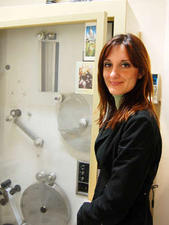
My German isn't up to much, but the third picture seems to say that they have equipment for film cleaning (Reinigungsgerät). Are all their staff called Claudia?
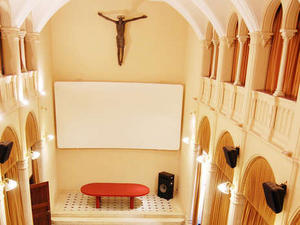
The auditorium is rather odd; are those windows behind the curtains at the sides? If so, then presumably it's used for other purposes as well, but it does have a proper projection room.
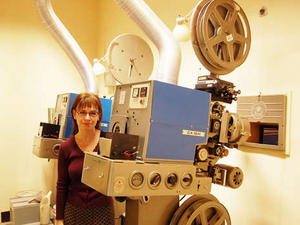
It seems to have only one (under) screen speaker, and that is on the right, not in the centre as you'd expect if it was mono, and yet it seems to have surround speakers, and there is what looks like a later type Dolby Digital reader visible on the nearer projector. Those are very strange looking ports.
In the early days of film a number of churches did install projection rooms, I suppose continuing on from the tradition of lantern slide shows. I've seen pictures of several of these early projection rooms, and they seem to be well equipped by the standards of the day.
I think I would rather not have a crucified body looking down at me while I was watching a film.
Posted by Richard Fowler (Member # 893) on 07-19-2008, 10:03 AM:
Cinemeccanica has been supplied the Vatican since the early 1930's. Rumour has it that the V-4 was designed as a simple to maintain / compact system for Church cinemas.
Posted by Paul Goulet (Member # 297) on 07-19-2008, 10:11 AM:
This might be easier to read:
http://translate.google.com/translate
Posted by Tim Reed (Member # 137) on 07-19-2008, 12:14 PM:
Yep, that's a Cat. 701 reader alright. The speaker on the floor under the screen looks like it's their sub-bass.
Posted by Brad Miller (Member # 2) on 07-19-2008, 01:07 PM:
Ok this is just weird. I copy/pasted the text from the google translation and got this...
quote:
BY Susanne Lang
Wenn Papst Benedikt XVI. When Pope Benedict XVI. Lust auf Kino hat, muss er seine heiligen Gemächer nicht extra verlassen: Er kann einfach in der einstigen Krankenhauskapelle am Petersdom Platz nehmen. Keen on cinema has, it must not his sacred Apartments on extra leave: He can simply in the former hospital chapel at St. Peter's Square. Film ab! Film!
So far, Pope Benedict XVI. jedoch nur ein Mal zu einer Filmvorführung in den vatikanischen Kinosaal gekommen, erzählt Claudia Di Giovanni, die Verantwortliche der vatikanischen Filmsammlung. However, only once to a film screening in the cinema came Vatican, said Claudia Di Giovanni, in charge of the Vatican collection. Ob das wohl an dem weißen Sessel liegt, auf dem es sich die Päpste für private Filmvorstellungen gemütlich machen sollen? Whether this is probably in the white chair, which is on the popes for private film performances comfortable? „Er ist viel zu unbequem“, so Claudia Di Giovanni. "He is much too uncomfortable," said Claudia Di Giovanni. „Johannes Paul II. brachte immer seinen eigenen Sessel mit.“ "John Paul II always brought his own chair."
Seit knapp 20 Jahren arbeitet die Archäologin und Filmverantwortliche in dem kleinen Archiv hinter dem Petersdom. For almost 20 years, the archaeologist responsible and film archive in the small behind the St. Peter's. Hinter einer schweren Panzertür liegt der Schatz der vatikanischen Filmothek verborgen: wertvolle Filme von den Anfängen des Kinos bis in die Gegenwart. Behind a heavy armored door is the treasure of the Vatican film hidden: valuable films from the beginnings of cinema to the present day.
The papal collection has been in existence since 1959 and includes not only historical or documentary films about popes and church work - quite the contrary: the works of gay Italian director Pier Paolo Pasolini are represented, although the Catholic Church its cinematic presentation of biblical figures strongly criticized.
Auch „Die Hölle“ klingt eher teuflisch – in dem Film von 1911 über Dantes Inferno wurden zum ersten Mal Spezialeffekt für Horrorvisionen verwendet. Also "The hell" sounds rather devilish - in the film of 1911 on Dante's Inferno for the first time special effects for horror visions.
Ein besonderes Highlight ist ein Archivfilm aus dem Jahr 1896. A special highlight is an archive film of the year 1896. Damals ließ sich Papst Leo XIII. At the time, was Pope Leo XIII. in den vatikanischen Gärten filmen. Vatican gardens in the film. Danach segnete er die Kamera, wird erzählt. Then he blessed the camera is told.
Der Vatikan bleibt filmisch auf dem Laufenden: Seit Ende der 90er-Jahre findet in der Kapelle jährlich ein kleines internationales Festival des religiösen Films statt. The Vatican remains cinematically to date: Since the late 90s will take place in a small chapel annual international festival of religious film.
Here is an edited version...
quote:
BY Susanne Lang
When Pope Benedict XVI. Keen on cinema has, it must not his sacred Apartments on extra leave: He can simply in the former hospital chapel at St. Peter's Square. Film!
So far, Pope Benedict XVI. However, only once to a film screening in the cinema came Vatican, said Claudia Di Giovanni, in charge of the Vatican collection. Whether this is probably in the white chair, which is on the popes for private film performances comfortable? "He is much too uncomfortable," said Claudia Di Giovanni. "John Paul II always brought his own chair."
For almost 20 years, the archaeologist responsible and film archive in the small behind the St. Peter's. Behind a heavy armored door is the treasure of the Vatican film hidden: valuable films from the beginnings of cinema to the present day.
The papal collection has been in existence since 1959 and includes not only historical or documentary films about popes and church work - quite the contrary: the works of gay Italian director Pier Paolo Pasolini are represented, although the Catholic Church its cinematic presentation of biblical figures strongly criticized.
Also "The hell" sounds rather devilish - in the film of 1911 on Dante's Inferno for the first time special effects for horror visions.
A special highlight is an archive film of the year 1896. At the time, was Pope Leo XIII. Vatican gardens in the film. Then he blessed the camera is told.
The Vatican remains cinematically to date: Since the late 90s will take place in a small chapel annual international festival of religious film.
Posted by Mike Schindler (Member # 1309) on 07-19-2008, 01:26 PM:
That's so cool! It looks like one of those themed home theaters you see in magazines designed to look like the bridge of the Enterprise or the Batcave or something. This one's designed to look like a little Catholic church! It's even got what seems to be a completely impractical alter-looking thing in the front.
I come from a long line of Catholic church employees. My dad was a priest, my mom is an organist. I always thought it would end with them. But maybe one day, I could be the Vatican projectionist!
Posted by Brad Miller (Member # 2) on 07-19-2008, 01:32 PM:
The sound has got to be godawful in there. Just look at the acoustics of the room.
Posted by Mike Babb (Member # 1379) on 07-19-2008, 01:54 PM:
godawful?
Posted by Frank Angel (Member # 248) on 07-19-2008, 01:57 PM:
Sound in churches is almost always horrendous. Just cause he's the pope doesn't give him an exemption from that. The sound in Sacred Heart Church (now upgraded to Basilica for some reason) was so bad that speech intelligibility was zero. They redid the system over and over and nothing worked. It is said that one of the acousticians after testing for a few days said to cut their losses they should just give everyone infrared earphone and be done with it.
I think Tim's right -- that speaker is undoubtedly a sub-bass; with that booth setup they've got to have speakers behind the screen. Why they wouldn't put the subbass behind it as well, only the angels can answer that one. At least paint the damn box white!
Anyone know what the small black box is sitting behind the lamphouse? Looks like an add-on of some kind.
Posted by Leo Enticknap (Member # 534) on 07-19-2008, 02:39 PM:
quote:
A special highlight is an archive film of the year 1896. At the time, was Pope Leo XIII. Vatican gardens in the film. Then he blessed the camera is told.
It must have worked for that film to survive from 1896 without decomposing! Interesting - the Vatican Film Archive is pretty much unknown in archiving circles generally. Just had a quick flip through the AMIA membership directory - no mention of them. They are listed in the FIAF online membership directory as so:
quote:
FILMOTECA VATICANA
Palazzo San Carlo , 00120 Città del Vaticano , VATICAN
T: 39-06 6988 3197/3597
F: 39-06 6988 5373
fv@pccs.va
Films : même adresse.
Correspondance: Ms. Claudia Di Giovanni Délégué
T: 39-06 6988 3197/3597
Languages: *Français / * Anglais / * Espagnol
Joined FIAF in 1986. Current status: Member
...which means that they must be pretty well equipped (you have to have climate-controlled preservation facilities and other expensive infrastructure before you're even considered for membership of FIAF, which involves an inspection visit). But I've never met Ms. Di Giovanni or any of her colleagues at archivists' conferences (which I've been going to for around 6-7 years now) or read any papers from them in places like The Moving Image or Journal of Film Preservation.
BTW, when I looked at the photo gallery on the bild.de website, photos of The Pope appeared with a 'Win a DVD box set of Sex and The City' banner ad underneath. Looks like his speech in Australia condemning loose morals and the consumer society last week didn't exactly work, then... ![[Roll Eyes]](rolleyes.gif)
Posted by Kenneth Wuepper (Member # 1174) on 07-19-2008, 03:37 PM:
Regarding the acoustics of the photographed room:
Notice that there are very few parallel and opposing surface areas in that "hospital chapel" space. The upper areas, presumably covering windows are heavy drapes. The alcoves or access to the side aisles are also covered with fabric. Only the narrow columns are parallel and opposite in this space. These conditions are not very different from some cinemas with pleated wall coverings.
The speaker located stage left could even have been pointed into the corner as that would enhance the low frequency efficiency by playing into the longest dimension of the room without many reflections. (A common practice with speakers for bass in organ installations) Locating the speaker behind the screen would not work as it is too far above the floor for efficient bass development as well as causing intermodulation with the dialog channel.
The only unknown here is the barrel ceiling that is not shown clearly. If it is covered with acoustical plaster, it could also work well as a cinema space. Suspended ceilings really eat up the bass from any sound system.
The back wall, not shown, could also be sound absorbent and would rule out reflections from that area. Note that the large banners in cathedrals, projecting from the side walls, serve to dampen echoes from the longest dimension of the building. Therefore something pretty is also very functional.
Here in SAGINAW, MI we had a project called "Cinema and Suds". The architect forgot that there had to be speakers behind the two screens that were flush to the outside walls. The solution was a very effective solid masonry sound wall with the entire speaker enclosure being mounted in a box built outside the wall of the theater. From outside it looked pretty funny with these six boxes sticking out about 10 feet above the ground.
KEN
Posted by Stephen Furley (Member # 1277) on 07-19-2008, 03:41 PM:
It doesn't look like there's room for speakers behind that screen, unless they cut a hole in the wall, and built a box outside for them, as I have seen done at a few existing cinemas which were converted to sound.
quote:
Correspondance: Ms. Claudia Di Giovanni Délégué
She's the Claudia standing behind the projector, rather than the one with the film cleaning machine.
Interesting that they allow women to become projectionists and film archivists, but not priests; whether that says more about the Catholic Church, women, priests or film handlers I'll leave for others to decide!
I saw something on television once about a library of 'banned' books which was kept by the Church in a Spanish-speaking country, I can't remember which one. They kept a large collection of books which the Church had condemned as 'pornographic', 'obscene', 'blasphemous' or whatever. They were all carefully locked away, and nobody was allowed to look at them; all seemed rather strange somehow. I wonder if the Vatican keeps a similar collection of 'banned' films.
Anyway, to get back to the subject of film, the pictures of church projection rooms which saw were in Scotland I think, from the first few years of the new century, and they were very well equipped, with two projectors, vented arcs, proper film storage, fire shutters and in one case it even looked like the projectors were motorised; they really wouldn't have looked out of place any time right up to the end of the silent era.
There was on display for a while a Kalee projector which was said to have come from the cinema on board the Royal Yacht 'Britannia'; I've also read elsewhere of the existence of this cinema, but I don't know anything else about it. At the time I saw the projector the ship was still in service, so the cinema must have been either removed or re-equipped at some time during its long life. Another very private cinema to add to the White House and Vatican ones. Has anybody tried writing to the White House and asking what equipment and facilities they have? I doubt that it's a state secret.
To return to churches, though strictly film and not religious aspects of them, there was in the UK a place called the CTVC, which was originally the Churches Television Centre, but was later renamed the Centre for Television Communication; I had to go there once to collect some tapes. It wasn't really religious in nature, but produced material on subjects likely to be of interest to churches, moral and ethical issues, that sort of thing. Again it was very well equipped, it had a pair of the very rare IVC 9000 super high band 2 inch helical machines. Only a few were built, but they were said to be the 'Rolls Royce' of 2 inch machines, and better than Quad. I think there's a picture of one somewhere on Quadruplex Park. This place also did training, for example they trained church people who were to appear on television how to present themselves, and they also made a training film for people doing 16mm shows in places like church halls. I can't remember the title of this film at the moment, but it was quite well known, and widely used, in its day. It's a long time since I've seen it, but as I remember it was about a vicar who is to give a talk, accompanied by a film show, on some subject. He has an assistant who, in setting up a 16mm projector and screen does just about everything wrong. The final piece of advice given is to always check hat you have been sent the correct film; the lights go out, the assistant starts the projector and, of course, something quite unsuitable, but with a similar title, comes up on screen. It wasn't a bad little film.
The man who runs Quadruplex Park by the way seems to have three interests in his life; video recorders, lions and Christianity, which always seemed a bit of an odd combination, but there's another connection between film/television and religion.
Posted by Brad Miller (Member # 2) on 07-19-2008, 03:56 PM:
But Ken, older theaters designed the way you speak really do not have good acoustics for movies. An organ? Sure. Stage performances? Sure. Movies? Oh hell no. They are way to live.
Posted by Michael Brown (Member # 890) on 07-19-2008, 04:04 PM:
Is that red bench where the audience sits to watch the movie? Their sat about a foot from the screen. ![[Confused]](confused.gif)
Posted by Leo Enticknap (Member # 534) on 07-19-2008, 04:25 PM:
The place looks like a church, and the red bench an altar. The screen also looks like it's hung up there temporarily - no masking and a solid wall behind it, so I very much doubt if there are any speakers behind it. That speaker looks temporary, too - the wiring from the booth to a speakon plug in the wall may be permanent, but it looks to me like the speaker and the screen are designed to be easily positioned and removed. I guess that this place is really a church or a chapel of some description, that it's only used for screenings occasionally and that the only permanent film-related fixture is the projection booth at the back.
Posted by Alan Gouger (Member # 543) on 07-19-2008, 04:48 PM:
quote: Michael Brown
Is that red bench where the audience sits to watch the movie?
When they passed the plate if you had nothing to contribute you sat up front:)
If thats a mid size JBL or comparable sitting on the stage Id guess the screen to be 10 to 12 feet in width.
Posted by Stephen Furley (Member # 1277) on 07-19-2008, 05:14 PM:
it's very difficult to judge the scale of that Vatican place. It looks quite small, and the lamphouses seem to confirm this. Also the translation says:
quote:
Since the late 90s will take place in a small chapel annual international festival of religious film.
Does this mean that it is still used as a chapel, and serves as a cinema only occasionally, or is it used only as a cinema now? I would have thought an 'international festival of religious film' might need a larger venue than this seems to be. Maybe the Catholic Church has only a few people Worldwide who are interested in film?
I've just thought of another connection between church and cinema. IVC, who built the 9000 video recorder had some connection with Rank, though I'm not sure exactly what. Rank Strand Electric supplied lighting equipment for theatres and studios, Rank took over Kalee, not long before the projector firm's demise, Rank owned Odeon cinemas for many years, and Rank Cintel, another part of Rank Precision Industries, made flying spot telecine machines, and photocells for projectors. Rank had a major involvement in film.
Rank himself was a Christian, and his involvement with film started with films of a religious nature. In the '50s, they were involved in various 'Biblical Epic' type productions. Rather more interestingly, in 1942, Rank made the very seldom seen British Technicolor Film 'The Great Mr Handel', about the life of the composer, and the writing of 'Messiah'. The acting is a bit strange in places, but the cinematography is by Jack Cardiff, who I met at a screening of the film at a small cinema in London some years ago, and Claude Friese-Greene. Much of the film is quite dark, as you might expect in candle-lit 18th century buildings, and Technicolor didn't approve of the way it was lit, and the muted colours used. It seems that there were various disputes between them and Rank and Cardiff over this. It doesn't look like a typical Technicolor film does. For anybody interested in Technicor it's worth seeing this film for what could be done with the process.
Powered by Infopop Corporation
UBB.classicTM
6.3.1.2