This is topic Kinoton FP20 picture stability in forum Film Handlers' Forum at Film-Tech Forum ARCHIVE.
To visit this topic, use this URL:
https://ft-forum.com/ft/cgi-bin/ubb/ultimatebb.cgi?ubb=get_topic;f=1;t=009439
Posted by Jeff Else (Member # 4063) on 08-04-2008, 12:43 PM:
I'm looking for some advice on a comprehensive approach to achieving optimum picture stability with the Kinoton FP20. What is the best approach to aligning the skates and runners? are there any common issues to look for?
Posted by Robert Minichino (Member # 3495) on 08-04-2008, 02:55 PM:
Two common issues that cause picture instability in the FP20s is the outer intermittent sprocket bearing end play adjustment and a worn framing coupler/bushing. If you have vertical instability that goes away at the extremes of the framing travel, you may need to replace the framing coupler. The end play adjustment on the intermittent sprocket shaft is covered in the manual; if you see weave on screen this may need adjustment.
Posted by Rob J. Buskop (Member # 3338) on 08-08-2008, 11:28 AM:
Jeff, I have just posted an important and often overlooked
maintenance subject regarding the omega spring in my response to
lube questions about the gear.
Have a look at that and you'll have some worthwhile info on this
subject.
Rob.
Posted by Ron Toole (Member # 4860) on 08-08-2008, 02:58 PM:
I have another question regarding Kinoton FP projectors. I have come into possession of two FP 28's. Kinoton emailed me a manual, and looking through it I see that the 16mm bulb is a 250 watt lamp (the 35 is 400 watts). This is curious to me because 16mm Eiki's I project with also have a 250 watt halogen bulb.
Is this going to be enough? I'm working with a 66 foot throw. Neal from Cardinal Sound can change out the power supply for a 1600 watt Xenon.
Does anyone have experience with these projectors? Has anyone seen the image from the 250 halogen? Is it delusional to think that the FP28 with a 250watt lamp could show at 66 feet?
Neal also suggested replacing the 3 blade shutter with a 2 blade unit in order to intensify light. Any thoughts on this?
Thanks,
(New Poster)
R. Toole
Washington, DC
Posted by Kenneth Wuepper (Member # 1174) on 08-08-2008, 06:55 PM:
Ron,
Welcome to the Forum. You will learn a lot here.
I have had very pleasant experiences with Neal and Cardinal Sound. You have a good person working for you.
To repeat the fact, throw distance is not the critical factor but rather the size of the screen. You don't mention the dimensions of your screen so it would be impossible to tell you what power of lamp is required. Since Neal must know this size, he can give you direction on the light required.
Exchanging the 3 blade shutter for a 2 blade does increase the light output from the projector. That can make the difference between Halogen and Xenon for the light source in some cases.
Tell the forum as much as you can about your installation so that the comments can be based upon your unique requirements.
Again, Welcome.
KEN
Posted by Ron Toole (Member # 4860) on 08-25-2008, 11:36 AM:
Hi Ken,
Thanks for the welcome. Whenever I have a chance to swim through the posts I learn a bunch.
Neal's reputation in the Washington DC area is top rate. Everyone I've spoken with reiterates Neal's capabilites.
We were lucky to get two FP28's with less than a hundred hours on them. Neal's recommendation is to machine the shutter from 3 to 2 blades, modify the power source to power Xenon, and purchase new sound heads in order to play Digi audio.
Problem is we haven't got the monies needed to perform all of these modifications (in the 20k range). And we need to either get the projectors working or find an alternative storage place for them which may mean the dump.
Naturally I'd like to get these projs up and running so they don't become members of the latter group: they're beautiful machines.
Our throw is 66 feet, and our screen size varies - we project on a wall. I know, a screen will help with brightness. We will be getting a screen soon, but the maximum height of the wall is 132 inches, with a width that would accommodate all ratios relative to that height.
If we can get by with maybe just the shutter modification this will shave a few thousand bucks off, and we can maybe add the new-fangled sound heads later (we don't play many films with cyan).
Is the Xenon power modification more helpful than the shutter going to 2 blades?
Thanks,
Ron
Posted by John Hawkinson (Member # 1135) on 08-25-2008, 09:06 PM:
A three-blade shutter interrupts the light at 72 Hz, versus 48 Hz for a 2-blade shutter. There are some differences in shutter angles, but if you ignore that, to a first approximation you have half-again (1.5x) as much light when you convert from 3-blade to 2-blade.
Going from 250W to 1600W is of course a 6.4x increase in light.
So the bulb change is definitely more significant than the shutter.
I'm not experienced at estimating brightness by screen size, but it sounds like you'd have a 20+ foot wide screen, and I would think you would ideally want at least 2K. Then again, Kinotons have glass reflectors (yes?), and that really helps.
I'm sure you wouldn't have to take them to the dump, I'd be stunned if Cardinal couldn't find a good home for them...
--jhawk
Posted by Steve Guttag (Member # 268) on 08-25-2008, 09:57 PM:
Actually, the Hirshhorn WAS the good home we found for them (they came from another museum). The machines and the situation has been a bit misrepresented here.
Note, among other things, the booth does not have 3-phase power so rectifiers are a must as the rectifiers that came with the machines are not only too-small but 3-phase. The lamphouses were always xenon with a 2K size max (special kind that looks like a 1600). The change in light output going from 3-wing to single-wing is pretty substantial as the 3-wing runs a single revolution per frame and the single-wing runs two revolutions/frame. It is a more than 2-fold increase in light and again, the lamphouses were never halogen on this set...always xenon and one per projector half (4 lamphouses total). The sound can certainly run as-is, if no cyan. However the RSSD upgrade would also not only address cyan but also be a step towards digital and improve upon the older style Norelco soundhead/drum that is notorious for flutter.
These things can certainly be taken in steps but it is probably best not to continue to discuss this matter in a public forum.
Steve
Posted by Leo Enticknap (Member # 534) on 08-26-2008, 04:49 AM:
Agreed that these don't want to go to the dump. The FP16/18 is the most gentle 16mm mechanism for film I've ever used. Because it uses a Maltese cross intermittent rather than a claw and cam pulldown, it's far more tolerant of slight shrinkage and perforation damage on older and more worn prints than an Eiki. I've put prints through an FP after having bet the owner a beer that they would never run without jamming or breaking ... and ended up with the bar tab.
Posted by Ron Toole (Member # 4860) on 09-03-2008, 12:32 PM:
Hi Steve,
Thanks for your input.
Your experience and reputation in projecting is obvious and well documented, and I appreciate your taking the time to respond.
You are correct in estimating that a museum is the new home for these beautiful units and that our intent is to get them up and running so we can continue to program films for audiences for years to come, since I and many of my fellow workers prefer film to digital projection and feel that working film projection systems will be harder to come by in the coming years and thus a museum setting is a perfect place to house decent and working projectors. We wish to preserve film projection so young people across the country can experience films they way their parents and grandparents did.
With this end in sight we aim to examine our projection situation and balance the resources we have with those we want. Clearly there is a point of demarcation involved and I want to do the proper research so the right decisions can be made unique to our situation. So I am posting here on Film Tech because like you, just about everyone who posts here knows what the heck they’re doing and has been doing it for a long time.
Who knows if maybe there’s someone out in Somewheresville who’s been in the same situation as I and has a plethora of experience in setting up these projectors in such a way as to contribute to our solution?
And who knows – maybe someone in Somewheresville will come across a similar situation in the future and with the knowledge gained in these posts can better approach their needs. I feel this kind of information is perfect for a public forum.
Perhaps I am missing your point with respect to your feeling this discussion isn’t relative to a public forum, or you would like to elaborate your reasons for feeling so. In the event that this conversation doesn’t interest other members of the Film Tech community, please feel free to email.
Thanks very much,
Ron Toole
Posted by Gerard Bierling (Member # 4900) on 09-04-2008, 04:14 PM:
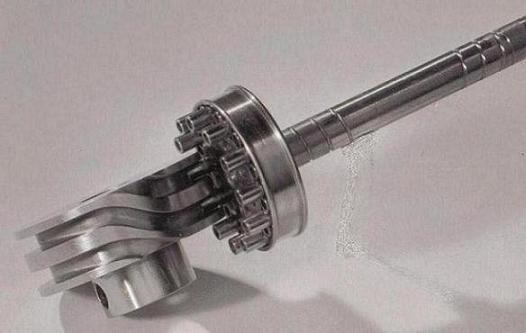
The Philips 16 mm. proj. don't have a intermittent but.....
Posted by Gordon McLeod (Member # 33) on 09-04-2008, 07:16 PM:
Actually that is an intermitent just not a geneva movement
It was based on a design that at the turn of the century was called the drunken screw movement
Posted by Emiel De Jong (Member # 4225) on 09-05-2008, 06:06 AM:
That's the first time I see this part (the wormwheel)not made out of nylon. Were metal ones used in projectors, or is this a demonstration-model?
Posted by Gordon McLeod (Member # 33) on 09-05-2008, 10:39 AM:
The EL5000 portable I have has a metal one
Posted by Robert Minichino (Member # 3495) on 09-05-2008, 11:36 AM:
That is one beautiful mechanism. Functional art, I dare say. ![[Smile]](smile.gif)
Posted by Emiel De Jong (Member # 4225) on 09-05-2008, 02:09 PM:
OK, I'm amazed... I have some 5-6 of these movements in my attic, all of them useless due to wear of the nylon wormwheel. The curve where it takes the pinwheel often even has a rough surface; you can feel it scraping when you turn it. And in some literature I have about this machine, it's mentioned the designer especially chose nylon; that material was elastic enough for the grooves to be machined some microns too narrow for the pins so they always would be 100% tight. Untill, of course, after years of service they came to be in the state they are now. Luckily the EL 5001's I sometimes use are still very good.
It's a beautiful mechanism indeed, that's why I don't throw the worn movements out. Will make a nice display item when taken apart. Note how the pinwheel is built; to be as precise as possible the spacers between the pins are pieces of the same pipe the pins are cut from; the ensemble shrunk fit in the holder.... I'm going to open a bottle of wine now.
Posted by Gene Stavis (Member # 110) on 10-11-2008, 02:44 PM:
Ron Toole:
I am looking for a good condition FP 28. Are you still interested in selling? I can't get your email address, but you can reach me at filmgene@aol.com
Posted by Ron Toole (Member # 4860) on 04-23-2009, 05:41 PM:
Thanks to everyone who offered advice back in summer ’08 on our Kinoton film projector installation.
I am happy to report that each of the units has been installed and they operate like champs. Neal Rockman of Cardinal Sound performed the installation and Neal's work was correlative with his reputation: excellent.
Last summer I asked film-techers their opinion on a couple of points, a brief summary includes:
1. 3-to-2 wing shutter modification
2. power supply / xenon
3. Sound
The power supply situation was resolved when further investigation revealed the rectifiers were 75’s, which would give us enough to power 2K Xenon bulbs. This freed us up financially to perform the shutter modification.
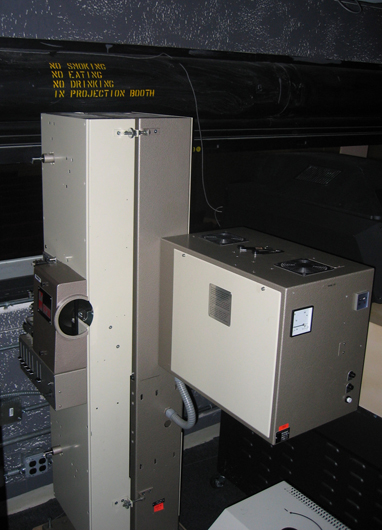
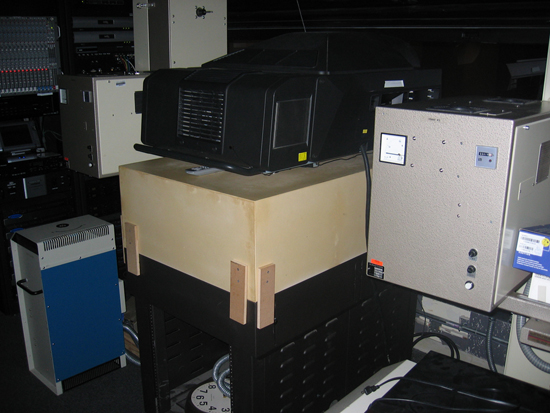
Here are a couple pics of our newly installed Kinoton’s. Booth environmental space is always a consideration but as you can see particularly relevant in our situation. Thusly did we decide to install just a single side of the 16mm projection. The space avings of a single lamphouse makes much difference to the operability of the booth, while giving us enough 16 projection capability to satisfy what comes our way.
We haven’t upgraded sound as of yet.
Thanks again for your input and thanks again to Cardinal Sound. If any of you happen to make it to the Washington DC area and are curious to see our facilities, send me an email.
Ron Toole
Posted by Mark Gulbrandsen (Member # 72) on 04-23-2009, 06:40 PM:
I agree it was a beautiful mechanism but it now has a slight hint of cheapness to it. All of the older 16mm phillips stuff I have had to deal with has had the fibre screw in them and that eventually breaks up. It now gets replaced by a delrin(or some sort of plastic) screw.
Posted by Jeff Else (Member # 4063) on 10-16-2009, 05:56 PM:
okay. i've finally got my pair of FP20's up and running. i've had a good tech by to show me some of the subtleties of setting up the gates. i have thoroughly cleaned the lateral guide rollers, but they could probably use some adjustment.. but i am getting ahead of myself... in time, of course, i will work out all the issues on these long neglected and abused machines. here is my most pressing issue. my machine number two has a terrible vertical shake. it is very rapid, but doesn't travel very far.. if that makes sense. i've heard worn intermittent sprokets and framing couplers as common problems. how can i narrow this down? (please don't let it be the framing coupler!!)
Powered by Infopop Corporation
UBB.classicTM
6.3.1.2