This is topic Kinoton FP20 lubrication in forum Film Handlers' Forum at Film-Tech Forum ARCHIVE.


To visit this topic, use this URL:
https://ft-forum.com/ft/cgi-bin/ubb/ultimatebb.cgi?ubb=get_topic;f=1;t=009440

Posted by Jeff Else (Member # 4063) on 08-04-2008, 04:08 PM:
 
what is the proper product to use to lubricate the chains and external gears in the back of an FP20? some sort of grease i assume...
 
Posted by Robert Minichino (Member # 3495) on 08-04-2008, 04:29 PM:
 
I use a light oil on the chains and Super Lube grease on the shutter gear.
 
Posted by Rob J. Buskop (Member # 3338) on 08-07-2008, 05:04 PM:
 
Never grease!!!!
Official lube is with car rear axle differential oil. The somewhat characteristically smelly viscous oil that you smell when visiting a car scrapyard.
 
Posted by Steve Guttag (Member # 268) on 08-07-2008, 08:58 PM:
 
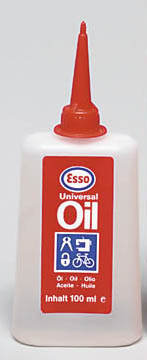
The offical lubricant for the chains, as per Kinoton, is Esso Universal Oil and this is supplied with all new projectors (yes it still has "Esso", right on the cans). It is to be reapplied every 3 months. It is a very light-weight oil.

You'll get more life (reduced time between reapplication) by using a synthetic oil like LaVezzi's intermittent oil. It clings real well and it keeps the links moving freely.

Steve
 
Posted by Rob J. Buskop (Member # 3338) on 08-08-2008, 11:22 AM:
 
I'm sorry to have to contradict the information above.
The gear train has to be lubed with hypoid oil of the type I described earlier. Apart from having intimate knowledge of the FP-20, as the designer was a personal friend of mine, I also have the original lube instruction card issued by Philips on the wall in my projection room. Kinoton instructions do not apply because it was Philips who designed and marketed the FP-20. Not Kinoton.
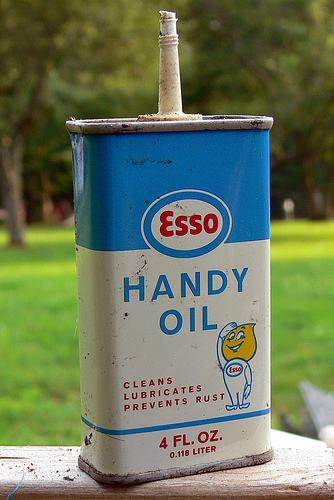
The chains are to be lubricated with Esso handy oil. (A general purpose light oil). Any other make of similar product is fine.
But after all this is said, I'm sure you will not ruin your
mechanism if you would use a lighter weight oil on the gear.
But it's not what Philips and the designer prescribed..
Another thing that's sometimes overlooked is the NECESSITY to remove the "omega" spring, that takes care of the pressure skate,
on a regular basis. The pivot points of this spring and the pins
on which it moves have to be cleaned at regular intervals and lubed with a light oil. Failing to do so will result in friction
on the pivot points of the spring. This will cause you to increase the tension in order to keep a steady picture.
After this it will happen that with the passing of a splice, the
friction in the spring pivots will prevent it to come back to it's original position and the picture will start to be unsteady.
Hereafter you increase the tension again and with the next splice the whole process starts all over again. And so on...
So: Screw the gate tension down completely, and take the spring off. Do the cleaning and lubricating so that everything has minimal friction. Remember that the pivot points are under a
load and it's inherent to the construction that the above mentioned preventive maintenance is performed once in a while.
Do you also know that the proper tension of the drive belt should
be extremely slack. And I mean really very, very loose.
This is for absorption of the intermittent load and will make the projector much quieter.
Best of luck with your fine machine!
Rob.
 
Posted by Jeff Else (Member # 4063) on 08-09-2008, 10:07 PM:
 
wow, thank you for the valuable info. i will get to work!
 
Posted by Gerard Bierling (Member # 4900) on 08-13-2008, 12:39 PM:
 
Hello Rob, long time no see.

I would go one step further then the above tip of Rob.
Remove the two rollers and their holder near the intermittent sprocket.
Remove the skateholder and clean and lubricate the shaft.
If the skateholder does not turn light then you got the same problem Rob discribed above.

Gerard
 
Posted by Mark Gulbrandsen (Member # 72) on 08-13-2008, 02:57 PM:
 
quote: Steve Guttag
yes it still has "Esso", right on the cans
Yep and they have been gone for years... used to be a division of Standard Oil. Nothing like a 40 year old can of ESSO Handy Oil to loosen things up
[thumbsup] .

 -
 
Posted by Jeff Else (Member # 4063) on 08-18-2008, 09:09 PM:
 
in order to remove the omega spring, do i have to remove the skate tension arm? i can't seem to see a way to do it otherwhise. how do i do it?
 
Posted by Mark Gulbrandsen (Member # 72) on 08-18-2008, 10:00 PM:
 
quote: Rob J. Buskop
I'm sorry to have to contradict the information above.

quote: Rob J. Buskop
I also have the original lube instruction card issued by Philips on the wall in my projection room.
Ron,

Will all due respect to that original lube card you have from the 1960's and especially the original designer whom today would certainly have agreed with Steve G., I don't think that in the modern day and age of synthetics you have much room for contradiction at all. Had that designer had access then to today's Synthetics he would have most certainly specified them!It's obvious that you are not familiar at all with LaVezzi synthetic oil or other synthetic oils nor modern synthetic grease such as Super Lube and several others. Investigation of them by any intelligent soul would soon reveal an incredibly superior lubricant for many simple reasons. I have used LaVezzi Oil in FP-20 intermittents for close to two decades and have yet to have one fail or even become noisy, in fact after a month or so running the stuff they normally become quieter!

LaVezzi oil is also brutally used in the Christie Ultramittent and I've torn down 15+ year old Ultramittents that have never seen any oil change and that show basically no wear to the star, cam, or cam pin... these smaller "Simplex sized" parts take a lot more beating then the larger star and cam used in the FP-20!! Aside from the fact that synthetics do not evaporate they also do not become acedic over time. Until you have come into the modern age and are using similar products and gaining ALOT longer running life out of just about all existing projectors as I have criticizing them is useless. But then again some love to work on the machines themselves... some manufacturers and even dealers like to sell parts. Thats life.

Mark
 
Posted by Rob J. Buskop (Member # 3338) on 08-24-2008, 08:28 AM:
 
There has been a misunderstanding.
I have to apologise for the remark "the above is not correct".
Actually I was concentrating on the best lubing method for the gears (hypoid oil) , whilst the "above" message was relating to the lubrication of the chains.... My brain was stalled, so sorry
for that remark. Chains advice was correct: light oil, like the
old Esso handy oil. Synthetic? Fine.
But as far as intermittent oil is concerned, I have no objection
to synthetics nor did I discard this idea in any way. It was
not touched upon by me.
I'm in full agreement that some proper viscosity synthetic oils will work perfectly. However the specs require Shell Tellus 37
which is readily available and has worked perfectly for some
50 years now. It's the stuff that is used here and personally
I would'nt see a reason to start betting on another product,
although it might work well.
The Tellus oils were specifically formulated for use in small
gear boxes (like in lathes) and has all the specifications
which that purpose requires. Like special anti-foam characteristics and other additives that make it what it was
designed for.
 
Posted by Mark Gulbrandsen (Member # 72) on 08-24-2008, 09:47 AM:
 
I understand Bob... My basis for how well LaVezzi oil works is how little wear the parts inside 15+ year old Ultramittent can look... that same 5 ounce dose of LaVezzi Oil oil having been in there those entire 15 years. They do mix in an additive to the synthetic that supposedly permeates the metal a molecule or two in depth and this is supposed to further reduce friction... probably why movements I've put the stuff in actually quiet down over time. All I can say is that the stuff works amazingly well.

Mark
 
Posted by Christian Appelt (Member # 1067) on 08-24-2008, 09:50 AM:
 
quote: Mark Gulbrandsen
Yep and they have been gone for years... used to be a division of Standard Oil. Nothing like a 40 year old can of ESSO Handy Oil to loosen things up
My bicycle likes this: [Smile]
 -
Esso Universal Oil ES 809 W

But your 40+ yrs old can looks much better!
 
Posted by Steve Guttag (Member # 268) on 08-24-2008, 11:40 AM:
 
Shell Tellus is good stuff. I have no problem using it. I would be interested in a controlled study of a synthetic like LaVezzi oil going head-to-head with it. The Shell oil does break down, as all natural oils do.

Steve
 
Posted by Mitchell Dvoskin (Member # 751) on 08-29-2008, 12:18 PM:
 
Ok, a stupid question, but how do you oil the chain so that all the links get oil without making a huge mess?
 
Posted by Leo Enticknap (Member # 534) on 08-29-2008, 12:50 PM:
 
A soft toothbrush?
 
Posted by Mark Beach (Member # 4636) on 09-03-2008, 08:32 AM:
 
The best way to get the oil on the chains is to get some rubber gloves (disposible type). Keep your fingers together and squirt some oil onto your hands and grasp the chain and work up and down. You will have to move the projector on by hand to get the bits you couldnt reach.

We also use Kinoton EL 4854 Slide Grease to Put on the nylon shaft.

We do both the above every 3 months as per Kinoton Manual.

If you want pics I can take some.
 
Posted by Mitchell Dvoskin (Member # 751) on 09-03-2008, 12:01 PM:
 
Would 3 in 1 oil be acceptable for oiling the chains?
 
Posted by Mark Beach (Member # 4636) on 09-03-2008, 01:56 PM:
 
Yes, thats what we use here. Have been for the last 4 Years.

We use the Esso Universal Oil.
 
Posted by Robert Minichino (Member # 3495) on 09-03-2008, 04:31 PM:
 
3-in-1 oil is fine, so is sewing machine oil. The purpose of the oil is not so much to lubricate the interface between the sprockets and the chain rollers, but the interface between the chain pin and roller, so a light oil that will get in there is ideal. This is not a critical lubrication point so I wouldn't fret too much over it; the chains are under light load and operate at low speeds in a fairly clean environment.
 
Posted by System Notices (Member # 2357) on 09-26-2009, 12:32 PM:
 

It has been 387 days since the last post.


Posted by Jeff Else (Member # 4063) on 09-26-2009, 12:32 PM:
 
let's beat a dead horse! is lavezzi HPO-2 intermittent oil appropriate in the intermittent of the FP-20? the lavezzi seems noticeably thicker than a couple of "kinoton intermittent oil"s i have around.. one ancient one from kinoton in NY and one from cinema source products..
 
Posted by Mark Gulbrandsen (Member # 72) on 09-26-2009, 02:06 PM:
 
Yes, it will work just fine. I run Lavezzi HPO in my Phillips FP-56's. Remember that synthetics may seem like they are either thicker or lighter depending on the synthetic oil analyzed. However they do an even better job of lubrication hands down. They leave no coating of varnish, film, or gunk behind either. They also do not evaporate. A friend here in Bountiful runs an FP-20 in his home screening room and has been using LaVezzi it it for three years...

Mark
 
Posted by Robert Throop (Member # 61) on 09-27-2009, 02:16 PM:
 
I worked a drive in 40 years ago that had Ballantyne supplied FP20's. As I recall, the manual specified and we were supplied with "cardan" oil which was a thick, black, sticky oil. I think this was used on the shutter gear.
Bob


Powered by Infopop Corporation
UBB.classicTM 6.3.1.2