This is topic Kelmer cleaner, Film-Guard, and a black scratch in forum Film Handlers' Forum at Film-Tech Forum ARCHIVE.
To visit this topic, use this URL:
https://ft-forum.com/ft/cgi-bin/ubb/ultimatebb.cgi?ubb=get_topic;f=1;t=009465
Posted by Justin Hamaker (Member # 2165) on 08-13-2008, 05:57 PM:
Yesterday I discovered a black scratch in our print of Swing Vote. It was a perfectly vertical scratch (running from the top of the screen to the bottom - I guess that might actually be a horizontal scratch). As best I can tell, the scratch resulted when one of the outside brain rollers on the AW3 platter somehow was halfway up the shaft so that the rim of the center roller was riding on the middle of the outer roller.
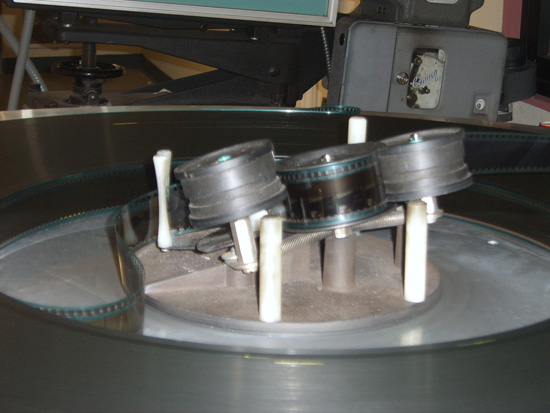
Before discovering the scratch, I discovered the roller had lost it's E ring, but I can only assume the reason the roller was halfway up the shaft was because the person who threaded didn't ensure it was seated properly - whether the roller moved during the show or was that way from the beginning, I can not say.
Anyway, the show after the scratch was discovered, I ran the Kelmar cleaner with a fresh roll of media saturated with Film-Guard - in fact we did this for the next 2 shows. Later in the day I checked the film and the black scratch was no longer visible. I had read on Film-Tech that this was possible, but this is the first time I had seen a black scratch removed (or at least masked) by using Film-Guard.
[ 08-14-2008, 04:35 AM: Message edited by: Justin Hamaker ]
Posted by John Wilson (Member # 269) on 08-13-2008, 06:35 PM:
A little while ago we received a print on a move over from one of the major chains in town. This thing I kid you not had at least 15 scratches on it running from top to tail of the print.
It took about 3 days to have them all with the exception of one very deep base scratch...completely gone. Even the deep one was barely visible.
Oh yes...Filmguard is good. ![[thumbsup]](graemlins/thumbsup.gif)
Posted by Chris Nolan (Member # 4853) on 08-13-2008, 10:12 PM:
I can top that, John! We had a print of Horton Hears a Who come to us on move over from a big 14-plex. There was only one scratch, but it was a huge green scratch right down the middle of the screen.
I don't know if Filmguard can help in that regard, as that was before I learned how to use the Kelmar, and we just opted to order a new print anyway.
Posted by John Wilson (Member # 269) on 08-13-2008, 10:32 PM:
Well, it may be a great product...but it can't replace emulsion image from a green scratch.
Posted by Chris Nolan (Member # 4853) on 08-13-2008, 10:36 PM:
Yeah, I figured it probably couldn't... maybe one day...
Posted by Joe Redifer (Member # 3) on 08-13-2008, 11:46 PM:
Maybe never. Unless you went in and Photoshopped each frame, there would be no way to reconstruct the missing image whereas a base-side scratch is usually just a groove filled with dirt.
quote: Justin Hitmaker
It was a perfectly vertical scratch (running from the top of the screen to the bottom - I guess that might actually be a horizontal scratch).
WTF?????
Posted by Justin Hamaker (Member # 2165) on 08-14-2008, 12:06 AM:
In reading Film-Tech, I have heard the different types of scratches describe by their orientation on the film stock rather than the screen. I have understood it to mean that a scratch that runs along the length of the film is described as a horizontal scratch rather than vertical as it appears on screen.
This caused me some major confusion when I was reading a thread about horizontal scratches caused by the take-up arm on an AW3 platter and I could not see how that would be possible.
Posted by Joe Redifer (Member # 3) on 08-14-2008, 12:24 AM:
Scratches should be called by the way they appear on the screen. Anyone who doesn't do that is being perhaps a bit too pretentious.
Posted by Justin Hamaker (Member # 2165) on 08-14-2008, 12:29 AM:
You'll get absolutely no objection from me on that one.
Posted by John Hawkinson (Member # 1135) on 08-14-2008, 04:14 PM:
While there may be some confusion between whether vertically means "vertically on the projected image" or "vertically on the film as it runs through the projector," it never means "vertically for the orientation that the film is using on the transport device." Since the first two are the same for 35mm 4-perf film, everything is crystal clear and unambiguous unless you decide to try VistaVision or IMAX.
(It would be the height of foolishness if the platter projectionists and the changeover projectionists described the same scratch using opposite terms!)
--jhawk
Posted by Joe Redifer (Member # 3) on 08-14-2008, 05:18 PM:
I agree, who says a film's natural state is horizontal (for those who would argue otherwise)?
Posted by Bruce Hansen (Member # 281) on 08-15-2008, 06:08 PM:
My natural state is horizontal. ![[sleep]](graemlins/sleep.gif)
Powered by Infopop Corporation
UBB.classicTM
6.3.1.2