This is topic How do I get my long shaft out of this hole? in forum Film Handlers' Forum at Film-Tech Forum ARCHIVE.
To visit this topic, use this URL:
https://ft-forum.com/ft/cgi-bin/ubb/ultimatebb.cgi?ubb=get_topic;f=1;t=009492
Posted by Joe Redifer (Member # 3) on 09-01-2008, 07:35 PM:
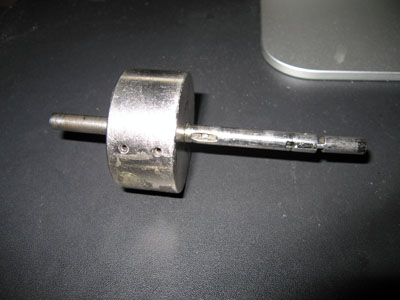
I have a Neumade PRT Ultra work bench which was designed in The Land Without Common Sense back in the 1400's or so. I have a spindle where the key for common shipping reels has long since worn off.
See?
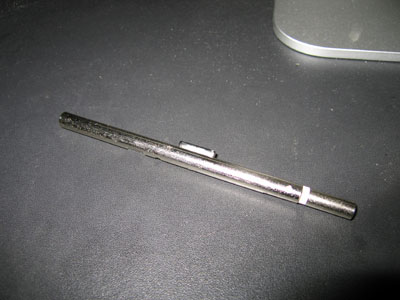
I need to get the shaft out and replace it with this new one I found:
But there doesn't seem to be any screws that allow this. There are only these weird, tiny holes with what appears to be some sort of pegs or things in them:
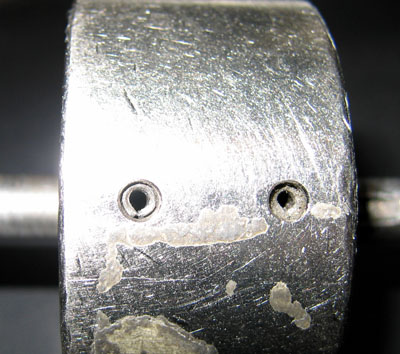
One goes through the shaft to the other side, and the other simply locks down and provides pressure on the outside of the shaft.
They aren't screws. How do I loosen them and/or get them out, and then how do I get them back in once the shaft is replaced? I imagine I'll probably have to travel back in time to before color was invented to procure the proper tool. Maybe one of the tools is a hammer?
Posted by John Wilson (Member # 269) on 09-01-2008, 07:44 PM:
You'll have to hammer the one that goes though out. The other one could be drilled out but what to put back in its place? Does the new one have the hole in it for when you want to put it back in?
This could take a while. Is the old shaft badly bent or is it just missing the key? It may be more trouble than it's worth.
Posted by Jack Ondracek (Member # 1466) on 09-01-2008, 07:47 PM:
I think they're called expansion pins. The one that goes all the way through, you can punch out with something of the same diameter, at least far enough that you can get some pliers around it.
The other one, you'll probably have to drill out. Hopefully, the pin is softer than the metal around it.
You can buy replacements at Home Depot, & some hardware stores with decent fastener sections.
Posted by Jon P. Inghram (Member # 4125) on 09-01-2008, 08:00 PM:
If the part isn't actually bent and/or broken, why not just get some new keys? If you don't know where to get them (doing a quick Google search didn't come up with any info) I can ask our tech where he gets 'em, we have the same type of icky workbench and, before I found the shaft with the adjustable pin that fitted both the shipping reels and our 6k reels, we used to chew up those puny keys.
Posted by Jeremy Weigel (Member # 4208) on 09-01-2008, 08:02 PM:
They're roll pins. You can either tap them out with an object slightly less in diameter or drill them out (which I usually do when they're that small). You can buy replacements at just about any hardware store.
Posted by Robert Minichino (Member # 3495) on 09-01-2008, 08:11 PM:
Those pins are called spring pins, roll pins or split pins (the latter also refers to cotter pins), they're friction fit into the holes (they're springy so they stay in) and they're driven out with a pin punch and a mallet (or hammer ![[Big Grin]](biggrin.gif) ).
).
Posted by Monte L Fullmer (Member # 2797) on 09-01-2008, 08:48 PM:
(OR, you could take out the key from the new one and put it in the old one ....be a bit easier... )
.. and find a supplier that still has those keys in stock for the PRT ULTRA...
Or, if you want to do it the hard way, get a good bench vise and a drill bit as a punch to press those spring pins out.
-Monte
[ 09-01-2008, 11:59 PM: Message edited by: Monte L Fullmer ]
Posted by Don Furr (Member # 1469) on 09-01-2008, 08:48 PM:
Joe I've got the same bench here at the house and got tired of breaking the pins so I now use the adjustable drive pin spindle. It fits cores, and all house reels and won't break. Throw that crap in the trash.
Posted by Louis Bornwasser (Member # 3063) on 09-01-2008, 09:11 PM:
Push out the one that goes all the way through. Using a vice, twist off the shaft, which will shear off the short pin.
Then push the short pin inward, shear it off with a punch, repeat until it is gone. Reassemble. Louis
Posted by David Stambaugh (Member # 1102) on 09-01-2008, 09:14 PM:
What Robert said. My experience with roll pins is on foosball tables where they're used to fasten the plastic "players" to the steel rods. The pins eventually shear off. Best way I found to get them out is pin punch (of the proper size) and a hard mallet or a hammer.
Posted by Joe Redifer (Member # 3) on 09-01-2008, 09:31 PM:
I need to have the key for my expandable trailer flange. The key on the new one does not look like it can be removed, and the old one has a worn space that does not look like it can be replaced. If you put something in there, it would just fall out via gravity. Yes, the new shaft has a hole in it for the pin to go through.
I don't understand why something like this even exists. The Kelmar table doesn't have spindles where keys break all the time. Who thought designing it this way would be a good idea?
Posted by John Walsh (Member # 168) on 09-01-2008, 09:32 PM:
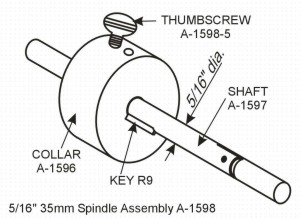
Wow, a spindle from the 1400's! Must be pretty good to last longer then some glaciers! Those keys do break, but it is often because of, er, uhm, rough use; using 6000ft reels with the 5/16 spindle, turning on the rewind table with the speed control on full, etc. Replace the spindle like everyone said. The pin is a 5/32 spring pin. The key is pressed in; don't just try to put a new key in 'cause it will only fall out. Replace the entire A-1597 shaft.
Posted by Jon P. Inghram (Member # 4125) on 09-01-2008, 10:08 PM:
Blu tack stuffed into the slot keeps the key from falling out.
Posted by Phil Ranucci (Member # 3820) on 09-01-2008, 10:35 PM:
If you have the R-9 key just knock out the old one and press the new one in in a vise. I've done it and it will stay if you press it hard enough. Otherwise you'll have to drive out the roll pin and replace the whole shaft.
Posted by Monte L Fullmer (Member # 2797) on 09-02-2008, 12:05 AM:
quote: Phil Ranucci
I've done it and it will stay if you press it hard enough..
I used to do the same thing with a vise. But, did an additional trick was to drill the opposite end of the shaft with a large bit to create a countersink to when I pressed in that key, the tab would be exposed enough to where I would flare that end of the tab in that countersink that I created.
That key didn't go anywhere...and I had a good dozen of those R-9 keys on hand.
Posted by Joe Redifer (Member # 3) on 09-02-2008, 12:28 AM:
How does one knock the old one out? It doesn't look like it'd go anywhere unless it was melted down. I am wondering why Neumade never bothered to offer better spindles for this table... or did they just stop altogether back in the 40's and any replacements since then are by 3rd parties?
Posted by Bernard Tonks (Member # 809) on 09-02-2008, 03:31 AM:
I would take it to a small engineering workshop to get it done. I had one man company near me who made me 1/2" spindles and fitted on new ball race bearings for my Westrex double sided long playing tower at a fraction of the cost that Westrex and others charged.
Posted by John Walsh (Member # 168) on 09-02-2008, 07:05 AM:
While it is true you can replace the R9 key on the shaft, I found there's usually no one at a theatre who has what is needed to press out the broken key and press in a new one. Also, there may not be enough of the key 'hole' left to retain the key. After replacement, the key sometimes will be loose, and wiggle around, breaking again soon after. If you have access to tools and ways to fixture the shaft, sure, but there's just very few projection room staff that can do it. That is why I suggest replacing the entire shaft.
Posted by Mark Gulbrandsen (Member # 72) on 09-02-2008, 07:48 AM:
quote: Joe Redifer
How does one knock the old one out? It doesn't look like it'd go anywhere unless it was melted down. I am wondering why Neumade never bothered to offer better spindles for this table... or did they just stop altogether back in the 40's and any replacements since then are by 3rd parties?
Joe,
With all due respect to John... that is why the Kelmar table exists!
Mark
Posted by Rick Raskin (Member # 1561) on 09-02-2008, 04:26 PM:
"How do I get my long shaft out of this hole?"
That's quite a title.
Posted by John Walsh (Member # 168) on 09-02-2008, 05:40 PM:
Well, admittedly the original PRT not my favorite table. If I still had to rewind 2000 foot reels all day, I'd rather have the Kelmar. OTOH, if I worked in a multiplex where I most likely would be rewinding 6000 foot reels, I'd rather have the newer PRT Ultra.
You have to give the original PRT a bit of a break, though. It was designed and sold starting in the middle 1960's, one of the first tables to have changeable spindles. It was discontinued (I think) in 1994.
Posted by Steve Guttag (Member # 268) on 09-02-2008, 06:01 PM:
I don't think any rewind bench has a total lock on good/bad designs. Kelmar uses flimsy spindles that bend REAL easy. Their keys will fall out too, with enough use. One has to lift the reel a bit higher on a Kelmar. The 2nd power head on a Kelmar does not offer an torque compensation. The Kelmar also doesn't provide a great means of splicing without potentially scratching the film on the flanges. Now the Kelmar has many good things about it too....in fact, it is our most popular rewind table and we sell a fair number of them for reel-to-reel operation.
Steve
Posted by Tony Bandiera Jr (Member # 2365) on 09-02-2008, 06:28 PM:
quote: Rick Raskin
"How do I get my long shaft out of this hole?"
That's quite a title.
Yeah, I had a totally different visual when I saw the title.. ![[Smile]](smile.gif)
Posted by Joe Redifer (Member # 3) on 09-02-2008, 06:55 PM:
quote: Steve Guttag
The Kelmar also doesn't provide a great means of splicing without potentially scratching the film on the flanges.
You'd have to be pretty clutzy to accomplish that. In fact the same could be said of just about any rewind bench where the reels are in front of the table edge.
quote: Mark G
Joe,
With all due respect to John... that is why the Kelmar table exists!
OK thanks. I'll see if they have one next time I go to Home Depot. Anyway I hear that the Kelmar table is much too expensive for what you get. Granted, it is the table I am most familiar with. I've heard there is a custom PRT Ultra 2 table out there that winds bidirectionally and is significantly cheaper than the Kelmar.
Posted by Gordon McLeod (Member # 33) on 09-02-2008, 07:41 PM:
Get a TECCO table and rewinder and your are set
Posted by Bill Enos (Member # 440) on 09-02-2008, 08:25 PM:
If the Kelmar shafts bent any easier you would have to put a prop under them over night so gravity wouldn't deflect them.
Posted by Richard Fowler (Member # 893) on 09-02-2008, 08:51 PM:
TECO is out of production......but they will build them if you pay for a run of castings.
Posted by Scott Norwood (Member # 30) on 09-02-2008, 09:48 PM:
Why are people having so much trouble with the Kelmar shafts? I've seen the keys break (usually when someone tries to rewind a 6000' reel with the key-drive shafts), but the 5/16" shafts only seem to bend when people drop them. The 1/2" shafts and 16mm shafts are quite sturdy. The only other issue that I've seen with the Kelmar table is that the wiper in the rheostat (autotransformer?) sometimes comes loose, but that is easily fixable.
The usual problem with the Neumade PRT table seems to be that the powered shaft does not turn freely when the power is turned off. If one feels a defect while inspecting a print, the natural reaction is to stop the motor and turn the left-hand reel backwards to find the bad spot. With the Neumade table, this tends to break the key on the right-hand shaft.
Were the PRT tables intended only for rewinding and not for film inspection? If so, then I can understand why they were designed as they are. If not, then this seems to be a major design flaw. I hope that the current-model Neumade table does not have this issue.
Posted by Joe Redifer (Member # 3) on 09-02-2008, 10:40 PM:
quote: Scott Norwood
The usual problem with the Neumade PRT table seems to be that the powered shaft does not turn freely when the power is turned off.
Yes, it fights you. Even if the switch is centered it will fight you for the first few seconds and then finally give in and spin somewhat freely. Maybe I will try unplugging it from the wall when I need to do this. Usually I just backspin the reel on the right by forcing the reel itself instead of pulling from the left (which will cinch-damage the film on the PRT table).
Also, I do not understand the need for the right position of the switch which is balls-to-the-wall full tilt mode, no variables. There is an adjustable knob, why not just let it go all the way up to that point? It sucks to accidentally flip the switch to that position. But then again, this was designed in the 1960s back when people were clearly freakin' idiots.
Posted by Tim Reed (Member # 137) on 09-03-2008, 08:11 AM:
Bitch, bitch, bitch!
Hell, I ran a repertory house for six years (14 different thirty-year-old acetate prints a week on one screen) using a Neumade PRT Ultra rewind. I stopped on EVERY splice and EVERY torn sprocket hole during inspection, too, and assembled to 6k reels with 1/2" bores. Whenever I stopped at a defect and needed to reverse, I always just kicked the right-hand reel off the drive dog, and backed up free as you please by turning the left-hand reel and letting the right one spin on the shaft. (But then, I had a propensity for devising solutions and workarounds. ![[Razz]](tongue.gif) ) I often inspected using the HIGH-SPEED position, too.
) I often inspected using the HIGH-SPEED position, too.
The speed control is an off-the-shelf Dayton controller, and not Neumade's design. The full-power position is just part of the package.
I rarely broke reel driving keys, since I only used that spindle for trailer flanges. That particular spindle is not for exchange reels; there's an adjustable-dog shaft for that purpose. The only problem I ever had was I'd occasionally break the internal roll pin on a 1/2" spindle, the part that engaged in the driven shaft to turn the whole assembly. But this only happened maybe 3 times over a six-year period of constant daily useage.
After adapting my operating habits to this rewind, I actually preferred a PRT over a Kelmar or a Goldberg, because they would run faster and the height was right for inspection. And, with that many prints a week, I needed the speed.
Posted by Jonathan Worthing (Member # 803) on 09-03-2008, 10:04 AM:
This may not work but you never know.
Use an old Tap & thread it in to the centre of the pin.
This will give you something to hold on to to pull the pin out.
As I say It may not work but depending how tight it is in the hole you should get some movment.
Posted by Robert Minichino (Member # 3495) on 09-03-2008, 10:16 AM:
When I was in the field without a properly sized punch, I actually used a tap to simultaneously push a roll pin out of its hole and thread the hole for a screw. (This was for a different application.)
Posted by John Walsh (Member # 168) on 09-03-2008, 04:58 PM:
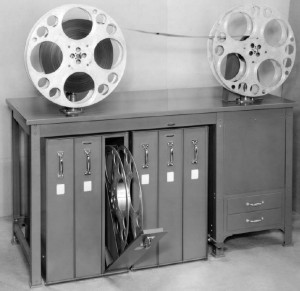
Some info on Neumade tables before the years go by and I forget ...
Neumade made many different tables that allowed you to clamp (or bolt) several different rewinders to. This seeemed to be the way things were done from the 'beginning' to the middle 1950's. But from what I can tell, (from the company documentation) Neumade's first 'integrated' rewind table was the 'Power Rewind Table 35/70.' This model came out of the design that was originally made for Cinerama, and started selling in the late 1950's for 70mm theaters. (There are several earlier 1950's dated photos in the archives showing tables with motors built-in holding those large Cinerama-type reels.) The PRT 37/70 originally only had 1/2" spindles, but after the PRT Ultra was released, you could get a retro-kit to make them changable. It had a foot pedal you pressed on to apply more rewinding torque. It was discontinued around 1975.
Most of the 'head' parts (spindles, collars, shafts, etc.) are still available. But (sorry) the motor, motor cradle, foot pedal parts, drawers, panels, legs, etc. are not made anymore.
The Power Rewind Table 35/70, below:
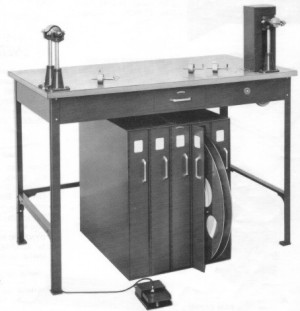
Not every theater needed a heavy-duty table, so in the early 1960's Neumade also made the PRT Ultra. It was designed with changable spindles, and a dead-side foot pedel to control tension. The motor controller is an AC controller, which means the low speed regulation is not very good. Most spindle parts, heads and the controller are still available. I saw a few white table tops in storage a few years ago, so if you really want one they might still be there. The PRT Ultra was discontinued in 1995 or so when the PRU Ultra II came out.
PRT Ultra:
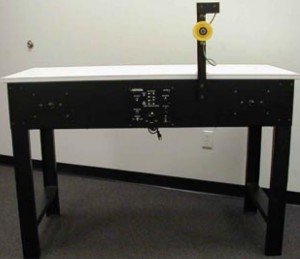
The PRT Ultra II is the current table. It uses a DC controller for a smoother speed control, a feature where the tension on the film stays constant as the rolls on each side get bigger/smaller. The spindles are different than the ones used for previous tables. No operator nowadays wants to stand on a foot pedal, so it's gone from the design.
PRT Ultra II
I have newer manuals and a 'spindle guide' for all these tables which I will email Brad & Co. tonight.
Posted by John Hawkinson (Member # 1135) on 09-04-2008, 12:03 AM:
We've got a table with an HFC PR1A on it (footpedal speed control) that I'm quite happy with (esp the tightwind). The handcrank side is a Neumade dynamic. Does HFC have anything that's competitive with Kelmar these days?
We've also got a Neumade Super-X. Not quite as solid as the PR1A, but still pretty decent...
--jhawk
Posted by David Boyd (Member # 4936) on 09-04-2008, 06:43 AM:
We call them roll pins here. You bash them out with a drift and hammer. New ones will be tight but are meant to be so they lock when they go in. You can buy a roll pin set and drifts on line easily. Good luck!
Posted by Jonathan Worthing (Member # 803) on 09-04-2008, 08:56 AM:
I thought the point he was trying to make was the one pin is not is all the way through. So yes you can bash the one out with a drift but not the other.
Posted by Rick Raskin (Member # 1561) on 09-04-2008, 12:32 PM:
quote: Jonathan Worthing
Use an old Tap & thread it in to the centre of the pin.
This will give you something to hold on to to pull the pin out.
Also, try heating the thing with a blowtorch to make it expand while you pull out the pin.
Other option, just drill it out.
Posted by Jonathan Worthing (Member # 803) on 09-15-2008, 04:54 AM:
Joe
Any luck
Posted by Joshua Waaland (Member # 287) on 09-16-2008, 05:33 AM:
I see everyone saying to drill the roll pin out. Do not drill the roll pin!!! I learned the hard way several times (I forget easily). Roll pins are hardened and you will just end up breaking your drill bit trying to get it out. Don't waste your time. You will probably need to use an easy out and try to twist it out enough to take pressure off of the spindle to pull the spindle out.
Posted by Bill Enos (Member # 440) on 09-16-2008, 10:18 AM:
Joshua is correct, the split in the pin will catch the edge of the drill bit and stop it and likely break the bit, especially since it is a small bit. The likely reason it won't drive out normally is that it is partly sheared. If so, the only way to get it out is to rotate the two parts held by the pin back into alignment. Then the pin will drive out as it should.
Powered by Infopop Corporation
UBB.classicTM
6.3.1.2