This is topic DTS reader gives rounded rather than square waveform in forum Film Handlers' Forum at Film-Tech Forum ARCHIVE.
To visit this topic, use this URL:
https://ft-forum.com/ft/cgi-bin/ubb/ultimatebb.cgi?ubb=get_topic;f=1;t=009536
Posted by Alex Rolfe (Member # 1648) on 10-01-2008, 09:39 AM:
We had problems with one print recently playing in DTS on one projector in our changeover setup, so we checked the output voltages. Both projectors read at 4V without film.
The projector that played fine gave roughly square waves with rounded corners as you'd expect when running film. The other reader (the one that didn't read reliably) gave something that looked more like sine waves- smoother curves and far less square. There were flat parts in the wave at the peak and troughs, but they were shorter than we saw on the other projector and the transitions were much longer.
There's no noticable horizontal play in the film as it goes around the drum on the reader. We also tried pushing laterally on the film as it entered the reader but that didn't change the output either.
Any suggestions on what to check or try before we think about replacing the reader?
Posted by Gordon McLeod (Member # 33) on 10-01-2008, 10:03 AM:
I would try increasing the reel tension
Posted by Robert Minichino (Member # 3495) on 10-01-2008, 10:38 AM:
Sharp edges = high frequencies, so if you lose your sharp edges of the waveform that means you're losing high frequency response. The obvious cause would be the reader being out of focus. If, as Gordon suggested, the film tension is okay (this can affect the placement of the film track with respect to the lens) then you should replace the reader and have it realigned.
Posted by Tony Bandiera Jr (Member # 2365) on 10-01-2008, 02:37 PM:
I concur, but with the 'scope connected would first mark the lens on the reader (the big hex nut) and carefully turn it slowly while watching the waveform, till it sharpens up. If trying that doesn't help, then return the lens to the mark. I would guess it would take no more than 1/4 turn MAX to bring it back in.
I don't think any harm can come of trying that, I don't think the DTS reader technology is exactly rocket science.
But first I would also make sure the lens is clean, use a cotton swab and lens cleaner and gently clean it off. Any oil or other residue could affect the reading accuracy.
Posted by Randy Stankey (Member # 64) on 10-01-2008, 05:27 PM:
quote: Tony Bandiera Jr
But first I would also make sure the lens is clean...
I second that motion! ![[Smile]](smile.gif)
I was taught to always clean the lens first whenever working on any sound head be it analog, Dolby, Sony or DTS.
It may seem silly thing to remind you of but it is often the silly things that trip us up the most.
Besides, the first rule of troubleshooting is to always eliminate the simple things first. ![[Wink]](wink.gif)
Posted by John Hawkinson (Member # 1135) on 03-21-2009, 07:45 PM:
We should have posted what happened here! Sorry about that.
Here's a view of the initial problem:
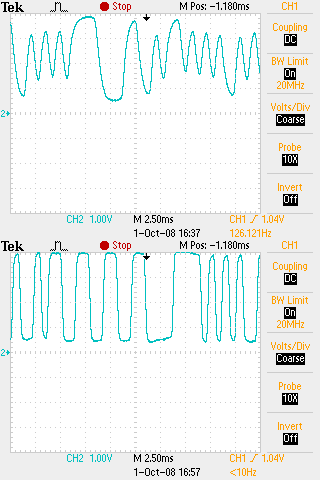
The image on top is the malfunctioning reader. The one beneath is the good reader. I think we spent too much time on introspection about this problem (specifically the rise time), worrying about whether it was a slow photocell, dying LED, etc., etc. DTS engineering suggested it was a bad cell.
But it turned out that adjusting the lateral alignment was all that was necessary to fix the slow rise time issue and get good performance out of this reader. I don't have quite as comparable scope captures (first capture is at 710mV/division, second is at 560mV/division), though:
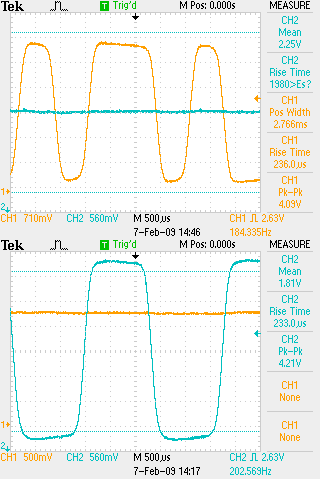
I'm not sure what the takeaway is. "Sometimes you have to adjust the lateral alignment," I guess. This was not a problem specific to a particular print, either.
--jhawk
Posted by Mark Gulbrandsen (Member # 72) on 03-21-2009, 08:28 PM:
Unless the incomming film comes in dead straight over it's operational life span you'll see some wear on one of the TCR drum's side flanges depending on which way the film was pushing. The added stability roller doesn't completely alleviate this problem. This wear will allow the film to ride over slightly and cause the mistracking and need for slight re-alignment. This is especially noticable if the print you receive also has it's TC track slightly off of it's normal position.
When I dismantle TCRs to re-led them I always measure the width of the drum... many, many of them show at least some slight wear... it is just alumnium after all...
Mark
Posted by Steve Guttag (Member # 268) on 03-21-2009, 08:49 PM:
The reader bracket doesn't help matters either...they don't get their 90-degree bends at 90-degrees. The film almost has to skew when going in/out of the reader. The upside...it forces it to ride a flange and not weave...the down side...as Mark pointed out is that the roller wears.
Steve
Powered by Infopop Corporation
UBB.classicTM
6.3.1.2