This is topic How old were you when you wanted to become a projectionist? in forum Film Handlers' Forum at Film-Tech Forum ARCHIVE.
To visit this topic, use this URL:
https://ft-forum.com/ft/cgi-bin/ubb/ultimatebb.cgi?ubb=get_topic;f=1;t=009575
Posted by Gunnar Asgeirsson (Member # 3882) on 10-25-2008, 07:54 PM:
How old was you when you start working as a projectionist and how old was you when you firt wanted to be a projectionist.
I was a little kid 9 years old the first time i saw a projectionboth and after that i start going to all the cinema and look at all the projectionboth in every cinema here in reykjavík iceland and after that i was shure this was something for me.. And i start working in this when i was 18 years old and i really find myself in this job ![[thumbsup]](graemlins/thumbsup.gif)
And now i work in the most popular cinema in iceland.
Posted by Monte L Fullmer (Member # 2797) on 10-25-2008, 07:57 PM:
I began at 18, yet was handling film while I was in grade school playing with 16mm.
Posted by Bill Enos (Member # 440) on 10-25-2008, 09:04 PM:
Ran 16mm in the 10th grade, first work as projectionist was at 42 in 1986.
Posted by Justin Hamaker (Member # 2165) on 10-25-2008, 09:57 PM:
I was 23 when I started in 1996.
Posted by Don Sneed (Member # 955) on 10-25-2008, 11:04 PM:
I was 14 when thinking about it, 16 when started in 1970 as a union projectionist at the Martini Theater in Galveston Texas, at that time I was the youngest projectionist in the IASTE-MPMO projectionist union, I worked out of local 279 Houston/Galveston until 1985, now technician.
Posted by Brad Miller (Member # 2) on 10-26-2008, 01:50 AM:
Gunnar, The title of this thread needs to be corrected. No teaser subject titles are permitted. This thread will be removed if you do not correct it.
Posted by Kurt Zupin (Member # 2751) on 10-26-2008, 04:07 AM:
The proper title should be, "How old were you when you wanted to become a projectionist?"
something along those lines.
As for me, I was 20 when I came back home and took a job at the local theatre as a team memember. It didn't take me long until I was hooked on the upstairs.
Posted by Joe Redifer (Member # 3) on 10-26-2008, 04:10 AM:
I think I was 20 when I was first taught how to thread. Maybe 19. Hard to say. I'm gonna go with 20. I'm 23 now. ![[Wink]](wink.gif)
Posted by Jesse Skeen (Member # 586) on 10-26-2008, 05:13 AM:
I wanted to be a projectionist as soon as I learned what one was- probably age 3 or so. I first got to handle real theater projection equipment at age 19; I left the theater business the week of my 29th birthday due to an overabundance of stupidity where I was working.
Posted by Don Furr (Member # 1469) on 10-26-2008, 06:47 AM:
I had a Ampro 16mm sound projector when I was 10 years old. I started in a change-over booth when I was 15. I lied about my age and told 'em I was 16. That was 1962.
Posted by Jeff Stricker (Member # 224) on 10-26-2008, 07:01 AM:
12 years old in 1959 when I first ran 16mm.
Posted by John T. Hendrickson, Jr (Member # 849) on 10-26-2008, 11:48 AM:
I became hooked at the age of 5 with my first 16MM projector. My hobby expanded and by the time I was 14 I owned two 16MM DeVry's and two old Holmes 35MM projectors.
I didn't start working professionally until 1970 when at the age of 26 I began doing relief work and summer house work for Local 243 here in NJ to suppliment my income as a teacher.
Posted by Louis Belloisy (Member # 3836) on 10-26-2008, 11:53 AM:
a mere child at 18 with the Simplex carbon arc projectors. that was a few decades ago ![[Smile]](smile.gif)
signs all over the booth......
(Save the copper for the war effort)
louis
Posted by Robert Throop (Member # 61) on 10-26-2008, 12:12 PM:
I was 17 when I got my first job in 1965. I'd been hanging around booths since the age of 12.
Bob
Posted by Monte L Fullmer (Member # 2797) on 10-26-2008, 02:05 PM:
...you can tell that we love our profession.... starting young and still doing it... ![[Big Grin]](biggrin.gif)
Now, who else can say that they'd stayed with their profession as long as we've done...
I guess, we should add to our comments on "What was it that drew you to being a film handler and/or to the booth?"
Posted by Richard P. May (Member # 3598) on 10-26-2008, 02:43 PM:
During junior high school, at about 14. Started with 16mm classroom films, and the school had 35mm Motiograph projectors, used in the auditorium during lunch in bad weather.
Posted by Martin McCaffery (Member # 37) on 10-26-2008, 04:21 PM:
Did AV Geek work in 6th Grade. Got a job as an usher my senior year of HS. Started working as a relief projectionist for Local 224 in DC/VA/MD in 1976 a few months before my 19th birthday. Moved to Montgomery in 1985 to run the Capri Theatre, so more of a projectionist emeritus these days;>
Posted by Mark Gulbrandsen (Member # 72) on 10-26-2008, 08:06 PM:
When I was in the 6th grade and saw Sound Of Music in Todd-AO.
Posted by David Mann (Member # 4917) on 10-26-2008, 08:43 PM:
My folks bought an old Fox Theatre when I was seven.It had Magnarc Type G lamps with a generator, Simplex E-7's and SH-1000 sound heads. Simplex mono sound and Ampex 4 track mag stereo. I was a pain in Dad's butt for about 7 years wanting to run the booth.
At 14, about 1978, Dad turned the booth over to me. Way too much fun.
David
Posted by Tyler Potts (Member # 4952) on 10-26-2008, 11:39 PM:
I read Fight Club back in 8th grade before it came out (yes, I'm a young'un), finally having a cool character with the name Tyler made me want to.
Posted by Tim Reed (Member # 137) on 10-27-2008, 08:15 AM:
My interest in the "mystery" behind the dancing beam of light was there from the very beginning - probably 4 years old - in 1965 or '66.
When I consciously said, 'this is what I want to do'... I was probably 11, because after looking in through portholes at area drive-ins and studying intently for a good while (just like in Cinema Paradiso), and after sitting-in with a couple of operators on two distinct occasions, I finally made my first changeover at age 12, on 9/7/74. Big barrel Century C's on 9030s, running 6k reels (believe it or not), with (Ashcraft) RCA Dyn-Arcs behind them burning an 11mm trim. Never will forget it.
Posted by Joe Redifer (Member # 3) on 10-27-2008, 10:48 AM:
I remember watching Empire Strikes Back when I was 8 or however old I was when it came out. I noticed the beam of light coming from the booth going to the screen. When the movie was over, credits rolling and I was exiting, I noticed the beam of light was coming from a different projector than when it had started. I was all like "LOL WTF? I didn't notice them switchin' projectors on me. What kind of scam are they trying to pull here? I must solve this mystery." I getting pretty close to putting a lid on the case, too. I ended up being a projectionist at that very theater, but we only used one projector. There was a gutted tank-like one sitting next to it which was made by the same company who shaves my face. Interesting indeed!
Posted by Joe Tommassello (Member # 4632) on 10-27-2008, 11:09 AM:
At six years old (1966 or '67) I realized there were changeovers occurring and that someone was up there running the show. Soon I started collecting 8mm and Super 8...silent at first then sound.` Started collecting 16mm in '78 or so. Added a 35mm booth with Super Simplex ('38) and RCA Soundhead in '95 and a Super Platter (?) acquired used from AMC in '97 or '98. The serial number on the platter was 38. About the same time (early '97) I was asked by a friend to fill in as a part time projectionist at the GCC Franklin Mills (original 10-screen location) and stayed with them for four years and two more theaters. I'd still be doing it if I didn't need enough money for both food AND shelter.
Posted by Mark J. Marshall (Member # 1409) on 10-27-2008, 12:10 PM:
Around age 6 or 7 I had a Super 8mm projector, and I was hooked immediately. I even lugged that thing into my 3rd grade class a couple of times to show the digest versions of Empire Strikes Back, Jaws, and The Black Hole. I was the A/V kid in elementary school up through high school where I worked with 16mm. I worked with 16mm & 35mm in college for the one semester I was there (I flunked out because I spent too much time at the theater & the radio station). Then I went to AMC in 1989 at age 18 and was a projectionist within a year or so. Two years later I was helping the engineers setup booths for new theaters.
Posted by Ed Alvarado (Member # 2760) on 10-28-2008, 04:47 AM:
ahh the booth I love the booth I started when I was 20yrs and this was back in 2001.
Posted by Rick Raskin (Member # 1561) on 10-28-2008, 07:47 AM:
In elementary school I was fascinated by the windows at the back of the auditorium and why they were at different heights. Saw my first real booth at age 12. Was A/V geek in Jr./Sr. High. Threaded up XLs at age 15 when a local operator taught me how. Ran my first shows at 18.
Posted by Hans Van Der Vlist (Member # 3315) on 10-28-2008, 08:48 AM:
At the age of 12 I was allowed a look into the booth of the local CINEAC theatre ( which showed
,non stop, 50 minute programs of newsreels) and was hooked right away.
I was about 14 years when I bought my first 8mm camera and an EUMIG 8mm projector.
From that moment on I knew I wanted "to be in pictures".
At the age of 16 I was allowed to become "volunteer apprentice projectionist" at the Thalia Theatre in Rotterdam.
After being a 16mm and 35mm projectionist during my military service I got a job as salesman/technician with a filmshop that specialized in Super8 and 16mm. equipment.
But my father wanted me to come and work with him in his drugstore where I've set up a Super 8 rental department.
I am still working in the same place...only the Super 8 rental has since long gone.
Still wanting to " be in film" I set up my own 35mm home cinema.
Now I run a MEO5XB (Czech) 35 projector equiped with a 500 watt xenon running 6k reels. With my CP50 I can run now Dolby Stereo/ surround, Dolby SR and DTS.
For 16mm. I use a BAUER P8 T400 with the powerful HTI lamp.( one never can have too much light).
I also can run my DVD's with a Sanyo PLV-Z4 beamer but as you know the quality stays far behind 35mm quality ( it's really not 'FILM').
So now you know!
Hans.
Posted by Damien Taylor (Member # 4255) on 10-28-2008, 09:37 AM:
I always wanted a job where I could barely afford to survive, work my ass off in 4000 degree rooms for little thanks, and clean with chemicals that make you sterile. So of course I was delighted when I found out such a job existed.
I immediately applied, and when I went for an interview... well the interview went a little like this.
Manager: You Damien?
Me: Yes
Manager: This is how you strike the lamp, thread the projector and work the lights. Ready to do it yourself?
Not joking.
This was all the way back in February 2008 when I was 21. Its been 8 months, and beside marquee night(formerly known as Wednesday), where I get to either
A. Climb a 20 foot painters ladder to spell out BURN AFTER READ1NG
or; B. Try to catch perspex letters in a milk crate, not square in the face.
The job is pretty awesome. I think I'm glad that I work in at least a partly existent deco palace, rather than a hyper-plex.
I now have Jedi-like reflexes for repairing failed lab splices mid movie and calming a buzzing rectifier with a swift booting. Very awesome job! My theater rocks
Oh, and I've collected films and projectors for years.
Posted by Jim Cassedy (Member # 4115) on 10-28-2008, 10:46 AM:
When I was very, young - maybe 6 or 7 years old, I
caught a glimpse of a projection room through the
open door at the local theater. The big machines
with turning reels and sputtering arc lamps held
an immediate fascination for me.
I don't know why, but I was 'hooked'
I went to a Catholic school. The nuns used to give
out little rosararies or prayer cards if it was
your birthday. So, one year on my birtday I was
presented with several prayer cards to pick from
as my gift. I had it narrowed down to two cards-
one showed a young boy driving a big steam locomotive,
and one showed a young boy running a film projector.
(Both accompanied by an ever-present Guardian Angel)
This is the card I picked
on that birthday in 1960.
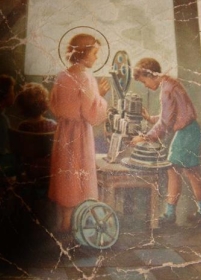
Who knows; if I'd picked the other card, mabye today
I'd be driving a train!
I began working (off the books)in 1968 for a projectionist
who I'd befriended who had two jobs. He'd sneak me into
the booth and pay me a few bucks to run the movies while
he napped through most of the evening shift.
That booth was equipped with Motiograph AA projectors
and SH-7500 soundheads, Peerless Magnarc carbon-arc
lamphouses powered by mercury-vapor tungar tube rectifiers
and a Motiograph vacuum tube optical-magnetic sound systems.
I was able to get into the union (Local 640 in NY)
about 2 years later.
The first films I remember running 'professionally' were
"Funny Girl" and "Oliver" - both in 4track mag sound,
which was still in use back then.
I have a friend who is a professional magician. I summed
up our respective carreers one day by telling him that
"The only difference between us is that you do your magic
at one end of a theater, and I do mine at the other"
It's still magic to me.
Posted by Dominic Espinosa (Member # 2122) on 10-28-2008, 03:03 PM:
Ahh good times...
I was obsessed with film, movies, and projection every since I realized it wasn't a TV at the theater (maybe 8 or so?). When I was 16 I hung around with some pals that worked at a local theater and talked them into letting me learn to thread. Fell in love with the business then.
First movie I built up was: The Banger Sisters
Posted by Frank Angel (Member # 248) on 10-28-2008, 07:19 PM:
Same experience as most of you guys -- being intrigued by that magic light coming out of a hole in the wall (and how they mysteriously switch from one hole to the other), so much so that I would brave the DO NOT CROSS ropes to get up to that booth door which was almost always cracked opened enough to look in; I'd first watch the movie, then go up there and sit peering in, watching the Wizard of Oz ply his craft. It was like I was mesmerized -- I couldn't pull myself away. One nice fellow caught me watching and rather than throw me out, actually let me come in to watch a few change-over and oooh those incredible arcs!
I also have to give a tip-of-the-hat to my dad who was as a fireman by vocation, but he loved to take home movies. He was shooting 8mm film from the time I was born, so there was always a projector showing home movies from as early as I can remember. I took over as projectionist from dad probably as soon as my fingers could manage the threading. I made an 8mm film (with sound -- a Reeve dual system using a special 1/4in tape with strobe lines printed on the tape to allow syncing the speed of the projector). That was when I was 14yr old. I quickly turned my basement into my first Home Theatre!
Naturally I got on geek AV squad in HS running 16mm, but when they installed the Century's in my HS auditorium booth, I decided I HAD to get in that booth. I broke into the booth (my Brooklyn street skills) and I had a Disney cartoon projecting the on the screen correctly and with sound within half an hour. And I got suspended for that little caper. But then on, it was just a matter time for me to figure out how I was going to maneuver my way into a projection booth, some place, somewhere.
My very 35mm first movie that I was paid to run was THE MIRACLE WORKER at college -- not quite a commercial theatre, but it was a real movie house and a real audience and that's all I needed. There were also four 16mm theatre across campus which I ran, the challenge being to get them to look just like real 35mm theatres. Then I dropped out of college and off to Texas when I worked in the first theatre as a commercial projectionist -- The Venus Theatre right outside Houston. The rest is history.
Posted by Tim Reed (Member # 137) on 10-28-2008, 10:10 PM:
OBTW, same here with the family home movies and 16mm at school. Saw my first 16mm in 4th grade, and gravitated straight towards it. I was amazed it played SOUND films... our 8mm's were silent.
Frank, where in Houston was that theatre?
Posted by Chris Dugan (Member # 3893) on 10-29-2008, 01:30 AM:
Ahhh...
Back when the re-release of the SE Star Wars. Got to build one. Been in love with it ever since. Still doing it today and kinda sad to see it go when Digital takes over. ![[Frown]](frown.gif)
And I'm only 28 now
Posted by Charles Greenlee (Member # 3856) on 10-29-2008, 02:26 AM:
I was around 20, I beleive. That was back in 2000, or 2001. I really enjoy it. Still trying to find a way to slide back into it.
Posted by Cameron Glendinning (Member # 3516) on 10-29-2008, 05:47 AM:
My story is also similar, but my interest in cinema projection started with an episode of Columbo that I saw when I was 14 in 1984. For those that haven't see it I won't spoil it, basically the projectionist is murdered mid show and the theory of change overs was explained. The penny dropped?
Already in the schools hall A/V crew I ended up responsible for the wet weather 16mm screenings and did my first c/o there.
For school work experience I ended up double booked at the old Village Ascot and Greater Union Cinemas in Sydney. So I asked Village if it would be ok if I could do the work experience during my school holidays and next thing you know I had my first cinema job in the candy bar and had treaded my first vic 8.
The next year for school work experience, Greater Union took me in a second time, this time at their former film lab, Colorfilm. I spent most of the week in the Dolby Stereo mixing suite with a film director called Philip Noyce imdb . (It was second hand, it was the same desk that had mixed Star Wars)
All I can say is the difference between the exceptionally high technical quality that the filmmakers were making and how crappy cinemas were in reproducing it still amazes me.
My High School Art major work was a video of the demolition of the Village/ Kings Mosman, Art Modern 1930s Cinema and the restoration of the neighbouring Egyptian themed deco Orpheum cinema in Cremorne. Which eventually landed me a contract with the Australian Broadcasting Corporation in the cinecamera section working with 16mm film.
Projectionist in 50 or so cinemas later, several custom built complete cinema speakers systems, directing, producing, DOP, sound recording, credits to my name. My love of film and cinema continues.
Posted by Frank Angel (Member # 248) on 10-29-2008, 09:00 AM:
Tim, I am not really sure where the Venus Theatre was located -- for the short time I worked there, one of the fellas from the local would drive me there, maybe a 15min drive, so it couldn't be too far. It played Spanish language films exclusively -- pretty much a rundown dump of a theatre, but it was mine! I did aprentice in a large, bigger theatre in Huston proper, but I can't recall the name of that house -- I was only there for a week or two while the chief showed me the ropes. From there it was to the Mattsonian Drive-in in Caldwell (one horse town) and Mr. Mattson's hard top on Main Street in Caldwell. Then to the Campus Theatre in Bryan-College Station. Then it was good-bye to Texas and hello back home to Brooklyn!
Posted by Tim Reed (Member # 137) on 10-29-2008, 09:35 AM:
I remember several of those kinds of theatres (Spanish language bills) in Houston, including one drive-in... yes, all were dumps. quote: Cameron Glendinning
my interest in cinema projection started with an episode of Columbo
That was 1973's Double Exposure. The other Columbo episode having to do with projectors and changeovers was Make Me a Perfect Murder, from 1978.
Posted by Martin McCaffery (Member # 37) on 10-29-2008, 10:05 AM:
quote: Jim Cassedy
This is the card I picked on that birthday in 1960.
I want to say, for all of the Catholics and ex-Catholics in the group, that prayer card is to DIE for
Posted by Blaine Young (Member # 3992) on 10-29-2008, 01:46 PM:
Going back to elementary school - probably 4th or 5th grade, I was an AV geek, and we had the auto-threading B&H 16mm projectors. By the time I hit Jr. High, that school was using older projectors that were manual thread. The projector could accept a jig that would allow for automatic threading, and then you pulled the jig out for operation. Could have sworn it was an RCA projector, but cannot find any images of it anywhere. Trouble was the jig seemed to disappear - there were probalby only two in the entire school so had to learn manual threading.
I continued my AV Geekdom through High School (graduated in '83). I talked my way into a 35mm booth in 1987, were I worked in a twin for 2 weeks (Century heads, Cristie AW3 platters). I quit to go work for an 8-plex that had Century heads with ORC lamphouses. 6 were change-over houses running 6k reels, and 2 had ORC platters (which I hated). I loved that theater. Alas, it is long gone. Next worked for a 10-plex running Cinemeccanica Vic-5 and Vic-8 projectors with AW3 platters.
Posted by Paul Mayer (Member # 355) on 10-29-2008, 02:45 PM:
Wanted to run film since sometime in elementary school, so maybe from 10 years old or so (1965). Started running 16mm at age 12 in junior high, and 35mm from age 17 in high school (definitely was an AV Geek). First paid 35 and 70mm work began at age 19 after I joined the IATSE in 1974.
Posted by Joe Redifer (Member # 3) on 10-29-2008, 02:52 PM:
I remember in elementary school when we'd have "film strips" in class and more often than not the film would break at least once. The teacher or whoever would just take the broken part, tuck it to the take-up reel (no tape or anything) and rethread. Of course anyone and everyone was qualified to run those films since they had a threading diagram on the projector itself, just like a lot of theater chains do these days!
Posted by Laurie Higgins (Member # 4843) on 10-29-2008, 05:27 PM:
Well I have always been a big movie buff. I always preferred seeing a movie in the theater with giant screens and total darkness. The theater has always been a magical place to me. I first saw the booth when my sister in law's friend who owns a private screening room in Atlanta was screening some horror movies for a Halloween party I was at and he let me in the booth. It was the first time I ever saw a platter system and was totally amazed. I had no idea. I asked him if he would teach me how and he said yes. That never happened as I went back to my regular job and it drifted away. But about a decade later I got laid off and another friend who owned a small mom and pop style twin cinema gave me a job and I learned the ropes shortly thereafter. I was 39.
Posted by Mike Blakesley (Member # 26) on 10-29-2008, 06:09 PM:
When I was about 10 my family went to see "The Sound of Music" at the Roxy. I got interested in the how the projectors worked, so my dad asked his friend Don (the theatre owner) if I could sit in the booth while the show ran. It was OK with Don, so I spent the next night in the booth.
My grandfather owned a 16mm sound projector -- why he ever bought it, I don't know -- and my dad would borrow that to show corporate films at training meetings held at the auto parts store where I now work days. Inevitably the projector wound up living at our house, and somehow I found out about Modern Talking Picture Service, a company that distributed corporate films to be shown at meetings and libraries, etc. I started ordering movies from them and put together a "theatre" in my bedroom. I hooked up an extension speaker (a 6x9 in an apple crate) so the sound would come from the screen. I would coerce my parents to come and watch movies. They hated it.
Then in high school I started hanging out with a friend whose parents owned the drive-in theatre in town. That was my intro to running the machines. I worked there unofficially for a couple of years.
Then in late '76, a projectionist job opened up at the Roxy and three years after that, Don, the owner, retired, and my brother-in-law and I bought the place.
Posted by Monte L Fullmer (Member # 2797) on 10-29-2008, 09:04 PM:
...and how many of us remember Films Incorporated for our 16mm school feature film provider?
Along with the Bell Systems Science Films that Frank Capra produced in the late 50's and early 60's which are now all-time classics to find: "Hemo the Magnificent". "Strange Case of the Cosmic Rays" and the other 6 that were released through Bell Systems. I ran them all while in the AV dept.
Also did 3 years in the highschool AV dept being their 16mm projectionist (running a pair of RCA's in changeover mode) when the school had special after-school films to present.
From these special showings, one film that the Latin class sponsored and rented out that became my favorite classic that finally own on DVD, Sam Bronson's "The Fall of the Roman Empire" - the newly released two disc version.
This was before I got introduced to 35mm cinema projection.
Posted by Tim Reed (Member # 137) on 10-29-2008, 10:36 PM:
quote: Monte L Fullmer
how many of us remember Films Incorporated
I do! I do! And Audio Brandon. Also recall MTPS, as Mike mentioned.
First feature my class saw for assembly was in 7th grade: The Fuller Brush Man.
Posted by Mark Gulbrandsen (Member # 72) on 10-29-2008, 11:23 PM:
quote: Monte L Fullmer
"Strange Case of the Cosmic Rays"
I forgot about that one! I do remember "Hemo The Magnificent" and "Our Mr Sun" though.... Weren't those done in Dye Transfer... I seem to remember they always had very good color...
Mark
Posted by Monte L Fullmer (Member # 2797) on 10-30-2008, 03:33 AM:
I remember the original 16mm releases were in IB Tech, but later on, the subsequent releases came on Eastman
Here is the complete order of the 9 release by Bell Science Films
1955 - Our Mr. Sun
1956 - About Time
1957 - Hemo the Magnificant
1957 - Strange Case of the Cosmic Rays
1958 - The Unchained Goddess
1959 - The Alphabet Consiracy
1960 - The Thread of Life
1964 - The Restless Sea
Frank Capra directed three episodes: "Our Mr. Sun", "Unchained Goddess", and "Hemo the Magnificant"
Jack L. Warner produced "the Alphabet Conspiracy"
Walt Disney produced the final episode "The Restless Sea"
Three Episodes, of "our Mr.Sun", "the Thread of Life" and "Gateways to the Mind" can be downloaded from this archive site.
-Monte
Posted by Frank Angel (Member # 248) on 10-30-2008, 05:49 AM:
And additionally there was Sterling Motion Pictures. Between them and MTPS, you could get enough really decent titles to make up full programs as I did for a small theatre in my college dorm common room. Every Friday nights were movie night in our rec room (Notre Dame was not coed when I attended, so movies were very popular on Friday nights. The common room or rec room as we called it had a small stage and curtain at one end -- that's all I needed to see and I spent much of my freshman year building a dorm theatre.
I built two 6 foot high stands with blimped soundproof boxes on top of each to house the two old B&H 300 series projectors. I attached the arms to the outside of the blimp boxes while the boxes themselves were walled with acoustic cieling tile I got from the university maintenance shop. The blimps worked very well -- you could hardly hear the projectors.
For dimmers for the curtain & house lights I actually had found a few of those huge resistive rheostats -- big round black things with the wire coils imbeded in cement and probably asbestos and with big handles. They were awkward and bulby, but they worked....and got hellishly hot if you didn't turn them off when once you dimmed the lights completely out. When we ran features, I would get another B&H from the next res hall & put it in my second blimp. I loved those Bell & Howell.
For change-overs I worked diligently trying all manner of solenoids & levers outside the projectors to flip in front of the lenses, but when I finally got one to work, the two of them made so much noise together that I finally gave up and opted for a two-way switch to flip the projector bulbs power on one switch. It worked well enough and it was a hellofa lot less noisy than those big solenoids slamming shutters on a fulcum up and down.
There was also a great source for sports news reels from the USArmy. They would send one every week (I called it our Sports Reel Spectacular) and it was a big crowd pleaser; the rec hall filled up every week. And the sports reels were totally free -- the Army even paid for the postage both ways. Evidently they had a huge film and processing facility and this was a bye-product. Our tax dollars at work.
Whenever I could save enough money from the popcorn sales, I would rent a feature from Films, Inc. The first one I ever played in that dorm theatre was MR. ROBERTS. The B&L anamorphics werent matched -- one was a integrated, the other was an attachement. The biggest hitch was getting a curtain/mask puller (no motors in that system). And even though I had indicator lights run to the back stage, they never could quite get it right. Mostly because lots of beer was consumed at these movie nights and although they got it pretty much at the start of the show, they weren't nearly as reliable by the end of the show. ![[beer]](graemlins/beer.gif)
Posted by Mark J. Marshall (Member # 1409) on 10-30-2008, 06:12 AM:
quote: Joe Redifer
I remember in elementary school when we'd have "film strips" in class and more often than not the film would break at least once.
Joe, were yours always out of frame too? Our teachers could never figure out how to thread the thing so that the natural stop on the little knob actually stopped with a full frame on the screen. It usually stopped with something less than 100% of the current frame and a little piece of the next frame on the screen. Which meant that every frame advance ("DING!") involved moving forward too far, and then backing up slightly.
Posted by Scott Norwood (Member # 30) on 10-30-2008, 08:31 AM:
How does one thread a filmstrip projector in frame? The ones that we had in school had a slot in the top of the machine where the leader of the filmstrip would go and, when pushed far enough, the leader would engage the advance sprocket under the gate. There was no way to insert or remove a filmstrip mid-strip. The entire thing would need to be advanced through the machine. The actual advance knob had detents every quarter-turn, so that the strip could be advanced four perfs at a time. There was also a framing adjustment knob that either surrounded or protruded from the center of the advance knob. The only way that I could see that the filmstrips could be reliably threaded in frame would be to cut the leader "in frame," although that position probably varied between projectors.
The usual problem with filmstrips (other than the fact that almost all were sleep-inducingly boring) was that whoever was assigned to advance them would either miss a beep on the record or would advance two frames instead of one, thus getting the picture out of sync with the soundtrack.
By the time I was in fifth grade (1987), my school got an automated filmstrip projector, which worked only with filmstrips with sound on cassette tape. These tapes were recorded with a stereo head with the beeps only on one track. The player in the projector would reproduce the other track (without beeps) and use the cue tones to advance the filmstrip. This worked fine if the operator put the proper start frame in the gate before starting the tape. The tapes would play normally (with audible beeps) in a mono player for schools without automatic projectors.
Another oddball format that we had in elementary school was the "film loop." These came in either standard-8mm or super-8mm (using different projectors for each format) and the film came in an endless-loop cartridge (which was keyed to prevent the use of a standard-8mm cartridge in a super-8mm projector and vice-versa). The projectors were made by Technicolor (!); they accepted the cartridges in a slot in the back and had only four controls: on/off, focus, frame, and lamp bright/dim. Even on "bright," the lamp was very dim and not suitable for a picture more than a couple of feet wide.
We had B&H 500-series auto-shred 16mm projectors in elementary and middle school and Elmo 16CLs in high school, though relatively few teachers showed actual film in class after 1990 or so.
Posted by Tim Reed (Member # 137) on 10-30-2008, 05:38 PM:
I remember filmstips! I used to love to be the "operator" for filmstrips, because they were 35mm. Occasionally, before or after the show, I'd sneak on a frame or two from the head of a snipe I'd garnered from one of the drive-ins... this one used to get cheers:

Posted by Fred Tucker (Member # 4482) on 11-02-2008, 04:32 PM:
I cant say that I ever wanted to be a projectionist or for that matter work in a movie theatre, but I was between jobs and a friend insisted that I apply for part time if nothing else. I did facilities maintenance work at first and got moved into projection after a week and fell in love. I now have a deep passion for film handling & a career that ties my pay scale that ties with what I made in a average week doing electrical work. Not planning on leaving this industry anytime soon!
Posted by William Del Valle (Member # 3569) on 11-04-2008, 09:34 PM:
I've been around motion picture projectors all my life (i'm 67). All I have ever wanted to do is show movies. My dad designed projectors so we had them. There is a picture my dad took of me at about one old next to an RCA PG-170 around 1942 or 43. My house is filled with projectors, film and other items. If my wife was still alive she would throw me and my projectors out.
I ran Centrys in the service, worked as a tech,joined the union in 1977.
Posted by Charles Greenlee (Member # 3856) on 11-05-2008, 10:46 PM:
quote:
Of course anyone and everyone was qualified to run those films since they had a threading diagram on the projector itself, just like a lot of theater chains do these days!
Hmm, and the minimum wage morons working the booths in the major chains still can't get it right. I think its lack of care, rather than lack of intelligence. I was a minimum wage booth moron, and I got it right. Or at least, I try, which therein may be the difference.
Posted by Steve Guttag (Member # 268) on 11-06-2008, 07:01 AM:
Hmmm....our filmstrip projectors had a means for setting the detent...you got the image on the first frame properly centered and then moved the dentent ring (outer ring) to effectively set the dentent (kinda like how Dolby did their faders through the CP65).
Another projector, I remember you could push the knob in and adust the first frame for the detent...kinda like a Simplex XL framing knob (on machines with the current framing mechanism)...again achieving proper frame.
The "Dukane" projectors were the auto advance ones via cassette tape. Unlike Scott's description, the tones were audible but they were bass tones that were not going to be reproduced by the dinky speaker in the projector so it was of no consequence.
Mind you, my experience predates Scott's by over a decade...so things, no doubt, changed quite a bit in that time. The first attempts at projection Video in the classroom were just starting in the '80s. During my entire K-12 (mostly the '70s) experience, it was a lot of film and film strip. Ditto machines also were used much more extensively than Xerox.
Steve
Posted by Scott Norwood (Member # 30) on 11-06-2008, 10:13 AM:
Steve explained the filmstrip framing mechanism better than I did; our machines operated the same way.
Interesting about the filmstrip cue tones being on the same track as the music and narration. I do remember that our tapes would play properly on a standard cassette player (tones would be audible). Maybe they were LF tones and I was thinking about slide-sync systems that use 1kHz tones? Maybe there were multiple systems for filmstrip automation? I can't imagine that automated filmstrip projectors were ever very common.
For whatever it's worth, I never saw video projection in a classroom until college (mid/late-1990s), and those were ultra-dim CRT units. DLP and LCD didn't become popular until after I graduated.
Posted by Sean Weitzel (Member # 244) on 11-06-2008, 01:54 PM:
1992, my junior year of high school was the last time I remember a teacher showing 16mm in a class. Our biology teacher felt that film projection held the class's attention better, and I'd have to agree! Our county office of education liquidated their entire 16mm film library in 1995. How many remember watching "Free to be You and Me" with Marlo Thomas? I was able to score all three "episodes" on estar stock for $10 dollars.
Posted by Stephen Furley (Member # 1277) on 11-06-2008, 03:40 PM:
Scott,
Motorised filmstrip projectors such as the Bell and Howell ones were not very common in my day. On the older ones, such as the Aldis Tutor 500 and 1000 wound the strip onto the top spool, pushed the two sprung glass plates apart, slipped the film between them, pushed the end of the film under the clip on the take-up spool, and then wound down to the first frame. You then attached the strip holder, or the slide holder, to the two bars on the front of the projector on which was also mounted the lens holder. The front of the projector could be rotated to position these bars horizontally or vertically. The slide holder was mounted horizontally, and the strip holder normally vertically for single frame (4 perf) strips, but could also be used horizontally for double frame (8 perf) strips, though these were much less common. A small metal mask was pulled out to use these. With the original holder there was no detent, you simply stopped turning when the next frame was correctly positioned on the screen. With a later holder, which I think was introduced with the tutor 2 halogen projector, though it could also be used with the older ones, a sprocket was introduced in the position where the take-up spool used to be, which the film wrapped around about 90 degrees, and then passed to the take-up spool just in front of it. You wound the film through until the first frame was correctly positioned, and then turned the knob on the sprocket until it clicked to set the detent. After this you just turned the knob on the take up spool until the detent clicked, once for single frame, and twice for double frame strips. The Tutor 2 with its 24V 250W halogen lamp gave better illumination than the older machines with their 500W or 1000W straight tungsten lamps, which put a lot of heat on the film.
A rather similar machine was made by Kershaws of Leeds, the same people that made the Kalee cinema projectors, and the same dark red plastic was used for the knobs on them. These were still in use at my primary school in the '60s, but were thought to be getting rather old then. I've got an Aldis Tutor 2 somewhere, but with only slide, not strip holder.
These machines were seldom maintained in good condition, and were notorious for scratching film, it is rare to find a used strip which is not scratched. I have just one strip, from 1951, which is in good condition. Somebody I know was interested in it, as he had not seen a copy, and he arranged to be able to put it on his web site; I did the scanning of both the film, and the lecture notes. For the younger people who have not seen a filmstrip, or to bring back memories for the older ones who sat through lots of these things when they were at school, there's a scan of the label from the top of the small metal film can, and the rather nicely letterpress printed cover of the lecture notes here:
quote:
http://nicwhe8.freehostia.com/btf/productions/filmstrips/BT0017/BT17.html
Clicking on the title frame will take you the whole of the strip, along with the text of the lecture notes for each frame. A typical 1950s filmstrip; the lecture notes, and some if the images, really do seem very dated today. I've actually been on the ship seen in frame 41, in its later days.
The black and white strips were normally made by photographing paper photographic prints, and the colour ones by copying slides, in both cases onto 35mm negative film. The negative was spliced into a loop, and run through a continuous contact printer to produce a large number of prints on a long roll of film, which were then cut off, and packed into cans, the older metal ones were about 50mm in diameter, the later plastic ones rather smaller.
The quality of the images from the small frames could actually be pretty good if the strip was in good condition. The later strips were generally printed on Eastmancolor, and have faded to almost total pink decades ago; they were generally too early to be on low-fade stock.
Interestingly, the strip shown above was printed from a nitrate negative, it must have been one of he last ones to have been. The strip itself is triacetate of course.
Posted by Bob Koch (Member # 1062) on 11-10-2008, 10:47 PM:
Maybe I should`nt even start this.Anyway in early 1937 I went to a hi school in Oakland Ca that had a very active stage crew that interested me and had a tin lined booth in this very large auditorium with a couple of Powers 6B`s on their original stands with the original Powers lamps, vertical trim, solid carbon arc lamps. The hi school was closely connected with UC Berkeley and they were experimenting with student government in our school and as a result several of us were allowed leeway to equip this booth to run 35mm sound. Away we went to film row in San Francisco[Golden Gate Ave] and attempted to obtain this from legitimate dealers,i.e. National Theatre Supply, B. F. Shearer and others who would`nt talk to us and ended up with a pipe organ dealer/manufacturer Geo. H. Leatherby. He sold us junk I can remember to this day[and I`m 86]called Weber Syncrofilm manufactured by Weber Machine Works in Rochester NY. Had an amplifier with a pair of 2A3`s with fixed bias in the output and it was pretty good but fought a losing battle with it,s in put and output sources. The speakers were a pair of Jensens with 110 volt fields and some tweeter I forget. We rigged this to fly as the auditorium had full fly galleries. This is what started me; but the IATSE operators locals were so strong at the time that we had to employ a union operator to run the booth for our paid audience. I started visiting the operator where he worked and really got hooked. A lot of members of Local 169 were kind to me but you did`nt get to touch the equipment. The original operator later was business agent for Local 169 and remained friends with me until his death and I was working for RCA Photophone.
After working in the country in St. Helena Ca for room and board I finally got an opportunty to work as an IATSE permit man. [Mark G. will love this]This is at a time when the International President was George E. Browne, late of Chicago stage hans Local 2, and he answered directly to Frank Nitti and more importantly, Paul Ricca of the Chiago "outfit". I paid quite a percentage of my wages to a fund directly controlled by Geo Browne. Later he and Willie Bioff were convicted of extorting money from the Hollywood studios. They "ratted"about their mob connections and Willie Bioff, some years later in Phoenix,pressed the accelerator of his car and was blown to bits. Readers Digest had an article about Browne entitled, "A Bullet is Waiting" but I never knew what happened.After that I worked until I went in the army and overseas but never got a membership card. When I returned after two years in the Marianas, the good brothers of Local 241 Vallejo Ca put me right back on the job I left and inducted me into full membership. That was 61ears ago. I spent the next 45 years in the projection room, either as a projectionist or RCA/Altec service engineer. Never done anything else.
Posted by Monte L Fullmer (Member # 2797) on 11-10-2008, 11:57 PM:
quote: Bob Koch
I spent the next 45 years in the projection room, either as a projectionist or RCA/Altec service engineer. Never done anything else.
With that duration of booth experience, did you have bouts of boredom, or was the other interest with RCA/ALTEC managed to balance out the boredom (if any)..?
Did you know J. Paul Swickart - tech with RCA/ALTEC of yore?
Posted by Carl Martin (Member # 1146) on 11-11-2008, 03:43 AM:
i always enjoy reading bob koch's posts. what a memory. i've worked a booth that he worked: the oaks in berkeley, ca. different equipment now, though.
when did i want to become a projectionist? i fell in love with film my last year in college, got a theater job after graduating, more for the sake of free movies than anything else, i suppose, but realized that being in the booth was the best way to be a part of it, and very soon i was.
Powered by Infopop Corporation
UBB.classicTM
6.3.1.2