This is topic Proper line grounding in forum Film Handlers' Forum at Film-Tech Forum ARCHIVE.
To visit this topic, use this URL:
https://ft-forum.com/ft/cgi-bin/ubb/ultimatebb.cgi?ubb=get_topic;f=1;t=009592
Posted by Jonathan Bodge (Member # 4072) on 11-04-2008, 04:28 PM:
I have always added a ground to every circuit run in a booth. The other day the electrician said you don't have to, the conduit is the ground. Technically he is right, what could the problems if a ground wire is not run?
Posted by Tim Reed (Member # 137) on 11-04-2008, 04:48 PM:
The National Electrical Code notwithstanding, electricians don't have to work with sound circuits. A conduit isn't always a good ground. They can, and often do, come apart. Also, if the pipe is grounded at more than one point, there can be circulating currents that form a ground loop. This causes hum.
Ideally, there should be only ONE grounding point for the booth, and it should be Earth ground. Cold water pipe ground was the old standard, but that was before PVC.
Posted by Marin Zorica (Member # 1716) on 11-04-2008, 06:20 PM:
Just idea to use pipe as grounding is so stupid.....if something is wrong than you could even get that device is running neutral true pipe and you could melt it down!!!
I remember in friend's neighbors house he did have hot and melted pipe on water heater......why??
Someone did use as ground also and did connect it with neutral....other neighbors did have same and neutral wire did went off on he's mains at home, so all current was going to neutral true other neighbors pipe!! Friend did measured it....that was something big....lucky for him he did figured out why.....
Posted by Jim Cassedy (Member # 4115) on 11-05-2008, 09:59 AM:
I deal with several theaters that were built 75-80 years ago.
A couple of them are ground-loop nightmares, as a result of
several different vintages of electrical wiring being put
in over the years. All of them also have at least some of
the original wiring still in use in various places.
One, in particular is an electrical balancing act when it
comes to grounding, with much of the grounding being
done through connections to water pipes.
Over the summer, a section of old cast iron drain pipe
which served a slop-sink and an ice machine sprung a
leak and was replaced with a section of PVC pipe.
It threw the whole building ground system "out of
balance" and caused severe huming in the audio system.
Efforts to get rid of the hum by re-configuring the
booth grounds were useless, and often made things worse.
I had to "jump" the new PVC section with some AWG12 wire
to get things back to where they were, electrically speaking.
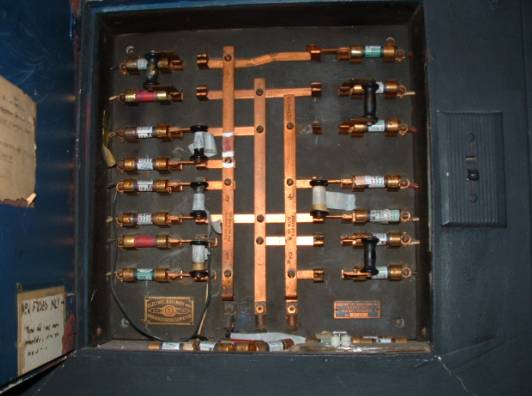
Here's one of the electrial panels at another theater I deal with that was built
before WWI ! As anyone who has worked around old theaters will tell you,
there are still plenty of these original old buss-bar & knife-switch panels still in use
Posted by Bill Enos (Member # 440) on 11-05-2008, 10:08 AM:
We've got a panel similar to that except 5 times bigger, the insulator that everything is built on is a 2 inch thick slab of slate. Nothing in or attached to our sound system can have an earth ground, if anything has an earth ground there is an incredible hum.
Posted by Gordon McLeod (Member # 33) on 11-05-2008, 11:04 AM:
I always spec a oversized ground conductor on all installations and usually it is the item the contractors have to go back and fish afterwards when we decline to sign off because they thought it was unnecessary and left it out
Posted by Mark Gulbrandsen (Member # 72) on 11-05-2008, 12:37 PM:
If one fllows standard "star grounding" proceedure as is done in all audio equipment then there won't be any grounding issues, ground loops or stray currents anywhere.
Mark
Posted by Fred Tucker (Member # 4482) on 11-05-2008, 12:55 PM:
If memory serves me right, you must have atleast a commonly shared ground wire in any building designed to hold over 100 people. In other words every conduit should have a groundwire unless the theatre's max occupancy including staff is less than 99 people.
Conduits come apart, they rust, they get painted all of these things result in a poor ground over time although the initial ground tests out just fine.
There is a terrific benefit to oversizing your grounding conductors especially in audio! I have seen so many electricians run a 2/0 ground wire on a 1,000 amp service (common size in a megaplex like I work at) to the same 8' copper ground rod that you will find used in a modern home. Myself I would spec four 16' ground rods spaced 15' or greater apart for a 1,000 amp service. Another gripe of mine, every transformer in a building should have its own earth ground in addition to tying into the buildings common ground, per the NEC.
Posted by John Hawkinson (Member # 1135) on 11-05-2008, 01:54 PM:
Fred, there is no such requirement in the National Electric Code. Your individual locality (or Texas!) might be different, though I would be surprised. From the NEC's perspective, conduit constitutes an effective ground-fault current path, and that is all that is required.
Painting should not effect the quality of a conduit's ground -- the relevant connections are internal.
Really, though, proper use of balanced audio should make most of these concerns a non-issue for audio.
Gordon, did you mean an oversize neutral? I've never heard of an oversize ground ![[Confused]](confused.gif) .
.
--jhawk
Posted by Fred Tucker (Member # 4482) on 11-05-2008, 02:38 PM:
John, you are right. I had to go back and reread my code book. There is however a local requirement (City of Stafford, TX) to us MC cable (has a full size ground conductor) instead of AC cable (bond wire only) in occupancies over 100. ad to make a few calls after re-reading the code to see why I had been doing that all these years.
Posted by Edward Jurich (Member # 1787) on 11-05-2008, 02:44 PM:
I know people will object and say I'm crazy but....this is from 35+ years in broadcast engineering and if the input to an amplifier is a true balanced input, you do not need to shield your wires. Now I always run shielded audio lines but on occasion I have had ground loop problems that were solved by lifting the ground off one end of the line or lifting the ground off both ends. On one occasion on the input to a Dolby unit (forgot the model) I had to lift both grounds on one projector. This only works of the input is true balanced.
For years AM and FM radio stations used miles of unshielded telephone pairs to get audio to transmitter sites through 100 pair cable that included telephone lines that had ringing current. This worked because the lines were terminated at both ends with balanced transformers.
Posted by Frank Angel (Member # 248) on 11-05-2008, 08:38 PM:
Older buildings very often have a potpouri of layers of wiring add-on with a variety of grounding schemes, it's a real challenge to figure out how to get a decent balanced electrical environment for audio equipment.
When I first begain rebuilding our recording studio in a building built in the 1950s, I found such a hodgepodge of grounding mess with a number of changes that used different grounding schemes layer on top of one another. Grounding points existed all over the place -- the star system was more the spagetti system. Ground was so poor that there were voltage between ground points. In one room, I put a meter between one (supposedly) grounded audio rack and the grounding pin on an AC sockets on the other side of the same room where tape decks were plugged into -- it read 7 volts! Try keeping THAT much AC out of the audio line with electronically balanced circuitry -- even a transformer balanced line would have a hard time balancing out much of differential.
It was in that installation, one of the older techs explained the "cut and solder" procedure to me -- when when it comes to those already wired messes, you go to each piece of equipement that has hum and you cut the ground. It the hum decreases, you leave it off; if the hum increases, you solder it back on. Repeat. You repeat because what you do at one end of the chain can affect what you've done previously.
Posted by Steve Guttag (Member # 268) on 11-05-2008, 09:34 PM:
I'm amazed by the general misunderstanding associated with ground and grounding practices.
No, it isn't the "balanced" part that kept your noise down...it was that the wire was TWISTED AND BALANCED. A true balanced circuit that electrically isolated off ground (like transformer based), will be pretty noise immune (receiving noise) if the wires have a reasonably tight twist. Since in a balanced circuit you have a "differential" input (and it is the input that is key), the way to keep noise out is to ensure that whatever induced noise is forced to cross BOTH wires in the differential system (hence the twisting). As such, if both wires are equally affected, you will get common mode rejection of the induced noise. The world is not a perfect place, one wire will get more noise than the other and it will be measurable, though it may be insignificant.
Shielding provides an electrstatic shield for both the wires on the inside as well as keeping the noise generated by the signal itself from radiating out too.
If lifting ground, at either end improves the system, you didn't find a soluiton, you identified a problem...sure the quick and easy way is to leave the shield lifted but you have not achieved as good a system as is potentially possible.
Since the chief noise in analog audio is hum...floating one end is the easiest thing to do and is, in fact, common practice by most folks.
For higher frequency stuff (video)...one has to shield at both ends if one wants the noise to drain.
Good grounding practices really have to start with the design of the room. If it isn't done right at the start, you will eventually be chasing your tail trying to get it better and better but never truly achieve it best performance. A proper ground DEPENDS on zero current flow. You can't get around Ohm's Law...if current flows through any conductor (building steel)..there WILL be a voltage drop, which translates into "ground loop."
Some of the more "hummy" systems I've seen have been caused by the installer's misguided efforts to "isolate" the ground/power. They have ground isolated outlets (thereby depending on "God knows who" electrician to make good/proper ground connections...all of the way to the ground rod of the system. They put gound bars in their racks and use those god-awful wire ladders to isolate the racks. They take all these precautions at the rack end...NEVER thinking about what is happening to the other end of that cable. It takes just ONE cable, via a piece of equipment connected to it at the other end to come into the "dirty ground" system to screw it all up.
I've done isolated racks...very isolated...the systems are incredibly quiet and noise free. The key is, controlling both ends of the cable to ensure the ground integrity is maintained. Note, the outlets in the rack were not isolated, but bonded to the rack itself, which was isolated and hardwire bonded to its own ground rod. If you can't control both ends of EVERY cable, better to be on a common ground system and ground often...to the point that you minimize the ground potential differences anywhere in the system.
For audio grounding, I refer you to Rane's excellent document Rane Note 151
As to transformers...can't beat em for isolation Frank. 7V differential...no problem...so long as you don't saturate the transformer, or burn up the coils, it is going to isolate the two coils because they are completely separate. It is one of my main lines of defense when I must integrate between my "Clean" system and "others" unknown system. Works every time.
Steve
Posted by Frank Angel (Member # 248) on 11-05-2008, 10:40 PM:
Steve, all good points, and yes, in this particular situation we finally decided that starting from scratch was the only solution; we had to bite the economic bullet. Had them put in a real ground up the two storied directly to the room, and then spidered it out correctly to everything.
As for xformer balanced equipment -- absolutely, that's the primo way to go, but unfortunately, in this room lots of unbalanced stuff -- semi-pro and even consumer equip -- had to be part of the pie. Sometimes a completely balanced head-to-toe room just isn't in the cards.
7 volts differential, no problem? Maybe, but not recommended -- that's when we just said, why do it halfass, and we re-did everything.
Posted by John Hawkinson (Member # 1135) on 11-06-2008, 02:33 PM:
Steve, I was under the impression that there was a safety problem associated with driving a ground rod for a particular piece of equipment... I'm trying to remember the reasoning and I can't seem to dig it up (I could lose another few days on mikeholt.com).
Of course, it is clearly unsafe to add a ground rod without bonding your ground rod to the existing building ground system, but that's not what we're talking about here...
--jhawk
Posted by Fred Tucker (Member # 4482) on 11-06-2008, 02:47 PM:
John,
Having an isolated ground rod, one that is not tied to any other ground system, gives the potential for electricity to travel through the earth to another grounding point. Obviously the earth makes an excellent ground and the electricity dispiates quickly but not all soils are created equal in this respect. Normally the greatest potential is between the isolated ground rod and the electrical service's bonded ground rod. Another big no-no is bonding the ground to the neutral more than once, the neutral should ONLY be bonded to the ground at the first termination. Although many utility companies do no want you to bond inside of the meter can so the disconnect switch/main breaker panel is a commonly excepted practice.
Fred
Posted by John Hawkinson (Member # 1135) on 11-06-2008, 02:52 PM:
Right, the case of the isolated ground rod is specifically not what I am asking about.
--jhawk
Posted by Edward Jurich (Member # 1787) on 11-06-2008, 06:45 PM:
Ditto on twisted wires...but I have had the same experience with cables that have very little twist. The magic is mostly in the balanced input though, ground one side of the line and the hum is almost as loud as the audio.
This may have been mentioned but another things that helps sometime is to ground the shield through a .1mfd capacitor.
Sometimes an isolation transformer on the 120VAC line helps by isolating the electrical ground (the hot ground not the ground ground).
Posted by Steve Guttag (Member # 268) on 11-06-2008, 07:05 PM:
It is absolutely against code to not have the ground rods bonded to each other where they enter the building. Thus, the sound system ground and the building ground are indeed at the same potential, at that point and are common.
However, the path and potential currents on "clean" ground are vastly different.
Edward, believe what you want, it was the combination of the differintial input AND the twised wire. Don't believe me, just you two ordinary wires and keep em separated. Run one by something with a decent EM force on it...say the feed to the power panel...and listen to the lack of quiet. Do the same thing with a twisted pair and it will be much quieter.
Steve
Posted by Oscar Neundorfer (Member # 458) on 11-07-2008, 05:18 AM:
I would add one thing to the discussion of twisted wires. I am in total agreement that twisting the wires makes a difference. The thing to note is that it is not really the twist per se, but it is the fact that the 2 wires have a better chance to be exposed to the same fields at the same point in the length of the wire, so that at all points the induced currents have a chance to better cancel each other when they appear at the balanced interface. Even a little phase shift or amplitude difference in the currents in the 2 wires can have a big impact on the common mode rejection of the balanced input system. Twisting the wires helps to ensure little phase shift or amplitude differences can exist between the wires.
Your example of separating the wires and laying one near a source of interference does indeed point out that a signal induced in one wire and not in the other is no longer common mode, and therefore will not properly cancel. The idea is that it is a combination of equal induced currents in the wires and the common mode rejection capability of the balanced interface that does the trick. Anything that degrades either of these will result in less than perfect cancellation of the comon mode signals.
The wire twisting should be done as symetrically as possible so that the lengths of the 2 wires that are twisted are as nearly equal as they can be. In high gain circuits like microphone preamps, this can be a factor in how much common mode rejection is achievable.
Posted by Edward Jurich (Member # 1787) on 11-07-2008, 10:46 AM:
Has anyone used plastic conduit between projector and audio rack? That might eliminate one extra ground path. I had an occasion while tracing a ground loop to just run a wire across the floor between projector and rack and had no hum while the cable in the conduit did.
Posted by Gordon McLeod (Member # 33) on 11-07-2008, 12:12 PM:
If putting it in plastic conduit reduced the hum says something else is wrong
Posted by Fred Tucker (Member # 4482) on 11-07-2008, 09:16 PM:
I am not an audio tech by any stretch of the imagination, but I would think that a clean solid ground always reduce hum, is this not the case? Guess I need to give my Dad a call, he served in broadcast radio for close to 20 years.
Posted by John Hawkinson (Member # 1135) on 11-08-2008, 12:01 AM:
The problem is there is rarely such a thing as a "clean solid ground." Any current flow across any resistance (such as a wire) produces a voltage change. If any small current flows, such as through bypass capacitors, then there are voltage differences, and they can affect audio.
What is apparently clean and solid for normal electrical distribution purposes is not necessarily sufficient for audio.
--jhawk
Posted by Steve Guttag (Member # 268) on 11-08-2008, 08:03 AM:
For mere electrical safety, small currents are insignificant. Get a short, it will trip the breaker.
Ground, for audio at least, provides an electrostatic shield from induced noise (both from radiating out and from receiving it in).
Its all in the current flow.
Powered by Infopop Corporation
UBB.classicTM
6.3.1.2