This is topic How do you thread --- and why? in forum Film Handlers' Forum at Film-Tech Forum ARCHIVE.
To visit this topic, use this URL:
https://ft-forum.com/ft/cgi-bin/ubb/ultimatebb.cgi?ubb=get_topic;f=1;t=009601
Posted by Joe Redifer (Member # 3) on 11-07-2008, 08:03 PM:
There are lots of different methods that people use to accomplish the seemingly simple task of threading a projector. One guy I was trying to retrain a few months ago said something to the effect of "Everyone has their own way of doing it". He is no longer allowed to touch the projectors because with an attitude like that I felt that he didn't care about a proper method, just as long as the movies played on the screen.
All of my platters are on the non-operator side of the projector. I thread so that the soundtrack faces the platter tree and away from the wall going to the roller on the tippy-top of the projector, bypassing it and back down to the bottom roller of the platter. The emulsion side hits the rollers as often as possible without any crazy twists. I have Strong platters and I do not tuck the leader into the so-called "notch" on the ring. I let tension do my bidding which makes the ring less than effortless to remove (no need to collapse) by lifting straight up as everyone should.
After this I open all of the projector parts if need be and rewind the film cleaning media since my cleaner is mounted on top of the projector. I spin the flywheel so that the the intermittent has JUST STOPPED its spin. Most people think that just as long as it isn't in motion, it is OK to thread. Not true if you value proper loop size. I thread from the bottom up, keeping the leader off of the floor and making sure the framelines of the leader are in specific places on each sprocket. This guarantees consistency in my loops.
That's about it in a nutshell. Sometimes when I am training others, I notice they occasionally go back and adjust their loops after the fact. I say that if you put the frameline where it needs to go as you thread up, you shouldn't need to do this... ever.
It should be noted that I was trained to thread soundtrack facing the platter tree and away from the wall and threading the projector top down, while the leader between the projector and the platter rests on the floor. I learned of a better way and made the effort to change.
So, how do you thread, and why do you do it the way you do?
Posted by Sally Ann Burgess (Member # 4746) on 11-07-2008, 08:30 PM:
Two of our projectors have the platters on the non-op side, but our other one doesn't, and I thread that one with the soundtrack going out and out. I always have the soundtrack facing the platter tree.
I taught myself how to lace up from the bottom up years ago as I just found it easier to do it that way.
As far as loops go, we have Kinotons and I always measure the bottom loop by turning the inching knob with my finger on the film, at it's lowest point it should be no higher than 1cm above the lower feed sprocket cover, any higher and we get sound issues like everyone is under water. The top loop at it's highest point should be no higher than the top of the nut next to the upper feed sprocket, that's how I was taught and am teaching newbies that way. If that is wrong please tell me!
Posted by Fred Tucker (Member # 4482) on 11-07-2008, 08:46 PM:
Sound track should always face the tree and the projector should be threaded from the bottom up without the leader ever touching the floor. Thats the way I was taught and that is the way that I train. Sad sad things happen to people who deviate from their training.
Posted by Mike Blakesley (Member # 26) on 11-07-2008, 09:08 PM:
I do thread from the top down. Somehow I have developed the amazing superhuman ability to do it without the film touching the floor. I use two methods for this: (1) the wastebasket method, in which the film is kept in a basket; or (2) the more common method, in which I keep the film between a couple of spare fingers and keep tension on it while threading from the projector to the platter, thereby keeping it off the floor.
I can definitely see the advantages of bottom-up threading and will get myself converted someday, or maybe not since we'll probably be digital in a year or two anyway.
Posted by Monte L Fullmer (Member # 2797) on 11-08-2008, 12:59 AM:
I've got 26 houses - all STRONG equipment - that are set up both ways - gear side and driver side platters.
Both set of platter setup: soundtrack going to and coming back always face inside..away from the screen.
On the gear side: soundtrack comes out of the brain away from the tower, yet facing the tower coming back making the film still towards you.
On the driver's side: soundtrack comes out of the brain towards the tower and comes back the same way.
I get lazy and do the classic top down threading, whereas, when I keep in shape and show others this, is by the reverse threading (starting from soundhead up to the top..some really need to learn how to do this and they'll find out that how much easier this can be along with keeping leads off the floor..), but I always attach the lead to the rewind ring first after I make my "triangle" - film to top roller of the machine, then straight down to the lowest roller on the platter tower.
Joe should have put down "how many of us know what "setting the intermittent sprocket" means ... and it's amazing how many people really don't know what this is let along doing the setting..
quote: Mike Blakesley
we'll probably be digital in a year or two anyway.
... that's pretty cool, Mike. Good luck on that venture since you've got the screen requirements to run digital.
-Monte
Posted by Mark J. Marshall (Member # 1409) on 11-08-2008, 07:33 AM:
I would say that I use Joe's method above pretty much exactly the way he says it with one exception:
For us, the soundtrack ALWAYS faces the tree and away from the auditorium no matter if the platter is on the operator side of the projector or if it's on the non-operator side of the projector. I've heard all of the arguments as to keeping the emulsion side on the rollers, and it all may very well be true. I just don't see evidence of the advantage in our location. We've gone for months and months and months without scratching anything... until a manager comes up and tries to run things their own way. Then all of a sudden we may have two scratched prints.
I would add that threading bottom up also allows you to not have to waste time afterward taking up the slack on the take up platter. Yes you still have to take up the slack, but for me that happens while threading the bottom roller on the projector at the same time. It only saves a few seconds but it counts.
And I would say that I do not thread to the "START" (8 second) mark. I thread before that and then manually advance to it. That way I can look at the film advancing in the projector and be sure that I don't have any problems (film slipping off sprocket teeth, or pad roller pinching the film, etc.)
Posted by Jon Miller (Member # 163) on 11-08-2008, 08:23 AM:
At the theatre where I help run film festivals, I work with Christie AW3s on the gear side of Century SA-TA projectors and thread in sort of a convoluted bottom-up/top-down fashion; soundtrack facing wall from platter to projector and facing away on the return trip.
First I thread the payout deck of the platter, run the film through the top projector guidance roller, give the film a half-twist, then take the film back to the platter and thread the takeup deck (yes, the "V" trick).
At the projector, I set the intermittent, then draw off slack from the platter takeup (triggering the motor and keeping the film off the floor), thread the lower guidance roller and failsafe, then clamp the film in place in the holdback sprocket of the R3 soundhead.
Next, I'll draw off enough slack from the payout side to load the film trap and intermittent, feed sprocket, idler sprocket, and soundhead, in that order.
Lastly, I release the holdback sprocket pad and feed off any remaining slack to bring the film into proper tension at the sound drum, then--as Mark recommended in the preceding post--manually advance the film to the proper starting point to ensure the film runs smoothly through the projector.
Whew. Thank goodness for AW3s! I could never pull this off with certain other platters (*cough* Potts *cough* Strong). ![[Smile]](smile.gif)
As to why I do it that way, the goal is keeping film off the floor. That, and because I never got the hang of threading in a pure bottom-up fashion.
Posted by Steve Guttag (Member # 268) on 11-08-2008, 08:27 AM:
You know...little rules to guide the newbie are fine and consistancy is the key...particularly when trying to diagnose the problem.
I normally let the equipment and the film path dictate the way I thread a paricular theatre. The film is always presented a path that presents the least amount of twisting and also how the film sits on the rollers is taken into consideration.
I can thready top->down, bottom->up or even middle->out...again it depends on the equipment and, quite frankly what position I'm in as to where I'll start. Generally speaking, I thread top-down still but often with Kinoton FP20/30s, I thread bottom up, it just feels more natural. Regardless of method, I never dump the film on the floor, the travel on the take up mechanism normally is sufficient to allow the full projector be threaded...thus, on can pull the film up too (from the take up side of things).
Steve
Posted by Joe Redifer (Member # 3) on 11-08-2008, 10:41 AM:
quote: Mark J. Marshall
I would add that threading bottom up also allows you to not have to waste time afterward taking up the slack on the take up platter.
quote: Jon Miller
Whew. Thank goodness for AW3s! I could never pull this off with certain other platters (*cough* Potts *cough* Strong).
I have the Strong platters which have the 4-way switches on each deck (OFF is totally useless, I usually just leave the decks on PAYOUT unless they need to be set to REWIND). Anyway, the way I teach others to thread these decks is to have them both set to PAYOUT and when the projector threading is done, switch the takeup deck to REWIND while braking the platter deck so it doesn't go apeshit insane and try to crush the leader and bend rollers all out of whack (which it WILL if you are not careful). The way I thread is to put the takeup deck on REWIND right at the start, so the deck is spinning away as I thread the platter. When I get to the ring I let the spinning deck take the leader on its own and tension comes naturally. The variac drops on its own at this point. Then as I begin to thread the projector I pull from the bottom to engage the variac and quickly pull so it raises without slamming into the top, that way it doesn't try to spin at warp 90, then I put the film into the bottom feedout roller and then upwards through the projector. I don't teach newbs this because I don't think I would like all of the crushed leader. It is easy to teach a newb this on a Christie platter, though.
Posted by Tony Bandiera Jr (Member # 2365) on 11-08-2008, 12:37 PM:
I run changeovers so I don't have to deal with 30 feet of leaders anymore. ![[Razz]](tongue.gif)
With my FP-38's I pull the film from the feed reel, start the leader on the takeup reel and wind down until the 10' (Academy) is right in front of the lens. I then thread the gate and upper feed sprocket. If using DTS, I then thread the extra sprockets and film capstans and DTS reader (mounted where the old 4-track mag goes). Then on the the reverse scan analog reader (BACP) and finally take up the slack on the takeup reel. Advance the film to the proper frame for the changeover.
So essentially I start in the middle and work up then down.
Best part the film never hits the floor. ![[Big Grin]](biggrin.gif)
Posted by Monte L Fullmer (Member # 2797) on 11-08-2008, 01:21 PM:
quote: Tony Bandiera Jr
I pull the film from the feed reel, start the leader on the takeup reel
..and I also used to do that all the time when doing a changeover house - attach the lead to the takeup first before the threading procedure.
Never on the floor (I was taught that at a drive-in...so much dust out there that the owner didn't his Motiographs damaged with dust in the machine during threadup..) and carried it over to this day.
quote: Joe Redifer
Anyway, the way I teach others to thread these decks is to have them both set to PAYOUT and when the projector threading is done, switch the takeup deck to REWIND while braking the platter deck so it doesn't go apeshit insane and try to crush the leader and bend rollers all out of whack
I do the same with my A3 platters - just make sure that the REWIND deck is NOT switched to REWIND ..I train to have the switch to the OFF position on that deck.
With the AP3's that doesn't have that rotary switch, I train with flipping the makeup switch in the ON position so the REWIND deck doesn't take off when that return roller lifts up so the deck doesn't take off when film get's accidently tightened when finishing the thread-up.
-Monte
Posted by Brad Miller (Member # 2) on 11-08-2008, 01:31 PM:
I'm going to pick on Tony for a minute because I see this all the time and it irks me.
quote: Tony Bandiera Jr
With my FP-38's I pull the film from the feed reel, start the leader on the takeup reel and wind down until the 10' (Academy) is right in front of the lens.
Bad practice. Pull down just enough to reach the takeup reel, thread the projector and then motor (or POS if your projector has it) down to the starting area. Handling the film on the countdown is precisely why older films that have "never been plattered" look like absolute shit at the reel changes, and lets be honest here, even really bad film handling practices during buildup and breakdown to/from a platter don't make the film THAT crusty at the ends of the reels. Fact of the matter is Tony's procedure is handling the film TOO CLOSE (only a wrap or two away) from the first/last section of picture.
Sadly Dolby is a big part of this film handling nonsense. Ever since 1992 people running SRD have had to deal with NOT using the motor switch to prevent triggering a false changeover, and most techs are not intelligent and/or don't care enough to give their operators a motor switch that isn't connected to the Dolby system for advancing leader. The result is that even a spectacular projectionist running such a booth is forced to use Tony's exact procedure above. ![[puke]](graemlins/puke.gif)
Assuming you have a booth that does not have such traditional silliness in regards to a SRD system and you have one of those leaders with 50 feet of clear before any framelines start and you don't have any time to add some extra leader or put a few frameline marks an arm's stretch from the tip end, just throw the film "good enough" into the projector, motor it down and then adjust the film in the gate and check your loops then. The film is handled much less, and also the entire leader isn't dragged across the side of the reel and/or projector.
With that being said, I thread platters bottom up and reel to reel top down. With platters you have the stretch of film hanging over the top roller of the projector that has just enough weight to keep the film out of your way, and you can pull as needed easily, so bottom up is much faster and easier. With reel to reel the way I do it the film never reaches the floor anyway, and with a heavy reel to pull (often slung backwards over the lamphouse to accommodate a ceiling height restriction) it is faster and easier to thread top down.
The big question Joe didn't ask is...how do you thread your test loops???
Posted by Jon P. Inghram (Member # 4125) on 11-08-2008, 02:39 PM:
We've got Century SAs and Christie AW3s, with the platters on the non-operator side. I thread the leader from the platter to the top roller on the projector and then back to the platter. Back at the projector, I pull leader down from the top roller while keeping the lower half off the ground. I thread the leader through the bottom roller, the fail-safe/optical cue reader rollers, lock it in place over the last sprocket, and finally pull the slack out to activate the take-up platter. Next I pull some leader down from the top roller and thread top-to-bottom through the Cat. 702 and projector, making sure to get the intermittent in the correct location to be in frame with the right loop sizes. Then I let any excess leader slip past the last sprocket so I can tension up the analog reader and finally motor the leader through.
I was trained with the "pull a pile of leader onto the floor" method but after having read about the "bottom up" method I've used that (or a variation of it) as it just feels more natural to me. I have tried threading the entire projector up from the bottom in one step but it just doesn't seem as intuitive to me with our particular projectors.
Posted by Steve Guttag (Member # 268) on 11-08-2008, 09:11 PM:
Brad, if you ever see the video of me making a changeover at the Uptown...you'll note that I do a "double-bump" to avoid the Dolby digital Changeover and also use the motor to keep ones hands FAR away from the countdown...in fact, the extra "leader" was just old trailers...easy to thread in frame.
While I'm not a fan of the double bump, it did not seem to have any notable motor issues due to the second start. With an inverter drive, things would have been much easier on the motor and everything else.
Speaking of the Kinoton positioning button...for some reason, Kinoton has deemed it isn't needed on "ES" grade and above...we add the functionality back in because it is the right thing to do.
Steve
Posted by Tony Bandiera Jr (Member # 2365) on 11-08-2008, 11:24 PM:
While on one hand I do agree with Brad, there are several points that need to be considered:
First, most prints do not have sufficient leader(With proper frame lines far enough ahead of the first frame of picture (FFP)) to permit threading up and rolling down into the proper timing for changeover;
Since we don't run first run, we don't have a supply of trailers (a good idea BTW) to act as additional footage to thread up on;
A LOT of the prints I run are archival/last prints around and they take a very dim view of any "added" splices, especially in the leaders;
In most cases, I do wear editor's gloves (and if not, I have a restroom and wash my hands frequently while running) and I ALWAYS clean the machines between reels.
Finally, I have kelmar cleaners for both machines and use Film-guard as needed. And the aux roller on the film cleaner bracket allows me to wind the film down without contacting the projector frame or lens.
In short, while I can see the point Brad has made, I disagree that my threading method causes ANY dirt build-up that can migrate to the image areas.
The REAL problem with dirt/scratches on 80%+ of the prints I get is caused by the bad condition of the shipping cans (flaking cardboard inserts, etc.) AND people who don't properly secure the leaders. (See the "Hey you suck" thread..)
In 11 years of operations at my booth NOT ONE print has left with scratches/dirt caused by my handling or equipment, and this is as confirmed by the feedback from MGM and other archives. In fact the Korean Film Archive sent a very nice letter to my dept. head thanking us for CLEANING AND "RESTORING" their prints.
Having said that, I will state that I DO agree that it would be far better to have an extended leader, with proper frame lines, to thread up on. But until labs start providing them (or I revert back to a first run cinema with platters), I will continue to thread as I do and sleep soundly about it.
Edited to add:
quote: Steve Guttag
Speaking of the Kinoton positioning button...for some reason, Kinoton has deemed it isn't needed on "ES" grade and above...we add the functionality back in because it is the right thing to do.
As much as those machines cost, I am dismayed that they took away the POS (Position) button. It is a far better way to advance the film instead of bumping the motor switch. Thankfully Steve is putting that function back. ![[thumbsup]](graemlins/thumbsup.gif)
Posted by John Hawkinson (Member # 1135) on 11-08-2008, 11:28 PM:
For really long leaders, on inspection, I haul out my sync block and lay down a piece of a paper tape 5' from the start of the leader, and mark three framelines on it.
--jhawk
Posted by Tony Bandiera Jr (Member # 2365) on 11-08-2008, 11:45 PM:
John, excellent idea when you have enough leader provided to do that. Sadly, most prints I've seen don't have that.
Posted by John Hawkinson (Member # 1135) on 11-08-2008, 11:47 PM:
Huh? That's my solution when you have "too much" extra leader (e.g. 20 feet of clear stuff).
When you don't have a lot of extra leader, then you can frame without having to haul out lots of leader.
(Oh, is the problem here the SRD motor relay issue? Not an issue for us in our configuration, but...)
--jhawk
Posted by Tony Bandiera Jr (Member # 2365) on 11-08-2008, 11:52 PM:
The issue is Brad disagrees with my threading method using a "standard" leader.
See the first page.
Posted by Brad Miller (Member # 2) on 11-09-2008, 02:10 AM:
Actually Tony, had you read my post carefully, you would've seen that I recommended precisely what John was suggesting above when you have a print with tons of clear leader at the front before usable framelines appear. Just mark a few frames about an arm's stretch from the tip of the leader and you're good to go.
Also, no studio will get angry because you added extra leader to a print. You aren't cutting the film anywhere. That is the stupidest argument I think I've ever heard on these forums. ![[Roll Eyes]](rolleyes.gif)
Regardless, the film should ideally never be handled closer than 25 feet from the first (or last) frame on the reel. Obviously reality prevents that in most circumstances, but regardless the fact of the matter is that every time the film is handled, it gets just a little bit more wear to it at and near that spot where it was handled, and every time the film runs, that section...even if only slightly dirty...migrates to the next layer of film. That's how it works, and is precisely why you can tell on an older print that you are approaching the reel change well before the cue marks appear.
If you only run a print a time or two (and especially if the print wasn't brand new to begin with), then I don't expect for you to be able to see what your practices are doing.
I do firmly agree with you though that the condition of the shipping cans and lack of tape to secure the leaders down are serious problems though. That is why for years when I used to work regularly in booths I would ship prints out with each reel individually wrapped in a small trash liner and about 8 inches of tape on each reel to secure the leaders.
Posted by Jim Cassedy (Member # 4115) on 11-09-2008, 10:35 AM:
quote: Tony Bandiera Jr
If using DTS, I then thread the extra sprockets and film capstans and DTS reader (mounted where the old 4-track mag goes).
I've got one booth with a 35/70 JJ where the DTS reader is mounted on
top of an SDDS reader which mounted on top of the original 37/70 mag penthouse.
I have to keep an old milk crate next to the projector so
I can reach that roller way on top
( and I betcha didn't know old milk actually came in crates! )
Posted by John Hawkinson (Member # 1135) on 11-09-2008, 10:48 AM:
For our shorter projectionists, we have one of these:
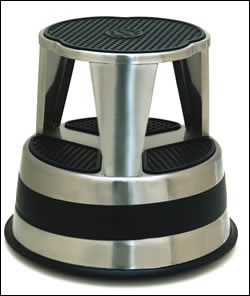
A "Rock Stop" or "Kik-Step" (trademarks both). Rolls when there's no weight on it, but when you step on it, the wheels disengage and it stays put. Quite handy.
--jhawk
Posted by Joe Redifer (Member # 3) on 11-09-2008, 11:12 AM:
That's space-age technology, there! Just look at the color of that metal. We are forced to use a metal cage to stand on when we want to reach high places.
Posted by John Hawkinson (Member # 1135) on 11-09-2008, 11:19 AM:
Well, gosh, Joe! It appears they're celebrating their 50th anniversary over at kikstep.com and they have all these colors:
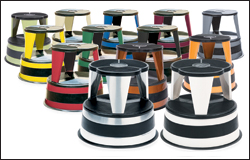
On the other hand, I suppose it's 2008, so 50 years ago is 1958, and Wikipedia says the Space Age started in 1957. ![[Eek!]](eek.gif)
--jhawk
Posted by Damien Taylor (Member # 4255) on 11-09-2008, 11:23 PM:
3 screens with AW3's two non operator side. I was always taught soundtrack away from tree all times and towards screen to and from projector, makes for some pretty gnarly twists. Also we use prints soundtrack down, which I heard was an old fashioned thing to do.
Posted by Tyler Potts (Member # 4952) on 11-10-2008, 12:52 AM:
Strong platters with simplex projectors and soundhead, dolby in 4 houses DTS in 10 (two of those needing the discs at all times, they don't save the media). I tree up like Joe's original post and thread with the proper loop sizes as my old (past and age) certifier instructed me. The 2 projectionists I personally trained thread this way, and I think I need to hold a back to basics seminar for the 3 others. They like to immediately pull nearly all the leader to the floor, loop to the top roller above the projector, tuck the tail under the print (even though we have MANY pucks), sometimes check the flywheel to see if they're in frame, and then the worst... after threading, pulling the leader away from the platter towards them to make it take up.
Posted by Jim Cassedy (Member # 4115) on 11-10-2008, 09:36 AM:
I tend to thread as most of the other posters here, but I have the sound track facing the front wall of the booth as it heads towards the projector.
In my particular situation which involves a number of extra rollers between the projectors & platters due to them being in seperate rooms ( ! ) this arrangement keeps only the base side of the film in contact with the rollers.
Same thing on the return side.
Posted by Dominic Espinosa (Member # 2122) on 11-10-2008, 11:40 AM:
Hey, Joe. What made you crave a can of worms?
I thread same as Joe with a few variations: I open up the pad rollers and gate and such, wipe it out, turn my intermittent, then start threading.
I as well learned to pull down a few feet of film onto the floor and thread top to bottom.
After becoming a Film-Techer I started locking it in the sound head holdback sprocket (Century R3's) and threading down until I learned to thread "up".
Now I teach everyone, regardless of machinery, to thread bottom to top and be as generous as possible with the leader when building up. We also do a "running start" by motoring through the extra leader before hitting the start button.
As was already pointed out, when you learn where the framelines go you never have to readjust your loops.
I can't imagine threading any other way because this way is so much faster, accurate, and let's face it, cooler.
![[beer]](graemlins/beer.gif)
Posted by Monte L Fullmer (Member # 2797) on 11-10-2008, 01:43 PM:
Looks like I'm about the only one that does the soundtrack away from the screen. Simple reason why I do this is that (and I know this doesn't matter since film is film...) the film has a certain curl and it just seems to lay across the upper projector roller better if I do it this way than soundtrack facing the screen.
Plus, even though when I began working with platters in the mid 70's, it was soundtrack to the screen at first. But, it was easier for me to do away from the screen and thus continued that practice to this day.
Plus, with those who don't have any digital devices attached to their projectors, it seems that the film hits the upper sprocket rather on a distressed angle with the film being pulled down mainly by the inboard set of teeth whereas if one does it the way I do, then that sprocket is pulling down the film with both sets evenly.
It's all personal preference....
-Monte
Posted by Bill Enos (Member # 440) on 11-10-2008, 01:46 PM:
This stupid topic will never die. A few years ago I asked some older, I'm talking 80+ years, retired union projectionists about threading up or down. They were all taught in the '40s to thread down and to avoid the floor but it was not an issue if it touched. One of these men was part of a 4 man crew that ran one print of one of the roadshow films for a year and a half and it didn't have visible dirt or scratches at the end. That was reel to reel 70mm on Norelcos. His comment was that if the booth was clean, the floor was swept 3 times a day, and damp mopped once, touching the floor didn't matter.
Posted by Tony Bandiera Jr (Member # 2365) on 11-10-2008, 02:34 PM:
quote: Bill Enos
One of these men was part of a 4 man crew that ran one print of one of the roadshow films for a year and a half and it didn't have visible dirt or scratches at the end. That was reel to reel 70mm on Norelcos. His comment was that if the booth was clean, the floor was swept 3 times a day, and damp mopped once, touching the floor didn't matter.
{Bold emphasis added by me}
Thank you for posting that. It emphasises my point in my post above, that if you keep things clean, including the machines, booth floor, hands, then it WON'T cause the film to get dirty no matter where you thread up.
Although even though I keep my booth clean, I still won't let the film touch the floor.
Posted by Joe Redifer (Member # 3) on 11-10-2008, 03:28 PM:
Bullshit. Just because YOU don't see scratches and dirt (or THINK you don't see them) doesn't mean that they are not there. It just means that either your light is insufficient to show things on your screen, your eyesite is bad or you are not capable of noticing such details... or a combination of the three. I'll often stand next to someone and say "you see those specks of dirt?" Of course they'll respond in the negative. That's when I start losing hope that others will care enough to do things correctly. Also keep in mind that the bulk of ancient union projectionists aren't the best source of valuable information when it comes to keeping things clean. They are the ones who taught the shoe polish method because they are blind and cannot find the splice any other way.
quote: Monte L Fullmer
Looks like I'm about the only one that does the soundtrack away from the screen.
My soundtrack is away from the screen. "Towards the tree, away from the wall" is what I always command with an iron fist. As indicated, our platters are on the non-op side of the projector.
quote: Dominic Espinosa
We also do a "running start" by motoring through the extra leader before hitting the start button.
If you don't have a start cue, this is the best alternative rather than motoring down, shutting off the motor and hoping your projector stops in the correct place and starting it later. The fools at Regal Cinemas are supposed to thread on a single number via their leader (piling the rest onto the floor... supposedly company policy) and then start the projector. They use Strong CNA-style automations which can accommodate a start cue. But of course haven't figured that out.
Posted by Matthew Bailey (Member # 601) on 11-10-2008, 05:02 PM:
I'm using another way to thread while keeping the leader off the floor. With the intermittent sprocket stopped in frame & framing knob in the middle of its range, using the MUT & a metal split reel that screws together by spinning the flanges by hand if using a large plastic spool on it or a trailer flange if a using a small plastic spool, I fist thread the center payout & wind several feet of film onto the spool remove the film & spool & use a rubber band or two to keep the film from unraveling as I thread then pull the last few feet off after threading the take up deck rollers keeping the film on the deck then winding onto the takeup ring.
Posted by Monte L Fullmer (Member # 2797) on 11-10-2008, 06:05 PM:
quote: Joe Redifer
They use Strong CNA-style automations which can accommodate a start cue. But of course haven't figured that out.
And CNA automations aren't that all hard to figure out. Yet, why do you need a start cue when the automation sequence can do that for you if you program the system right?
CNA's were the massive upgrade to the old CPA-10's - in which I do like better (if the system behaves..) due to the batch file programming along with the neat bells and whistles that came with this older automation.
CNA-100's reminds me of the extinct SPA 5 and 7's that EPRAD made for STRONG with choosable settings than the old rotary switch of the SPA series..
-Monte
Posted by Joe Redifer (Member # 3) on 11-10-2008, 06:15 PM:
How else would the film know when to start if it didn't have a start cue on the leader? Unless ALL of your leaders are the same exact length, ALL of your platters exactly equidistant from the projectors, ALL of the movies are ALWAYS threaded from the top deck to the middle (or any combination of the three, but one must ALWAYS be the payout and one must ALWAYS be the takeup) and everyone in the complex threads the same exact way without exception and ends up with the same frame in the gate, there is no way for the automation to know when to open everything up, hence the old programmed delay of 8 seconds or so which is so primitive that even a modern light switch is more advanced.
Start cues kick ass. No need to worry, opens on the same frame every time on each projector without any effort (or lame motoring) whatsoever.
Posted by Brad Miller (Member # 2) on 11-10-2008, 06:55 PM:
quote: Joe Redifer
Bullshit. Just because YOU don't see scratches and dirt (or THINK you don't see them) doesn't mean that they are not there.
And even though many reading this may not understand Joe's dry sense of humor from time to time and give him proper credit, I have worked with Joe before and I can assure everyone that he is a damned good projectionist and his prints are immaculate when he is finished with them. I have proven his point time and time again over the years where just because YOU don't see the defect on YOUR screen truly does not mean it is not there on the print and won't be seen on someone else's screen.
Also 70mm shows dirt significantly less than 35mm films. The same speck will be substantially smaller. That's just simple math. Regardless though there is no way anyone ran a print without film cleaning for a year and a half and it was just like new. Joe put it right when he said "bullshit". Maybe he should have said "gullible" to anyone believing that.
Too many people seem to think age means knowledge and expertise. Bullshit. That just isn't the case. I know guys who have been projecting all their life who are in their 60s and they absolutely suck compared to some teenage kid properly trained with a year's experience. Likewise I know a couple of other guys in their 60s who are spectacular projectionists. It all depends on the person and if they take the foolish attitude "I've been doing this for three thousand years" approach, of if they actually give a shit and are open to learning new and better ways of film handling. Even today I will occasionally be somewhere and see a trick that someone else was doing and will integrate it into my methods and training. There is no such thing as one person who knows the best ways of doing everything, and yes that includes me too...but at least I am constantly open to new ideas, unlike most people who have many years worth of experience.
And by the way, union does NOT mean quality either. Again, it all depends on the person and how much they actually care about their presentation.
For the record, the reason why you will sometimes see people pitching to thread the emulsion side of the film on the rollers is because after doing a year's worth of testing, I have found that it is the base side of the film that carries the dirt. Running the emulsion side on as many rollers as possible (without introducing stupid twists into the film path) keeps the films cleaner.
Posted by Joe Redifer (Member # 3) on 11-10-2008, 07:38 PM:
Brad's definitely correct on that one... one just needs to look at the media pads to see which is taking off more dirt. I have two people at my theater which I cannot convert to threading on the emulsion side. These two individuals also thread so that the leader hits the floor. I have tried, but there really isn't anything I can do to make them switch (it really chaps my ass when they decide to start training others as well). Looking at the media cleaners, the pad which wipes the base side is ALWAYS significantly dirtier. I imagine it would still be dirtier even if everyone threaded the same way... like me. The base side absolutely does attract more dirt.
The biggest problem is that many don't seem to care. I'll get the "we have film cleaners on every projector, so what does it matter?" response a lot. I tell them it is my goal to not let the print get dirty in the first place if I can help it, not just attempt to clean it up when it does get dirty (which is always a much more difficult task to accomplish).
Posted by Monte L Fullmer (Member # 2797) on 11-10-2008, 09:42 PM:
quote: Joe Redifer
hence the old programmed delay of 8 seconds
..unless you have the good ol countdown leader and frame between between "11" and "10".
This theatre that has these CNA-100's were having horrible startup due to them keep on forgetting to add that start cue, and if I put one one to do the show right, the booth monkeys would only remember that for a couple of days and still manage to fubar it up afterwards.
Thus, I reprogrammed the automation to go back to the default 7 second dowser opening on the "Cue 1" setting, and things been tons easier for them...and the patrons.
..and also do agree with Brad with his comments....seen a lot of both sides in his descripts.
-Monte
Posted by Joe Redifer (Member # 3) on 11-10-2008, 10:42 PM:
How could they mess up the start cue? Once they are on a leader, they never need to add it again. All they have to do is thread the machine. The only way to mess it up is to consciously remove the start cue physically. I don't care for motoring to a specific frame when I thread. Countdown leaders are not ideal because not all platters are the same distance from the projectors, so the motoring would be required. I also like my leaders to be as long as possible. Start cues are the proper solution.
Posted by Monte L Fullmer (Member # 2797) on 11-10-2008, 11:42 PM:
quote: Joe Redifer
How could they mess up the start cue
Do you have the FP350 cue readers?
back when I began, it was a total mess! There were more clowns than a circus up in this booth and none of them knew what they were doing along with not listening on how things were supposed to be.
This problem began and was augmented with no control from the manager-the manager didn't care on what happened, thus nothing and no-one higher up was taken seriously.
It's has since cleaned up tremendously when this plex hired an old gentleman projectionist to do filmwork and some building/booth maintenance.
Thus, I just left things as I set them and as of date, the presentations have been tons better, just that the manager problem still somewhat exists even though some of those problems of the past have been solved. Yet the booth clowns are still present,yet not as bad while the worst clowns have, thankfully, left.
I used to leave new leads for this plex to use, yet I would give them a month and those new leads were totally destroyed and tossed. Thus, I would make up their leads to use - taking 10ft of the clear framed stuff and splice that on 20 ft of old trailer, whereas the trailer was their threading leader and they're to frame in the short clear stuff.
When they would fold the tape over the leads, that cuetape would eventually tire out and wouldn't get sensed by the detector in the cue unit-and these clowns were too lazy in replacing the cuetape-why I took out that start cue in the programming and went back to default settings.
Posted by Joe Redifer (Member # 3) on 11-11-2008, 01:31 AM:
I've found that if you put a single-sided splice over the cue tape, it will last longer. Also with the FP-350 you don't need an arm's length of cue tape like the manual says. The cues I apply are about as long as the tip of my pinky finger is thick.
Posted by Mark J. Marshall (Member # 1409) on 11-11-2008, 09:32 AM:
I'm sorry, but I feel like I have to respectfully disagree with Mr. Redifer here on this one. Start cues are nice, but if you're running a digital pre-show, and you want to ensure a perfectly seamlessly invisibly smooth transition (aka "change over") from your DLP pre-show projector's "Thank You for watching..." outtro to the 35mm content then your staff needs to learn about the 8 second start up method. It's not that difficult to get right.
Posted by Brad Miller (Member # 2) on 11-11-2008, 01:32 PM:
In Mark's case, you pretty much have to deal with firing up the motor and cueing the leader down to the starting point. Of course with a start cue, you can make that just about any point you want. For example, you could put a piece of yellow opaque splicing tape down at 30 feet prior to the end of your leaders and always cue that to the top of the projector and press START for however long it takes to make a perfect changeover from a digital preshow. Since every one of them I've seen ends in a welcome/policy snipe, that should be easy to time out. The benefit is that you can still guarantee that the douser opens on precisely the frame you want, ever time.
Posted by Fred Tucker (Member # 4482) on 11-11-2008, 02:49 PM:
Policy at my chain (the three letter one) is to thread the projector, then at show time to run the motor on and wait until the content portion of the film arrives to press start on the automation then the motor may be turned off. This is to minimize wear & tear on the projector motor (granted really just the capacitors) and the gear train. To me this makes quite a bit of sense, but I hate the sometime 40-second gap of silence.
However, it is preferred to pull leader through to where running the motor is not necessary, kinda hard to do when you thread from the bottom up though.
Posted by Joe Redifer (Member # 3) on 11-11-2008, 02:54 PM:
Don't most digital pre-shows hold a looping "welcome to our shitty theater, we love showing you tacky ads" screen indefinitely until the projector starts? If not, they most certainly should. I am glad I don't have to deal with the headache (and tackiness) that is the digital pre-show.
Posted by Mark J. Marshall (Member # 1409) on 11-11-2008, 07:03 PM:
Yes they do have that, and to me it amounts to little more than a buffer for people that can't tell time.
Posted by Jon P. Inghram (Member # 4125) on 11-11-2008, 07:24 PM:
quote: Joe Redifer
Don't most digital pre-shows hold a looping "welcome to our shitty theater, we love showing you tacky ads" screen indefinitely until the projector starts? If not, they most certainly should. I am glad I don't have to deal with the headache (and tackiness) that is the digital pre-show.
I wish our pre-show DVDs were that well produced. They stop playing right after the ending "Welcome" slide and gives the audience the DVD players logo. And the person who makes them apparently doesn't understand the difference between 16x9 and 4x3 aspect ratios, nor even how to properly encode the slides: It's not uncommon for an advertisement to be corrupted bad enough that it can't be read.
Posted by Monte L Fullmer (Member # 2797) on 11-11-2008, 07:38 PM:
quote: Fred Tucker
kinda hard to do when you thread from the bottom up though.
Not really. One can still reverse thread and still get your mark in the trap where you want it to be - give or take a few frames.
You'd just have to find a new system to make it work for you the same as a forward threading would be.
Posted by Steve Guttag (Member # 268) on 11-11-2008, 11:33 PM:
Oh Jeez. I've worked with both types of Autos and can deal with either. The olden SPA-3 was charming in that it used a start cue and had no real timing function to it. It also couldn't ever burn up your changeovers. I actually liked the SPA-3, for what it was.
By and large though, all of the theatres I've worked for used countdown leaders...they are cheap and effective, plus they are available in multitudes of lengths prior to the countdown. You'd have to be brain dead to now be able to thread up consistantly.
Either way works.
And as to not adding any dirt or damage by threading in the coundown area...sorry...you are just plain wrong. Dirt migrates, period. Your hands can't be clean enough. The part of the leader you touch, will wrap onto the next revolution which transfers a portion of the dirt, which eventually tranfers it to the next wrap and so on.
Think about the arch-typical changeover house of your...they always telegraphed their changeovers as the dirt would speckle the screen even before he cues. Why? no one ever touched the tail near the picture...the just let the film tail out and then before they could shut the machine down, the take up reel would slap the tail on the floor...that is where it started...the dirt/oil then started its migration on back. Things were better when people had magazines instead of just reel arms as the dirt level could be controlled.
When I ran a booth regularly...I put a relatively large amount of scrap film on both the head and tail, used magazines when ever possible too. I also never let the heads/tails slap around after a c/o or rewind. If the scrap started to show its age, change it.
After Film Guard came out, I added that to the arsenal of keeping the film spotless.
In the screening rooms I operate, I use PTR rollers. The prints are often EK type and the shows are 1-offs. The PTRs are changed every reel and every time the film runs through the machine there will be a PTR pass (including tests/run-throughs). Net result...zero visible dirt.
I don't recommend PTRs for platter or even long-reel use and when used they need to be changed (cleaned) on each reel to be effective. You never want a PTR to "fill up". They are great at keeping dust off and keeping dirt from accumulating. They don't do well at cleaning a dirty film...which is generally not an issue for an EK print.
Steve
Posted by Joe Redifer (Member # 3) on 11-12-2008, 12:22 AM:
quote: Steve Guttag
You'd have to be brain dead to now be able to thread up consistantly.
Huh? I am able thread consistently. Does that mean I am brain dead?
Posted by Chris Slycord (Member # 4239) on 11-12-2008, 06:58 AM:
It's called a typo. He typed "now" when he meant "not."
Posted by Damien Taylor (Member # 4255) on 11-12-2008, 08:13 AM:
Typo's are inexcusable, they will be exposed and mocked without mercy for multiple pages. Or at least until the next splicer brand argument.
Posted by Joe Tommassello (Member # 4632) on 11-12-2008, 11:16 AM:
I started with the soundtrack facing the tree and the screen, over the top roller, down through the bottom roller (track still facing the screen) and back to the take up deck. Our automation was timed to a specific interval so I started with the top sprocket on the projector keeping the show start at approximately 18" from the top roller above the projector in order to match the automation. Then I threaded down through the projector and up through the digital readers and/or film cleaner. Why? I was taught that way and it never gave us any problems. Of course our equipment was always properly maintained. Starting with the top sprocket gave us a standard by which to time the aperture opening regardless of which combination of digital readers or cleaner we had above that spot.
Posted by Steve Guttag (Member # 268) on 11-13-2008, 08:28 AM:
God, there are about 50 typos in my previous post. I never proof read these things so yes meanings can change as "can" could be used instead of "cant" with the mere omission of the "t."
Then there are the spelling issues...in my previous post I used "your" instead of "yore." They sound similar, they mean different things. I generally don't go back and re-edit even when I see that I've goofed up a bit.
And yes, Joe, you ARE brain dead. I think that has been confirmed for some time now.
Steve
Posted by Joe Redifer (Member # 3) on 11-13-2008, 04:45 PM:
I'd have to have a brain to be brain dead. Joke's on you, Steve!
quote: Joe Tommassello
Why? I was taught that way and it never gave us any problems.
You should revise that sentence. Here, I'll fix it for you:
quote: Joe Tommassello
Why? I was taught that way and I never thought about doing it differently even with a mountain of evidence that it would improve my presentation.
Just because you were taught a certain way doesn't make it correct.
Posted by Laurie Higgins (Member # 4843) on 11-15-2008, 07:39 PM:
We thread with the sound facing the tree then when it comes off the top roller and over to the projector it's facing the screen, then down through the bottom roller that leads back to the platter it is still facing the screen until it goes through the first roller on the tree and from that point it faces the tree and faces up when attached to the ring. We then pull out the slack and thread the projector from the bottom up. No mater which side the platters are on.
Posted by Dominic Espinosa (Member # 2122) on 12-23-2008, 03:50 PM:
quote: Fred Tucker
However, it is preferred to pull leader through to where running the motor is not necessary, kinda hard to do when you thread from the bottom up though.
This is the general attitude I wish would go away in this job.
That argument, along with the ol "this is how I've done it for xx years" statement are the two cheapest cop-outs I've heard over the years.
I kind of wonder why it is that folks don't want to explain to the operators how the automation works, how the projector works, how a changeover is supposed to happen.
That modicum of information can make a huge difference to someone who actually wants to be there yet so many are kept clueless!
I'm intending to shoot a bit of video this coming week demonstrating a few different threading procedures that produce the same end result: film threaded to it's starting position in hopes it will illustrate for some folks I mean to convince of the benefits of threading "up".
Anyone else wants it, let me know.
Posted by Joe Redifer (Member # 3) on 12-23-2008, 04:32 PM:
Post a link.
Posted by Jonathan Althaus (Member # 5042) on 12-24-2008, 12:43 AM:
I've been a booth worker for 2 yrs now, booth mgr for 1. I tried to thread up and it just didnt feel right and took me a lot longer. I'm sure I could retrain myself, but not til it calms down a lil bit.
Posted by Monte L Fullmer (Member # 2797) on 12-24-2008, 03:00 AM:
I shot this thread up below 2yrs ago on this same topic. I still use it today (tried it on Century's and Christies also with the same results) and ones I've "retrained" to this procedure, find it much easier to use.
For those who wanna try this for snickers and giggles, give this a whirl.
"Perfect Threading Procedure"
You have nothing to lose.
-Monte
Posted by Dominic Espinosa (Member # 2122) on 12-29-2008, 12:46 PM:
If nothing else, I think this demonstrates how much time threading down wastes...
Enjoy.
EDIT: Please pardon the crumby quality of the demonstration.
Also, it's assumed that everyone knows why there's a mile of old trailer before the threading leader and that at this location we thread to a specific start position rather than do a running start or a cued start.
Threading up vs. Threading out
Posted by Monte L Fullmer (Member # 2797) on 12-29-2008, 01:24 PM:
Good presentation, yet a question:
On your threading down, why didn't you attach the lead to the LP-270's ring and spin the platter (doing your "triangle" load as you did with the threading up procedure) til the area that where you need to frame up was close, so that only 4 ft of film was on the floor when you pulled down to the required number area instead of wasting the time untangling what was accumulated on the floor to attach the end to the ring?
That's definitely called "WORK"!
Still, a good video..
Good luck - Monte
Posted by Dominic Espinosa (Member # 2122) on 12-29-2008, 02:07 PM:
Good eye, Monte! Spotted that Speco from a mile away didja?
quote: Monte L Fullmer
On your threading down, why didn't you attach the lead to the LP-270's ring and spin the platter (doing your "triangle" load as you did with the threading up procedure) til the area that where you need to frame up was close, so that only 4 ft of film was on the floor when you pulled down to the required number area instead of wasting the time untangling what was accumulated on the floor to attach the end to the ring?
I thought about doing that as demonstration 2 and then threading up as demo 3 however I decided not to as I've only ever seen that done once. In fact that's how I learned back in the day.
I've seen more frequently the first method of just throwing it all on the floor.
Now, I agree, that's a lot of film to put on the floor, more than you might see on a normal basis however we have a few houses in the chain with long distances between platter and projector so it is a reality for us.
I'm trying to convince powers that be that threading up is faster, more accurate, and cleaner so I'm comparing the two practices in use. The one the chain staff was trained to with and the one I've been training the new hires with.
Posted by Monte L Fullmer (Member # 2797) on 12-29-2008, 02:19 PM:
quote: Dominic Espinosa
Spotted that Speco from a mile away
Worked with these units for 8yrs - got to know them inside and out pretty well..and how to make them stand on their heads and bark at the moon when I hollered "Do IT"
quote: Dominic Espinosa
however we have a few houses in the chain with long distances between platter and projector so it is a reality for us.
...and this is where 'reverse threading' comes into play if you have that distance. Yet, I have a house that has the distance also, and I still attach the film to the ring first then wind the lead on the ring until my mark on the lead comes up to thread. I still have my 4ft to work with during the regular downthread.
It's like "we are supposed to have FUN while doing our work. So, why make it into work?" The goal is to make work easy in this occupation.
I know of one 3plex that has the same Century/SPECO setup and the people do what you showed on your presentation in piling the film on the floor...and the floor is totally horrendously oily and filthy ... and I'm surprised that the Centurys are still running...
Good luck in doing your conversion then with the 'reverse threading' procedures. It's gonna be a challenge to make the convincing happen.
I've showed a few how to 'reverse thread' and the majority of them refused to accept this. Only one girl loved this procedure and accepted this hands down. - Monte
Posted by Scott D. Neff (Member # 185) on 12-29-2008, 03:56 PM:
Teaching people to thread the entire platter first and then threading down might be a good compromise until people can bring themselves to even CONSIDER threading up.
I was taught to throw it all on the ground and never even considered the platter method until I worked at UA. There I was taught to thread the entire platter and then put what I needed in the projector and motor it until I got it where I needed it. (Still not the best method.)
My point being -- that nobody wanted to thread the platter first, they were so stuck in throwing it all on the ground. It took months of nagging and nit-picking just to get people to thread platter first then projector. Perhaps if you approached it this way, the idea of threading upward might not be so foreign and be met with less resistance.
Posted by Joe Redifer (Member # 3) on 12-29-2008, 04:06 PM:
People amaze me. I can't believe there exists anyone who would just throw all of the leader on the floor like that! I teach the threading up method from the very start and it is not hard for the newbies to comprehend.
Posted by Kurt Zupin (Member # 2751) on 12-29-2008, 05:16 PM:
Everyone that I teach learns to thread the entire platter system up and then thread from the bottom up, not an inch of film hits the floor and once they are compatent in this it only takes 45 seconds or so to do the whole thing.
Posted by Monte L Fullmer (Member # 2797) on 12-29-2008, 08:17 PM:
Oh, I agree with Kurt (have you thrown that SP-35 'doorstop' splicer at anybody yet to knock them out of their senses..lol?) and Joe about training them from the get-go on reverse training since these two are probably at their respective location at all times and can have that control over whoever comes upstairs in the booth.
But my position isn't company booth manager, but company engineer that works P/T at a 6plex where my office is at.
Thus, the mgr is responsible of booth training and I just check the trainees out to pass them or not on their training.
..and trying to convince these mgrs to do reverse training is like pulling teeth from a rapid crocodile...so, I leave it at that.
Posted by Bill Enos (Member # 440) on 12-30-2008, 06:45 PM:
None of this stupid discussion matters at all, you won't be threading at all in a few years, so give it up, learn all you can or at least all you'll need to know about digital cinema so you will be of some use and be one of those who has a job.
Posted by Mike Blakesley (Member # 26) on 12-30-2008, 08:46 PM:
quote: Kurt Zupin
once they are compatent in this it only takes 45 seconds or so to do the whole thing.
I wonder if people trying to set "speed records" for threading are the ones responsible for all the out-of-frame starts we hear about?
Posted by John Koutsoumis (Member # 1855) on 12-30-2008, 09:42 PM:
It takes me about 2 minutes to thread platter and projector. I don't go super fast. I am comformtable with the way I thread. I have others go faster which results in hand/finger smears on lenses, gates dropped (VIC 8's), platter mis-thread, wrong film threaded and of course as Mike said out of frames.
There are those that can thread lightning fast with no errors but I say "whatever". I am going to enjoy the joy of threading while I still can.
Posted by Monte L Fullmer (Member # 2797) on 12-31-2008, 01:16 AM:
quote: Mike Blakesley
I wonder if people trying to set "speed records" for threading are the ones responsible for all the out-of-frame starts we hear about?
When I used to work at a 4plex with CineV5's and LP-270 platters, I could do the complete lace by the time I pulled the ring til the time the rewind platter had the film tight between 50 sec to a minute .. and still managed to be in frame.
We booth people would have these races and I still managed to beat them, even though my guys were quick at it as well and they also threaded in frame ...
DANG! I sure taught those guys well.
-Monte
Posted by Jack Ondracek (Member # 1466) on 12-31-2008, 10:44 AM:
quote: Bill Enos
None of this stupid discussion matters at all, you won't be threading at all in a few years, so give it up, learn all you can or at least all you'll need to know about digital cinema so you will be of some use and be one of those who has a job.
Since the way I thread makes no difference to the customer, nor damages the film in any way, I just keep the critics out of my booth until I'm done.
Posted by Damien Taylor (Member # 4255) on 12-31-2008, 11:26 AM:
quote: Bill Enos
None of this stupid discussion matters at all, you won't be threading at all in a few years, so give it up, learn all you can or at least all you'll need to know about digital cinema so you will be of some use and be one of those who has a job.
I choose to believe film and digital will be living together for quite some time.
BTW nice trolling.
Posted by Dominic Espinosa (Member # 2122) on 01-01-2009, 01:31 PM:
quote: Damien Taylor
I choose to believe film and digital will be living together for quite some time.
Until D-Cinema is readily accessible this will probably be the case. Even though (maybe not at the moment) the majors can afford to go digital more so than the indies it's still not worth the roll-out cost. Even in a new installation it's a big jump in build-out costs.
Even once it becomes affordable it'll take time. And even so there will still be a need as there will still be product that is only available on 35mm such as certain repertory titles.
I believe it'll take at least the bulk of my lifetime for 35 to go the way of 70 in terms of popularity due to the digicinema craze.
Film Done Right has a much bigger wow-factor, in my opinion. Especially since watching 2k DLP gives me headaches.
Back to the topic at hand however:
Speed-threading is a good way to put undue strain on the equipment (platters, mostly) so I don't encourage operators to do this -- however -- normal threading patterns can do this as well depending on how you pull the film.
I find it's best to try and maintain a smooth, steady motion rather than pulling fast, pausing to thread something, pulling fast, pausing, etc. which I've seen many operators do.
All in all, opening the machine up, turning the intermittent, wiping out the gate/trap and threading takes me an average of 2 minutes regardless of machinery.
At one point I could thread AW3 with Simplex XL+5-star & cat 700 in 1:05 average.
Once again though if you have film pulled all the way around the brain you're probably going to bend the feed arm, possibly get it stuck, and if your leaders are short scratch your first trailer.
I know I don't have to tell any of the regulars that but it should be said as a caution to the newbs.
P,S.
Happy 10-year anniversary Film-Tech!
Posted by Kurt Zupin (Member # 2751) on 01-04-2009, 04:00 AM:
quote: Mike Blakesley
I wonder if people trying to set "speed records" for threading are the ones responsible for all the out-of-frame starts we hear about?
I should of said, they can do it in 45 seconds, this does not mean that they do. The average projectionist probably takes one and half to two minutes to thread a projector after it has been cleaned.
With a new position I have been given within my company I have the chance to make sure everyone in the company is threading the proper way now. Not just my own theatre, but all of them.
I also agree that it will be some time before Projectionist will be obsolete. At least 10 more years before its gone for good and taken over my digital.
Posted by Damien Taylor (Member # 4255) on 01-04-2009, 04:43 PM:
I get out of frame starts sometimes because I like to thread on the junk film when the top rollers aren't aligning properly and the film keeps slipping off. I just wind enough through to get to the ring, then thread, and motor through (BOOO HISS) from there. Someone else didn't cut the scrap in frame.
I usually take a minute or so to clean the projector, but thats because I take the back of the gate out, which no-one else seems to do at my place, so theres always super hard crud to be found. (Vic 8)
Posted by Monte L Fullmer (Member # 2797) on 01-04-2009, 05:56 PM:
You know, you could put a two foot section of clear frame leader in the middle of this junk film so you can eliminate out-of-frame starts since you stated in "threading up in the junk area" - which looks like someone who can't do their job in the eyes of the patron. Also, inspect your lead splices to make sure that every splice is in frame......(HINT,HINT! - tips for you...)
You can also do two things when framing: keep the framelight slit clean so you can see the frameline in the lighted slit, or frame in the trap using the aperture plate itself.
I've worked with V8-s before and never had a framing problem with these excellent units.
-Monte
Powered by Infopop Corporation
UBB.classicTM
6.3.1.2