This is topic brittle prints break at startup - argh! in forum Film Handlers' Forum at Film-Tech Forum ARCHIVE.
To visit this topic, use this URL:
https://ft-forum.com/ft/cgi-bin/ubb/ultimatebb.cgi?ubb=get_topic;f=1;t=009631
Posted by Scott Norwood (Member # 30) on 11-24-2008, 12:01 PM:
Let me start by saying that I have an unusual setup for my screening room. It's a changeover setup, with these bases:
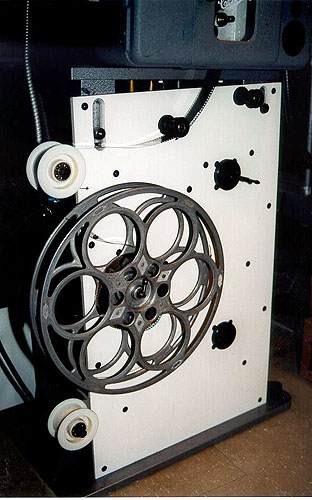
The takeup mechanism is a standard Kelmar clutch, driven by the soundhead. The takeup path runs under the first black roller and over the top of the big white roller at the back.
The projector motors lack the usual flywheels (why?) and also lack start capacitors. They come up to speed rather quickly (I thread at "9").
Normally, all is well, but old, brittle prints sometimes break at startup (fortunately, it has only happened on leaders). The film makes it through the projector and soundhead without difficulty and then breaks after the first (black) takeup roller. No amount of adjusting takeup tension (yes, I have the spring scale thing) seems to help this. I am wondering if there is perhaps some issue with the severe angles in the takeup path. I am using standard fixed-hub 2000' Goldberg reels (5" hub).
My current plan is to install start capacitors (standard Century slow-start kits) this weekend and clean the grease off the the takeup belts (one of them tends to slip a bit). Do I need to get inverter drives with programmable ramp-up? Is anyone using an electronic constant-tension takeup system and, if so, is it worth the upgrade?
I've never had this issue elsewhere, but, again, my own setup is unusual. I don't damage/tear/stretch perfs with normal acetate or polyester prints.
Posted by Bob Koch (Member # 1062) on 11-24-2008, 12:41 PM:
Years ago, when economics precluded a proper solution and I was stuck with RCA 1040 soundheads[no flywheel] I used a couple of conical heater elements in series with the ac line[yes you heard right] in order to eliminte that "wrench" at the start. The projector mechanism must be free, no high spots on the intermittent, for this to work as it reduces the torque somewhat.I wouldnt dare do this with the booth personnel used today.Used a 2 ohm 200 watt resistor later on Motiograph 7500`s As this is your screen room in which ,I assume you are the "operator" maybe it would work.
Posted by Tim Reed (Member # 137) on 11-24-2008, 12:50 PM:
Scott, the slow-start kit should help, but I'm guessing that black roller's shaft isn't precisely perpendicular to the pedestal frame, so one side of the film is getting tugged on harder than the other.
Can you just go straight down to the takeup reel, and bypass those rollers entirely, when running composite prints?
Posted by Monte L Fullmer (Member # 2797) on 11-24-2008, 01:44 PM:
Wow. This brings back memories when running a full Motiograph booth!
We know that the Mirrorphonic 7400 soundheads were chain driven and the motor had no flywheel to allow ramp up speed, thus the unit would take off suddenly.
With the film wrapped around the takeup reel, if you didn't have things snug an tight, you'd snap the film in a heartbeat when the machine would take off.
Thus, it was common practice, when we would hit the motor switch, is to have our hand holding that takeup reel to keep the film tight, to actually spin the reel as the motor took off. This prevented any film breakage from sudden the sudden takeoff that the Mirrorphonic heads were known for.
Thus Scott - get your finger on the takeup reel when you hit the motor switch .. to keep the film tight on the reel as you turn it when the projector takes off - which looks like you got a Century setup there, which ramps up pretty quick in itself.
If you had a good ol SH-1000 (4 star) head, you wouldn't be sending this note...
-Monte
Posted by Steve Guttag (Member # 268) on 11-24-2008, 01:45 PM:
Scott,
It looks like a Century soundhead there. FIRST get the flywheels...it will help with both starts and stops...not to mention, smooth out the whole operation.
On the start capacitor....do you have Async or Sync motors? If they are Async...then a suitable high-wattage resistor (about 40-Ohm, as I recall) will really knock the kick out of the start up and allow it to run nice.
However, if you have sync motors...I'm much more in favor of actually switching out to inverter controlled. You can get inverters that are of decent quality for just a couple of hundred and you can set the ramp ups/downs anyway you want. You also get a variable speed machine when you are done too.
Steve
Posted by Scott Norwood (Member # 30) on 11-24-2008, 03:28 PM:
Thanks, all. These are async Westinghouse motors, 1725 RPM. Soundheads are Century MTR3-67 (same as MR-3).
I'm going to order the flywheels and install the slow-start kits and see what happens. If anyone has any more ideas, let me know.
Posted by Phil Hill (Member # 371) on 11-24-2008, 04:00 PM:
Scott, (If I were you...(and I'm NOT!) HA! ) I would invest in 3-phase motors and variable freq drive controllers for your home projectors. (Ask Steve for recommendations...he's helped me alot to get on the right track!)
I bet by the time you get done futzing with all the flywheels and slo-starts and the associated crap, there will not be much $ difference. In the long run, it's well worth it for the gentle film handling of the controlled ramps and accuracy of that system!
Posted by Gordon McLeod (Member # 33) on 11-24-2008, 04:27 PM:
Plus with motor drives if the movie is boring you can run them faster ![[Smile]](smile.gif)
Posted by Mark Gulbrandsen (Member # 72) on 11-24-2008, 05:08 PM:
I think Andy Margolin made those as custom bases many years ago.. his bases were typically teamed up with Century machines.
Mark
Posted by Jack Ondracek (Member # 1466) on 11-24-2008, 05:18 PM:
Scott, the film looks slack as it goes onto the reel. Is that the way it is when you start the projector, or did you just thread that up for the picture?
In the Motiograph booths I ran, we usually had little trouble, as long as we manually turned the spindle key clockwise to snug up that slack after threading.
Posted by Brad Miller (Member # 2) on 11-24-2008, 07:39 PM:
Scott, definitely go the route of 3 phase motors with inverters. You will be extremely happy you did down the road as they are well worth it.
I also added a dancer arm to my setup, but that is because I am often getting a 24" split reel with a 4" core up to speed on takeup. The arm takes out any bounce and can be made out of just about anything with a spring.
Posted by Scott Norwood (Member # 30) on 11-24-2008, 08:58 PM:
3-phase motors would require having 3-phase power, correct? If so, that idea is out. I do like the idea of having variable speed but, as a practical matter, it would not be all that useful. I'm more concerned about print condition, since I regularly run old film, some of which has been stored poorly and has dried out.
Jack--the picture is old and was probably taken before I inched the film forward. It isn't normally that way.
Posted by Mark Gulbrandsen (Member # 72) on 11-24-2008, 09:00 PM:
Just be careful WHICH variable drive motors you use... some I've tested (8 brands so far), particuluarly Baldors and Reliance, suffer from bad speed drift. The speed drift is also induced by the load you are driving as things like temperature and other factors cause the load itself to change. You will not get closed loop speed performance unless you spend some pretty big bucks but you can get adaquate performance by selecting the right drive and motor. My favorite motors so far are the Mitsubishi brushless motor series... Mitsubishi Brushless DC Servo expensive but worth it! A 2KW motor is about equivelent to a 1/4hp AC motor.
Mark
Posted by Gordon McLeod (Member # 33) on 11-24-2008, 09:58 PM:
I have done many cinemecanica and prevost installs with 3 phase motors running on either the Baldor or the Gavasi inverters from single phase with zero issues
An Assync motor will hunt for speed depending on all the variables Mark mentioned even worse
for single phase soft start I always put a 2ohm 200 watt resistor in line with them to rob them of some starting torque
Posted by Phil Hill (Member # 371) on 11-25-2008, 01:26 AM:
quote: Scott Norwood
3-phase motors would require having 3-phase power, correct?
Using an inverter will allow the 120vac single-phase supply power to be converted to 208/230 volt 3-phase for the motor.
Posted by Robert Minichino (Member # 3495) on 11-25-2008, 08:32 AM:
Mark,
Hitachi has an encoder feedback module for their SJ300 VFD. That should give better speed regulation than a sync motor without feedback and be significantly cheaper than a DC servo system.
Posted by Frank Angel (Member # 248) on 11-25-2008, 11:17 AM:
How do you do changeovers with a long ramp-up speed?
Posted by Robert Minichino (Member # 3495) on 11-25-2008, 12:30 PM:
You just thread up later (lower number) on the leader on the incoming projector. The longer ramp times also tend to be more predictable, so you can make your changeovers more repeatable.
Posted by Tony Bandiera Jr (Member # 2365) on 11-25-2008, 02:40 PM:
Robert's right...the ramp times are very predictable and make for easy changeovers. I have a relatively short ramp time on my machines at UC Irvine, and I thread up 12 frames past "8" on the Academy leader..my changeovers will hit the first or second frame of the incoming reel.
quote: Phil Hill
Using an inverter will allow the 120vac single-phase supply power to be converted to 208/230 volt 3-phase for the motor.
Yep, the coot's absolutely correct. Many brands of inverters will accept 120vac single phase and give you the three phase out.
I have used ABB and Woods E-Trac inverters with no speed regulation issues. I have also used Danfoss, a quality inverter but very touchy on setup (I call 'em Damn-Fussy).
Another thing to remember when dealing with inverters, regardless of brand: READ the manual throughly!! And be sure to set the "PWM Frequency" (the basic frequency of the output, most are set at 4,000 or 8,000 from the factory) to the setting that produces the least amount of whine and noise.
Posted by Frank Angel (Member # 248) on 11-25-2008, 07:09 PM:
quote: Robert Minichino
You just thread up later (lower number) on the leader on the incoming projector.
You mean later -- on a higher number, no?
Posted by Tim Reed (Member # 137) on 11-25-2008, 07:49 PM:
Lower number, Frank. The projector is taking longer to come up to speed.
Posted by Steve Guttag (Member # 268) on 11-25-2008, 09:33 PM:
I tend to target 2.75-3.00 second ramp ups. Most operators are comfortable with them and you don't have flutter issues with the sound on changeover.
I've been happy with both TB Woods and Lenze inverters. I've also had very good luck and perfect speed (checked with strobe) on Bodine Inverter rated motors.
I've used other brands of inverters and other motors and have had less than accurate results...normally being the inverter's fault...it said 60Hz but as it turns out (verified on an O'scope) it wasn't.
For most industrial applications...the speed variance isn't significant...for film, in my opinion, there is the correct speed and the rest is incorrect. It affects not only motion but the pitch of the sound (and over 2-hours, the actual running time).
Posted by Brad Miller (Member # 2) on 11-26-2008, 04:22 AM:
I'll have to look at the ramp-up time on my inverters in my screening room, as I specifically did a number of tests to find out just how slow I could have it start without sacrificing a drop from SRD to analog at the changeovers. I do not recall what that number was off the top of my head though.
Posted by Steve Guttag (Member # 268) on 11-26-2008, 07:06 AM:
Brad, I seem to recall you telling me that 5-seconds was the ramp up time that just barely made it, sound wise.
Steve
Posted by Gordon McLeod (Member # 33) on 11-26-2008, 09:18 AM:
I set up our Baldor and Gavazzi invertors on the vic8's and vic 5's as a 4 sec up ramp and 2 sec down ramp
Posted by Steve Guttag (Member # 268) on 11-26-2008, 11:05 AM:
On ramp downs (and I normally ramp down, not coast)...I tend towards 5 seconds or so from 24fps.
Posted by Scott Norwood (Member # 30) on 09-30-2009, 09:29 PM:
Bump.
As an update, I finally got around to installing the flywheels (which involved rerouting the takeup belts) and they made a world of difference in smoothing out the startup of the machines. Everything is now as gentle as can be, with no "bounce" in the takeup at all.
The slow-start kits are next weekend's project, but I am now questioning whether they are necessary at this point.
Three-phase motors with inverters would have been nice, but also would have been cost-prohibitive, especially since I don't absolutely need variable-speed operation.
Posted by Frank Angel (Member # 248) on 10-02-2009, 03:28 AM:
I taken it you were having snapping problems with you older acetate prints, yes? Perhaps adding a length of poly leader right at the start of the count down so that the initial tug will be on poly and not the acetate would be the poor man's solution, although it sounds like the flywheel addition pretty much solved your problem fairly well.
Nice to hear that you had a successful outcome without too much headache....love when that happens!
Posted by Robert Throop (Member # 61) on 10-02-2009, 01:00 PM:
quote: Monte L Fullmer
We know that the Mirrorphonic 7400 soundheads were chain driven
.
Monte,
I think you mean the Motiograph SH 7500 soundheads. The Erpi TA7400 was an entirely different beast. These were also called Mirrophonic.
Bob
Posted by Bruce Hansen (Member # 281) on 10-02-2009, 07:27 PM:
Would using a plastic reel for take-up help it keep up, since it would be lighter? Could you put a spring on one of the rollers?
Posted by Daniel Weber (Member # 2866) on 10-02-2009, 07:52 PM:
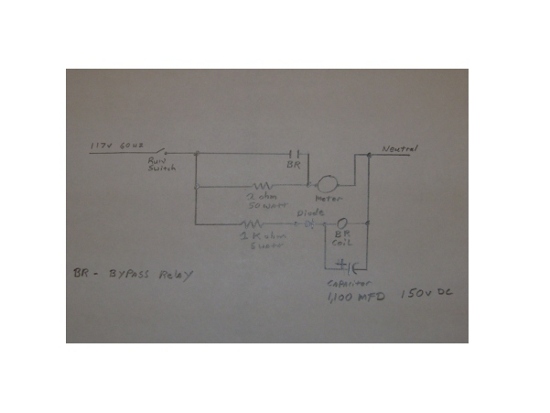
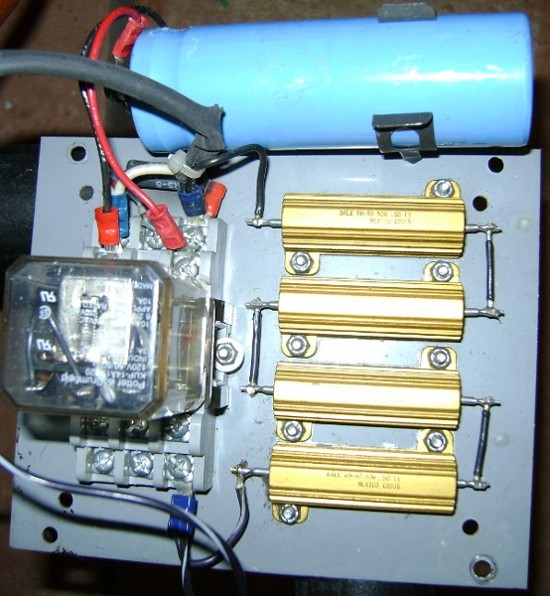
I found this little reduced voltage motor starter in my projector console when I pulled it from a closed theatre. It works very well. I have a sync motor (on a Century R3e/SA) and the start is way too fast without the motor starter. I made a mistake on the drawing it is 4) .5 (half) ohm resistors in series that are rated at 50 watts each not one 2 ohm. Maybe this will help somebody.
Posted by Donald Brown (Member # 5427) on 10-04-2009, 06:16 PM:
Your posting reminded me of an incident that I encountered with a film collector from Massachusetts many years ago: After closing for the night at the Valley Drive-In theatre in Naugatuck, CT, I would often get together wjth a friend of mine and run off our collections of old drive-in theatre intermission programs. On one occasion, one specific reel( which we tried to run several times )failed to complete its path through the Simplex Five Star sound head; it broke each time! To avoid any significant damage to the reel, we simply stopped trying to run it. Upon further examination, the stock, which was quite old, appeared to have shrunk and warpped.though this never happened with any other film, old or new, when we ran off this vintage footage. What was curious was that the same reel ran through an RCA 9030 on previous occasions with no trouble. My observation was that different equipment places film stock through varying retention capabilities ( spring loaded tension rollers, keeper rollers, or the absence of these features ) and that these differences have a significant impact on a projector's ability to successfully handle old stock in less-than-perfect condition. You could try a mylar leader to get your old stock through the heads at start up. This would eliminate the often abrupt tensions of start up from being placed on your old film.
Don Brown
Powered by Infopop Corporation
UBB.classicTM
6.3.1.2