This is topic Aside from lack of oil, what could cause the intermittent to fail on a Simplex 1050? in forum Film Handlers' Forum at Film-Tech Forum ARCHIVE.
To visit this topic, use this URL:
https://ft-forum.com/ft/cgi-bin/ubb/ultimatebb.cgi?ubb=get_topic;f=1;t=009696
Posted by Justin Hamaker (Member # 2165) on 01-12-2009, 03:44 PM:
I had to replace the intermittent on one of my 1050s on Friday. When it was threaded for the first show the machine was very difficult to turn by hand and was very loud when the motor was started.
I've eliminated lack of oil as the immediate cause because the oil was at the correct level (just a small bubble from the top of the viewing glass on the front). Also, all the oil delivery tubes seems to be functioning just fine. However, the machine is 12 years old and I can not say it was never run low on oil before I took over the location about 3½ years ago.
I realize mechanical parts sometimes fail for no identifiable reason. I'm just trying to rule out any operator errors.
Posted by Monte L Fullmer (Member # 2797) on 01-12-2009, 05:39 PM:
Gate tension is horribly tight! On the inward side of the trap by the aperture plate, you'll see a small allen screw head. That is the gate stop allen screw.
What has happened is that this screw eventually gets threaded in and causing the gate to close tighter than normal against the trap.
How to adjust is to roll the screw out until the INT sprocket shoes just barely close completely over the sprocket with film in the gate.
...this has happened to me a few times as well..
Good luck - Monte
Posted by Justin Hamaker (Member # 2165) on 01-12-2009, 07:18 PM:
Trying to get those screws set right has been driving me crazy.
Not long after I took over the theatre we started having problems with the gate closing too far causing it to over extend the pivot. I tried backing out the screw to prevent this problem then I have problems with the picture bouncing or not getting a sharp focus. I move the screw back in and I have problems with print shedding.
At one point when I thought I had it set right I put some lock-tight on the screw, but then I couldn't move it when I discovered it was too loose. Unfortunately there isn't enough room to get a hex wrench in to screw without completely taking apart the gate assembly (not just removing the gate as you would to clean).
What makes it worse is I have yet to get a clear definitive answer on how to get the screw adjusted just right. I'll try your suggestion and see if I have any luck.
Posted by Tim Reed (Member # 137) on 01-12-2009, 07:51 PM:
quote:
Aside from lack of oil, what could cause the intermittent to fail
Sometimes, a cigar is just a cigar.
Posted by Louis Bornwasser (Member # 3063) on 01-12-2009, 08:46 PM:
Recently I swapped an XL rebuilt intermittent in the field, which had a severe gear mesh problem with the gear in the projector.
Luckily the input gear was good on the old intermittent, so I swapped back to the old gear. Everything is now OK: bad gear!! (Ran perfectly in the "run in" projector.) Louis
Posted by Jonathan Althaus (Member # 5042) on 01-12-2009, 09:12 PM:
The first thing that comes to my mind is, wow only 12 yrs old? 12 of our models are 1989 and the other 3 are 91's. Been here 2 yrs now, no problems with the actual Simplex's. I'd check the shafts and bearings of the sprockets, but I'm a noob.
Posted by John Wilson (Member # 269) on 01-12-2009, 09:12 PM:
quote: Tim Reed
Sometimes, a cigar is just a cigar.
That's not what Monica says. ![[Eek!]](eek.gif)
![[eyes]](graemlins/eyes.gif)
Posted by Monte L Fullmer (Member # 2797) on 01-12-2009, 09:46 PM:
quote: Jonathan Althaus
The first thing that comes to my mind is, wow only 12 yrs old? 12 of our models are 1989 and the other 3 are 91's. Been here 2 yrs now, no problems with the actual Simplex's.
Mine are the same vintage: May and Aug of '89 along with some PR-1014's of 1994 and both experienced this problem that I brought up and had to adjust that stop allen screw for proper shoe/sprocket clearance - what this screw actually sets - where you make the band adustments with the tension knob.
I cheated and used long needlenose pliers to tweak that stop allen screw, thus I could keep the trap mounted with just removing the gate to make my adjustment.
If you got a screw that doesn't set, you could take the screw out and slightly 'mike' the threads so it will grab on to the threads inside the trap.
What happened with me is that one machine, on startup, would rattle horribly and sounded like a train engine chugging away from the depot til it ramped up to speed. I did the same - took out the INT assembly, yet I could easily spin the flywheel with no problems. After reinstalling the assembly and doing the sprocket alignment with the gate shoes, is where I noticed how the gate was closing too tightly. Thus, sorry if I misunderstood the original question, for I automatically took it as this overtension by the trap and gate assembly.
.................................................................
When you took the assembly out, were you able to turn the flywheel by hand real easily?
One thing you could also check to see if the drain tube on the end of the funnel is inbetween the flywheel and INT casing. For the oil actually gathers in that little "U' shaped galley inbetween the flywheel and the driven and drive gear, and the gear shaft has a spiral that is cut in where this spiral actually "feeds" the oil to go inside the INT case..to oil the starwheel and cam.
With the "FRAME" knob where you can read it normally, the rear of the INT case above the driven gear has two little holes where the oil exits after being fed in by that gear shaft. The main goal is to see oil gushing out of these two small holes during operation. Thus, you know that the assembly is being oiled ... and why I fully maintain that the "FRAME" knob is at this readable position so the INT assembly is getting the best oiling.
-Monte
Posted by Justin Hamaker (Member # 2165) on 01-12-2009, 11:19 PM:
One of my assistants threaded this particular machine when it happened, but I was just a few feet away working on something else. When she started the motor it was making the worst noise I have ever heard. She stopped it immediately and I came over to check it out. The flywheel was so stiff I could not turn it by hand using pretty much all my strength.
I removed the belt between the motor and the soundhead and the motor turned easily. When I tried to turn the pully that the sound head/projector belt attaches to, I could barely get it to turn. After turning it a few times it loosened up a bit but it was still very difficult to turn through pull down.
I will say I was very surprised at how easy it was to change out the intermittent. I had done one previously on a Century projector, but this was my first time on a Simplex. I guess I just expected it to be much more complicated.
Posted by Monte L Fullmer (Member # 2797) on 01-13-2009, 02:11 AM:
Shoot some oil in those two holes that I mentioned and all rotating surfaces and let it sit in a pan of sorts with the sprocket up to allow oil to seep past the rotating surfaces for a good day
..and hopefully, moving parts will begin to free up so you can rotate the flywheel freely.
I don't think nothing will be damaged since you caught it in time and where you could be back online with that assembly reinstalled.
Luckilly, you've never done an assembly on a PRO-35, for if you do, then we can say you've been 'seasoned' in.
good luck-Monte
Posted by James Westbrook (Member # 3690) on 01-13-2009, 02:56 AM:
Running a 1050 with the frame knob turned upside down for a long time will starve the intermittent of oil, casing it to fail. That's because the oil is not entering the holes mentioned by Monte earlier.
The framing knob can be reset to show FRAME in the readable way but the intermittent could still be cranked way too far one way or the other.
Posted by Brad Miller (Member # 2) on 01-13-2009, 04:29 AM:
James has some damn good advice there for those stuck running Simplexes. (Right Phil? ![[Razz]](tongue.gif) )
)
And since he didn't clarify, you can press in on the FRAME knob and rotate just the knob without the shaft turning so that you can physically center the intermittent in its travel and then push in on the FRAME knob until it the printed "FRAME" word is level. Never, ever run a Simplex at the end of its range (except to get through a show).
Posted by Justin Hamaker (Member # 2165) on 01-13-2009, 02:48 PM:
Just to be clear, my frame knobs are set in the center position. I am aware of the ability to reset them so "FRAME" is always horizontal, but I prefer to have room to adjust in both directions. But it's certainly good to know.
Posted by Monte L Fullmer (Member # 2797) on 01-13-2009, 06:03 PM:
For the curious... and please excuse the camfone picts..had to do some color editing and resizing to fit...
the two holes that should be in this position with FRAME knob readable..

Oil gushing out of the two holes during operation..
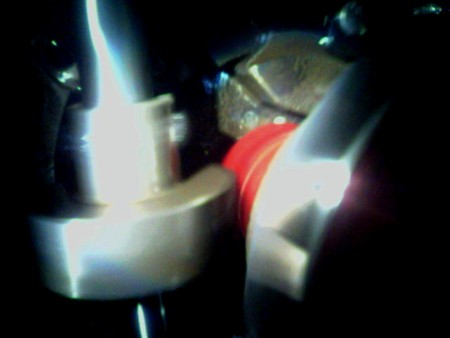
thx-Monte
Posted by Dave Macaulay (Member # 813) on 01-13-2009, 11:37 PM:
Make sure oil is actually getting to the intermittent. The dribble tube can be bent or slid in its clamp and either miss the governor (or paddle) or hit it where little or no oil sprays into the collector funnel. Framing down to where you can see the delivery tube, you should see a quick dripping or constant dribble of oil down onto the intermittent valley around the little drive gears.
The gears perform as an oil pump - forcing oil into the intermittent case through a hole below the mesh point. If the flywheel is not pulled in tightish to the case - there's a groove at the end of the shaft you can pry the shaft out of the flywheel with as you tighten the screws - this pump works poorly as the gap beween the flywheel and case lets a lot of the oil just leak away.I usually pull it tight, snug up the screws, then gently tap the shaft end with a screwdriver handle until the flywheel turns freely (not actually rubbing on the case).
The intermittent doesn't really need a lot of oil, it just shouldn't run dry. Failures in my experience are from some kind of film crash breaking or bending the pin, or from way high gate tension for a long time.
The little indicator bushing on the sprocket end of the shaft sets the free axial play of the cross shaft. The sprocket shouldn't move in-and-out enough to feel, too much movement and the pin and cross can be rubbing together. Unfortunately the tiny Bristol Spline tool needed for the setscrews on that bushing is pretty hard to find.
Posted by Monte L Fullmer (Member # 2797) on 01-14-2009, 02:00 AM:
quote: Dave Macaulay
Unfortunately the tiny Bristol Spline tool needed for the setscrews on that bushing is pretty hard to find.
The later Simplex XL assemblies went to the standard 1/16" allens. Luckilly, the units that I work on uses these instead of the Bristol Spline set. Prob the black case XL's used the Bristol tool.
Yep, I always get that collar clearance correct - and it's a bugger to get that right oil clearance from a tap here and there.
I even go the extra mile on putting a drop of oil on that shaft to keep that OILITE bearing on that collar lubed. You think that should have had a dimple hole drilled in that collar to do this like the Century units have.
-Monte
Powered by Infopop Corporation
UBB.classicTM
6.3.1.2