This is topic What happened to Cinema Digital Sound? in forum Film Handlers' Forum at Film-Tech Forum ARCHIVE.
To visit this topic, use this URL:
https://ft-forum.com/ft/cgi-bin/ubb/ultimatebb.cgi?ubb=get_topic;f=1;t=009744
Posted by Claude S. Ayakawa (Member # 1401) on 02-09-2009, 04:41 PM:
I understand the Eastman Kodak Company and along with the Optical Radiation Corporation wanted to play a very vital role in the early days of the development of digital sound for the theatres and introduced the CDS process known fully as Cinema Digital Sound. I understand only nine film were released with CDS track and they were DAYS OF THUNDER, DICK TRACEY, EDWARD SCISSORHANDS, FINAL APPROACH, FLATLINERS, TERMINATOR 2, THE DOOR and the final film UNIVERSAL SOLDIER. How did this sound process differ from todays SRD, DTS and SSDDS process? For those of you who had experienced working with this system, was it better than todays sound or not as good? Was it very costly to set up compared to the three existing system or cheaper? I think T2 played at the Cinerama Dome in Los Angeles in 70mm and CDS. I also saw the movie in 70mm here in Hawaii at the Waikiki #3 and I do not know if the print was encoded with Dolby A six track mag sound. Now that the system has been defunct for years, what ever happend to the equipment?
-Claude
Posted by Mitchell Dvoskin (Member # 751) on 02-09-2009, 04:48 PM:
The short answer is it went bust. The problem is that their digital tracks covered the same real estate as the analog tracks (ie. replaced the analog tracks), so the studios needed to maintain dual inventory of prints.
CDS has been widely discussed on Film-Tech. See This Thread for more info.
Posted by Tony Bandiera Jr (Member # 2365) on 02-09-2009, 06:04 PM:
And because it covered the analog track area, there was NO fallback if the digital track couldn't be read.
And the processor itself was gigantic, it took up the rack space of TWO CP-200's!!
Posted by Claude S. Ayakawa (Member # 1401) on 02-09-2009, 06:27 PM:
From what I had heard so far, the CDS process deserved to fail.
-Claude
Posted by Bill Gabel (Member # 1105) on 02-09-2009, 06:32 PM:
"T2" and "The Doors" both sound really good at the Cinerama Dome.
Posted by Joe Redifer (Member # 3) on 02-09-2009, 06:33 PM:
More like it was destined to fail from the beginning, just like ORC. Has ORC ever done anything good for mankind? No, they have not. In fact they set it back several notches.
Posted by Mark J. Marshall (Member # 1409) on 02-09-2009, 06:43 PM:
At 6 MB vs. the less than 1 MB digital 35mm sound systems used today, I bet it sounded awesome.
Posted by Joe Redifer (Member # 3) on 02-09-2009, 08:13 PM:
The compression was less advanced at the time so I bet it sounded similar to today's film sound in quality, needing more room for the same thing. The resolution was the same. In fact I think it may have been at 44.1Khz instead of the 48Khz that Dolby Digital offers.
Posted by Louis Bornwasser (Member # 3063) on 02-09-2009, 10:12 PM:
Sounded OK. . . . .when it functioned at all. Louis
Posted by Martin Brooks (Member # 1269) on 02-13-2009, 11:51 AM:
You actually only listed 8 films, and according to my records (which may or may not be accurate), there were actually 10 CDS films. The two missing from your list is "For The Boys" and "Hudson Hawk".
Also according to my notes, some were 35mm, some were 70mm, some were both.
Dick Tracy, Flatliners, Edward Scissorhands were released in CDS in 70mm only.
Days of Thunder, The Doors and Terminator 2 were released in CDS in both 35 and 70mm.
And the others were released in CDS in only 35mm.
As I remember it, Dick Tracy, the 1st CDS film, sounded harsh and brittle. Flatliners, Edward Scissorhands and The Doors sounded really good (in 70mm), especially The Doors. But Dick Tracy played at the Loews 84th St 6 in NYC, which wasn't great, and I believe the other three all played at the Ziegfeld in New York, so that could explain some of the difference. Also Dick Tracy was the first CDS film, so they obviously had less experience mixing for digital at that point.
I can't remember if I saw Terminator 2 in a movie theatre. I didn't see the other films.
Posted by Louis Bornwasser (Member # 3063) on 02-13-2009, 12:01 PM:
CDS and SDDS have a lot in common: same recording camera, not reliable, not here and Howard Fleming. Louis
Posted by Gordon McLeod (Member # 33) on 02-13-2009, 12:07 PM:
A lot of the CDS people went over to SDDS
Posted by Bill Gabel (Member # 1105) on 02-13-2009, 12:40 PM:
Well the film "For the Boys" got a 70MM Dolby Stereo release in LA & NYC. Paramount withdrew the 70MM CDS prints and replaced them with 70MM Dolby prints. And from Mike's site "The Doors" (SR) and "Flatliners" (A) were 70MM Dolby Stereo playdates at the Ziegfeld in NYC.
Not every film was released in the CDS format from that list.
Posted by Gordon McLeod (Member # 33) on 02-13-2009, 03:38 PM:
dick tracey played toronto in 70mm mag with the stips applied over the cds track
Posted by David Stambaugh (Member # 1102) on 02-13-2009, 05:04 PM:
quote: Martin Brooks
As I remember it, Dick Tracy, the 1st CDS film, sounded harsh and brittle.
Everyone's mileage varies, but I saw Dick Tracy in 70mm CDS at the Edwards Big Newport, and it sounded awesome, not harsh at all.
Posted by Mark Gulbrandsen (Member # 72) on 02-13-2009, 07:16 PM:
quote: Louis Bornwasser
Sounded OK. . . . .when it functioned at all.
Thats exactly what we tell customers that have them too! Thankfully just a few odd 3000's here and there and those are actually pretty darn reliable.
Mark
Posted by Joe Redifer (Member # 3) on 02-13-2009, 07:40 PM:
quote: Martin Brooks
Flatliners, Edward Scissorhands and The Doors sounded really good (in 70mm)
Since you distinguished 70mm sounding good, was the bitrate for 35mm and 70mm the same, therefore one could not sound better than the other?
Posted by Gordon McLeod (Member # 33) on 02-13-2009, 08:44 PM:
the linear speed of the print vs error correction probably made the difference
Posted by Sean Weitzel (Member # 244) on 02-14-2009, 10:18 AM:
Some published CDS specifications:
FORMAT SPECIFICATIONS
* Columns of Data: 180
* Rows of data per second: 32,494
* Track Width 0.102 in (2.59 mm)
* Bit size, 35mm (height x width) 14 x 14 microns (0.00055 x 0.00055 in.)
* Bit size, 70 mm (height x width) 17.5 x 14 microns (0.00069 x 0.00055 in.)
* Sound/picture displacement: Zero frames
AUDIO SPECIFICATIONS
* Number of Channels: 6 (5 full bandwidth plus 1 sub-woofer)
* Dynamic Range: 90dB
* Channel Separation: 90dB
* Sampling Frequency: 44.1 kHz
* Frequency Range: 20 Hz-2OkHz +/- 0.5dB
* Total Harmonic Distortion + Noise: <0.1%
* Control Channel: MIDI*
* Synchronization Track SMPTE Time Code
* Film ID Number: ID Data Fields
* Bits Per Sample: Equivalent to 16-Bit Linear PCM
* Data Encoding: Proprietary
* EDAC Strategy**: Uses Reed-Solomon Burst Error Correction with Cyclic Redundancy Check Character Backup. Details Proprietary
Posted by Martin Brooks (Member # 1269) on 02-20-2009, 03:45 PM:
quote:
quote: Martin Brooks
Flatliners, Edward Scissorhands and The Doors sounded really good (in 70mm)
Redifer: Since you distinguished 70mm sounding good, was the bitrate for 35mm and 70mm the same, therefore one could not sound better than the other?
|
I dunno. I was just indicating that I saw those films in 70mm and not 35mm. But I think the bitrate for 70mm was higher which is why the first films were released only in 70mm - if I remember correctly they couldn't initially get it to work in 35mm.
But I'm sure others will have the tech details to confirm either way.
Posted by Mark J. Marshall (Member # 1409) on 02-21-2009, 09:06 AM:
I seem to recall that the bit rate was the same but the physical bits were bigger. But I could be wrong.
Posted by Thomas Hauerslev (Member # 566) on 02-24-2009, 01:38 AM:
Film list
Don't forget the demo "Sounds like the real World" - simply spectacular sound
I ran "T2" in CDS 35mm - very good sound
Posted by William Short (Member # 5170) on 03-15-2009, 02:45 PM:
This recent thread reminded me I should dig up some archival materials and put them here for those curious about the early days of what eventually became CDS. In doing so, I don't mean to take away from the fabulous work done by Ron Uhlig and his team at Eastman Kodak and Howard Flemming and his team at ORC. This work was done independently, with their knowledge and cooperation, to get some quick sense of how bad the error rate might be with the small spot size they required on the film. The hope was that some quick and dirty measurements with readily available equipment would give some confidence before building up the specialized recorders and readers needed to do the definitive experiments.
I used a test target where the digital data in each column of the row was the same, so I didn't have to worry about tracking the film laterally. I made error measurements when the print was new, and then after several hundred passes through a Century C in a changeover house, spliced into their trailer reel, figuring that would be worst-case.
The photos show what the film looked like. No film cleaner in use in this booth (at least not back then). Film travel in all these images is left to right. The top image is a new print, the middle is several hundred passes, and the bottom is the image at a tape splice after several hundred passes.
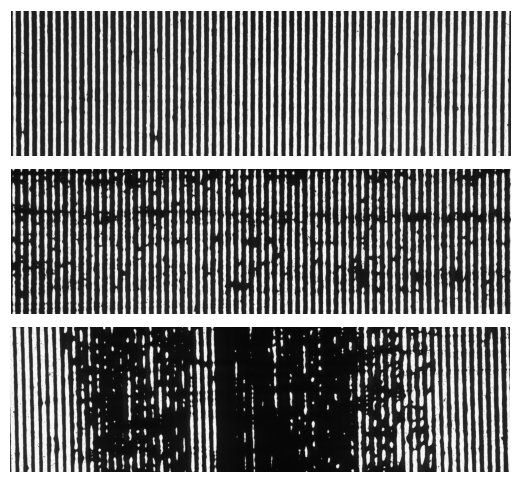
The images look pretty wretched, but the actual error rates were manageable, which encouraged the Eastman Kodak folks and ORC folks in the early days.
The next photos show the installation of the prototype CDS system in the screening room at the Eastman Kodak Hollywood sales office. The rack has a booth monitor at the top, three Yamaha stereo DSP units that provided third-octave eq, and then the rest is prototype processor. The prototype CDS reader sits atop the mag penthouse.
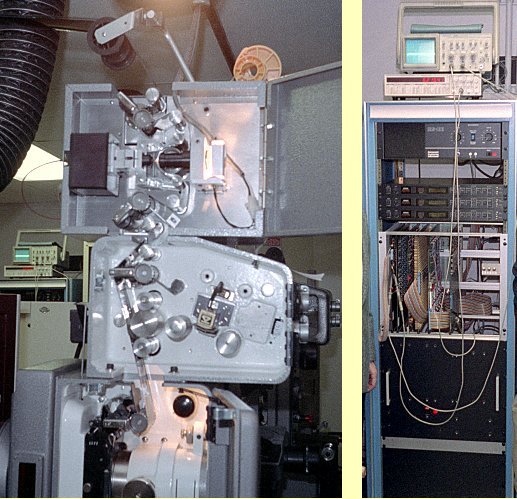
One of the reasons the processor was so big was that the custom high-performance DSP chip needed for the system failed to meet specs, and so four of these heat-generating power hogs were needed in the processor, rather than one as originally planned. Second generation processors (which were manufactured at least in pilot-run quantities, but I do not know if any were ever installed in theaters) were considerably smaller.
All the development work was done on 35mm. The reason to introduce on 70mm was purely a marketing decision, as far as I know. Track specifications were identical for 35mm and 70mm. Spot widths were the same, but spot length was 25% longer in 70mm, due to the faster linear speed of 70mm film.
One problem with 70mm was where to put the track. It had to be inboard of the perfs so it could be printed with existing machines, but there wasn't room between the perforations and the nominal projectable image. My recollection is that CDS cheated, and intruded into what nominally should have been projectable area.
The photos below compare the CDS data spot size on 35mm to the Dolby Digital 35mm spot size, at the same magnification. The individual spots on the CDS track can't be resolved at this magnification, so the track has a mottled appearance.
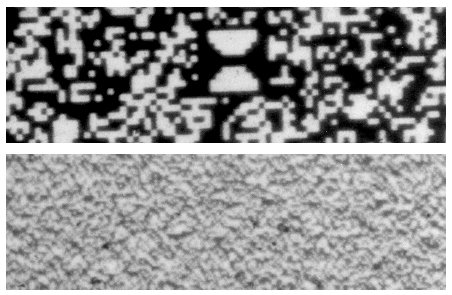
Here's a view of the CDS soundtrack image from a 35mm print at greater magnification showing the individual data spots.

Posted by Mike Blakesley (Member # 26) on 03-15-2009, 08:14 PM:
quote: William Short
My recollection is that CDS cheated, and intruded into what nominally should have been projectable area.
Really? I always thought CDS used the exact same amount of film real estate as the analog track...?
Very interesting pics, thanks for posting them and welcome to the forum.
Posted by Marco Giustini (Member # 4544) on 03-15-2009, 08:26 PM:
Very Interesting, thanks William!
Marco
Posted by Sean Weitzel (Member # 244) on 03-15-2009, 08:31 PM:
The CDS track completely replaced the 35mm analog optical track. However from photos previously posted of a strip of 70mm CDS, the track appears to be printed inboard of the sprockets, intruding on the normal projectable area.


FWIW, there was a great discussion about CDS in a previous thread a few years ago:
CDS Discussion
I am actually in posession of a complete CDS system with two readers and a processor in my home screening room. At this point, however, I have no CDS prints and the processor does not seem to boot up so the whole thing is more of a curiosity piece. Perhaps someday I'll run across a CDS print and see if I can get the system to work.
Posted by Michael Schaffer (Member # 1204) on 03-15-2009, 09:51 PM:
Probably not because the reason it doesn't boot up is that the CMOS battery is depleted. So the firmware is gone. Oops. I don't think there is any way to get that these days.
Posted by Sean Weitzel (Member # 244) on 03-16-2009, 03:30 AM:
I think it's a little beyond firmware. I have power and fans, but nothing on the front display panel. The LCD doesn't even illuminate.
I've run across systems that have gone dead due to an expired CMOS battery. fortunately swapping out said battery seemed to resurrect said equipment as the firmware resided on non volatile ROM modules. I only hope the system isn't like old General Instruments Videociper RS modules for Satellite. Once the batteries died in those, the decrytion keys died with them rendering the module useless.
I'll have to hunt around for batteries in this processor - perhaps I might get lucky just swapping out the cells... of couse it doesn't matter unless I can find some CDS material. Thanks for all the suggestions.
Powered by Infopop Corporation
UBB.classicTM
6.3.1.2