This is topic cinema sound design in forum Film Handlers' Forum at Film-Tech Forum ARCHIVE.
To visit this topic, use this URL:
https://ft-forum.com/ft/cgi-bin/ubb/ultimatebb.cgi?ubb=get_topic;f=1;t=009815
Posted by Mike Moreno (Member # 4887) on 03-25-2009, 08:58 PM:
i wonder if there is a web site where i can learn how to design a cinema sound system, like what kind of speakers or amplifiers i have to use for front speakers, the power of the amps, the ohms of the speakers i have to consider.
Posted by Scott Norwood (Member # 30) on 03-25-2009, 09:15 PM:
I've been looking for this for years.
There are a couple of Dolby publications from the 1980s and early 1990s that have some good guidelines, as well as the THX documentation, but I haven't found anything resembling a complete guide to specifying a modern cinema sound system.
I'm still not entirely clear on why systems with similar equipment and room shape/size can sound so different. I'd also be interested in reading about modern systems that have been installed in older-style (single-screen with balcony) houses and why some of these systems completely suck and others sound amazing.
The best sound that I have ever heard in a theatre was in February, 2000 in the Cinerama Dome in LA (now the Arclight), from about 1/3 of the way back from the screen and almost dead center. Someone please tell me how to make every theatre sound like that.
Posted by Monte L Fullmer (Member # 2797) on 03-25-2009, 09:46 PM:
quote: Mike Moreno
the ohms of the speakers i have to consider.
..and what kind of wire to use and gauge.
14g 25 plus strand since it requires low voltage to run speakers.
If you're gonna get crazy with high power behind the screen, then think on 12g stranded runs esp on subwoofers.
Surrounds, twisted 14/2 pair helps.
..and behind screen, you always have at least two extra runs just in case a run opens up, you got a spare right there to replace.
Posted by Mark Gulbrandsen (Member # 72) on 03-25-2009, 09:56 PM:
quote: Scott Norwood
Someone please tell me how to make every theatre sound like that.
Seems to me those were the original Altec A-2's back then. There were originally A-2's installed in the Dome when it opened.
The best sound I've heard in Hollywood was at the large mix stage at Todd-AO which is no longer in existance.
Mark
Posted by Bobby Henderson (Member # 840) on 03-25-2009, 10:05 PM:
There seems to be many more variables to good movie theater sound than the shape of the room and the sound system hardware installed in it. Although I'm fairly convinced standard sloped theaters have better acoustics than stadium seated theaters.
The building's construction (type of materials used for the walls, ceiling, etc.) play a big part. It would be interesting to know what materials were used in building the Cinerama Dome auditorium, as well as what kinds of acoustical wall treatment, baffles, etc. were installed.
Posted by Sam D. Chavez (Member # 1841) on 03-25-2009, 10:33 PM:
Dolby School served this purpose for many years.
It wasn't that Dolby dictated the spec's but the seminars were in part an exchange of ideas and Dolby usually identified hardware and ideas centered on that worked specifically for this application.
Tom Holman of THX had a lot to do with advancing the art when he was there.
The THX spec's were an enhancement to the Dolby guidelines and are still relevant today.
Posted by Andy Frodsham (Member # 4061) on 03-26-2009, 02:52 AM:
I'd like to know how good a well specified system should sound? Against what criteria should one judge it from a subjective point of view?
I know this all sounds rather vague, but I don't know anymore what I am listening for! Trying to compare the sound in my theatre to a well matched home hi-fi system does not seem particularly fair - but why not? Doing a fairly straight comparison, shouldn't a CD played at home sound about the same when played through the theatre's non-sync? I know it is harder to judge soundtrack material.
I am talking about subjective evaluation here (I spent some time working in a Hi-Fi shop when I was younger and have a fairly well-trained ear) not frequency response specifications etc.
Posted by Steve Guttag (Member # 268) on 03-26-2009, 08:23 AM:
Monte...where do you get your rules of thumb?...with wire gauge, it is all about the current, not the voltage. So lets say you are driving a single 8-ohm sub to 800-watts (not very much in the subwoofer world)...do the math...that is 10-amps on that cable. If you were an electrican, depending on the run and the fill in the pipe, you'd say you need 14awg. The problem is, you are not running 800-watts to a sub in most theatres...you are running much more and often paralleling them up. In-line resistance is also the enemy of bass as it kills the damping of the system. For subs...think in terms of 8awg for the long runs. The same rules apply to the other speakers too. Look not only at the current on the cable but how that cable's resistance over the run compares to the driving load...it shouldn't be anywhere near (beyond a factor of 10) or you are compromising the system.
The room is the most difficult aspect of getting good sound, for me. Often, that deck of cards is dealt before I ever have a chance...but good sound starts with the room's design...long before the first piece of sound making equipment is ever chosen.
Steve
Posted by Michael Schaffer (Member # 1204) on 03-26-2009, 09:38 AM:
The "Cinema Sound System Manual" by JBL which can be found on jblpro.com under Downloads>Technical Library>Manuals answers a lot of the basic questions and is a good starting point for reading up on the subject. Of course, it doesn't answer all questions and a lot of the information given there is specific to JBL products.
Posted by Louis Bornwasser (Member # 3063) on 03-26-2009, 02:18 PM:
I have send the "Guidelines for Dolby Stereo Theatres" book to architects for decades.
When (if) the room is deficient, then I can show the architect which page number he failed to comprehend. It may not fix the problem, but it sure fixes the blame. All you need is in that book. Most was writtenor editted by Ioan Allen. Louis
Posted by Monte L Fullmer (Member # 2797) on 03-26-2009, 06:55 PM:
Thx Steve for that info. What I put in my comments is from what I've seen other installers use for their installs.
They mainly run 14g for the stage, subs and surrounds (and I know one plex that ran 12g SOLID for their speaker runs..)
-Monte
Posted by Steve Guttag (Member # 268) on 03-26-2009, 08:11 PM:
Another misconception...Solid does not have any problem moving sound (or picture for that matter)...it isn't the best conductor to make the termination with though.
Steve
Posted by Geena Phillips (Member # 3726) on 03-27-2009, 01:13 PM:
In this day and age, I would also recommend having a processor with optional RCA input jacks for flexibility when it comes to Non-Sync audio. Most modern processors have this capability, but if you get one that doesn't, it's not difficult to remedy.
Posted by Gordon McLeod (Member # 33) on 03-27-2009, 05:38 PM:
I preferto have all my I/O's as balanced if possible
Posted by Eric Robinson (Member # 2966) on 03-27-2009, 09:11 PM:
quote: Louis Bornwasser
I have send the "Guidelines for Dolby Stereo Theatres" book to architects for decades.
This is also located in the film-tech manuals section under.
Dolby Technical Guidelines for Dolby Stereo Theaters (1994 publication)
By the way, does anyone here use the Jiffy test film?
Posted by Monte L Fullmer (Member # 2797) on 03-27-2009, 10:12 PM:
quote: Steve Guttag
it isn't the best conductor to make the termination with though.
What would happen if you crimped on either a forked or ring connector on that solid, then filled it with solder..would this then work for solid and tight termination to the lugnuts on the amplifier?
Posted by Steve Guttag (Member # 268) on 03-28-2009, 07:57 AM:
That would work but don't crimp too tightly...just enough to hold the crimp on until you solder. Note, any flexing on that joint will work against it...also the more the solid cable is flexed the more the conductors will likely break.
Posted by John Hawkinson (Member # 1135) on 03-28-2009, 10:41 AM:
This thread is so weird.
With respect to the last question, of course it depends on the gauge of wire, but best practice is to long heavy wire runs solidly terminated and then a short flexible patch to the amplifier (and on the speaker end). Any electrical fitting designed for good termination is probably appropriate for such a junction. I wouldn't use wire nuts, but realistically they're probably fine for No. 10, though of course they don't keep the wire from flexing, which makes them a poor choice if nothing is clamping the cable itself. Use a terminal block.
Of course if you're running 8AWG, similar advice applies, though you're not going to be running 8AWG solid [ha ha!]. But even stranded, those gauges are quite stiff.
(We ran some 8AWG and terminated the speaker-side with eurostyle terminal blocks and a few inches of No. 12 to pretty Speakon receptacles. Works great. On the other side, we ran the No. 8 straight into banana plugs to the amps. That was a mistake, huge pain in the neck to deal with strain relief and keeping them in the amps. On the other hand, we haven't gotten around to redoing the amp side. But do it right from the start.)
But again, don't pick a wire gauge out of a hat. Pick it based on the distance of your wire run, the resistance you can tolerate (based on damping factor), and the power levels.
I don't understand Geena's comment. It's not difficult to remedy so you recommend getting one anyhow? ![[Smile]](smile.gif) Honestly, panel-mount RCA jacks are easy enough to add, and you can wire them into any cinema processor. Seems like something the installer should deal with, anyhow, since the right place for such jacks will vary from install to install.
Honestly, panel-mount RCA jacks are easy enough to add, and you can wire them into any cinema processor. Seems like something the installer should deal with, anyhow, since the right place for such jacks will vary from install to install.
Steve, I can't believe you didn't mention EG18! [I realize it's slightly tangential to this, but still].
--jhawk
Posted by Steve Guttag (Member # 268) on 03-28-2009, 01:04 PM:
I'm nothing, if not tangential...I like trig.
EG18 is not too prolific on designing sound systems though. The Dolby Technical Guidelines is a good place to start.
As to wire nuts...I use them all of the time and generally use tape as a strain-relief...I've NEVER had one fail. If one is joining stranded to solid, solder is just about a must. Also, don't use junk materials or even wire nuts...and yes you can get them to work with #8.
John, RE: Bannana plugs and #8...it is doable but a pain, as you noted. Many 5-way posts will let you put the bananna plug in from the side and tighten down the "screw" onto the plug for a secure connection
Here is a blurry picture of the back of such a rack...the amps are QSC MXa series
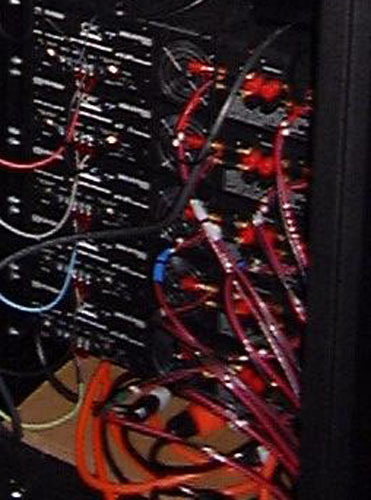
Belden has come up with some real nice "speaker" wire. It is jacketed Red/Black with a twist (though they don't broadcast that part) and a real high/fine strand count. They have it all of the way down to 10awg too (1313A). You can get 4 conductor Bi-Amp (you can also use 4 conductor for the MF/HF section of a tri-amp). The 4-conductor goes down to 12AWG. By fine strand I mean 259 34awg makes up a 10awg conductor. Oh and another plus, Belden doesn't wind it onto a tiny core and make a slinky out of the last 50-feet.
For those looking for high-strand count 8awg...think about your friends in the Welding world...that is small stuff or them but welding cable is often very high-strand count.
Steve
Posted by John Hawkinson (Member # 1135) on 03-28-2009, 03:47 PM:
Wait, why are we looking for high-strand-count 8AWG? Surely no one would do the full run that way (it's quite expensive!), and as for the last few feet to the amps/speakers, what's wrong with going up to 10AWG?
Now, if we're talking about lamphouses...
--jhawk
Posted by Steve Guttag (Member # 268) on 03-28-2009, 06:42 PM:
Given a choice? You don't want any splices in the speaker cable, like any other cable. I dislike terminal blocks to transition because you create numerous points for a bad connection. I have absolutely run #8 the full distance from amp to speaker...in fact, I think you would find, if the detail was there...#8 going to the bottom amps in that picture (MX-3000a amps). In this case it was THHN stranded, not "speaker wire" I also don't know of a cable manufacturer that makes a high-strand count red/black twisted...perhaps a white/black. There is always the clear jacketed twin-lead stuff but who wants to pull that?
Steve
Posted by John Hawkinson (Member # 1135) on 03-28-2009, 06:59 PM:
Err, well, obviously you don't have a special set of 8AWG speakon connectors, so do you run the 8AWG into screw terminals on your JBL speakers?
I mean, sure, keep the number of splices to a minimum, but I think one on each end of a huge run isn't too big a price to pay...
--jhawk
Posted by Louis Bornwasser (Member # 3063) on 03-28-2009, 08:44 PM:
Look inside anyone's subwoofer and note how small the wire is (short run). There is no shame in a short run of #12 or #14 on either end of the long, low loss cable. Louis
Posted by Marc Hansen (Member # 705) on 03-29-2009, 12:23 PM:
If you put the amps at the speaker end and send a low level signal to them will you have problems with picking up more noise in the line? The wire would be cheaper but how much would it degrade the sound?
Marc
Posted by Scott Norwood (Member # 30) on 03-29-2009, 01:22 PM:
It works fine if you used balanced lines. The problem is that it makes it harder to diagnose problems if there is no way to monitor the amplifier output in the booth.
Another approach that I have seen in older systems is to run 70v lines from the amplifiers in the booth to the backstage area. This also saves money on wiring, but requires expensive transformers at each end if you care about sound quality.
Posted by Brad Miller (Member # 2) on 03-29-2009, 01:59 PM:
quote: Steve Guttag
I dislike terminal blocks to transition because you create numerous points for a bad connection.
Steve, I am curious as to your opinion regarding wiring surround speakers together. Do you use wire nuts for that, a terminal block, etc?
Posted by Steve Guttag (Member # 268) on 03-29-2009, 03:28 PM:
95% of the time, wire nuts. Wire-to-wire connection. Never had a failure or noise. I ID the lines so trouble shooting is a breeze if a speaker develops a problem (foam rot or some such).
I've done a few systems with terminal blocks but when you add up the connection points and the potential for failure...I just don't like the added connections.
As for stepping down the wire guage at each end...it isn't the end of the world and I will do it when making drops....but ideally, I'll make it splice free (no drops).
The arguement of the wire in the cabinent as a justification is worthless...what about the wire on the voice coil? Is that a justification for running 30awg? In fact, I know some top sound guys that run the speaker wire straight to the drivers (separate runs to each LF driver).
Steve
Posted by Martin Brooks (Member # 1269) on 03-30-2009, 10:23 AM:
quote: Scott Norwood
The best sound that I have ever heard in a theatre was in February, 2000 in the Cinerama Dome in LA (now the Arclight), from about 1/3 of the way back from the screen and almost dead center. Someone please tell me how to make every theatre sound like that.
I was there sometime before the 1996 to see the revival of Lawrence of Arabia and I thought the sound was terrible (at least as compared to the Ziegfeld in New York for the same film). There was tremendous slap-back echo from the rear walls making dialogue intelligibility very poor. Perhaps they renovated after that and before the Arclight renovation.
Best sound I ever heard (aside from the Cinerama and Todd-AO days) was Close Encounters and Apocalypse Now, both at the Ziegfeld in New York. They had installed extra subwoofers for the original roadshow of Encounters and Apocalypse had the first split surround. When I saw Apocalypse Redux a few years back at the Astor Plaza (before that closed), the sound (or mix) was not quite as impressive.
Posted by Geena Phillips (Member # 3726) on 04-01-2009, 01:18 PM:
quote:
I don't understand Geena's comment. It's not difficult to remedy so you recommend getting one anyhow? [Smile] Honestly, panel-mount RCA jacks are easy enough to add, and you can wire them into any cinema processor. Seems like something the installer should deal with, anyhow, since the right place for such jacks will vary from install to install.
I'm just saying that the OP should try to know up-front if the processor has RCA jacks for non-sync or not, because it is easier to have the installer deal with it at the time of installation. I apologize if I wasn't clear about that.
Powered by Infopop Corporation
UBB.classicTM
6.3.1.2