This is topic Apr 2 Nitrate booth fire at the Stanford, Palo Alto in forum Film Handlers' Forum at Film-Tech Forum ARCHIVE.


To visit this topic, use this URL:
https://ft-forum.com/ft/cgi-bin/ubb/ultimatebb.cgi?ubb=get_topic;f=1;t=009831

Posted by Jim Bedford (Member # 4) on 04-05-2009, 06:06 PM:
 
Sprinklers don't put out nitrate fires. What was the projector? Were they using magazines? Was the fire contained in the heads and magazine? Was the damage limited to the projector?

News story on nitrate booth fire

1944 Gene Kelly film burns at Stanford Theatre
Gene Kelly, Rita Hayworth 'Cover Girl' film jams in projector, catches fire -- but sprinklers douse blaze

The 1944 film "Cover Girl," starring Gene Kelly and Rita Hayworth, caught fire Thursday night about 10 minutes into the film at Stanford Theatre in downtown Palo Alto, forcing evacuation and temporary closure of the 1920s theater.

"We cauld see the flickering light from the flames from the orchestra" area near the front of the theater, audience member Kenneth Allen said of the 7:35 p.m. incident.

The theater, at 221 University Ave., was closed for repairs, primarily from water damage from overhead sprinklers that doused the flames.

Fire Battalion Chief Niles Broussard said no one was injured.

Allen said in an e-mail to the Weekly and some individuals that the film apparently jammed in the projector and caught fire.

"The downtown Stanford Theatre caught fire tonight when the nitrate film jammed in the projector and burst into flames. We along with all other patrons safely evacuated, and it looked like the fire did not spread, but fire trucks were still rolling a half hour after the first alarm," he said.

The subject line of his e-mail was, "It was okay to yell 'Fire' in a crowded theater."

Broussard said the blaze was controlled by the theater's sprinkler system in minutes, and the fire damage was limited to the projector.

But he said the theater sustained between $5,000 and $10,000 in water damage.

-- Bay City News/Palo Alto Weekly staff
 
Posted by Steve Guttag (Member # 268) on 04-05-2009, 06:32 PM:
 
quote: Jim Bedford
Sprinklers don't put out nitrate fires.
WRONG! Sprinklers are one of the best ways to extingish a Nitrate fire. The key is in lowering the temperature. This is a case where a sprinkled system will beat dumping the burining Nitrate in a bucket of water, where it will merely create its own oxygen.

NFPA-40 is quite clear about NOT shielding the Nitrate film from sprinkled water. If it is to be enclosed (storage cabinet), there is to be a sprinkler head in there...there is to be a sprinkler head above each magazine too.

Somewhere floating about on Film-Tech or possibly RAMT (use-group) is a link to the studies done on putting out Nitrate fires that leaves sprinkled water as the winner.
 
Posted by Jason Burroughs (Member # 68) on 04-05-2009, 08:35 PM:
 
Depending on the sprinkler head, they don't just spray out water, as often seen on TV/Movies. Due to size of the head nozzle and pressure, this essentiallyl atomizes the water. This does 2 things:
1. Lowers the temperature - 1 side of the fire triangle
2. Disperses "free" oxygen available to the fire. (though this part would likely not be applicable to a Nitrate fire)

The other common mis-conception is that once a single head is triggered, that all sprinkers in the building go off. Only if the temperature rises to the rating of the fuse-plug will those specific heads go off.
 
Posted by Bill Enos (Member # 440) on 04-05-2009, 09:48 PM:
 
Why does anybody run nitrate at all? Even in a properly equipped booth the odds will eventually catch up running 65 year old prints. While the outcome certainly was the best that could be expected, the actual cost of repairs will undoubtedly be several times higher than the fire officials guestimate, plus lost revenue during the closed period and the significantly increased insurance costs that result from a claim.
 
Posted by Don Furr (Member # 1469) on 04-05-2009, 10:04 PM:
 
There is only one way to run nitrate.....you sit by the projector while it's running.
 
Posted by Jack Theakston (Member # 4484) on 04-05-2009, 10:08 PM:
 
...or you don't run it at all. I really wonder if they'll be affected in their insurance.

And really... I know first-gen prints look great and everything, but you mean to tell me Sony doesn't have a safety print of COVER GIRL?
 
Posted by Brad Miller (Member # 2) on 04-05-2009, 10:12 PM:
 
Am I the only person who would consider running nitrate from a platter in a fire-proof room all to its own with a CD of "Disco Inferno" cued up to the film chopper automation in the wall? Such a setup would be undeniably safer than running on reels attached to the projector, plus how awesome would it be to have tunes ready to go in the event it did catch fire? [Cool] [Wink]

Its good to hear nobody got hurt though.
 
Posted by Monte L Fullmer (Member # 2797) on 04-05-2009, 10:16 PM:
 
quote: Jack Theakston
if they'll be affected in their insurance.

I'm sure that their insurance has a clause in operating nitrate so they can be allowed to run such flammable substances and to have such sprinkling systems installed to contain such a sudden fire as with nitrate...esp where the new story mentions of the main damage was with the projector.

I guess why ones do love running nitrate is to be close to the real thing. For running safety dupes or reduction prints just isn't 'classical' to present to moviegoers.

-Monte
 
Posted by Phil Hill (Member # 371) on 04-05-2009, 11:24 PM:
 
...for our Grand-Poopie-BAH... "Disco Inferno"
 
Posted by Stephen Brown (Member # 292) on 04-06-2009, 01:13 AM:
 
I would have thought that if it was on a platter the song should be "Burning (centre) Ring of Fire"
 
Posted by Steve Guttag (Member # 268) on 04-06-2009, 06:46 AM:
 
Anyone that has shown Nitrate films knows that their look has not been duplicated. They are simply the best.

The number of incidents versus showings remain extremely low.

Steve
 
Posted by Bill Enos (Member # 440) on 04-06-2009, 10:56 AM:
 
Our insurance specifically prohibits the use and storage of nitrate film. The last time we inquired about coverage for nitrate was about 15 years ago. Sprinklers were required as well as inspections by the insurance company and city fire inspectors. The city people were very reluctant to grant any permit to run nitrate at all so we dropped it. Insurance coverage would have been on a per event basis and cost would have been several hundred dollars with several pages of requirements and exemptions.

Forget the fire damage, what will a thousand gallons of water do to the facility?
 
Posted by Jim Bedford (Member # 4) on 04-06-2009, 11:18 AM:
 
Over the years, as we updated booths for the Telluride Film Festival without magazines, fire-rollers, etc., we were required to post signs as you entered the booth "SAFETY FILM ONLY IN THIS BOOTH." Meanwhile, the same petty bureaucrats (building "inspectors" and even some architects) requiring the signs still wanted us to put toilets in the booths not understanding that the history of requiring toilets in booths stemmed from running nitrate unattended. Jesus, don't they know that's what they make empty cans and cups for!
 
Posted by Jack Theakston (Member # 4484) on 04-06-2009, 11:52 AM:
 
quote: Steve Guttag
Anyone that has shown Nitrate films knows that their look has not been duplicated. They are simply the best.
In my "having had run nitrate" opinion, nitrate prints look great, but modern safety prints, if correctly done with original materials can look just as good.

And seeing as this was a Technicolor film rather than a high-silver black and white print, I'm baffled as to why they bothered when a composite made from the three-strips today can look as good as-- if not better-- than the original.

There is no magic to the substance. It's all in the lab work.
 
Posted by Scott Norwood (Member # 30) on 04-06-2009, 12:31 PM:
 
Jim--bathrooms in the booth are a requirement in Mass. as well, although I can point to many examples of violations (in both old and new buildings) that apparently have managed to slip through the cracks.

As for nitrate, I've seen it projected at the Egyptian in LA and "elsewhere," and I do think that it has a unique look. The base is almost perfectly clear, unlike safety base. White looks white (sort of like D-cinema white vs. a film projector running a loop of "clear" film). Also, the lab work is far better in the older prints that what we see today, and the B&W prints have better density and contrast range (supposedly due to higher silver content).

Is nitrate safe to run? I wouldn't try it at home or in a modern theatre, but I would feel reasonably safe as an audience member in an original nitrate-era house if all the original protection mechanisms were still in place.
 
Posted by Bill Gabel (Member # 1105) on 04-06-2009, 12:48 PM:
 
The Stanford Theatre Foundation is one of those Special Venue theatres that can book films from Film Archives like UCLA Film Archives, George Eastman House collections and others. The print lost was an archive print, but not from UCLA's collection.
 
Posted by Steve Guttag (Member # 268) on 04-06-2009, 01:00 PM:
 
Jack...I'll say this..._I've_ never seen a modern print ever come close to a Nitrate in its look...regardless of stock or lab work done in the modern print. That includes color or black and white.

Steve
 
Posted by Jack Theakston (Member # 4484) on 04-06-2009, 01:09 PM:
 
Steve, I've split-screened several safety films with their nitrate components. Some obviously didn't look so hot (being off of dupe negs), but others that were off of the o-neg and had good labwork behind them looked as good as the nitrate originals. Book Universal's print of HOUSE OF FRANKENSTEIN sometime and you'll see what I mean.

As for Technicolor prints, any new print is going to look sharper if done directly from the three-strips, in my opinion. Technicolor prints from before 1954 are often inherently soft because of the printing technique. Technicolor changed their chemistry that year to compensate, and no doubt the growing number of theaters showing widescreen at that point lit a flame under their asses.

Another print that looked better than the original IB was ironically another horror film from Universal: BRIDES OF DRACULA. At this point, it would be safe to say that Kodak's stocks post-Vision have as wide a color range if not better than Technicolor's dyes.

[ 04-06-2009, 04:09 PM: Message edited by: Jack Theakston ]
 
Posted by Richard P. May (Member # 3598) on 04-06-2009, 01:38 PM:
 
One of the reasons nitrate prints have such a legendary reputation for looking good is that most of what survives was probably made from the original negative, with slow and careful lab work. I have seen many modern Estar prints made from the original negs that look beautiful. It's like Jack says above, the lab work is what really counts.
Even if a nitrate print appears to be in very good condition, projecting it is a chancy thing, as the newest of them is in the range of 55 years old, and would have some degree of shrinkage. That could cause the film to jump off a spocket, with expected disastrous results.
It's not like working with such old film in a lab environment, where there is no appeciable heat involved, and if film breaks in a printer it can be stopped very quickly.

DM
 
Posted by Stephen Furley (Member # 1277) on 04-06-2009, 01:41 PM:
 
quote: Jim Bedford
"We cauld see the flickering light from the flames from the orchestra" area near the front of the theater, audience member Kenneth Allen said of the 7:35 p.m. incident.
Did the fire shutters not drop then? One function of them, apart from the obvious one of stopping the fire spreading to the auditorium, is to stop the audience from seeing the fire, and panicing. Do we know exactly what happened? Was the fire contained to the film in the gate, or did it spread to the spoolboxes (magazines)?

I haven't heard of any nitrate fires for several years; the last one I can think of was in the vaults at Henderson's Labs in south London, probably something getting on for ten years ago now. I can't remember the last nitrate film in a cinema that I heard about; there was one in Paris in about the late '80s, have there been any since?

I wonder if this will spell the end for the exhibition of nitrate prints? It might be used as the excuse to introduce a total ban.

The best safety print of an old film that I've seen was 'The General' a few years ago at the National Film Theatre. I'm pretty sure it was polyester, it was a fairly recent print, and it really did look superb.
 
Posted by Bill Gabel (Member # 1105) on 04-06-2009, 02:01 PM:
 
quote: Stephen Furley
Did the fire shutters not drop then?
For most fire shutters to work in that era type theatres. The fire would have to melt the lead spacer that holds the chain to the shutters for it to drop or the operator to do it manually in the booth. The fire would have had to be a major booth fire for the shutters to work on there own.
 
Posted by Stephen Furley (Member # 1277) on 04-06-2009, 02:18 PM:
 
But not for the operator to pull the manual release. If they see the film catch fire they should be able to drop the shutters within a second if they've got their hand on the release. I agree that if the fusible links go then you've already got a sizable fire on your hands.
 
Posted by Rick Raskin (Member # 1561) on 04-06-2009, 02:34 PM:
 
I agree with Steve. I've never seen a safety print look anywhere near as good as nitrate. I've seen old WB cartoons on nitrate stock and the look is absolutely amazing. Ultra fine grain and a depth that just isn't there with safety stock.

What exactly caused the fire in CA? Obviously the film jammed in the gate but my question is what caused that to happen? Additionally, if they were using magazines shouldn't the fire trap rollers have stopped the spread of the fire? In that case, the fire should have not spread beyond the projector head if everything was being operated properly. Anyway, the film that was already projected should have remained intact on the takup reel.
 
Posted by Louis Bornwasser (Member # 3063) on 04-06-2009, 04:25 PM:
 
Scott: density, in the audio track, is very critical. In the B & W days, sound density was precisely controlled, so the picture followed along at no charge, since there was one step development. Color had picture developed first, then sound in a sequential process. One of the byproducts of cyan tracks, is that we are back to a one step process; sound density being the more critical. Picture quality gained accordingly. Louis
 
Posted by Monte L Fullmer (Member # 2797) on 04-06-2009, 06:19 PM:
 
Besides, dye transfer printing was just not a fast process anywhos, let alone the few prints that were pressed anyways back in those days.

Thus, time was definitely in the lab's favor for making excellent prints.

The sharpest that I've ever seen when it comes to I.B. printing, is of "the Ten Commandments."

Far cry from the gazillion miles printed today ....

-Monte
 
Posted by Jack Theakston (Member # 4484) on 04-06-2009, 06:57 PM:
 
Of course, THE TEN COMMANDMENTS was a large format production essentially being printed 1st gen, as opposed to the 2k intermediates that are used today.

Depending on what stock shot the film in the first place, the post-'68 IB prints tend to look best, to my eye. Of course, if you're in a low-light setting, it's going to be grainier.
 
Posted by Monte L Fullmer (Member # 2797) on 04-06-2009, 08:00 PM:
 
but, what made "10 C" as clear as it was being that the camera negatives were the 8 perf VV horizontal negatives with printing negatives done 90* for standard 35mm presentations.

Last time I ran nitrate was at a drive-in. We had a b/w clock reel and it looked better on the screen than the regular features.

I told the owner that this reel was nitrate, he knew about the stock, but said it was okey to run anyway...which it did, but I was right there at the machine at all times...
 
Posted by Mark Gulbrandsen (Member # 72) on 04-06-2009, 08:05 PM:
 
At the end of the second dye transfer round I thought Technicolor had the speed up in the 800 to 1000 foot per min. area... Anyone know for sure???

Mark
 
Posted by Claude S. Ayakawa (Member # 1401) on 04-06-2009, 09:29 PM:
 
What was the actual statistics of nitrate film fires before safety film was introduced? Have there been instances when entire theatres were destroyed with tremendous loss of lives from nitrate film fires ?

-Claude
 
Posted by Martin McCaffery (Member # 37) on 04-06-2009, 09:34 PM:
 
That may be a fun thing to search through the Boxoffice magazine files for. They used to run reports on booth fires. My issues from the 1940's seem to have a couple every week. Common enough they were rarely more than a paragraph or two in length. Unless, of course, the theatre was destroyed.
 
Posted by Jack Theakston (Member # 4484) on 04-06-2009, 10:58 PM:
 
quote: Monte L Fullmer
but, what made "10 C" as clear as it was being that the camera negatives were the 8 perf VV horizontal negatives with printing negatives done 90* for standard 35mm presentations
That's what I meant by "it was a large format picture."

quote: Mark Gulbrandsen
At the end of the second dye transfer round I thought Technicolor had the speed up in the 800 to 1000 foot per min. area... Anyone know for sure???
That is correct. In 1974, the average speed was about 330 feet per minute. In 1999, the running speed was about 800 feet/minute, which was still slow compared to the 1000-1200 feet/minute most printers were doing.

quote: Claude S. Ayakawa
What was the actual statistics of nitrate film fires before safety film was introduced? Have there been instances when entire theatres were destroyed with tremendous loss of lives from nitrate film fires ?
The chances were actually lower pre-1950, as most projectionists were familiar with nitrate safety protocol. If a fire broke out and all went well, only the booth was damaged, and this was covered by insurance.

Regarding the initial story-- I still don't understand why the Stanford risked running a nitrate print when Sony has a perfectly good safety print of the film in question available for rental.
 
Posted by Monte L Fullmer (Member # 2797) on 04-07-2009, 12:16 AM:
 
quote: Jack Theakston
the Stanford risked running a nitrate print when Sony has a perfectly good safety print of the film in question available for rental.

..this may not be a logical answer that you're seeking, yet, I fully understand why they did and the comments above have clarifed why the nitrate was presented - just a lot better presentation along seeing something on the screen that had that 'romantic' touch to the days of yesteryear...on how film was really presented.

I'm sure that the members of Film-Tech who have personally ran nitrate can testify to how it looked on the screen compared to the film of today...and the comparison would be just like night and day in quality.

My old booth that I was chief projectionist at still had the carbon tet extinguisher bottles hanging over the machines (which were finally removed in the mid 70's), 3/16" plate steel fire shutters above all of the portholes with the lead break in the holding chains..along with the red sand bucket( which was now in storage) still on the premises. Booth entrance doors were still tin covered along with the walls having tin under the lath and plaster, but don't know if asbestos was under the tin or not, yet, I've seen booths that were lined with sheet asbestos with tin layover.

Booth also had spare fire rollers in the parts bin for the magazines if needed.

I did find two B/W reels of nitrate at this theatre still in excellent condition - no shrinkage, decay or any abnormalities. I ran those two reels from time to time and really appreciated how the film still ran though those XL's (which still had the fire shutters in them..) and how the picture looked on the screen. Those reels disappeared one day - think the mgr took them.

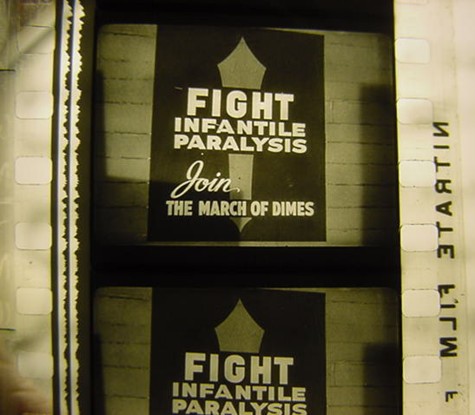
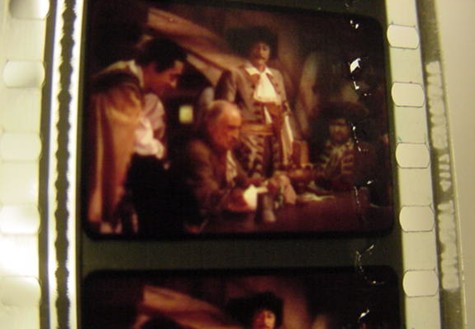
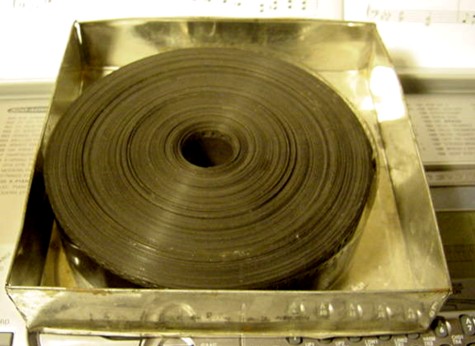
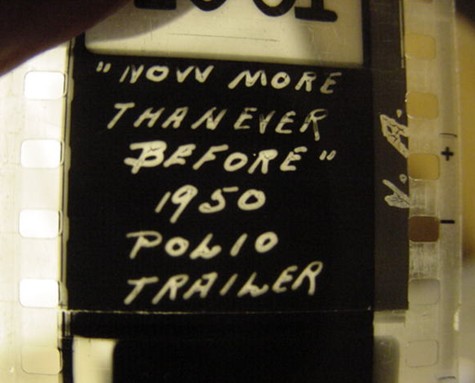
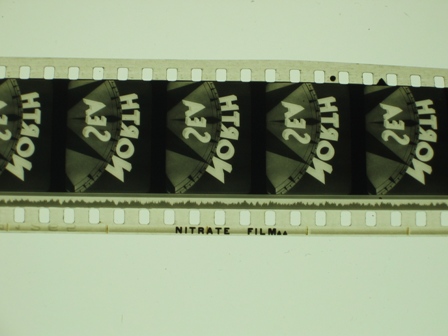
Here are some nitrate samples. I found this tin of film in a theatre that was long closed. Film is in an almost prestine condition. No scratched on the stock and have both head and tail leaders still attached.

One could alway tell nitrate with the horizontal lines inbetween the sprocketholes. Safety from Technicolor took these lines and ran them vertically - in line with the sprocketholes
 -

 -

 -

Nitrate in IB color .. sorry, didn't get this one in focus too well, but you can see the "duPont Nitrate" on the side

 -
 
Posted by Joe Tommassello (Member # 4632) on 04-07-2009, 11:38 AM:
 
Getting into this late but...

The article said it was about ten minutes into the show. If it was the first reel...and it was in the original ten minute-per-reel configuration...it would have been very near the end of the reel. If the film snapped below the gate before the film ignited there may have not been much film left to burn.
 
Posted by Richard P. May (Member # 3598) on 04-07-2009, 12:24 PM:
 
Out of all the postings in the last two days on this and other forums, there has been nothing from anyone who represents the Stanford Theater, and really knows what happened.
Everything is speculation.
 
Posted by James Westbrook (Member # 3690) on 04-07-2009, 03:02 PM:
 
Monte,
how exactly are you storing that film?
I am asking this knowing you are an intelligent fellow and would store and handle that film safely.
 
Posted by Joe Tommassello (Member # 4632) on 04-07-2009, 03:35 PM:
 
quote: Monte L Fullmer
I'm sure that the members of Film-Tech who have personally ran nitrate can testify to how it looked on the screen compared to the film of today...and the comparison would be just like night and day in quality.
I saw an original release print of Disney's "Pinocchio" about fifteen years ago. It was amazing.
 
Posted by Monte L Fullmer (Member # 2797) on 04-07-2009, 10:21 PM:
 
quote: James Westbrook
how exactly are you storing that film?

I store this stuff down in my basement in what used to be the coal room (now, a storage room)...on a lower shelf close to the floor. Room stays cool and under a decent controlled humidity. I've had these rolls for almost 15 yrs.

quote: Richard P. May
there has been nothing from anyone who represents the Stanford Theater, and really knows what happened.

I'm sure that legality reasons are keeping them from talking to the media...serious business here.
 
Posted by Jim Cassedy (Member # 4115) on 04-08-2009, 09:27 AM:
 
While working for AAMPS (Army/Air Force Motion Picture Service)
around 1974, I recall seeing a 35mm projector on board a ship
in Virginia that contained a built-in C02 fire suppression system.

There was a CO2 bottle mounted on the pedastal. Small tubing
connected the cylinder to points near the top of the projector
head, and the lower magazine. There were a couple of "head"s
inside attached to the tubing.

In the event of a film fire, the heat would melt away some low-temp
solder that allowed a spring loaded sharp pin-like device to puncuture a metal disk releasing the CO2 into the projector.

Unfortunately, since this was a officially a "spy ship" I was
not allowed to take any pictures.

I also recall seeing pictures of a similar British made
machine (perhaps a Kalee) online several years ago.
 
Posted by Richard P. May (Member # 3598) on 04-08-2009, 09:54 AM:
 
With his permission, I am posting a memo from David W. Packard regarding the recent nitrate fire at the Stanford Theater.
This should answer many of the speculations of the last few days.

The recent fire in the projection booth at the Stanford Theatre has stimulated interest and discussion,
so I will try to explain the event and its background.
The Stanford Theatre in Palo Alto was built in 1925. For its first 25 years every film shown was
nitrate, and I am not aware of any notable event during that period. We purchased the theatre in 1987
and made major renovations and seismic upgrades (being near the San Andreas Fault). We designed
the projection booth to comply with all code regulations regarding nitrate film, and we received approval
from the local authorities to run nitrate. The booth has walls with very high fire ratings, two exit
doors, smoke and heat detectors, fire sprinklers, and metal shutters to cover the ports into the auditorium.
Nitrate reels are stored in specially designed bins.
Between 1989 and 2009 we have shown nitrate prints as part of our regular program many hundreds
of times. When we show nitrate we always have two skilled projectionists, so neither machine
will ever be unattended. We always inspect the film very carefully. Occasionally we have had splices
break in the sound head (away from the heat of the film gate) but never any serious problem.
On April 2, we were showing a Technicolor nitrate print of Cover Girl (1944). The event happened
about three minutes into the first reel. The film broke, or jammed, or somehow got stuck in the film
gate and immediately caught fire. The film below the gate continued into the take-up magazine and
was not affected by the fire. The fire traveled up the film above the gate and entered the supply reel in
its magazine. The entire reel (nearly 2000 feet) burned in the magazine.
After briefly trying to control the fire, both projectionists left the booth. The heat detectors did not
respond immediately. The fire burning in the upper reel was briefly visible to the audience through the
ports. Then the shutters closed over the ports, and the fire sprinker flooded the projector. The fire was
over within a few minutes.
When we returned to the booth, we found that fire damage was restricted to the projector and was
less than I had expected (thanks to the sprinklers). The sprinklers did not prevent the nitrate from
burning but did limit collateral damage. We use Simplex XL projectors with carbon arc lamps. After
cleaning the projector, we re-opened the theatre two days later.
The fire sprinklers continued for about 15 minutes and created an enormous flood of water that
flowed into the balcony and seeped into lower floors. The water damage was significant, though not
catastrophic.
My conclusion is that the proper design of the booth and the skill of our projectionists had their
intended effect of minimizing the damage. It appeared to me that the Fire Department had the same
opinion.
We plan a temporary moratorium on running nitrate until we evaluate whether we can take any
further steps to make the booth even safer. One idea is a panic button that the projectionist can push
to activate the sprinklers and shutters sooner. We certainly intend to install a floor drain to handle the
water from any future sprinkler event. We also believe that we can develop a way to sense a fire in the
gate and quickly and automatically cut and isolate the film in the two magazines.
Some people may wonder why we show nitrate prints at all. Sometimes they are the only print available.
But often we do it for the quality. The afternoon of the event, we had done a side-by-side comparison
(with alternating projectors) of our old nitrate print and a newly-made, nearly pristine print. A
professional filmmaker was sitting beside me, and we both felt that no one could fail to be amazed by
the great difference. This is no criticism of modern film restoration. The plain fact is that the old dyetransfer
printing process can achieve results that are not possible with current methods. We all hope
that future technology may bring back the old experience.
David W. Packard
President
The Stanford Theatre Foundation
 
Posted by Brad Miller (Member # 2) on 04-08-2009, 10:31 AM:
 
Thanks for posting that. Maybe they will consider my idea of putting the reels in another adjacent fireproof room and feed the film into and out of the booth via small holes in the wall with fire rollers and a "chopper" to cut the film instantly should a fire arise in the future. That way only 10-15 feet would be inside the booth during "travel". Having the reels inside the booth as I've often felt would sacrifice the entire reel and give the fire more fuel.
 
Posted by Monte L Fullmer (Member # 2797) on 04-08-2009, 12:29 PM:
 
It's interesting that no mention of magazine fire trap rollers was mentioned in that report.

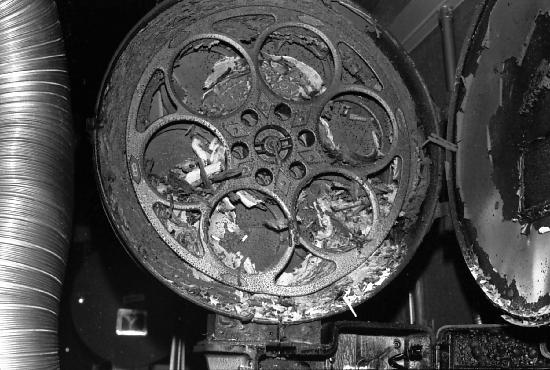
Plus, I saw a pix of another XL with its respective magazine and that did suffer damage due a nitrate fire and wonder if these rollers actually do the job needed.

I wonder if their XL's have the fire douser installed in them with the trip hoop.
 
Posted by Steve Guttag (Member # 268) on 04-08-2009, 12:34 PM:
 
Fire rollers have never been 100% effective. They don't completely cover the film or they would scratch. I've heard of instances where they have worked and seen where they have not.

As to the fire shutter ... that is a good question...I'd hope it was there but many do not have the trip still installed...for Nitrate, it should definitely be there.

Steve
 
Posted by Bill Enos (Member # 440) on 04-08-2009, 02:33 PM:
 
Briefly trying to control the fire, I have been told means that one of the "skilled projectionists" opened the magazine, one of the biggest absolutely don't do's in running nitrate. It should burn inside the magazine, opening the mag. allows the fire to escape and further endanger the building and public.

My question is, After the first few minutes and the OOOOH and AAAAHH factor is over, a nitrate screening is no different than any other. It doesn't make the movie any better, won't make a bad movie good, so is it really worth the risk? My opinion says no, especially in a theatre such as the Stanford where so much else is put at risk.
 
Posted by Joe Tommassello (Member # 4632) on 04-09-2009, 04:01 PM:
 
Bill - couldn't you say the same about HD television vs. standard? The first time I watched "Adventures of Robin Hood" on an HD disc I did indeed get over the "ooohhs and aahhhhs" quickly but little subtleties would catch my eye occasionally that I never noticed before - even after seeing the film maybe a dozen times. Maybe some wall decoration in the background or the actual texture of a particular fabric.

The first time I watched "Gone With The Wind" on my 35mm print I noticed shots of Vivien Leigh in which she had acne pimples covered up by makeup. Not a major plot point but it adds a greater sense of realism.
 
Posted by Ian Parfrey (Member # 5122) on 04-09-2009, 04:26 PM:
 
Does anyone remember the BTH projector model that used a frame or two of nitrate film held under spring tension which was connected to a cutoff switch and two guillitenes-one just below the feed spool-box, and one just above the take-up spool box? I recall seeing a photo of this projector in a projection book recently. I will try to dig it out and post.

This type of simple idea seems like an ideal situation to prevent any further fires of this sort. It would indeed be a sad day if nitrate screenings were to be legislated out of existance because of one fire.

Technicolor dye transfer nitrate does look superb. It seems strange that with all our modern chemistry, we really can't match what was done 50-60 years previous.

These people at the Stanford should be applauded for taking the risks involved to exhibit these films to a new audience. They are keeping alive an aspect of "film-done-right" that may soon be lost forever.

Cheers
Ian
 
Posted by Bill Enos (Member # 440) on 04-09-2009, 06:53 PM:
 
Maybe a partial alternate to running brittle dried out, shrunken 60+ year old nitrate would be to persuade a manufacturer in a third world country with few or no safety regulations to make some new nitrate film to print old films on. The "look" could be preserved and projection would be safer from new film that would be a lot less likely to break or tear. Of course the prints would probably have to be made there too.

How are nitrate prints transported? UPS FedEx and the USPS won't touch it, can't go by air at all, none of the trucking companies I've contacted will take it. Private courier? Pack mule?

[ 04-09-2009, 10:04 PM: Message edited by: Bill Enos ]
 
Posted by Ian Parfrey (Member # 5122) on 04-09-2009, 10:54 PM:
 
....and we all have our own opinions.
 
Posted by Jack Theakston (Member # 4484) on 04-10-2009, 01:08 AM:
 
It would be a waste of time, and a risk of safety, Bill. As I've previously alluded to, it is not the BASE of the film that makes those images look so good, but good labwork, direct printing from the camera negative, and most of all, the way the cinematographer shot the film in the first place.

Comparing a nitrate film from 1945 to a film from today is apples and oranges-- one is a 1st gen print utilizing the entire image area, whereas the new print would be blowing up the 1.85 area (and therefore grain) while having been generated off of a 2k negative.

Instead of romanticizing the stock, which will get you no where, we ought to be pushing labs to take more care in the printing of intermediates and final releases. While at Technicolor, I saw many a trial run off the OCN. The sharpness and color of those prints put the modern release print to shame.

PS. FedEx still ships cellulose nitrate, but you have to fill out a hazardous materials form.
 
Posted by Rick Raskin (Member # 1561) on 04-10-2009, 07:14 AM:
 
I recently helped a collector in Seattle, WA donate a nitrate print to the Library of Congress Packard Center in Culpeper, VA. According to the collector "if anyone else needs to ship nitrate, best bet is to go to FedEx and consult with the person who handles dangerous goods to make sure the paperwork is correct". According to the nitrate vault manager at LOC, the film is complete and in pristine condition.
 -
 
Posted by Stephen Furley (Member # 1277) on 04-10-2009, 09:14 AM:
 
Rick,

Was that print from the Film-Tech member who was trying to determine whether it really was nitrate about a year or so ago? I can't remember who it was now, or are there suddenly several nitrate prints of this film in circulation?

This is from my 16mm print of the film:

 -

It's an old print, I think from memory it's on Diacetate, and the picture quality is pretty good. The sound quality is another matter, but then it wasn't that good on the 35mm version either.

BFI web page on the film

Three clips, and the whole film are available via links from that page, but only to registered UK educational and academic institutions.

A few months ago the BBC broadcast a radio programme on the British documentary film movement. The programme featured interviews with many of those involved in the movement in the '30s and '40s. I'd like to quote a few lines of what Harry Watt had to say about 'North Sea'

"We had no conception of doing anything but using the real people; this was very important, we never thought of actors, and I cast 'North Sea' in the Labour Exchange, in Aberdeen. I sat there as an employer, and this is a terrible comment on acting. I sat in the background, and of course it was depression time so there was a chap at the desk there and people came up and if somebody came up and said 'Any work?' and they said 'No' and he just turned and went away, then he wasn't an actor, but if he came up and said 'Any work?' and they said 'No', and he said 'Look, I'm the best deck-hand in Aberdeen, and I've got my own gear and the last time we went out and caught record catch and I'm lucky ...', and was in point of fact a Bullshit merchant, he was an actor. So then, in the back, and had a talk with him. And I cast the whole thing. We hired a trawler; we were so hard up that we went out and fished, and sold the fish towards the film to make a few more bob."

Is this true, or was Harry Watt a 'Bullshit merchant' too? I don't know, but it's a nice story.
 
Posted by Rick Raskin (Member # 1561) on 04-10-2009, 03:35 PM:
 
Stephen,

I don't think the Seattle collector is a film-techer. The discussion came up on 16mm site a while ago in This Thread.
I'm hoping they will screen it at one of their regular public screenings. I've been to their theater and its like a mini movie palace that can show anything from 70mm on down. Steve G. did the install.
 
Posted by Stephen Furley (Member # 1277) on 04-10-2009, 04:03 PM:
 
Take a look at the 'Film is nitrate... now what?' thread in the film Handler's Forum. Right city, right state, sounds like it could well be the same print.

I remember Steve posting a picture of the place while under construction; Kinoton machines still under wraps. It would be interesting to see some pictures now it's finished.
 
Posted by Rick Raskin (Member # 1561) on 04-11-2009, 09:11 AM:
 
September, 2008 at a screening of "Snow White". The projectionist is staffer Dave Marsh.

 -
 
Posted by Steve Guttag (Member # 268) on 04-11-2009, 09:38 AM:
 
September? Really? I don't think the booth was operational then.

Steve
 
Posted by Demetris Thoupis (Member # 833) on 04-11-2009, 09:42 AM:
 
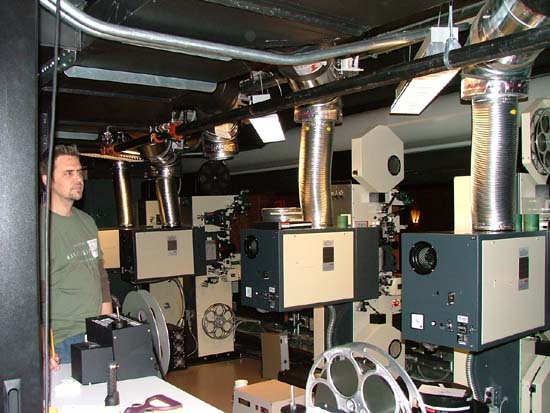
Those Kinotons look good
 
Posted by Steve Guttag (Member # 268) on 04-11-2009, 02:09 PM:
 
Yeah, its nice having four film projectors for just one screen [Wink]

I'm fortunate enough to service two such installations.

Steve
 
Posted by Rick Raskin (Member # 1561) on 04-11-2009, 02:10 PM:
 
September 20, 2008 was an open house for family members of LC staff.
 
Posted by Stephen Furley (Member # 1277) on 04-11-2009, 04:08 PM:
 
I'm a bit surprised not to see a digital projector; is one going in that space in the centre? Even if they won't normally be running feature films digitally I would have thought one would be useful during events such as lectures and on-stage interviews etc.

Five projector positions, even if one of them is empty at the moment is a lot to fit in. How long is the throw there? Are they using offset lens holders; they don't have the horrible amount of inward horizontal tilt (that's not the right word is it, but you know what I mean) that I've sen in other places with that number of machines. Do they have any other projectors, video, slides?

How are they handling the sound from that many machines? Multiple processors, switchers, patch panels?

Pity it's a long way from me, I'd like to see the place. I've seen pictures of the auditorium and it looks nice.
 
Posted by Steve Guttag (Member # 268) on 04-11-2009, 05:44 PM:
 
The space in the middle is indeed for a digital projector...it was futured for the moment and one can be put in on a temporary basis if an event so dictates, for now.

The sound...why the greatest cinema processor of them all...the Dolby CP200...it even does Surround-EX in-house.

If you do make to the mid-Atlantic area... go to the AFI/Silver too...it also has 4 film projectors and one digital.

The throw at the LOC/Packard is short...about 66 feet. All lenses are mounted in Schneider PC-Cine adapters to minimize keystone artifacts but machines 1 and 4 are clearly at the most disadvantage. Note, the pairs are grouped on either side of the center rather that opposite of center. That is, the 35/70s are in the #1 and #2 position, the 35/16s (nitrate) are in the #3 and #4 position. This was done to minimize any perceivable perspective shift on changeover. It works pretty effectively. One should never changeover between 1st and 4th position as a rule (in any theatre). If Kinoton made a 70/35/16 all from one side (not like the DP-78), that would have been the way it would go and would have been much preferred...less compromise.

All four machines can run all of the common 35mm formats

For more perspective...here are projectors 3 and 4 running 16mm simultaneously (looking back at the projectors from the theatre)

 -

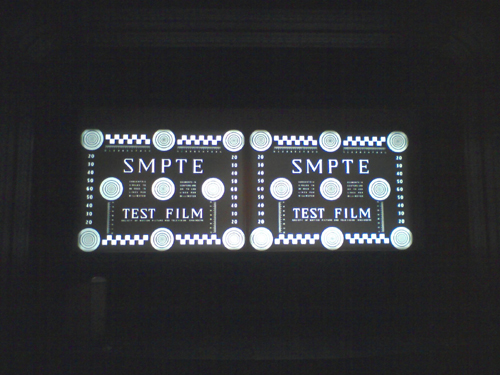
Now here is what it looks like on screen (the target is SMPTE 16RT as defined in RP20)

 -

Note, projector #3 is showing on the left edge of the screen, projector #4 is showing on the ride side. All of the image manipulation was done with the PC-Cine adapters just like one would do with lens-offset on a digital projector. The projectors are not re-pointed when they go between side-by-side and single projection.

Note, these images were taken with my camera phone so they are not the greatest to begin with but you can get the idea.

Steve
 
Posted by John Eickhof (Member # 323) on 04-12-2009, 09:17 PM:
 
Just so you know..I personally reconditioned the projectors and soundheads that were installed in the Stanford over 20 years ago. The heads are XL and they were reconditioned and had all the factory fire apperatus re-installed and tested. ( including the lensholder seals) At the time of the installation ( Done by Mac Wurtsbaugh and a SF Local Projectionist ) Theye were fully operational and tested well. The trap loop trips were new, there were new fire trap rollers in both the feed and take up magazines. They have Peerless Magnarc lamps running 8&9mm sticks. The booth was equipped with modern 'Cookson' automatic fire shutters, not the old standard drop & run shutters. ( Mainly because there are ports that exceed the max 144 sq. in size for spot lights etc.) The rule when they opened was to have two operators in the booth at all times, the film was rewound and stored in an adjacent room (the original generator room) and that was also the second fire exit. I have watched many silent nitrate prints there through the years! I have always been afforded an excellent presentation! Mr. Packard spared no expense in making it the most up to date, safe, and functional theatre. I am proud to have been a part of it. And for those who have never seen a nitrate print, I can't describe how beautiful the Wizard of Oz looked on opening night at the Stanford! I could not begin the give you a count of how many reels of nitrate have been shown to this day, but like anything else, it's a matter of odds when something can or will go wrong! I talked with the Tech, an old friend of mine ) who went in the next day and upon cleaning up, the machines are in great condition and the fire safeties work fine too!; When I was young I was shown by an old operator to reach in and quickly tear the film either below or just above the fire trap rollers, thus cutting off the film connection from the trap to the feed reel, I had actually seen him perform this task a couple times while projecting nitrate! He always told me to stay right there with the machine! He had E-7s so it was not as easy to see if the film had a problem, like it would be in an XL! I am glad they are up and running again!
 
Posted by John Hawkinson (Member # 1135) on 04-12-2009, 10:10 PM:
 
It does seem like the lesson here is to think about drainage. Apparently nobody ever tested the fire suppression system (stands to reason, soaks the booth!), but if they had, they'd have figured out this water problem.

Engineering systems is hard.

--jhawk
 
Posted by Philip Krikau (Member # 4616) on 04-14-2009, 03:26 AM:
 
I am the chief projectionist at the Stanford Theatre in Palo Alto and have been for the past 18 years. We have Simplex XL's that were rebuilt by the designer himself Howard Straight who has since passed on. In 1996 we removed the inadequate Peerless Magnarc's for the larger Strong rotating positive 35/70 Specials.
These were found at the Warfield in San Francisco and rebuilt.

On the night of the screening of "Cover Girl" the print I believe, combusted in the aperture starting the flaming trail to the feed sprocket and within seconds went to the upper magazine. My training taught me to bail out once a fire starts and not to play hero as we all know that the ramifications of such a fire are immense. The fire which was by no means small was tremendous. Amazingly enough, only the upper magazine was destroyed with the Ampex mag head sustaining the rest of the heat. The projector in the upper feed area had some scorching but is able to still function. The sprinkler system while it did nothing to extinguish the fire itself, prevented the rest of the booth from going up. It is true that a lot of water was dumped into the theatre but this being the first time, left us with no experience as to how to shut that off.

Nitrate film does not improve with age and we will begin an intense discussion on how best to prevent this from happening again. Comments made on this site range from the sublime to the ridiculous. It is true that the film company had a safety print of Cover Girl but the color and clarity didn't even come close to the nitrate print we had. One would have to see it to understand. And to suggest as someone wrote, that they could play a nitrate print on a platter just boggles my mind.

Any comments or questions will be gladly answered here.
 
Posted by Brad Miller (Member # 2) on 04-14-2009, 03:29 AM:
 
Sometimes people's minds NEED to be boggled. Separating the film into a different fireproof room with film choppers and fire rollers, whether it is on 1000 foot reels or on a platter would be far safer than leaving the reels on the projector. Also in the event of a fire like this, only maybe 20 feet would have been destroyed instead of burning the entire reel and making a bigger fire.

Do the math. The concept is far from ridiculous. It is much smarter than the way you have been running nitrate. Are you really incapable of seeing why?

Just because someone has been doing something for a long time a certain way doesn't make it the best way. Technology is your friend. Use it.
 
Posted by Monte L Fullmer (Member # 2797) on 04-14-2009, 04:49 AM:
 
What I'm curious is the removal of the Magnarcs. Was is due to the age and wear and tear of the transmission that couldn't keep the "8's and 9's" aligned up with the lampcard?

I ran a theatre similar with this above setup (XL's with Magnarcs running the same size of arcs) with a 55' throw...and we had great light hitting our silver screen.

Thus, using those higher 35/70 Strong units, I wonder if the mirror was slightly out of focus where the film got to hot-why it combusted in the trap, or was it just fate that a small secton of film had a weak spot to let go like that.

Has this film been ran before, or first time on the screen?
 
Posted by Bill Enos (Member # 440) on 04-14-2009, 10:19 AM:
 
Time will be the ultimate determining factor in exhibiting from nitrate film. Eventually all the available prints will be worn out or in such poor condition or missing reels that even marginally safe projection in a public space will be impossible. Any guesses as to how long that will take? How many presentable prints of nitrate films are out there?

After an event such as the Stanford fire, does the theatre have to pay for the destroyed reel or does the owner of the film accept the risk the same as the theatre?
 
Posted by Sam D. Chavez (Member # 1841) on 04-14-2009, 10:33 AM:
 
Monte,

Throw's got nothing to do with it. I know you know this but this is one of my pet peeves. It only the size of the screen that matters.

You said silver screen right? The Stanford is a Matte.
 
Posted by John Hawkinson (Member # 1135) on 04-14-2009, 10:46 AM:
 
Brad, maybe since there's a lot of emotion here, it might be a good idea to seperate the proposals on how to platter nitrate elsewhere into another thread?

In any case, I think the fear with your proposals are:
Philip: Thanks for stepping forward and telling us what happened to you. It sounds like a harrowing experience! Chin up!
--jhawk
 
Posted by Brad Miller (Member # 2) on 04-14-2009, 11:04 AM:
 
John, I am aware of how many people are scared of platters even for regular safety film stock, but you cannot tell me that putting two 1000 foot fireproof magazines in an adjacent room equipped with double (if you want) choppers on the leading side of the walls (feed and takeup) with 10-15 feet of distance from the projector to the wall is anything but tremendously smart for running nitrate. You know how slow the film burns. In such a situation a projectionist could even simply sit by the wall where the film enters and exits the booth via the tiny slots in the wall with fire rollers (even a second set if you like) and through film choppers AND keep a pair of scissors in his hands to boot. Fact of the matter with such a design, there would be tons of time for the projectionist to cut the film himself if he didn't want to rely on some form of automated film cutter, it would put the projectionist's life at less of a risk and virtually guarantee that only a few feet of the print would be destroyed (which unfortunately can not be said for the print that ran in this incident).

I am not saying the Palo Alto guys did anything wrong, but the fact remains that just because this is "the way its always been done" is NOT necessarily the best way it could be done. I will draw you a picture if you still don't get it.
 
Posted by Philip Krikau (Member # 4616) on 04-14-2009, 11:23 AM:
 
My experience with people who've gone on before me and that are still present who ran nitrate is that fire rollers or choppers as Brad likes to call them, work only half the time. They didn't work for me. The flame worked itself right up to the magazine. Imagine that happening on a platter. I shudder at the thought.
 
Posted by Monte L Fullmer (Member # 2797) on 04-14-2009, 12:29 PM:
 
Sorry Sam, I added the throw out of habit. Our screen size was 35 feet wide when the side tabs were open for scope.

We had silver due to early 3D presentations...and just kept the screen up since.

-Monte
 
Posted by Steve Guttag (Member # 268) on 04-14-2009, 01:01 PM:
 
Bill,

You'd be amazed at the amount of projectable Nitrate film still available...and I mean millions upon millions of feet!

Philip...you are misinterpreting what a chopper is...it is what its name implies...it CHOPs the film like a spring loaded pair of scissors.

What Brad is proposing is basically increasing the time available to break the film once the fire is started...you are still only putting one reel on the platter but you are putting that reel at a greater distance so you have time to either manually or automatically cut the film before the fire reaches the rest of the pack. With conventional reels/magazines, there is not enough time to respond and you are at the mercy of the fire rollers which, work some times. Imagine if you had 20-feet of film between the projector and the reel...in that 20-foot path you have have a spring loaded film cutter (chopper) that if either fire system went off or you manually pressed a button (heck we could even make it tension related...if the system looses all tension for over a second or two, CHOP)...this would keep the fire from ever reaching the rest of the pack...the fire would be over in mere seconds as it would run out of fuel.

Note, it does not have to be platters...just locate torque motor reels, in magazines, at a sufficient distance from the projector/soundhead such that there would be time to break the film in some manner.

And I'll repeat...I've never seen a safety version of a print compare favorably to its Nitrate counterpart. Some may call it lab work but I think there is more at play there...again, my experiences, other experiences may vary and I'm okay with that too.

Steve
 
Posted by Monte L Fullmer (Member # 2797) on 04-14-2009, 07:26 PM:
 
...and to add to this: have tonnage of updraft ventilation to carry the fumes and smoke straight up and out of harms way - to even have an exhaust hood over the setup.
 
Posted by Brad Miller (Member # 2) on 04-14-2009, 08:37 PM:
 
Thank you for explaining that Steve. Surely Philip can follow your more lengthy explanation of the proposed AND MUCH SAFER setup. (My design always had in mind a "lack-of-tension" automatic chopper action, but a projectionists could always sit on a barstool beside the "wall" with a pair of scissors in his hands too.)

Philip, where you interpret "fire rollers" out of the term "chopper" (made by Kelmar Systems I think) I have no idea. Regardless you could stand to learn a lot if you care to read the posts here carefully in the future.
 
Posted by Sam D. Chavez (Member # 1841) on 04-14-2009, 09:04 PM:
 
Brad,

You have a good idea but getting local fire inspectors to approve anything new sounds like a nightmare. They go by the book like a traffic cop.

I would only agree to one of these systems if it were in a completely different room and most Rep houses are in crowded older booths with no space for a platter or film room.

Then there is always the possibility the film on the platter will go up for some entirely different reason than the film aperture lighting the film. A platter speed control, motor fire, who knows?

Nitrate vaults have been known to go with up with no documented ignition source. There's a good reason magazines have doors on them.

Imagine a platter with a metal cover.
 
Posted by Gordon McLeod (Member # 33) on 04-14-2009, 09:38 PM:
 
Phillips used to have that chopper built into some of there heads and the GK21 had a system built into it as well
 
Posted by Brad Miller (Member # 2) on 04-15-2009, 02:52 AM:
 
Sam, A platter with a magazine cover would be pretty funny actually.

I would have thought your first two points would be obvious enough that they would have been a bit of a "well duh", but in hindsight you never know who is reading this stuff and how they are interpreting it.
 
Posted by Steve Guttag (Member # 268) on 04-15-2009, 06:49 AM:
 
Again...loose the "platter" visual. Now replace that with a pair of magazines driven by torque motors...okay...now we are talking about the SAME apparatus that looks familiar...the only difference is that we are separating them from the projector so that one has time to cut the film (manually or automatically) before the rest goes up.

They need NOT be in another room anymore than the print needs to be in another room (not according to federal code...you local codes WILL vary). There is no particular danger in having strips of film exposed for that 20-feet because it is a very limited fuel source and could not catch anything else on fire unless the path was right below a flamable object. Heck, you could use a common wire trough as a film path to the magazines.

It is something worth considering. It would reduce damage to theatres, people and even the film itself.

Steve
 
Posted by John Hawkinson (Member # 1135) on 04-15-2009, 07:11 AM:
 
Brad said to me, "You know how slow the film burns."

Actually, embarassingly, I don't really know how fast nitrate burns. I've only ever burned 1-perf wide cuts of nitrate, never a 35mm width of appreciable length.

How fast does a strip of nitrate running across the room burn? Naively I would guess something like 10 meters/second, but are you saying it's a lot slower?

--jhawk
 
Posted by Bill Enos (Member # 440) on 04-15-2009, 09:44 AM:
 
I've had nitrate that burned a 6 ft 35 mm strip in a couple of seconds and I now have a small roll of unexposed 70mm unperforated that burns only slightly faster than paper. Big difference, but what makes them different? The 70mm is dated 1945, the super fast 35mm was from a few years later.
 
Posted by Stephen Furley (Member # 1277) on 04-15-2009, 09:59 AM:
 
quote: John Hawkinson
How fast does a strip of nitrate running across the room burn? Naively I would guess something like 10 meters/second, but are you saying it's a lot slower?

It burns pretty fast, but not that fast; I was going to say about half to one metre per second, so that seems pretty close to Bill's 'fast' sample. I don't know why the 70mm sample should be slower; if it's that date then it's too new for Fox Grandeur, and too old for Todd-AO, so I'm guessing it was for some sort of still photography, and the fact that it's unperforated also tends to point that way, possibly some sort of small wartime aircraft camera or something. This wouldn't need to be as tough as cinematograph film, so maybe it wasn't normal nitrate, but a mixture, as I believe the Pathe 28mm film was, to reduce the hazard.

I've only ever burned short sections to test the fire traps on projectors before running nitrate film. (Not in a public cinema).
 
Posted by Philip Krikau (Member # 4616) on 04-15-2009, 11:10 AM:
 
Take it from me it burns fast. Too fast for some chopper to catch.
 
Posted by Steve Guttag (Member # 268) on 04-15-2009, 11:31 AM:
 
It only seems to burn fast when just a foot or two is what is you have to work with. That is, with just a typical set up...in less than 2 seconds, it is in the magazine...pretty fast.

With 20 or more feet you have closer to 20-seconds to react...the chopper would certainly work. Especially if the design was layered to have both manual and automatic means of chopping the film.

Steve
 
Posted by Monte L Fullmer (Member # 2797) on 04-15-2009, 01:26 PM:
 
..and why it burns fast since the film path is vertical and fire loves to climb upwards since the fuel to supply it is greater.

But, you run that film horizontal and the flame has to actually "hunt" for fuel to keep ignited, thus the flame travels slower.

You light up a wood match and hold it head down and see how fast that stick goes up in flames compared to holding the stock at a horizontal level.

You would then construct a 'roller tray' system to keep the film horizontal, so if the film does torch up, the rollers won't allow the film to drop to a vertical position to allow it to torch faster...and in this tray assembly is where the 'chopper' mechanisms can be placed. And this assembly can be completely covered with a opening side panel for threading.

-Monte
 
Posted by Jack Theakston (Member # 4484) on 04-15-2009, 03:14 PM:
 
Monte is correct. The orientation of the film means everything. Horizontally, nitrate burns no faster than a strip of paper (and will actually go out under most circumstances). Burning UPWARD, it's just like matchstick.

The actual rate of burning for nitrate horizontally is quite slow-- about 2 to 3 seconds/foot, ample time for the operator to simply rip the film with his bare hands, or even snuff the flame out with his fingers.
 
Posted by Rick Raskin (Member # 1561) on 04-15-2009, 03:36 PM:
 
I got news for you, by the time you realize what has happened it'll be inside the magazine. There is a reason magazines had doors.
 
Posted by Brad Miller (Member # 2) on 04-15-2009, 04:35 PM:
 
Guys, the SPEED of the burn is everything. Since in this concept the film would be fed and taken up from FULLY ENCLOSED FIREPROOF MAGAZINES in an adjacent FIREPROOF room, the film would be traveling horizontally and the speed of a burn horizontal is quite slow. There would be PLENTY of time for a projectionist to walk over and physically CUT/CHOP the film by the wall before it ever even tried to get through the fire rollers in the wall and then through the fire rollers in the enclosed magazines in that adjacent room.

What I was proposing most specifically was to use the "chopper" (yes this is a product) that is designed to mount on a platter and cut the film in the event of a brain wrap, but to set it up in reverse so that once the tension was lost (meaning the film broke or caught on fire...which is also a "break") the chopper would come chomping down on the film at 10-15 feet away from the projector. No human could possibly react as fast as this device would enable the film to be cut...and to be cut from a safe distance.

It would work VERY elegantly and be significantly safer. I understand that there are lots of people who just cannot make their brains reason and use logic toward new ideas, but try. Even if the "fireproof room" was only a steel fireproof box just big enough to hold a 2000' fireproof magazine inside of it and the box hung on the wall, the concept is still amazingly smarter than running with a reel of film mounted to the projector.

The flames from a fire burn fastest upward. Take a piece of paper and light it from the bottom as you hold the paper vertically. How long were you able to hold that paper until you had to drop it? Now do the same but hold the paper horizontally and light it from one end. This isn't rocket science. [Roll Eyes]
 
Posted by Tony L. Hernandez (Member # 3524) on 04-16-2009, 03:11 AM:
 
Ironic, I just ran a nitrate short a week ago last night. It was a special showing of a 10-minute short and the first time I have run nitrate or seen it on screen. There is a hands down difference between the way nitrate and safety film look...weather or not this indeed has something to do with the stock or the lab work of the time is something I do not know enough about to speculate on. The print was from 1939 and in almost perfect condition considering its age..even when gently bent it did not break or tear.
I have projected countless prints over the course of my life and have yet to see one break or "jam" (I still do not know what is meant by the term "jam") in the gate. The only breaks I have had have been on very old, brittle prints and they usually break right above the take up. When I build prints, I always let the film run thru my fingers so that I can feel for any tears or damage and repair it before I run the show.

I don't feel there is much to fear with nitrate so long as you take adequate precautions. In the case of a feature, I would have three people in the booth...one operator sitting right next to each machine and a "helper" rewinding, checking sound in the auditorium and bringing the operators the next reel of film after changeovers so that the operators never left the side of their machine.
In the case of my little short, I just sat next to the projector the entire time with my hand on the dowser.
Some have said "why run nitrate at all?" I would agree except for the fact that when you are dealing with classics, sometimes that's all you can get. In my case, that print was once of a kind. There was no safety 35mm print, 16mm print or DVD copy to be used.

Weather or not Brad's platter idea is any good or not seems to be a moot point. Every year that passes, there will be less and less nitrate prints. That said, they are hardly ever run right now. So why bother constructing/inventing something that may get used once every couple of years? With all the diverse and specialized projection work I've done, that was my first nitrate print and I would imagine my last.

[ 04-17-2009, 06:10 AM: Message edited by: Tony L. Hernandez ]
 
Posted by Brad Miller (Member # 2) on 04-16-2009, 03:23 AM:
 
So you just had your hand on the douser, eh?

 -

...then again, maybe you are. [Roll Eyes]
 
Posted by Tony L. Hernandez (Member # 3524) on 04-16-2009, 03:41 AM:
 
I take that as an insult. Don't know what else I should have had my hand on. I was not terribly concerned seeing as I had inspected the print previously and it was in perfect condition, as I stated above.

A nitrate fire will start when the film breaks or stops in the gate, right in front of the light source. Hence, that is why I had my hand on the dowser. Should I have seen or heard anything go wrong (I had my eye on the projector at all times), I would have shut her down. I don't know about anyone else, but my reaction time is pretty damn fast.

Every last one of us, weather we drive or take a bus, ride around with a huge tank of very flammable gasoline right underneath our behinds. Some of us commute long distances...I personally drive about 100 miles round trip almost every day of my life. Should we all either walk, bike or convert to horses so as to stay away from this flammable, dangerous substance that will burn and explode should anything go wrong? [Confused]
 
Posted by Brad Miller (Member # 2) on 04-16-2009, 03:55 AM:
 
Once the film ignites for any reason, you can close douser or even do a quick rain dance if you like, but the fire at that point has been initiated and that's the end of it.

Were you running this in a proper facility, meaning nitrate-certified environment, or was this at a regular theater or at home?

At least you didn't get hurt.
 
Posted by Tony L. Hernandez (Member # 3524) on 04-16-2009, 04:27 AM:
 
I understand and respect that fact however every bit of training, research and reading I have done has indicated that the only way nitrate film will ignite is if it breaks or stops in front of the light source. I have also heard tales of it spontaneously combusting but this was not a large concern since the print spent a grand total of 1 hour in my booth and the time it was not on my bench or in my projector, it was in an steel vault with asbestos interior lining built for the nitrate days.
This showing occurred in a theater (a specialty theater) with sprinklers above each projector, although if we were to run nitrate more often, would need further upgrades.

There was indeed some risk involved however I did personally assess and judge the print prior to showing and if it had been in any condition less that it was, I would not have run it. Would I run a nitrate feature by myself in that booth? Most likely not. Would I run a nitrate short every month? Hell no.
All things considered, it was a gamble but a very, very small one. Nitrate has been dead for 56 years so I would be surprised if I ever even hold a nitrate print in my hands again in my life.
 
Posted by Stephen Furley (Member # 1277) on 04-16-2009, 08:01 AM:
 
quote: Brad Miller
Once the film ignites for any reason, you can close douser or even do a quick rain dance if you like, but the fire at that point has been initiated and that's the end of it.
But it's still a good idea to keep a hand on the douser; if the film should jam, or stick in the gate, and you close it very quickly, and then kill the arc, you may keep enough heat off the film to prevent it igniting.

If the film does ignite, and the flame gets past the fire traps, so that you've got a whole reel on fire, forget whatever the rules used to say about shutting down generators and that sort of thing, make sure the shutters have dropped, any fire suppression system has activated, if not, pull the manual release, shouldn't take more than a second or two, and then get out.

Interesting thoughts about moving the reels away from the machines.
 
Posted by Louis Bornwasser (Member # 3063) on 04-16-2009, 11:51 AM:
 
Yep: it burns very slowly. . . . .but then it hits a reel that is tightly wound. At that point it burns so fast that it is almost an explosion.

I have seen the film clip of an underground bunker that was deliberately "set." From start to finish the flame only burned 20-30 seconds. Looked light a rocket engine test in Florida. Louis
 
Posted by Monte L Fullmer (Member # 2797) on 04-16-2009, 01:23 PM:
 
Instead of a hand on the douser (prob the lamphouse damper handle), I'd have a pair of scissors open at the end of the upper magazine ready to snip.
 
Posted by Stephen Furley (Member # 1277) on 04-16-2009, 01:50 PM:
 
One is useful before the film has ignited, to try to prevent it from doing so. The other may be useful, if you've got time, (which is where Brad's idea comes in of course, and I can see things both for and against it) if it has ignited, but the flame has not passed the fire trap and reached the feed reel. If the whole reel is on fire then get out; the fumes from burning nitrate are toxic and corrosive. In a confined space, like a typical nitrate-era box, you could be overcome by them if you don't get out.
 
Posted by Phil Hill (Member # 371) on 04-16-2009, 02:14 PM:
 
I don't know why y'all are getting your panties in such a tightwad. From his posts, I'm sure Tony is a highly knowledgeable and skilled projectionist and had taken ALL the necessary precautions and steps to allow the projection of nitrate film in a group "A" gathering venue whether for just himself or for an audience:

1) Film magazines w/doors and fire traps.
2) Permission from the theatre owner.
3) Fire Dept permit to store, handle and/or show nitrate film prints in a group "A" gathering venue...empty or not.
4) Took out the required additional insurance for liability and the theatre to avoid a claim rejection should anything go wrong.

...etc.

.
 
Posted by Tony Bandiera Jr (Member # 2365) on 04-16-2009, 02:26 PM:
 
I agree with Phil, lighten up people. [Big Grin]

I am currently working with a film archive lab and they handle and project nitrate a lot..it's NOT that big of a deal. Use some common sense and take precautions and you'll be fine. Most important thing is to carefully inspect the film for torn perfs or bad splices, run the lowest wattage on your lamps top get an acceptable image, make sure the gate and trap are spotlessly clean so no buildup of emulsion, etc. can cause issues..and stay right at the machine at all times.

We all have to keep in mind that for many years, nitrate was the ONLY game in town...and yes there were tragic accidents, but there were also hundreds or even thousands of shows WHERE NOTHING WENT WRONG. And there have been cinema fires and accidents (although not because of the film) since.

I also posted on a thread here a few years back about an experiment I did which had surprising results: take a single frame of modern safety film and light it with a match or lighter, holding it vertically. It will burn like flashpaper!! Do the same with a single frame of nitrate, and it will actually burn SLOWER than the safety film. (I repeated the test with a soldering iron to kinda duplicate radiant heat from a lamp..the results were as expected, i.e. the safety film charred and melted but did not flame, and the nitrate did catch to flame.)

I do like Brad's idea.. as he pointed out, the horizontal burn of nitrate is slow enough that someone could react to cut the film in plenty of time, automatic chopper or not. I for one would not hesitate to run a full feature platter (yes I said full feature platter) of nitrate using the setup Brad describes.

I do like the suggestion someone made about mounting rollers into a wiring gutter to cover and protect the film in transit. I would however put a heat-proof glass cover on it so the film can be observed at all times though.
 
Posted by Phil Hill (Member # 371) on 04-16-2009, 03:25 PM:
 
Tony (Bandiera), I think you missed the point of my tongue-in-cheek post...
 
Posted by Tony L. Hernandez (Member # 3524) on 04-16-2009, 04:18 PM:
 
Oh, I'm sure he got it. It was more like tasteless sarcasm than tongue-in-cheek. Remember, one catches more flies with honey than they do vinegar.
I don't know why I am being bombarded with all of the catty comments rather than the polite advice, criticism or agreements forums of this nature were created for.
It all boils down to this: 1. The event that I am being torn up over happened in the past, nothing can be done to change anything about it now. 2. Everything went perfectly 3. It was at my theater and in the end, it is my decision what happens there.

Back in, lets say, 1935, every town with as little as 300 people had a movie theater and they were well attended do to the absence of television sets. Every last feature, short and newsreel was run on nitrate in that era.
So when you consider that huge number of theaters and the number of nitrate showings and the ratio to the number of nitrate fires, I'd say that the nitrate panic is way over done. I'm not saying that nitrate is not a hazard, but I think that everyone needs to mellow out.
 
Posted by Phil Hill (Member # 371) on 04-16-2009, 04:25 PM:
 
Well Tony, DID YOU do what was outlined in my post? Somehow I doubt it.

Bottom line, get over youself and OFF your high horse. Hopefully you'll grow up to be a REAL/REEL man instead of a wannabe.
 
Posted by Tony L. Hernandez (Member # 3524) on 04-16-2009, 04:41 PM:
 
I'm not going to personally patronize you by explaining what I may have done or may not have done.

I think it is you who is on the high-horse judging an event and a person (myself) that you know nothing about.
If you are judging my status of being a "REAL/REEL man" by my posts, which you must since you know nothing about me outside of Film-Tech, I find that quite laughable considering that in my 4 years of being registered on here and 2 years before that "lurking", I have yet to see you make any useful contributions to the forum.
 
Posted by Phil Hill (Member # 371) on 04-16-2009, 04:54 PM:
 
Yawn...

OBTW: You didn't post a public answer to the questions I raised...

Yours in Christ...
 
Posted by Tony L. Hernandez (Member # 3524) on 04-16-2009, 05:06 PM:
 
Okay, here ya go:

The only parts of your "specifications" that did not occur during the showing were the last two. They are explained in the order that you posted them:

3. No such permit was required in the town where this was screened, hence none was obtained.
4. Ya may have got me here. However none of the involved parties saw this as necessary considering the print was to me in our possession just under an hour and it is something that hasn't occurred before and likely will not again.

I really don't want to exchange attacks with you, Phil. I have no idea what initially brought it on anyway. Its very childish. Let's either exchange polite advice and comments or just ignore each other.
 
Posted by Phil Hill (Member # 371) on 04-16-2009, 05:41 PM:
 
Tony, I really have no ax to grind with you. But when I read your apparently uninformed, somewhat arrogant, and potentionely dangerous posts such as yours, I just gotta post a response.

I admit I'm a sarcastic guy, but in all honesty, I'm well known on this site for it.

At any rate, you may want to take the advice of the many people that responded to your post...

I've made my point and I have nothing more to say on this subject..

Good luck to you in the future...
 
Posted by Stephen Furley (Member # 1277) on 04-16-2009, 06:16 PM:
 
quote: Tony L. Hernandez
2. Everything went perfectly
Tony, I don't want to preach at you, but of all the things you say, this one really worries me. I don't know the exact conditions under which you ran this film, and can make no comment as to how great the risk was, nor will I say anything about licensing or insurance.

You say 'Everything went perfectly'; well yes, it probably did, nitrate fires are rare events and were not common even when there were thousands of theatres running the stuff every night. 99%, maybe 99.9% of the time if you run a nitrate print you'll get away with it, and nothing nasty will happen. However, there is a risk, you can take various precautions to minimize it, but you can never totally eliminate it; if you run nitrate film there is a risk that it will catch fire, and as Steve has said, fire traps don't always work, so you may end up with a full reel fire on your hands.

Have you seen a full reel of nitrate film burning? If it did happen, are you confident, and is that confidence justified, that no major damage would occur, and more importantly that nobody would get hurt? Maybe you are, and it is, and you could safely contain the fire, as happened in the recent case, I don't know. But 'Everything went perfectly' really isn't the right attitude. You really need to assume that the worst will happen and be sure that you could safely contain it if it did, before you even think about whether you're allowed to run nitrate.
 
Posted by Tony L. Hernandez (Member # 3524) on 04-17-2009, 06:00 AM:
 
Stephen: I understand and appreciate your concern. No, I have never seen a reel of nitrate burn however I have seen pictures of nitrate fires and even burned half a foot of it myself. My comment "everything went perfectly" simply reflected and summarized how that one isolated showing went. And it did go perfectly...that time, at least. I would be a fool to say that I believe or believed that if I fire broke out, that myself or the building would be perfectly safe....fires of any kind are most often devastating. However, my choice, be it wise or unwise, was based on the condition of the print, (which showed no signs of deterioration), the length of the print (10 minutes, 1k feet) and the resources I had on hand. At the time I decided that it was a gamble but a remarkably small one. I imagine that will be the last time I encounter a nitrate print and will not really mind if it is...I do take the risks and precautions at hand quite seriously.
I am grateful for your concern but I hope I have correctly expressed my thought process, be it correct or incorrect. It is often hard to clearly express things in witting.

Phil: I have been told, even by close friends, that my witting style is arrogant. I am not an arrogant person (quite a laid back and open minded person at that) but I believe my writting may reflect that as when I write, I state both facts and my personal beliefs in a very dry, matter-of-fact way. If you were to meet me in person or talk to me on the phone, I'm sure I would come across quite differently to you or anyone else reading this, just as I'm sure you would to me. That's why I made the comment about you knowing nothing about me...frankly, forums and emails suck when it comes to getting to know someone or their true thoughts on a subject.

Let me state to everyone once and for all: I do not shun or disregard the dangers of nitrate or the precautions and equipment necessary to run it. I do think there is a little too much hype about these dangers at times and by some individuals, however I am aware and concerned about these dangers none the less..
I appreciate the concern but I hope I have made my side somewhat clear. I also appreciate the tips and will remember some of them for the future.
 
Posted by Rick Raskin (Member # 1561) on 04-17-2009, 07:49 AM:
 
 -
 
Posted by Frank Angel (Member # 248) on 04-17-2009, 08:34 AM:
 
And Rick has the last word!
 
Posted by Martin McCaffery (Member # 37) on 04-17-2009, 09:03 AM:
 
Is that the AFI Lady From Shanghi fire?
 
Posted by Rick Raskin (Member # 1561) on 04-17-2009, 09:36 AM:
 
It is. In the words of the late great business agent Leonard Sanford, "the night Sidney Herwood and Rick Raskin tried to burn the AFI down".
 
Posted by Martin McCaffery (Member # 37) on 04-17-2009, 09:51 AM:
 
The scortch marks were still in the booth as a warning when I showed the nitrate print of the Claude Raines Phantom of the Opera in the 80's. And it did look really good. Of course, Carl smoking cigars in the booth kept me nervous the whole time;>
 
Posted by Steve Guttag (Member # 268) on 04-17-2009, 09:54 AM:
 
And even after that fire (at the AFI/Kennedy Center)...the theatre continued to run. It was not the end of the world though it was for that magazine.

Steve
 
Posted by Louis Bornwasser (Member # 3063) on 04-17-2009, 09:56 AM:
 
If I were running a 10 minute reel of nitrate under similar conditions, I would have also "taken the risk." (small fire if one at all.) Louis
 
Posted by Sam D. Chavez (Member # 1841) on 04-17-2009, 10:11 AM:
 
This post has gone on for a while. Sort of like moths to a flame, no?
 
Posted by Mark Gulbrandsen (Member # 72) on 04-17-2009, 10:15 AM:
 
Ha... exactly what I've been thinking Sam.... This is just a best case example that you never ever run ANY valualable film no matter what!!

Mark
 
Posted by Rick Raskin (Member # 1561) on 04-17-2009, 10:57 AM:
 
quote: Martin McCaffery
Carl smoking cigars in the booth kept me nervous the whole time
Those guys are all gone now. They were the pioneers in the business and you & I are are among the last of the guys who grew up knowing and working with them.
 
Posted by Tony Bandiera Jr (Member # 2365) on 04-18-2009, 12:38 AM:
 
quote: Louis Bornwasser
If I were running a 10 minute reel of nitrate under similar conditions, I would have also "taken the risk." (small fire if one at all.) Louis
One of the best comments in this thread yet... except of course for mine:

quote: ME
I am currently working with a film archive lab and they handle and project nitrate a lot..it's NOT that big of a deal. Use some common sense and take precautions and you'll be fine. Most important thing is to carefully inspect the film for torn perfs or bad splices, run the lowest wattage on your lamps top get an acceptable image, make sure the gate and trap are spotlessly clean so no buildup of emulsion, etc. can cause issues..and stay right at the machine at all times.

We all have to keep in mind that for many years, nitrate was the ONLY game in town...and yes there were tragic accidents, but there were also hundreds or even thousands of shows WHERE NOTHING WENT WRONG. And there have been cinema fires and accidents (although not because of the film) since.

quote: Sam D. Chavez
This post has gone on for a while. Sort of like moths to a flame, no?
Or the film "Titanic" on a platter. [Big Grin]
 
Posted by System Notices (Member # 2357) on 03-27-2012, 04:30 PM:
 

It has been 1074 days since the last post.


Powered by Infopop Corporation
UBB.classicTM 6.3.1.2