This is topic Speakers on an open stage. in forum Film Handlers' Forum at Film-Tech Forum ARCHIVE.
To visit this topic, use this URL:
https://ft-forum.com/ft/cgi-bin/ubb/ultimatebb.cgi?ubb=get_topic;f=1;t=009834
Posted by Randy Stankey (Member # 64) on 04-08-2009, 01:45 AM:
I'm working on ways to upgrade our sound system.
Our theater is a regular stage with the screen flown in, not a normal cinema. Our speakers are on roll away carts because we have to strike them after the movie is over to make way for other shows or events. Consequently, when they are in place the speakers have to sit in the middle of the open stage, behind the flown screen. We lose a lot of sound in that big, empty box behind the screen. I'm thinking of ways to solve this, if possible.
Up till now, I have been flying in the large mid-stage traveler curtain behind the speakers. It helps but curtains don't do much to stop sound. They only muffle it a bit.
My idea is to rebuild the speaker carts so that they have fold-out panels on either side. In can roll them into place then open the wing panels, sort of like a set of French Doors so they will make a solid wall behind the drivers.
I can build them like Hollywood flats and hinge them together.
Here's an animation I made:
http://homepage.mac.com/randystankey/.Movies/speakers.mov
Do you think this will work?
Posted by Monte L Fullmer (Member # 2797) on 04-08-2009, 02:00 AM:
That's a great idea of the moveable baffle panels to create that "baffle wall.." for this speaker assembly that you drew up!
Real big trick is to have the speakers as close as possible to the backside of the screen - almost touching - so the sound, esp the HF's, definitely penetrates through the screen without hardly any reflection from the backside of the screen.
Then,still use the fly curtain behind all of this..
Good luck - Monte
Posted by Steve Guttag (Member # 268) on 04-08-2009, 06:30 AM:
It will work...you will need to re-EQ afterwards...you will be amazed at the bass improvement.
We set up some Altec A4s similarly where thw wings folded in. You will want to make sure the wings are RIGID when opened to avoid rattles.
Keep the mid-stage traveler...not just for sound but for light too.
BTW...if you have access to Altec A4s...you'd be amazed at how much better they do than direct radiator type speakers in this environment...keeping things horn loaded down to 80Hz keeps most of the sound going forward to begin with.
JBL's PD5000 series speakers also do well (PD5322).
Steve
Posted by Sam D. Chavez (Member # 1841) on 04-08-2009, 10:32 AM:
Steve is on the money as he usually is.
Posted by Kenneth Wuepper (Member # 1174) on 04-08-2009, 11:53 AM:
Randy,
Those are very fine animations you have created. I wonder where you get the invisible stage hands who are opening the wing panels?
You might find this page interesting as it is an Altec catalog from the early days. We have one of those A-2 systems and it still works great. We did make it Bi-Amp though.
http://www.voiceofthetheatre.com/vottcat.1945.th.htm
The wing panels are very heavily reinforced and they have little or no resonance. The Altec panels are carriage bolted to the main box.
Hope this helps.
KEN
Posted by Randy Stankey (Member # 64) on 04-08-2009, 02:08 PM:
I made the animations with Blender 3-D.
It took a couple of hours to do the modeling and animation and about 15 minutes to render to a file. I tweaked them up and compressed them for the internet with Final Cut Studio. The whole process was done in an evening's work.
I plan to make the wing's like Hollywood flats.
I'll make frames out of 1-by lumber and skin them with 1/4" luaun. They'll be glued and screwed to keep them from vibrating.
There'll be a couple of runners made from 2X4 to attach the wings to the cart and I plan to put brackets on the back so you can use a piece of wood as a brace to lock them all together. (Kind of like the way you keep an old barn door shut.)
I'll paint everything black, as will the carts be painted black. I only colored them like wood in the animation because I wanted the viewer to be able to see what is speaker cart and what is baffle panel.
Should I cover them with insulation on the front or just leave them bare wood, painted black?
As they are set right now, the speakers are just about 8 feet apart. That's good because it will be cheaper to make from 4X8 plywood. Just zip a sheet in half, vertically.
How tall do you think the wing panels should be?
Can I make them out of single sheets of plywood and center the 8 foot tall panels around the speakers? Or, should they go all the way to the floor?
Yes, I will put a plywood panel on the center cart to block the open hole. Again, I left it out for clarity.
I would LOVE to get new speakers but I practically have to sell my mother to get what I've got! (JK ![[Wink]](wink.gif) ) I'm going to have to make due. The center speaker is not the same as the stage left and right. The left and right are JBL 4675C. The center is different. If forget the model# but it is the previous version with the longer horn, shaped more like a giant trumpet.
) I'm going to have to make due. The center speaker is not the same as the stage left and right. The left and right are JBL 4675C. The center is different. If forget the model# but it is the previous version with the longer horn, shaped more like a giant trumpet.
(Don't yell at me! I tried to convince them. They didn't listen.)
The bright side is that the center speaker is damaged and will need to be replaced. When it is replaced it will have to be a 4675. Then I can push all three speakers up close to the screen.
For 10 years, I have been bitching and screaming about getting a new sound system. Several occasions I have pitched the idea but it always fell through the cracks. Seems like I have a half decent chance this time.
Some of you may already know that I have a real cobbled-together setup here. I'm trying to get a USL JSD-80 to replace the old Smart Mod IIB and all new amps. I'm trying to get them to get the Dolby Digital reader to go along with.
Let's keep our fingers crossed. Eh?
Posted by Kenneth Wuepper (Member # 1174) on 04-08-2009, 04:32 PM:
Randy,
Perhaps you should consider making the panels from a non-laminated material like OSB. There is very little resonance to it and it does not de-laminate when flexed or subjected to humidity changes like plywood. Marine plywood is very expensive but has no voids within the lamination.
The Altec bracing is more like 2 x 4 and is all bolted together where it meets the paneling. Something like a piano hinge on steroids would work best for the swinging panel attachments.
If you are going to store these things around people, you might consider having the panels swing in front of the speakers and make them safer from tampering while they are not in use.
KEN
Posted by Randy Stankey (Member # 64) on 04-08-2009, 05:48 PM:
Funny you should mention...
When we first bought those speakers I was concerned about the cones getting busted when they are stored around the shop. I kept saying that we should get grills for the front. When they asked me the price I told them it would be about $20 per speaker. At 6 speakers it came out to $120. They wouldn't hear of it!
It was barely a year later when the speakers were stored in the shop and somebody was pushing a big piece of scenery around the shop when we had our first accident. It was the corner of a piece of plywood that went through one of the cones. It put a nice big gash right through the middle!
The very next Monday I was told to order grills for the front of the speakers. It ended up costing the $120 for the grills PLUS the cost of a replacement speaker!
Stuff like this is a near-daily occurrence, sometimes.
I like the idea of folding the panels around the front. I'll think about it.
You're right about the OSB. I only thought about luaun because of the weight. I think I'll use your idea. ![[thumbsup]](graemlins/thumbsup.gif)
Posted by Marco Giustini (Member # 4544) on 04-08-2009, 06:22 PM:
Hi Randy
I had the same issue in a cinema that had to be setup with a stage too.
The speaker are (not self) suspended. The sound was poor so we built wings with 2.5" acoustic damper on it up to the horns. The same around the subwoofers, just the wings were larger.
I had +6dB on subwoofers response. The sound back from the screen did not jump on the back wall (many meters behind) anymore. The result was a very soft and clean sound, much much better than without the wings. So: do it.
I think that the wings should be very solid. I don't know if you can build something strong like the animation you did. Try to put something that can lock in place the wings once they're fully opened.
Let us know
Marco
Posted by Louis Bornwasser (Member # 3063) on 04-08-2009, 06:42 PM:
I use a variation on the JBL 4675 for rentals; same except for a shorter horn (not the 4670). Mine are built into rock & roll cases with the front cover split in the middle with piano hinges on the side; rollers on back!
In use, you roll into place, lift upright, open the case and then secure with bungee cords across the back. The only thing that is a little wierd is that the LF is too close to the stage. Louis
Posted by Randy Stankey (Member # 64) on 04-09-2009, 11:45 AM:
Thanks guys.
Your encouragement means a lot. ![[Smile]](smile.gif)
I think I'm going to push to get this done now, even before the sound system is upgraded.
I'll try to get the wings made from OSB instead of thin plywood.
I gather that you think the panels should go from the top of the horns all the way down to the floor. Correct?
Weight is a consideration. Height is too.
I have no problem going up as high as the top of the speaker is now but much higher than that and the panels stand to get hung up on overhead cables, curtains and scenery, etc.
I'm thinking of making them about a foot off the floor as well.
They may have to be pushed over and around obstacles. Sometimes they have to be pushed up and down on a ramp. Too close to the floor and they could run aground.
I'm going to go pester the boss about it today.
If, as you say, the system will need to be re-equalized, it would be silly to install a sound system, EQ it only have to redo it all when the panels are finally put in. Right?
Posted by Monte L Fullmer (Member # 2797) on 04-09-2009, 01:09 PM:
quote: Randy Stankey
EQ it only have to redo it all when the panels are finally put in. Right?
Yeppers. Just like completely finishing an install.
Posted by Louis Bornwasser (Member # 3063) on 04-09-2009, 01:11 PM:
Right!
If you are elevating the roller mounted speakers, make your frame in the form of a triangle with a wide base. Speakers are usually top heavy with the weight of the drive and horn. The wide base will hopefully prevent "upsetting" the speaker. Louis
Posted by John Hawkinson (Member # 1135) on 04-09-2009, 01:16 PM:
I had always envisioned that if you had a system like this, you would build a rigid wall with cutouts for the speakers, and then fly the wall. Maybe that's really naive? But wouldn't it be superior to fold-out walls on the speakers?
--jhawk
Posted by Scott Norwood (Member # 30) on 04-09-2009, 01:41 PM:
With respect to jhawk's point: Is there any reason not to fly the entire assembly (wall, speakers, screen)? I've not seen this done--is there a reason why it is not common practice?
In the "legitimate" houses where I've run film, the speakers are either on wheels and can be rolled to the side when the screen is raised, or are permanently suspended from the ceiling above and in front of the screen. The issue with the speakers-on-wheels method is the space that they take up when stored, and the issue with the speakers-suspended-from-ceiling method is bad sound.
Posted by Marco Giustini (Member # 4544) on 04-09-2009, 01:47 PM:
quote: Randy Stankey
I gather that you think the panels should go from the top of the horns all the way down to the floor. Correct?
I think the best solution would be the one you showed on the 3D animation but it could be difficult to operate.
Just in case, I think that fixed and smaller wings around LF would be acceptable. There was a thread here about wings. Take into consideration that the lowest frequency that your LF speaker will play is around 35/40Hz. This will limit the size of the wings. I didn't put any solid baffle behind the horns, just sound absorber (nor rockwool, something made by polyester, it's physically stronger). A solid baffle would have been better, but for many reasons it hasn't done, but I think the result is very good.
About subwoofers, unfortunately you have to think that the lowest frequency is 20Hz and your wings shall be very large.
Marco
Posted by Cameron Glendinning (Member # 3516) on 04-10-2009, 09:50 PM:
No you don't need to extend the wings next to the horn, I tend to in fixed installations, this is to kill of early reflections reflected from the screen with the fiberglass dampening I add to the front of the baffle.
On wheels I would not
(a)extent the wings up
(b) use fiberglass.
What I would do is still drop the curtains and add the wings.
Also make sure you eventually get eq'ed as you plan to use it. In the short term all that will happen is too much bass (which in the real world isn't going to be a major problem).
If you add 4 ft of wings to each side of the JBL bass boxs you will find the total enclosure width will be around 1/4 the size of 33hz wave, this will dramatically increase the quality and realism of the bass in your system.
Personally I prefere to use wings instead of bass reflex ports for a better more natural overall sound.
Posted by Randy Stankey (Member # 64) on 04-10-2009, 11:32 PM:
I'm in the process of pricing things out. The price is about $450.00 plus labor. I'm going to be the primary labor so that's not really added to the cost. I want to make sure people know that there is labor involved. (i.e. "Time is money.")
I plan to use 3/8" OSB. (oriented strand board) Even 1/4" luaun is about triple the price. Real 1/4" plywood is even more expensive. If I went down to 7/16" OSB it would only save about 25¢ per sheet.
I drew the plans up for 10 foot tall wing panels. That would make them go from 1 foot above the floor to just a little above the top of the horns.
I could make the wing panels 8 feet tall, going about 1 foot above the top of the cabinets. (More or less.) If you don't think it will make much difference, the smaller panels would cost a whole lot less. I could simply saw a 4' X 8' panel of OSB in half down the middle and end up with two 2' X 8' panels. Just enough to make one set of wings.
I will frame them with 1" X 4" lumber and sort of stress the panels across the frames then block the corners on the back. If the panels are screwed every six inches and glued down with construction adhesive they will be very rigid and won't vibrate.
I am going to put "L" shaped bar holder brackets on the backs of the panels. (Two per wing. Four per adjoining pair of wings.) When an 8 foot long 2" X 4" is dropped into those brackets, the wings will be locked together so they can't move. If I put a rim of foam tape along the edges of the panels they won't vibrate together.
I have the wheels and the bases of the carts already. No additional cost to them. They are heavy steel dollies. They are 17" wide, 34" long and about 1/2" thick steel. The wheels are small (about 2" dia.) but they are heavy duty. Each cart weighs at least 50 lbs. A piece of heavy plywood will be bolted between two of these carts to make the base and wheels. With over a hundred pounds of weight on the bottom, they will be pretty bottom-heavy. There will be 8 wheels per cart.
The carts I have now are made from this configuration. They work well.
The whole deal will be painted flat black. If I can keep the price of this project down I will try to get some fiberglass batting to staple on the front.
I always have dropped the black drape behind the speakers. As you said, it is mainly for light but it also dampens the echoes. There is also a 6 foot tall border curtain that comes down right behind the backs of the horn drivers. I also like to fly in all the legs (4 pairs) to break up as much reflection (sound and light) from back stage as possible.
The garage door to the scene shop is rolled down at all times. All the stage doors are locked. We don't want people bumping around back there in the dark. Believe me! People will! I have had it happen!
I'm going to tell the boss the cost will be between $500 and $600. When I come in at $450 he will be pleased.
Now, let's cross our fingers and hope he goes for it.
Posted by Marco Giustini (Member # 4544) on 04-11-2009, 08:20 AM:
This is what we did. It's a no-profit installation.
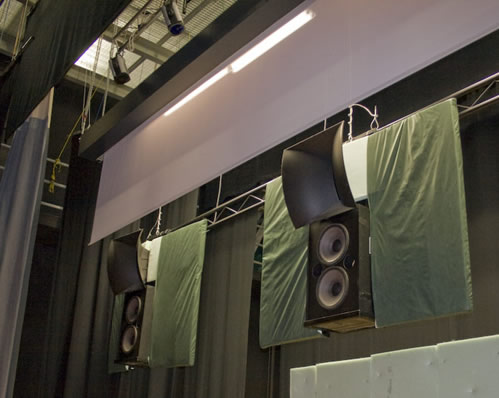
I strongly suggest you to put sound dampeners up to the horn. I used some polyester dampener, it will not crumble like rockwook, and it's healty. It has been covered with green fabric, that was available. Black would have been better
The size of the wing has been calculated by the lowest frequency the speaker could reproduce.
Posted by Randy Stankey (Member # 64) on 04-11-2009, 11:27 AM:
I truly wish I could fly the speakers. We just don't have the lineset to sacrifice.
Our stage is 40 deep and 80 wide including wing space. It is 53 feet from the deck to the steel. It is 42 feet across the prosceneum and 24 feet tall. We do not have a proper grid. All the blocks are underhung from the steel. They are set on 8 inch centers. The electrics are set on 16 inch centers. Thus, we can not kick the linesets apart to make room for the speakers.
We only have 28 lines. 2 are used for the rag and the valence. 4 of them are permanent electrics. 4 of them are permanent orchestra shells. The screen takes up 2 lines. One for the screen. One for the masking. There are 4 legs, 4 borders a cyclorama and a scrim. That's 22. We only have 6 lines open for general use.
As is the case with many auditoriums, they spent all the money in front of the plaster. We have to struggle with crap like this all the time.
As much as I would love to fly them, the speakers have to go on wheeled carts on the floor.
I'll do the cost calculations at 10 feet tall, up to the tops of the horns. I'll look at the cost of some batting material for the fronts. I don't know what it will be. Like you say, fiberglass is crumbly. (And itchy too!) I'll have to look around and see what is available and doesn't cost too much.
BTW: The wings I have designed will form a continuous wall that extends 4 feet out from the sides of the outside speakers. The speakers will be 8 feet apart. The carts will be 3 feet wide. The total width of this wall will be 36 feet. The viewing area of the screen is 31 feet wide and 13 feet tall. This wall will just about enclose the entire back of the screen except for a few feet at the top. I will fly one of the border curtains down right behind the speaker wall to cover that area.
Posted by Steve Guttag (Member # 268) on 04-11-2009, 02:11 PM:
Oh Randy...you just need to expand your collapsing wing concept further and include the horn and LF cabinet too! Then it won't take any depth...just unfold the speaker and whola! Probably easier to to in animation than in real life...though there are folded horn speakers.
Steve
Posted by Bob Jones (Member # 1756) on 04-11-2009, 05:45 PM:
Interesting topic - we are actually in the process of upgrading cinema sound in our local historic theater - which is also a mixed-use venue.
For years - we have been rolling in speakers just like you - and the weight has dictated leaving them close to the floor (which of course is not proper positioning for cinema).
We are fortunate to have some of the folks who have worked on IMAX sound and loudspeaker design for years come in and help. And the first issue was the proper placement of the speakers in a highly efficient and repeatable process. And here is what they came up with. Our screen with masking is on its own lineset. We took the first electric which is right behind the screen - and went above it and added a second batten and then fly the stage speakers from the batten on the same line as the first electric but ABOVE IT - when the speakers are in the proper position with a center point at about 2/3 from the bottom of the screen --- then you can literally reach up and touch the lights from the first electric on their own batten below the speakers.
There are three subs and they are easily rolled in and placed under each each screen speakers.
Posted by Randy Stankey (Member # 64) on 04-11-2009, 09:28 PM:
Steve, I was thinking of making them inflatable like a lifeboat. Just pull the rip cord and PFFT! You have speakers!
I found an old picture of backstage taken during a changeover from a musical theater gig to a movie. Things aren't quite where they are suppose to be. You can still see some stage cables and junk in the picture. The tape lines on the floor are spike marks where a bunch of scenery is supposed to be.
I don't have the curtains pulled down like I usually do.
As I said, this picture was taken half way between two gigs.
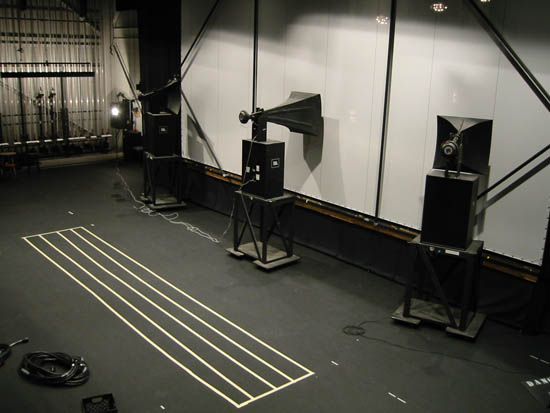
The pictured speaker carts are about 90% of what they will be when the project is done. The bases of them are the metal dollies I mentioned above.
Their construction is substantially the same as I plan to build in this project. I want them to be a little taller so they are closer to the middle of the screen.
Posted by Steve Guttag (Member # 268) on 04-12-2009, 10:15 AM:
Wow...a 40x20 horn...you don't see them much anymore.
Steve
Posted by Kenneth Wuepper (Member # 1174) on 04-12-2009, 11:40 AM:
Randy,
I just had a terrible thought!
Do that horn and your panel arrangement make the cart front heavy and in peril of falling through the screen?
I would guess that you could add a few spare weights from the rigging to the rear of each cart before opening the wings. Perhaps you have thought of another way to keep the low center of gravity for that wheeled arrangement like maybe two legs out in front since you can't really get close to the screen with those horns the front legs would not interfere with anything.
KEN
Posted by Randy Stankey (Member # 64) on 04-12-2009, 08:21 PM:
That horn in the middle is going to go.
It has seen some damage from the screen being lowered onto it. The top of the cabinet is damaged. I made "temporary" repairs to it but that was more than a year ago.
I have been telling people for years that all three horns and cabinets need to be identical to produce a uniform sound field.
The horn is not very much heavier on top than the other two.
Like I said, the bases to those carts are over 100 pounds each.
If I need to weight the bases more I can put a couple-three stage weights on the bottom. At 20 kg. apiece, that will bring the weight to nearly 250 pounds.
The main danger is that the horn sticks out so far that it always gets caught on things as you move it.
The speaker was in place before the screen was in. The kid who was setting up thought he had the cart on the spike marks but he was about a foot too far downstage. He lowered the screen and the bottom of the bar hit the front of the horn and pretty much ripped it right off the top of the cabinet.
I replaced the top of the cabinet with a piece of heavy plywood and bolted the horn back in place. It's not pretty but it held for over a year. :roll:
I'm trying to get that speaker replaced. We'll see what I can do to convince the boss.
Posted by Cameron Glendinning (Member # 3516) on 04-12-2009, 08:37 PM:
quote: Randy Stankey
I plan to use 3/8" OSB. (oriented strand board) Even 1/4" luaun is about triple the price. Real 1/4" plywood is even more expensive. If I went down to 7/16" OSB it would only save about 25¢ per sheet.
I am a bit worried, I personally would not use anything less than 3/4" which was also strongly braced, MDF or chipboard would be a/ok but 3/4" baltic birch plywood would be the best in my opinion. Please correct me if I am wrong.
quote: Randy Stankey
I could make the wing panels 8 feet tall, going about 1 foot above the top of the cabinets. (More or less.) If you don't think it will make much difference
I know it will make absolutely no difference to the bass response, The wings only need to be next to the woofers, not the horn. The curtains you hang will easily solve your early reflections/ bounce from the screen issues, so the 8ft tall wings are are a waste of time. If your total enclosure width is around 11' wide (speaker box plus wings) you will have the physics about right.
quote: Randy Stankey
If I can keep the price of this project down I will try to get some fiberglass batting to staple on the front.
Fiberglass is not very nice stuff, It's one thing to place it backstage in a cinema were no one goes, but on a live stage where it can be bumped and easly damaged, I would think you are better off without it.
Posted by Randy Stankey (Member # 64) on 04-12-2009, 10:05 PM:
I've already done the finite materials analysis.
3/4" birch plywood is more than $40 per sheet.
23/32" BC pine is $31. per sheet.
7/16" OSB is $6.25 per sheet.
1/2" OSB is $7.00 per sheet.
The project will use 10 to 12 sheets of plywood or OSB.
If I make every cut perfectly and don't waste a sliver of wood I can do it with 10 sheets and have only one 24" square of wood left over. (Or something like that.) If I give myself some leeway to make a mistake and not make every cut perfectly straight it will take 11 or 12 boards.
Using the 7/16" OSB my project estimate is $467 plus labor. (I'm the labor.)
If we go up to 3/4" birch we're talking $884 for cost of materials.
With 23/32" pine it will be $764.
Using 1/2" OSB it will be $475.
With 7/16" OSB it will be $467.
Chopping 2 feet off the top of the wings will save $35 because there will be 2 less panels of OSB and I can buy 8 foot sticks of 1" X 4" instead of 10 footers.
If you don't think the wings need to be 10 feet tall, I don't have a problem using 1/2" OSB.
Remember the individual panels will be only 24" wide but they interlock together to form a solid wall 33 feet wide. There will be plenty of bracing and a 2" X 4" bar across the back holding them together.
OSB does have a strength axis similar to plywood. Particle board, chip board and MDF do not.
Of course, I would rather use plywood but, given the cost of plywood, I don't think OSB is a bad second choice.
I haven't added in the cots of any eventual batting on the front faces. I haven't decided what to use. Fiberglass is what I would normally use but, like you say, it is not good to use where people will be exposed to it. I'm still thinking about that.
Posted by Cameron Glendinning (Member # 3516) on 04-12-2009, 11:24 PM:
quote: Randy Stankey
I don't have a problem using 1/2" OSB.
But will you be wasting your time and money? I have no problem with OSB, its it thickness that troubles me!
Many people have made the mistake of using too thin a material for wings and speaker stands. Wings if done wrong are MUCH worse than doing nothing! I have repaired many poor installations in the past. I personally would not use a material thinner than that the speaker box itself is made of. Especially not with speakers with 4" voice coils like the JBL (but that's yet another can of worms)
Please someone else that has done this before, what do you think?
Personally I would not bother going the full width of the stage. In theory it is better, but in practice, in a temporary situation it might be hard to notice the difference. (my 2 cents worth)
Randy, I am only posting due to genuine concern!
EDIT
To place it in perspective, a THX wall would use 3 layers of at least 18mm gyprock, braced/ supported with a heavy steel frame for a baffle wall. Does 1/2" seem even ballpark? I really would try to keep it as small and structually strong as you can.
Posted by Randy Stankey (Member # 64) on 04-13-2009, 01:09 AM:
I'm listening.
I haven't bought any materials yet. I'm still not above making changes.
Even with just the curtains in, there is an audible difference in the sound. Adding the wall will be an even greater improvement even if it's not perfect. This installation will probably never be perfect. I could write a book on all the things that are "not perfect" in this place.
Sheets of plywood, OSB or what have you are 4 feet wide.
As they are set right now, the speakers are approximately 8 feet apart. That's two sheets of plywood between them.
23/32" OSB is $11.50 per sheet. The cost of the project with 23/32" would be $530. That is a cost I could conceivably get approved. I'm shooting for between $450 and $500.
I am still open for ideas.
Posted by Louis Bornwasser (Member # 3063) on 04-13-2009, 09:17 AM:
Anything you do will help some. Even my portable swing open "wings", while not perfect, made a big difference.
I agree there is no reason to side baffle the horn.
The goal is stiffness and mass; in fact, authentic 18th century cemetery markers are "the best." (lol) Louis
Posted by Marco Giustini (Member # 4544) on 04-13-2009, 01:45 PM:
quote:
The wings only need to be next to the woofers, not the horn. The curtains you hang will easily solve your early reflections/ bounce from the screen issues, so the 8ft tall wings are are a waste of time
I don't agree. Perhaps the wood baffle is not necessary but I would add some fiberglass (or similar) around the horns. If you have a big stage behind the speakers, I believe that curtains are not enough to stop the reflections. In the theatre you saw in the photo I uploaded, there is a curtain at the end of the stage, with some sound dampener (made by wood, not so efficient) at the very back wall. However the wings you saw dropped A LOT sound reflections that were coming from the back wall.
Posted by Scott McGuire (Member # 4508) on 04-15-2009, 12:45 AM:
Have you tried bringing in the accoustic shell? That would send the sound out rather than having a curtain that would absorb it. You could also fly the speakers on a line that has borders or legs on them. I guess it depends on how fast your change over needs to go.
Posted by Randy Stankey (Member # 64) on 04-15-2009, 01:10 AM:
Yes, we have a Wenger acoustic shell. I have tried it and it does work. The problem is that it is all white. It sticks out like a sore thumb behind the screen. I can't paint it or cover it. It needs to be white for use in concerts.
It is also true that my idea for the fold-out wings (or shell, if you will) was derived from that.
The Wenger shells are made from welded steel frames and they are faced with what looks like Masonite with Formica cemented to the front. They are only about 1/4 inch thick. They are 4 feet wide and about 16 feet tall. There are two big, heavy concrete blocks in the bases to weight them down and keep them from falling over. They lock together with hasps and turnbuckles.
I really would LOVE to fly this wall I am thinking of but we just don't have the linesets to do it. They have to be portable enough that one or two people can do the job by themselves. We don't have a lot of room back stage to store the speakers, the current orchestra shells plus this new shell for the movies.
The carts I currently use are made so the horns nest together like Dixie Cups. You push them up against the wall, facing sideways and they all stack together really nicely.
My whole idea is based on these principles. It has to reflect the sound. It has to be portable. It has to be stored in the scene shop after use.
Although I am have pretty much settled on the overall design I am still tweaking things, even as we speak. (Write.) Nothing is decided for certain until I start cutting wood.
Even then there's still room for improvements.
Posted by Scott McGuire (Member # 4508) on 04-15-2009, 01:34 AM:
What about blue foam insulation rather than fiber glass, or even the osb all together?
Posted by Randy Stankey (Member # 64) on 04-15-2009, 02:30 AM:
You mean attach blue board to the faces of the wings? I can do that but it doesn't take paint very well. It will take latex if you roll it on but it will scratch off very easily.
Do NOT try to paint it with petroleum based spray paint! ![[Eek!]](eek.gif)
(Ask me how I know this! )
At this point I am thinking of just painting the OSB black then coming up with an idea afterward. I might be able to staple some polyester batting on the front then cover that with black Duvetyne.
Too bad I can't get a whole bunch of those old paper egg cartons and staple them up there with a staple gun...
Posted by Randy Stankey (Member # 64) on 04-16-2009, 10:12 PM:
Here's an update on the project.
Had a meeting on the subject of sound system upgrades. I got a favorable verdict. We're probably going to go ahead with this by summer after school lets out.
But there are likely to be some changes:
We're thinking about moving the screen downstage by one lineset. (Approx. 16 inches.) We'll consolodate the masking on that downstage lineset onto the screen frame so only one lineset is used. The empty lineset will be used to fly the baffle.
We are thinking about making a welded frame out of square tubular steel then facing it with either OSB or plywood.
We'll probably get an upgrade to the rest of the sound system too. They are planning to upgrade the sound system in the entire hall. I'm trying to get them to buy a new cinema processor while they are at it. I'm looking at the Ultra-Stereo JSD-80. More on that when I get more info.
Posted by Elia Orselli (Member # 4673) on 04-21-2009, 12:33 PM:
I read this topic and I have some questions:
1) Marco says that there's another topic about wings but I can't find it. Can somebody tell me the name of this topic?
2) I was going to build the wings for my theatre because we have the same problem: the stage is used for conferences and we are a no-profit association and we haven't a lot of money. What is the minimum width for the wings? I have KCS 2000 series speakers ![[Frown]](frown.gif)
Thanks for all the replies.
Elia Orselli
Posted by Randy Stankey (Member # 64) on 05-08-2009, 08:07 PM:
Elia,
According to my design, the baffles will extend 4 feet. (1.2 meters) from each side of the speakers.
The speakers are almost exactly 8 feet apart. If I rearrange them just a little bit I will have a wall that is approximately 33 feet (10 meters) long with the speakers arranged at equal intervals along the wall. There will be 4 feet of wall extending past the outer speakers. Our screen is 31 feet wide. Therefore, the wall will extend about a foot past the screen on either side.
Update on our plans to build our wall:
We have been having some discussions and it looks like we might be able to fly the wall after all!
With a little creative rearrangement we will be able to weld the frame out of square, tubular steel and cover it with 1/2 inch OSB. It will be made in 4 foot by 12 foot sections. We'll suspend it on chains, attached to the pipe with batten clamps.
If we ever need to use the line for anything else, we will be able to unhang the wall and stow them back stage.
I think this will be a much better arrangement than the collapsable panels attached to the cart.
I just won't be able to make such cool 3-D animations to explain it.
Posted by Elia Orselli (Member # 4673) on 05-09-2009, 03:07 AM:
Randy,
thanks for the infos. Unluckily I can't fly an entire wall, but I hope the wings will help the sound system in reproducing low frequencies.
Bye,
Elia
Posted by Gordon Bachlund (Member # 124) on 05-09-2009, 12:40 PM:
A long, long time ago I worked in theatre with stage house. Happily it sported a motor operated main drape and a motor-operated title curtain, with the screen hung the next pipe back. The speakers were behind the screen and quite close to it. Behind the speakers, hung on the next pipe, was a heavy wool felt blanket that served as the baffle wall. One could walk around backstage during a film and hear only little of the film sound, while, in the house it was playing at a comfortable level. I would guess the speaker installation date to have been in the late 1940s, certainly "old tech" but a quite satisfactory solution to the problem.
Powered by Infopop Corporation
UBB.classicTM
6.3.1.2