This is topic ANSI and On/Off contrast. in forum Film Handlers' Forum at Film-Tech Forum ARCHIVE.


To visit this topic, use this URL:
https://ft-forum.com/ft/cgi-bin/ubb/ultimatebb.cgi?ubb=get_topic;f=1;t=009867

Posted by Alan Gouger (Member # 543) on 05-03-2009, 07:02 AM:
 
This topic is more common to electronic displays but I am curious to what kind of ANSI and On/Off contrast film can produce before
lens, port hole glass, lights come into the equation.
On average what are we seeing on the screen. Do they make a test film for checking ANSI?

Thanks.
 
Posted by Steve Guttag (Member # 268) on 05-03-2009, 10:26 AM:
 
This has been probably the most spirited topic on what was the P3 committee in the SMPTE.

There were two projects on this...one using a subjective test film that was worked on by John Pytlak and I think that work will not be continued after his passing. The problem being that it was nearly impossible to get a subjective film that allowed meaningful consistant results.

On the more calibrated instrument method...Glenn Berggeren was working pretty hard. The trick being on agreeing on a test pattern that would excite the room sufficiently to ensure that one was measuring the actual contrast ratio rather than a skewed version since when an actual image is on the screen...the theatre walls, lens flare, screen dispersion/curvature...etc all factor in the achievable contrast ratio.

As for merely measuring the capability of film...it is some absurd number like 4000:1. I say absurd because you can't project it at that level. In fact, most people would be very surprised at just how low a real contrast ratio is. About the limit of projectable contrast ratio is about 1000:1 in a VERY controlled theatre (like the motion picture Academy's Samual Goldwyn Theatre). In a typical cinema however...you'd be lucky to hit 400-500:1.

The 2000:1 that DCinema projectors boast is as stupid as 4000:1 from film...they really can't deliver that. Put up a checker board pattern on a DCinema projector and it is on the order of 200-300:1

One of the tricks is having a suitable pattern that excites the room and projection system and has targets sufficiently large enough that a meter can read the white section without being infringed upon by the black section as well as vice-versa. Most patters look like a checker board of some sort with some largish area to allow a meter to not pick up an adjacent area.

The ANSI number of all-on/all-off is an indicator but nor a real number as it is not achievable with current technology...film or digital.

Steve
 
Posted by Julio Roberto (Member # 4976) on 05-03-2009, 10:34 AM:
 
Questions like this make me wish John Pytlak would still be among us.

Different stocks are made to tolerate better high light levels and increase effective on/off contrast ratios, but of course you don't get a real contrast RANGE higher than the negative used to produce the film.

Healthy human retinas (hope you don't smoke) have contrast ranges that vary in different conditions (time of day, amount of ambient photons hitting it, diet, etc). It's often around static 100:1 equivalent and it never peaks above static 600:1

But the retina can change and adapt along the course of several (30 or more) seconds to different conditions, and thus can range (but not anywhere near instanly) to a range of about 1 million to 1. The iris works in hopping to maintain values as even as possible and below the damage threshold.

Scenes in nature are often perceived in contrast ranges varying from around 100:1 in a cloudy day to 2000:1 in a sunny day. You would need to concentrate on dark areas and squint your eyes (or use sunglasses) to perceive detail on dark areas under those conditions.

I have always believed that an imaging system should be able to display a static luminance range of *at least* 750:1 to sufficiently cover most-all humans under most conditions (dark, night scenes as well as bright daylight ones).

Converted to ANSI contrast ratio, your average film negative probably carries around a 600:1 ratio. Well made prints are usually around 500:1. Each color within the film (i.e. red-green-blue) has its own contrast ratio though, so this is just an average aprox. figure. Hop over to Kodak and Fuji sites for specific stocks. The convertion from density to contrast ratio would be a 10x factor per each 1.0 density increase (i.e. 1.0 density = 10:1 contrast ratio, 2.0 density = 100:1 contrast ratio, 2.6d tonal range = 400:1 ratio)

The best commercial films (photography, not cinema) made probably had an ANSI contrast ratio equivalent of about 8.000:1 theoretical. But most are 2.500:1 and below.

The short answer: around 500:1 for a film print.

That's enough the bother the heck out of audiences, in spite of the iris coming into play, and to make poor patrons close their eyes in movie theaters if all of the sudden you cut from a dark scene to a mostly white one or if you dare to do a full fade-to-white in a properly lit theater. The eye can not (confortably, instantly) travel that much of a range in spite of iris and squinting.

It's my belief that on normal theater viewing conditions, more than 2.000:1 is moot. DCI agreed [Wink] and made all DCI approved projectors be optimized for this fixed contrast ratio (i.e. all DCI projectors are suppossed to allow a correct 2.000:1 contrast ratio on the screen and no more nor less). All actual DCI projectors could be capable if they wanted of around 2200:1 contrast ratio, with some perhaps obtaining 2500:1 or above with some lenses etc.
With 12 bits pixels, the maximun contrast range is limited at the input to a theoretical aprox. 4.000:1 anyway (again, different colors have different sensitivity curves in the eye, but this is a bold-park average).
 
Posted by Alan Gouger (Member # 543) on 05-03-2009, 12:37 PM:
 
I have heard numbers for film ranging from 130 to 500:1 for ANSI
but did not know if anyone had anything documented. I think Barco claims up words of 800:1 ANSI with their DCI machines and was curious how film compared. I am sure we will see contrast from DCI exceed film at some point if not already but as everyone pointed out the room is the limiting factor for both media.
 
Posted by Julio Roberto (Member # 4976) on 05-03-2009, 01:39 PM:
 
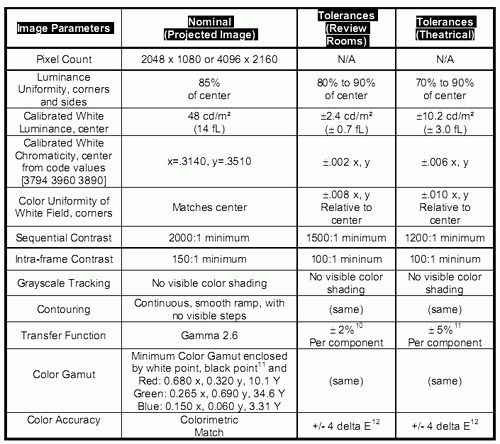
Well, in reality DCI is happy with 2000:1 full field minimum and 150:1 intra frame (a lá ANSI) minimum.

 -

quote:
8.3.4.8. Intra-frame (Checkerboard) Contrast
With the spot meter placed at the reference viewing position, measure the luminance levels of each of the patches in the checkerboard test pattern. Intra-frame contrast is computed by summing the luminance of the white patches and dividing by the sum of the luminance of the black patches. Infra-frame contrast is reduced by many factors including projection lens flare, port glass flare, ambient light spilling on the screen and back-reflections from the room itself. Note that this measurement is made with the projector in situ, with the screening room or theater in full operating mode.

Under ideal (and impractical) conditions, the figures on interframe and intra-frame contrast should remain close to the same. In practice, as we know, ANSI is often 3 times (or more) less than full field.

Basically it goes like we are discussing. Anything "too high" is just either not "true" and only theoretical under some conditions or just not necessary.

We could all be happy with something around "true" 500:1 and never miss out on anything else.

And 95% of the time, we would be equally happy with 300:1

And 90% of the time, with 150:1

But since "true" figures are usually not given, and factors such as ambient light and room reflections affect so much, and those figures are the "best obtained under specific conditions designed to 'cheat' the tests", then we are probably safer asking for a bit higher figures to be sure.

Here is someone comparing some transparency (slide) films to digital projection of the time (2003).

http://cool-palimpsest.stanford.edu/byauth/vitale/digital-projection/
 
Posted by John Hawkinson (Member # 1135) on 05-04-2009, 12:04 AM:
 
Guys, ANSI is the American National Standards Institute, they issue hundreds of thousands of standards. Please don't say "checking ANSI." Maybe "ANSI contrast" or "ANSI lumens" or whatever. Though more properly it should be "ANSI IT7.215-1992 lumens" or whatever...

Thanks!

--jhawk
Spoiler Alert - Click to Toggle


Posted by Julio Roberto (Member # 4976) on 05-04-2009, 04:35 AM:
 
quote: John Hawkinson
ANSI is the American National Standards Institute, they issue hundreds of thousands of standards. Please don't say "checking ANSI." Maybe "ANSI contrast" or "ANSI lumens"
[Razz]

John, we are counting on you to fill the void. But from now on, it'll say ANSI-x instead of ANSI and you can substitue x for the most appropiate term or a more international ISO equivalent [Wink]

I wouldn't want to upset the peeps of wikipedia with ANSI-lumens and the like ... [Razz]

quote:
The standard ANSI IT7.215-1992 defines test-patterns and measurement locations, and a way to obtain the luminous flux from illuminance measurements, it does not define however a quantity named "ANSI lumen".


Powered by Infopop Corporation
UBB.classicTM 6.3.1.2