This is topic What's this bore for (Century)? in forum Film Handlers' Forum at Film-Tech Forum ARCHIVE.
To visit this topic, use this URL:
https://ft-forum.com/ft/cgi-bin/ubb/ultimatebb.cgi?ubb=get_topic;f=1;t=009870
Posted by John Hawkinson (Member # 1135) on 05-04-2009, 11:29 PM:
What's the purpose of the 1/2" bore between the operator's side and the driving side on a Century, to the right of the intermittent and beneath the lens mount?
Taking a decent picture of a Century from the Warehouse (Broadway Cinemas, Tillsenbourg, Ontario, Canada), here's the bore circled in green:
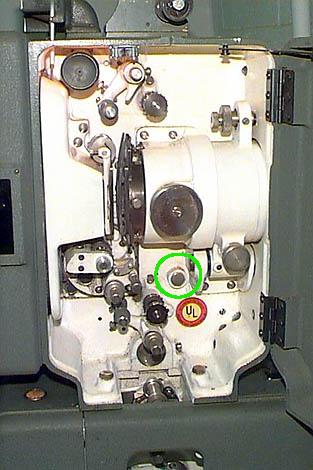
(It has a 1/2" steel plug in it.)
What's it for? Bypass roller or sprocket to skip optical sound?
(What else do people use it for?)
--jhawk
Posted by Robert E. Allen (Member # 1351) on 05-05-2009, 03:25 AM:
Is it a plug or could it be a shaft for a connecting gear? Just a wild guess. What's it look like on the drive side?
Posted by Louis Bornwasser (Member # 3063) on 05-05-2009, 06:51 AM:
Good question!
I have always thought it might be to allow a different pad assembly for Cinerama, etc. (No optical soundhead) I've never seen it used otherwise.
Perhaps a reference point during manufacturing??? Louis
Posted by Brad Miller (Member # 2) on 05-05-2009, 07:24 AM:
Given the age of the Century design, I am quite sure this wasn't the original intent, but I have seen Centurys that had a special cue detector mounted here. In fact the GCC Northpark theaters had them installed with the Cinemation 2000 automation, but we took them out and ran manually since the cues had to be over the picture.
Posted by Mark Gulbrandsen (Member # 72) on 05-05-2009, 07:39 AM:
Actually there used to exist a pad roller assy. they went in that hole. Over the years I've had a couple of C model machines with them. There were some conditions where the lower mounted pad roller couldn't be used such as in dailies projection. Cinerama was another good example. VistaVision also used that hole to mount the pad roller...
Mark
Posted by John Hawkinson (Member # 1135) on 05-05-2009, 08:42 AM:
Mark, can you explain how that worked? The new pad roller would still clamp against the holdback sprocket, and then where would the film go to avoid the optical sound path? Surely you're not expected to modify the main frame...or is it intended for use with something other than an R3, or something mounted between the R3 and the projector head?
(I'm mostly curious academically. I was thinking of mounting some fun stuff there, and of course the question of its real purpose came to mind.)
Robert: It's posssssssssssible, but I think unlikely. Go look at the driving side of a century, there are photos in the same collection that that one came from. The bore appears behind the vertical shutter adjustment shaft, and in fact, if you protrude more than 3/8" or so into the driving side, you restrict the range of the framing carriage (which is to say: you hit it). If you were really fancy/lucky/whatever, you might be able to mate with the holdback sprocket's fiber gear...
I expect the next Century C I see on EBay to be advertised as Cinerama Ready! ![[Smile]](smile.gif)
--jhawk
Posted by Louis Bornwasser (Member # 3063) on 05-05-2009, 09:49 AM:
John; sometimes the RCA soundhead film path, when misthreaded, can allow the film to contact the normal Century pad assembly near the pivot point. It may well be much worse with other old soundhead, long forgotten. I think Mark is right about VV and Cinerama and, possibly, other older systems.
Remember in those days Century made a lot of different models. I believe the SA was meant to be able to cover a great deal of territory so that custom made machines were either not required or could at least be done easily.
I think the "C" had a boss in that location, but not a hole. Louis
Posted by Scott Norwood (Member # 30) on 05-05-2009, 10:27 AM:
Interestingly, the machine in the picture is an "H" or an early SA with an H style trap. Those traps suck!
Posted by John Hawkinson (Member # 1135) on 05-05-2009, 12:53 PM:
Fascinating.
Actually, we've got a pair of Cs, both with the hole (and the boss). I'm afraid I was too lazy to trot out a camera...
--jhawk
Posted by Bernard Tonks (Member # 809) on 05-05-2009, 03:47 PM:
I seem to remember that a special pad roller assembly was mounted into this bore replacing the normally used position pad roller, solely for the purpose of double head projection of picture and sound, the seperate track being magnetic or older optical. A slot was cut out at the lower back and front of the Century casing for the feed of the seperate sound track, and to the picture take-up split spool, also known as clover leaf projection. Picture and sound being constant driven together for sync through the lower Century sprocket.
I saw an installation of double head Westar's (Century) at the old Academy Cinema Oxford Street in London often used for morning test screenings and trade shows.
Posted by Mark Gulbrandsen (Member # 72) on 05-06-2009, 12:21 PM:
If you look at the photos of my VistaVision projector in the picture warehouse you'll see one of those pad roller assys. mounted in that upper boss.
Mark
Posted by Jim Cassedy (Member # 4115) on 05-09-2009, 03:06 AM:
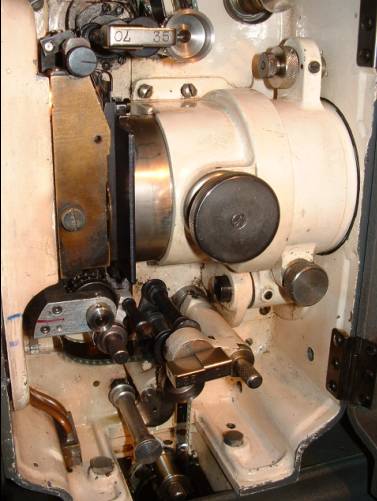
On the Century JJ's I run, the post on which the
lower sprockets' dual 35/70mm pad roller assembly
pivots open and closed is anchored through that
hole by a flat-head screw on the gear side.
I'm not sure if the screw is countersunk but it
doesn't seem to interfere with the framing carriage.
Posted by Louis Bornwasser (Member # 3063) on 05-09-2009, 05:37 AM:
Thanks, Jim. I should have remembered the JJ. (I have 6 of them) None arr still in use in theatres I service, although I once had 8 70mm houses.
That sure is an old JJ you have. Where is it? (2 of mine are s/n 104-105 from Oakland.. . . . #4 and #5 ever made.) Louis
Posted by Jim Cassedy (Member # 4115) on 05-09-2009, 09:30 AM:
Louis:
The JJ in the picture is at The Presidio
Theater (built in 1937) in San Francisco.
Here's a wider shot of the whole machine.
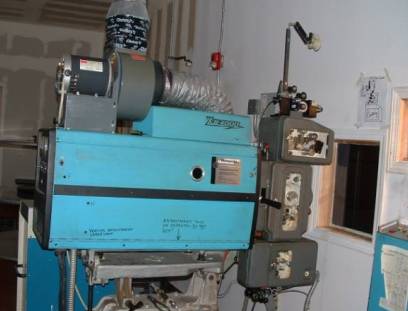
I'd say this JJ dates to the mid 1960's based on
what I know about that theaters' history. I don't
have the serial number in front of me- - I'll edit
this message to include it later.
Posted by John Hawkinson (Member # 1135) on 05-09-2009, 09:41 AM:
Do all centuries use the same main frame casting? I had assumed it would be different between the C and the JJ, f'rinstance...
--jhawk
Posted by Jim Cassedy (Member # 4115) on 05-09-2009, 10:22 AM:
I don't know about "all" Centuries; but last night
I compared that JJ with a couple of SA's and SAW's
& even took a few measrements, and the body castings
of all seem to be identical. I didn't have a model C
at that location to compare it with.
Posted by Louis Bornwasser (Member # 3063) on 05-09-2009, 11:53 AM:
JJ is prety close to the SA and H casting; exactly the same before machining. Louis
Posted by Robert Throop (Member # 61) on 05-12-2009, 06:36 PM:
That picture sure looks like an H rather than an SA but I didn't think that the H had the eccentric lens adjustment.
Bob
Posted by Dave Macaulay (Member # 813) on 05-13-2009, 09:12 PM:
You can't really tell what a Century started out as. I've seen a lot of them that have been rebuilt sometime, with an assortment of vintages of parts used. I think Wolk did a lot of rebuilds, maybe others as well. So finding a single shutter machine with an SA water cooled trap reading "CC" on the nameplate doesn't surprise me any more.
Posted by Louis Bornwasser (Member # 3063) on 05-13-2009, 09:20 PM:
At one time Century must have made 10 or 15 different projectors (see list of Essenay changeover models just for Century).
It would appear that the H was an attempt to reduce the castings to one or two. (and in addition, to move the lens center to the image center) The plan was not perfect. Later, the SA was more successful; the JJ casting being identical except for machining.
Complicating the picture was the elimination of the H or C curved gate kit. The SA gate kit was force fit into many C's to eliminate the straight gate problems when automation came around in the 1970's. I know, I was guilty myself. Louis
Posted by Jim Cassedy (Member # 4115) on 05-14-2009, 08:37 PM:
To correct something I wrote in my post that included
the picture of the JJ showing how that bore is used
to support the 35/70 lower pad roller assembly- -
I mis-identified one of the other two projectors
I checked. The SA has that bore, the SAW does not.
I mis-read one of the model ID plates.
Posted by Louis Bornwasser (Member # 3063) on 05-15-2009, 12:39 PM:
Jim; some had it, some didn't. The SA and the SAW are the same machine, just with a water cell. Louis
Posted by Stan Gunn (Member # 554) on 05-19-2009, 03:13 AM:
Many years ago I rember repairing a couple of centurys,model unknown.
In this position 2 bearings were fitted with a shaft and gear on the rear, what it drove I cant remember but the repair involved the gear etc.
Stan ![[Confused]](confused.gif)
Powered by Infopop Corporation
UBB.classicTM
6.3.1.2