This is topic Century Projectors Retrofitted for Reel-to-Reel in forum Film Handlers' Forum at Film-Tech Forum ARCHIVE.
To visit this topic, use this URL:
https://ft-forum.com/ft/cgi-bin/ubb/ultimatebb.cgi?ubb=get_topic;f=1;t=009882
Posted by Chris Nolan (Member # 4853) on 05-10-2009, 09:42 AM:
At my theater we run with Century projectors set up with Christie AW3s. Years ago (before I transferred in) we had a film club that occasionally rented a movie so old that the distributor said no splicing (or something along the lines of it) requiring us to retrofit the projectors with reel-to-reel arms above and below. Like I said, it's been years since we've had to use them, but they're still mounted on.
The other lead projectionist and I have recently been digging around and found a couple giant reels that I can only assume were designed so that you could build an entire movie onto it back before platters were popular or affordable, and we're playing with the notion of experimenting with them.
Since I've never used r2r before, I was wondering if there's anything majorly different (other than the obvious lack of platters) done while threading? How does the projector keep tension/know the proper speed to spin the bottom reel?
Posted by Randy Stankey (Member # 64) on 05-10-2009, 10:05 AM:
There should be a belt that runs from a take-off pulley in the sound head and goes to a pulley on the lower, takeup arm. Depending on the age of the projector it might be made of leather, urethane rubber or something that looks like a long metal spring.
Without this belt, you will not be able to run reel-to-reel unless you want to stand there for the entire movie and spin the lower reel by hand. ![[Wink]](wink.gif)
If your projector was outfitted for R2R that belt should be laying around somewhere. If you can't find it you can order one.
Posted by Chris Nolan (Member # 4853) on 05-10-2009, 10:27 AM:
It does. The belt is still hooked up, and it spins all the time when we aren't using it. I was more so referring to how the projector know to modify the speed as the diameter of the film spool expands and right from the get go the take up reel takes a second longer to get up to speed with the projector motor.
Posted by Randy Stankey (Member # 64) on 05-10-2009, 11:38 AM:
It should have a friction clutch on the lower arm. The belt and pulleys spin at a constant rate. When the tension on the film hits a certain point the clutch will slip. Thus, the lower reel will spin only as fast as needed to take up film.
There should also be a friction clutch at the top too. Not only does this clutch regulate the tension of the film for payout, if you have a bell on the upper reel, it regulates the point at which the bell will start to sound. This way you are given a couple-few minutes advance warning to be ready for the changeover.
Look in the Manuals section of this site. You will find all sorts of manuals with diagrams in them that show you how these things work.
Posted by Darryl Spicer (Member # 711) on 05-10-2009, 12:48 PM:
The real question is are your reel arms long enough to accept a 26" reel. Are the two reels you found 26" or 46" reels?
Posted by Robert E. Allen (Member # 1351) on 05-10-2009, 04:53 PM:
Randy pretty well answered your question Chris. A tension clutch on the top keeps the film from spilling out too fast and the take-up clutch on the bottom keeps the constant speed belt from pulling on the film too hard. The bottom clutch can run all the time without hurting anything. FYI for about 70 years two-projector "changeover" systems were the norm for movie theatres. It was in the late 60s that theatres began using single projector platter systems. (I'm convinced their purpose was to get union projectionists out of the booth.) Today the distributors who release classic films will still not allow you to run them on a platter system, that is if you want the best prints. They will send you a platter print but it will probably be full of splices and scratches. That happened to me with a print of "Singing In The Rain" back in '06. There are still change-over houses running around the country. In fact I hope to build a mini-cinema which will be a changeover house as I plan to run a lot of classics.
Posted by Randy Stankey (Member # 64) on 05-10-2009, 09:07 PM:
As to the other part of the question.
There's not a whole lot of difference between running the projector R2R or plattered. The projector threads the same way.
Mount the full reel on the top spindle and lock it in place.
Mount an empty reel on the bottom spindle. Run the film down to take up, bypassing the projector momentarily. Thread the projector. Check your film path then run.
If you are not doing changeovers you do not have to worry about threading on a timing mark. Just make sure the film is advanced far enough that the audience doesn't see any leader when the projector goes on-screen.
You will need to have a good rewinder to run R2R. Every time you run film it will have to be rewound in order to play it again.
The guy who taught me to run reels always wound the reels so that it resembled a letter "S" when it was going through the projector. In other words, the payout reel spins counter-clockwise as it plays and the lower, takeup reel spins clockwise as it rolls up the film. When you rewind, the full (tails-out) reel on the left spindle feeds out film from the bottom as it spins counter-clockwise and the empty reel on the right spins clockwise, taking in the film over the top.
I always worked with the sound track toward me as I faced the reel side-on.
If you do things right, it will become second nature to dismount the old reel from the projector, pop it in the rewinder, mount the new reel, start the projector then go back to take the last reel off the rewinder and put it in the rack... Repeat until done.
This is not the only way to do things. It might not even be the best way. It's the way I was taught and the way I have always done things. I'm sure somebody else will come along and tell me everything I do wrong.
Posted by Robert E. Allen (Member # 1351) on 05-11-2009, 04:06 AM:
Actually Randy it is the only way to run a two-projector changeover booth. I did it that way for more than 20 years.
Posted by Rick Raskin (Member # 1561) on 05-11-2009, 07:20 AM:
When I ran changeovers I threaded Academy leaders on #9 and SMPTE on #6. Your point will depend on the projector ramp up speed and your reaction time. If you are running 6K' reels you may want to help start the takeup reel so it doesn't snap the film when it starts.
Posted by Richard P. May (Member # 3598) on 05-11-2009, 10:05 AM:
If you are intending to run "no splicing" prints from distributors, the matter of being able to use 6000 ft. reels is irrelevant. Those obviously also require removing leaders and splicing reels together, although only half as much as platters.
Standard reel to reel projection uses 2000 ft. reels, as received from the distributor.
Posted by Steve Guttag (Member # 268) on 05-11-2009, 03:22 PM:
As a world-wide statement...clockwise rotation on the upper reel is more prevelent and is the method recommended by RP39 as well as myself. Only the US did the "S-wind."
Steve
Posted by Gordon McLeod (Member # 33) on 05-11-2009, 03:40 PM:
Canada alsodid the S wind but my own experience the clockwise feed reel definitely gave me better maintained focus
Posted by Stephen Furley (Member # 1277) on 05-11-2009, 04:07 PM:
But Brad claims the opposite, and I've found that in the vast majority of cases, except for a few troublesome prints, it makes no difference. I've seen all four possible combinations of emulsion in and out for feed and take-up used in different places, and most projectors these days seem to be able to feed either way. I'd say run it whichever way you find works best with your equipment.
Emulsion in for both feed and take-up is the most common here for 35mm.
Posted by Brad Miller (Member # 2) on 05-11-2009, 04:34 PM:
Yup, at least down here in "tha south" running both reels counter-clockwise produces better focus and the print doesn't physically warp over time.
RP39 was also created like 3 decades ago and is hardly current advice.
Posted by Randy Stankey (Member # 64) on 05-11-2009, 09:28 PM:
quote: Robert E. Allen
Actually Randy it is the only way to run a two-projector changeover booth. I did it that way for more than 20 years.
See! I told you so! ![[Big Grin]](biggrin.gif)
Posted by Steve Guttag (Member # 268) on 05-11-2009, 09:36 PM:
I did quite a bit of testing and found emulsion-in here in the mid-atlantic area was vastly superior.
Steve
Posted by Brad Miller (Member # 2) on 05-11-2009, 10:28 PM:
Its ok Steve, we knew after all these years that sooner or later you would be wrong about something! ![[Razz]](tongue.gif)
Posted by John Wilson (Member # 269) on 05-11-2009, 10:52 PM:
quote: Brad Miller
Yup, at least down here in "tha south" running both reels counter-clockwise produces better focus and the print doesn't physically warp over time.
You mean clockwise, right?
quote: Steve Guttag
I did quite a bit of testing and found emulsion-in here in the mid-atlantic area was vastly superior.
Which is clockwise. You're actually both talking about the same method...unless your clocks work differently to ours too.
Posted by Brad Miller (Member # 2) on 05-12-2009, 12:22 AM:
No John, I always run my reels counter-clockwise (as viewed from the operator side).
Posted by John Wilson (Member # 269) on 05-12-2009, 12:44 AM:
So you're emulsion out both feed and take-up? Interesting...
Posted by Damien Taylor (Member # 4255) on 05-12-2009, 01:43 AM:
I didn't know it was possible to change the direction of the take up reel
Posted by Brad Miller (Member # 2) on 05-12-2009, 03:09 AM:
Yup you sure can! In fact if you watch Daryl's clip in the Ridiculously Advanced Booth Training Seminar at about 0:45 seconds, you will see both reels are running emulsion out, as it should be.
Posted by Monte L Fullmer (Member # 2797) on 05-12-2009, 03:28 AM:
Well, 16mm runs ("A" wind) emulsion out on both supply and rewind, so why can 35mm ("B"wind) - just looks odd seeing the rewind reel going anti-clockwise...for 35mm.
To do anti-clockwise rotation, you'd put a half twist in the takeup belt between the pulleys (and you would then want to use round leather belt material so the twist can be done easier..NOW, if you had Ballantyne B6 soundheads below those Centurys, the rewind pulley rotated in a anti-clockwise rotation so belt twist wasn't necessary...)
And prob the same holds true then: winding emulsion out on platters-being soundtrack up.
So, why do some circuits runs their prints on platters with soundtrack down (outside of being "force taught" by some idiot to have it as company policy to have it running that way) thus, being emulsion in? Where they scared in scratching prints, or what..?
Posted by Brad Miller (Member # 2) on 05-12-2009, 04:29 AM:
It again goes back to that wacky little SMPTE RP39 that is terribly outdated. Some people took that as the bible and insisted that platters had to be emulsion in as well, when if they had even read the study they would've found that it really didn't affect platters with their inner to outer diameter difference. That recommendation was mainly targeted at 6000+ foot reels (running reel to reel), but regardless I don't have this supposed focus drift running 6000 foot reels in an exclusive emulsion out orientation in my screening room with a 35mm lens...and that setup would sure as shit show it!
Other than Steve and myself, I've never even met anyone who has done extensive testing like we have. Everyone seems to just do it the way they were taught. The odd part of this whole argument that pops up from time to time is that Steve swears emulsion in provides better focus, while my findings have been exactly the opposite.
Running soundtrack down on platters puts the emulsion "on the potentially abrasive" (emulsion feeding down over the deck, potentially dragging around the centerfeed, etc). Granted if your platter is setup properly and your threading is done correctly platters won't damage your film either way, but its still silly to run soundtrack down as the film is more easily scratched that way. To each his own though.
Posted by Frank Angel (Member # 248) on 05-12-2009, 11:39 AM:
Ah, but you've both done extensive testing and have come to opposite conclusions. Now what?!
At least in long throw houses like mine, I can run with feed clockwise & takeup counter-clockwise or feed counter-clockwise & take-up clockwise or both feed and takeup counter-clockwise or both feed and takeup clockwise and it makes not an iota of difference. Hence conclusion #3.
Posted by Scott Norwood (Member # 30) on 05-12-2009, 12:25 PM:
What I think is so weird about the emulsion-in/emulsion-out argument is how many different theories exist about it.
For example, why is the 16mm standard to run with both feed and take-up reels spinning clockwise, yet the 35mm standard (at least in the US/Canada) is to have the feed reel spin counterclockwise? I realize that 16mm can have the emulsion on either the lamp side or the lens side, but why the same standard for both? What about the Europeans (and Steve) who run everything emulsion-in? Why do Hortson and Norelco 16mm projectors takeup "backwards"? Why do new prints come from the lab in a seemingly random orientation?
Posted by Monte L Fullmer (Member # 2797) on 05-12-2009, 12:27 PM:
quote: Brad Miller
that Steve swears emulsion in provides better focus, while my findings have been exactly the opposite.
Would the film curl have somehing to do with this since film doesn't lay perfectly flat on a table, but has s very slight curl?
I've been finding ways to have some concete evidence on why we wind soundtrack up on platters...not from just being taught that way since I began with soundtrack down of LP-270's back in the mid '80's, but now do it the "up" way.
Interesting. I did a search on the SMPTE RP39 and came up with that study, which I fully agree: definitely outdated to today's standards (where back then, it was for acetate base stockage..not with poly as it is now..).
For example: Back then, there were only the changeover booths with the 5inch house reel usage with we stateside booths using the Edison "S" wind. Yet, film always came in tails out, or emulsion in. And we sent it back tails out since we used shipping reels as our takeup reels on the last show of the schedule.
I think also why we did the "S" wind is due to how the firetrap rollers were designed in the magazines, for if you did do the reverse takeup wind, the three rollers won't be aligned for a reverse film path.
Now, we get our new prints in a both heads and tails cofiguration..
thx-Monte
Posted by Martin McCaffery (Member # 37) on 05-12-2009, 01:02 PM:
Other than brand new prints, does it really matter?
Posted by Rick Raskin (Member # 1561) on 05-12-2009, 01:12 PM:
This discussion sounds like a variation of the brown versus white egg argument to me.
Posted by John Hawkinson (Member # 1135) on 05-12-2009, 05:59 PM:
So, RP39 is about acetate film.
Brad, are you saying it makes no difference for you on acetate film?
I think Brad has clearly said that emulsion-out is better for him on polyester film on platters. And Steve has said that emulsion-in works better for him on both reel-to-reel and platters on polyester.
I'm mostly concerned about acetate, though. Because on old acetate prints I've seen significant focus drift, but never on polyester. And that focus drift has appeared to have been helped by emulsion-in storage, though I haven't been really scientific about it.
Prerequisite for this discussion: please make sure you read the Paul Preo and Eric Yavitz paper, Effect of Winding on Projection Performance of 35mm Motion-Picture Film (June 1965) before offering technical commentary/speculation. We should all understand what we're talking about and what the prior work has been.
Monte: it absolutely has to do with the curl, yes. Also, I would not want to take-up with a halftwist on old brittle acetate prints for which this is the most pertinent (practically speaking)
Brad: RP39 is based on the Preo/Yavitz paper and that's 2,000-foot reels, not 6,000-foot reels.
Frank: One minor issue is that many reel-end alarms require counterclockwise supply reels, which implies emulsion-out (conventional US 35mm S-wind, not RP39).
Also, relative humidity is very different in Texas (Brad) from the Eastern seabord (Steve and I, and for that matter, Rochester, NY, where Kodak's work was done by Preo and Yavitz). And it's well-documented that film's curl varies dramatically with RH (no debate!).
--jhawk
Posted by Monte L Fullmer (Member # 2797) on 05-12-2009, 06:29 PM:
quote: John Hawkinson
One minor issue is that many reel-end alarms require counterclockwise supply reels
Unless, you had Motiograph upper magazines that used the "drop-ding" bell alarm mechanism. Then you can go either way with this one.
If I also remember that those rotating Hatke alarms could be disassembled and the insides could be reversed so it will function on a clockwise rotation feed shaft, but don't quote me on that one..
On the discussion on how Brad run his reels in the anti-clockwise direction: I have seen picts of very early 35mm projectors with both reels rotating in the same, anti-clockwise direction.
Guess, Mr. Edison didn't like that arrangement and created the "S" wind for his projectors.
Yet, aren't the movie cameras of old used the "S" wind during operation as well? Maybe this is where this "S" wind for projecting came from-to follow the same film movement as the camera.
Yet, true as Rick said: this discussion is almost like a white/brown egg comparison....
-Monte
Posted by Scott Norwood (Member # 30) on 05-12-2009, 06:47 PM:
All of the cameras that I have seen wind emulsion-in ("B-wind") for both feed and takeup. The only exception that I can think of is the Aaton A-minima 16mm camera, but that's a special case (the camera was designed to be small and light) and requires specially packaged raw stock on 200' daylight spools.
Posted by John Hawkinson (Member # 1135) on 05-12-2009, 06:51 PM:
A and B wind are terms that only apply to single-perforated films, like 16mm; they don't have any meaning for 35mm.
B wind is not synonymous with emulsion-in (both A and B wind are emulsion-in). 35mm is not A or B wind, because it is double-perforated.
quote: http://motion.kodak.com/US/en/motion/Support/Technical_Information/Film_Video_Glossary/index.htm
A OR B WIND. When a roll of 16mm film, perforated along one edge, is held so that the outside end of the film leaves the roll at the top and toward the right, winding "A" should have the perforations on the edge of the film toward the observer, and winding "B" should have the perforations on the edge away from the observer. In both cases, the emulsion surface should face inward on the roll.
P.S.: Monte: it's not at all like eggs. Scientific measurements have been done and a twofold shift in focus position has been demonstrated for emulsion-in versus emulsion-out. You can certainly quibble about whether the measurements made in 1965 apply now, and whether they apply to polyester or just acetate, or whether they happen only at particular relative humidities. But there is no question at all of a difference under certain controled measured circumstances.
--jhawk
Posted by Monte L Fullmer (Member # 2797) on 05-12-2009, 07:10 PM:
quote: John Hawkinson
no question at all of a difference under certain controled measured circumstances.
..what I was wondering on due to certain areas where varying degrees of humidity being the factors in all of this..
..and why film storage is great deep in the mountains...
..why IMAX booths are strictly climated controlled - 50% humidity controlled at all times during operation..
-Monte
Posted by Sam D. Chavez (Member # 1841) on 05-12-2009, 07:16 PM:
Does anyone know what projector was used for these tests?
Monte,
One good reason to wind soundtrack up on platters was to avoid scratching the analog soundtrack during makeup. This was important back in the day when we used the analog soundtrack 100% of the time.
Posted by Steve Guttag (Member # 268) on 05-12-2009, 07:28 PM:
Actually...I'm an emulsion out on the platter and emulsion in on reels.
My tests were primarily done on Century JJs...using hubs as large as 8" with a max diameter of 22". Without fail, emulsion-in resulted in notably more stable focus on either acetate or polyester. While I don't believe Brad is lying about his findings, I have not personally seen anything that contradicts my findings.
It is a hope of mine to be able to do a more quantitative study on the subject (for the 5 people that may actually care) by running/storing film for a lengthy period of time and maintain direction exclusively in that particular reel's set up (one only ever emulsion in, one only ever emulsion out) and have suitable targets at the beginning/end and possibly middle to make absolute measurements as to the effects.
I've run and am responsible for a fair amount of reel-to-reel booths so I don't treat this subject with mere speculation...it is a serious discussion for those that want superior shows.
Steve
Posted by Monte L Fullmer (Member # 2797) on 05-12-2009, 08:16 PM:
quote: Steve Guttag
using hubs as large as 8" with a max diameter of 22
Thus, larger diameter hubs meant less bend on the film itself along with lower rotation torque...makes sense.
..be like those low-torque, large hub 5 and 7 inch audio tape reels that the recording factories which produced pre-recorded infomation of the past used.
Posted by John Hawkinson (Member # 1135) on 05-12-2009, 09:25 PM:
Sam asks, "Does anyone know what projector was used for these tests?."
Sadly, I don't know if Preo and Yavitz are around --- John Pytlak would almost certainly have known. However, John did mention that Kodak's "Theatre on the Ridge" has AAIIs, and given that the paper has passing reference to 70mm projection, it seems plausible that a 35/70 projector was used, and in 1965, so I think that's a good bet.
Steve: Do you run 2k changeovers on 8" hubs? (probably not; but just in case:) Wow! I thought 5" hubs were the largest anyone ever used for 2k reels...
--jhawk
Posted by Sam D. Chavez (Member # 1841) on 05-12-2009, 10:16 PM:
I would wonder about the AA11 as a stable test bed as the 35mm gate on these is not its best features. Heresy you say?
I have observed other tests done in '60's with JJ's where they seemed to prefer emulsion in for best focus, particularly toward the end of the reel.
Posted by John Hawkinson (Member # 1135) on 05-12-2009, 10:44 PM:
The end of the reel is definitely the place where this shows up, because the claim is that the focus shift should be a function of the winding diameter, which changes faster and faster (square-root n) as you hit the end of the reel.
Though oddly enough Figure 3 of the paper shows the change being linear. So wtf?
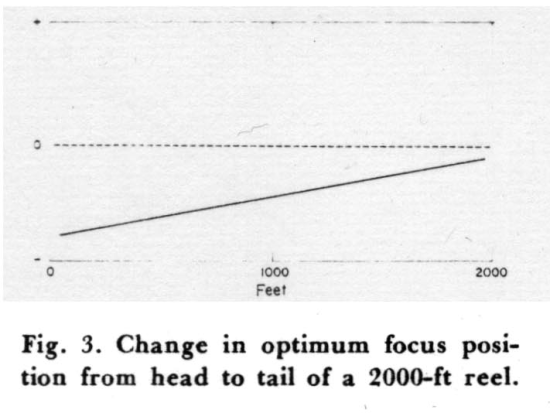
--jhawk
Posted by Brad Miller (Member # 2) on 05-12-2009, 11:55 PM:
quote: John Hawkinson
Brad, are you saying it makes no difference for you on acetate film?
I think Brad has clearly said that emulsion-out is better for him on polyester film on platters.
My findings have been that in every instance, whether platter or reels, acetate or polyester, winding emulsion-out consistently produced the least focus drift AND didn't warp acetate film over time like storing emulsion-in does.
quote: John Hawkinson
I would not want to take-up with a halftwist on old brittle acetate prints for which this is the most pertinent (practically speaking)
Nobody should EVER twist the actual film on projector-mounted reel to reel system. If there is no other way to do it, then twisting the takeup belt is the proper solution.
quote: John Hawkinson
Also, relative humidity is very different in Texas (Brad) from the Eastern seabord (Steve and I, and for that matter, Rochester, NY, where Kodak's work was done by Preo and Yavitz). And it's well-documented that film's curl varies dramatically with RH (no debate!).
Agreed, but I have received prints that have been in storage for a long time in that area of the country that were wound emulsion in and they had severe focus drift on them when I first projected them, but once I leave them stored emulsion out for a long time, that focus problem lessened.
quote: Sam Chavez
Does anyone know what projector was used for these tests?
Sam may have very well pinpointed a MAJOR issue with the RP39 testing there.
quote: John Hawkinson
The end of the reel is definitely the place where this shows up
Yes, but the first couple of minutes matter too, but that is not from the film, it is from the optics being cold.
Posted by Monte L Fullmer (Member # 2797) on 05-13-2009, 12:43 AM:
..From my comment above quote: Monte L Fullmer
To do anti-clockwise rotation, you'd put a half twist in the takeup belt between the pulleys (and you would then want to use round leather belt material so the twist can be done easier
.. quote: John Hawkinson
I would not want to take-up with a halftwist on old brittle acetate prints for which this is the most pertinent (practically speaking)
I should have added the words "of the takeup reel" after the 1st comma in the above comment.
Sorry, if I mislead anyone on the half-twist in the takeup belt on the lower magazine...
-Monte
Posted by John Hawkinson (Member # 1135) on 05-13-2009, 02:51 AM:
I'm sorry, Monte. Your words were clear, but I just read them wrong. My fault!
--jhawk
Posted by Dave Macaulay (Member # 813) on 05-13-2009, 09:34 PM:
OK, how do you get the takeup to go counterclockwise? Twist the belt?
Posted by Brad Miller (Member # 2) on 05-13-2009, 10:02 PM:
That or in the case of a Century you can simply install a simplex pulley on the holdback sprocket shaft.
Some Kinoton projectors come with a convenient selector knob to dictate direction. ![[thumbsup]](graemlins/thumbsup.gif)
Posted by John Wilson (Member # 269) on 05-13-2009, 10:08 PM:
Ah, Kinoton. ![[Smile]](smile.gif)
Posted by Chris Nolan (Member # 4853) on 05-16-2009, 02:43 PM:
Wow, I can't believe I haven't hopped back on this week to see the vast explosion that my question has caused!
Thanks for all the advice, it's nice to get such varying degrees of opinion, and see you guys discuss the pros and cons of each method. I haven't been able to mess with my Centurys too much this week. But I'll definitely get back to you guys with whether I make it work, or burn the place down.
Posted by Robert Throop (Member # 61) on 05-18-2009, 01:44 PM:
quote: John Hawkinson was the last to post
Does anyone know what projector was used for these tests?
Paul Preo is alive and well. He'll be 91 in November.
I was introduced to him by a mutual friend a few years ago. I called him this afternoon to ask him this question.
Here's what I found out: The projector was a straight gate XL with a Peerless HyCandescent lamp at 180 amps. The lens was a 3.25" B&L Super Cinephor with a 1.375 academy aperture.Paul did say that the tests were done with black and white film and the problem would be much less with color. Also the larger winding diameter of a platter would minimize the effect. The tests were all done with acetate film so the behavior of polyester is unknown.
Hope this helps.
Bob
Posted by John Hawkinson (Member # 1135) on 05-18-2009, 03:19 PM:
Awesome, Bob! Thanks for taking the time to pick up the phone!
--jhawk
(p.s.: Sam Chavez was actually the one who asked the question. I just took a stab at guessing at an answer --- completely wrongly, it turns out!)
Posted by Brad Miller (Member # 2) on 05-18-2009, 07:17 PM:
Another thank you for taking the initiative on that Robert.
Posted by Robert Throop (Member # 61) on 05-19-2009, 11:19 AM:
quote: John Hawkinson
"Theatre on the Ridge" has AAIIs
John,
The Norelcos at the TotR came from the Riviera theatre and were not installed till the early 1980's.
Bob
Powered by Infopop Corporation
UBB.classicTM
6.3.1.2