![[Big Grin]](biggrin.gif)
quote: Jack OndracekJack, it's NOT the scribe that made it look so horrible, it is the incompetent boobs who added cues because they were too fucking stupid to learn how to do a properly timed changeover. It really annoys me when people say things like that when you yourself know it's not the scribe that made the problem. It's like those who say platters are harder on film than reel-to-reel..bullshit.
Back in my changeover days, that gadget, and exacto knives were used so much, some films looked pretty horrible.
quote: Jack OndracekSo basically you had two film jumps at each motor cue and three at each curtain cue? And you thought that to not be as distracting as a properly scribed cue? You're right, I recoil at that.
As I recall, we used 2 clicks for the motor cue (something like 8 frames apart), and one click at the changeover. Curtain cues were 3 clicks.
![[Eek!]](eek.gif)
quote: Jack OndracekThe alternative for the motor and changeover cues would be to use the scribe, and for your curtain cues use your skills and a pre-run of the reel to judge by image or soundtrack when to hit the curtains. That's exactly what we had to do on the military base I started my film career at, we were not allowed to put any cues on the National Anthem trailer or the preview and feature snipes.
Maybe using the artists tape would be a good alternative?
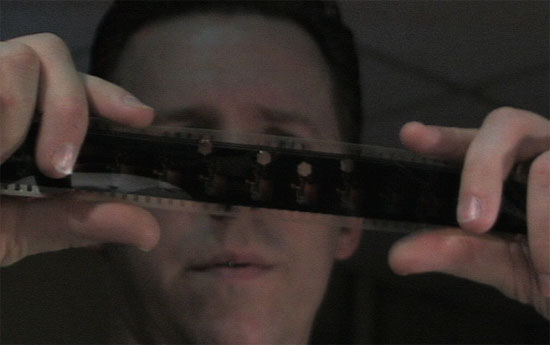
![[beer]](graemlins/beer.gif)
quote: Tony Bandiera JrI don't recall image jump being a major issue. Perhaps the width of the cues were small enough that they didn't cause the same jump that a glue splice would have. They were wrapped around the non sound-track side, and normally didn't make it halfway into the frame. In any case, it was a long time ago, and the practice was endorsed, and taught me by senior members of the Seattle local. Hard to argue with the wisdom of the time.
I don't like the idea of the "Click" cues, as they will cause noticeable image jump and it would be possibly for the soundtrack to mask them. (You do changeovers with the monitor loud enough to hear the soundtrack, right? To avoid cutting off dialogue? )
quote: Chris SlycordYes. At which point most patrons leave.
Maybe it's just me but wouldn't having the fog come in (to the point of making the image impossible to see through it) also make the on-screen image awful, even for a drive-in?
![[eyes]](graemlins/eyes.gif) Bummer for them was, as soon as interval hit, the fog disappeared so everyone who stayed (all 50 cars) got to see Rocky Horror with no fog whatsoever.
Bummer for them was, as soon as interval hit, the fog disappeared so everyone who stayed (all 50 cars) got to see Rocky Horror with no fog whatsoever.![[thumbsup]](graemlins/thumbsup.gif)
quote: Chris SlycordYah... I suppose you could make the case that whatever diffusion is caused the picture on the way from the projector to the screen is doubled by the time it gets back to you. In any case, it pretty much messes up your evening.
wouldn't having the fog come in (to the point of making the image impossible to see through it) also make the on-screen image awful, even for a drive-in?
quote: Robert E. AllenWe were talking about the guy who taught me about changeovers. This reminds me of a funny story he told me.
If you do use grease pencil make it a small mark not clear across the frame like I've seen some apparently half-blind operators do.
quote: Paul BurtPaul, I hope I never see a print coming from your theatre after you've used one of those hole punches...
I'd sure like to get one of those. Anyone have a contact in Japan?
![[Mad]](mad.gif)
quote: Paul BurtI can tell you why: Let's say the print's been around the mill for a long time, and sloppy operators keep cutting frames off of the tail, to the point that the last frame of picture is the changeover cue. (I have seen this more than once.)
Tony, I can't imagine why you'd want to see scribed circles rather than the tiny Japanese punch holes. Neither one can be removed, and the tiny holes are a lot less visible on the screen.
quote:Joe that brought back some memories from my early days , even over here in the land of precission projection
Do not use scribe circles! Grease pencil can wear off much too quickly. Instead, I highly recommend hole punches. Never miss another changeover again!
![[Roll Eyes]](rolleyes.gif) we used to see prints ome in with puch holes, i will however admit there was no ecuse for missing the cues!
we used to see prints ome in with puch holes, i will however admit there was no ecuse for missing the cues!
![[evil]](graemlins/evil.gif)
quote:To answer back in reverse order, yes I have seen the holes, yes they are tiny and yes they are permanent and cannot be covered up no matter what. And if the print is that beat up, why add to it with more hole punches? As I said, even scribe cues can be covered up with my method.
I would assume that if the last frame of picture has the changeover cue due to bad handling, then the correctly timed changeover cue would appear first and there would be no problem. And if a print is that beat up, the obtrusiveness of a tiny punch hole is not something that an audience would be likely to notice. Ever see those holes? They're tiny.
![[Smile]](smile.gif) (I'd better as I have been doing this since 1982.)
(I'd better as I have been doing this since 1982.)quote:Martin, you're diabolical.
Why risk missing the changeover with the cue only in one corner? Get out your pocket knife and scratch a big X across the whole frame. Emulsion side, of course. [evil]
It has been 904 days since the last post.
quote: Christian AppeltThe MAIN cause? Really? Okay, I've seen some horrible changeover cues, but I've also seen MANY, MANY new prints with lab changeovers RUINED by careless plattering. And a good portion of these were observed on opening day. So I think it would be more fair/accurate to blame it on poor handling technique and leave it at that.
With archival prints, no permanent cues. Making C/O cues is the main source of dirt which will spread all over the reel during a print's life. I believe Brad decribed the effect when he wrote in another thread about keeping leaders off the floor.
quote: Tony Bandiera JrI worked at a military theater for several years too.
we were not allowed to put any cues on the National Anthem
quote: Jim HenkYou just haven't asked the right person.
Actually, I'd love to find a cue maker today. Haven't ever seen one being offered.
![[Razz]](tongue.gif)
quote: Steve GuttagSame here. I used gloves on a few prints but found them lacking, especially as they rob your fingers of the sensitivity to detect edge damage too.
I'm not a big fan of gloves...I've yet to see any benefit because they get so dirty so fast...I just keep my hands clean and my fingers off the face of the film.
quote: Jim CassedyI am not surprised by the LtC's reaction as the NA was sacred as far as AAFES (Army-Air Force Exchange Service) was concerned. I had the additional pleasure in that the numbered Air Force Commander (a two-star General) was resident on base and a HUGE movie fan. If you screwed up the opening of the show or blew a changeover you got read out in the booth and if you really screwed up you'd be in his office the next day as well. The flip side was that he really was a fair but tough bird to work for. If you did well, he let you know. If you screwed up, and it was honestly a mistake or accident he would minimize the damage to your career. But if you were a f-up or didn't care, he'd throw the book at you.
I worked at a military theater for several years too.
Once, I had some Lt.Colonel up in the booth on an
inspection tour. At one point as I was threading up the
National Anthem film, a bit of the leader touched the
floor. "DON'T LET THE STARS SPANGLED BANNER TOUCH THE
FLOOR!!" he SCREAMED at me. He wanted me to treat the
anthem film as though it was the flag itself , and I
was in no position to argue, so from that point on
I did as he wished.
.... They would update the anthem every few
years, and I found a whole bunch of old anthem films
stashed in a booth closet. .....
quote: Steve GuttagMy last booth had a sink. My current one does not. So I use nitrile gloves, and I change them frequently.
I'm not a big fan of gloves...I've yet to see any benefit because they get so dirty so fast...I just keep my hands clean and my fingers off the face of the film.
quote: Steve GuttagI guess it depends on what you'd consider "over-handling." I think wiping off a grease-pencil cue from the base side of a print is far, far less violent than actually projecting it.
They leave too much residue. I don't know how Manny removes them without seriously over-handling an archival print.
quote: Steve GuttagUsing a fresh piece of Webril, gently wipe away the cue following the direction of the "slash," moving in the direction of the outside edge. I use a fresh portion of the Webril for each wipe. It takes about 3 wipes per frame to remove a cue this way.
How do you wipe it off without abrasions?