This is topic No Tape - Take Down Question in forum Film Handlers' Forum at Film-Tech Forum ARCHIVE.
To visit this topic, use this URL:
https://ft-forum.com/ft/cgi-bin/ubb/ultimatebb.cgi?ubb=get_topic;f=1;t=009948
Posted by Tom Maguire (Member # 5314) on 06-17-2009, 11:26 AM:
Is there a reason why not using tape on take down of a print is a bad idea? Not sure it there's a technical term for it but I call it a Tension Wrap - where no tape is used to on the heads or tails. The only tape would be some paper tape to adhere the beginning of the head. Hopefully this description isn't confusing. Looking for input, thanks.
Posted by Ian Parfrey (Member # 5122) on 06-17-2009, 12:47 PM:
Hi Tom.
Welcome aboard! You'll find the most comprehensive team of experts here more than willing to help.
Id suggest that the biggest problem with using the tension-wrap would be the risk of "cinching", where sliding friction between layers of film causes short emulsion and base scratches along the length of the wrapped section. It doesn't take too many sliding layers to cause very noticeable on-screen artifacts, and would recommend at least a single-sided tape splice. Paper tape does leave a residue which again, leaves visible on-screen artifacts.
Cheers
Ian
Posted by Chris Slycord (Member # 4239) on 06-17-2009, 02:38 PM:
I think he wasn't referring to the splice but rather using tape to secure the tail to the reel when tearing down the print. And one could argue that the tape isn't needed since the reel already has a slit for the tail to attach to (they don't normally come taped when you get a new one).
Posted by Barry Floyd (Member # 385) on 06-17-2009, 03:01 PM:
Every now and then we'll get a previously viewed print where someone has done this "no tape to the heads and tails" thing, and peronally I find it annoying - especially on the head of the reel. For some reason, many times the tape used to secure the flapping film on the outside of the reel comes loose and the film ends up being a spaghetti mess inside the cans.
Posted by Brad Miller (Member # 2) on 06-17-2009, 03:02 PM:
Tape should never be used to secure the last of the tail/head leader to the REEL's core, but I don't think he was referring to that. I think he was referring to re-splicing the heads and tails back on.
In the latter instance, taping the leaders back together is CRUCIAL. Doing the "tuck-under/tension wrap" not only causes some marks on the print, but when the next theater is unreeling the film not having the tail taped onto the last frame causes the film to drop from the reel and slap on the ground, causing more damage. Furthermore by not re-taping the heads and tails back PROPERLY...and by properly I mean by USING A SPLICER and USING SPLICING TAPE, I have seen countless examples of sprocket damage thanks to the idiots out there who use a roll of masking tape and no splicer to break down with.
So if you aren't using a splicer and actual splicing tape to break your movies down, you are doing it wrong. Do note however that it is proper to only make a single sided splice when re-attaching the leaders.
Posted by Joe Redifer (Member # 3) on 06-17-2009, 03:04 PM:
Please do not attach the heads and/or tails to the reel with anything but splicing tape, preferably only a single-sided splice after you have peeled off the tape that was used to hold the reels together.
Posted by Brad Miller (Member # 2) on 06-17-2009, 03:08 PM:
You may want to reword that. He may take the word "reel" literally.
Posted by John Wilson (Member # 269) on 06-17-2009, 04:05 PM:
Yeah, reely.
Posted by John Hawkinson (Member # 1135) on 06-17-2009, 04:42 PM:
Wait, what's wrong with taping the tail of the tail to the hub of the reel with paper tape? I know some people do this instead of finding the slot, and I've never had it present a problem either when feeding from a reel into the projector or on the rewind bench or anywhere else.
I don't generally do it, but I've never seen it be a problem.
(What is a problem is when people knot the end of the tail inside the core, who the heck knows how, such that it won't pull free easily.)
--jhawk
Posted by Matt Skilton (Member # 5288) on 06-17-2009, 05:05 PM:
I fully agree that the heads and tales should be taped (on one side) with a splicer. I wouldn't dream of not doing that when breaking down a film.
I also agree that the film shouldn't be taped down onto the bobbin. It doesn't always break free when being wound onto a spindle and can cause a lot of damage to both the film and equipment.
We sometimes get new trailers that have been taped to their bobbin and it can easily do serious damage to your fingers if you're winding it onto a trailer set. Further more there's no indication that it has been taped down so you can't even prepare for it.
Posted by Joe Redifer (Member # 3) on 06-17-2009, 05:14 PM:
Yes you can. Slow down as the film gets close to the core.
Posted by John Wilson (Member # 269) on 06-17-2009, 08:26 PM:
There's no need to tape it to the core...or put it in the slot. Just wrap it around and pull tight.
Posted by Monte L Fullmer (Member # 2797) on 06-17-2009, 09:47 PM:
Yea, we call it "slip winding". I've been doing that since I began in this business - never used the slot.
Posted by John Hawkinson (Member # 1135) on 06-17-2009, 09:49 PM:
It's a lot tougher to do that in a magazine than it is on an open rewind bench. It can be particularly tough with some reel geometries.
--jhawk
Posted by John Wilson (Member # 269) on 06-17-2009, 10:39 PM:
Nah, it's just practice.
Posted by Bill Langfield (Member # 818) on 06-18-2009, 12:14 PM:
I agree with all the above statements of, Brad, John, Joe, Matt and Monte.
Most questions like this should not even need to be asked if Projectionist's were taught correctly in the first place.
But do understand these days far too many 'floor' people getting a foot into the projection room/Booth/Bio-Box without enough training, then handing down lack of knowledge to the next usher!
JOHN: When and if you read this, I have been forced to retire due health (cancer), do you know the guy I need to contact regarding 'Cinema Pioneers' program?
Ron Hart gave me a Name and email address a year ago but I lost it. All the google searches I do come up with basically useless results.
PM me here or try the email button thing here, hopefully the update I just did worked. (Took me a week to find my password to get in here!)
Email me so I can add you to my address book and we should catch up, before... well we should catch up!
B!
Posted by Bill Enos (Member # 440) on 06-18-2009, 12:43 PM:
Here's my take on all this tape bullshit. I work second run and I've NEVER received a used print that had the end of the film stuck in the slot of a core based shipping reel, always taped. This is from studio classics divisions too.
The myth of paper tape not leaving residue is just that, a myth. I've found it to leave just as much goo as masking tape after it has been in place for an extended period and it releases on its own nearly as quickly too. In any case a little Film Guard removes whatever is there. The only real residue difference is masking tape adhesive eventually dries out and is extremely difficult to remove where in the same time frame paper tape looses enough adhesion to release but the adhesive is still soft and can be removed with some effort.
Posted by Monte L Fullmer (Member # 2797) on 06-18-2009, 12:49 PM:
Dang, then we should abolish the use of masking tape and convert in the use of the white Artist's Tape.
Posted by Joe Redifer (Member # 3) on 06-18-2009, 02:56 PM:
The only thing resembling residue from the artists tape that I use is a bit of "scum" around the area of the tape edges after I peel it off, but it wasn't deposited by the tape itself. It's just that underneath the tape looks bare and the rest of the film has been treated with Filmguard, etc. I only use the tape for labeling prints as well as labeling the head leader. I do NOT use a piece of tape to stick the hanging tail leader to the reel flange or worse... the core of film itself. I hate it when people do that.
Posted by Matthew Bailey (Member # 601) on 06-18-2009, 03:25 PM:
Securing the film around the outside of the shipping reel with a large size rubber band? I use smaller size rubber bands to secure the film when storing trailers in my trailer collection.
Posted by John Wilson (Member # 269) on 06-18-2009, 05:08 PM:
quote: Bill Langfield
I agree with all the above statements of, Brad, John, Joe, Matt and Monte.
HOLY SHIT! IT'S BILL! ![[Eek!]](eek.gif)
I'll send you an email.
Posted by Justin Hamaker (Member # 2165) on 06-18-2009, 05:56 PM:
I have actually had more problems related to gum left on the film by artists tape than by masking tape. When the artists tape gets warm, there is a tenancy for the adheasive to separate from the base. Of the three projection rooms I've worked in, two of them would get pretty hot in the summer time.
When it comes to masking tape, I have found some tape is horrible at leaving adheasive on the film and others leave nothing. The tape I use is a 1" Ace Hardware brand masking tape.
I know others have had different experiences, but this is based on my experiences.
Posted by John Wilson (Member # 269) on 06-18-2009, 06:40 PM:
Bill
Your email bounced back..send one to me at Galaxy (click 'mail' above)
John
Posted by Bill Enos (Member # 440) on 06-18-2009, 07:10 PM:
You people who aggravate over what kind of tape is used to temporarily secure a previously detached head or tail a worrying about the insignificant, I'm happy as hell when all the heads/tails are present whether attached or not, when they are attached by any means (staples, masking tape, paper tape, or any thing else to the correct reel) I consider it a near miracle.
Somebody tell what difference it makes how the end of the film is secured to a core. Cite an authoritative source. Anybody who runs the end of the reel thru will cut that heavily creased/folded end off so they can insert it into the slot of a reel.
Sorry guys but film is a disposable, cheap and plentiful media. Take enough care of it to get your use and it is soon back to you as beverage containers, plastic wrap.....
Posted by Jonathan Althaus (Member # 5042) on 06-18-2009, 08:34 PM:
Justin
The problem with the 1" tape is I find it a little too wide. When I get used prints with the 1", I find the tape to make more of a mess than a thinner size. I prefer the 0.7" Scotch brand masking tape, although it is a little more difficult to find.
Posted by Jim Cassedy (Member # 4115) on 06-18-2009, 10:25 PM:
As I think I mentioned once in another post long ago-
when I started working as a union projectionist putting
tape of ANY kind (even splicing tape) on film was frowned
upon. Reels ends were secured with "reel bands".
Unfortunately you very rarely see them today, and most
booth people don't know how to use them anyway.
(Some of them TAPE the of the band to the film which
totally ruins it ![[Mad]](mad.gif) )
)
And while we're talking about taping down film, beleive
it or not, there is a right and a wrong way to do this.
I learned this from the old projectionist who taught
me this craft. Since then I've spent a lot of time in projection
rooms and also a short time as an editor handling many,
many little rolls of film,and these two simple "tricks" can
make doing both tasks a little easier & save a little time.
Here's a demo I've made from an old trailer.
I spliced a little camera negative stock on the
begining for contrast so that it's easier to see.
In this example, the film is wound counter-clockwise.
The light colored film is the "body" of the roll.
The dark film with the tapered end is the "end" of the roll.
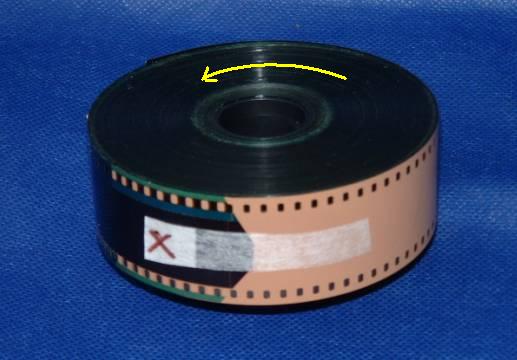
What's so great about this?
If tape is applied this way, it can be removed in one pull ,
and using only one hand.
If the "X" was facing the other way, it requires
two seperate pulls and two hands to remove the tape.
You have no idea how much easier this is! If you don't
beleive me, get yourself a roll of film & some tape and
try doing it both ways.
Another advantage is that the little tab makes finding
which end to pull easier, and since the tape will also
ususally come off in one piece, it can be re-used again
to re-tape the film end down when you're through.
(The tapered cut film end is for illustrative purposes only)
Posted by Brad Miller (Member # 2) on 06-18-2009, 11:08 PM:
What Jim just posted above is a HUGE pet peeve of mine. I am in full agreement with him that the above is how films should be taped.
Posted by Jarret Chessell (Member # 5077) on 06-18-2009, 11:39 PM:
I know this will irritate a few people but....
My secret to attaching masking tape to film is to have it on the old splice tape, and not over lapping onto the film. This way the next chap (or myself) can remove any residue from the masking tape when you peel off the splice tape on the frame. This doesn't do much for the head or tail I'll agree.
I think I'm going to try to train booth staff into using rubber bands on house trailers in light of a shipment of new trailers. I've had problems with tape residue being sticky enough that it trips the brain wrap sensor, and ultimately wears down the lamp from a restart right after starting up ![[Frown]](frown.gif) (it's a little embarrassing with an audience too)
(it's a little embarrassing with an audience too)
Posted by John Wilson (Member # 269) on 06-18-2009, 11:56 PM:
quote: Brad Miller
What Jim just posted above is a HUGE pet peeve of mine.
Absolutely.
I had a guy in the booth working for me a few years ago who simply would not...could not...get it into his head that Jim's way is SOOOOOOOOOOOOO much easier. Used to drive me batty.
He no work here no more. ![[Smile]](smile.gif)
![[thumbsup]](graemlins/thumbsup.gif)
quote: Jarret Chessell
I think I'm going to try to train booth staff into using rubber bands on house trailers
I use rubber bands on all our trailers too. Just make sure when you're training them that they remember to keep their fingers off the print as much as possible or you'll end up with a nice big greasy thumb print right on your green band.
Posted by Brad Miller (Member # 2) on 06-18-2009, 11:59 PM:
No need for rubber bands if you use the method that has been published right here for years. (The top half is slightly outdated, but scroll about halfway down the page to "WINDING AND STORING TRAILERS".)
Posted by Mike Blakesley (Member # 26) on 06-19-2009, 02:42 PM:
We used rubber bands for awhile but they're no good for long term storage -- they dry out and break after a while.
As for artist tape not leaving any scum behind? Well there are good and bad kinds of artist tape, just like anything else. I have used 3M's "green" colored masking tape to tape down the ends of trailers for several years and it doesn't leave behind any gunk at all even after a long time. The stuff costs about $6 a roll but it works really well.
Posted by Scott Norwood (Member # 30) on 06-19-2009, 03:44 PM:
Rubber bands are bad for film if used for long-term storage. John Pytlak has posted about this in the past. And, yes, they do turn to goo and, eventually, dust.
Paper reel bands really are the correct approach for long-term storage. White paper tape ("artist tape") is a poor substitute, though wrapping a length of junk film (preferably clear or white leader) around the "good" film and then taping that down with artist tape is a reasonable compromise.
I dislike the use of tape to attach film to reel hubs for shipping purposes. It is unnecessary and someone who is tempted to run film off of a shipping reel directly through the projector without inspection (dumb, but I've seen it done) may be in for a nasty surprise.
I don't use the slots in the reel hubs, either. Friction works just as well, is faster, and doesn't crease the leader.
Posted by Damien Taylor (Member # 4255) on 06-19-2009, 07:44 PM:
I thought long term storage of paper and film in a metal can was a very bad thing.
Posted by Joe Redifer (Member # 3) on 06-19-2009, 07:52 PM:
I miss reel bands. I hated them at first but now I really miss them. I liked the soft-ish brown ones that came with non-Technicolor prints, though they seemed kind of dusty/flaky. I didn't care for the stiff bands that came with most TES prints (usually sans string, latch or both with the band taped to the film no matter if the band was complete or not), but I'd prefer those (if complete) to nothing. I remember when some trailers even came with reel bands.
Posted by Ron Curran (Member # 3631) on 06-19-2009, 08:29 PM:
We store trailers on spools and we have a rack of spools with trailers. No tape. Trailers that we might not run are kept in a drawer in their original boxes until either the feature is booked or a no-show decision is made. In the latter case, the trailers are returned.
I have been guilty of taping the classification tags and the result on screen is not pretty. In theory, the tags should arrive on the trailers or as soon as the feature is classified - that would save me confessing my criminal behaviour.
Posted by Mike Blakesley (Member # 26) on 06-20-2009, 01:55 AM:
quote: Joe Redifer
I remember when some trailers even came with reel bands.
I remember when all trailers came with reel bands. (Mainstream ones that is.) National Screen Service used to raise holy hell if you dared to send one back without its band. Yes, people...we used to send trailers back. What a concept! Of course this was when there were only a few hundred prints of a movie and a print would circulate for years, not weeks, and the idea of enclosed trailers hadn't been thought up yet.
Posted by Justin Hamaker (Member # 2165) on 06-20-2009, 04:10 AM:
I understand the reason many of you bemoan the death of reel bands. However, after several bad paper cuts from TES bands, I was not sorry to see them go. I also hated receiving (first run) prints where the strings on the bands where an ungodly tangled mess.
I'll admit that when TES was still using reel bands, I knew much less about film handling than I do now. But as I recall, they were often much more trouble to deal with than they were worth. The string clasp was often torn free and securing with tape was not very effective. I remember opening more than one print with reel bands that was just as messy as with poorly taped heads.
I think what it ultimately comes down to is taking the time to actually securely tape down the ends of the film. I get the impression that some projectionists see masking tape as a rare commodity. Too often when I get a second run print, the ends are taped with just a short (1"-2") scrap of tape. I do like when one of my assistants has to build up one of these second run prints, because it makes a good object lesson in breaking down with consideration for the next person to handle the print.
Posted by Gordon McLeod (Member # 33) on 06-20-2009, 01:11 PM:
In Ontario the reel many years were a painted cloth band with string that was issued by the Ontario Censor Board (now the classification board) The band was the certificate for that reel as proof passed by the censor board
They were very durable
Posted by John Hawkinson (Member # 1135) on 06-20-2009, 07:49 PM:
I should post some pictures of trailers with NSS bands. And for that matter, with 20-year-old masking tape versus 10-year-old paper tape.
I spent a while today trying to stuff a tail into a 2" core on a split reel with the friction method, and totally gave up. Maybe you guys are way ahead of me (I'm sure practice helps), but I couldn't get my hands close enough to the hub to make it stick. I can do friction on a 4" core or a 5" house reel, but even then, I find the slot easier (and not damaging). In fact, on a 2" core, taping was much easier than getting it into the slot.
(No, I don't normally use 2" cores. Yes, I had a good reason. No, it was not for permanent film storage. Yes, it was junk film.)
One of the big wins of paper tape over masking tape is that it doesn't distintegrate. Old masking tape peels up in awkward thin slices and and crumbles. Leaving a bit of adhesive behind is just fine, of course. We only put the tape (masking or paper) on head and tail leaders, not on any actual projectable film. So a bit of adhesive? Well, OK, whatever.
--jhawk
Posted by Carl Martin (Member # 1146) on 06-21-2009, 02:02 AM:
quote: Joe Redifer
I do NOT use a piece of tape to stick the hanging tail leader to the reel flange or worse... the core of film itself. I hate it when people do that.
taping the head of the tail leader to the reel flange (even folded over the edge of the flange!) is common practice around here. i do artist-tape the film to itself around the hub, using a tab oriented as in jim's pic. is this what joe objects to? the tape pulls right off, and without it, the tail leader is at risk of unspooling in the can and getting dusty. yes, the rolled-up head leader is mooshed down between the flanges and ought to hold the film end down, but i don't trust it no to jostle loose.
i don't put tape on non-leader film for an extended time, ever. on trailers, i put the tab opposite the way jim has it. pull the tab and the protective layer (original leader if i have it) comes off with the tape. this i then roll up and re-secure with the same tape. a substantial piece of tape is good for several cycles. i write title, version, picture/sound formats, and duration on this tape.
orienting the tab as in jim's pic makes sense if you don't have an outer protective layer, but then that in itself makes no sense. (major pet peeve of mine!)
Posted by Joe Redifer (Member # 3) on 06-21-2009, 10:44 AM:
Yes Carl, that is annoying. Berkeley California must be a crappy place. I am not sure that it has the right to exist any more.
I don't know how the film will unravel itself in the can. When I open the cans to break a print down, the tail leaders are still as I left them. And there really isn't too much you can do about the dust issue other than hose out the insides of the can. Taping the film down won't really help. But the courtesy tab (as pictured on the trailer rewinding page Brad linked to) is what I have been doing for the last 15 years and it helps greatly.
Posted by Carl Martin (Member # 1146) on 06-21-2009, 01:48 PM:
used to be we'd get the occasional film move over from other theaters, on 6k's or whathaveyou. i don't know if maybe they have film-can bowling tournaments at these theaters but it was common for the rolled-up head leaders to have popped out from between the flanges and be loose in the can. so it's not totally outlandish, and for that reason i also write the reel # on the tape holding down the tail (which, as i said before, comes right off because i use that "courtesy tab").
Posted by Bill Enos (Member # 440) on 06-21-2009, 06:14 PM:
Damn! These discussions of tape can get almost as heated as discussion about something equally worthless--politicians. Maybe tape should be banned too.
Posted by Brad Miller (Member # 2) on 06-21-2009, 06:35 PM:
Bill, the difference is most of these guys are first run theaters and are used to getting brand new prints and expect for their presentations to stay that way (or they at least strive to). Your situation is different since you are sub run and you are usually screwed with whatever quality random print you get. You should be happy to see these guys are at least TRYING to take care of the prints before you get them.
Posted by Joe Redifer (Member # 3) on 06-21-2009, 07:45 PM:
Carl, I'm sure you also leave an ID frame on the head AND tail so that would be super redundant to also write it down. But I am happy that you use the courtesy tab. More people need to. More people also need to understand which side the tab goes on as well.
Posted by Adam Martin (Member # 641) on 06-21-2009, 08:46 PM:
I don't have time for courtesy tabs. I'm too busy adjusting the volume knobs.
Posted by Jarret Chessell (Member # 5077) on 06-22-2009, 12:38 AM:
I really like it when you spend countless hours unraveling heads and tails that are no longer attached to the reels... only to find that the masking tape they attached let go... but it did have a courtesy tab, so it's all okay
Usually when a print has been shown at a few other locations before getting to me I'm happy as long as I can identify the reels, put them in correct order and hopefully not have one of those giant green platter peg scratches down the middle. The only thing that burns me up is when several "ID" frames have been removed (it's been to a few cinemas) and you find things like the distributer logo is still out of frame...
Posted by Carl Martin (Member # 1146) on 06-22-2009, 02:25 AM:
quote: Joe Redifer
Carl, I'm sure you also leave an ID frame on the head AND tail so that would be super redundant to also write it down.
nope. i'd prefer to leave none at all, but i'm forced to leave one at the head. even if i did leave one at the tail, it's a lot quicker to glance in the can for a number rather than pull out a bunch of reels to examine id frames.
of course, this all makes no difference at the end of the day as it's all undone when the print ships out.
Posted by Jim Cassedy (Member # 4115) on 06-23-2009, 07:08 PM:
quote: Mike Blakesley
I remember when all trailers came with reel bands. (Mainstream ones that is.) National Screen Service used to raise holy hell if you dared to send one back without its band.
" EXHIBIT 'A' " (Recently Unearthed At An Old Theater)
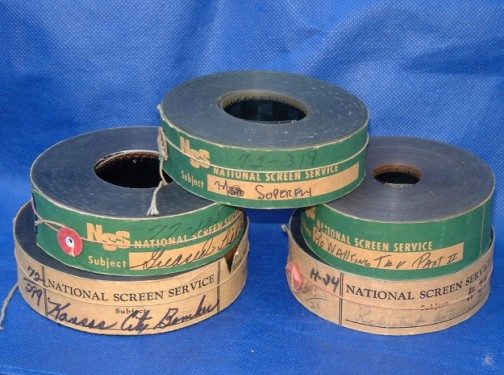
NSS not only raised hell if you returned the trailers
without the bands, they billed the theater for the
trailer prints if you didn't return them promptly.
Posted by Joe Redifer (Member # 3) on 06-23-2009, 07:59 PM:
Ewwww.... shoe polish and no cores?
Posted by Jim Cassedy (Member # 4115) on 06-23-2009, 08:18 PM:
That's not shoe polish, Joe.
Thats just top end of the paper reel bands which have
gotten a little frayed and look white in the photo.
What looks like shoe polish on inside of the top left
trailer roll is just a reflection from the camera flash.
I can't explain the absence of cores. As I recall it
wasn't all that unusual to get trailers from NSS
without cores. (mabye they were skimping on on cores
so they could afford to buy reel-bands! ![[Big Grin]](biggrin.gif) )
)
Unlike today, unless you were a first run theater you
very rarely got new trailer prints. They usually were used.
Also, the trailers did not arrive with the feature film.
They were shipped, individually via mail or UPS, with
each trailer in its'own little box. ( ! )
Afterwards you had to put the proper reel band on
each trailer and then find the right little box to
ship it back in. It was all part of the job.
Posted by Brad Miller (Member # 2) on 06-23-2009, 08:30 PM:
The trailer on the left has shoe polish on the inside of the roll.
Posted by Jim Cassedy (Member # 4115) on 06-23-2009, 08:47 PM:
quote: Brad Miller
The trailer on the left has shoe polish on the inside of the roll
![[Razz]](tongue.gif) At the risk of getting into a pissing match over this:
At the risk of getting into a pissing match over this:
"EXHIBIT 'B' "
Same Trailer- slightly different angle
and with the end pulled out. What looked
like shoe polish in the first photo was
a reflection from the camera flash.
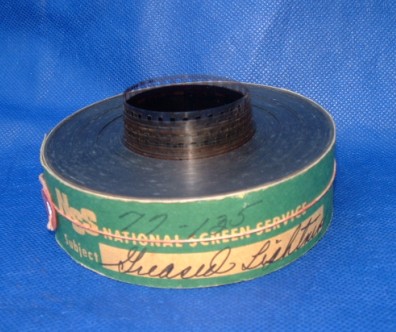
In the circuit I was working in, eveybody ran reel to reel.
There were no platters, and NO SHOE POLISH!
Heck- - I didn't even have any to polish my shoes with!
I was in the booth all day & nite- - so who was going
to see my shoes?
And no tape! We spliced film with good old fashioned ozone
depleting, brain cell killing noxious toxic chemical compounds!
Powered by Infopop Corporation
UBB.classicTM
6.3.1.2