This is topic Training Program in forum Film Handlers' Forum at Film-Tech Forum ARCHIVE.
To visit this topic, use this URL:
https://ft-forum.com/ft/cgi-bin/ubb/ultimatebb.cgi?ubb=get_topic;f=1;t=010003
Posted by John B. Keathley (Member # 5205) on 07-28-2009, 07:41 AM:
I will be training new projectionists in the next few weeks and I need to come up with a training program for them. Any suggestions? I have a rough concept, but it's not good enough for my GM. ![[Smile]](smile.gif)
Posted by Mark Gulbrandsen (Member # 72) on 07-28-2009, 08:23 AM:
Depending on what chain you work for nothng may be good enough for your DM...
Posted by Brad Miller (Member # 2) on 07-28-2009, 12:16 PM:
Beginner's booth training
Advanced booth training
Ridiculously advanced booth training
Just use the videos and certify them each step of the way.
Posted by Monte L Fullmer (Member # 2797) on 07-28-2009, 12:33 PM:
quote: John B. Keathley
but it's not good enough for my GM.
![[Confused]](confused.gif) What does he know? Maybe he should do the training then.
What does he know? Maybe he should do the training then.
"Heaven Help Us!"
-Monte
Posted by Robert E. Allen (Member # 1351) on 07-28-2009, 05:35 PM:
Last I heard Kodak was offering a projectionist training program. But I think it was at their facility. Perhaps they also have some material available.
Posted by Sally Ann Burgess (Member # 4746) on 07-29-2009, 04:54 AM:
My training programme has been streamlined somewhat in the last few months, but basically I have a checklist that starts with start of day procedures, where spares are kept, and health and safety. I use a trailer for the trainee to lace up over and over, once I'm happy with that (they must lace up perfectly 3 times in a row) we move on to basic troubleshooting like wrong film procedures (just in case)and manual controls. The most important thing for me when I'm training is to drill the CHECK CHECK and CHECK again rule into their heads. The checklist has a "shown" column and then a "proficient" column that only gets signed off when I'm happy. I also wrote a projection procedures manual for them to dip into which includes all the problems I have ever dealt with and what the cause and solution is. I hope that helps.
Posted by Jonathan Althaus (Member # 5042) on 07-29-2009, 07:06 AM:
I found the best way to teach troubleshooting is to tamper with a presentation. We're lucky enough that we have several shows a day that are empty so we don't have to worry about angry customers. I also have them trail me during a normal shift to see how I do things (like cleaning).
Posted by Justin Hamaker (Member # 2165) on 07-29-2009, 08:16 AM:
One of the best things I've found for training on threading is to put together a couple 3-4 minute trailer packs on two adjacent projectors. The trainee goes back and forth between the projectors threading over and over for 2 hours. Do this before you open or after you close. On average the trainee will get probably 25-30 repetitions over 2 hours.
I have also used trailer trailer packs to to help teach how to fix problems like out of frame splices, threading the wrong movie, fixing film breaks, fixing brain wraps, understanding aperture and lens settings. For the last, I would find flat and scope trailers that are "letter boxed" so they understand what is and isn't normal.
Posted by Andy Bajew (Member # 5330) on 07-29-2009, 08:39 AM:
quote: Jonathan Althaus
I found the best way to teach troubleshooting is to tamper with a presentation.
This is also a great way to make sure they are checking everything. Towards the end of the training week, I will come in early one day and thread up 1 or 2 projectors and purposely do 5-10 things wrong on each thread--recording what each one is, of course. I give them a little speal about I got bored and thread a few projectors and noticed I messed up X amount of things, and to please fix them. I find playing stupid helps to test their knowledge--pretend you don't know what you are doing and ask them questions to make sure they know it. I am not one to rely on a written test to prove a persons capability like the rest of the theater staff.
I've noticed it helps a whole bunch to visually show things that normally aren't seen (i.e.-dowser).
Posted by Richard P. May (Member # 3598) on 07-29-2009, 09:56 AM:
The Kodak training program was in Los Angeles, but was discontinued several years ago.
Posted by Brad Miller (Member # 2) on 07-29-2009, 11:14 AM:
Remember, when they start to get an attitude about how easy everything is, give them a brand new trailer of something animated and tell them to "build it". Let them build it however they like. Don't remind them to do ANYTHING. Then have them run it over and over non-stop for a couple of hours without pointing out a single mistake they make.
Then take a look at the print on screen and point out that they were the only person to handle that print and how much they suck due to the film damage and dirt. Not only does this usually do the trick, but this is also the point where people actually learn the importance of adding extra tail leader. ![[Razz]](tongue.gif)
Posted by Jarret Chessell (Member # 5077) on 07-29-2009, 09:11 PM:
quote: Jonathan Althaus
I found the best way to teach troubleshooting is to tamper with a presentation.
I really don't like that approach. You have some poor kid learning how to thread... they thread the projector perfectly, double check it... you come along and pull the film off a roller, they start it and the automation shuts it down, they aren't sure what's wrong because they checked everything. I think that confuses them. I typically inspect the threading before the show starts, if they do something bad and it will wreck the film I point it out and explain what would have happened and offer tips... alternately, if they do something bad and I know the automation will catch it, I let it happen, this way it's their mistake, it becomes their problem and they'll remember it way better than being "set up".
Posted by Mike Blakesley (Member # 26) on 07-30-2009, 10:34 AM:
In some other thread, somebody mentioned a 15-minute "training reel" they'd put together from old trailers. It contained a misframed splice, a backward splice, a misplaced cue, and a couple of other tricks. The trainee was given that reel and timed to see how long it would take them to get through the "show," fixing all the problems as they happened. That sounds like a good (and devilishly fun) idea but I haven't had to train anybody for a couple of years so haven't had a chance to try it.
Posted by Mark Gulbrandsen (Member # 72) on 07-30-2009, 12:02 PM:
quote: Justin Hamaker
One of the best things I've found for training on threading is to put together a couple 3-4 minute trailer packs on two adjacent projectors. The trainee goes back and forth between the projectors threading over and over for 2 hours. Do this before you open or after you close. On average the trainee will get probably 25-30 repetitions over 2 hours.
It also helps to remove the framing knobs during at least part of the training session so they learn to remember to set the intermittent sprocket before threading!!!
Posted by Monte L Fullmer (Member # 2797) on 07-30-2009, 12:34 PM:
I just do repetitive threading on white frame mylar leader when I train recruits.
They lace, I check, I take out and have them do it over again.
Posted by Eric Robinson (Member # 2966) on 07-30-2009, 01:23 PM:
Its easy to assume that a projectionist would be aware of a presentation flaw. I was repeatedly offended by the presentation at a particular theatre. Then I thought, what if they dont even know there is a problem. To test the theory I posted a presntation audit form that I designed at each projector. I asked the projectionist to notate on the form the presentation errors they observed. The form was a picture of the screen with symbols they would write on the screen which had a corresponding symbol to definition key. I noticed the responses were quite varied and that many of the presentation flaws were not noted. From this I concluded that the presentation could not be improved until the projectionists were thouroughly trained on all aspects of presentation. In summary assesment should be the first step, training the next and then finish it off with frustration.
Posted by Monte L Fullmer (Member # 2797) on 07-31-2009, 06:13 AM:
I hope that the new trainees are getting paid more than minimum, or they will not care too much to be critical.
Why the "K.I.S.S." method has been the norm in this industry: simple job task for a low wage.
Posted by Jarret Chessell (Member # 5077) on 07-31-2009, 08:27 AM:
I agree with Monte. You can pay someone to be in the booth, but you can't pay someone to care. I usually try to snatch up the staff who ask a lot of questions.
Posted by Graham Ritchie (Member # 5226) on 08-05-2009, 07:32 PM:
We trained up a young projectionist last year "does a brilliant job" one of the things I got him to make was his own framing tool out of an old Ernemann2 sprocket, simply clamp in a vice and cut a groove with a hacksaw and finish with a polish up. similar one to the following photos.
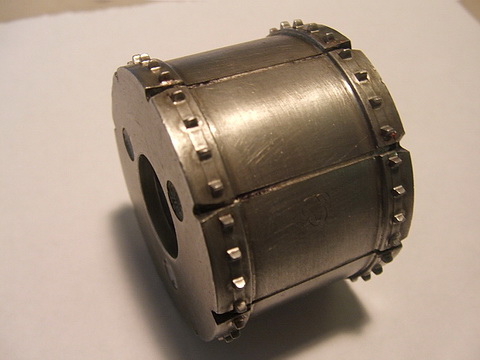
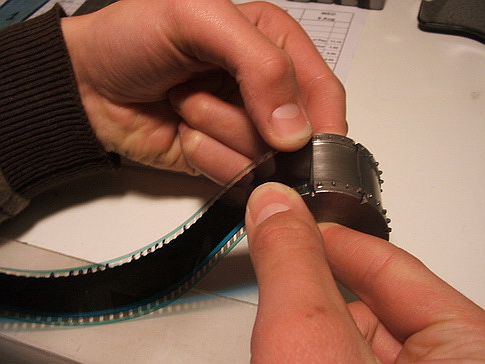
I guess you have all got one? very handy. In the almost 10 years ![[Roll Eyes]](rolleyes.gif) I have been doing projection work I can only recall one out of frame splice.
I have been doing projection work I can only recall one out of frame splice.
Graham.
Posted by Joe Redifer (Member # 3) on 08-05-2009, 07:54 PM:
I made one of those but it sucks because it is kind of a pain to keep the film on. A real frame/footage counter is MUCH preferred.
Posted by Ed Alvarado (Member # 2760) on 08-05-2009, 07:55 PM:
well never work for a terrible company like MT they dont pay projectionist for there job so thats why most of them leave or get fired.
Powered by Infopop Corporation
UBB.classicTM
6.3.1.2