This is topic 3D Coming back to film? in forum Film Handlers' Forum at Film-Tech Forum ARCHIVE.
To visit this topic, use this URL:
https://ft-forum.com/ft/cgi-bin/ubb/ultimatebb.cgi?ubb=get_topic;f=1;t=010049
Posted by Kevin Fairchild (Member # 4985) on 08-28-2009, 11:26 PM:
Here is an article from the LA times about technicolor.
quote:
latimes.com
COMPANY TOWN
Technicolor dreams of a bright future in digital cinema
While much of Hollywood is scaling back, the film processor has invested more than $200 million in its production facilities. 'We are pushing harder than anybody else in the industry,' the CEO says.
By Richard Verrier
August 24, 2009
Quantcast
Technicolor has been a fixture since the early days of Hollywood.
The company brought color to the big screen in such classics as "Gone With the Wind" and "The Wizard of Oz." When its pioneering "three-strip" color process fell out of favor, Technicolor reinvented itself as a successful film processor. The company later became a leading duplicator of VHS tapes and DVDs.
Now, after 94 years of serving Hollywood, Technicolor Inc. has planted itself in the heart of Tinseltown, leaving its nondescript headquarters in an industrial neighborhood near Burbank Airport. Its new digs -- a modern, six-story structure at the corner of Sunset Boulevard and Gower Street -- are a symbol of the company's latest transformation.
Technicolor is now refashioning itself to keep pace with the digital revolution that has reshaped the entertainment industry.
It has invested more than $200 million in digital post production and visual effects facilities, including in Bangalore, India, London and the company's new Hollywood headquarters, as well as in a sound editing facility that is slated to open next year on the Paramount Pictures lot on Melrose Avenue.
"People say Technicolor, it's just fighting to stay in the old business and they will never make it in the digital business," said Frederic Rose, chief executive of Thomson, the French media technology company that owns Technicolor. "In reality, we are pushing harder than anybody else in the industry to go digital."
The global expansion comes at a time when many other companies that service Hollywood are scaling back in the face of a severe production slowdown. Not that Technicolor has much alternative: The bulk of the company's business derives from replicating DVDs and processing film prints for theaters, both challenged segments. DVD sales are slowing and more movies and TV shows are being shot digitally.
Technicolor is the largest manufacturer of DVDs and remains one of the largest processors of film -- it processed 1.8 billion feet of film during the first half of this year.
But the company also has emerged as a market leader in the processing and distribution of digital cinema. Its new headquarters includes nine digital scanners, which cost more than $1 million apiece. They are part of a "digital intermediate" process that Technicolor developed several years ago that allows film to be color-corrected and edited on digital equipment as opposed to in a film laboratory using chemicals. The process is less expensive and faster.
As part of a strategy to expand into creative services, Technicolor in March hired Tim Sarnoff away from Imageworks, Sony Pictures' visual effects and computer animation unit, to lead its new Digital Productions division, which creates visual effects for movies, television shows, commercials and video games.
"They could have put their head in the sand and said, 'This is what we do.' But they didn't," said Randi Altman, editor in chief of trade publication Post Magazine. "They've adapted and evolved with the industry."
Technicolor's outlook brightened recently when its parent company reached a deal with creditors to slash 45% of its $4.1 billion in debt. Thomson, a provider of digital set-top boxes and other telecommunications equipment, amassed the huge debt after a string of costly acquisitions.
As part of a restructuring plan, Thomson is focusing more resources and marketing on Technicolor, which generates $3billion in yearly revenue and accounts for about 45% of Thomson's revenue.
Rose, who keeps offices in Hollywood and Paris, wants to position Technicolor as the French company's cornerstone brand. That's a departure from his predecessor Frank Dangeard, who struggled to transform Thomson into a "one-stop shop" of digital equipment and services for movie studios, TV channels and cable and telecommunications companies.
Dangeard resigned last year as Thomson's losses mounted. The board tapped Rose, a former top executive with French telecommunications firm Alcatel-Lucent, to turn things around.
To highlight the Technicolor brand, Rose insisted that all references to "Thomson" be removed from Technicolor signs and employee e-mails. He's also marshaling Thomson's researchers, who helped develop the technology for the MP3player, to create and patent new technologies for Technicolor's customers, such as finding ways to deliver 3-D entertainment in the home.
Technicolor also is shedding businesses that don't directly involve its key customers -- studios and filmmakers. That includes Premier Retail Networks, a company that manages video networks for retailers including Wal-Mart; and Screenvision, a joint venture with British broadcaster Carlton Communications that provides advertising for movie theaters. Thomson also plans to unload its Grass Valley unit, which supplies digital cameras, routers and switchers to the broadcast industry.
"The company had stopped focusing on its customer and instead focused on diversions," Rose said. "The new Technicolor is focused exclusively around content creators. What do these people want and what do they need to grow?"
Some aspects of Technicolor's digital strategy haven't worked. The company last year pulled the plug on a planned rollout of digital equipment in theaters, concluding that it wasn't economical and that it veered too far from its core business.
Instead, Technicolor recently devised a system that can show 3-D movies using conventional film projectors, potentially saving exhibitors from spending $75,000 on a digital projector. The rollout of 3-D screens has been significantly delayed because exhibitors have had difficulty funding the conversion, raising concerns among studio executives who are releasing dozens of 3-D films in the next two years. Technicolor's system will be tested this fall at an undisclosed theater in Los Angeles.
Industry insiders say reaction among studio executives and exhibitors has been mixed. But at least one studio executive who has seen a demonstration of the system is impressed.
"The solution they are working on today could potentially be very helpful to the deployment of the new 3-D platform in theaters across the globe," said DreamWorks Animation SKG chief Jeffrey Katzenberg, who is an outspoken proponent of 3-D.
Technicolor has 13,450 employees, including about 2,000 who work in various offices throughout Los Angeles. Its chief rival is Deluxe Entertainment Services Group Inc., the post production house owned by Ronald Perelman's holding company, MacAndrews & Forbes Holdings Inc. As the world's largest film processing company, Deluxe has faced similar challenges as Technicolor, and also has moved heavily into digital services.
Like other service companies, Technicolor's business was buffeted by last year's labor unrest in Hollywood and the effects of the recession, which slowed film production and further damped DVD sales.
The company cut 1,200 jobs at its North American facilities in 2007, largely because of the slowdown in DVD sales. The mastering and replication of DVDs generates about 40% of the company's revenue. Technicolor saw a 22% drop in DVD replications in the first half of this year.
Yet the company's earnings (before taxes, depreciation and amortization) rose 13% to $77 million in the first half of 2009, according to a company filing.
One reason has been growth in Technicolor's digital asset management business, which involves encoding movies and TV shows so they can be distributed in various formats, including video on demand and over the Internet.
Another small but growing area for the company is visual effects and computer animation. In late 2004, Technicolor bought the Moving Picture Co., a leading London visual effects house known for its work on Super Bowl commercials as well as films including the "Harry Potter" movies and "Lara Croft: Tomb Raider."
Moving Picture Co. has offices in London, Vancouver, Canada, and Santa Monica. It also works with an effects and animation house in Bangalore, India, called Paprikaas, which is partly owned by Thomson. Technicolor in 2007 partnered with DreamWorks to build and staff the facility, which has become another production outlet for DreamWorks, animating DVDs, the successful "The Penguins of Madagascar" cable TV series for Nickelodeon and, eventually, feature films.
To be sure, Technicolor is entering an arena dominated by larger, more established players such as Sony Pictures Imageworks and Industrial Light & Magic. A number of visual effects firms have struggled with the high cost of producing effects and overseas competition, and some, notably the Orphanage in San Francisco, have gone out of business.
Sarnoff, who is working to integrate the various facilities, says Technicolor can compete by offering high-quality effects at a lower cost than rivals.
"Technicolor has a distinct advantage in that it is truly a global company," he said. "It has facilities in places where they already have tax incentives and strong talent pools."
richard.verrier@latimes.com
Copyright © 2009, The Los Angeles Times
Most of this was trivial, but one paragraph stuck out to me.
quote:
Instead, Technicolor recently devised a system that can show 3-D movies using conventional film projectors, potentially saving exhibitors from spending $75,000 on a digital projector. The rollout of 3-D screens has been significantly delayed because exhibitors have had difficulty funding the conversion, raising concerns among studio executives who are releasing dozens of 3-D films in the next two years. Technicolor's system will be tested this fall at an undisclosed theater in Los Angeles.
Does anybody think this will actually happen, or will 3D remain digital only?
Posted by Jesse Skeen (Member # 586) on 08-29-2009, 01:28 AM:
Technicolor already moved one of its DVD manufacturing facilities to Mexico a few years ago (which has turned out a good number of defective discs.)
Posted by Frank Angel (Member # 248) on 08-29-2009, 07:25 AM:
Surely 3D on film is no mystery -- it can be done, it has been done, and well with no apologies. To do it again today is only a matter of dusting off the principals and perhaps mitigating some of the negatives that 3D imposes on all delivery systems, be they digital or film based.
The big bugaboos in both formats when trying to impliment 3D are twofold: 1) deminished illumination due to the polaroid filtering and 2) ghosting due to the less than 100% efficiency of the polarization filters. Seems that dim pictures have been tolerated by audiences with digital 3D -- the industry seems to be happy if they can get between 5 and even as low as 3 foot lamberts back to the views, considering that's down from the benchmark of 16ftL for 2D movies, 5ftL isn't a terribly difficult goal to reach and even best. Over/Under worked in the past -- it eliminates the synchronizing problems of dual strip (but of course at a loss of that extra projector and its light output) -- it would be out of the question today anyway given that most theatres only equipped with a single projector. The good news is that there is enough flexibility with existing lamphouses on existing film projectors that light output could be increased by a number of tweaking tricks like upping bulb wattage and/or by changing to more efficent reflectors, especially on older and even some of the vintage lamphouses sit sitting behind even older projector heads. Installing a TechniLite conversion kit so you can get better light output for 3D film is a lot cheaper for the exhibitor than buying a 3D digital rig.
Then there is the new developments, for example, I think it is RealD that is using a mirror and reflector box where instead of letting the polaroid filter just blocking the light, it captures that light and redirects it back out so it is utilized rather than lost. Seems this can easily be applied to film and one would think if Technicolor is working on this, they will come up with even newer and better patents that will solve the light issues. Rememeber, plenty of Under/Over 3D films in the 80s were shown using much older equipment and dim pictures some surely were, but most played to happy audience. With today's technology, it can only get better and even much better. The improvement in optics alone over the past 30 years should allow the convergence boxes much more efficient than the ones which projected JAWS III. It would be like the difference between those old Superscope or Hilux prismatic anamorphics as opposed to today's ISCO lenses.
Same thing with ghosting -- only with film it will be EASIER to get ghosting down to nearly imperceptable because with film, it is all about the polaroid filter efficiency. If the filters are good, the ghosting is gone. With modern circular polarization, ghosting is pretty much a thing of the past....and a thing which can still plagues digital, because unlike film which presents BOTH images to BOTH eyes at the same time, digital can't do that and has to present each eye in sequence, separating the images temporally. Evidently this can impact ghosting -- RealD is plagued with this (I am told), while they Dolby 3D system is fairly free of ghosting. But again, film should, if not best digital on this issue, at the very least can be as good as digital.
My sense is that Technicolor will only have to tweak the old O/U system (after all, it was working for 3D years ago), get someone to start to manufacture the convergence boxes with efficency improvements and perhaps offer lamphouse upgrade kits to kick up the light output for the polaroid filter hogs.
No reason this can't work, and you can bet your sweet bottom that Cameron is pulling his hair out knowing that out of the 36,000 screens in the country, only a miniscule fraction can actually show his film in 3D. Having a film-based 3D system in place will be like striking gold for outfits like Disney and Pixar. Hollywood isn't wont to pass up on a gold mine.
Posted by Bill Enos (Member # 440) on 08-29-2009, 11:24 AM:
I was thinking that they may be adapting film projectors to use some sort of electronic imaging system to do 3D.
Posted by John T. Hendrickson, Jr (Member # 849) on 08-29-2009, 11:38 AM:
Can't say that I agree with you, Frank, although I would wish that you are correct on your opinion that this would be a gold strike for 3D film.
IMHO the studios are too committed to turning the industry into a digital format. Less expensive for them in terms of distribution, and they seem to feel that this is the way to cure the piracy problem as well. Of course, that's debatable and the subject of many other threads on this site.
What do you now tell the big chains that have now signed on for the 4K conversion, which has already begun in some locations? Can the suits wiggle out of the Sony contracts to return to 3D film? And what about those who have already begun the digital conversion and already spent big bucks to do so?
It was the studios who began the drum beat to get exhibs to go digital, and many have only installed digital ONLY to accommodate 3D. They (the studios) are the ones who stand to save the most money, and they are the ones in the equasion who are calling the shots. It's not fair to change the rules once the game has begun, but who ever said that life is fair?
It would be in the best interests of exhibitors to get a good film 3D system, but the game is not played by the distributors to enhance their (the exhibitor's) bottom line.
Posted by Julio Roberto (Member # 4976) on 08-29-2009, 12:02 PM:
3D in film can, of course, be done just as well as in digital, if not better.
No breakthroughs would be needed, as the over/under or side/side system would still be the best practical method. The pre-separation of light into two polarized beams used in Reald new XL optical adaptors wouldn't really work as they are actually still doing time-sequential 3D (48fps, 144hz refreshes) for which film projectors can not be easily adapted.
Don't get me wrong, it COULD be done, but you would end up with a much more complicated (large) optical box and most likely 4 beams of light, but the light output would indeed improve by some +30%.
The only thing needed is good threading practice (i.e. a "3D" leader tape with half the frame, say the top part, say corresponding to the right eye, colored in red while the other half frame colored in blue so then, a quick glance at the gate would show the frame to be centered and in-phase). That would be all. And careful splicing practice etc, perhaps aided by making very obvious colored marks outside the frame in perforation marks at the end/beginning of new rolls.
The 3D optical adaptors could also be made a bit better nowadays. Since the cinema projectors lack light-integrating rods that even-out the illumination across a bit more and the frame is splitted in these over/under side/side systems, a bit of density filtering would help the illumination assymetries at the cost of a bit of light output.
Will it be done? Only if distributors/studios want. They can do it no sweat: just tell the computer to print out an over/under 35mm print timed to 4.5fl instead of using one eye only for the 35mm 2D prints they are producing. Voila.
And then, open a certification program for 35mm 3D adaptors if you want. Several vendors I'm sure will start providing them of great performance. Old ones would work just as well, although they probably need better installation know-how and maintenance, such as replacing the polarizing filters, etc.
But Hollywood first needs to get the message across in the industry that they want 3D in film by making 35mm over/under prints available for booking today.
The rest will quickly follow.
Will that happen? ![[Confused]](confused.gif)
Posted by Frank Angel (Member # 248) on 08-30-2009, 09:38 AM:
Well, on the plus side, there's Katzenberg and Cameron who are really 3D evangelists and are well aware that the numbers are still substantially low in terms of number of screens that are 3D equipped. They are powerful enough to move the industry toward the Technicolor solution, despite the studios' overall digital agenda.
And yes, John, I agree that the studios have a vested interest in having exhibitors convert to digital on every screen, but in the interim, they still want to pull in as much $$ as they can from the 3D productions. The paultry number of 3D screens available compaired to the number of film installations still operating might be enough of an incentive for them to make 3D film prints just to get more 3D play. Certainly the producers and creative people who invest money and energy into making a film like AVATAR will want their film shown in 3D on as many screens as possible regardless of the medium or the studios' long-term goal of ever increasing digital conversions. If Techincolor can provide a viable 3D film system that is fairly foolproof, even for marginally compentent booth operations, I think there will be a hard push for its implimation by the filmmakers themselves, even if the motivation there is more ego driven than anything else. I am sure Cameron will be feeling less the "king of the world" if more than half the people who see is film will never see in 3D, I am guessing.
Posted by Jim Cassedy (Member # 4115) on 08-30-2009, 09:54 AM:
Mabye I should start dusting off & polisihing
up my old Paramount/Stereovision lenses!
Posted by Jack Theakston (Member # 4484) on 08-31-2009, 08:20 PM:
Why even bother? Coming from a 3D nut such as myself, this horse is already tired. With the decreasing box office interest in 3D, why would anyone think it's salvageable at this point? Money talks, and it ain't talkin' for 3D.
The biggest issue aside from digital installations are the silver screens. I'm going to ignore the issue of hotspotting, since truth be told, most theaters have at least one screen that's the right dimensions, but who is going to put up the money for something that's not guaranteed to make it back?
And with people ambivalent about the current press about AVATAR, at over $300, do you think it's going to make back its money? Sure, it might do well compared to some of the other 3D pictures out now, but what talks is domestic grosses. I just don't see it happening.
FWIW, while it's a system plagued with problems, there's no reason over/under or side/side can't be resurrected. I don't see what single-projector systems have to do with anything (same amount of film as a regular feature). If anything, if properly adjusted, you're going to maintain good 3D projection throughout the entire feature, rather than fiddling with two stereo boxes.
Ironically, on the heels of this, IMAX is simply shooting themselves in the foot with their digital nonsense.
Posted by Julio Roberto (Member # 4976) on 09-01-2009, 01:49 PM:
To save myself some time on rants on 3-D, here are some excerpts from this blog entry:
http://www.davidbordwell.net/blog/?p=5334
quote:
Has 3-D already failed?
Years ago, James Cameron announced that his upcoming film, Avatar, would only be released to theaters capable of showing it in 3-D. Since then, he has proselytized fervently at trade shows and fan cons, hoping that Avatar would be such a blockbuster that exhibitors would finally decide to make that expensive leap and invest to convert their auditoriums to add 3-D.
....
Avatar will need about 4,000 screens for a 3-D-only release, estimates Doug Darrow, manager of DLP brand and marketing at Texas Instruments, which makes the chips that power theatrical 3-D projectors. Of course, once the Avatar-inspired infrastructure is in place, other 3-D-only releases will follow.
The problems with conversion are manifest. Number one is the expense. 3-D systems are digital, so first the theater owner must convert from 35mm projectors to digital. 3-D is an add-on system that entails additional expenditure. A digital conversion alone costs over $100,000, about five times the cost of a 35mm platter projector. Right now most “D” theaters have 2K projection, but 4K is gradually being introduced for both shooting and showing. (Che and District 9 were shot mostly on 4K.) What theater owner wants to buy an expensive projector that will be obsolete within a few years? And what was supposed to be the breakthrough year for 3-D sees us at what may be the bottom of a huge financial crisis. It has slowed down an already laggardly process.
....
I’ll admit that the signs that 3-D is finally going to become a routine and frequent method for making and exhibiting films are clearer than ever this year. More theater chains are announcing conversion to digital projection after years of resistance. More films in 3-D, and good films, are appearing, like Coraline and Up. And I have to admit that I enjoyed Monsters vs. Aliens more than its tepid reviews had suggested I might.
But there are negative signs as well. Perhaps most notably, the major proponents of 3-D, after years of berating the exhibition wing of the industry for its slow adoption of digital and 3-D technology, are still berating it. Jeffrey Katzenberg, who had announced that all Dreamworks Animation features would henceforth be made in 3-D, is one such complainer. Cameron is another. As of now, roughly 320 of the U.K.’s 3600 screen are digital—which doesn’t entail that all have 3-D capacity. In the U.S. it’s 2500 out of 38,000.
These days, a major blockbuster may open on 4000 screens or more. Given Avatar’s massive budget, rumored at $237 million (not counting prints and advertising), Twentieth Century Fox couldn’t settle for showing only in 3-D, even if every properly equipped screen in the country showed it.
The recent theatrical free previews of scenes from Avatar in 3-D have renewed the claims that this approach is the future. Yet some commentators are cautious about that claim. The Guardian quotes Louise Tutt, deputy editor of Screen International: “It seems a little overambitious,” she says. “A little over-enthusiastic. I mean, take a film like 4 Months, 3 Weeks and 2 Days – who needs to see that in 3-D? So no, I don’t believe it will happen.” She sighs. “But then who am I to contradict James Cameron?”
Cameron is a mighty force for change, no doubt. The Abyss and Terminator 2 introduced the sort of morphing technology that made digital effects a reality. But oddly, there aren’t a lot of other directors quite that gung-ho about 3-D. They’re willing to praise it and suggest that they may make films in 3-D, but they don’t go around to trade shows pressuring exhibitors to convert their theaters.
Peter Jackson, for example, keeps hinting at such a possibility. Apparently his team is testing the new Red camera’s 3-D model with an eye to using it in the remake of The Dambusters. That’s slated to be produced by Jackson and directed by Christian Rivers. But if Jackson were as enthusiastic about the process as Cameron, wouldn’t The Lovely Bones be in 3-D? Steven Spielberg hasn’t been pushing 3-D, although there are rumors about the Tintin films being 3-D. But rumors and expressed interest don’t influence exhibitors reluctant to invest in upgrading theaters on the basis of the still-limited 3-D product that’s out there so far. Where’s Ridley Scott in this debate? Well, to be fair, he called the Avatar footage “phenomenal,” but I don’t see him making 3-D movies and demanding that they play only in properly equipped theaters. Where’s Tim Burton? Even George Lucas, Mr. Digital Technology, who keeps saying that Star Wars will be converted to 3-D, doesn’t have Cameron’s zeal.
Retro-fitting movies is hugely expensive, by the way. One of the few retro-fitted titles, Tim Burton’s The Nightmare before Christmas, has taken to returning annually, as if to remind us of that fact.
Even Pixar, which has said it will henceforth make all its films in 3-D, has been strangely low-key about its current project of re-doing the first two Toy Story films in 3-D and re-releasing them as a lead-up to the premiere of the third film, planned in 3D from the start. (This year the first two will be shown at the Venice film festival, which has added a 3-D prize.) Presumably they are content to provide both 3-D and 2-D prints.
We’re also not seeing a lot of directors in other countries clamoring for the option of making their movies in 3-D. Hollywood may dominate world cinema in terms of screen time occupied and tickets sold, but there are still thousands of movies made elsewhere each year.
There are still few enough theaters in the U.S. capable of showing 3-D movies that films end up with truncated runs. Coraline perhaps suffered most from being taken off screens while it still had commercial potential and before word of mouth had time to help it gain the audiences it deserved. The release of the partially 3-D Imax version of Harry Potter and the Half-Blood Prince was delayed by the fact that Transformers 2 was still occupying Imax theaters. I can’t help but wonder if there are some studio executives who look at this situation and, without announcing it to the world, decide that the films they’re about to greenlight will be made in 2-D. Plenty of those theaters to go around. (Well, not for all the independent films jostling each other in the market, but that’s another blog topic.)
Cameron has bowed to the inevitable and is allowing Avatar to play in both 3-D and 2-D theaters. It seems obvious that it will still take years before a film can go out into the world without 2-D 35mm prints being included in its distribution.
During those years, there’s the potential that 3-D will lose its luster for audiences. One of the main arguments always rolled out in favor of conversion is that theaters can charge more for 3-D screenings. Proportionately, theaters that show a film in 3-D will take in more at the box-office because they charge in the range of $3 more per ticket than do theaters offering the same title in a flat version.
But what happens when, say, half the films playing at any given time in a city are in 3-D? Will moviegoers decide that the $3 isn’t really worth it? Even now, would they pay $3 extra to see The Proposal or Julie & Julia in 3-D? The kinds of films that seem as if they call out for 3-D are far from being the only kinds people want to see. Films like these already make money on their own, unassisted by fancy technology.
Then there’s the fact that the extra $3 is not simply profit. There has to be an employee handing out the glasses, though sometimes the ticketseller does that. And those glasses in themselves cost money. Some will get damaged. When David and I saw Monsters vs. Aliens, there was a woman with a child, perhaps four years old, in front of us in the concession line. She handed both pairs of glasses to the kid while she dealt with paying for the refreshments. He had his fingers all over the lenses, of course.
If a theater is using the RealD 3-D system, it’s no big deal if kids with sticky fingers get hold of the glasses. They are so cheap as to be disposable, if the theater doesn’t want to bother collecting and re-using them. Problem is, the theater has to buy or rent a special silver screen to project on. The Dolby 3D system doesn’t require a special screen, but its glasses cost a whopping $50 apiece as of 2007. In Dolby theaters, you’ll find tense ushers waiting outside, making absolutely sure everyone returns theirs for washing and re-use.
No doubt 3-D enthusiasts would object that someday the system will be so routine that we’ll all have our own glasses and bring them along. That would cut the expenses to the theater, to be sure. But remember, different 3-D systems require different kinds of glasses. Are audiences willing to collect one of each and keep track of which they need to take along when they head for the theater—especially those $50 ones? (“Check the theaters listings, honey. Is it RealD or Dolby tonight?”) And there are more competitors entering the market, with their own glasses.
Is current audience enthusiasm permanent?
As usual, the studios take box-office figures to equal enthusiasm on the part of fans. In public, at least, they don’t speculate as to whether 3-D might again be, as it was in the 1950s, a mere fad or a specialized taste. But because spectators are willing to pay extra now because 3-D is still a novelty, does that mean they’ll maintain that attitude once 3-D is common?
Maybe not. And maybe even now not all filmgoers care. Some even dislike 3-D.
One vocal critic is Roger Ebert. His “D-Minus for 3-D” blog entry is an eloquent takedown of the technique on aesthetic grounds. He just doesn’t like watching movies in 3-D:
In my review of the 3-D “Journey to the Center of the Earth,” I wrote that I wished I had seen it in 2-D: “Since there’s that part of me with a certain weakness for movies like this, it’s possible I would have liked it more. It would have looked brighter and clearer, and the photography wouldn’t have been cluttered up with all the leaping and gnashing of teeth.” “Journey” will be released on 2-D on DVD, and I am actually planning to watch it that way, to see the movie inside the distracting technique. I expect to feel considerably more affection for it.
Ask yourself this question: Have you ever watched a 2-D movie and wished it were in 3-D? Remember that boulder rolling behind Indiana Jones in “Raiders of the Lost Ark?” Better in 3-D? No, it would have been worse. Would have been a tragedy.
He refutes the widespread argument in favor of realism:
There is a mistaken belief that 3-D is “realistic.” Not at all. In real life we perceive in three dimensions, yes, but we do not perceive parts of our vision dislodging themselves from the rest and leaping at us. Nor do such things, such as arrows, cannonballs or fists, move so slowly that we can perceive them actually in motion. If a cannonball approached that slowly, it would be rolling on the ground.
It’s true that the “coming at you!” effects in 3-D movies are disruptive. I remember the 3-D in Bwana Beowulf, excuse me, Beowulf primarily for those weapons thrusting out of the screen or the gratuitous overhead tracks past beams looking down toward the distant floor. More interesting, though, is that fact that although I saw Coraline and Up in 3-D, I remember them in 2-D. Those films didn’t throw spears at the spectator or otherwise seek to pierce that fourth wall with their props. Of course as I was watching, I noticed that the mise-en-scene had layers of depth and the figures a rounded look, but apparently my life-long movie habits filtered those aspects out as the films entered my memory. I look forward to seeing both films again on DVD, and given the fact that home-theater 3-D is still in its very early stages, I’ll probably see them flat. Fine with me.
Yes, Coraline was carefully designed with 3-D effects in mind, playing with skewed perspective to characterize the two worlds the heroine moves between. But as David showed by reproducing a frame here on our merely 2-D blog, the same motifs worked without the glasses. They’re quite similar, in fact, to the forced or distorted perspective used in German films of the 1920s.
We saw District 9 this week. No 3-D, and I for one am glad about that.
On August 26, TheOneRing.net, the premiere Tolkien site on the internet (for both novels and films), pointed to the current results of its ongoing poll. They asked, “Should the Hobbit films be in 3-D?” Many of the fans who frequent TORN do so because of the films. They have heard rumors over the years, mainly hints dropped by Peter Jackson, that The Hobbit might be made in 3-D. So what is their reaction as reflected by the poll? As of August 26, 55% say no, 13% say emphatically no (“Ugh … 3-D?”), 13% are sitting on the fence, and 13% say yes.
....
TORN subsequently checked with director Guillermo del Toro, who reassured them, “I can safely say that, as of this moment, there are absolutely NO conversations about doing the HOBBIT films in 3D.”
Of course, my title, “Has 3-D already failed?” was meant to be provocative. Its answer depends on how one defines success. If you’re Jeffrey Katzenberg and want every theater in the world now showing 35mm films to convert to digital 3-D, then the answer is probably yes. That goal is unlikely to be met within the next few decades, by which time the equipment now being installed will almost certainly have been replaced by something else.
Right now, the big proliferation is in tiny personal screens, iPod Touches, cell phones, portable gaming devices. Will teenagers allow themselves to look dorky by sitting with 3-D glasses staring at their phones? 3-D has the effect of making films that won’t play well on the very devices that studio heads would love to see playing their movies. So far, it is a remarkably inadaptable technology to try and force on people whose movie-playing gadgets change every few years. The big break-through, home-video 3-D, is aimed at a machine that people are supposedly abandoning in favor of other screens. 3-D movies on your computer? So much for inviting pals over for a sociable evening of popcorn and a movie in your impressive home theater.
Maybe Hollywood will forge ahead, despite all the obstacles I’ve mentioned. But it also seems possible that the powers that be will decide that 3-D has reached a saturation point, or nearly so. 3-D films are now a regular but very minority product in Hollywood. They justify their existence by bringing in more at the box-office than do 2-D versions of the same films. Maybe the films that wouldn’t really benefit from 3-D, like Julie & Julia, will continue to be made in 2-D. 3-D is an add-on to a digital projector, so theaters can remove it to show 2-D films. Or a multiplex might reserve two or three of its theaters for 3-D and use the rest for traditional screenings.
If that more modest goal is the one many Hollywood studios are aiming at, then no, 3-D hasn’t failed. But as for 3-D being the one technology that will “save” the movies from competition from games, iTunes, and TV, I remain skeptical. Given the banner year that Hollywood is having, I echo Daffy Duck in The Scarlet Pumpernickel when after his lover picks him up and, crying “Save me,” races from her forced marriage, he says,“So what’s to save?”
You can read on imdb about a guy that wanted to go watch Final Destination (or whatever it's called) 3-D with his girlfriend. They quoted him $17 per ticket in NY (maybe Imax?). For $34, not counting concessions, he decided to wait for the blu-ray and watch it home. Too expensive. He stayed home. Money lost in ticket AND IN CONCESSIONS because the 3D surcharge (or, perhaps, an Imax surcharge and he just didn't know or cared what Imax was).
Posted by Victor Liorentas (Member # 5272) on 09-03-2009, 02:56 PM:
If this were implemented with any success ,would it not really piss off the digital monster virus?
![[Smile]](smile.gif)
I think this would be great fun to watch film ![[sex]](graemlins/sex.gif) the digital beast a wee bit!
the digital beast a wee bit!
Posted by Mark Gulbrandsen (Member # 72) on 09-03-2009, 03:16 PM:
It's moneys wasted IMHO. Ever since 3-D film based systems went single strip 35mm the 3-D has sucked big time and is so inconsistant as to be a joke. It's also still going to cost theaters about 10 grand or more to get another special lens and the silver screen. Many will also need to install larger lamphouses as well. All in all this is money that would be better spent in the long run on digital!!
Mark
Posted by Joe Tommassello (Member # 4632) on 09-03-2009, 04:19 PM:
Maybe it's some sort of alternate frame thing where one frame is right eye, the next left, etc. and they are developing that syncs with the projector and polarizes each eye accordingly!
(I am only half joking!)
Posted by Mark Gulbrandsen (Member # 72) on 09-03-2009, 04:32 PM:
Actually Joe, thats not all that far fetched... just gear the filter wheel to the projector shutter shaft and so on.... Install a 32 tooth sprockets and so on. Would eat up lots of film running at an equivelent 48 fps just to acheive a resultant 24fps.
Mark
Posted by Jack Theakston (Member # 4484) on 09-04-2009, 06:47 PM:
It's just the same over/under system from the '80s.
quote: Mark Gulbrandsen
It's moneys wasted IMHO. Ever since 3-D film based systems went single strip 35mm the 3-D has sucked big time and is so inconsistant as to be a joke.
I'll agree with you that since films started shooting single-strip, the 3D has sucked. But what makes you think they're shooting single-strip? Most of these camera rigs are two-camera digital.
quote:
It's also still going to cost theaters about 10 grand or more to get another special lens and the silver screen. Many will also need to install larger lamphouses as well. All in all this is money that would be better spent in the long run on digital!!
Even though 3D is declining at the box office, the 3D versions always do better than the 2D. A theater would be spending the same amount on a screen for digital than they would for film (and the linear polarization glasses cost less, too).
No matter-- by next summer, this fad will be over.
Money should be spent on equipment that works and won't be obsolete in three years.
Posted by Scott Norwood (Member # 30) on 09-04-2009, 07:20 PM:
Unless the technology is substantially better than under/over was in the 1980s, this sounds like a loser. It still requires the silver screen and new lenses, and the manager-operators at the mini-mall theatres will screw it up.
The only good 35mm system that I have seen is 2-strip. I've not seen much Real-D, but it looked better than under/over or side-by-side (and I say that as a film snob!).
Imax 15/70 2-strip 3D is still way, way better than anything else, though.
Posted by Don Furr (Member # 1469) on 09-04-2009, 08:40 PM:
According to the information I've read Technicolor has chosen to stick with 35mm with a newer higher quality lens which will cost 5 to 7 thousand bucks. Same over/under but with circular polarization instead of linear polarization. I've already heard rumors that both of the "major" lens companies are making lens. Anyone have further information about this? I'm assuming the newer lens will allow more light to pass.
Posted by Jack Theakston (Member # 4484) on 09-04-2009, 08:48 PM:
If Technicolor is so concerned about film prints and are putting so many millions back into it, why don't they just resurrect their Vectograph printing system? Sure it's dye-transfer, but it's single-strip polaroid, with no sync/phase/framing issues.
Reason: no one there even knows what the hell a Vectograph is.
Posted by Claude S. Ayakawa (Member # 1401) on 09-04-2009, 08:59 PM:
As a 3-D nut, I will no longer have any problem seeing a movie in either Real D or Dolby 3-D because there are three theatres very close to where I live that can show them. The over/under 3-D of the eighties sucked big time and unless they come up with some major changes in the original system especially screen brightness, it will fail again.
-Claude
Posted by Demetris Thoupis (Member # 833) on 09-04-2009, 11:51 PM:
I am wondering whether someone could install two dolby filter wheels in a projector between the light path and the image and synchronise it! That would give an advantage and not require a silver screen would it?
Posted by Christopher Seo (Member # 7) on 09-05-2009, 02:02 PM:
Vectograph is an amazing system, even though I've only seen it in the splicey Professor Owl cartoon that was shown at World 3-D Expo II. It was startling to see the 3D image in the film print itself by simply looking at it through polarized glasses on the rewind bench. Theatre owners would certainly appreciate not having to upgrade the projector at all - only the screen. But my impression is that this system was barely ever used for motion pictures. Am I incorrect?
It would be interesting to take the Vectograph approach - i.e., single-strip embedded 3D - but using Dolby's 'wave multiplex' model. One would have to find six film dyes (two CMY triplets) that function in a similar way to the Dolby filter wheel, along with the complementary glasses. No modifications would be required for projector, lens, or screen. But, probably way too complex an undertaking to fit anyone's R&D budget.
Posted by Darryl Spicer (Member # 711) on 09-05-2009, 03:14 PM:
The problem for this system to make it to major players is the fact that some signed exclusive Real D agreements.
Posted by Mark Gulbrandsen (Member # 72) on 09-05-2009, 05:17 PM:
quote: Jack Theakston
But what makes you think they're shooting single-strip? Most of these camera rigs are two-camera digital.
Nothing leads me to believe otherwise... I meant the single strip at the projection end. One has to assume it's done with two cameras one way or another.
Mark
Posted by Frank Angel (Member # 248) on 09-05-2009, 09:58 PM:
Chris, I too saw the Vectograph film and stood there dumbfounded, looking at a piece of film that was, in and of itself 3D with both images imbeded and polarized; you thread it, you've got 3D. All the exibitor needs to do is get a silver screen, or do like some did in the 80s -- just have their old scree spray painted silver. Really, you couldn't ask for a simpler system and one that completely solves booth operational problems. It just can't get mucked up.
If Hollywood wants to get 3D penetration into most of the screens in the country and REALLY make some serious money, the Vectograph system is far and away the answer. That is if they just want to play their 3D product in the highest number of theatres as possible. On the other hand, they really may only be interested in using 3D as the carrot & the stick to get exhibitors to buy into digital. They've got to pick their poison -- either release 3D product in both digital and film so it can make as much $$$ for them as whatever the potential 3D process might have....or, they can continue to only use 3D to get exhibition to move to digital, which in this economy seems to have just stagnated.
Whatever the studios intentions with 3D product, I am sure producers like Cameron would rather show AVATAR in 3D on more screens rather than just 18% of the existing screens that are 3D/digital capable.
Posted by Mark J. Marshall (Member # 1409) on 09-06-2009, 12:53 AM:
Agreed on Vectograph. The only issue they seemed to be having was a slight ghosting issue - but it's been 50 years. I think they could have fixed that by now had they stuck with it. What a wasted opportunity!
I wonder if they could figure out a way to polarize the emulsion on the film today to produce the same effect.
Posted by Jack Theakston (Member # 4484) on 09-06-2009, 03:41 PM:
Properly done transmission Vectographs won't have any crosstalk. The MELODY segment was a test piece, that's why it doesn't have a soundtrack on it.
Setting up the line for 3D prints would be perfect. There wouldn't be as many prints as there are for 2D engagements, and so the prints could be made with quality at a timely rate.
But my estimation is that by the Technicolor could get their dye-transfer equipment up and running, and installed the Vectograph equipment, formulated new dichroic dyes, had Kodak make the special base necessary, experimented, et cetera, the fad will be over.
Posted by Ramon Lamarca Marques (Member # 3621) on 09-06-2009, 05:25 PM:
I am probably the only one who enjoyed the 3-D revival in the 80s. I remember seeing Friday 13 III in 3-D and I still think the opening credits are one of the most fascinating 3-D titles ever, especially because cinemas were big then and the titles had to come a long way to reach my seating position. I do not know, memory is not always reliable but it was a big cinema with a big silver screen and I remember a good 3-D all throughout. Amityville 3-D had more ghosting but wasn’t bad and Spacehunter had very few coming at you effects but I do not recall any ghosting. I did not see Jaws, which apparently was the worst of the lot in terms of 3-D quality. I have not seen, yet, anything in digital 3-D that has improved on my previous experiences, but mind you, I have seen a lot of interlocked new 3-D 35mm prints in London before digital 3-D and so the bar is high.
Well, I suppose the false claim that 3-D was only good in digital and that 3-D was unique to cinema has been fully refuted. 3-D TV is round the corner in many different formats and in the not too long future probably without glasses, so 3-D is not unique to cinema, as for the false claims that before digital all 3-D was the red and the green glasses, well, just go to real IMAX to see how good 3-D already was.
As for Vectograph, I had read about it, is there any of you with contacts at Technicolor who could remind them about it? They could use the dye transfer plant to also produce 2-D film prints for those of us who won’t go to the pictures unless it is to see good old film and I definitely would go out to see a gorgeous dye transfer print on a big and slightly curved screen. I can get digital at home as much as I can, but I can’t get film. I cannot get either a big huge screen, and this is something producers and cinema chain owners seem to forget, even though the success of The Dark Knight in its proper IMAX screenings was quite obvious.
It is really silly this thing studios and cinema chains have about one system becoming the panacea to their financial problems, why they just don’t just use all the tools they have and create good multiplexes with screens well adapted to VistaVision type ratios, screens for scope, screens for 70mm and screens for 3-D, why don’t they instruct audiences on the advantages of customised auditoriums for the perfect viewing conditions for each film. I mean, I am happy to see films in 3-D, in scope, academy ratio, black and white, colour, actually I like the difference and what different directors can do with different tools.
I personally hope there will be a more personalised type of cinema that will bring back some of cinema’s theatrical origins in presentation and grandeur and I hope the different tools available to storytellers will remain available and this includes film, both as an acquiring format and as a presentation format for those of us who appreciate it and enjoy it and if film 3-D comes back I will be up for it.
Posted by Frank Angel (Member # 248) on 09-07-2009, 12:30 PM:
quote:
It is really silly this thing studios and cinema chains have about one system becoming the panacea to their financial problems, why they just don’t just use all the tools they have and create good multiplexes with screens well adapted to VistaVision type ratios, screens for scope, screens for 70mm and screens for 3-D,
Ramon, you obviously are a real cinephile. Problem is most in Hollywood are just investors and rarely do art and greed good partners make. As for it being "really silly," my friend, you are being too too kind. There are allot more accurate adjectives that you could use to describe Hollywood decision makers, but my momma told me it wasn't nice to use that kind of language.
Posted by Ramon Lamarca Marques (Member # 3621) on 09-08-2009, 05:30 PM:
quote: Frank Angel
Ramon, you obviously are a real cinephile. Problem is most in Hollywood are just investors and rarely do art and greed good partners make.
Frank, it saddens me that there is so little interest in showing films as they were originally exhibited. I know this is a complex subject and would generate a thread in itself but when even dedicated institutions like the British Film Institute are going digital to exhibit old films I despair. I understand that the general public may not care about seeing dye transfer prints, or proper ratios, or nitrate prints, 70mm prints or interlocked 35mm 3-D films but I think film history should be preserved as close as possible as to what it was and they cannot say they are preserving film history when they are removing something essential, which is film itself. Classic films should be shown on film.
Anyway, I hope 3-D film will make a comeback in a perfected format, this will prolong film’s life. I wonder what exhibitors who have invested in digital for 3-D will say about it.
Posted by Kevin Fairchild (Member # 4985) on 09-17-2009, 01:38 PM:
Looks like it is here now.
quote:
Hollywood, Calif.,—Sep 17, 2009 Technicolor Launches Industry’s First “Production to Projection” Solution to Deliver High-quality 3D to More Moviegoers Moviegoers Rank 35mm 3D Identical in Quality to Digital 3D in Warner Bros.’ Final Destination 3D Exit Polls
To address the unprecedented demand for 3D, Thomson (Euronext Paris: 18453; NYSE: TMS), through its Technicolor Business Group, today announced a high-quality, affordable 3D solution that works with existing 35mm projectors. The Technicolor 3D Solution can be deployed immediately to bridge the gap until digital cinema can be more widely rolled out. According to exit polling interviews conducted by independent research firm OTX, moviegoers ranked Technicolor 3D as being comparable to digital 3D cinema technologies, making it the first viable celluloid complement to existing 3D efforts.
A wider platform is needed to accommodate the growing consumer demand for 3D content. With more than a dozen 3D movies and even more special 3D events (concerts, sporting events, etc.) slated for 2010, 3D engagements are a proven complement to 2D at the box office. In fact, 3D engagements outperform 2D by more than 2-to-1 in attendance and even greater in box office. Existing 3D technologies work exclusively with digital projectors, but currently only approximately 6,500 theatre screens in the U.S. have been converted to digital and roughly only 2,500 of those screens will be 3D-capable by year’s end. This means more than 90 percent of theatre screens in the U.S. are not able to provide a 3D experience to moviegoers…until now. Because there is no need for a digital cinema system, which can be costly, Technicolor’s innovation puts 3D within economic reach of all theatre circuits, allowing them to complement 2D engagements and benefit from incremental revenue generated from increased ticket sales and ticket sale surcharges.
“In today’s economic environment, it’s a harsh reality that not every exhibitor has access to the funding required to install digital 3D projection systems. It was the desire to make 3D accessible to the masses that resulted in Technicolor creating a 3D solution to fill the gap between celluloid and digital cinema,” said Frederic Rose, Chairman and CEO of Thomson/Technicolor. “Technicolor 3D equals the quality of digital 3D, and since it’s a fraction of the cost of digital 3D, it allows every exhibitor to benefit from the incremental revenue generated from 3D presentations while giving content creators the widest possible platform on which to share their movies.”
Warner Bros. and AMC, which have teamed with Technicolor for initial consumer testing, are encouraged by moviegoers’ response to the Technicolor 3D Solution. Sixty-five percent of moviegoers polled after viewing Warner Bros.’ box-office success Final Destination 4 in Technicolor 3D said the “overall image quality of the 3D” was “excellent” or “very good”—this compares identically to the results from digital 3D exit polls.
Movie Exit Poll Highlights from Technicolor’s 3D Presentation of Warner Bros.’ Final Destination 4
· Satisfaction of Overall Viewing Experience. Overall satisfaction was similar in Technicolor 3D and digital 3D and both test groups felt “satisfied” to “extremely satisfied” with this experience. The 35mm 3D group registered somewhat higher “extremely satisfied” responses that the digital 3D group.
· 3D Quality Compared to Last 3D Movie Experience. Comparing this experience to the last movie they saw in 3D, moviegoers who watched in 35mm 3D were near-identically inclined to perceive the 3D quality as “excellent” or “very good” as those who watched in digital 3D—comparisions to their last 3D experience were at parity.
· Movie Ratings & Recommendation. Moviegoers who watched in Technicolor 3D were more inclined to rate the film itself “excellent” and to “definitely” recommend it to friends versus those who watched in digital 3D.
How the Technicolor 3D Solution Works
The Technicolor 3D Solution employs a propriety “production to projection” system that leverages 35mm (film) projectors already in use by 90 percent of U.S. theatres today to deliver high-quality 3D content to moviegoers. A patented lens system assembles the left and right eye images as the film runs through the projector and delivers a 3D ready image onto a silver theatre screen. The solution works with circular polarized glasses—identical to the ones used for existing digital 3D cinema—to “translate” the film’s content into an image that is perceived by the viewer as being three dimensional. The silver screen can be used for the projection of both Technicolor 3D as well as digital 3D content. The Technicolor 3D Solution can be installed nearly immediately. No build-out or significant modifications of the projection booth are required.
Posted by Julio Roberto (Member # 4976) on 09-17-2009, 04:33 PM:
I never understood why some people that should know better claim that, somehow, the over/under 35mm 3D system used mostly in the 80's, from the projection point of view, is any worse than any other 3D system.
Let's see the advantages and dissadvantages and comparisons.
-About the same resolution-per-eye (a bit less, actually) than 2K systems when showing 1.85 material and considerably more when showing 3D 2.35 scope, as the split frame 3D 35mm uses the absolute full frame and spherical optics (while, i.e, scope digital 3D uses a 2048x856 pixel grid, often 4:2:2 10bits jpeg2k compressed to ~120mb/s for each image, as the bandwidth is split in two at 48fps).
-o/u 35mm has about the same illumination problems as digital 3D: the FULL 35mm frame, which yields say 14fl, is split in 2 and then halved once again by polarizers. The same or better than same as RealD (old, non-xl), Master Image (current), and much better than Dolby. There are no "blanking intervals" so no additional loss. If a split barrel lens is used in 35mm, no additional loss. If a mirror/prism box is used, then a little loss is induced, but this is akin to RealD's dual-lens assembly for Sony 4K projectors 3D solution which, mind you, is EXACTLY like over/under 35mm.
-No "3D flicker" (temporal disparities). Only Imax and Sony have this in digital.
The main problem with 80's over/under were: many poor optical adapters yielded uneven illumination. Digital projectors start easier since they use an illumination rod to even out the whole frame. 35mm projectors don't, and thus the corners are significantly darker than the center of the frame. Since the frame is assymetrically splitted, the illumination becomes assymetrical as well, so each eye is seeing an image that is a little different in illumination "evenness" than the other. No good. This could be corrected in the optics, but once again, most 80's optical adapters weren't but 4 mirrors in a wood box with a pair of polarizers made for $100 and sold for $2000.
Sony's over/under has a bit of the same issue, but, hopefully, they have corrected it in the optics and it's not so bad to begin with (due to the integrator rod).
That's it. In theory.
In practice, many of the 35mm optical adapters needed careful alignment that could change if the film was re-threaded or the adapter/focus/etc moved. If the framing was adjusted, the optical box needed re-adjustment as well. Even split-barrel lenses needed good framing on the projectionist side. Not really much of a problem today in endless-film systems (thread one, adjust the optics, leave alone for the whole run). But you know how that goes ...
Over/under is exactly the same 3D as any other 3D. There is nothing "bad" about it at all or any PHYSICAL POSSIBILITY WHATSOEVER THAT PRODUCES ANY RESULTS ANY DIFFERENT AT ALL FROM ANY OTHER SYSTEM.
They ALL strive to do the same: show two (aligned) images on the screen, hopefully at the same time. Most digital 3D system fail and only show the images in rapid succesion. Most optical-multipath systems, like digital imax, dual 35mm, o/u 35mm, Sony, Reald XL (not classic RealD) produce slight assymetrical stereo keystoning, and, perhaps, assymetrical illumination (two hotspots, different brightness in corners, ...)
That's it. There are no other difference. 80's 3D over/under is "so good" that it's being used again in digital in top 4K presentations (sony). Or with this Technicolor system. 35mm dual-projection is so good that is being used again in top digital Imax presentations.
It's stuff like RealD XL, which split the frame over/under with a "polarizing-half-way-mirror" (technically, reflecting polarizer), only to recombine it in the screen (with slight keystone and uneven illumination) ... but they are not even the different eye frames but each single one which still must be blanked out to then project the next-eye in temporal succession.
In another words: RealD-XL has almost all the problems of over/under and all the problems of frame-sequential (to obtain the benefit of avoiding a 75% light reduction and leave it at 50%)
And Dolby uses color filters which messes up the original image's color (with additional color correction to try to re-match it, which of course leads to lower color gamut). Also, the eyes are presented with slightly different colormetry to each (more retinal rivalry).
Don't get me wrong: Dolby is a great system, and one of the best results, but uses more light than 80's 3D and 80's 3D didn't mess up with the colors (anymore than any other polarizing system).
I guess what I'm trying to say is that no system is 100% perfect, but all of them, old and new, always have been 99% there and there are no practical (huge) differences between them. The bad reputation of 80's over/under is, from the projection point of view (not the quality of the films shown), TOTALLY undeserved. Except that it was easy to mess up (also easy to correct) by projectionists ... and we all know how that goes.
I've also seen the surviving vectograph reel and even have some b/w traditional vectographs "reflective prints" at home and some color sterojet transparencies (similar to vectographs, no imbibition but inkjet depositing), and, obviously, the "ideal" perfect 35mm system would indeed be a (high efficiency) vectograph system coupled with a low-gain non-depolarizing screen. I think we can forget that ever happening. The next best thing: a high efficiency (low ghosting, high light output) extremely fast frame sequential system (say, 240hz, instead of today's 144hz, and call it quintuple-flash, instead of triple-flash).
Until then, I'd like to see what Technicolor is up to and why they want $5000 for a split lens with circular polarizers ....
But if indeed studios start to strike over/under 35mm prints ... I know of a lot of people that are going to dust-off their adapters, buy circular filters (or perhaps leave the linear ones) and install new silver screens ... Then it'll be no hurry to wait for 4K cheap projectors and VPF deals to independents.
Technicolor in 3D
Posted by Jack Theakston (Member # 4484) on 09-17-2009, 06:46 PM:
The short answer is-- with over/under, SO MUCH CAN GO WRONG.
Given some theaters have a hard enough time with 2D films on film, what makes you think they're not going to muck up something that actually takes thinking to do?
The '80s films were a perfect example of this business model. How many shows were pseudo-stereoscopic because they were out of frame? How about all that light that many theaters can't afford to lose in the first place?
And again I reiterate, if AVATAR bombs, that's it for this 3D wave.
Posted by Julio Roberto (Member # 4976) on 09-17-2009, 09:18 PM:
quote: Jack Theakston
The short answer is-- with over/under, SO MUCH CAN GO WRONG.
Yeah, I totally agree with this. But it's wrong to say stuff like "over/under" sucks. Or dual-35mm (or digital Imax, i.e.) sucks because people weren't able to align/focus both projectors "perfectly" on the screen.
With digital, there are no "framing issues" as framing is always perfect and rock solid. If an expert aligns the 3D optics on a Sony 4K, it's bound to remain fine for a long time, while 35mm will no doubt be thrown out of alignment at some point and the projectionist in charge is going to do the usual average job in the industry ...
I was just saying that over/under 35mm 3D is fine per-se. As is dual 35mm. A different story is getting a projectionist to thread/synchronise/align/focus those things correctly. No doubts it's easier to get that done in digital, since usually projectionists don't have to touch anything, than in 35mm, where projectionist have to splice film, thread, frame, focus, etc.
But do notice that there have been pseudoscopic (reversed) 3D showings in digital too, where the projectors' left-and-right frames had been reversed from the dual HD-SDI cables or the RealD zscreen had the reverse polarity switch in the wrong possition.
And about the light .... digital also loses all the same light and end up with ~4fl. If they would've timed/limit the contrast of the 35mm prints in the 80's to 16fl / 4 (1/4 the light) ~ 4fl then we would've had the same problem/solution (although the silver screens would've double that for those sitting in the sweet spot) and the image would've looked as good/bad as 3D does today in digital.
But, again, I agree it's harder to mess up with digital and "too easy" to mess up with 35mm. But when done right, both systems are fine and it's total boloney that one is significantly worse (or hardly any different AT ALL, for that matter) than the other. Over/under, like done in the 80's, can be fine and PERFECT, when done right.
Only problem being, it was seldom done right ... or that the movies sucked .... or that the movies weren't SHOT right (again, I'm talking about the projection, not the filming here) ...
If Avatar bombs, the 3D will go sooner. But it will "mostly go" anyway sooner or later. No matter if the movies are good, or have big stars, like some of the 50's, or they are cool-scary, like a few in the 80's, people grow tired quickly of the "miniature looking 3D people on the dimm screen" and the "poke me in the eye" tricks. They want to watch a film, not a theme park attraction.
Sure 3D has its place for some children/horror stuff, or for some EFX productions perhaps or an occasional movie, but not for the core movie business, I don't think.
Posted by Scott Norwood (Member # 30) on 09-17-2009, 10:39 PM:
My only direct experience with over/under is from playing with the Paramount system at home. The big problem (other than the low resolution, problems of misframed film, and the dim screen image) is that it's too easy to knock the mirrors out of alignment. This is probably fixable with a better mirror box design.
The other issue is that the box is clearly designed to fit a typical Simplex or Century head and requires large portholes. I don't think that it would be easy to adapt this unit for, say, Kinoton or Cinemeccanica or Norelco projectors. There is supposedly an additional set of parts for projectors with small lens holders, but I don't have those parts.
So, basically, the system limits you to theatres with silver screens, a few models of projectors, large portholes, and competent operators. That seems fairly restrictive.
Has anyone actually used the Technicolor mirror box? Can the new prints be used with the 1980s-vintage mirror boxes and vice-versa? Does it solve the issues that I described above? Can it be used with standard 12x12" portholes?
Posted by Julio Roberto (Member # 4976) on 09-17-2009, 11:23 PM:
Several methods are used to project 35mm over/under. A common and cheap one was the use of mirror boxes. The main advantage being that it was very cheap to build and flexible to align. The disadvantage, as said, that it was just as easy to de-align it and that it was "bulky" and thus needed large-ish portholes. Also, the frame masking was seldom bad, so more often than not needed a bit of help from soft-masking on the port window.
Another widely used method, was to use a prismatic adapter. Instead of 4 mirrors, you got two large prisms. A regular porthole was fine, all other problems being the same (alignment, masking)
Another system, that AFAIK was never used in 35mm but is now used in digital with sony, is to use a prismatic/reflective adapter and two separate lenses.
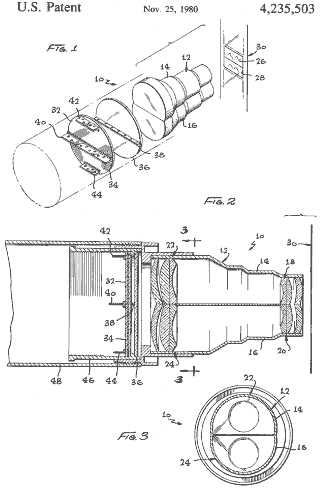
But another system that was widely used in the 80's and is the same as Technicolor is doing now, is to replace the projector's lense with a split-lense single-barrel design. These lenses were available for a long time from ISCO as well as from Stereovision. This system offered the least (virtually none) alignment. You just had to buy the correct focal length for your screen/distance, place the projector in the place to get the perfect spot, focus it and you were done. It also had the best illumination (no light bouncing from mirrors or going through prisms), the least keystoning, etc. But it was usually the most expensive and the one were the polarizers "burned" faster.
The main dissadvantage of the split-lens, besides the price, is that it is only effective for "one system" (i.e. one standard separation between the stereo frames) and only one screen-size/distance. In the 80's, different camera lenses provided images that had slightly more or less separation between the stero images within the 4 perf area. Ideally, lacking a single standard, different projection lenses would've had to be purchased for the different systems. In practice, a lot of soft masking did the patchy job we had come to hate from the 80's when the print didn't match the lens ....
Posted by John Wilson (Member # 269) on 09-18-2009, 12:33 AM:
quote: Jack Theakston
And again I reiterate, if AVATAR bombs, that's it for this 3D wave.
I seriously doubt that...not that it might bomb (it may well do but I hope not), but if it does it won't make an ounce of difference.
Posted by Don Furr (Member # 1469) on 09-18-2009, 06:36 AM:
I have found that the Paramount Box doesn't work well (for me) on a short throw. At home I use a StereoVision split lens with great results. Problem is that you would need several different split lens to project different titles. One size does not fit all.
Posted by Bill Enos (Member # 440) on 09-18-2009, 10:22 AM:
We had to significantly enlarge the ports to use the Paramount boxes. Also due to clearances and attachment issues we made brackets and mounted the boxes to the wall. We've used them for both over/under and side/side images.
Posted by Gordon McLeod (Member # 33) on 09-18-2009, 04:43 PM:
The other problem with the Split lens was the heat buildup inside them destroying the polarizers
I much preffer the paramount boxs or the trimensional units
Posted by Stephen Furley (Member # 1277) on 09-18-2009, 05:19 PM:
I've seen a few films in over/under 35mm; I find it works reasonably well if correctly set up on smaller screens, up to maybe 8-10 metres; bigger than that and it's difficult to put enough light on the screen.
Posted by Monte L Fullmer (Member # 2797) on 09-18-2009, 06:23 PM:
(I'm coming on a little late on this topic..) in the late 70s to early 80's, I had the opportunity to operate all forms of single projector, 3D presentations that is listed above - side by side and over under along with the split lens and the "Paramount and Columbia mirror box".
The famous side by side 3D was the "X-rated" "The Stewardesses" (I had to work this film due to that I was of age since the booth operators were minors at this one theatre..), using linear polarized glasses... and our mods, for our good ol' carbon arc, changeover booth, were the red tint refectors in our Peerless lamphouses, larger carbons since our generator could easily handle the increased current, along with the usage of the split lens and the screen was already silver from the old, two machine 3D usage of the 50's.
Warner did the same side by side with the 3D re-release of "House of Wax" on IB technicolor.
Only big drawback of the side by side was the usage of anamorphic attachments to expand the two images to give a 1.33:1 picture on the screen.
I then did the over/under format which the leaders had definite marks for proper framing. If you were 180* out on the framing, no 3D effect was seen unless you turned your glasses upside down. But still, this over/under using the 'box' held very good effects..and no silver screen usage was needed.
One film in particular that was the "over/under" format was Columbia's 1983 3D sci-fi flik "Spacehunter: Adventures in the Forbidden Zone" which Columbia had their mirror box.
This gave the image of a good 2.35:1 on the screen and it wasn't at all grainy, very bright with using only two sprockeholes of imagery. If I remember right, the film stock was a fine grain variety for being an Eastman positive.
I do think that Technicolor realizes this and is really moving forward in making film stock as sharp as the IB dye transfer prints where this stock will be fully compatible with this new 3D film concept.
I'd rather pull off a deal in a 5 grand lens per each machine than having to pull a deal in 'signing my life and soul away' for digital conversion - a conversion that is so unstable and will alway be unstable with the updates that these units always require .. or sit dead in the corner after new units had to be installed.
-Monte
Posted by Frank Angel (Member # 248) on 09-18-2009, 06:29 PM:
I don't know, Steven, the industry seems to think that a mere 3 to 5ftL is just peachy fine when it comes to digital 3D. I saw a bunch of o/u titles in theatre back then and only one - HALLOWEEN 3D was really underlit, but it was in a dive of a theatre that was underlit even in 2D. So I don't know why everyone seems to be wringing their hands about o/u looking underlit; it won't be any worse than the really dim levels that digital gets on 3D screens. No one was saying they can't do digital 3D because there's a whopping 60% light loss. Maybe because it's digital it is perfect, even at 3ftL down from 16ftL.
Also you have to remember in the 80s a lot of the theatres were still single screens and those screens tended to be larger than a lot of multiplexs, which is an advantage for either system.
Forget the problem with light....what's good enough for the digital goose is good enough for the film gander. It's the ability to run film competently which would be film's disadvantage -- THAT would be the real issue. At least back in the 80s there were still some competent people up in the booths. Then again, I would imagine a theatre that feels it wants to run 3D product badly enough will find that running it on film will still be much cheaper to hire someone who can threat an o/u print in frame rather than having to shell out for a digital 3D install. And gee, they could keep that operator on so that even their 2D runs would actually be in frame most of the time too! What a concept.
Posted by Monte L Fullmer (Member # 2797) on 09-18-2009, 06:54 PM:
quote: Frank Angel
And gee, they could keep that operator on so that even their 2D runs would actually be in frame most of the time too! What a concept.
..just don't let him get organized - why you have, to this day, booth clowns.
..almost a "Catch 22" here...
-Monte
Posted by Victor Liorentas (Member # 5272) on 09-18-2009, 07:04 PM:
Is framing in o/u possible while the feature is running, can you check for dead on in frame without a test film?
Posted by Frank Angel (Member # 248) on 09-18-2009, 07:05 PM:
Monte, pay him a decent wage and treat him with respect and he won't need to get organized. I've worked both union and non-union houses and there advantages and disadvantages to both. I work at a venue for 10 years and each and every stage hand, lighting, sound, projection tech all get propositioned every year to join the union and, to a person, everyone says "Go home Mr. Union Man." One year they even put up the inflatable rat in front of the site. It deterred not the patrons nor did it intimidate any of us. I am not saying one way or another if unions are good or not, just that it all depends on the employer. I come from a big union family and without unions there would still be sweatshops. But unions can ruin the work ethic too -- we have all seen it. So you are right there is quite a Catch 22 there.
And Don Furr pointed out that it was FRIDAY 13TH 3D, not HALLOWEEN 3D that I was referring to above. He's right, of course, and it was still too dark. ![[Wink]](wink.gif) Thanks Don.
Thanks Don.
Posted by Monte L Fullmer (Member # 2797) on 09-18-2009, 10:18 PM:
True, Frank - sorry, should have put quotes around the word "organized" - meaning if you get a person, as you say, pay them well enough, to take care of things which is an ideal situation.
Just that he'll soon get a head on his shoulders and get "organized" - meaning that he'll develop an operational organization to an eventual perfect system in of doing stuff which that could be a possible "threat" to that employer which could possibly disrupt the harmony of that operation and create a hostile work enviornment when other employees see this alternative form of operation.
Sorry, if I mislead on that term-not meaning the actual term of Organization as in joining a Union....
-Monte
Posted by Mark J. Marshall (Member # 1409) on 09-18-2009, 10:51 PM:
quote: Julio Roberto
No "3D flicker" (temporal disparities).
How can that be when the shutter opens on one eye before opening on the other eye, and moves a little slower than the DLP chip flashes. I'd think you would have some sort of temporal problems with over/under, but not so (or significantly less so) with side by side 3D. No?
Posted by Louis Bornwasser (Member # 3063) on 09-19-2009, 03:48 PM:
Is thia for sale NOW? Louis
Posted by Mark J. Marshall (Member # 1409) on 09-20-2009, 12:30 PM:
Who's thia?
Posted by Frank Angel (Member # 248) on 09-20-2009, 12:59 PM:
And why is she for sale?
Posted by Christian Appelt (Member # 1067) on 09-20-2009, 01:20 PM:
All over/under 3D films I saw in theatres did suffer from insufficient brightness. Back in the early 1980s, many theatres had no more than 1600 or 2000W bulbs for screens sizes that no one would try to fill today with less than 4kW. With such low levels to begin with, the light loss from beam splitters and polarizers seriously hurt the stereoscopic effect.
Also, most films were low budget and some did not use an experienced 3D supervisor/consultant which resulted in eye straining images.
It's funny how some people from the post production world explain that over/under 3D was so bad that it never could compare to digital, because it used such tiny 2-perf height images.
The same guys will praise Super-35 cinematography (as long as James Cameron uses it) because "filmstocks are so good that you don't need anamorphic any more". Well, you have to decide whether it is inferior or great, please make up your mind.
I'd really like to see some footage shot with state-of-the-art film stock and high quality stereo lenses in over/under.
Posted by Brad Miller (Member # 2) on 09-20-2009, 01:39 PM:
quote: Christian Appelt
The same guys will praise Super-35 cinematography (as long as James Cameron uses it) because "filmstocks are so good that you don't need anamorphic any more". Well, you have to decide whether it is inferior or great, please make up your mind.
Read your own words. The reality of it is that Super 35mm photography is FAR BETTER than anamorphic photography from the 1980s. Yes, the filmstocks really HAVE improved that much...particularly in regards to the stocks the final prints are made on.
Posted by Jack Theakston (Member # 4484) on 09-20-2009, 01:49 PM:
But there's no contest (in my opinion, at least) to modern anamorphic elements. And you don't have DPs compromising their compositions with true anamorphic, either!
Super 35 is here to stay ONLY because everything is a DI now. If actual optical work had to be put into these productions, many producers would reconsider the cost.
Posted by Brad Miller (Member # 2) on 10-24-2009, 04:11 AM:
quote:
Strong Industry Support Accelerates Technicolor 3D Rollout
Multiple Movie Studios Planning on Showing Content in Technicolor 3D
HOLLYWOOD, Calif., Oct. 22, 2009 – Thomson (Euronext Paris: 18453; NYSE: TMS), through its Technicolor Business Group, today announced support from multiple major motion picture studios for the release of theatrical content presented in Technicolor 3D, a high-quality 3D solution that works with existing 35mm projectors that was announced last month. DreamWorks Animation, Lionsgate, Paramount, Overture, Universal Pictures, Warner Bros., and The Weinstein Company are working with the company to deliver content for presentation in Technicolor 3D.
With the continuing success of 3D movies at the box office, 17 3D titles have already been announced for 2010 release, with more expected from several distributors. The studios noted above account for the majority of these titles, including How to Train Your Dragon, Piranha 3D, Shrek Forever After, Despicable Me, Cats & Dogs: The Revenge of Kitty Galore, Friday the 13th: Part 2; Guardians of Ga’Hoole, Alpha and Omega, Burst, Oobermind, and Yogi Bear.
Additionally, Deluxe Entertainment Services Group Inc. has agreed to enter into a marketing and technology arrangement with Technicolor and will provide their customers with the necessary post production and film printing services to deliver Technicolor’s 3D solution. Kodak and Fuji have also announced support of the Technicolor 3D solution and will be working with Technicolor and Deluxe to ensure their film stocks are delivering the highest quality possible for the Technicolor 3D experience.
“The Technicolor 3D rollout substantially increases the 3D theatrical footprint, delivering to studios a larger platform for reaching masses of moviegoers – and thereby increasing the box office for distributors and exhibitors” said Frederic Rose, Chairman and CEO of Thomson/Technicolor. “Technicolor is thrilled to extend our partnerships with these top studios and other key industry players to address the 3D gap and ensure every exhibitor that wants quality 3D will be able to afford it.”
Numbers show 3D is a driver of ticket sales with 3D engagements outperforming 2D by more than 2-to-1 in attendance and even greater in box office. Prior to Technicolor’s 3D solution, 90 percent of theatre screens in the U.S. were not able to provide a 3D experience to moviegoers. The Technicolor 3D solution will provide a solution to immediately bridge the gap until digital cinema can be more widely rolled out, providing additional screens to advance the medium of 3D to mainstream levels.
quote:
About Technicolor 3D
Announced earlier this year, Technicolor has innovated a high-quality, affordable 3D solution that works with existing 35mm projectors. Technicolor puts high quality 3D within economic reach of all theatre circuits, allowing them to complement 2D engagements and benefit from incremental revenue generated from increased ticket sales and ticket sale surcharges. The Technicolor 3D Solution is an opportunity to deploy 3D immediately, without waiting for financing to be available for digital conversion and can not only bridge the gap until such financing can be put in place, but actually help generate the funds required by distribution and exhibition to pay for the conversion.
According to exit polling interviews conducted by independent research firm OTX, moviegoers ranked Technicolor 3D as being comparable to digital 3D cinema technologies.
How the Technicolor 3D Solution Works
The Technicolor 3D Solution employs a propriety “production to projection” system that leverages 35mm (or film) projectors already in use by 90 percent of U.S. and international theatres today to deliver high-quality 3D content to moviegoers. A patent-pending lens system assembles the left and right eye images as the film runs through the projector and delivers a 3D ready image onto a silver screen. The solution works with circular polarized glasses—identical to the ones used for existing digital 3D cinema—to “translate” the film’s content into an image that is perceived by the viewer as being three dimensional. The silver screen can be used for the projection of both Technicolor 3D as well as digital 3D content. The Technicolor 3D Solution can be installed nearly immediately. No build-out or significant modifications of the projection booth are required.
###
About Thomson
Thomson (Euronext Paris: 18453; NYSE: TMS) is a worldwide leader of services to content creators. http://www.thomson.net.
Press contacts:
Season Skuro +1 818 371 0006 season.skuro@technicolor.com
Julie Mathis, Hill & Knowlton +1 415 281 7189 Julie.mathis@hillandknowlton.com
Posted by Monte L Fullmer (Member # 2797) on 10-24-2009, 04:36 AM:
Great articles. Thus, could this put a possible damper on digital unit sales where it shows that the above mentioned studios are now looking forward to work with TechniColor in doing 3D film releases - something that approaches a contradiction where they wanted to reduce print production from the beginning?
Posted by Steve Guttag (Member # 268) on 10-24-2009, 07:18 AM:
I wonder just how well thought out this is for the studios, that want digital.
The BULK of the Digital installations I see are FOR 3D where the myth has been you need digital for 3D.
So now exhibitors will have this cheap alternative to Digital (how expensive can the lens be?). Lets just say it is pricey at $10K. So why would an exhibitor spend 7-10 times that on a digital system?
This could slam the digital sales to a crawl. Then you will have those (including the "big boys" crying "foul" since they spent so much on Digital 3D when film 3D was ALWAYS possible. Furthermore, if, like in the '80s, most every theatre dedicates one or two screens to 3D...the "Take" on 3D will approach zero since every theatre complex will have it. Gone will be the concept of getting more than your normal share of patrons (stealing them from the 2D only theatres). Thus, per screen, 3D profits will take a HUGE nose-dive to the point only the film 3D would be somewhat viable.
And it all comes back to 3D is only going to be around a short time (relatively). No matter how they dance around it...if you look at the profits of all of the movies and rank them...you can't pick out the 3D titles because they "took in more"...they don't. The best movies make the most money...regardless of how many "Ds" are in the title.
Steve
Posted by Martin McCaffery (Member # 37) on 10-24-2009, 08:43 AM:
Steve, I think you meant to say "The movies that appeal to the most people..."
I really don't think too many of the films on this list are going to down as "the best";>
Gross Movie
399,416,040 Transformers: Revenge of the Fallen (2009)
294,258,075 Harry Potter and the Half-Blood Prince (2009)
289,639,811 Up (2009)
270,237,753 The Hangover (2009)
256,673,273 Star Trek (2009)
198,255,437 Monsters vs Aliens (2009)
193,250,211 Ice Age: Dawn of the Dinosaurs (2009)
179,863,544 X-Men Origins: Wolverine (2009)
176,461,908 Night at the Museum: Battle of the Smithsonian (2009)
160,154,402 The Proposal (2009)
Posted by Steve Guttag (Member # 268) on 10-24-2009, 10:10 AM:
Best is too subjective...you will find plenty to argue that they loved the movies that grossed well too.
But look at that list you provided.
How many were in 3D? Now if they didn't do them in 3D would their position on that list change any?
Then take into account that the average increase in production costs are 15% to make a movie in 3D...would that lower any of the 3D rankings in terms of profitability rather than gross?
No matter how you cut it, 3D doesn't increase studio revenue and it definitely cuts into theatre revenue once prime saturation is reached. Special formats always do better when there is a bit of exclusivity to them (70mm, IMAX and even 3D). If it is common, it just costs more.
Posted by Mark Gulbrandsen (Member # 72) on 10-24-2009, 11:28 AM:
I have to agree with Steve on some of this. Only cuustomers that have 3-D and are locked into their own area seem to do better with it. I personally have not seen any 3-D movies in a long time and pretty much go out of my way to avoid them. If the light levels ever come up to near normal then I might re-consider seeing more 3-D but not until. Oh, and don't expect 3-D film based light levels to be much better. Just because it's film doesn't mean it will be any better. In fact I'm betting that on average it will be worse. In past times film based 3-D has been what has killed 3-D and ALWAYS a short time period. The cost for film based 3-D will also be high if one takes into account installing a larger lamphouse which in the past film based systems has usually been ignored. Then compare the total below to what the Generation 2 digital projectors will cost you... The reality is that you're probably about half way to buying a Generation 2 digital system and since digital is still going to end up taking over the town for both 2-D and 3-D I would say save your money for digital and skip any 3-D all together.
Lens 8,000
Screen 4,000
Lamp/rectifier 7,000
Labor-Install 5,000
Realisitc Total 24,000
Oh, and another thing... Just how many theater owners do you think are going to take this seriously? They probably are not interested in adding to the stack of already unused/obsolete 3-D lenses they have in the projection room closet.
Mark
Posted by Steve Guttag (Member # 268) on 10-24-2009, 12:21 PM:
The mom n pops are already flooding us with calls on the Technicolor thing. Are you kidding? A cheap way to get 3D?
As for light...right now film has no advantage to digital...if you NEED 3KW for digital, you also NEED 3KW for film.
However, if the theatre is lamped correctly for film and hits 16fL on their matte-white screen. Adding a silver screen will kick that up to about 40fL (in the middle)...then add in the polarizing process and you are back down to 6fL (15% efficient), typically. And hey...guess what...we are back to the current silver screen light levels for DCinema or Film. No magic there.
So...to the typical theatre, you are talking about $12-15K total in a lens/screen (for get about the lamphouse since it isn't going to be needed too long)...the question is...will the EXTRA profits from 3D repay that sort of investment? One can knock off part of the screen price since odds are, the white screen needed to be replaced anyway in many theatres.
Steve
Posted by Demetris Thoupis (Member # 833) on 10-24-2009, 12:32 PM:
OK I've mentioned it to another Film-Techer about a month ago so I think is time to pop it up. The easiest way to manage 3D on film would be to use the Dolby 3D colour wheel and use the DTS timecode to synchronise it. Keep White screen and be happy.
Demetris
Posted by Steve Guttag (Member # 268) on 10-24-2009, 12:34 PM:
Have you looked at the color shift by using the Dolby color wheel on film?
Steve
Posted by Demetris Thoupis (Member # 833) on 10-24-2009, 12:45 PM:
not really but in any case you can get dual inventory prints
Posted by Mark Gulbrandsen (Member # 72) on 10-24-2009, 01:37 PM:
Steve,
Like anything technically based there are always trade offs. To be honest I think you're the only one here that actually complains about the color shift. No one else actually needs to give a crap nor does it matter that much. We're talking on average 3.5 top 4.5 footlamberts and you'd better care a whole lot more about being at the higher end of that that total color spectrum available. For what it is and how it works it does a dam good job at both 3-D and preserving the bit more limited color spectrum it has to display. Really, the color from Dolby 3-D system is actually much more watchable to me than viewing a 3-D film on a silver screen. I don't go to 3-D because of the low light levels and the glut of crappy films... no other reason really.
Just like Technicolor brought I.B printing back for a speck of time my view of 3-D for film is that it will also go no place really fast. It will be resisted by theater owners and chains whom already have many older 3-D lenmses laying around and whom have already covered theor bases with Digital 3-D systems.
Mark
Posted by Steve Guttag (Member # 268) on 10-24-2009, 02:13 PM:
Mark,
You must be mis-reading my post...I was referring to the color shift of using the Dolby system on FILM without the means to correct for the dramatically shifted color differences between each eye. One will be quite red while the other will be quite magenta while the other is quite cyan. DCinema machines allow one to correct for that.
As for film, I've personally toyed with the idea (even broached it to Dolby) of just using static filters in my Kinotons for dual projector 3D to skip the silver screen...Kinoton has two potential mounting points, built in...I'm in favor of right behind the aperture and after the heat filter.
Steve
Posted by Mark Gulbrandsen (Member # 72) on 10-24-2009, 07:14 PM:
Yea, sorry I thought you just meant it in general. Of course there is no way to correct the color shift unless it's printed on the film that way. This would be the only way it can be done. Even in Dolby D-Cinema systems there is still some color spectrum limitation going on after all the filtration and shift but it's minimal and it's never bothered me at all. Again, the brightness level is what bothers me.
Mark
Posted by Karl Borowski (Member # 5424) on 10-24-2009, 07:44 PM:
With DIs becoming ubiquitous, and 3D movies using this method probably all using it, augmenting colors on these new films should be as simple as a click of the mouse.
Posted by Julio Roberto (Member # 4976) on 10-24-2009, 07:54 PM:
You guys just said it all. My personal summary:
1) Of course there is no need whatsover to go digital to have 3D. It can be done just as well, if not better, in film, like it has in the past. It has some advantages and some disadvantages. Overall, it's probably slightly better to do the 3D digital, but mostly because film relies on projectionist doing the job right, and that's proven to be harder. Resolution, illumination, artifacts and other performance measures can be just as good, if not better, in film.
2) Of course 3D doesn't bring significant higher profits to theatres or producers, except like they always had in the past: as a novelty for the first couple of years and to those who offer it while the competition doesn't. This is a no-brainer. Sure, on the long run, it can gross a little more, but it also costs a little more to produce/exhibit. Overall: just a modest profit-maker that is cool to have, but not a paradigm shifter. You SHOULD install a 3D screen or two, but NOT spend $$$$$$$$$$$$$ on it and expect to recover it all from the ADDED benefit compared to showing the same thing 2D while spending $0 additional with your current setup.
3) If Technicolor can offer this worldwide for the lowest absolute price and get backed up by film manufacturers/labs and ALL major studios then it will take off big time. Even I would purchase one or two of those for those screens where digital is totally out of the question $$$$-wise. This should be sold "not for profit" as it's a means for film/labs to keep their core-business for a little longer and for producers to allow recoup of their 3D stuff in a world full of 35mm only screens. One or two studios not participating can be ignored, but if i.e. Disney and Fox BOTH don't fold in, it starts to be a though sell. Also, the 3D prints must be available in all markets, not just the USA.
I'm interested in the Technicolor lens. It sure hurts that I have tons of similar 3D lenses in the closet, but if they are not too-greedy-expensive, I don' mind installing a few of those as to get "optimum" (I hope) performance and less (I hope) compatibility problems (i.e. frame spacing).
If anyone has more info or is about to install one of this, I'd like to know more details. Wonder if FOX's desire to make $$$$ out of Avatar will overpower their desire to save the $$$ in digital distribution and they'll release it in glorious Technicolor 3-D Weren't they complaining of not-enough 3D screens? So what now that a 35mm one can be converted for (say) under $15k without paying the $100k digital-3D tax?
Posted by Mark Gulbrandsen (Member # 72) on 10-24-2009, 08:47 PM:
quote: Julio Roberto
It can be done just as well, if not better, in film, like it has in the past.
EXCUSE ME! In the past 3-D debacles of the 1980's 98% of all the film 3-D sites have sucked beyond belief. I don't really count any of the later analglyphic stuff to be watchable 3-D. The only consistantly good film based system has been Imax. Technicolor already announced the lens would be priced somewhere around 7K which is already going to cause much resistance. With digital looming to take over I seriously doubt that any of my customers will be hopping on baord. They'll be saving for when thre is no alternative to digital. This lens will just be one more lens gathering dust in closets. On top of that most critical locations in the USA are already covered by Digital 3-D systems.
Mark
Posted by Ron Curran (Member # 3631) on 10-24-2009, 09:31 PM:
I'm afraid we can't consider 3D in any form except, perhaps, the Dolby system. Our screen must be rolled to clear the stage for live theatre twice a year. A silver screen wouldn't like that.
By the time dci becomes a necessity the 3D fad will be over.
Posted by Stephen Furley (Member # 1277) on 10-25-2009, 04:24 AM:
When MOMI was built in London its cinema had four screens, two different conventional ones, one silver for 3-D and one rear projection one. All of these were roller screens. I saw the silver screen used a few times, and it didn't seem to suffer from being rolled. Nor did the rear screen which I only ever saw used once to demonstrate some early projection equipment, which had been set up behind the screen, during a lecture. Behind all of the screens was a large window, covered by a roller shutter, through which it would have been possible to see the real world if the shutter was opened. I don't know if this was ever done; I never saw it open.
I believe this set-up was replaced by a conventional screen after MOMI closed, and the cinema became NFT3, not to be confused with an earlier NFT3 which was a tiny viewing room which had been converted into an office some years previously.
Posted by Julio Roberto (Member # 4976) on 10-25-2009, 09:26 AM:
quote: Mark Gulbrandsen
EXCUSE ME! In the past 3-D debacles of the 1980's 98% of all the film 3-D sites have sucked beyond belief.
I was talking more about the 50's, with the dual 35mm projection, but still, I don't know what joints you went to during the 80's, but the ones we did over here worked fine. Why were they so bad around there? (besides the low light levels which, in digital today, suck just as bad)
I guess you were exagerating when you said 98%. Technicolor proved the system, the same used during the 80's, was "perfect" on itself:
quote:
Warner Bros. teamed with Technicolor for initial consumer testing at the AMC Burbank 16 and were encouraged by moviegoers’ response to the Technicolor 3D Solution. Sixty-five percent of moviegoers polled after viewing Warner Bros.’ box-office success The Final Destination in Technicolor 3D said the “overall image quality of the 3D” was “excellent” or “very good”—this compares identically to the results from digital 3D exit polls.
Movie Exit Poll Highlights from Technicolor’s 3D Presentation of Warner Bros.’ The Final Destination
• Satisfaction of Overall Viewing Experience. Overall satisfaction was similar in Technicolor 3D and digital 3D and both test groups felt “satisfied” to “extremely satisfied” with this experience. The 35mm 3D group registered somewhat higher “extremely satisfied” responses that the digital 3D group.
• 3D Quality Compared to Last 3D Movie Experience. Comparing this experience to the last movie they saw in 3D, moviegoers who watched in 35mm 3D were near-identically inclined to perceive the 3D quality as “excellent” or “very good” as those who watched in digital 3D — comparisons to their last 3D experience were at parity.
• Movie Ratings & Recommendation. Moviegoers who watched in Technicolor 3D were more inclined to rate the film itself “excellent” and to “definitely” recommend it to friends versus those who watched in digital 3D.
And I have a hard time believing that 98% of projectionists/installer in the USA weren't capable of aligning an over/under film to the silver screen during the 80's. If you tell me 40%, fine, I concurr. But 98% could only mean the system is VERY flawed, and that, I don't agree with (what did the other 2% do differently?)
Now the MOVIES themselves were another story. Many in the 80's were shot with all kinds of optical problems. But the projection "system" itself is just fine. You can ask SONY that uses the EXACT SAME PRINCIPLE of splitting the FULL frame horizontally and project each half through polarizers. Or Technicolor, which showcasted it publicly to press and public and they couldn't tell it appart from any other (digital) system. Because, of course, they are all the EXACT same principle: to put two frames on the same screen with a way to separate them on the eyes through filters in glasses.
Or see LieMax, which does the EXACT SAME PRINCIPLE of 3D during the 50's of dual polarized projection.
I think we can all forget about the VERY (very) few anaglyph 3D engagements in the history of cinema (compared to non-anaglyph 3D engagements). Anaglyph always sucked, even when shown on (real) Imax or in digital, of course.
quote: Ron Curran
Our screen must be rolled to clear the stage for live theatre twice a year. A silver screen wouldn't like that.
Most (all?) silver screens can easily take a couple of rolls a year without a problem. It'll be a bitch, as they can get dirty easily etc and can usually not be effectively cleaned, but if very careful, can be rolled a few times during their lives.
If in doubt, consult the manufacturer and they'll be able to advise on how much they can take. There is even one manufacturer's silver material that can take a bit of folding, cleaning, etc, but it's also the material that performs worse for 3D ![[Frown]](frown.gif)
Regardless, one could always use Infitec (Dolby) passive 3D filters with a 35mm film system, but that would mean that the 35mm print would have to be colour corrected just for those types of engagements. I think Technicolor is having a hard enough time convincing the distributors to strike over/under 35mm prints for them, much less to carry yet another dolby-corrected stock ...
While the majors in the USA have pushed digital adoption, forcing some small players to follow suit, overseas it's another story. People are installing digital, yes, but as one's off to do 3D with no intention to converting the rest of the screens until the dust settles (full DCI compliance, 4K), the prices come WAY down (if ever) and the real beneficiaries of digital pay for at least part of it (distributors offering no BS VPF in offset to print costs).
Somebody at Technicolor needs to get this thing in high gear.
http://www.technicolor.com/GlobalEnglish/Deliver/Film/Welcome-to-technicolor-in-3D/Pages/default.aspx
I heard of the lens price bracket between $5k and $7k. If it is the lower part of the bracket, then maybe they have a chance. $7K is a lot of money for something we all know will be worthless in 5 years, but $5K could be recouped by 3D surcharges during that time frame in many sites. It's much better than current non-DCI $120k 3D 2K digital systems that who knows if it will work in 15 years or be an obsolete piece of museum paraphernalia.
Posted by Mark Gulbrandsen (Member # 72) on 10-25-2009, 10:01 AM:
Julio,
I think the reason it bombed over here really badly was because none of the chains at the time took it seriously. They also viewed it as a fad ans also viewed it as a way to fatten theor pocketbooks. You also had a bunch of Cheapo assholes running the chains and they did as little as possible to get the 3-D systems installed... even resorting to spraying many screens with silver paint. Fortunately all those people are gone and many of the chains history. But you are still overlooking one major things and that is the fact that almost all critical locations already have 3-D Digital.
While your 5 to 7K price is already known do you really think anyone is going to spend another 7K on a larger lamphouse and 3 to 5 K on another screen? Come on now... get real. The only thing they would get to keep when going to digital is the screen.
Mark
Posted by Martin McCaffery (Member # 37) on 10-25-2009, 10:33 AM:
Just curious, would the lenses be rentable instead of a purchase? Thinking of the mom & pop's Steve mentioned, wouldn't it make more sense to rent the lens for the one or two shows they have a year?
Lamp and screen are another story, but those can at least be used the rest of the time and be considered an upgrade.
Posted by Julio Roberto (Member # 4976) on 10-25-2009, 11:09 AM:
They could (should) time the 3D 35mm prints for a lower light level of (say) 6ft (better than digital's 4.5) and no lamp upgrade would be needed in many cases, as the gate would use the whole 4perf area and the lenses would be non-anamorphic, hopefully light optimized.
Sure the polarizers suck over half the light. But the silver screen "gives back" over "double" the light as well. And the illumination circle fits better 4-perf than 3-perf, so some 25% more light can be squeezed out of current lightboxes in some (non Scope-sized) screens.
Overall, just a slight adjustment to the print density to allow good contrast at lower light output would be needed. They do this in digital (not to mention ghostbusting or colour correction), so no point in not-doing it for film.
That was one of the problems in the 80's. They timed the prints just like if they were going to be 16ft on the screen. When it was half that (sometimes below), it all looked too dark and lacking contrast.
Renting the lenses or lowering the price to the bare minimum would be a good move. Kodak should purchase a bunch and rent-them-out for non-profit to keep their 35mm business alive a little longer ![[Big Grin]](biggrin.gif)
I agree that moving to digital is the "sane" choice. But not as it currently stands. You are forced to buy, IMHO, inferior (2K), expensive (by many times), obsolete (non-DCI compliant) equipment with almost zero help from distributors, who are the ones saving money.
I'll say it again, and sorry for repeating myself. If the WHOLE digital 3D system for a (small/medium) screen was $50k with current equipment (i.e. 2K), fine, I'll buy.
Or if the studios paid for most (say 80%) of it through VPF in time.
Or if the equipment was $80K -BUT- it was top quality, 4K, over 8fl-in-3D, and fully DCI compliant. Then, I would also consider buying on my own without the help of VPF as an "investment" and hoping to recover some of it through savings in labor and 3D surcharges.
But to buy current "bad" (2K), "obsolete", "non-compliant", "expensive", "low-light 3D" equipment for ABSOLUTE TOP prices many-times over a GOOD 35mm system ... hell no.
Since 4K equipment is non-existant to expensive-and-propietary, the only option today is to remain 35mm. And if you want 3D (which you should want if the competition has it), then 35mm 3D is the only (sane) option.
For the time being.
Posted by Mark Gulbrandsen (Member # 72) on 10-25-2009, 05:44 PM:
quote: Martin McCaffery
Lamp and screen are another story, but those can at least be used the rest of the time and be considered an upgrade.
Good idea on the lenses but for what time will you be using the lamphouse? By then film will be gone fmr any major distribution arena.
If they time for 6fl then they have to dual inventory prints. Not likely again.
quote: Julio Roberto
I agree that moving to digital is the "sane" choice. But not as it currently stands. You are forced to buy, IMHO, inferior (2K), expensive (by many times), obsolete (non-DCI compliant) equipment with almost zero help from distributors, who are the ones saving money.
Then just wait and buy the 2nd Generation machines. They are supposed to be easily convertable between 2K or 4K and besides not all theaters need 4K.
Again, Unless you are in a locked in zone all of your own 3-D is meaningless to profits. If you have a largish area all to yourself then 3-D might make sense. In any case you are not going to loose a thing by NOT installing 3-D and you may have alot to gain in a very short period by putting banking that money and later on putting it towards a 2nd generation 2-D Digital system.
Really Julio, How many of your customers will you be able to convince to spend upwards of 15,000 dollars to put in yet another iffy 3-D film setup, especially one in which everyone knows will become yet another relic in a very short time period and especially one in which the number or realease prints will also be iffy and also be dwindling in quantity as digital takes over.
Mark
Posted by Scott Norwood (Member # 30) on 10-25-2009, 06:21 PM:
Two questions:
- has anyone actually seen the Technicolor system? if so, how did it look?
- how is this different from the Paramount (etc.) over/under systems from the 1980s?
As much as I love film, my immediate reaction is to say that this is a lousy idea, but I could be convinced otherwise.
I'd rather see 3D done right, which (to me, anyway) would be 2-strip 35mm, Imax, or Real-D.
Posted by Ron Curran (Member # 3631) on 10-25-2009, 08:50 PM:
On the silver screen issue, the theatre group only has two shows a year but they have 12 rehearsals on that stage for each show ond they spread their performances over 2 weekends, so that is a lot of rolling up and down.
In addition, they sometimes come into the building un-announced for set construction or lighting tests. This is an amateur group that needs a lot of work and it must be on stage.
Every live theatre group I was ever involved with was lucky to see the stage a week before.
Will somebody please give us alternative premises!
Posted by Demetris Thoupis (Member # 833) on 10-26-2009, 01:29 AM:
quote: Mark Gulbrandsen
How many of your customers will you be able to convince to spend upwards of 15,000 dollars to put in yet another iffy 3-D film setup, especially one in which everyone knows will become yet another relic in a very short time period and especially one in which the number or realease prints will also be iffy and also be dwindling in quantity as digital takes over.
In reality Mark even D-Cine 3D solution will be come a relic in a very short time period. Film gives you the lower cost advantage. Already sales to 3D are going down.
Demetris
Posted by Brendan Penny (Member # 5041) on 10-26-2009, 03:20 AM:
quote: Julio Roberto
Most (all?) silver screens can easily take a couple of rolls a year without a problem. It'll be a bitch, as they can get dirty easily etc and can usually not be effectively cleaned, but if very careful, can be rolled a few times during their lives.
I dunno man, in my experience I ![[bs]](graemlins/bs.gif) myself even unrolling new screen straight out of the shipping create let alone repeatedly taking one down and rolling it up again. Not saying it can't be done but its playing with fire. All it takes is one little mark and its game over IMO.
myself even unrolling new screen straight out of the shipping create let alone repeatedly taking one down and rolling it up again. Not saying it can't be done but its playing with fire. All it takes is one little mark and its game over IMO.
Posted by Steve Guttag (Member # 268) on 10-26-2009, 05:54 AM:
I've never found one screen company that okayed rolling a silver (or any painted) screen. It gets rolled just once; and that is for shipping...with separators put in to keep it from killing itself.
I've discussed with a manufacturer using a roll down screen for silver (hang the box just in front of the regular screen)...they said..."maybe" IF you left it unrolled most of the time (unroll it nightly left it that way and then re-rolled at the beginning of the day for your normal 2D shows).
If anyone can get a screen company to be good with re-rolling a Silver screen...please post it.
Steve
Posted by Stephen Furley (Member # 1277) on 10-26-2009, 07:24 AM:
The MOMI screen was the opposite situation; The silver screen was only used for very occasional 3-D shows. I think it was normally rolled up when not in use. It was certainly rolled up on the extremely rare occasions when the rear projection screen was used, or when what was normally the space behind the screen was used for displays, performances, exhibitions, usually during lectures, but such use was also rare.
Posted by Frank Angel (Member # 248) on 10-26-2009, 01:18 PM:
Can you project polarized 3D thru a rear projection screen? Will the polarization carry thru to the other side or does it get defused? Just curious, not that it would solve the hot-spot problem -- RP screens, in my experience have worse hot-spotting that silver screens.
Posted by Darryl Spicer (Member # 711) on 10-26-2009, 01:22 PM:
quote: Frank Angel
Can you project polarized 3D thru a rear projection screen? Will the polarization carry thru to the other side or does it get defused? Just curious, not that it would solve the hot-spot problem -- RP screens, in my experience have worse hot-spotting that silver screens.
I would probably have to say no. I have never worked with rear projection but I would think that you would loose the reflectivity since you need the light to reflect back at you to make the 3-D work properly.
Posted by Tony Bandiera Jr (Member # 2365) on 10-26-2009, 01:22 PM:
quote: Steve Guttag
I've never found one screen company that okayed rolling a silver (or any painted) screen. It gets rolled just once; and that is for shipping...with separators put in to keep it from killing itself.
I've discussed with a manufacturer using a roll down screen for silver (hang the box just in front of the regular screen)...they said..."maybe" IF you left it unrolled most of the time (unroll it nightly left it that way and then re-rolled at the beginning of the day for your normal 2D shows).
If anyone can get a screen company to be good with re-rolling a Silver screen...please post it.
Steve
Steve, back in the late 80's I worked at Knott's Berry Farm here in So. Cali running an insipid 3-D short called "Sea Dream" (insert your own comical nicknames for it here). We had eight prints made up on a Potts Super platter (I later sold them a Christie ELF to avoid the rethreading issues some folks had).
We had a Stewart silver screen which was rolled up nightly and it lasted for over three years of that without even a scuff. Maybe it was specially coated to take that, but knowing how cheap Knott's was then I doubt it.
The original prints were over/under 3-D , with 4-track mag sound!! Later prints were redone in Dolby-A optical and I sold them an Ultra*Stereo processor.
Posted by Steve Guttag (Member # 268) on 10-26-2009, 04:06 PM:
It was Stewart that told me about having to leave the screens unrolled most of the time. Stewart is my favorite screen, by far but if one is "cheap" they are not for you...they are typically 4-5X the cost of typical cinema screens.
They are the only roll-down screen, in my opinion, that can look like a fixed screen. They also have some of the niftiest masking systems for their roll-downs.
Steve
Posted by Hillary Charles (Member # 769) on 10-26-2009, 04:28 PM:
quote: Frank Angel
Can you project polarized 3D thru a rear projection screen? Will the polarization carry thru to the other side or does it get defused? Just curious, not that it would solve the hot-spot problem -- RP screens, in my experience have worse hot-spotting that silver screens.
Yes Frank, it IS possible to rear-project polarized 3-D without losing polarization. There were a few RP units for stereo slides made in the 1950s (I have one version), and the process works well. I have no idea how large anyone has tried that, and it may depend upon the screen material. The RP unit I have has a ground glass screen. That might not be practical on a large scale (or to try to roll up).
Posted by Mark Gulbrandsen (Member # 72) on 10-26-2009, 10:24 PM:
quote: Steve Guttag
they are typically 4-5X the cost of typical cinema screens.
Steve,
I for one will admit they are the best but it is interesting to note that the reason they are 4 to 5 times more expensive is because of all the EPA and State Of California pollution charges they pay to let the chemicals evaporate when the screens are poured. It is not because they are 4 to 5 times better although I'd probably allow them that claim too!! If it wasn't for all the chemicals they use and the evaporative method used to make them they would'nt cost all that much more than a regular screen. One also wouldn't consider them to be a very "Green" screen by any means.
If you wanted to attempt to roll a Silver screen I woould reccomend that you look into either the Hurley or Big Sky washable silver screens... put the Hurley at the bottom of the list though as it's very blotchy and inconsistant! One of these screens wold probably survive for a number of years being rolled up and down as long as its not too many times a year.
Mark
Posted by Steve Guttag (Member # 268) on 10-27-2009, 06:09 AM:
Hurley screens are not good for rolling at all. Their seams are made by embedding a wire to form a butt splice. If they are to be used as a roll up, they have to have the wire go horizontally and due to how the screen will be tensioned (or lack there of), the bulge from the seam will be very noticeable.
Didn't Big Sky buy the Technikote screens? Never known for being particularly good. Also, as a roll up...a bit too thick. In some ways, Hurley's normal SilverGlo would be the best materials but not with the seaming they use (and they are thick screens too).
As for Stewart...I don't know if it is all EPA related...EVERYTHING from Stewart is 4-5X the cost...including their hardware, screenboxes...you name it. They just have the best "look" by far...to me, at least.
Steve
Posted by Richard Fowler (Member # 893) on 10-27-2009, 06:32 AM:
Another cost factor with Stewart is their seamless, one piece, construction. They admit that their Silver 3D surface is "too stiff" for roll up applications.
Posted by Mark Gulbrandsen (Member # 72) on 10-27-2009, 03:52 PM:
Thats what I was told by someone from Stewart quite a long time ago, probably about 10 years ago. They said that prices would keep going up the stiffer that EPA and California got with the pollution laws that pertain to them. Gee, we can't do mag stripe here in the States any more and I certainly hope that doesn't catch up to Stewart!! At that point they'd have to trap and remove the stuff from the air.... and for all I know may already be doing that. It doesn't surprise me that all their prices are high having to pay the Feds and the State what amounts to a tax to be able to pour their concoction out to evaporate. But I do agree it's the finest looking and measuring surface made. Not very durable though because it is so thin.
Mark
Posted by Julio Roberto (Member # 4976) on 10-27-2009, 04:59 PM:
quote: Mark Gulbrandsen
Really Julio, How many of your customers will you be able to convince to spend upwards of 15,000 dollars to put in yet another iffy 3-D film setup, especially one in which everyone knows will become yet another relic in a very short time period
A few more than I could convinced to move to 1.3K DLP projection when that was "the norm" Sure 3D in film is Dead On Arrival, just as film itself has the writing on the wall, but CURRENT digital cinema is not THAT far behind the pale one ...
I agree that, if you can wait for Gen2 DCI equipment (or, should we call it, REAL DCI equipment, as most of today's equipment is NOT "dci" in spite of the claims), then fine. If you can't wait or want to wait much longer, I say the Technicolor solution can buy you the 3D market for the next 5 years until 3D dies anyway and perhaps can pay for itself in some situations.
But I agree that waiting for Gen2 equipment, if this ever becames affordable and "good" (i.e., why the hell don't they include audio digital EQ in the DCI players?), is pbbly the better choice.
quote:
- has anyone actually seen the Technicolor system? if so, how did it look?
- how is this different from the Paramount (etc.) over/under systems from the 1980s?
I haven't seen it. My understanding, it's just about the same print-wise as the 80's (i.e. frame separation or frame area might be slightly different, density may be adjusted to correct for illumination levels or optical disparities) and very similar to Stereovision (prominent in the 80's) in that it uses a split-lense (two half-lenses in the same barrel) with polarizers, although this time they'll be circular instead of the prominent method of linear during the 80's (there were a few public circular polarization engagements in the 80's as well, but most were linear).
I've seen Stewarts and Da-lite's silvers being rolled all the time. I've personally have rolled Tecknicotes w/o problems. I have heard of Harkness'es silver being rolled too. Again, we are talking about a few rolls a year, carefully done and with some protective (i.e. paper) "spacer". Silver screens are NOT done for rolling etc, but if you need to, and it's only a couple times a year, well, then you need to.
quote: Frank Angel
Can you project polarized 3D thru a rear projection screen?
Absolutely. Many rear screen materials don't change (much) the polarization of the light as it goes through. Some better, some worse. Rigid material, made by tensioning, usually preserves it (when oriented in the right position). But large, foldable, seamed rear-screen common material of the "curtain shower" type, like polacoats, performed adequately for 3D, amazingly enough. They hotspot a lot, and usually the more they diffuse, the more they depolarize. Such are the laws of physics.
In a circular polarized rear-screen projection system, you want to invert the possition of the circular filters to match the glasses, as no specular reflection exists to change the handeness of the circular rotation of the light.
Posted by Ramon Lamarca Marques (Member # 3621) on 10-28-2009, 06:13 PM:
I have just read through Technicolor's website and it is nice to see references to 'people who love film'. I like projected film, it is a unique experience. I hope that there is going to be an option to see film for a little while and this offer from Technicolor seems an interesting option for those of us who like film. I do not think 3-D should disappear, it is a valid tool for filmmakers if they want to use it. Actually, I think that once they achieve 3-D without glasses it may become commonplace. Well, it is easy to speculate, but I hope that a variety of formats and textures will continue present in cinemas for years to come.
Posted by Michael Marini (Member # 3490) on 10-30-2009, 10:49 AM:
Technicolor lines up partners for 3D Silver Screen Fund
Oct 28, 2009
Thomson’s Technicolor Business Group has aligned with Deluxe Entertainment Services Group, Eastman Kodak Company and Fujifilm to provide financial assistance to motion picture exhibitors seeking an immediate 3D technology solution. The Silver Screen Fund will defer costs associated with the purchase and installation of silver screens by providing financial assistance to exhibitors who deploy the Technicolor 3D solution. The fund will be managed by Technicolor, which last week announced broad studio support for their new process.
The Silver Screen Fund will finance up to 500 silver screens to be installed at theatres in the United States, Canada and the United Kingdom. Funding is available immediately for qualified exhibitors. When exhibitors complete the terms of the Silver Screen Fund agreement, they will own the silver screen, a necessary component for future digital 3D projection.
“Technicolor is committed to delivering high-quality, affordable 3D solutions, and the creation of the Silver Screen Fund accelerates our promise to our exhibition partners by helping them defer upfront costs associated with the purchase and installation of silver screens,” said Lanny Raimondo, head of Technicolor. “Thanks to overwhelming studio and industry support, we expect to sign up these first 500 screens in the coming weeks, keeping us on track to reach our target of more than 1,000 Technicolor 3D screens by mid-2010.”
“Deluxe is proud to have a long history of supporting our customers by providing whatever format they choose for their content. This technology bridge for 3D exhibition is a cost-effective way to help our customers maximize their theatrical release schedules,” said Cyril Drabinsky, president and CEO of Deluxe.
“Right now, there are not enough 3D screens to accommodate major releases and the screen shortage becomes compounded when you consider issues of overlapping 3D releases,” said Kim Snyder, president, entertainment imaging, and VP, Eastman Kodak Company. “The industry desperately needs additional screens to satisfy demands by studios and movie fans, who consistently vote for 3D with their box-office dollar. The Silver Screen Fund levels the playing field so all exhibitors can realize the benefits of 3D presentations.”
“With the digital 3D rollout slowed significantly by the economy, and because of the prohibitive cost associated with digital-cinema conversion, we believe Technicolor’s film-based 3D innovation is the right solution,” said Graeme Parcher, group VP, Fujifilm North American Motion Picture Group.
addthis_url = location.target='_blank' href; addthis_title = document.title; addthis_pub = 'nielsen1'; Save | E-mail | Print | Most Popular | RSS | Reprints
Technicolor lines up partners for 3D Silver Screen Fund
Oct 28, 2009
Thomson’s Technicolor Business Group has aligned with Deluxe Entertainment Services Group, Eastman Kodak Company and Fujifilm to provide financial assistance to motion picture exhibitors seeking an immediate 3D technology solution. The Silver Screen Fund will defer costs associated with the purchase and installation of silver screens by providing financial assistance to exhibitors who deploy the Technicolor 3D solution. The fund will be managed by Technicolor, which last week announced broad studio support for their new process.
The Silver Screen Fund will finance up to 500 silver screens to be installed at theatres in the United States, Canada and the United Kingdom. Funding is available immediately for qualified exhibitors. When exhibitors complete the terms of the Silver Screen Fund agreement, they will own the silver screen, a necessary component for future digital 3D projection.
“Technicolor is committed to delivering high-quality, affordable 3D solutions, and the creation of the Silver Screen Fund accelerates our promise to our exhibition partners by helping them defer upfront costs associated with the purchase and installation of silver screens,” said Lanny Raimondo, head of Technicolor. “Thanks to overwhelming studio and industry support, we expect to sign up these first 500 screens in the coming weeks, keeping us on track to reach our target of more than 1,000 Technicolor 3D screens by mid-2010.”
“Deluxe is proud to have a long history of supporting our customers by providing whatever format they choose for their content. This technology bridge for 3D exhibition is a cost-effective way to help our customers maximize their theatrical release schedules,” said Cyril Drabinsky, president and CEO of Deluxe.
“Right now, there are not enough 3D screens to accommodate major releases and the screen shortage becomes compounded when you consider issues of overlapping 3D releases,” said Kim Snyder, president, entertainment imaging, and VP, Eastman Kodak Company. “The industry desperately needs additional screens to satisfy demands by studios and movie fans, who consistently vote for 3D with their box-office dollar. The Silver Screen Fund levels the playing field so all exhibitors can realize the benefits of 3D presentations.”
“With the digital 3D rollout slowed significantly by the economy, and because of the prohibitive cost associated with digital-cinema conversion, we believe Technicolor’s film-based 3D innovation is the right solution,” said Graeme Parcher, group VP, Fujifilm North American Motion Picture Group.
Posted by Michael Marini (Member # 3490) on 11-13-2009, 02:26 PM:
Technicolor's 3D Format Lines Up 7 Studios, 37 Movies
Paramount, Universal, Warners adopt film process that works with existing 35mm projectors.
By Wrap Staff
Published: October 22, 2009
ShareThisEMAILPRINTvote
nowBuzz up!
Related
Keywords
Technicolor 3D
Slideshow
TheWrap Hosts 'Under Our Skin' Filmmakers
After Wednesday's screening of documentary "Under Our Skin," TheWrap hosted a Q&A with director Andy Abrahams Wilson; actress Joanna Kerns, a self-described "Lyme mother"; and actress Tracey Silver, who has Lyme disease. Read more. Photographs by Jonathan Alcorn. Technicolor's new 3D process has lined up the support of seven studios that are actively developing films in the format, the company said Thursday.
Paramount, Universal, Warner Bros., DreamWorks Animation, Lionsgate, Overture and the Weinstein Company all have slated movies that will employ Technicolor 3D, the format unveiled last month that is compatible with existing 35mm cinema projectors.
Among the 37 Technicolor 3D movies in the pipeline for 2010 are "Shrek Forever After," "How to Train Your Dragon," "Piranha 3D," "Despicable Me," "Cats & Dogs: The Revenge of Kitty Galore," "Guardians of Ga’Hoole" and "Oobermind."
Frederic Rose, chairman and CEO of Thomson/Technicolor, said the format addresses the "3D gap" in theaters because no significant modifications are needed for the existing 35mm projectors in 90 percent of U.S. cinemas.
"The Technicolor 3D rollout substantially increases the 3D theatrical footprint, delivering to studios a larger platform for reaching masses of moviegoers," Rose said in a statement.
Technicolor also said Deluxe Entertainment Services Group would provide its customers with the postproduction and printing services to deliver films in the format.
Home > movies
Posted by Steve Guttag (Member # 268) on 11-13-2009, 08:44 PM:
First rumors in are that the "deal" is a bit pricey for exhibitors though. Also, Disney, a major 3D studio does not seem to be on their list, yet.
Anyone have any hard information?
I'm also curious if some existing 3D lenses with suitable circular polarizers used in place of the '80s linear polarizers could allow exhibitors to use what is already out there.
Steve
Posted by Frank Angel (Member # 248) on 11-13-2009, 09:51 PM:
It would seem foolish not to make this backward compatible with the existing hardware that is out there. Since it's no secret that this is intended only as a stop-gap system, exhibitors will certainly not be enthusiastic about plunking down any substantial amount of moolah to play only a few 3D titles.
On the other hand, those exhibitors who resisted the move to digital but can now put 3D up on their screens WITHOUT buying into digital, they may very well decide that this give them even LESS of an incentive to convert. There won't ever be any pressing reason to convert as long as the studios are willing to supply celuloid. 3D film could very well slow down the conversion train to 3D. And lets face it, if distribution has come to the realization that the number of digital 3D screens is just too small to bring in the $$$ they need to get those opening weekend grosses up where they need to be to make them happy, they they're not going to care very much what format they need to supply the exibitors as long as they can open on those essential 4000 3D screens; digital or film, who cares.
Posted by Ian Parfrey (Member # 5122) on 11-14-2009, 12:23 AM:
Frank
You have summed up the whole situation in one paragraph.
And I'd venture to say that Technicolor's holding back and then releasing their film-based system was no coincidence. Who else would have the "inside" track on how the digital 3D rollout is going? They supply the film prints, duplicate the hard drives &tc, so they would see first hand how the digi-conversion is going.
It just MAY extend the life of 35mm for quite a while yet.
Posted by Mark Gulbrandsen (Member # 72) on 11-14-2009, 11:40 AM:
This film 3-d thing is foolish to say the least. It'll still end up costing the average exhibitor 15 to 20 grand with labor added in! Save the cash for digital because its comming and you WILL need it to stay in buisness... Investing in film 3-D when you will at the very least require 2-D digital to stay in buisness is the equivelent to throwing your money in the camp fire.
Mark
Posted by Monte L Fullmer (Member # 2797) on 11-14-2009, 01:59 PM:
quote:
It'll still end up costing the average exhibitor 15 to 20 grand with labor added in!
Then,this draws a question here on this:
If a exhibitor does decide to go the TECH 3D way, he leases the lens, have to change out his screen to silver, then what's the next step? Does he also need to change out the reflector, or do any lamphouse mods for more light efficency?
Thing I'm seeing so far is that the exhibitor can keep his projectors, keeping the same usage of his bulb inventory along with the same operating bulb durations, et.al. .. and stay in the same budget for bulb purchases - not having to horribly increase his bulb purchases for less hours of usage, let alone for the high cost of purchasing new digital equipment...
..but I'm just only seeing the shiny surface on this whole TECH 3D thing. For there could be a lot more to this format below the shiny surface that really needs to be brought forward, especially to those venue owners who are looking at this option.
And if their is, TECH better get all the facts out on the table for all of us to see before "lemmings running over the cliff" becomes the norm for the budget-minded venue owners.
-Monte
Posted by Scott Norwood (Member # 30) on 11-14-2009, 02:47 PM:
At least the silver screen can be re-used if the theatre later converts to ![[dlp]](graemlins/dlp.gif) 3D. And if it works with the old-style mirror boxes, those can be had cheaply on the used market (I bought two of the Paramount boxes for $75 apiece a year or two ago). This doesn't sound like a bad deal if there are new films that can be shown on this system, assuming that it works with an acceptable level of quality.
3D. And if it works with the old-style mirror boxes, those can be had cheaply on the used market (I bought two of the Paramount boxes for $75 apiece a year or two ago). This doesn't sound like a bad deal if there are new films that can be shown on this system, assuming that it works with an acceptable level of quality.
Posted by Darryl Spicer (Member # 711) on 11-14-2009, 03:03 PM:
Still the problem with this is if you signed an exclusive real D agreement, most likely you will not be able to use this system even if it is film related.
Posted by Louis Bornwasser (Member # 3063) on 11-14-2009, 05:49 PM:
You will need a "checkout:" 16 ft/lm with old screen and right focal length of backup lens, etc. If so, you are probably OK. Louis
Posted by Frank Angel (Member # 248) on 11-14-2009, 06:10 PM:
As far as needing to upgrade the lamphouse for 3D film, the digevangelists seem to think that 3D is just peachy-keen at a vomit-making paultry 3 to 5ftL, then they can't get their panty-hose all up in a bunch and poo-poo 3D film because it will drop in brightness as well. If "it's good enuf" for the digital goose, then it's "good enuf" for the film gander.
Plus, I don't know where you're pulling that $15k to $20k figure from Mark. What will be needed more that the silver screen and the convergence mirror box or split lens? And the silver screen can't really be counted since it is common to both systems and is an investment that as Scott points out, can certainly be used if down the line he decides to do the digital conversion once the full DCI stuff is settled on and the 4K resolution finally gets really locked in as THE standard.
And let's not forget that if Mr. 3D Digital Exhibitor has the cahoones to adding a surcharge for showing 3D (which I personally think has been a big marketing mistake), then no reason at all why Mr. 3D Film Exhibitor can't add the same surcharge.
So if an exhibitor can make a profit by spending $90k to put in digital 3D, I don't see why a exhibitor wouldn't spend say $5K for lens and screen for a 3D film system and couldn't make a profit as well. And yes, I admit it -- I am pulling that $5K figure out of my ask, but I think my ask is a little closer to a reality figure than Mark's (and I bet it's cuter too).
Posted by Karl Borowski (Member # 5424) on 11-14-2009, 08:32 PM:
With a $3.50 or $3 ticket surcharge, even a $15K upgrade pays for itself in no time. If you take into account a screen pending replacement anyway, and a lens install that is orders of magnitude easier than a full projector replacement, you're spending a tenth of what DLP will cost; keep in mind a 2K projector is rapidly nearing the point of becoming disposable technology too.
IDK though what sort of surcharges might exist for TECH 3D prints.
I'm sure the 3D printing process will be more expensive, at least at the master positive or IN/DN stage, to manufacture than your standard DI=>35mm production chain.
It wouldn't surprise me, since studios are probably all against this move anyway, if they tried to pass all of, or more than all of the cost of manufacturing 3D film prints on to the theatres.
I think the only people smiling at this, besides me of course, are: Technicolor, then Eastman Kodak's Entertainment Imaging Division, and then FujiFilm's Mo. Pic. division.
The digital conversion, whenever the tide fully turns in that direction, is probably going to kill a lot of the poor indie theatres, so I applaud Technicolor for taking steps to keep the film systems competitive.
Posted by Monte L Fullmer (Member # 2797) on 11-15-2009, 04:26 AM:
quote:
signed an exclusive real D agreement,
Most definitely true. Cinemas that are using "Real D" are simply stuck, for this is where the prospective venues searching for a 3D usage could gain an advantage in TECH 3D with their lens lease (lens isn't allowed to be purchased which the venue owner doesn't have to anti up the $7k for a lens purchase) and recycleable glasses that TECH would distribute.
This definitely could be a big plus for "mom and pop INDIES" and small business cinema operators..
-Monte
Posted by Mark Gulbrandsen (Member # 72) on 11-15-2009, 10:44 AM:
quote: Monte L Fullmer
This definitely could be a big plus for "mom and pop INDIES" and small business cinema operators..
It would be a plus if 3-D actually caused any real increase in ticket sales... overall... It actually doesn't.
Posted by Gordon McLeod (Member # 33) on 11-15-2009, 11:38 AM:
Also the glasses surcharge is subject to the distribs taking their standard percentage cut
also here they are subject to entertainment tax
Posted by Brad Miller (Member # 2) on 11-15-2009, 08:45 PM:
quote: Gordon McLeod
Also the glasses surcharge is subject to the distribs taking their standard percentage cut
Is that true in the US and across the different 3D formats? I wasn't aware as an example that the Dolby 3D system (where the distributors don't supply glasses) was handled in that manner.
Posted by Monte L Fullmer (Member # 2797) on 11-16-2009, 01:10 PM:
quote: Mark Gulbrandsen
It would be a plus if 3-D actually caused any real increase in ticket sales... overall... It actually doesn't.
Thus, it's still in the "fad" section of the entertainment world then...
Thus, is it this "fad" that is keeping digital in a whole alive? From what I gather is the majority of films released in 3-D has mainly been CGA, fantasy/children's features...and that is going to get old pretty quick down the road..
Posted by Frank Angel (Member # 248) on 11-16-2009, 08:11 PM:
quote: Mark Gulbrandsen
It would be a plus if 3-D actually caused any real increase in ticket sales... overall... It actually doesn't.
Better be careful Mark, I bet that can be said about digital period.
Posted by Mike Blakesley (Member # 26) on 11-16-2009, 08:43 PM:
What do you mean "I bet?" That's just a given. Digital never sold any tickets. Most movie fans don't care how the picture gets on the screen, just as long as it gets there.
Posted by Monte L Fullmer (Member # 2797) on 11-17-2009, 04:07 AM:
quote: Mike Blakesley
Digital never sold any tickets. Most movie fans don't care how the picture gets on the screen, just as long as it gets there.
Dang, this can get routed back to square one then: why convert to digital - what is the concrete and absolute reason to convert if the venue owner isn't going to gain any more sales?
Posted by Frank Angel (Member # 248) on 11-17-2009, 06:46 AM:
The reason is, Monte, because it saves the distributor print costs, period. That's the beginning middle and end of it. But also because distribution rules and because NATO is an emasculated, eunuch organization which laid back and let the studios screw its members and then NATO said, "Thank you," and added, "Sure we'll spend $150K to put in 1.3K digital projectors that will be obsolete after they've played half a dozen releases."
Also because the studios kept floating the big bugaboo, "Film is finished Mr. Exhibitor; it's on the way out and you'd better not let this new technology pass you by or you'll be out of business, what with your old film projectors that we won't supply any film for you to run in them. Film will be gone in the next 5 years, Mr. Exhibitor (said in 1999)." The studios also said, "We'll help you pay for this new technology with Virtual Print money (wink, wink, nod, nod) and you won't have to worry about the reason no one is coming to your theatre -- thos horrid scratches and image jitter and color fade that makes it impossible for customer to ever enjoy a movie if it is on film --but all that will be gone with digital and attendence will skyrocket without those scratches and jitter and faded color. All you have to do is put in this $150K piece of spanking new DIGITAL equipment. How can you go wrong....IT'S DIGITAL just tell your patrons that and they will flock back to your theatre to see the same crap we will still be putting out. AND, Mr. Exhibitor, if you have digital, you can spend even more money and make it 3D capable -- we'll make dozens of 3D cartoons for you to show, and the best thing is, 3D will never be able to be duplicated in those pesky home theatres, and even if somehow 3D technology for the consumer does becomes a reality, we're PARTNERS with you; we would never, EVER release our 3D product to the home 3D video market (wink, wink, nod, nod)."
And SOME exhibitors bought it. Distribtuion said the word DIGITAL, and Exhibition's eyes glazed over like a deer caught in headlights.
And that's why, Monte.
Posted by Louis Bornwasser (Member # 3063) on 11-17-2009, 11:38 AM:
Point of order: the digital print is significantly more $$$ than the film print, especially if you include the cost of administrating the "key code."
Also, the quality of the demo at Showeast was equal to or better than Digital 3D. Steve G. was there along with many others who were suitably impressed.
The primary difference "this time" is that theatres will need a check out PRIOR TO getting the lens. Those lower than 16 ft/lm on the old screen will be de-selected. Louis
Posted by Karl Borowski (Member # 5424) on 11-21-2009, 06:37 PM:
Louis, while I am a big film fan, I can't fathom it costing more than $2500 a hard-drive to encrypt a movie. . .
Posted by Jack Ondracek (Member # 1466) on 11-22-2009, 10:05 AM:
Geez, Frank. What a great bedtime story to tell the kids! ![[beer]](graemlins/beer.gif)
Posted by Martin McCaffery (Member # 37) on 11-22-2009, 10:44 AM:
It really does come down to (take your pick):Greed or penny pinching on the distributors part. On a tens to hundreds of-million dollar film production, the cost of the prints is insignificant, it's a rounding error. What's a full page four color ad in the NYT cost these days? How much do they spend on the star's lunch?
Going cheap on the print--which is the part the public actually sees, is like saving money on washers in an automobile. Sure, it adds up after awhile, as long as the gas tank doesn't fall off while the car is still under warranty.
And if making digital prints is really cheaper, why haven't the indies all converted (ok, no place to show them, still...)
Posted by Brad Miller (Member # 2) on 11-22-2009, 12:20 PM:
Print costs are more like $1000'ish for a typical movie.
Regarding digital, think of it like the pharmaceutical industry. They may be able to make a pill for one penny each, so why do they sell each pill for $20? Its because that FIRST pill cost them $5 million in research to develop it. Likewise, it may cost the studios a fortune to create that first hard drive, but after that it is cheap, cheap, cheap to duplicate.
Posted by Karl Borowski (Member # 5424) on 11-22-2009, 04:20 PM:
I think $1000 is definitely too low, even for a 6-reel movie.
Let's see. I think print stock is something like U.S. 27¢/ft. (88¢/m). Let's call it a quarter.
For your average 90 minute movie (Let's say 100 minutes for simplicity of numbers and the credits.) there is 9,000 feet of film. That's $2,250 just in raw stock.
I'm sure big labs can get print stock even cheaper, maybe half that, say a bit per foot, but that's still over a thousand just for the physical media, and then there are chemistry, labor, miscellaneous lab, and shipping costs all on top of that. That isn't including the cost of striking interpositives, or film recording them as is almost always done now, several internegatives, on much slower, more-expensive machinery and on more-expensive stock.
So maybe they can churn this stuff out for under $2,000 with a sweet deal from Kodak or Fuji (are Agfa & China still making print stock?) but I can't see under, say $1,600 to make a print.
Martin, while I agree with you that studios wanting to phase out film is regrettable, it's certainly understandable that their thinking is that will stick the studios with all the real costs of "equipment" (considering a film print as such for them), since currently theatres do the same thing to *them*.
Personally, I wish there'd be some sort of compromise, as film is still a better experience, IMHO. It seems that the transition is very haphazard because of these conflicting agenda.
Posted by Ian Parfrey (Member # 5122) on 11-22-2009, 06:28 PM:
Yep. Agfa still make 35mm print stock.
Here is the link to Agfa.
http://www.agfa.com/en/sp/solutions/cine/agfaprintcp30/index.jsp
Posted by Gordon McLeod (Member # 33) on 11-22-2009, 06:52 PM:
karl said "I think $1000 is definitely too low, even for a 6-reel movie"
check your facts before you spout off (not being rude) but in large print runs that is the norm
Posted by Brad Miller (Member # 2) on 11-22-2009, 09:11 PM:
I wish Agfa would stop manufacturing print stock. Or at least for Screenvision to stop using it! ![[Mad]](mad.gif)
Posted by Ian Parfrey (Member # 5122) on 11-23-2009, 01:49 AM:
Here in Oz we seem to get Agfa in bursts. Im wondering if it is specified for particular releases or if it is what's on hand in the lab at the time of printing?
Projection-wise, it doesn't seem to pose any problems- at least with our Vic 8's anyway.
Posted by Karl Borowski (Member # 5424) on 11-23-2009, 09:47 AM:
Gordon: I have checked my facts. Most of the smaller labs are paying 25¢ a foot for print stock.
You're telling me it is less than one third that figure?
Where are *you* getting your numbers from?
Don't forget chemistry, printing, and labor in the cost of manufacture.
Brad: What's the matter with Agfa? Not that I really check each film thoroughly for the stock type, but I can't think of seeing a single modern movie printed on it or screen ad printed on it.
Posted by John Hawkinson (Member # 1135) on 11-23-2009, 09:53 AM:
Karl, I think you'll have to accept the fact that these numbers are not publicly available and are considered proprietary, and that the people who do know them are not in a position to reveal them, or they are not in a position to reveal too precisely the mechanism by which they know them.
Discount structures are rather steep in this industry.
There is good reason to believe $1k is a reasonable cost of a volume release print. If you don't have personal knowledge otherwise, I'd advise you to keep your thoughts on this to yourself.
--jhawk
Posted by Karl Borowski (Member # 5424) on 11-23-2009, 10:45 AM:
Nice response John: It's classified, so we're right and you're wrong.
I can buy the notion of a discount, but not to below 10¢/ft. And yes, I do have personal knowledge: That it's 25¢ a foot. I can't believe that Kodak would give the large labs *66%* off.
And again, we're just talking about the raw, unexposed, undeveloped film.
Do the math: Even 8¢ x 2000 feet x 6 reels is $960 just for the rawstock. And that is a 6-reel movie.
I know that Gordon is an IMAX projectionist. I'm sure that there are far-more-sizable discounts for 65- and 70mm film.
Posted by Scott Norwood (Member # 30) on 11-23-2009, 11:57 AM:
For whatever it's worth, I once received a replacement reel (early 2000s) with a billing statement in the box (why?). The price listed was $.05/foot for a printed and processed color release print. This was for a major release from either Technicolor or Deluxe labs (I don't remember the details).
With inflation and such, $1k per print sounds reasonable.
Naturally, a B&W print with laser subtitles for a limited release would cost much more.
In any case, pretty much no one pays list prices for this stuff. (Interesting fact: Kodak's biggest motion-picture custoemr is NFL Films. No doubt, they aren't paying anywhere near the catalog prices for anything.)
Posted by Karl Borowski (Member # 5424) on 11-23-2009, 12:44 PM:
So, 80% off list? Really?!?!?
If it's really that low, per foot, then it's more than that, due to labor. I still can't fathom 3-4¢ per foot plus labor. That's 85% off. . .
Clearly I am getting my color print stock from the wrong people. . .
Posted by Monte L Fullmer (Member # 2797) on 11-23-2009, 01:12 PM:
quote: Karl Borowski
What's the matter with Agfa?
Good ol "Agfa -Gaevert". That stock has been used for tonnage of years in almost all of the gauges used in projection-both home and commercial-both B/W and Color.
True, it chatters through the gates (prob don't edgewax the stuff), sticks together at times, esp in the "rolling stock" form, color is so-so, et-al.
-Monte
Posted by Gordon McLeod (Member # 33) on 11-23-2009, 01:18 PM:
quote "Clearly I am getting my color print stock from the wrong people. ."
typically a major studio makes a deal at the beginning of a year for a volume of print stock and lab services for all there release requirements and yes there deals with labs and supplies is highly confidential
Posted by Martin McCaffery (Member # 37) on 11-23-2009, 01:25 PM:
Karl:
I think you should think more along the lines of paper printing.
If 500 pieces is the minimum run, then 250 pieces is going to cost the same as 500 -- so you are paying twice as much per piece. A 3000 piece run is not going to cost 6 times as much as a 500 piece run. The ink and paper cost next to nothing, it is the setup and overhead.
Economies of scale. You, as an individual, are not going to be as important to the lab as a major Hollywood Blockbuster. That's big money to the lab, and as I said earlier, just a rounding error to the studio.
Keep in mind, we're also dealing with Hollywood bookkeeping through which a movie that cost $30million to make, grosses over $100million and still loses money.
Posted by John Hawkinson (Member # 1135) on 11-23-2009, 01:43 PM:
It's those darn exhibitors and their cut of the gross!
--jhawk
Posted by Monte L Fullmer (Member # 2797) on 11-23-2009, 06:35 PM:
quote: Gordon McLeod was the last to post
Clearly I am getting my color print stock from the wrong people. . .
(Is Karl a photographer then..to make this statement??)
Thing that can be the "iffy" with the TECH 3D setup is to train the booth clowns on to make sure that their splices with this new form of stock.. ARE IN FRAME and in the CORRECT PHASE!
Posted by Jack Theakston (Member # 4484) on 11-23-2009, 06:54 PM:
quote:
Thing that can be the "iffy" with the TECH 3D setup is to train the booth clowns on to make sure that their splices with this new form of stock.. ARE IN FRAME and in the CORRECT PHASE!
We're talking about the "new" over/under system, right? How could it go out of phase if both frames MUST be projected at the same time?
Posted by Monte L Fullmer (Member # 2797) on 11-23-2009, 07:00 PM:
Being an "Over/Under" one could splice two sprocket holes off and can still say -"I spliced the thing in frame."
If that happens, then the occupant would have to wear the glasses upside down to be in correct phase. Otherwise, headaches would definitely occur...
And if the booth clown is not paying attention to what he is doing and simply did a splice out of frame -like one sprockethole - They'd have to actually stop the movie and rethread to be back in phase to continue the performance..can't just simply roll the FRAME knob.
Just hope that the production would include definite large framelines for the defined frame and thin ones for the "over/under" segment within the defined frame.
This sounds like a respectable and economical system to use, but the immense training from each circuit/location is mandantory on how to handle such print assemblies correctly...and this definitely falls out of the KISS system that is in common use nowdays...
-Monte
Posted by Jack Theakston (Member # 4484) on 11-23-2009, 09:19 PM:
Ah, I thought you were referring to shutter phase. Yes, they're going to have to mark these things to be idiot-proof.
Posted by Monte L Fullmer (Member # 2797) on 11-23-2009, 09:49 PM:
(Sorry Jack and to all, my bad-should have make that more clear being the phasing of the frame per assigned eye..)
Posted by Louis Bornwasser (Member # 3063) on 11-24-2009, 03:42 PM:
A suitable plan is to go back to the triangles pointing to the frame line; but then no more sdds! (Are any still used? Not around here.
Costing: At one time I was able to get the yearly budget for two film companies. Using the number of features released, the number of prints released, and 5 as the number of reels per print; the cost was less than $50 per reel. That was probably 10-15 years ago and did not include any freight or any distributor markup; just the actual money paid out to the printmaker.
Therefore, I would believe $1000/print to be a rather high number even when reels and cans are included. (You always get NEW reels and cans, right????) Louis
Posted by Steve Guttag (Member # 268) on 11-24-2009, 04:52 PM:
No problem with SDDS...just print the triangles in the Magenta layer...the SDDS will be blind to it.
Steve
Posted by Jack Theakston (Member # 4484) on 11-24-2009, 05:09 PM:
Technically, you could do the same thing the optical track, right? I wonder if any latent silver image might become detrimental.
Posted by Stephen Furley (Member # 1277) on 11-25-2009, 12:24 PM:
quote: Monte L Fullmer
Being an "Over/Under" one could splice two sprocket holes off and can still say -"I spliced the thing in frame."
If that happens, then the occupant would have to wear the glasses upside down to be in correct phase. Otherwise, headaches would definitely occur...
This actually happened once at the National Film Theatre. Something was obviously wrong; some people who realised what had happened turned their glasses upside down, others who didn't know about how polarised 3-D works tried turning them left to light. Eventually just about everybody had their glasses on upside down. After a minute or so the box realised what had happened and corrected it, and the whole audience then turned ther glasses over.
Posted by Mike Frese (Member # 4361) on 11-25-2009, 02:02 PM:
Regarding film stock costs: I have been told that kodak and others have drastically cut their film stock costs so they can still be in the game. So the costs for film today are significantly lower than they were 5 years ago.
Posted by Karl Borowski (Member # 5424) on 11-25-2009, 04:28 PM:
$50/reel is 2-1/2 ¢ / foot (8.2¢/m).
Even if inflation has doubled those figures (which it hasn't quite, using the general inflation index as a guide), that can't be right.
So is everyone else here talking about five-reel films? I've been using six reels for my average.
Posted by John Hawkinson (Member # 1135) on 11-25-2009, 05:30 PM:
It doesn't matter. And the average reel is more like 1700ft, maaaaybe 1800, definitely not 2000.
Anyhow, Karl, you're new here. And you've caused people not to trust you. And you're adopting a position that's contrary to that of several experienced people. Best to think about that.
Have a Happy.
--jhawk
Posted by Jonathan Althaus (Member # 5042) on 11-25-2009, 06:55 PM:
Lets not forget the mini-reels, like #6 on New Moon. Or the fact that reels 1-5 of Public Enemies were about the same length as 6-8.
Posted by John Hawkinson (Member # 1135) on 11-25-2009, 07:03 PM:
Average.
Did we say median? No we did not!
--jhawk
Posted by Jonathan Althaus (Member # 5042) on 11-25-2009, 09:28 PM:
Well our average reel length for our 16 prints we have is 1580 ft, I'm assuming due to "mini reels".
Posted by Karl Borowski (Member # 5424) on 11-26-2009, 01:02 AM:
I'm new here?!?!?
No shit!
[I really don't get this cross-thread banter crap. Are you trying to HAZE me or something? My thick skin is worn really really really really thin at the end of a 14-18 hour day, sorry. This is a place I come to relax, not deal with more of the same NEEDLESS drama I have to deal with all day at work.]
That doesn't mean I don't know what I am talking about. If you want to go with a 5-reel, 1500 foot per reel movie, fine.
5x1500=7500 feet still (So I can't fathom any less, than, bare minimum of $750 of rawstock). Now that is getting you in the price range where it'd be a thousand dollar movie, after costs of actual printing are factored in.
But that short a length is no more average than an eight-reel movie.
I'm going on the assumption that an average movie is 90+ minutes, say 95, maybe 100 minutes on average with credits. I think that assumption is perfectly good, even if I shouldn't be using full two-thousand foot reels.
@Monte, yeah, I get my figures from the lab industry. I am between gigs at the moment, but I used to be involved with low volume negative to "slide" printing using the ECP-2D Kodak VIsion print stock. My figure was for Vision Granted the quotes I got were from labs that weren't Technicolor Hollywood or anything, but they were NOT small consumers like I was, either.
Have a Happy Thanksgiving everyone in the States. Hopefully you aren't working [too much of the day].
I am working in the evening, but am having Thanksgiving Dinner before then, thankfully.
Posted by Monte L Fullmer (Member # 2797) on 11-26-2009, 02:43 AM:
"Dark Knight" have 7 full-to-the-brim reels, That was the best building session that couldn't be beat.. I was impressed with the lab to come up with that one to get all necessary reels full like that.
Last time I saw all reels full in a feature release is when Paramount issued "The Ten Commandments" (IB acetate stock) on 12 full reels in a 1972 re-release.
Posted by John Wilson (Member # 269) on 11-26-2009, 03:03 AM:
What about Star Wars or The Spy Who Loved Me in '77? Or Empire Strikes Back in '80?
All chock-a-block full 6 reelers.
Empire was so full when they added the mag coating it was hard to get the trunks to close.
Posted by Brad Miller (Member # 2) on 11-26-2009, 11:30 AM:
Reel 2 of True Lies in 35mm was literally right to the edge of the reel.
Posted by Cameron Glendinning (Member # 3516) on 11-26-2009, 03:06 PM:
Filum was thicker in them days though!
Posted by Mark J. Marshall (Member # 1409) on 11-28-2009, 01:08 PM:
quote: Jack Theakston
Ah, I thought you were referring to shutter phase. Yes, they're going to have to mark these things to be idiot-proof.
Actually, even if it's projected correctly, I still anticipate seeing a certain amount of the images being out of phase. The spinning shutter will unblock one image before unblocking the other. I'm really curious to see how my eyes react to that.
I recently had a chance to see IMAX digital 3D which used two projectors. Presumably the eyes were supposed to be in sync. Although it looked quite a bit better than RealD, something about it was still off.
I know I'm one of about three people here that can actually see this, and that's fine. I'm just saying that I'm really curious to see how over/under on film looks to my annoyingly highly critical eyes.
Posted by Monte L Fullmer (Member # 2797) on 11-28-2009, 01:54 PM:
quote: Mark J. Marshall
I'm just saying that I'm really curious to see how over/under on film looks to my annoyingly highly critical eyes.
Actually, the over/under films of the early 80's was better than RealD - if you sat close in the middle of the house since that old stuff was the typical linear polarization process back then.
"Spacehunters: Adventures in the forbidden zone" (1983) was the best over/under 3D that could have came out for Columbia. Movie had more realism to the image instead of the 'layered look' that comes from these live action 3D movies of today (prob why there is a tonnage of 3D films made using the CGA process..which is eventually gonna destroy the 3D market).
-Monte
Posted by Karl Borowski (Member # 5424) on 11-30-2009, 06:50 AM:
Mark, if you can see the shutter closing down on one part of the stereo image before the other, do you have a problem with seeing temporal distortions from the shutter when the movie was originally photographed too, or seeing the shutter close on a 2D film? ![[Razz]](tongue.gif)
I mean, this stuff isn't perfect. Even if you had a movie photographed with a focal plane or a leaf shutter, instead of a slit mopic one, there'd still be slight artifacts visible from one part of the image being exposed at a slightly different moment in time than another part.
There's a famous still photo, forget who the photographer was, of a race car being photographed, probably from back in the '20s, where you could actually see the top of the car was further to the right of the frame than the bottom, due to the shutter and the great speed at which the car was travelling.
Posted by Mark J. Marshall (Member # 1409) on 11-30-2009, 07:33 AM:
No I don't see the shutter closing. What I see is one eye being slightly ahead of the other eye. Properly projected dual strip 3D DOES appear perfect to my eyes. Properly projected single projector RealD does not. I've posted about this extensively here if you want to go back and search on it.
Posted by Jack Theakston (Member # 4484) on 11-30-2009, 03:54 PM:
Mark, you are correct that RealD is by definition out of phase (unless they're using a two projector system). I notice it, too, although I think the cycle rate is higher, so it's not as bad as dual-strip out of phase, for example.
Correctly photographed 3D is always is phase.
Posted by Karl Borowski (Member # 5424) on 11-30-2009, 03:57 PM:
You're right guys, you're absolutely right. Let's tear out every one-projector auditorium and switch back to all duals!
While we're at it, let's tear out the platters too. . .
If you're going to argue trivial BS like spinning shutters and film pull-down intermittent movements, you had might as well stop arguing against DLP projectors, because you can, currently, only have one "evil" or the other.
Might as well have finger puppets in front of a flickering candle in the mean time if you can't get past the technological limitations that aren't noticeable by 99.99% of the audience that pay to keep you working at your jobs.
Posted by Martin McCaffery (Member # 37) on 11-30-2009, 04:12 PM:
quote:
You're right guys, you're absolutely right. Let's tear out every one-projector auditorium and switch back to all duals!
Works for me! I'd be the only game in town ![[evil]](graemlins/evil.gif)
Posted by Jack Theakston (Member # 4484) on 11-30-2009, 04:44 PM:
quote: Karl Borowski
Might as well have finger puppets in front of a flickering candle in the mean time if you can't get past the technological limitations that aren't noticeable by 99.99% of the audience that pay to keep you working at your jobs.
I was going to reply courteously to your otherwise vitriolic post, but after reading the last paragraph and thinking about it, with all due respect, Karl... ![[fu]](graemlins/fu.gif)
Posted by Cameron Glendinning (Member # 3516) on 11-30-2009, 05:37 PM:
Because Karl has no idea......
IMAX digital 3d and Sony 4k projectors systems are basically 2 projector 3d systems.
Film based 3d in the 1950's and IMAX 15/70 3d also are duel systems.
quote:
technological limitations that aren't noticeable by 99.99%
Personally I would say that perhaps 10-20 percent of the population have issues with 3d and is one of the major reasons films in the same multiplex are often offered in 2d as well...
quote: Karl Borowski
do you have a problem with seeing temporal distortions from the shutter when the movie was originally photographed too, or seeing the shutter close on a 2D film?
WTF? What do you do for a living again? ![[sleep]](graemlins/sleep.gif)
Posted by Karl Borowski (Member # 5424) on 11-30-2009, 06:47 PM:
I'm a projectionist, Cameron.
I stare at the DLP 3D projector, with 3D glasses on, every day I work up in the booth.
To say that 2-projector 35mm projection is better than a 1-projector system is like saying that fucking 70mm 5-perf. is better than 35mm scope.
NO SHIT!
Instead of arguing past standards against current technological dilemmas (35mm TECH 3D vs. Real 3D DLP) howabout living in the real world, the 21st century, and our current technology?
There are, what, under 500 IMAX systems worldwide? How many real 15/70s are there now that "New IMAX" dual 2K is here?
And how many 15/70 film IMAX installations are set up for IMAX 3D, 10%?
Sony 4K, now THERE is a big segment of the market! That's not an ideal, it's a BIG CHUNK of the pie, a REAL REALITY. Hell, every theatre I've been to in the past DECADE has 4K. It's ubiquitous it is so common in your average mutlplex.
If I were working at one of maybe a couple dozen IMAX 3D locales WORLDWIDE, or 4K DLP for that matter, I would hardly be so arrogant as to tout it as a viable option for a 10-billion person audience, no sarcasm or vitriolicity intended. . . ![[Eek!]](eek.gif)
Posted by Mark J. Marshall (Member # 1409) on 11-30-2009, 07:18 PM:
quote: Karl Borowski
I stare at the DLP 3D projector, with 3D glasses on, every day I work up in the booth.
Try looking at the screen instead. Maybe you'd notice that the images are out of sync.
Honestly, I'm not sure what you're ranting about. If you're going to be a troll, at least be a good one. I said that I was curious how MY EYES would perceive the 3D from a single projector over/under system since they have a hard time with other out-of-phase systems.
Posted by Karl Borowski (Member # 5424) on 11-30-2009, 07:35 PM:
Yeah, fine!
I'm not being a troll, just pointing out that you can't bitch about TECH 3D and DLP RealD both unless you have some legacy theatre or super-expensive 4K facility within an hour's drive of your home.
And, again, the very act of spinning a shutter leaves artifacts. I have read your prior posts BTW. I don't get how can you be that picky about what amounts to a minor phenomenon; I don't even buy that you are in the 10% that supposedly gets dizzy or distracted by 3D movies.
Sure, there are people that get sick, but they don't have concrete descriptions, as you do, as to why. I rememeber seeing an early 120-Hz video projector, early model, where I could see a rainbow effect, due to, apparently, its spinning RGB filter, as I scanned my eyes back and forth across the screen.
I was the only one who objected to it out of several dozen viewers. Yet I don't have nearly the same problems watching a 2K DLP 3D Barco projector, or excuse me, the 2K DLP 3D Barco's projected image (NOW who is the troll?!)
So I have noticed projection phenomena, just as you have. Seriously, though, what is your solution, though, Mark?
I am the one ranting, right? I am perfectly fine with both systems. You are pefectly fine with no system that has anywhere near widespread acceptance.
Posted by Joe Redifer (Member # 3) on 11-30-2009, 08:14 PM:
quote: Karl Borowski
I'm not being a troll, just pointing out that you can't bitch about TECH 3D and DLP RealD both unless you have some legacy theatre or super-expensive 4K facility within an hour's drive of your home.
#1 - You are being a troll and you will eventually be banned from this site for it. Then you will proceed to bitch elsewhere about how this site doesn't matter anyway and how it is full of blowhards (or other insulting word of your choice) that talk about the most useless things.
#2 - You are saying that someone has no right to complian unless that have experienced something better. That is bullshit. If that were the case, technology would never improve. Think about it.
Posted by John Wilson (Member # 269) on 11-30-2009, 08:31 PM:
quote: Joe Redifer
You are being a troll and you will eventually be banned from this site for it.
There's only one person you could be talking about, Joe. Is Karl STILL here? Jesus!
Fortunately, since I installed my '[remove_karl_borowski@film-tech.com]' application I had a friend write for me, I no longer have to put up with his inane bullshit.
Ahhhh...it's just heavenly on FT lately. Sorry for all you other guys who still have to put up with him.
And Karl, since I'm quite positive you have no friends, let alone a friend who could write such a script and apply it to me...
Posted by Karl Borowski (Member # 5424) on 11-30-2009, 08:38 PM:
Who is following whom across threads?
While technology tends to improve, recently the trend has been to make all things cheaper, easier.
It is no more realistic to bring back '50s technology than it is to bring back the Apollo program.
Bitching about something, arguing for an improvement is one thing. Bitching about all of the current technology out there, both film and digital, arguing for IMAX 3D (coming in at a whopping $60-80K U.S. per PRINT), '50s 3D film Technology, and 4K dual projection is just silly.
The 4K is the only thing I can see catching on ( I LOVE IMAX though!), but not before I see this current 3D trend dying out. It has a long shot chance of success with "Avatar," but even that looks like a dead-on-arrival.
And Joe, seriously, who is trolling? I don't post a snide, negative comment, to everything you say. Sometimes you are very witty, other times you're just puerile and naive. I am having a disagreement between Mark, anyway. If you have similar issues with 3D, now is your chance to chime in and voice them, not just to discount me out of principle.
I wish you would extend me the benefit of the doubt that you had a bad first impression of me, instead of just needlessly discounting everything I have said, and say. I'm sorry, I don't take too kindly to people solely owing to their seniority status.
Do you really see the world in Black and White like that? And anyway, speaking of your seniority, you probably do have enough that, if you tried, you *could* get me banned from here. I may have said some things that have crossed the line of civility on this forum, but I chalk that up to being a passionate person. I argue that you can not, in good faith, see past all of the worthwhile contributions I have made here owing solely to your own personal misgivings towards me.
Posted by Phil Hill (Member # 371) on 11-30-2009, 08:38 PM:
quote: John Wilson
Is Karl STILL here? Jesus!
Yes, my son...
Posted by Brad Miller (Member # 2) on 11-30-2009, 09:05 PM:
Karl, please dial your passion down a notch. Nobody here is interested in your unnecessary drama.
Posted by Mike Blakesley (Member # 26) on 12-01-2009, 12:25 AM:
By the way, Karl has changed his location to "Sulking in GameFAQ Forum." That's grounds for banning right there, isn't it?
I would miss him though. Arguing with him is so easy.
Posted by John Wilson (Member # 269) on 12-01-2009, 12:53 AM:
Who?
Posted by Joe Redifer (Member # 3) on 12-01-2009, 01:06 AM:
Somehow I doubt he did that because it is just too funny.
Anyway, although I do have a divine influence over all that happens, I do not need to use it to get Karl banned. He's more than capable of doing it on his own. John, do you have some sort of anti-Karl Firefox plug-in?
Back on topic: Mark, I know what you mean by the out-of-phase stuff. One eye switches first on the scene changes. It is very, very slight, but it is there. But there is no way the common plebe would ever notice. They don't notice 4:3 pictures stretched to 16:9 or even Flat movies running with a scope lens.
Posted by Brad Miller (Member # 2) on 12-01-2009, 02:01 AM:
quote: Mike Blakesley
By the way, Karl has changed his location to "Sulking in GameFAQ Forum." That's grounds for banning right there, isn't it?
Yup. Bye bye Karl.
Posted by John Wilson (Member # 269) on 12-01-2009, 02:22 AM:
KA-CHING!
Thank goodness you did that, Brad. My email was being swamped with requests for my anti-Karl plug-in.
Posted by Mark J. Marshall (Member # 1409) on 12-01-2009, 05:09 AM:
Joe, you're absolutely right that they don't notice it. But it may explain why some get a head ache or otherwise can't deal with 3D and aren't sure why. I'm just lucky that I can discern what it is that I'm seeing. I used to think RealD was "flickering" but eventually it dawned on me what it was.
I took my wife to see House of Wax in dual strip 35mm and she thought it was great. Then I took her and her sister to see Nightmare Before Christmas 3D, and they both hated the 3D effect (so did I). We eventually left because it was so bad. I convinced her to give it another try with Toy Story and she thought that was good. We recently saw Christmas Carol in IMAX digital 3D, and that looked good to her too. I thought it looked much better than RealD, but sometimes the eyes looked a little off to me. So I don't know what that's about. Overall I enjoyed it a lot better than RealD.
I'm sorry to whoever is left that hasn't been banned (by the way... bye, Karl) who thinks I'm just complaining, but the projectionist in me wants to jump out of my chair and go fix something every time I see a problem with the picture and that's a bitch to turn off!
Jack seems to think the over/under thing will look worse to me than RealD. I respect his opinions greatly, and he may be right. I'm eager to see it for myself.
Posted by Frank Angel (Member # 248) on 12-01-2009, 08:55 AM:
quote: Joe Redifer
there is no way the common plebe would ever notice. They don't notice 4:3 pictures stretched to 16:9 or even Flat movies running with a scope lens.
True dat.
This is truly a mystery to me. How it it even possible that people can watch distorted images like that and not seem to even notice, or if they do, not even be botherd by it (which is worse, I think)? Yet, there it is. There's a PhD thesis in there somewhere -- is there something missing in the frontal lobes of the majority of the populous? Seems to be, and I guess that's a good bit of luck for Mr. Exhibitor, eh?
They sit there and don't seem to notice that PEOPLE IN THE PICURE ARE FUKIN STRETCHED (me screaming at my nephews). They just laugh at me. I get no respect.
Posted by Martin McCaffery (Member # 37) on 12-01-2009, 10:12 AM:
They've been well trained by their flat screen TV's
When I go visit my parents it drives me nuts that they watch TV shows in the wrong ratio, but in their defense, it is a pain for them to adjust from 4:3 to 16:9. I would think the tv should take care of that automatically (I still have a TV tube, what do I know?)
You will see the same effect ON tv though. I've often watch cable news shows where they have the guest on a wide screen monitor squished, but when they cut to the direct feed he is in the correct ratio.
The evil overlords want us not to care. Beware.
Posted by Jack Theakston (Member # 4484) on 12-01-2009, 10:38 AM:
I was considering asking Karl if he was a RealD stockholder, but maybe that's too subtle an insult for him.
quote: Mark J. Marshall
Jack seems to think the over/under thing will look worse to me than RealD. I respect his opinions greatly, and he may be right. I'm eager to see it for myself.
While I've got issues with the shutter phasing on RealD, too, I just don't think most booths have the technical clout to be putting on over/under shows.
Forget the light issues, and forget the lens adjustments... simple things like starting in frame are ways that this is just asking for trouble, but I like Steve's idea of putting something in the magenta layer as a guide; it's a good start. The question is-- given that even modern color film is processed with silver halides and that there is usually some latent silver left in the image, would markings in the SDDS or even optical soundtrack area affect the pickup of the sound?
Posted by Joe Redifer (Member # 3) on 12-01-2009, 03:42 PM:
Ever notice that CNN stretches ALL of their web video for no reason? Everything they offer is 4:3 but for some reason that have little 16:9 video windows. I don't know if the actual cable channel is the same way since I refuse to pay for TV programming.
Posted by Mike Blakesley (Member # 26) on 12-01-2009, 07:15 PM:
quote: Frank Angel
They sit there and don't seem to notice that PEOPLE IN THE PICURE ARE FUKIN STRETCHED (me screaming at my nephews). They just laugh at me. I get no respect.
This is one of my pet peeves too but I have grown weary of arguing about it with people. Usually it goes:
Me: Your TV picture is on the wrong setting.
Them: What's wrong with it?
Me: Well, see how the people are all stretched out of shape there?
Them: Yeah?
Me: Well, that's WRONG! They should look like real people!
Them: If I set it that way, it doesn't fill the screen.
Me: So what?
Them: Well...uh, I like it to fill the screen.
Me: (slaps forehead in disgust again)
Posted by Tim Reed (Member # 137) on 12-01-2009, 09:14 PM:
Oh, GAWWWD! That's it, Mike! That's the exchange (or, the variation: "Well, why have a wide-screen TV if I can't use it?"). I purely hate it. I don't even bother pointing it out anymore.
It's hard to care about something when no one else does.
Posted by Sam D. Chavez (Member # 1841) on 12-01-2009, 09:18 PM:
Same here, not even my daughter who was practically raised in a booth, was watching the cooking channel stretched on my Kuro. Arggh!
Posted by Monte L Fullmer (Member # 2797) on 12-01-2009, 09:34 PM:
I know that we're slightly drifting a bit off-topic now onto HDTV reproduction, but have to chime on this one with what others have noticed:
Okey, you got a fancy 16:9, 1080p HDTV sitting in your living room (we got ourselves a VISIO 37" 1080p variety last month from WallyWorld..)..
You got into your settings and you can still choose 4.3 standard TV presentation, or the other options of 16.9 - being the panoramic and zoom features... which stretches out the picture on the sides slightly while keeping the center of the image more natural looking (like doing a 1.39:1 anamorphic side stretch with no correction diopters in the middle).
Now, on broadcast TV, it's somewhat tolerable (yet, like on CNN, when you see the words scroll across the bottom how they come in from the right slightly ballooned then scrink down to normal size by the time they reach the middle of the screen, only to balloon back up when they exit to the left), yet you pop in a DVD that is in letterbox and you get a major total "Super 3.34:1 "Band-Aid" looking picture on the screen.
Thus, what am I missing - wrong settings, or is this what we're stuck with...?
-Monte
Posted by Victor Liorentas (Member # 5272) on 12-01-2009, 09:43 PM:
Monte, I think you are stretching a letterboxed dvd instead of zooming in on it.
If the dvd is anamorphic enhanced then 16.9 works to spread the image out correctly.
If i understood you right that is.
Posted by Monte L Fullmer (Member # 2797) on 12-01-2009, 09:46 PM:
(Thx..I think that is my problem then - need to use the zoom feature intead of using the default panaramic TV settings .. thx for the help - Monte)
Posted by Frank Angel (Member # 248) on 12-03-2009, 12:15 AM:
quote: Mike Blakesley
Them: Well...uh, I like it to fill the screen.
Me: (slaps forehead in disgust again)
No, no Mike, THAT's your mistake....you're supposed to slap THEM in the forehead!
Actually that non-linear stretch than some set use is the lesser of two evils (the other worse evil is the linear stretch where EVERYTHING is wrong), and it tolerable. The reason I say it's tolerable and barely, is because I can fantasize that I am watching Cinerama or a deep curved Todd-AO picture, which is an advantage of living in a fantasy world as I am fully capable of doing.
Posted by Sean Weitzel (Member # 244) on 12-03-2009, 02:40 AM:
My wife used to watch her programs with the direcTV reciever set to "stretch" despite my protests. Recently she asked me to screen our print of "The Wizard of Oz" which is a 1.37 LPP print. I threaded it up and put my 1.37 aperture plate and scope lens on and fired it up. Very soon came the complaints. I countered with "you don't notice it on your TV shows. I'm filling our screen how you like it." Now she can't understand how she overlooked it all this time.
Posted by Mark J. Marshall (Member # 1409) on 12-03-2009, 07:43 AM:
Hahahahaaa ![[thumbsup]](graemlins/thumbsup.gif)
Posted by Louis Bornwasser (Member # 3063) on 12-20-2009, 06:46 PM:
Back on topic: Technicolor has had its dealer meeting, is scheduling training for Certified Engineers, and has agreements with 7 film companies. First film is March 2010, How to Train Your Dragon.
As stated earlier, picture is equal to or better than D-Cinema.
Hadden Theatre Supply is one of the dealers at the meeting; I will let the others speak for themselves. Louis
Posted by Jack Ondracek (Member # 1466) on 12-21-2009, 10:12 AM:
quote: Louis Bornwasser
Hadden Theatre Supply is one of the dealers at the meeting
So Louis... Have you stocked any "weatherproof silver screen paint" for us drive-ins?
Posted by Louis Bornwasser (Member # 3063) on 12-21-2009, 07:36 PM:
Good thought! Believe me, the drive ins are trying. Technicolor seems to be interested; the concern being not only the light issue, but the preservation of the polarized light.
Maybe 4500 watts on a smaller screen? Louis
Posted by Gordon McLeod (Member # 33) on 12-22-2009, 12:03 PM:
apparently tech has lowered the price as well
I will be at the January course who else is going
Posted by Frank Angel (Member # 248) on 12-22-2009, 01:40 PM:
Does a silver painted screen preserve polarization as well as a "native" silver screen? We've got a solid Hurley screen; I am wondering if the back side could be painted and then with the fairly simple, albeit work intensive reversing the screen on the frame, we could have the best of both worlds.
If the Technicolor system takes hold as it might given that there is supposed to be 60 new 3D releases in 2010 and I can't see the studios not wanting to make sure they get as much play in 3D as possible, it would behove the screen manufacturers to make "dual purpose" screens -- silver on one side and regular on the other. This would be a boon for theatres signing onto the the 3D film process. They get a silver screen for 3D but can reverse it when and if the fad ends. Or if they just want to be able to show 2D titles without a hotspot between 3D releases.
Posted by Stephen Furley (Member # 1277) on 12-22-2009, 02:15 PM:
quote: Frank Angel
Does a silver painted screen preserve polarization as well as a "native" silver screen? We've got a solid Hurley screen; I am wondering if the back side could be painted and then with the fairly simple, albeit work intensive reversing the screen on the frame, we could have the best of both worlds.
Frank, I believe silver screens are sprayed, albeit under carefully controlled conditions at the factory, so it theory it might be possible, but I can see a lot of problems.
Would the silver take on the back surface of the screen; a surface which wasn't designed for this purpose?
How would you spray it on stage without silver getting where you don't want it, on curtains and seats for example? Some of the spray is bound to get into the air, and air currents could carry it a considerable distance.
Stages are not designed for spraying; you'd probably need fume extraction for example, unless they've removed the nasty solvents from screen coatings now.
Reversing the screen on the frame would involve not only a lot of work, but also a lot of time, during which the theatre couldn't be used, and a lot of handling, which is the last thing you want to do with a silver screen. I think it would be almost impossible to reverse the screen without getting marks on it.
Do you have enough height to fly your screen frame? If so, then you could install two screens, each on its own frame. Obviously, this would add extra cost, and take an extra set of lines.
If your screen is not too large you could use a roller screen, as Pictureville does with the flat screen in front of the Cinerama one, or MOMI used to do with four different screen surfaces.
I was wondering if you could mount a screen on each side of the frame, then attach a set of lines to the bottom of the frame, and turn the whole thing over top to bottom, but you'd need a very deep stage to be able to do it. I'm also not sure if it would affect the acoustic properties of the screen, and whether the frame would be rigid enough to support its own weight while being turned over in this way. You'd probably also need a special double sided frame to be able to do this, though some old wooden ones I've seen could do it.
Posted by Gordon McLeod (Member # 33) on 12-22-2009, 02:34 PM:
Technicote used tot sell silver screen paint I peeled the lable off the can and found the original lable there for aluminum barn paint
after that that is all we used
Posted by Demetris Thoupis (Member # 833) on 12-29-2009, 06:30 PM:
Brief brochure on the Technicolour 3D System
Posted by Monte L Fullmer (Member # 2797) on 12-29-2009, 09:50 PM:
Wow, "patents pending" on the over/under film system. Same process that those 3D movies that came out in the early 80's used: "over/under, 2 perf imagery".
Looks like was a 'free market' thing back then where no patents were issued on that process.
Be interesting how the lens does circular polarization intead of the older linear type of polarization that was also used in the '80s
Just, no big mirror box hanging out in front of the projector.
..see what happens. Yet, looks like one of the 3D releases coming out in March will be also available for TECH 3D
- Monte
Posted by Demetris Thoupis (Member # 833) on 12-30-2009, 04:20 AM:
What sort of resolution would this be? 2 Perf only imagery!!?
Posted by Ian Parfrey (Member # 5122) on 12-30-2009, 04:42 AM:
Demetris.
My 2-perf imagination with 2-perf resolution thinks that you may be right!
Posted by Demetris Thoupis (Member # 833) on 12-30-2009, 04:52 AM:
2 perf imagination is better than digital imagination!! Film Rules
Posted by Ian Parfrey (Member # 5122) on 12-30-2009, 04:54 AM:
Give that man a cigar!
Posted by Cameron Glendinning (Member # 3516) on 12-30-2009, 05:06 AM:
2 perf is pretty close in size to super 35mm, the process now typical with 2.35 aspect hollywood movie.
The last feature film shot in 2 perf here in Australia that I heard about was "The Crop". DI replacing the optical stage combined with Kodaks huge investments into film stocks makes a BIG difference over the traditional 1960s spaghetti westerns look.
Posted by Demetris Thoupis (Member # 833) on 12-30-2009, 05:30 AM:
I for once still believe that the Infitek technology can be employed in the 35mm area utilising the 3D filter wheel in conjuction with DTS timecode! Also from the Technicolour brochure does that mean that each image is flashed 24 times per second at each eye?!!
Demetris
Posted by Ian Parfrey (Member # 5122) on 12-30-2009, 08:24 AM:
Cameron.
Don't forget two of the world's best films EVER were made in 2-perf...."Thunderbirds Are Go!" and "American Graffiti."
True, they looked rubbish but as you say, modern stocks make a huge difference.
Still not equal to full frame anamorphic goodness, though.
Posted by Jack Theakston (Member # 4484) on 12-30-2009, 11:00 AM:
For what those Techniscope titles were, some of then looked damn good to my eye. Not as defined as a real 'scope film, mind you, but perfectly acceptable image.
My understanding is that Technicolor is working with Chris Condon on this system, which is a plus. Condon has been working with over/under since the '60s and knows what he is doing.
The split lens, by the way, is far superior to the mirror-box system.
Posted by Stephen Furley (Member # 1277) on 12-30-2009, 11:02 AM:
'The Good, the Bad and the Ugly' was one of the better looking 2-perf films, and that wasn't even shot on the newer stocks.
Split frame 3-D works quite well on smaller screens; it's difficult to get enough light on larger screens.
It's also really only suitable for 'Scope ratio films; if you're starting out with a frame that small you don't really want to mask it down to 1.85, or similar. There's the side by side anamorphic process which can be used for older Academy ratio films, but that tends to lose even more light.
With the exception of IMAX, 3-D film has come, and gone again, several times. It's been around a long time, long before the '50s, and stereoscopic still photography even longer. Whether it will last any longer this time is anybody's guess. If I owned a cinema I wouldn't consider installing digital projection just to get 3-D, though if I could afford it I might install it for other reasons. If I owned the right sort of cinema, i.e. screen not too large, auditorium not too wide, projection rake not too steep, then I might be interested in the relatively cheap Technicolor option for a few years to see how it goes. I'm still a bit put off by the silver screen though.
Why do they talk only about the number of 3-D screens in North America? Film distribution is an international business, and certain countries, the US, Brazil and China are three I believe, have installed many more digital systems than others. Their main markets may be elsewhere.
Posted by Julio Roberto (Member # 4976) on 12-30-2009, 11:42 AM:
Of course over/under split-lens has been WIDELY used before. The first 3D films I ever projected were done that way. Even with circular polarizers, like some showings of Jaws 3D, although linear was the norm back then.
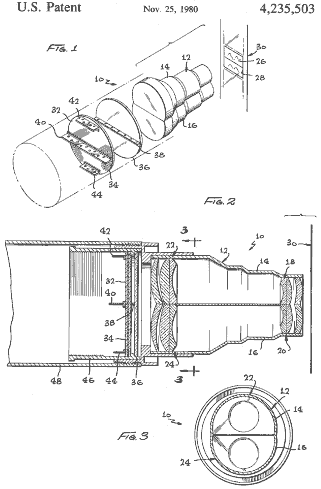
2 perf "quality" is just fine. I think that all of us around here agree that a "well made" print today can hold 4K of detail (in the 4-perf area). That is, 4096x2160 pixels.
4K is, once again a reminder, FOUR times the amount of pixels as 2K, so you can fit FOUR (not just two) 2K images into a 4K "area".
So even if you don't make full use of the ratio and mask the film 1.85 onto the 2-perf area, theoretically, you still have TWO full 2K resolution images in there out of the FOUR full-2K images that fit if you use all the film.
Remember that a Scope digital 2K film is, i.e., only 2048x856 pixels in resolution. I think that fits in a 2-perf area just fine. And that even a flat one is only 1998x1080.
About the difficulty of illuminating large screens, specially in 1.85 films, just a quick reminder that Hollywood is fine illuminating it to 3.5fl with 3D digital, so why not with film? Also, remember that the entire 4perf area is used as a illumination cone (above-and-below) without a masking plate eating any of it, so you actually start-up with about 25% more light than a regular "3-perf" masked flat film.
Do the math and you'll see that over/under film 3-D, which is full "4 perf" area illuminated and splitted 2-perf-and-2-perf, has no problems competing with digital in resolution (1998x1080 or 2048x856 in Scope) or light (3.5fl to 5.5fl).
The main obstacle for 3D on film is twofold. First, TRUE availability worldwide of prints. Second, alignment/framing, which I have the feeling is going to be a problem as it requires operators belonging to the human species. Primates are not suitable.
A third dissadvantage of illumination assymetries (the corners "don't match up") can be dealt with before hand either within the lens itself with optical compensation or at the time to print the negative from the computer through digital filtering. Cheap and easy. Same as the reduced illumination level obtainable (say 4fl). Just time the negative with that level in mind to make best use of the contrast available in the film. Labs have been making low-con prints forever to be used with the weaker "lamps" used by telecine machines.
If Tech3D can promise that most distributors will hand out 3D prints in Spain and sell the lenses under $5K, I'll be waiting in line to install quite a few of those.
quote:
for once still believe that the Infitek technology can be employed in the 35mm area utilising the 3D filter wheel in conjuction with DTS timecode! Also from the Technicolour brochure does that mean that each image is flashed 24 times per second at each eye?!!
The technicolor system shows both images "at the same time" (shutter blade permitting) sort of like Sony 3D does. It is 24 fps per eye if you want to see it that way, but it's simultaneous, not one-eye-see-black-while-the-other-sees-a-different-frame. Here, while the shutter blade remains open, both eyes see their images at the same time. This NEVER happens in Dolby/RealD/MI, where both eyes never, nor for a split second, see the same image. One must always be seeing black.
In your usual 2-blade shutter projector, that would look like 48 "flashes" per eye (simultaneous, so you can think of them as 96 flashes if they were sequential).
Of course trying to spin an Infitec filter would be nearly impossible (film can not really run at over 24fps plus it would be mechanically incompatible without any special shutters). But you can just place two passive infitec filters in front of a split lense (like Technicolor, just remove polarizers first) or a mirror box. Voila. Film 3D with Dolby glasses (the print would have to be color-corrected before duplicated, though).
Posted by Demetris Thoupis (Member # 833) on 12-30-2009, 11:55 AM:
quote: Julio Roberto
Of course trying to spin an Infitec filter would be nearly impossible (film can not really run at over 24fps plus it would be mechanically incompatible any special shutters).
Julio what do you mean by that?
Posted by Julio Roberto (Member # 4976) on 12-30-2009, 12:09 PM:
Well, film can only really run at 24fps with a normal, unmodified projector.
Most shutters "sweep" the framing area "irregularly" starting in a corner and going down (or up) until it's fully covered for a while and then showing it again. This motion covers the whole 4-perf area before going to the next frame.
For a sequential system (i.e. a spinning wheel like Dolby or MI), the wheel puts the correct-eye filter in front of the image at the right time and then switches to the "other" filter when the NEXT image (frame) for the other eye is shown.
If you attempt to do this "as-is" on an unmodified 35mm projector, which again runs 24fps even if "doubled-flashed" by a two-blade shutter to 48hz, you end up with 12fps for one eye and 12fps for the other. Waaaaayyyy too low.
You can not even "double flash" the 12fps because the two-blade shutter shows the SAME image twice, not DIFFERENT images like a digital projection can do.
In a digital projection, the PROJECTOR ingests the left-right frames pair at 48fps and stores them in memory. Then it shows the left one for 144th of a second (aprox.) that is picked-up by one eye, while the other eye remains seeing black.
Then shows "complete black" for a little bit while the filter wheel (or the RealD zcreen) reaches the correct position (both eyes see black). Then it shows the right-eye frame for another (aprox.) 144th of a second for the other eye (the first eye now sees black).
Then, it goes back to the SAME left-eye view it had stored in RAM memory and shows it AGAIN (the same old "left-eye" view). And repeats the whole thing 3 times before going to a NEW set of left-right frames. This way, it "simulates" a 144fps sequence while only requiring a 48fps stream.
You can't do this on a physical projector since it doesn't have a "memory" and the film can not run "back-and-forth". And the stream is only 24fps to begin with.
If you modified a shutter in a projector with a horrendously complicated design and used split-frame 3D (thus sort-of simulating a 48fps sequence), it could conceivably be used with a filter wheel. But then, the projector would be incompatible with anything in the market, so it's of no use.
Besides, it's supersimple to use a projector with PASSIVE filters instead of using a spinning "active" filter wheel. So why even try?
Posted by Demetris Thoupis (Member # 833) on 12-30-2009, 01:15 PM:
I Admit you are correct
Posted by Monte L Fullmer (Member # 2797) on 12-30-2009, 03:16 PM:
..basically called "triple flash" ..
You think we'd might be seeing barrel shutters come back for TECH 3D usage then to eliminate the "sweeping"?
Posted by Julio Roberto (Member # 4976) on 12-30-2009, 03:54 PM:
Barrel shutters would be more perfect to minimize/make more symetric temporal disparities indeed. Do any currently made projectors use them?
Posted by Mark Gulbrandsen (Member # 72) on 12-30-2009, 04:15 PM:
Julio,
The better question might be "Who is making projectors any more...?" Cinemecanicca and Kinoton... thats about it. This idea is rediclous as is the list of films mentioned on the Technicolor brochure. Looks like another year of mostly watching Blu-Rays at home to me...
Posted by Demetris Thoupis (Member # 833) on 12-30-2009, 04:52 PM:
Mark everywhere else in the world except the US ppl are sticking to 35mm for more time. Good luck with all the D installs you will need to upgrade in a year or two. And besides the Technicolor system is for existing and new film systems. You might need a lamphouse upgrade but nowhere near the cost of a Digital projector, 3D system and content server!
Demetris
Posted by Julio Roberto (Member # 4976) on 12-30-2009, 05:11 PM:
We've talked about this before.
It makes no sense to stay with 35mm IF manufacturers start offereing 4K 3D full DCI complete systems prices under $50k and/or if studios start offering no-questions-asked no-middleman-integrator-taking-profits reasonable VPF's.
Since none of those two things seem to be happening any time soon, 35mm is here to stay for a while with digital being put only in 1 auditorium per theater to make use of 3D. Even then, I know of people who has installed a single 3D digital and refuses to play non-3D stuff on it unless they get VPF payments and run the 2D prints on the 35mm alongside.
If we can get 35mm 3D for under $10k total with Technicolor, then it's a no-brainer, compared to a >$100k make-over for a new screen, new digital projector, new server, new 3D system+glasses just to show 3D films. The 3D surcharge doesn't pay back all that in a LONG time, specially considering how the 3D shows need more expensive lamps and glasses/washing/batteries/royalties/whatever. The $10k can be a write-off in a couple of years as oppossed to >15 years for a digital $100k 3D make-over.
We won't even mention obsolency or maintenance costs. If 35mm 3D prints become available, to stay 35mm it's NOT a perfect option but it is the ONLY rea$onable option available right now.
Distributors can change all this if they start offering TRUE, worldwide, generous VPF's deals. Or if manufacturers stop pushing half-baked, half-dci, 1/4 resolution, 2K half-obsolete projectors/equipment for TOP $$$$$$$$$ like the stuff was made out of gold and was going to last as much as the competing 35mm projector which, BTW, is a fraction of the cost and better.
Posted by Ian Parfrey (Member # 5122) on 12-30-2009, 05:26 PM:
Julio.
quote: Julio Roberto
We won't even mention obsolency or maintenance costs. If 35mm 3D prints become available, to stay 35mm it's NOT a perfect option but it is the ONLY rea$onable option available right now.
Very well put.
As long as the likes of Sony who continue to release newer models, then they can be assured that very few exhibs will fork over the cash for something that already has obsolescence guaranteed...and at big $$$ too.
History has shown that exhibs are a tight bunch, and aren't prone to throwing hard earned $ at technologies that wont achieve payback within reasonable timeframes.
History also shows that 35mm is a very adaptive media, and does not require major upgrades to the current equipment in order to operate successfully, and has built in legacy to boot.
Want better image quality, look at Showscan- film at 60 fps.
Want better sound, SR.D, DTS &tc.
Want lower print costs, look at 3-perf, 2 perf pulldowns.
As an adaptive medium, film is hard to beat. And it it this, in addition to the VPF fiasco and high cost of digi conversions, that will ensure celluloid wont die all that soon.
Posted by Demetris Thoupis (Member # 833) on 12-30-2009, 06:15 PM:
Film will stay for a long time. Because large chains in the US have the comodity and money to convert it does not mean the whole world has! Unfortunately you guys in the US don't get it. Perhaps in your grandeur multiplexes the digital move offers better quality than the average projectionist in there but come to Europe or even more, go to China or Japan and see a film. 35mm is still the logical choice with perhaps just 1 digital screen if money allows just to have a small flexibility.
Demetris
Posted by Steve Guttag (Member # 268) on 12-30-2009, 07:50 PM:
As odd as Mark may find it...Strong is still cranking out Simplexes in large quantities/year...just not so much for the domestic market...as long as the dollar remains cheap, Simplexes are inexpensive projectors.
Steve
Posted by Monte L Fullmer (Member # 2797) on 12-30-2009, 09:31 PM:
I thought STRONG was phasing out 35mm .. but must have heard wrong...
quote: Julio Roberto
Do any currently made projectors use them?
I think the Ernemanns still uses barrel shutters...but just more effective ones than what Motiographs had in theirs.
-Monte
Posted by Steve Guttag (Member # 268) on 12-31-2009, 05:14 AM:
The last Ernemanns I had my hands on use conventional shutters.
Posted by Louis Bornwasser (Member # 3063) on 12-31-2009, 11:15 AM:
Finally. . . . . a series of comments that understands digital exactly! Thank you!
(btw: it makes no more sense, moneywise, in the USA than it does anywhere else.) Louis
Posted by Fred Georges (Member # 505) on 12-31-2009, 01:47 PM:
quote: Jack Theakston
The split lens, by the way, is far superior to the mirror-box system.
UGH..I think NOT! It remains to be seen the quality of the Technicolor lenses (Isco?) but those coke bottle splits were designed in the 70's & early 80's. The only "Advantage" is they didn't throw extraneous shadows that you had to chase down & mask.The downsides were legion. It was easy to burn up the internal polarisers & I always thought the contrast of those things were dreadful. I remember some of the siruis lenses would expand slightly when heated & knock your convergence off. A "Good" mirrorbox, while maybe not being quite as optically efficient, can give much better results as it allows you to use the BEST of modern lenses & to choose your method of polarization. They just wont suffer booth clowns gladly (neither will the split lenses). I applaud Technicolors efforts but, make no mistake, You could display these films with ANY of the old over/under methods.
Posted by Don Furr (Member # 1469) on 12-31-2009, 02:31 PM:
I wonder if Technicolor will stick with a single center spacing number or change the alignment for different titles? Seems like there were at least 7 or 8 spacing changes back in the 80's. If they start changing the numbers it's just gonna create a can of worms. I can only imagine.
Posted by Monte L Fullmer (Member # 2797) on 12-31-2009, 03:06 PM:
quote: Fred Georges
You could display these films with ANY of the old over/under methods.
$$"Ka-ching!"$$ .. and how many of these mirror boxes were manufactured, now sitting in some warehouses, booth storage locations, home collection item, et.al., that now has the potiental of regaining their value as a useful and stable commodity?
Can agree with Louis: is DCI worth it in an actual sense?
-Monte
Posted by Steve Guttag (Member # 268) on 12-31-2009, 03:46 PM:
I'm wondering about the reuse of the old lenses...they would just need the circular polarizers and they should work.
I still don't get how Real-D has anything that they can actually license...what is so special about their system? Certainly there isn't 50-cents, or whatever they get per ticket worth of technology there.
I also don't get Master Image's price either...its a motor that is kept in sync with a pulse...okay...yes there is technology there but $25K or whatever they are going for? Dolby's actually seems the most reasonable in that the pricey part is in the color wheel (seemingly expensive to make or others would do it cheaper) and the glasses...again...nobody seems to be making them cheaper).
Steve
Posted by Monte L Fullmer (Member # 2797) on 12-31-2009, 04:38 PM:
quote: Steve Guttag
I still don't get how Real-D has anything that they can actually license...what is so special about their system
I bet some generic company can design the same circular polarization box to get hooked up to the system that would cost much less.
Yet, I call it that RD shot out of the gate with their system right in first place and are determined to remain there.
Plus RD knowing that they got something that they've got a good lead on along with knowing that cinema owners are nowhere anything close to being tech savvy who will grab at the first straw that waves in front of them and pay the consequences to beat out the competition.
TECH 3D might shake this monopoly up some.
-Monte
Posted by Richard Fowler (Member # 893) on 12-31-2009, 05:21 PM:
Real D basically is licensing the Z-screen modulator which they obtained when they bought out SteroGraphics. Lenny Lipton, who was the inventor, was around the last time 3D was hot in the early 1980's.....he wrote the textbook "Foundations of the Steroscopic Cinema".
The past over and under 3D systems used several spacings from .380 to .404.....it would make sense for Technicolor to pick their own "unique" spacing and simplify matters by sticking to one "designed" spacing.
Some of the Stereovision type split lenses in the 1980's where all over the map technically due to their limited hand made production. The elements where mostly available camera lenses cut up, repurposed and mounted to set spacings within new projector barrels; which was O.K. for rental but not for large sale lots. Technicolor split lens makes more sense on hopefully more new projectors with lens turrets...which was a rare item in the early 1980's.
Think of film 3D in the 1980's as Madonna and film 3D for now as Lady Gaga......both good singers ![[Cool]](cool.gif)
Posted by Mark Gulbrandsen (Member # 72) on 12-31-2009, 05:46 PM:
quote: Steve Guttag
I also don't get Master Image's price either...its a motor that is kept in sync with a pulse...okay...yes there is technology there but $25K or whatever they are going for?
I agree. It's literally just several hundred dollars worth of components all wrapped up in a nice little box. Even the logic circuit is nothing special at all. The replacement wheels are not over 500.00 either... The biggest problem with Master Image is the fact that the filters tend to pick up and become coated what ever is in the booth air... at most locations I've seen them installed at they they become coated with muck that eventually stops the circular polarizers from working and you loose all 3-D. The filters can be cleaned off a number of times with a micro fiber rag before it has to be replaced. They need to seal up the area where light passes through the wheel in order to stop this. For 25 grand it should be sealed!!
Mark
Posted by Jack Theakston (Member # 4484) on 12-31-2009, 06:05 PM:
quote: Fred Georges
It was easy to burn up the internal polarisers
Depends on how you treat them, naturally.
quote: Fred Georges
I always thought the contrast of those things were dreadful.
Matter of opinion, but for the good lenses, I disagree.
quote: Fred Georges
I remember some of the siruis lenses would expand slightly when heated & knock your convergence off.
Those lenses were crap.
Posted by Fred Georges (Member # 505) on 12-31-2009, 07:47 PM:
quote: Jack Theakston
Matter of opinion, but for the good lenses, I disagree.
What, pray tell, are the "Good" lenses? I own every example of split lens ever made (including a couple of Russian models) save for the new Technicolor lens(which I'll bet is just the current Isco split with circular polarizers) & have set them up for 30 years. So which one is the "Good" one because I must have missed it?
Posted by Jack Theakston (Member # 4484) on 12-31-2009, 08:23 PM:
Still got a chip on your shoulder about me, eh Fred? ![[Roll Eyes]](rolleyes.gif)
The best split lenses that I know of were the ones that Col. Bernier used in the late '60s/early '70s. They were custom made for him. Got those?
Posted by Kevin Fairchild (Member # 4985) on 12-31-2009, 09:28 PM:
How difficult would it be for MasterImage to relesase an internal polarizer? Couldn't they just utilize the same location inside the projector that Dolby has? If it were internal, you wouldn't need to clean the polarizer nearly as often, due to the projector's air filters.
I know they are touting that their unit is portable, but that only works if you have a digital projector and a silver screen in multiple rooms.
Posted by Steve Guttag (Member # 268) on 12-31-2009, 09:34 PM:
Where Dolby's is you would have heat issues with the polarizers...Dolby's come right in the light beam from the "lamphouse" before the integrator...you are going to get much of the heat of the lamphouse there.
Why not just have optical glass on the in/out of the disc shield and seal it up like Mark said.
Steve
Posted by Mark Gulbrandsen (Member # 72) on 12-31-2009, 10:06 PM:
It is possible to make linear polarizers that can take heat like the Dolby wheel but they would be uber expensive... probably more expensive than the dolby wheel costs(15+ grand).
There needs to be a cheap copy of the M.I. put out by someone. The thing is way way way over priced!
Mark
Posted by Ron Curran (Member # 3631) on 12-31-2009, 10:26 PM:
Seeing we can’t install a silver screen, I was thinking that replacing our 35mm projector with a Kinoton electronic intermittent set-up would give enough increase in light to compensate for 3D losses.
Could I assume that the whole ensemble (projector, lamphouse and Tech lens) would cost a fraction of going dci 3D?
Our 175-seat single screen would probably never recoup the cost of dci 3D, particularly as we mostly cater to a mature crowd.
Anyone guess at the cost of the above?
Posted by Fred Georges (Member # 505) on 12-31-2009, 11:34 PM:
quote: Jack Theakston
"Still got a chip on your shoulder about me, eh Fred?"
Don't flatter yourself I could care less about you BUT, I do like "Opinions" backed with personal experience lest some poor schmuck go off half cocked & take them to heart.
I Met Col. Bernier when I ran a retrospective of Obolers Bwana Devil & 2 SpaceVision pictures Years ago. (Col.Bernier was the "inventor" of the SpaceVision over/under Camera system.)I ran "The Bubble" on break & the Attachment We had from the Distributor was of eastern European origin & it did say for "SpaceVision". Any attachment of that vintage will be a horrible contrast killer by todays standards. But, I'm sure this History is boring the Forum to tears. So, I stand by My statement, backed by experience,that a modern Isco or schneider attached to a quality Mirror box will outperform any of those old "Coke Bottle" split lenses.
Posted by Victor Liorentas (Member # 5272) on 01-01-2010, 12:13 AM:
Oh there is nothing boring here ,i am hanging on every word!
Every bit of info on old lenses gives me a better perspective on where we have been and where we might end up!
Great stuff!
Posted by Don Furr (Member # 1469) on 01-01-2010, 12:42 AM:
Fred I too have StereoVision, Sirius and Paramount Mirror Box lenses in my screening room. My problem with the Mirror Box is that with a 20 foot throw I can't seem to get the spacing right. The split lens (Sirius) seem to work really well. I installed a new polarized filter on my mirror box but can't get a sharp picture. I assume that a mirror box was not made for a short throw.
Posted by Monte L Fullmer (Member # 2797) on 01-01-2010, 01:18 AM:
quote: Don Furr
I assume that a mirror box was not made for a short throw.
Maybe not for short throws, but screens back then were dinky sized.
I worked at a 3plex where we used this mirror box setup and the throw was close to 35 ft, but the screen size was a dinky 10.3ft x 24ft - a common height screen with manual side maskings.
If I remember: the prime lens was taken off the scope lens, then added an extension so it can be attached to the mirror box to keep the same scope image size, especially for the 1983 Columbia release: "Spacehunters: Adventures in the Forbidden Zone" (which was excellent in 3D..), but can't remember now how it was all done since I was only doing PT at that 3plex.
Amazing: the advantages of Film 3D is definitely coming over the horizon ...
Oh brother ..."Paramount just listed Jackass 3-D as a 2010 production (via Cinematical)...."
Posted by Peter Castle (Member # 1997) on 01-01-2010, 04:11 AM:
Ron,
The Technicolor solution is polarised so requires a silver screen.
Can't just have more light.
If you cannot install a silver screen (possibly due to theatre width relative to screen width, as in our case), then the Dolby 3D or XPand DCI systems are the only way to go 3D.
Posted by Mark Gulbrandsen (Member # 72) on 01-01-2010, 08:52 AM:
quote: Monte L Fullmer
Oh brother ..."Paramount just listed Jackass 3-D as a 2010 production (via Cinematical)...."
Yep! Doesn't that make purchasing a 10K+ or 100K+ 3-D system seem worthwhile ...
Posted by Julio Roberto (Member # 4976) on 01-01-2010, 09:55 AM:
Knowing how the manufacturing of 35mm projection lenses is a "dead market" (i.e. after current stock is depleted, it's doubtful a lot of those lenses will be needed in the future as digital starts, at some point, replacing film), it shouldn't be hard for Technicolor to get Isco or Schneider to OEM manufacture a run of "top" quality lenses (to be cut and splitted in two) for them for relatively cheap.
Technicolor pbby isn't so much in this for the profit of the lenses' sales itself but for the added services (print-out to over/under, film duplication/distribution, etc). They can pbbly afford to sell the lenses at little-over-cost as to deliver a modern (couple of stacked together) lenses to theaters for not-a-whole-lot-of-$$$$.
Indeed many mirror boxes could pbbly display the system. Not sure if an agreement with Technicolor would stop distributors offering over/under prints to theaters that have not purchased Tech3D. You don't even need to use circular polarizers if you don't want with those mirror boxes. Just keep using linear+linear glasses and you get a tiny little better light, a little better ghost performance and a little cheaper filters/glasses.
Theoretically, a split lense manufactured to the specifics of each theatre could provide top optical performance, pbby better than a mirror box or a prismatic adapter. Early burning of the polarizers is a concern, but FAR less than it was 30 years ago (there are polarizers used in LCD and Lcos projectors that can take more than enough flux). Still, a method of easy replacement should be included in Tech3D so that once a year or so a new fresh set can be put in to guarantee performance.
I agree with MI being way overpriced. They are silly not to dramatically lower their price to lure the market into adopting them massively. They can get a constant stream of revenue through the permanent sales of glasses and spare filters/parts. For that price, thinking about dual-projection with passive filters looks more attractive than it otherwise would be.
The only player that "knows" what they are doing is RealD. Offer "cheap-almost-free" 3D and make the money selling millions and millions of glasses through the years and years the thing keeps working.
quote: Steve Guttag
color wheel (seemingly expensive to make or others would do it cheaper) and the glasses...again...nobody seems to be making them cheaper).
I don't think you can make compatible systems as Infitec pbbly has the patent territory covered for the use of light bandwidth division for 3D applications in this way. But nothing prevents you from manufacturing active plate retarders (zscreens) or rotating polarizing filters (Master Image). Or polarizing glasses, of course. Stereographics can't enforce stuff since Tektronics had prior art in the field of active LC based shutters (active polarization direction switching), even for stereoscopic applications.
Posted by Mark Gulbrandsen (Member # 72) on 01-01-2010, 11:47 AM:
quote: Julio Roberto
it shouldn't be hard for Technicolor to get Isco or Schneider to OEM manufacture a run of "top" quality lenses (to be cut and splitted in two) for them for relatively cheap.
Julio... BE real about it chap! Thats not going to happen... Imax designed a new lens for Liemax Digital and had Schneider quote building them... Imax ended up having them built by Konica/Minolta for reasons of economics and the quality was as good...
The only place Technicolor could afford to pull off something like that would be to get them made in China. Now in case you did not know all the glass for the Konica Minolta DLP lenses comes from a glass factory in China.
Posted by Monte L Fullmer (Member # 2797) on 01-01-2010, 01:07 PM:
quote: Mark Gulbrandsen
lenses comes from a glass factory in China.
...now why doesn't that surprise me .....
Posted by Julio Roberto (Member # 4976) on 01-01-2010, 04:57 PM:
EVERYTHING is (or can be) made in Asia nowadays, of course. And I mean EVERYTHING, even those things that were "top secret, high tech" not long ago. Maybe it is NOT being made right now, but it CAN be made easily and cheaply for sure.
I was giving an example of ISCO and Schneider IF they were smart about it. If they are going to keep their high horses and not OEM good lenses for cheap (w/o branding), then they'll be out of the picture sooner rather than later.
Of course that very top quality lenses are being made in Asia at prices that are a FRACTION of what americans or europeans wanted for them with either the same, near the same, or superior quality, depending on each case.
Look at the prime lenses for the digital camera used to shoot most pictures today. You can buy TEN of them for the price Cooke or other high-horse players wanted for one. And the quality is MEASURED over and over independently by production/rental houses/DP's/aficionados and the numbers are clear. They are almost as good/just as good/even better depending on each individual case.
Posted by John T. Hendrickson, Jr (Member # 849) on 01-02-2010, 05:38 PM:
I posted early on this topic, and I was skeptical that 3D film would fly. However, after reading recent posts, it looks like it may happen.
Can anyone shed light on whether Fox and Disney have gotten on board with the Technicolor initiative?
I know a number of independents (including the one I work for) have put in one screen of digital for 3D. With 13 screens, and additional 3D releases coming out, I suppose it would make sense for us to equip an additional screen with 35MM 3D to give us flexibility with booking. This would be sort of a hedge on the whole 3D issue, as I'm not convinced that this current 3D wave will last.
Wish I had a crystal ball.
Posted by Mike Blakesley (Member # 26) on 01-02-2010, 06:40 PM:
quote: Julio Roberto
pbby
How come people can write long posts and spell everything correctly, but can't bring themselves to fully spell "probably?" If I see prolly, pbbly, pbby or prob one more time, I'm gonna put the Vulcan Death Curse on you guys. ![[puke]](graemlins/puke.gif)
Posted by Monte L Fullmer (Member # 2797) on 01-02-2010, 06:50 PM:
quote: Mike Blakesley
I'm gonna put the Vulcan Death Curse on you guys
Ah, gee Mike, it fun to cut words down ....
quote: Julio Roberto
Barrel shutters would be more perfect to minimize/make more symetric temporal disparities indeed. Do any currently made projectors use them?
Or, if barrel shutters isn't the answer, are we going to see Brenkerts come back out with the BX100's with the dbl shutter drive, and along with other makes with dbl shutter setups?
Can we see mod kits come out for the classic machines to run dbl shutters when this TECH 3D really takes off?
-Monte
Posted by Mark Gulbrandsen (Member # 72) on 01-02-2010, 06:55 PM:
Thx Mike!
Posted by Phil Hill (Member # 371) on 01-02-2010, 07:03 PM:
Mike =
Posted by Scott Hicks (Member # 376) on 01-03-2010, 02:08 PM:
quote: Julio Roberto
The only player that "knows" what they are doing is RealD. Offer "cheap-almost-free" 3D and make the money selling millions and millions of glasses through the years and years the thing keeps working.
I agree that RealD "knows" what they are doing, and it ain't anywhere close to "free." With a $0.50 per per 3D ticket fee over a 5 year contract, it makes D3D, MI, X3D, and even T3D seem cheap by comparison!
One of my clients just spoke of writing a rather huge commission check to RealD for Avatar so far. He will probably hit $20k in commissions in the first year. Do the math.
Posted by Julio Roberto (Member # 4976) on 01-04-2010, 10:13 AM:
quote: Scott Hicks
.... With a $0.50 per per 3D ticket fee over a 5 year contract, it makes D3D, MI, X3D, and even T3D seem cheap by comparison!
One of my clients just spoke of writing a rather huge commission check to RealD for Avatar so far. He will probably hit $20k in commissions in the first year. Do the math
Let me do the math. $20k x 5 years = $100.000
Plus RealD seems to be charging studios for the glasses as well, rumored $0.65 ... so another $115.000 for that theatre we are talking about. And that's just in 5 years.
Let's weight the (hypothetical) $10k Tech3D system against a $100k digital makeover with Silver Screen and RealD ....
Well. Let's not. Perhaps theatres will start to realize that even dual-projection is not a bad option at all.
And remember, money that doesn't stay with the distributor/producer/exhibitor/consumables-maintenance but goes to a third party like RealD or a digital "integrator", is paid by the industry one way or another, through increased cuts, higher ticket prices that drives customers to less concession spending, etc.
Avatar can GROSS a billion dollars, but if $1.15 per head has to go to RealD ... the producers are going to need to gross even more ...
Posted by Monte L Fullmer (Member # 2797) on 01-04-2010, 02:02 PM:
quote: Julio Roberto
the producers are going to need to gross even more ...
You think that this could be the "Damocles' syndrome"-a state of long-term uncertainty, that Real D could be the "sword" that the studio's and cinema owners could evenually fear if more involvement with 3D by the studios grows by public popularity and demand?
Maybe then, Tech3D could be the definite alternate choice with this -the "escape route" so to say..
"Avatar" could have started something with this.
-Monte
Posted by Jonathan Althaus (Member # 5042) on 01-05-2010, 07:51 PM:
I like the Tech3D system, but they seem a few years late to matter much. The big 3 chains have already signed major deals with Sony or Barco for a full rollout in the next few years. The Tech system will work great for small chains and single sites, but how much of the money is already invested in digital 3D?
Posted by Monte L Fullmer (Member # 2797) on 01-05-2010, 10:34 PM:
quote: Jonathan Althaus
but they seem a few years late to matter much
TECH designed this for smaller cinemas circuits or "Indies" that are waiting for DCI units to arrive to fill in that gap created by the demand of the "Big Box" circuits.
Thus, TECH is really approaching at the right time and the right place since the fruit it ripe for pickin' in this market area.
-Monte
Posted by Demetris Thoupis (Member # 833) on 01-12-2010, 04:41 PM:
Well it seems here comes the bad news for Technicolour. Technicolour will be charging 2000 USD licence fee per feature to each exhibitor!!!! Who said RealD was expensive!?
Demetris
From Technicolour FAQ for 3D
quote:
Q: How much are the licensing fees?
A: Technicolor will offer exhibitors the following pricing structure - $2000 per feature with an annual cap of $12,000. There will be no charge for moveovers, no per ticket charges or fees for increased attendance, and no fees once the annual cap is achieved on a per lens basis.
Demetris
Posted by John Wilson (Member # 269) on 01-12-2010, 05:20 PM:
So much for that.
Posted by Monte L Fullmer (Member # 2797) on 01-12-2010, 05:54 PM:
Heard that this cap is for the usage of the lens-like a lease of sorts.
Now, is this $12k cap is a one time thing, or does the cinema owner have to fork out $12k every year on per lens usage?
-thx .. Monte
Posted by John Wilson (Member # 269) on 01-12-2010, 06:04 PM:
quote: Monte
$2000 per feature with an annual cap of $12,000.
$12,000...every year.
Posted by Scott Norwood (Member # 30) on 01-12-2010, 07:08 PM:
I will happily rent out my two 1980s Paramount mirror boxes for $1500/feature or $11k/year. Don't miss this bargain! Act now!
Does the lens even cost anywhere near $12k to manufacture?
Posted by Julio Roberto (Member # 4976) on 01-12-2010, 08:51 PM:
Times like this, I need a crying "smiley".
Oh well.
quote:
I will happily rent out my two 1980s Paramount mirror boxes for $1500/feature or $11k/year. Don't miss this bargain! Act now!
I offer 5 Mark's Polarator Prismatic units for only $10k/year or $1.200/film!!! Mirror boxes also available!!! New circular filters just installed!! Even a few split lenses!!!
quote: Scott Norwood
Does the lens even cost anywhere near $12k to manufacture?
Manufacture?
Of course not.
Purchase or commission a manufacturing run in volumen (Technicolor seems to have ordered 1.000 units)?
Of course not.
I would've probably paid up to $12k for outright purchase, although $10k would've been my desired upper limit.
But in reality it's only going to be used for a couple of 3D films a year, so it's not that outrageous considering they will also make the studios supply "unlimited glasses" and RealD royalties can be somewhat up there as well, and RealD doesn't have a yearly cap.
Let's think about it. Say you show 10 3-D films a year, almost 1 every month. Say you get a 5.000 audience on each film. Say RealD charges you $0.50 per patron, but gives you the glasses free. Or you don't pay anything to Master Image, but you need to buy glasses at $0.50, so same thing. So that makes it a $2.500 per film expense for the 3D with either system. After 10 films, that's $25.000 to RealD in royalties or $25.000 to Master Image in glasses or $12.000 in rent to Technicolor.
With RealD, you didn't have to pay (much) to install the system, same as with Technicolor. With Master Image, you paid several tens of thousands. All 3 need the silver screen expense.
This is assuming what Technicolor is saying that supporting studios will pay them for glasses to give them to you free and will give you a 3D print "free", as usual.
And, of course, we won't even mention the cost of going high-brightness digital to qualify for RealD or Master Image ...
Thoughts?
Posted by Scott Norwood (Member # 30) on 01-12-2010, 09:05 PM:
It still seems way overpriced for what it does.
Does the price double if you need two of them for a changeover booth?
Posted by Brad Miller (Member # 2) on 01-12-2010, 11:28 PM:
quote: Julio Roberto
After 10 films, that's $25.000 to RealD in royalties or $25.000 to Master Image in glasses or $12.000 in rent to Technicolor.
Don't forget you also have the option of paying $0.00 to Dolby for the best of all the 3D systems and OWN it without being stuck to a 10 year no-competition contract.
It amazes me in this economy how many people still can't do math.
Posted by Monte L Fullmer (Member # 2797) on 01-13-2010, 12:19 AM:
Ya, for what scares the masses is the price for them Dolby 3D glasses and not thinking that they can OWN the Dolby unit as long as they want to instead of "flushing the toilet" every month on them leases for what ..."ABSOLUTELY NOTHING!"
- like the only thing they see is what is right in front of their noses is that $$$ sign and not even thinking long term of the $$$ that can be saved ...
"DANG!" Do, or don't they have confidence in their operations or what? Are they scared of being successful?
-Monte
Posted by Cameron Glendinning (Member # 3516) on 01-13-2010, 01:29 AM:
quote:
# Q: Which studios and/or groups support this new technology? Who opposes it?
A: Technicolor has shown the solution to multiple studios and exhibitors and has received strong support for both the picture quality delivered as well as the attractive economic payback associated with our solution. Technicolor has announced public support for its Technicolor 3D solution from the following seven studios: Paramount Pictures, DreamWorks Animation, Universal Pictures, Warner Brothers Studios, Lionsgate, The Weinstein Company, and Overture Films. These studios represent the strong majority of the features currently slated for 2010.
Ok who's missing from the list? Disney A 20th century fox? I wonder if the next "Bond" film is going to be avaliable to Tech 3D? Anyone else obvious missing from the list?
Posted by Mike Blakesley (Member # 26) on 01-13-2010, 02:03 AM:
quote: Monte L Fullmer
TECH designed this for smaller cinemas circuits or "Indies"
Not with that price tag, they didn't.
Posted by Monte L Fullmer (Member # 2797) on 01-13-2010, 02:10 AM:
True, at that time, the lease arrangements didn't come out. Now, things got totally shifted around with these absurb arrangements.
Guess Mike is gonna keep his 35mm booth setup running in tip-top condition for quite the time now.
-Monte
Posted by Stephen Furley (Member # 1277) on 01-13-2010, 02:14 AM:
quote: Scott Norwood
Does the price double if you need two of them for a changeover booth?
That's the was I read it.
2,000 seat theatre with one projector in use, running something for six weeks, selling out most shows, $2,000.
100 seat changeover house, running a film once and only selling a few seats, maybe a Saturday morning children's show for example, $4,000.
Posted by Monte L Fullmer (Member # 2797) on 01-13-2010, 02:34 AM:
Dang, read this insane exhibitor term sheet (course, this isn't a binding agreement, but for discussion purposes only...)
-Monte
Posted by Scott Norwood (Member # 30) on 01-13-2010, 03:01 AM:
As Stephen points out, the pricing scheme just doesn't make sense.
They should have gone with a per-ticket surcharge and/or a minimum guarantee per year, possibly with a slight increase for theatres that need multiple lenses. As it is now, exhibitors can easily lose money with this system, which benefits no one in the long term.
Posted by Steve Guttag (Member # 268) on 01-13-2010, 07:12 AM:
Nah, they should have a purchase plan and a per title plan. Thus you could decide how long you think 3D will last. If you think it is long-term...buy the lens(es) but if you think it is a short term thing (lasting only a year or two more)...per-title.
But the plan laid out seems too expensive for what it is. I'm still amazed that Real-D has done as well as it has. It is very expensive, long term, for virtually nothing offered. They don't do very much and haven't really brought any real innovations to the technology. They also seemingly have had people to sign long-term agreements (10-years) that excludes other technologies. I know I couldn't sign something like that...especially knowing there are much more profitable alternatives (for the exhibitor). Hey, more power to them if folks are so short-sighted.
Steve
Posted by Julio Roberto (Member # 4976) on 01-13-2010, 08:06 AM:
RealD has always been a "scam" or sorts .... Good thing they didn't obtain "monopoly" status.
While the Dolby system doesn't require the payments of "any amounts" for either glasses or RealD-type royalties, it's not "free of costs per 3D film shown".
As we know, there is a cost in labor and consumables in dealing with the pick-up and re-sanitation of the glasses, as well as the loss of glasses to theft and breakage and end-of-life glasses cycle. Granted that the cost in water, detergents, electricity for washing/drying the glasses, and even replacement of damaged units is LOWER than current throw-away-glasses (like Master Image) or royalties (like RealD), but it's not free. For the same example of 10 films/year with 5000 audience each, it would be $0.15*50000=$7500. Very reasonable.
And we won't even mention Dolby's up-front cost, which involves the purchase of digital, plus very expensive 3D hardware of several tens of thousand, plus the restriction of using only servers which do Dolby color correction (which usually means higher priced models), plus many thousands of dollars in 3D glasses (600 glasses=$16.800). Also Dolby often needs the bigger, more expensive projectors and higher lamps/electricity costs.
I ran a spreadsheet of costs for different systems (I'll try post it here after I'm done with other things and translate it to english). Dolby is indeed the 2nd best option in the long run, after ... surprise, Technicolor if you run 10 3D films a year to 6000 or more audience each and manage a $1 profit for yourself per person on 3D surcharges.
Of course, after 10 years the Dolby equipment doesn't just "breakdown" and eventually, probably after 12 years or so, it would start being cheaper to go Dolby than to go Technicolor at these price schemes. Hopefully after 3 years, Technicolor would reconsider or ... just go away fully replaced by digital anyway.
This is assuming the studios would pay for Tech3D glasses for 10 years, which I'm not so sure about.
You can also think of Tech3D as "free". Have one installed for the cost of the screen (which is good to have for digital anyway, call it a $5000 investment). If you don't show any 3D films, you owe nothing. If you show 1 film, you must pay $2000, so you need $2000 in extra profits. Figure you show it to 2000 people and charge them $2 extra ($2000 for the distributor, $2000 for you). Now you paid Tech3D. If more than 2000 people come to the film, you keep $1 for each extra profit. If you show more than 6 3D films a year, you "keep" an additional $2000 for each film you run (with a minimun of 2000 audience).
Posted by Louis Bornwasser (Member # 3063) on 01-13-2010, 03:59 PM:
I am involved with Tech 3D.
Consider the first year expense, Tech vs. Digital.
Consider the next year expense, Tech vs. Digital.
My initial thought is that this is too much; it is a GIFT compared to the alternative. Louis
Posted by Jack Ondracek (Member # 1466) on 01-13-2010, 04:42 PM:
'scuse the dumb question... just never saw it asked.
Does projecting 3D on a non-silvered screen totally screw up the polarization... or just reduce it to some unknown degree... or what?
Posted by Gordon McLeod (Member # 33) on 01-13-2010, 04:56 PM:
totally screws it up as it diffuses the polarization
Posted by Julio Roberto (Member # 4976) on 01-13-2010, 05:22 PM:
Yeah, a non-silver screen totally screws the polarization (fully unworkable).
I run some numbers, and they proved interesting. They are NOT meant to represent fully real scenarios/prices, just some hypothetical stuff. Corrections and suggestions very welcome.
First spreadsheet tries to figure out how much up-front cost it will take to make a screen 3D that seats 300.
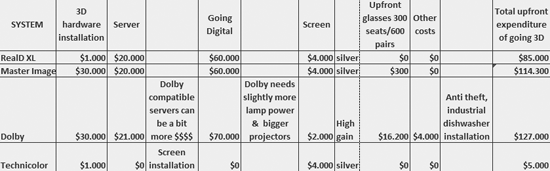
It reaches the conclusion that to turn to RealD XL, it would take some $85k, factoring a cheap digital projector and cheap small lamp, due to Reald's XL nice light performance and silver screen gain and virtually free Zscreen and $0 for upfront glasses.
It then figures Master Image is a bit more at $114k, due to the purchase of the filter disc mostly.
It then figures Dolby is even more at $143k, due to the need for a more expensive projector with a bigger lamp, a slightly higher $$ server to be compatible with dolby color correction, lower non-silver screen cost, but $16k for 2 pair of glasses per 300 seat plus $4000 in dishwasher/anti-theft purchase and installation. And the Dolby filter wheel, of course. It shows wrong in the spreadsheet
This other spreadsheet figures how much it costs to run 10 films/year in 3-D with an audience of 2000 each film. It figures RealD wants $10k for royalties, MI $13k for glasses, Dolby $3k in glasses/lamps related expenses, and Tech3D $12k in rent.
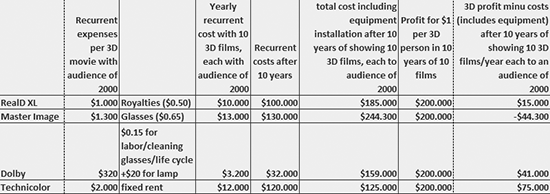
After 10 years of showing 10 films per year to 2000 people each, if we write-off the initial cost of equipment and we can make a clean additional $1 "gross profit" out of the 3D surcharge for each of those people, we figure a "net profit" of $15k for RealD, a LOSS of $44k for MI, a profit of $41k for Dolby and a profit of $75k for Technicolor.
If we increase the numbers to same 10 3D films/year but 4000 patrons each film instead of 2000, then we write off the equipment and get net profits after 10 years for all systems of RealD $115k, MI $25k, Dolby $211k and Technicolor $275k.
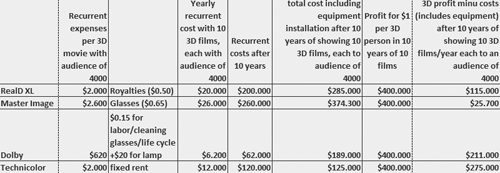
If anybody notices any major errors in the numbers or anything, please let me know.
The prices are just approximations and equipment prices in Europe are higher than in the US, so they should be taken only at their RELATIVE value, rather than face. If you find i.e. that server prices of $20k don't match at all projector prices of $60k and it should be more like $15k on the average, pls let me know.
The closer we can get to good real ball-park numbers, the better.
Korean manufacturer Master Image was recently bought by a USA company. I have the feeling they may start to work with the studios to obtain the $$$ for the glasses from them, as RealD does and Technicolor pretends, to improve their competitivity.
XpanD numbers would be similar to Dolby's, as their up-front glasses are more expensive and require $1/month in batteries, but also they don't require any special screen, neither silver nor high gain, and their light performance usually is ok with smaller lamps than Dolby. Also, no $$$ for a Dolby filter wheel and the claimed life cycle of their glasses is 3 times that of Dolby.
I already enquired Technicolor and hope it works out and they produce copies of at least 8 good films in Spain with it. If not, there is no need to pay pretty much anything to Technicolor, so no big deal if you don't have competition around with digital 3D yet and wanna wait for cheap 4K DCI (<- if that ever happens)
EDIT: Notice an error that makes Dolby look better than it should by about $15k, so factor that in. Don't feel like changing/re-uploading the spreadsheet, as it was a quick hackjob translation from the spanish cost study and would have to re-do it.
Posted by Jack Ondracek (Member # 1466) on 01-13-2010, 07:08 PM:
Julio,
Could you please provide sources that would install the "going digital" part of your layout for $60,000?
I know of no company that would take a prepped 35mm booth and provide the equipment and conversion costs for such a low figure. Your spreadsheet also does not include maintenance costs, which I understand to be mandatory in many cases.
My understanding to this point, is that it would cost about that much to add 3D to a screen that was already converted to digital.
On the other hand, if that really is a typical price, It would surprise me that there aren't more theatres taking advantage of it.
Otherwise, your numbers are very interesting.
Posted by Julio Roberto (Member # 4976) on 01-13-2010, 07:25 PM:
Well,
Remember in those numbers the cost of the server/its installation, is separate, as is the cost of the 3D hardware/its installation, as is the cost of a new screen/its installation.
So basically, $60.000 is just for the projector.
Sure you need to factor stuff like new lamps, etc, that are not included in those numbers, but a "plain projector w/installation" can be had for $60.000/$70.000, I guess. If we all feel this is wrong, I can update the figure to better represent reality. As I said, they are just some ball-park gross numbers that don't have to match reality verbatim.
Posted by David Zylstra (Member # 4230) on 01-13-2010, 07:32 PM:
I know how much I paid for each projector and server in my last new building and I actually thought the $80,000 is a little high (at least for small to medium screens).
Posted by Julio Roberto (Member # 4976) on 01-13-2010, 07:35 PM:
Yeah. Prices in Europe are higher. Around 25% or more than USA, so you can factor that in however you prefer. $20k server + $60k projector can be high in many cases, ballpark on others, low in yet other markets. Sometimes installation alone can shoot up that number a lot, sometimes it can be included, depending on the size of projector/brand of server, etc.
It's just for the sake of running relative comparisons, that's all.
Posted by Scott Norwood (Member # 30) on 01-14-2010, 09:31 AM:
The economic viability of the Technicolor system also depends upon when/if distributors will stop making 35mm prints available for new releases (thus forcing the conversion) and how long the projectors will actually be viable before becoming obsolete or requiring significant upgrades.
If it is assumed that 3D will be around for many years and also that the digital conversion is inevitable and will be required in the near future in order to show current films, then it makes little sense to install the Technicolor system, pay the royalties, and end up having to pay for a digital conversion eventually, anyway.
On the other hand, it might make much more sense if 35mm film outlasts the current generation of projection equipment as a mainstream exhibition format.
Either situation is entirely possible, but the pricing scheme does not make it sound like a guaranteed winner (vs. converting to ).
Posted by Gordon McLeod (Member # 33) on 01-14-2010, 10:06 AM:
I don't know overall it seems a relatively good deal going forward as the cost of the screen is common to both
Posted by Steve Guttag (Member # 268) on 01-14-2010, 10:20 AM:
Does anyone know of a Technicolor deal where you can simply purchase the lenses? Also, has anyone looked into just reusing the lenses of the '80s but with circular polarizers?
Steve
Posted by Gordon McLeod (Member # 33) on 01-14-2010, 10:29 AM:
I am assuming that the licensing of the making of the 3d prints will require there lens in distribution and I have no idea what the offset spacing is
Posted by Julio Roberto (Member # 4976) on 01-15-2010, 07:52 AM:
quote: Steve Guttag
Does anyone know of a Technicolor deal where you can simply purchase the lenses? Also, has anyone looked into just reusing the lenses of the '80s but with circular polarizers?
Technicolor hasn't answered my emails yet, but it seems like their agreements are all going to be a fixed amount per-film, with a maximun yearly cap.
I guess part of the agreement of offering to do over/under prints for studios "for cheap/free/same price" will imply that such prints are only used in cinemas with their system. Besides, the studios probably want some assurance that their prints are being shown in "top quality, modern systems", to avoid the patchy quality of many 3D projections during the 80's.
I hope they have set up a distribution system for the glasses and offer to do the dirty work of delivering them for the distributors for a price, so that they come free to theatres as RealD's do.
Using an 80's lens is probably not supported by a custom spacing, but using an optical adapter like a mirror box should probably work without much trouble.
You can, of course, fit the 80's adapters or lenses with circular polarization filters, heat considerations permiting.
Posted by Louis Bornwasser (Member # 3063) on 01-15-2010, 11:30 AM:
Gordon is correct. However, since it is an over/under system, you could use your old lenses and glasses, if you could obtain a print.
The large benefit to the Technicolr system besides quality and price, is that it has a hammer in its ability to guarantee a standard. If there are quality "issues" then a theatre may need to be recertified to continue onward. The theatre owner has contractually guaranteed to meet and continue to meet the agreed upon standards.
This is really no different than the Digital 3D systems have done. Louis
Posted by Steve Guttag (Member # 268) on 01-15-2010, 12:15 PM:
Well...yes and no.
I wonder how Technicolor could constrain a studio...who owns the print from issuing it to anyone it wants. The over/under process is LONG out of patent protection...heck, there is a SMPTE standard on it.
The only tie Technicolor would have would be to its lenses, presuming it does not sell them.
A mirror box style lens from the '80s, including the Paramount, Marks and even the Stereovision one with the knob on top should work with the correct polarizers. Even the Sirus II lens with the correct polarizer should work.
I think it is amazing that people would pay such huge rental fees for what really is stale technology...with a twist (seemingly just a variable magnifier to get a precise fit to the screen).
As for the other digitals. Only Real-D, theoretically, can control its quality (has anyone in recent memory had a Real-D inspector come out to "check" on the installation?)
Steve
Posted by Stephen Furley (Member # 1277) on 01-15-2010, 12:29 PM:
quote:
Instead, Technicolor recently devised a system that can show 3-D movies using conventional film projectors
Posted by Mark Gulbrandsen (Member # 72) on 01-15-2010, 05:54 PM:
They way I'm seeing it is Technicolor controls the 3-D prints AND the 3-D lens. You get the 3-D lens WITH the 3-D print. You send the lens BACK with the print when you're done with it. Hence no one can use an older lens adapted to make it work for the new prints because they will not send the 3-D print without their 3-D lens.
Posted by Steve Guttag (Member # 268) on 01-15-2010, 06:53 PM:
Who owns the print though? Is Technicolor printing the 3D prints gratis to the studios? If so...I could see that and part of the "rental fee" covers the cost of the print.
From what I understand, one does not send the lens back and forth...in fact, they want you to play every Technicolor 3D available.
Steve
Posted by Julio Roberto (Member # 4976) on 01-15-2010, 07:19 PM:
The way I read it, it goes as Steve says.
My understanding, and of course I could be wrong, is that:
-The theater pays for a professional installation done by a Technicolor certified technician
-There is a gentlemen's understanding that, if there is a Tech3D print available of a title you'd like to play in your house, you would book it for their system (i.e. and not in 2D or in another non-tech3d auditorium).
-You pay $2000 per film flat fee to a maximum of $12k/year (i.e. "free" for the rest of the year after 6 films are shown). You agree to this price scheme for 3 years, and it's negotiable after that on a year-by-year basis.
-Technicolor makes the mastering/processing for the studios at cost/free and the prints at the same identical price they have always gotten for 2D 35mm prints, with the gentlemen's understanding that they will be used to be booked for their system (I guess otherwise Technicolor would start charging more for producing the master or perhaps even printing the prints).
-Technicolor offers to supply and ship out glasses to theaters at good cost for studios as RealD does, or you can otherwise get the glasses directly or however you want.
Could be better, but it doesn't look so bad to me.
They say they are really expecting this to catch up, and even in Spain they are working out the deals as we speak hoping for the first print in March.
Time to place up orders for Silver screens quickly!!!
Posted by Steve Guttag (Member # 268) on 01-15-2010, 08:56 PM:
Gentleman's agreement? Not too likely in this Country where there is more lawyers than honest people.
It is a matter of who owns the prints...and it is likely the studio owns the print. They get to choose where their property goes.
Furthermore, mere ownership of any 3D system is no guarantee of a 3D booking...that goes through the normal channels.
I could see how Technicolor would have to pick up the mastering costs. What incentive would the Studio have for increasing their film manufacturing costs...they want digital now so it better be a zero cost feature. Technicolor would still make out since they do get to rent lenses, sell more prints...even if some out there used their own equipment.
Steve
Posted by Julio Roberto (Member # 4976) on 01-15-2010, 09:01 PM:
quote: Steve Guttag
What incentive would the Studio have for increasing their film manufacturing costs
That they get ~60% of the 3D surcharge that way. If they give you a 3D print rather than 2D and you charge people $2.50 extra, about $1.50 more could go to them. With that, they pay the $0.50 for the glasses and pocket the $1.
They were going to run a 35mm for you anyway, so the cost to do it over/under is the same to them if the mastering costs are low/none, which Tecnicolor is willing to do since that way people book their system and they get $2.000 from the theater.
Technicolor was going to get an order for a print for theater X whether 2D or 3D, i.e, so they don't really make significantly more number of copies by offering 3D. They just stay in business longer with film, make a profit out of the 3D rents, and offers studios an inexpensive way to make $1 more per patron to those not willing to switch to digital in 3D surcharges.
Posted by Steve Guttag (Member # 268) on 01-15-2010, 09:04 PM:
No...they'd rather you just switch to digital and then they could pocket their money AND not pick up any film printing costs!
Posted by Julio Roberto (Member # 4976) on 01-15-2010, 09:11 PM:
Well, ideally, they'll want to do both.
But let's say $1000 is the cost of a distributor to a print (2D or 3D) for theater X and $75 if they were to ship out a KDM/hard drive instead.
How much is the profit for a 60% cut of a 3D surcharge if they allow theater X to run it 3D? With 1.000 audience, that's likely your $1.000 extra right there for the studio. They paid off the print. Since doing the print 2D or 3D doesn't significantly matter to them ...
Ideally they'll want both. For you to save them the cost of the print (say $1k) and for them to pocket their cut of the 3D surcharge (say $1/patron). And, in the future, to save them the cost of glasses (say $0.65/patron) as well.
But that ain't happening anytime soon at $100k/screen convertion prices for so-so 2K DCI solutions on small independents ...
Even more, distributors are willing to pay the (aprox) $1k/print cost in VPF anyways ... at least to the majors and integrators (or Paramount to everybody) for the next 10 years or so, so in the short term, 35mm print or digital hard disc costs them about the same ...
Although we have always known that 3D was an excuse by the majors to make digital easier to swallow (or should I say to force digital down the throat), sometimes the producer of a 3D film may be a small independent that wants it shown that way to boost their grosses with surcharges and may force the distributor to use all available 3D systems.
Posted by Julio Roberto (Member # 4976) on 01-21-2010, 08:18 AM:
Oh well.
Now there is a choice. Maybe.
http://www.oculus3d.com/Oculus3D%20OculR%20Brochure.pdf
quote:
Oculus3D™, a company focused on film-based 3D projection technology, today announced its first product, the OculR™ system, a low-cost 3D lens and print format for the installed base of 35mm movie projectors.
The OculR system eliminates the need for exhibitors to purchase a new digital system to play 3D films. The OculRsystem also does not require exhibitors to pay per-seat or per-show royalty fees. The OculR lens provides exhibitors with a 3D solution that works with all standard 35mm projectors, delivering superb quality film-based 3D presentations that are equal to or better than more costly digital options. The OculR3D system consists of the OculR lens for the theater’s 35mm projector, a “silver” movie screen and low-cost plastic frame linear polarizer eyewear, delivering the finest 3D image at an affordable price. The OculR lens can be installed rapidly, eliminating theater downtime and providing a minimum brightness of 6 foot lamberts, which equals or exceeds the brightness of most digital and single-projector film systems to ensure flawless 3D performance for exhibitors.
“The team at Oculus3D has created a cost-competitive and projectionist-friendly 3D film-based delivery system that bypasses the problems of the resurrected, discredited, and obsolete ‘over/under’ film-based approach of the 80’s that plays inside-out images much of the time,” said Lenny Lipton, president and chief science officer, Oculus3D.
Economic Benefits to Theater Owners and Studios
Exhibitors and studios will benefit equally from the OculR system because the industry is unable to meet current audience demands for 3D presentations as the number of 3D feature releases will continue to grow in 2010. The motion picture industry is missing out on millions of dollars of revenue because of a shortage of 3D screens.
“We see a substantial worldwide market for the OculR 3D system and estimate some exhibitors could save $150K per screen in equipment, 3D software conversion and installation costs while the studios could add a meaningful number of new 3D screens in 2010,” said James Marsh, analyst, Piper Jaffray & Co. “Exhibitors who have been concerned about the cost of switching over to a digital cinema system now have an interesting new option to consider.”
Oculus3D estimates that it can get theater owners up and running with the OculR system (the lens and upgraded movie screen) for approximately $20,000 - $25,000 per screen. This is 85 – 90% less than investing in a digital projector approach.
The OculR print format is created by applying an algorithm to the final digital intermediate file to produce a master negative. Release prints are then made using standard lab techniques and costs are identical to making a standard print, making conversion from 2D to 3D a seamless process for the labs, exhibitors, and studios.
“Our product stops the forced marriage between digital and 3D as many exhibitors are being pushed into replacing workhorse film projectors to take advantage of the boom in 3D movie releases,” said Marty Shindler, founder and CEO, Oculus3D. “OculR will help meet movie patron demands for 3D while saving an estimated $150,000 to $175,000 in per screen set up costs and eliminate hardware and software ongoing maintenance expenses.”
“There is a pressing need for 3D film systems on a global basis for two key reasons including a higher volume of 3D theatrical releases as well as the high import duty costs associated with digital projectors in many parts of the world,” said Albert Mayer Jr., executive vice president and chief technology officer, Oculus3D. “With OculR, exhibitors can help meet movie patron demand for 3D.”
About Oculus3D Corporation
The mission of Oculus3D is to offer quality 3D projection at lower cost with higher profits for exhibitors and studios. The principals, Lenny Lipton, Al Mayer, Jr. and Marty Shindler have a combined 100 years of experience in the movie business. For more information please visit [URL=http://www.oculus3d.com.
So now we know what Lenny Lipton was up to since he got (kicked?) out of RealD.
Well, the system does have some advantages (starts with better lighting symmetry, hard to screw up splicing/framing/aligment). Also, it pays off for good with the money saved with Technicolor in just 2 years. Better light for 1.85 films, worse for Scope than Tech3D.
And, of course, some disadvantages, like possibly higher keystoning and larger light loss compared to a split-lens.
Overall, no big difference from Technicolor, except I think Technicolor is going to get more support in prints and glasses distribution, which are key to make the system successful.
If only Technicolor could push the manufacture of over/under prints worldwide, ship glasses for distributor at their cost and be a tad cheaper ...
At least in the 50's there was (mostly) just one system. Dual projection.
And in the 80's another ... (mostly). Over/under.
Even during the 90's Imax was sort of a standard ...
But now, there is dual projection, single projection, digital, 35mm, over/under, side/side, ghostbusted, non ghostbusted, Dolby color corrected ...
-XpanD (and its clones 3Din, EdeD, Nestri): shutter glasses
-Dual projection: well, dual projection.
-Imax: dual projection with the front rows of seats removed.
-RealD: Liquid crystal polarizer rotator.
-RealDXL: add a mirror box with dual image output to the above.
-Dolby: sort of super time sequential anaglyphic.
-Master Image: just put the two filters in front of the projector real fast.
-Sony: who needs two projectors when you can have two lenses?
-Technicolor: who needs two lenses when you can make a split-one?
-Oculus: who said mirror/prismatic boxes were out of fashion?
All this exciting, never-ever-ever-ever seen before technology is, of course © James Cameron who has spent 20 years developing it exclusively for Avatar.
Posted by Steve Guttag (Member # 268) on 01-21-2010, 09:12 AM:
How much do you want to bet that if this device makes any headway that they switch to circular polarizers? Dual-Inventory of anything, including 3D glasses begs for problems.
Posted by Julio Roberto (Member # 4976) on 01-21-2010, 09:36 AM:
Well, Imax has been doing linear for years, so you could say that it was digital that started the craze for "incompatible" circular.
Anyway, they probably want to have a saying in the sale of glasses, which is where money comes from. I wouldn't even be surprised if they custom manufacture a particular angle (say 10º/100º) just to screw up everybody with a stock of standard glasses. They do have a point that linear offers (very small) better performance, in both ghosting (unless you turn you head) and illumination, as well as in cost.
Personally, I would do circular if I were them, though. People like it better when they can turn their head. And they can make it propietary all they want (like reversing left and right lenses, or making any custom angle).
Anyway, if you want to see how it works, it's all here in this 1948 patent (except why 2 mirroed prisms and a mirror costs $20k)
http://www.freepatentsonline.com/2693128.pdf
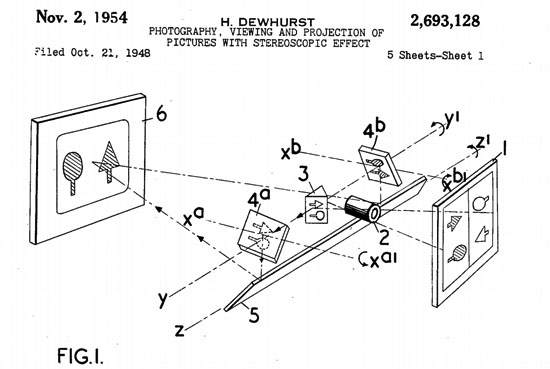
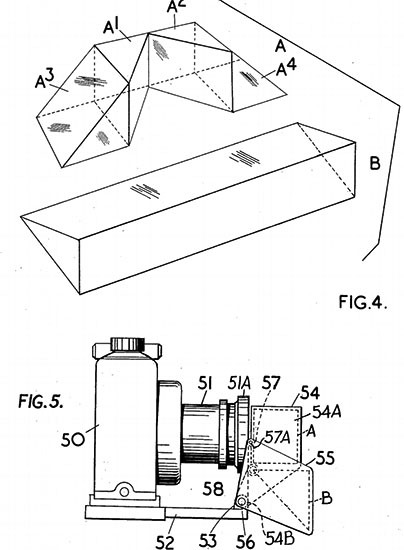
Posted by Steve Guttag (Member # 268) on 01-21-2010, 11:55 AM:
Imax has always enjoyed a level of control in their theatres that few other suppliers have. As such, the fact that Imax and conventional theatres not sharing the same glasses (or anything else) would not pose the same problem that conventional theatres using similar glasses (disposable) would have.
Steve
Posted by Monte L Fullmer (Member # 2797) on 01-21-2010, 12:05 PM:
Interesting..trying to come back to the left/right anamorphic film format. In 1971, I ran "The Stewardesses in 3D" in this left/right format.
It worked but definitely a square picture... As far as I remember, this was the only time this left/right format was ever used.
Also, the lens doesn't have a patent on it yet.. just "patent pending"
Don't think studios will go with this one too well ...
-Monte
Posted by Jack Theakston (Member # 4484) on 01-21-2010, 12:40 PM:
If memory serves, DIAL 'M' and HOUSE OF WAX rep prints were also done that way.
The patent that Julio posted is similar to, if not the Moropticon extension that was available in 1954. The L/Rs are side-by-side in one frame, but turned on their side 90-degrees. The extension is a monster and sucks out a lot of light, but a neat idea-- the mirrors/prisms are on a billow system, so when you want to go to 2D, you don't have to take the extension off... you can just push the billow with the main mirror (in front of the projector lens) up so that it shoots straight through.
Posted by Stephen Furley (Member # 1277) on 01-21-2010, 02:37 PM:
'House of Wax' was definitely released in side-by-side anamorphic; I've seen it that way, and there's also a frame from it on one of the BKSTS film formats wallcharts. The print that I saw was rather dark, I don't know if they all were, so combined with the light loss through the optics the picture wasn't too bright.
I've never seen 'The Stewardesses', but I have been in the box at NFT2 the day after it was shown, and the optics were still there. If you can get enough light it's not a bad format for 1.37 films; certainly better than doing them under and over, with half the frame blank would be. There's no reason I can see that you'd want to release any sort of widescreen film this way.
Some claim that 'The Stewardesses' was the film that really launched the 3-D revival.
I've never seen any of the 90 degree rotated ones, either same sense or opposite sense. I seem to remember that Bolex had a 16mm system that worked this way.
Posted by Julio Roberto (Member # 4976) on 01-21-2010, 03:09 PM:
Yeah, this may be a different format to the one used in a couple of movies in the 80's, like Stweardeses or the re-release of House of Wax, which unless you got something different from me that I don't know about, used the side-by-side anamorphic system instead.
So some are probably mixing formats "B" and "F" in this drawing, not that it matters much
B was used by a number of prints in the 80's.
AFAIK, c, d, e & f were never very popular in the professional 35mm world. At least one movie was released here in Europe in the "H" format (although less pillar-boxed to a 1.66 or thereabouts ratio).
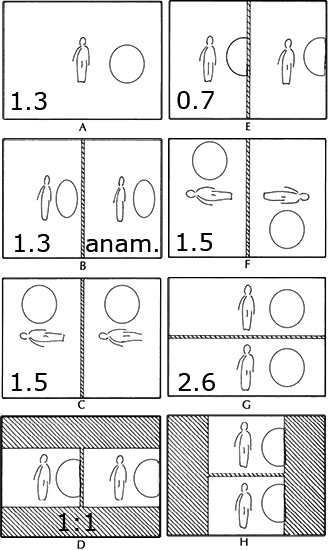
It's a good thing the new modern technology rids of all these different systems and standarizes in 1.85 and 2.39 ratios.
Oh, wait. Sony 3D skips 40 lines of pixels on their over/under system for the horizontal division frame line and projects a non-DCI compliant 1998x1040 (instead of 1080) flat image.
Scratch that.
Posted by Louis Bornwasser (Member # 3063) on 01-23-2010, 08:34 AM:
Well,I'm certified as a Technicolor 3D installer and dealer. Louis
Posted by Don Furr (Member # 1469) on 01-23-2010, 09:07 AM:
What do those new lens look like Louis?
Posted by Scott Hicks (Member # 376) on 01-23-2010, 09:44 PM:
Well...they look like a Schneider, but in black anodized finish.
For anyone in the Northwest, we are presenting a T3D demo on Tuesday Jan 26. We'll be running the "dog and pony" reel that some of you saw at Show East. A Technicolor rep will be there to answer questions. Brian Francis is hosting us at his Cameo Theatre in Newberg, OR. Time is 1pm.
I just went out there today to pre-qualify the house. We will be utlizing a 15'x30' curved Silver T-screen and projecting with a Century C with Super Lume-X 2kw OSRAM lamp. With a new lamp running 80A and everything aligned I was able to acheive 70FL in the center and 50FL on the sides with a Kollmorgen prime lens and ISCO 2X anamorphic!! The good old reliable C and rebuilt movement (LaVezzi kit) yielded vertical stability of less than 1/10 of a square of jitter. I'll bring along a rebuilt Century SA, just in case we can't focus the lens in the small barrel C.
Anyone and everyone is welcome, but please call or email me your RSVP so I can arrange to have enough cookies, chips & dip on hand.
Scott Hicks 503-285-7015
Posted by Steve Guttag (Member # 268) on 01-23-2010, 11:07 PM:
And how curved was that screen?
Posted by Louis Bornwasser (Member # 3063) on 01-24-2010, 09:51 AM:
The usual Schneider quality--very good' two primary lens, individually focusable and convergeable. This is a level higher than I have seen before; NOT a mirror box.
Remember we are dealing with very short focal lengths here. Anything less than THE BEST will be horrible. Louis
Posted by Julio Roberto (Member # 4976) on 01-24-2010, 10:58 AM:
Technicolor will be running seminars in Europe soon as well to become certified installers.
I'm already asking for quotes on several silver screens and awaiting further news. Seems they already upping their order to 1200 units. I'm sure studios won't ignore such a number of screens able to generate extra income from 3D surcharges. Otherwise, a 2D print will have to be served anyway. A lot of people not moving to digital until it is 4K, full DCI, able to do at least 7fl in 3D, cheap, and can get some help from studios (VPF). Most/none of this, outside Sony, is happening yet, so there.
Hope Technicolor can really "push" distributors to print a small number of prints for the smaller countries and that they nail the delivery of glasses for them, which is very important for the success of the system.
Posted by Frank Angel (Member # 248) on 01-26-2010, 05:21 AM:
Knowing the studios loathing double inventorying, what with its added cost and then the logistics of getting the right print to the right theatre (which ones can play 3D and which ones nee 2d prints), it is very possible that they may just say, there will be no 2D enagements hence forth for any of our titles that we've shot for 3D release.
Since they are offering a much MUCH cheaper way for the exhibs to show 3D without forcing them to install digital 3D, I think they will be very reluctant to offer both 2D prints just to allow the REALLY cheap exhibitors to get away with not stepping up to the plate to install the fairly simple and relatively inexpensive Tech3D system.
And in that same vein, all it will take is for a big-shot director like Cameron to say, "I shot this film in 3D and that's the way I want it to be seen -- no 2D engagements." All it will take is one director to say that and get away with it and the egos will prevail and the rest of them will follow. Not to mention that by the end of 2010 there will be a plethora of 3D display platforms for the 3D home theatre....3D will be everywhere. LG has already announced that it has a 3D video projector ready to launch and a I saw quite a number of consumer video projectors all displayng the "3D Ready" tag on them (I have no idea what that means); all this indicates the industry is moving to 3D en mass. It wouldn't be unreasonable for a studio or a director to say, the ticket purchasing/BluRay purchasing public can see this release in 3D practically EVERYWHERE, why should we devalue the product by allowing it to be shown theatrically in 2D by a handful of cheap exhibitors, especially since we offer them a reasonable solution?
If the 3D on film system catches on big time, I think 2D only exhibitors will be hearing that all too familiar distriubtor's excuse, "Sorry, we don't have any prints available" a lot more frequently. Or why even need an excuse? It is not unreasonable to imagine that it will be common practice to have 3D in digital or on film or not at all.
Posted by Warren Dewey (Member # 3609) on 01-26-2010, 01:17 PM:
A dumb semi-rhetorical question: could a changeover house with platters and synchronized projectors be allotted 2 prints?
It would not seem difficult to make custom plates and use an appropriate set of lenses-- and any polarization system would work, theoretically. Result would be a nice bright image-- (how retro!)
Posted by Ben Sanderson (Member # 5225) on 01-26-2010, 03:10 PM:
After talking to technicolor they said that everybody except Disney was on board for this. And then after talking my booker, she said that only Dreamworks (Para) and WB is the only people on board. And that Disney, Fox and Sony have all stated they will not support this format. Was wondering if anybody here heard anything. I love coming here and checking out new info, you guys have help keep my little theater stay open, ha ha. Thanks
Posted by Julio Roberto (Member # 4976) on 01-26-2010, 03:12 PM:
All I heard is that most of the big guys are on board, except Fox and Disney.
Their loss.
It would make sense for Sony not to be as well, since they sell the digital 4K stuff ...
Posted by Ben Sanderson (Member # 5225) on 01-26-2010, 06:01 PM:
With Disney, Sony and Fox not being on board that is a major blow to Film 3D. I mean it is a great deal, but Disney and Fox are the biggest studios right now in 3D with Disney really being number 1 with all the family films they have planned.
Yes it is cheaper than going digital, but in the long run is it worth it to be running a crappy 3D movie like say Halloween 3D, Piranha 3D, and Saw 3D, I mean yes there will be a few good ones, like Clash of the Titans, (Which the rumor is will be in 3D now with a pushed back date.) Harry Potter now being confirmed, and How to Train your Dragon. But, they are few and inbetween unlike the big boys ie, Disney and Fox.
For smaller cinemas like ours that 2000 pay back per film for the first six films will be hard if we get one and it flops. Now some of the bigger cinema it might work ok. Without some of the bigger studios being involved it is hard to go with it right now. Still like to hear from the rest of you guys to see what you think.
Posted by Mark J. Marshall (Member # 1409) on 01-26-2010, 06:26 PM:
Yeah but "Disney Film 3D" doesn't have a nice ring to it like "Disney Digital 3D".
Posted by Louis Bornwasser (Member # 3063) on 01-26-2010, 10:35 PM:
7 of 9 have "signed on." The others may or may not release on a picture-by-picture basis. The marketplace will decide.
18 family pictures this year in 3D and revenue drops for non-3D are ranging from 50-80%. This is a must-do for most competitive cinemas.
Not all will qualify from a technical perspective. Louis
Posted by Gordon McLeod (Member # 33) on 01-26-2010, 11:40 PM:
Why not just contact technicolor directly to get the scoop rather than alot of rumour
Posted by Julio Roberto (Member # 4976) on 01-27-2010, 02:47 AM:
Although I do see Tech3D a little out-of-reach for really small cinemas, I also think of the system as free. You don't pay anything if you don't show any 3D movies, either because you can't get prints or whatever.
IMO, there are two scenarios for a small/medium theatre. You either can't/won't do a $100k 2K digital 3D investment or you can/will.
If you can/want to go digital, then that's probably the way you should go.
If you can't, you can get the Tech3D for "nothing". You weren't going to show any 3D pictures anyway before, so with Tech3D what does it matter if you can only show 10 movies a year (i.e. Sony Fox and Disney refuse) or 25. Before, you could show none.
The only "requirement" is that, for at least the first 6 films a year, you must get a clean cut of the 3D surcharge for you of $1 per person and you must get each film to be watched by at least 2.000 people to pay-off Tech3D and break even. After that, it's a free lunch. If you think you can do that, then I suggest you jump to the Tech3D. Little to lose, some to gain.
If you think you can show say 8 3D films this year and that among them all you won't be able to raise $12.000 in 3D surcharges to pay off Tech3D, then don't do it.
The list of 3D films for this year I have is (the dates may be for Spain):
Alice in Wonderland (Disney, 5 Mar 2010)
How to train your dragon (Dreamworks/Paramount 26 Mar 2010)
Toy Story 3 3D (Disney, 29 Jul 2010)
Shrek Forever After (Dreamw/Paramount, 7 Jul 2010)
Despicable Me (Universal, 6 Aug 2010)
Rapunzel Unbraided (Disney, 16 Nov 2010)
Megamind (DreamWorks/Paramount) (5 Nov 2010)
Beauty and the Beast 3D (Disney, 12 Feb 2010)
Tron Legacy 3D (Disney, 17 Dec 2010)
The Hole (2010)
Step Up 3-D (Disney, 6 Aug 2010)
Cats & Dogs: The Revenge of Kitty Galore (Warner,4 Aug 2010)
Friday 13th part II (New Line, Warner, 13 Ago 2010)
Piranha (Entertainment) (16 Apr 2010)
Resident Evil: Afterlife (Sony, 27 Aug 2010)
Guardians of Ga’Hoole (Warner, 24 Sep 2010)
Alpha And Omega (LFG, 10 Oct 2010)
Yogi Bear (Warner, 17 Dec 2010)
Posted by Dick Prather (Member # 1136) on 01-27-2010, 06:23 PM:
Attended a Technicolor 3D demo yesterday. Sponsered by Technicolor and American Cinema Equipment. Looked very good with no problems. First 3D film scheduled for March 2010.
Requires silver screen and uses the same type glasses as Real D. Special lens made by Schneider. Over / Under process.
12+ year old 30 foot silver screen using a 2K Super Lumix and a Century SA projector. It had plenty of light. Most film companys on line now with the rest expected to follow.
Dick
Posted by Scott Hicks (Member # 376) on 01-27-2010, 06:51 PM:
Cameo screen curve is 1:20. Straight poop available at:
http://www.technicolor3d.com
email me for a copy of the theatre contract/application.
Posted by Jack Ondracek (Member # 1466) on 01-27-2010, 08:16 PM:
My daughter and I were there, too. Scott, Brian (the owner) and Technicolor put on an excellent presentation.
My perception of the demo was that it's easily equal to what we're getting from digital... maybe better, given that the light levels were higher.
Posted by Scott Norwood (Member # 30) on 01-27-2010, 09:23 PM:
This could have been a cheap and easy system that would have made sense in a wide variety of venues, including small towns and mom-and-pop theatres.
Unfortunately, the pricing structure that has been mentioned in this thread pretty much limits it to mid-size multiplexes. I can't see how it would be a winner in a small town single-screen house.
Posted by Frank Angel (Member # 248) on 01-28-2010, 03:50 AM:
$12,000 before you get to run 3D "free" of the Technicolor surcharge? Eat me.
Basically this is an Over/Under process, yes? So what I can't figure out is, why does the studio's print inventory handler get a cut out to the tune of $2000 an engagement? Technecolor didn't get to impose a fee when they started to strike Dolby stereo prints for the studios or when DTS or Dolby SRD tracks were added. And certainly the Over/Under process doesn't belong to Technicolor -- it's been around since the 80s, both with mirror as well as lens type convergence attachments. So how come Technicolor gets to demand a big chunk of money per title/engagement for a lens that if you listen to them tell it, is way better than any lens of all times, but you know what, plenty of us have our own O/U capable adaptors. Let us decide it their lens is all that of an improvement. IF I think it is an improvement, then let me BUY one; I can buy the best Schneider or ISCO lens for what they are charging for about three movie bookings worth of their fees. But they want me to shell out $12,000 for a what will basically be a lens rental; the lens still belongs to Technicolor? (that's not clear in their documentation.
My question is, why is what is essentially the film lab getting a piece of the action? Why can't the studio just release O/U prints the same way they did in the 80's the lab didn't get a cut back then, did they? And if the Technicolor R&D guys came up with a better lens and have had it manufactured by Schneider, then the studio should just do the O/U printing and let the exhibitor buy or rent the lens from whatever source -- Schneider or ISCO or Technicolor, but they should be two separate deals, not linked to a threat of "You don't get the picture if you don't rent my stuff." The exhibitor shouldn't be locked into Technicolor's lens where there are other contraptions that can do O/U just fine.
By this line of reasoning, next Technicolor will be looking to get a piece of the action on prints that carry DTS code and Dolby and SDDS prints too. $12,000 to run 6 titles on top of the film rental. That's out outrageous. Again, I don't see why Technicolor has to put their fat grubby fingers in this pie at all. The studios can hire whatever lab they want to do the O/U optical printing -- it's not brain surgery, and it's not proprietary at all, just like the silver screen isn't proprietary. Why are we being held hostage by Technicolor for THAT 3D related technology as well? I am surprised they don't insist that I have to rent the a Technicolor screen from them as well and pay them 1/3rd what it would cost me to buy it, every time I project a picture on it. Or is it mine to keep once I've shelled out $12,000?
Posted by Gordon McLeod (Member # 33) on 01-28-2010, 03:14 PM:
the technicolor is a system of intigrated print generation and it is not just the same over under, a lens system and polarizers to there spec and technical support
Of the cost structure it is reasonable the screen is still part of even a D cinema solution so that is not part of the equation
The system works and the background engineering at the lab end is definetly patentable
Posted by Tony Ratcliff (Member # 1196) on 01-28-2010, 04:55 PM:
My thoughts are along the same as Scott's.
If a small town theatre can draw 2000 people to a film title,
then that theatre is probably already busy/profitable enough to afford one of the digital options and charge the $3 upcharge.
The Technicolor pricing is still too high for the small town theatre to afford. And that assumes the theatre already has a silver screen and enough light output to meet the specs.
Posted by Cameron Glendinning (Member # 3516) on 01-28-2010, 07:50 PM:
What am I missing? If a small town theater can add a $3 upcharge why wouldnt they be able to afford to use the tech 3d system? It does seem way cheaper than digital.
Posted by Victor Liorentas (Member # 5272) on 01-28-2010, 11:16 PM:
I think many small town cinemas are in the downtown where big crowds are absent and it's likely a labour of love situation.
Posted by Scott Norwood (Member # 30) on 01-29-2010, 08:39 AM:
quote: Cameron Glendinning
What am I missing? If a small town theater can add a $3 upcharge why wouldnt they be able to afford to use the tech 3d system?
- many small-town theatres have lower prices than their urban counterparts; a $3 surcharge would be substantial and many patrons would likely resist paying it
- when all is said and done, the money is gone and theatre still does not own anything
- it is entirely possible that the theatre may be forced to install eventually, anyway; if (a big if) one believes that this will happen in the near future and that the technology is mature and unlikely to change before a possible forced conversion, it would probably make more sense just to install the hardware now and finance it over several years, after which the theatre would actually own something
The 35mm system being discussed here would only be a winner if one can be fairly certain that 3D is a temporary fad, believes that is many years away from being a mature product, already meets the required specs, and already does enough business to justify the rental/license cost.
I'm still curious to know if the license fee doubles for 2-projector installations. That would rule out a huge number of potential customers right there.
Posted by Gordon McLeod (Member # 33) on 01-29-2010, 09:48 AM:
I beleive a 2 machine booth is negociated on a per theatre basis but since 2 lens are required then it would entail probably close to double the cost
Posted by Jack Ondracek (Member # 1466) on 01-29-2010, 11:49 AM:
2-projector booths didn't come up in the conversation.... and I didn't think about it. Good catch, Gordon.
OK... maybe some small-town theatres, already hanging on by a thread won't be able to do this... you can't fix everything. But I have a drive-in that's maybe in the upper 50%, performance wise. Even being seasonal, I could (and would) do this in a heartbeat, if I can find a workable answer to the screen issue.
Posted by Tony Ratcliff (Member # 1196) on 01-29-2010, 04:42 PM:
Good thought Jack.
The Tech 3-D would be a good solution for a drive-in, if it worked, since digital isn't quite ready for drive-ins yet.
If someone could find a way to do 3-D at a drive-in, that would be awesome.
Posted by Ian Parfrey (Member # 5122) on 01-29-2010, 04:54 PM:
Thats my thoughts too...but wouldn't the windscreen futz up the polarisation?
Posted by Jim Cassedy (Member # 4115) on 02-05-2010, 03:12 AM:
One of my auditoriums will be installing the new
Technicolor 3D system in March. They gave me
some sample glasses, which IMO look exactly
like the ones used for Disney Digital/Real D
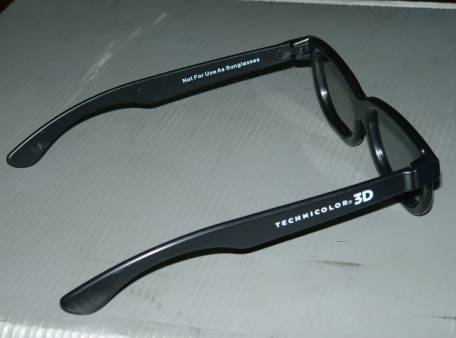
(and apparantly they are, technically, the same)
FUN FOTO:
While cleaning up backstage last year I found a
couple of NATURALVISION polarizers from the 1950's.
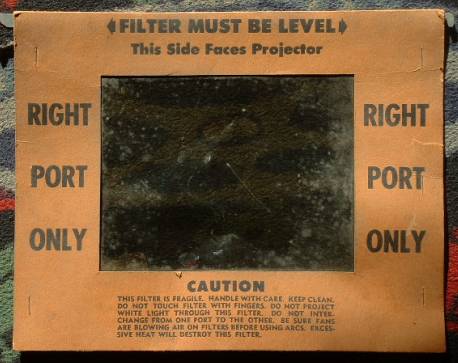
Posted by Steven J Hart (Member # 2340) on 02-05-2010, 07:33 AM:
This system will leave my theater out in the cold miserable 2D world just like Digital 3D. My biggest film ever was Titanic and we didn't have 2000 people attend over a two week run. The town we're located in only has 2500 residents. If they would sell me the lens, maybe I could make it work but there is no way we can afford $12,000 per year when we gross less than $100,000 on tickets and concessions in a typical year!
Posted by Adam Fraser (Member # 1074) on 02-06-2010, 08:20 AM:
I just checked out their website the other day, my feelings are similar to Steven's. I don't mind buying a lens even at $5000+. But a $12,000/yr licensing fee if I play 6 films in 3D in a year? Seems a little far fetched for any small town theatre owner.
I would rather pay the same amount per year over a 7 or 8+ year loan and get digital 3D. Which is probably what we will do in the next couple years. Why would anyone do this over just getting a $75,000-100,000 loan to get digital 3D, even the multiplexes?
The economics of this system just do not work for any small theatre.
Posted by Jim Cassedy (Member # 4115) on 02-06-2010, 09:09 AM:
One thing I haven't figured out or gotten an answer on yet
is how I'm supposed to run the screenvision ads & coming
attractions trailers once the system is installed.
I'm not sure Technicolor or the studios are going to go
to the extra expense of printing "3-D comptable" flat
trailers, or will they?
OR- - I assume the 3D over/under images have a slight
lateral displacement from each other. So I'm wondering
what happens if you just project a "standard" frame
through the lens. Will it just expand the top part
of the frame "up" and the bottom half "down" and
the image will wind up looking normal since there's
no lateral difference? I'm trying to get an answer
from my supplier on this.
Posted by Mike Blakesley (Member # 26) on 02-06-2010, 09:38 AM:
Steven and Adam: Look at it this way. You're going to be charging a 3 or 4 dollar premium on 3-D tickets. You could choose to play only the major blockbusters in 3-D. Marginal movies could still be played in 2-D (if you even choose to play them).
If you sold, say 1000 tickets and charged $4 extra for 3-D, and paid half of the premium to the film company as rental, you would still have $2000 left. The 3-D price would be a wash.
Still it seems dumb to flush $12,000 a year when we're probably all going to need to someday embrace digital anyway if we want to stay in business.
Posted by Scott Norwood (Member # 30) on 02-06-2010, 09:48 AM:
A $3-4 surcharge for 3D would be a tough sell in many communities. It could represent a 50%+ increase in the ticket price for some theatres.
Posted by Louis Bornwasser (Member # 3063) on 02-06-2010, 10:15 AM:
No. The "digital reality" is a myth. We will probably still be 40-60% film in 10 years even if the projectors were free.
Think not? See the complaining above about the $12,000 for Tech 3D, which, compared to digital, is a free gift. Louis
Posted by Adam Fraser (Member # 1074) on 02-06-2010, 04:16 PM:
I dont mind large upfront expenses. I just hate paying licensing fees, mortgages, rents, etc.
I just think they could have thought out a better strategy to charge for this system.
I would be perfectly happy paying a few thousand for the lens, a few thousand for the screen, and maybe a "3-D print" surcharge in the way of a 5 to 10% higher film rental.
As the pricing is now, it just seems more wise to get a loan for a digital 3-D setup and at least own something in the end, at a similar annual cost.
We will be waiting though until all of these competing systems flush themselves out. Could be 2 years, could be 10 years.
Posted by Louis Bornwasser (Member # 3063) on 02-06-2010, 04:24 PM:
The cost for the 3D is less with Tech. This does not include the acquisition cost, hardware/software upgrades, maintenance for the underlying digital projector; all of which are paid yearly.
Don't forget that Tech is less but does not suffer any quality losses. Louis
Posted by Mark Gulbrandsen (Member # 72) on 02-06-2010, 07:25 PM:
I have two customers that will be doing this. I have to go for training very soon at Technicolor...
Mark
Posted by Julio Roberto (Member # 4976) on 02-07-2010, 01:02 AM:
Digital also has a "per 3D film" cost one way or another. First, higher watt lamps/higher electricity. Then, per-person royalty with RealD/Sony or glasses cost with other systems (i.e. clean and replace Dolby/XpanD glasses, batteries or purchase Master image one's etc).
You need to factor the upfront "cost" of say $100k also carries a significant financing (interests) yearly cost. You either lose the money the bank will give you yearly if you left it invested or you'll have to pay a yearly interest if you borrow it. This is money you "dump" to the bank instead of to Technicolor any way. Perhaps get a modest profit. But if you couldn't show any 3D film before and you cover your cost, what's to lose? The 12K you are "giving" Technicolor you wouldn't have been able to raise w/o the 3D surcharge to begin with ...
It's true that worst-case scenario with Tech3D is not very good for the small theaters they are trying to serve. Worst case scenario is when you can only show 6 3D shows a year and you can't get around 2000 people on each show. I wouldn't do it unless I KNEW I could get some 8 films a year or so and get the clean $12000 out of surcharges. Then, it just becomes a way to slightly increase the audience to get them to buy more popcorn and keep the competition at bay.
Also, you agree to this pricing scheme for 3 years. Who says that in your 4th year perhaps you could get a better deal from Tech 3D or move to digital then. 3 years from now, the digital equipment may be cheaper (better be) or better quality (4K) which will allow you to give your audiences a better experience over 35mm instead of the same-or-worse from a 2K investment.
I do think the Tech3D scheme is not the best there is and certainly a bit high. If I were them, I would've cap at $10k a year and allow other pricing schemes.
Posted by Mark Gulbrandsen (Member # 72) on 02-07-2010, 04:50 AM:
Reports from people that have seen it say it's actually much better than digital 3-D because it's considerably brighter and of course with film the colors will not wash out.
Mark
Posted by Adam Fraser (Member # 1074) on 02-07-2010, 09:31 AM:
Thanks for the different points of view guys. I guess I will see how it rolls out with other theatres and go from there.
Posted by Louis Bornwasser (Member # 3063) on 02-07-2010, 09:37 AM:
The hard sell is that there are so many 3d pix this year that there should be no problem exceeding 6. There is a great deal of overlap.
I have had the training and think that once a theatre has one system installed, that there will be some that will want a second or third screen. Time will tell. Unlike Digital, there is no rush for this. A good idea will always be a good idea. Louis
Posted by Jack Ondracek (Member # 1466) on 02-07-2010, 11:08 AM:
quote: Julio Roberto
I do think the Tech3D scheme is not the best there is and certainly a bit high. If I were them, I would've cap at $10k a year and allow other pricing schemes.
Some good points in your post, Julio. However, as seems always the case, Any price (but free) will meet with resistance from someone, for any numbers of reasons.
There's a member of another chat list I'm on who might never be happy with this system, merely because it's Technicolor and they might possibly make a buck from it.
Posted by Matt Gress (Member # 5377) on 02-08-2010, 12:53 PM:
It's interesting, we were just thinking about getting rid of our silver screen because interest in 3D was so far down. We used to do an annual NaturalVision week. Last year it was kinda poorly attended - it's always the same prints: "Dial M", House of Wax", "Kiss Me Kate", can't remember the rest. It looks awesome, by the way!!! Much more work and requires an intermission but wow. We have done StereoVision here as well afew times too, but that always looks like shit. Anaglyph, too but obviously that looks really bad and gives you a headache.
Maybe we ought to hang on to our silver screen for a bit and see what happens next. Ot looks bad for 2D films though. A big hot spot follows you wherever you want to sit. Clever filmmakers sometimes tell me my lamps aren't focused right. Gotta love that.
Posted by Jonathan Smith (Member # 5609) on 02-09-2010, 10:10 PM:
You can put 4K straight onto print film. No $250,000 projector required.
How about the LABS invest in a straight-to-print film printer?
35mm film is still unmatched in things like colorspace and black-to-white ratio.
I think Tech 3D is a good deal, even for a small run theatre. Some smaller theatres need to all band together and play hard-ball with Technicolor.
Posted by Carsten Kurz (Member # 5396) on 02-11-2010, 05:42 PM:
The fastest digital printers need about 6 days to create a 2hr master (3s-5s/frame). Now try to create a couple of hundred release prints...
Technicolor will have a public viewing of their 3D system at the Berlinale today.
It seems that germany/europe will see a different price model - purchase of the lens for about 20.000-23.000 Euro (ex/plus silverscreen), no running fees.
- Carsten
Posted by Julio Roberto (Member # 4976) on 02-11-2010, 06:43 PM:
€23k ($31.500+tax, usually around 17%) is a bit too much now that Digital has become a bit more competitive with the new series 2 projectors. And still need to factor in the silver screen.
€20k may be ok for some of the larger theaters than don't intend to convert for at least 3 years. And there are plenty of those.
They should offer a leasing option where you rent it for say €7k/year for 3 years and then you own it at the end.
I'm more worried about print availability and glasses distribution over here, though, but I'm totally in for it.
Distributors have proven that they have no intention to offer serious VPF for independents, so heck with it. They had plenty of time and only Paramount has done something about it and then only in some countries.
DCI manufacturers have proven, IMHO, that they want the same model of business done in the consumer industry of "phasing out model-after-model-and-force-upgrades" instead of offering a "single", solid, total-top-quality product for a low price. It takes more money to tool a factory and pay the engineering to produce 6 different projector models at 6 different prices than just make a single (or perhaps 2) excellent 4K projector and be done with it. Support it for the next 15 years.
And what's up with cinema servers not integrating better stuff like audio EQ or even more powerful automation modules? They are just selling a regular computer with a JPEG decompression board w/SDI outputs for $$$ more.
Oh well. Long life film.
Posted by Mike Blakesley (Member # 26) on 02-11-2010, 11:13 PM:
quote: Jonathan Smith
Some smaller theatres need to all band together and play hard-ball with Technicolor.
HAHAHAHAHA! That's a good one. What are we supposed to do, tell them to lower their price or we won't buy their damn equipment? They would laugh in our collective face and probably jack the price up a little out of spite.
I learned a long time ago that "smaller theatres" have zero bargaining power, because we have nothing to bargain with. At a convention once, a guy from 20th Century Fox flat-out told me, "We don't need any of you people [at this convention]. It would be barely a blip on our radar if you all went out of business tomorrow."
Being treated like the dirt on the soles of the studio's shoes is old hat for a small exhibitor.
Posted by Louis Bornwasser (Member # 3063) on 02-12-2010, 08:26 AM:
Mike: Yes, but. . . . .the large theatres pay back the "nut" to make films. The litle guys pay less money, but a higher percentage, also anything they send in goes straight to profit, since the "nut" is usually fully paid by then.
btw: the Tech3D: you are NOT paying for lens rental, you are paying for a SYSTEM of quality assurance, print availability, sytem administration and the fact that they fronted the money for the design and the lenses. During the dealer and technician certification instruction, it became obvious that the main goal was to assure that the theatre and the equipment was as good as possible. Time was spent on getting the most from the existing system on scope. The minimum standards are very high on light output, jump, weave and focus. All phases of quality control is "closed loop" which means that problems will be resolved.
Every booth op will be able to properly frame and focus a 35pa loop. I know you guys do this routinely, but this is an instruction and professionalization program for the masses. Louis
Posted by Victor Liorentas (Member # 5272) on 02-12-2010, 09:55 AM:
Sounds like this could help improve overall projection skills among the generally untrained staff!
What a concept!
Posted by Mike Blakesley (Member # 26) on 02-12-2010, 11:34 AM:
quote: Louis Bornwasser
Mike: Yes, but. . . . .the large theatres pay back the "nut" to make films. The litle guys pay less money, but a higher percentage, also anything they send in goes straight to profit, since the "nut" is usually fully paid by then.
Louis - your last sentence makes my point. We pay a higher percentage on new movies because we don't have the screen space to play a film in those lower-percentage later weeks. We jump through all the same "hoops" that our big city counterparts do, but we have to do it without promotional help, sometimes can't get trailers or onesheets (and have to pay for some that we do get), no co-op advertising, prints aren't available for weeks, restrictive long playtimes on new films, can't "share" a screen with an unrelated title even when it would make consummate sense to do so, etc., and now we find that there will be absolutely zero help for smaller places to convert to digital (even though the studios are saving money on us too).
Sorry for the thread drift, I'm just very heavily troubled by all of this.
Posted by Carsten Kurz (Member # 5396) on 02-13-2010, 08:34 AM:
'btw: the Tech3D: you are NOT paying for lens rental, you are paying for a SYSTEM of quality assurance, print availability, sytem administration and the fact that they fronted the money for the design and the lenses. During the dealer and technician certification instruction, it became obvious that the main goal was to assure that the theatre and the equipment was as good as possible. Time was spent on getting the most from the existing system on scope. The minimum standards are very high on light output, jump, weave and focus. All phases of quality control is "closed loop" which means that problems will be resolved.'
Well, following first reports, the Berlin Technicolor demo wasn't even near that goal. Scratched print, wrong lens focal length, standard lamp in projector (dark 3D images). If they can not get this right on a 'Berlinale Demo' - then how will 'the system' perform in the wild?
Interest in the demo wasn't very high - although open and free, yet just about a third of the seats were occupied, at least in one of the two sessions.
In germany/europe(?) you will have to buy their 3D lens for about 24.000 Euro (+ silver screen). Then no further cost.
- Carsten
Posted by Scott Norwood (Member # 30) on 02-13-2010, 08:57 AM:
quote: Carsten Kurz was the last to post
During the dealer and technician certification instruction, it became obvious that the main goal was to assure that the theatre and the equipment was as good as possible. Time was spent on getting the most from the existing system on scope. The minimum standards are very high on light output, jump, weave and focus.
Why are these standards only being applied to 3D? Shouldn't they be applied to all bookings?
Posted by Louis Bornwasser (Member # 3063) on 02-13-2010, 08:58 AM:
Yes, outright sale has its problems (as described above). In the USA, Technicolor retains more control. Louis
Posted by Carsten Kurz (Member # 5396) on 02-16-2010, 07:51 AM:
Actually two guys from Technicolor USA were giving the demo.
They also said that the T3D system was good for a maximum screen width of 12metres.
- Carsten
Powered by Infopop Corporation
UBB.classicTM
6.3.1.2