This is topic Changeover on Inglourious Basterds in forum Film Handlers' Forum at Film-Tech Forum ARCHIVE.
To visit this topic, use this URL:
https://ft-forum.com/ft/cgi-bin/ubb/ultimatebb.cgi?ubb=get_topic;f=1;t=010079
Posted by Paer Hoegberg (Member # 3133) on 09-15-2009, 11:46 PM:
Right before the end of a real (before changeover) there is a signal from a bell.
Can anyone explain how this works?
/Pär
Posted by Joe Redifer (Member # 3) on 09-16-2009, 12:26 AM:
I believe it has something to do with the weight of the reel feeding out. When it gets low, it rings to wake the projectionist up from his nap so that he doesn't miss the changeover.
Posted by Jack Theakston (Member # 4484) on 09-16-2009, 02:02 AM:
It's a lazy, noisy piece of technology as far as I'm concerned. It's a distraction to the audience, who can almost always hear it-- and if it's one of those particularly noisy ones, boy do they hear it over and over and over again.
If you've done changeovers for any length of time, you start to "know" how long 15-20 minutes has been (just like you "know" how long to hold an exposure when printing up photos). You don't need no stinkin' bell.
Posted by Monte L Fullmer (Member # 2797) on 09-16-2009, 02:13 AM:
Old Motiograph upper magazines had, what was called, a "drop ding."
There was an arm that was inside the magazine with a roller on the end of it which rode on the outer surface of the film while the reel was rotating. On the other end of the arm's shaft was another shaft with a small hammer attached and a small bell was mounted on the magazine.
When the film on the reel reached a certain diameter (which was maybe a minute worth of film on the reel) the arm would drop and the other arm's hammer would ding the bell - to let the operator know of a changeover was approaching.
Prob in the case of "IB" (which was rather incorrect for that time frame of 1944 due to the exposed reel concept in the movie and using nitrate film..That Ernemann VIIb would have had enclosed upper and lower magazines and could have had the same "drop ding" as with the Motiograph projectors..) there was a flywheel on the end of the upper reel shaft that had some sort of centrifical forced device when the shaft's hit a certan RPM, it would swing out and hit a bell to do the same reel change announcement...but a wild guess here..
Posted by Hillary Charles (Member # 769) on 09-16-2009, 05:38 AM:
In my old booth the bells on the upper magazines of the Simplex E-7s attached to cams on each feed spindle. When the feed reel was turning slowly, the "bounce" from the cam wasn't enough for the clapper to ring the bell, but as the reel neared the end and began to turn faster, it created just enough force and the bell rang. And it would ring faster and faster until the reel change.
That was our version anyway. A bit different than the system in IB.
Posted by Bernard Tonks (Member # 809) on 09-16-2009, 05:44 AM:
Interesting Reel End Alarm.
Posted by Scott Norwood (Member # 30) on 09-16-2009, 05:54 AM:
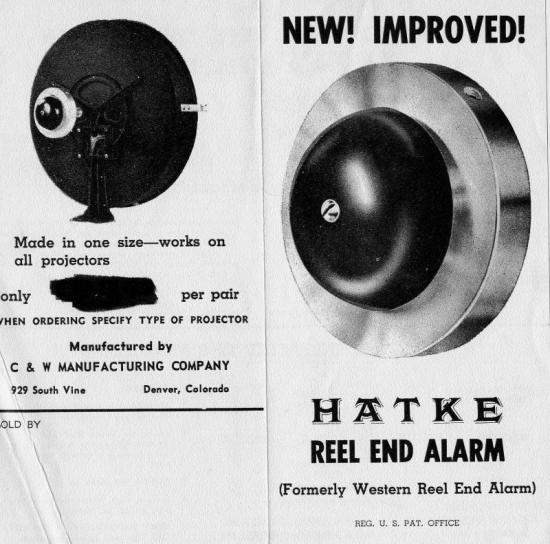
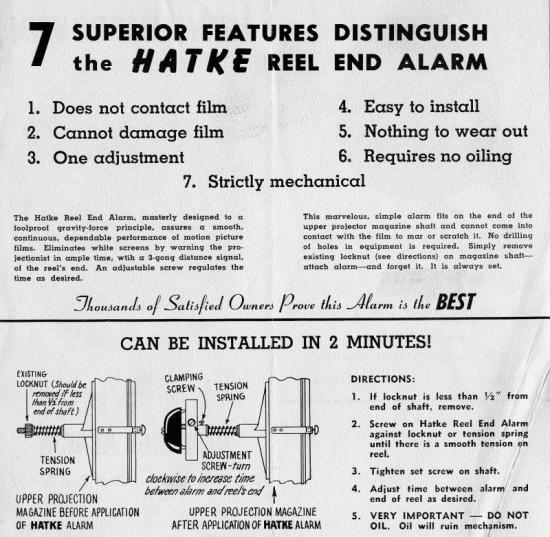
This one is based upon the rotational speed of the feed reel:
Posted by Tim Reed (Member # 137) on 09-16-2009, 07:53 AM:
The Hatke alarms were LOUD! "DING! DING! DING!" They always rang three times. That is, unless they were old, and the little rubber labyrinth the ball bearing lived in got dry and shrank... then you never knew if it would work or not. If it did, then the ball might keep ringing until the reel ended!
My favorites were the ones with the pendulum weight on the outside of the assembly (don't remember the manufacturer). As the shaft speed increased, the pendulum would swing back and forth enough to start gently hitting the inside of the bell housing. They rang for about 30 seconds, and were just loud enough to be heard in the booth.
Monte, Motiograph didn't make those. Reel end alarms were aftermarket.
Posted by Martin McCaffery (Member # 37) on 09-16-2009, 08:45 AM:
I remember a reel alarm in an old theatre in downtown LA. It was a footage counter. The projectionist had to set the footage for each reel every time he loaded the reel. Obviously, when the film came in and was inspected, the footage was measured and marked on the head of each reel. A little complicated, but it worked.
Posted by Mark Gulbrandsen (Member # 72) on 09-16-2009, 08:55 AM:
Where I grew up as a kid all the theaters had them... seems like all Union projectionists had to rely on them as they were busy doing other things in the booth instead of the work they were contracted to do... I know other cities were not so bad...
Mark
Posted by Paul Gordon (Member # 3320) on 09-16-2009, 09:11 AM:
For 2000ft change over booths the bells are pretty important... You can get caught up making up or breaking down films, fixing stuff in the booth, reading etc... all you have to do is as soon as the bell starts is to dampen it with a metal clip, so that it stops ringing after you know the change over is soon.
Posted by Steve Guttag (Member # 268) on 09-16-2009, 09:27 AM:
If I could, I'd ban changeover alarms in all theatres, including 2K reel booths...PAY ATTENTION!
Posted by Jack Ondracek (Member # 1466) on 09-16-2009, 09:34 AM:
Interesting, the negative comments about these alarms. Up until reel-to-reel disappeared, for the most part, I never heard much talk about them. They were simply a way of life back then. Certainly, nobody in the Seattle local made a point to make an issue about them.
The end alarms that relied on the arm touching the film, I thought, were kind of interesting. I didn't care for the constant contact with the film, but I never saw any damage that could be attributed to them. The little wheel at the end of the arm seemed to do the job well enough.
Those arms also forced you to move your film to house reels, if you expected the arms to be accurate. Shipping reels had a smaller hub diameter, drastically extending the alarm time.
Other than the arms (there were very few in our area), there didn't seem to be much preference over which type to use. We had plenty of pendulums, the Hatke that Scott posted about, and a verson that had a flat plate on the spindle end. The alarm mounted above the plate and had a small wheel that rode against it. I saw the name a million times, but don't remember what it was.
Posted by Richard P. May (Member # 3598) on 09-16-2009, 09:56 AM:
In my early days of projecting the "drop-down" alarms were pretty common. Also common were prints run with these where the little roller was stuck or came off, and the arm scratched the full reel in a nice wobbly pattern.
Jack's instinct of how long a reel runs is logical, but I've been caught missing a changeover when a print had a short reel somewhere in the middle.
Unless one constantly keeps an eye on the feed reel, the bells are very useful.
DM
Posted by Joe Redifer (Member # 3) on 09-16-2009, 10:14 AM:
Thank you, Steve! I agree completely.
quote: Paul Gordon
For 2000ft change over booths the bells are pretty important... You can get caught up making up or breaking down films
I don't think you'd be too busy making up or breaking down films in a 2K changeover booth.
Posted by Paul Gordon (Member # 3320) on 09-16-2009, 10:18 AM:
We do 12,000 ft tower reels, 6000ft reels, trailer packs, make DTS trailer discs etc... plus our makeup room is not with the projectors. Jesus whats with all the negative bell talk...almost every booth had them before platters.
Posted by Scott Norwood (Member # 30) on 09-16-2009, 10:25 AM:
I don't particularly like the bells, either, especially when they can be heard in the auditorium (which is most of the time). I can't think of any newer (last decade or so) installations that I have seen that have them.
Posted by Joe Redifer (Member # 3) on 09-16-2009, 10:30 AM:
I think it would be better if the "bell" was just a sensor, and instead of ringing a bell it sent out a remote command to a taser that is strapped on to the projectionist's ass. If the projectionist is within 6 feet of the projector, nothing happens. If he is not, well, you get the picture.
Of course that is way too technically complex for those old booths.
Posted by Martin McCaffery (Member # 37) on 09-16-2009, 10:32 AM:
quote: Joe Redifer
I don't think you'd be too busy making up or breaking down films in a 2K changeover booth.
Not most days, but I certainly recall times when it was pressing. Rep houses were particularly busy with films coming and going on a semi daily basis and often in pretty bad shape during inspection. AFI could get pretty crowded on weekends back when it was still in the Kennedy Center. Theoretically, the contract gave us time to build up and break down, but it didn't always work that way.
I agree that the sound of the bell is a distraction in the auditorium, but for me it brings up an almost Pavlovian nostalgia response ![[Wink]](wink.gif)
Posted by Paul Gordon (Member # 3320) on 09-16-2009, 10:39 AM:
I'm not saying I'm a fan of an annoying bell but it can be silenced after a couple rings. The booth I worked at changed films every day, and we did a lot of double and triple bills all on 2000ft reels so it was kinda handy.
Posted by Tim Reed (Member # 137) on 09-16-2009, 11:01 AM:
quote: Steve Guttag
I'd ban changeover alarms in all theatres, including 2K reel booths.
With so many c/o's in 2k reel booths, it was just too risky not to have them. Too many other things going on. In drive-ins, where I spent most of my years as a projectionist, our free between-reel time was spent repairing in-car speakers. quote: Jack Ondracek
The alarm mounted above the plate and had a small wheel that rode against it. I saw the name a million times, but don't remember what it was.
"Can't Scratch".. follow Bernard's link above, to go back in time. ![[Smile]](smile.gif)
quote: Joe Redifer
I don't think you'd be too busy making up or breaking down films in a 2K changeover booth.
Sure you could. I changed 3 features a week in single screen drive-ins. Plus, just a few years before I started working in booths, most theatres changed the bill two and three times a week - and plenty of double-features. There were always prints coming and going. Plus, to inspect prints, remember they had to be hand-cranked on the bench. Didn't see many new prints - they were always several years old. Repairs were made with scissors (to smooth over side tears) or cut out damage entirely and splice it back with a chemical splicer - which took several minutes, by the time you cut and scraped the film, and let the cement set. There were no tape splicers.
A 20-minute-reel carbon-arc booth was a busy place.
Posted by Gordon McLeod (Member # 33) on 09-16-2009, 11:17 AM:
The pendulum type was the Jackson reel end alarm made by a BC projectionist named Jackson
Posted by Steve Guttag (Member # 268) on 09-16-2009, 11:40 AM:
quote: Joe Redifer
I don't think you'd be too busy making up or breaking down films in a 2K changeover booth.
Actually, they can be some of the most intense booths with very many single-show movies...however that being said, you are lazy or incompetent if you can't pay attention to the show at hand and not use the stupid alarm.
Steve
Posted by Monte L Fullmer (Member # 2797) on 09-16-2009, 12:40 PM:
quote: Steve Guttag
they can be some of the most intense booths with very many single-show movies
Aint that the blessed truth -I'd go back to a 2k reel carbon arc changeover booth any day of the week instead of playing with platters since you had to always keep your eye on the lamphouse to keep your carbon trims on the focus lines - even if you got your motor feed speed settings right on along with other booth chores that actually made the shift go quick.
Had two booths with "drop dings" and the others, including my last carbon arc booth before my transition to xenon contained Hatke end reel alarms.
quote: Tim Reed
The Hatke alarms were LOUD! "DING! DING! DING!" They always rang three times
Since all of my booths were the open port variety, I would take strips of duct tape and tape across the outside of the bell to the aluminum frame and lay down small spots of the same tape where the ball would strike the inside of the bell. This definitely muted the "DING" down when the ball hit the bell to a very quiet "tink, tink, tink" .. and was barely heard in the auditorium.
-Monte
Posted by Stephen Furley (Member # 1277) on 09-16-2009, 05:29 PM:
How common were these things? I've seen pictures of them before, but I've never seen them actually installed in any cinema that I've visited. Obviously, that would be only a tiny fraction of those that existed, but were they quite rare, or was it just by chance that I never saw any?
Posted by Joe Redifer (Member # 3) on 09-16-2009, 06:10 PM:
quote: Steve Guttag
Actually, they can be some of the most intense booths with very many single-show movies.
OK, I can definitely understand that. But perhaps he should have said "inspecting" instead of "building up and breaking down" which implies that there is a platter in the 2K changeover booth (which there very well could be) and multiple reels are being spliced together.
Though I guess assembling/removing trailers and whatnot could be construed as building and breaking. So I concede.
Posted by Bernard Tonks (Member # 809) on 09-16-2009, 06:29 PM:
quote: Stephen Furley
How common were these things? I've seen pictures of them before, but I've never seen them actually installed in any cinema that I've visited. Obviously, that would be only a tiny fraction of those that existed, but were they quite rare, or was it just by chance that I never saw any?
End of reel alarms were around but mostly in some Gaumont British Cinemas, Independent and small circuit cinemas. Gaumont Kalee made a small neat top spool box device. Last time I heard one was as a paying customer at the late Gaumont (Royalty) Richmond, the dong was faintly audible in the circle seating area.
Never did see any of these alarms in any ABC or Odeon cinemas. However in later years Odeon did replace many BTH Supa projectors with Gaumont Kalee equipment removed mostly from closed Gaumont cinemas.
Posted by Jim Cassedy (Member # 4115) on 09-16-2009, 07:24 PM:
Most of the changeover booths I worked in had the Hatke
alarms. Yes, they were loud, and could be heard in the
back row of the balcony. I usually toned them down by
either putting a thick rubber band around the bell
casting or jamming a paper or styrofoam cup over the
bell. Both muffled the sound to where the 3 "clacks"
could be heard in the booth, but not outside the ports.
Posted by Bob Koch (Member # 1062) on 09-16-2009, 08:00 PM:
MonteS "drop ding" was indeed after market and was made by an operator in Louisville by the name of R Hullet. Had a small diameter roller that sure ruined a lot of prints.
Posted by Martin McCaffery (Member # 37) on 09-16-2009, 08:46 PM:
My favorite reel alarm I hope never existed.
There was an episode of Columbo in which solving the murder came after they figured out the projectionist (in a studio screening room no less) put a nickel in the reel which would drop to let him know it was at the end.
I sure hope no one in the studio they shot Columbo in ever did that.
Posted by Joe Elliott (Member # 4006) on 09-16-2009, 10:31 PM:
Great system, the crunch, crunch, crunch of the projector lets you know it's time to changeover. Both your film, and the gears.
Yeah, I saw that episode too, and cringed at the idea. I was thinking, that nickle is going to stick and end up in the projector.
Posted by Joe Redifer (Member # 3) on 09-16-2009, 10:40 PM:
I must see this episode!
Posted by Randy Stankey (Member # 64) on 09-16-2009, 11:33 PM:
I saw that episode years ago when I was a kid. I thought that was something they really did. A lot like "cigerette burns" that kids think are real, these days.
I used to love to watch Columbo. I'd spend the first 10 minutes of the episode figuring out whodunnit. Then I'd spend the rest of the episode trying to figure out which one of Peter Falk's eyes was the glass one.
![[Big Grin]](biggrin.gif)
Posted by Mike Blakesley (Member # 26) on 09-17-2009, 12:37 AM:
We had the Hatke bells back in our changeover days. I can still remember the sound. Yes, they could be heard in the balcony but not in the main floor. I didn't even hear them when I was working the booth -- we had to watch the carbons anyway, so it was an easy matter to watch the reel as well. We had a stool next to each projector, so once the threading and other work was done, we would just sit by the machine. I'd keep a paperback book handy, and had trained myself to look at the carbons, the picture and the upper reel after each paragraph of the book I was reading.
Posted by Stephen Furley (Member # 1277) on 09-17-2009, 01:35 AM:
quote: Bernard Tonks
Never did see any of these alarms in any ABC or Odeon cinemas.
That might explain why I never saw any; most of the places I visited would have been either Odeon or ABC.
Posted by Damien Taylor (Member # 4255) on 09-17-2009, 02:07 AM:
Where can I get some of the Hatkes? I want to make my machine as annoying for my family as possible.
Posted by John Wilson (Member # 269) on 09-17-2009, 03:32 AM:
Nowadays (sorry for stealing your phrasing, Monte) you could simply add a light beam connection to a computer and have any alarm you want...it could play the Psycho theme (reeeent rreeeeent reeeent) or a cute puppy barking.
Actually, I think the reeeeent rreeeeeent reeeent would be kind of neat.
I must do that.
Posted by Monte L Fullmer (Member # 2797) on 09-17-2009, 04:26 AM:
Posted by Rick Raskin (Member # 1561) on 09-17-2009, 08:21 AM:
I occasionally ran prints where a previous theater had placed three or four splices very close together just before the SM cue. I guess the clack-clack-clack would alert the visually challenged operator of the passing cue. ![[Cool]](cool.gif)
Most of the houses had Hatke alarms which were often muted with masking tape inside the bell. Other versions I encountered were the drop arm which would hit the side of the feed magazine and a centrifugal type rocker attached to the back side of the feed magazine. That type would continuously rock back and forth until enough momentum would cause a bell to ring.
When I worked in military theaters there were no reel end alarms. One had to pay attention but with experience you would develop a sense of timing for when a reel was about to run down.
True the comment about having to watch the carbons keeping you aware of timing. ![[thumbsup]](graemlins/thumbsup.gif)
I also remember the Colombo episode but I believe there was a timer attached to the back side of the lamphouse. I don't recall the coin trick but I have heard some operators did that.
I used the term 'operators' and not 'projectionists' for a reason obvious to us old timers.
Posted by Robert Throop (Member # 61) on 09-17-2009, 10:51 AM:
quote: Martin McCaffery
I remember a reel alarm in an old theatre in downtown LA. It was a footage counter.
That was the Cue-Meter. The projectionist measured the footage and set a dial on the meter. There was a one minute warning as well as motor start and co cues. The one I saw used a flashing light rather than an audible cue. The Cinerama Dome in LA had these on Norelcos with 6k reels.
A projectionist I worked with built an alarm that consisted of a light on the magazine door and a solar cell on the back window. This operated a relay which switched on a light.
Bob
Posted by Bill Enos (Member # 440) on 09-17-2009, 11:28 AM:
I use the Hatke alarms and mute them sometimes, but these days most sound tracks are so loud it's hard to hear the alarm in the booth, in any case the ding of an unmuted alarm or the dink of a muted one is better than a missed changeover. A dust ball in the labyrinth will cause them to fail so once a year I use a straw and blow them out.
Ran carbon arcs for 15 years, don't ever want to see one again.
Ran 2k reels exclusively for 5 years, don't want them on a continuous basis again either, though we do use them for special events, etc.
Posted by Randy Stankey (Member # 64) on 09-17-2009, 05:28 PM:
You know, given the technology we have, nowadays, we could pair that up with some standard things that have been used in film for years like foil cues, footage counters, rotary encoders and all those fun things.
Why couldn't a cue detector on the projector be connected to a computer in the projection booth? Instead of ringing a bell, the computer would send a text message to your cell phone!
Now THAT would be cool!
(Of course, your phone would be set for "vibrate.")
Posted by John Wilson (Member # 269) on 09-17-2009, 05:33 PM:
The text message could say:
Your reel runs out in 60 seconds.
And then a sub-note from your phone service provider...(Please note: Text messages may be up to 60 seconds late)
![[Eek!]](eek.gif)
Posted by Rick Raskin (Member # 1561) on 09-17-2009, 07:06 PM:
quote:
Why couldn't a cue detector on the projector be connected to a computer in the projection booth? Instead of ringing a bell, the computer would send a text message to your cell phone!
Why go to all that trouble? I once worked a triple booth that used foil cues to automate changeovers.
Posted by Karl Borowski (Member # 5424) on 09-17-2009, 07:14 PM:
Why take something as beautifully low-tech as film and needlessly complicate it with SMS warnings?
Posted by Joe Redifer (Member # 3) on 09-17-2009, 07:31 PM:
If you are going to do that, why not just have it cue the next projector start? That way you don't even have to wake up (because all projectionists are lazy).
Posted by Randy Stankey (Member # 64) on 09-17-2009, 07:34 PM:
But you'd still have to change the reel.
The text message should read, "Go change the reel, you lazy bastard!"
Posted by John Wilson (Member # 269) on 09-17-2009, 07:49 PM:
quote:
I must see this episode!
It's called 'The Forgotten Lady'. Series 5 Episode 1.
Posted by Joe Redifer (Member # 3) on 09-17-2009, 08:15 PM:
Is this masterpiece of TV history available anywhere online?
Posted by Dennis Benjamin (Member # 1137) on 09-17-2009, 08:18 PM:
I remember that "Columbo" episode also. Didn't it involve subliminal messages on the films being played? Also, didn't the nickel play a major part in figuring out who the murderer was?
I think the projectionist was murdered in that epsiode.
Anyways.....
Posted by Phil Hill (Member # 371) on 09-17-2009, 08:32 PM:
The episode with the nickel is "Double Exposure".
The one with the digital footage counters is "Make Me a Perfect Murder".
Both are among my favorites...
Posted by Frank Angel (Member # 248) on 09-17-2009, 11:18 PM:
The concept of "subliminal messages" can be put into the same class as psychic readings. They are bull. If something is displayed so fast or so quietly as to not be detectable by one or other of the sense, in this case the eyes, then if the eyes are not seeing the image, they are not sending anything to the brain. If the image persists long enough for the eye to see it....then you've seen it and it's no long subliminal, so either way it's still dog turd sandwiches.
In a discussion about this, one guy at an SMPTE meeting no less was pontificating and insisted they were putting words in the film frames like DRINK COKE in a single frame and the audience wouldn't be able to see it, but it would make them buy coke. And this was from a projectionist to boot. I didn't even know where to begin explaining that he was out of his freaking mind and should seek immediate psychiatric help or at least get his hands on some really fly drugs. So I just asked if he could see a big blob of dust if it were on a single frame. No, says he, it goes by too fast. It took me quite a while to stop laughing and by the time I did, he had already move on.
As for psychics.....how come not one of them, not that mind reader guy who had his own show and would keep guessing names until he got one the person recognized and then said he was communication with that dead person only to have the audience member say, "but he's still alive".... or that fat sow with the gobs of hideous costume jewelry who the otherwise fairly intelligent Montel Williams use to have on...she was one piece of work, anyway, how come not a sing one of all these psychics that rip people off on a daily basis, not one predicted 9/11? The minute some fool say he or she is psychic, someone should throw their sorry ass in tub full of fire ants and ask, "So how come you didn't see THAT coming, MF?"
Posted by Richard B. Perrine (Member # 409) on 09-18-2009, 08:31 PM:
Ok....the subliminal Bull.
The film was Shampoo.....some of the guys I knew who were taking media classes at Kent State wanted to do an experiment.
I made them a film loop with the word "thirsty" on it, which I shot on my Arri35.
They put it on the 3rd machine and mounted a shutter assembly from a 4X5 still camera on the front of the lens.
I don't remember the exact shutter speed that they snapped it at....but is was faster than 1/125.
This was done in the disco-tech sequence of the movie....and only on the last show after the concession stand was closed (the theater didn't want to get in trouble ...if it was detectable).
They counted 38 people lined up at the drinking fountain.
Sub-liminal does work.
RBPerrine
Posted by Frank Angel (Member # 248) on 09-18-2009, 11:26 PM:
Sorry, that's not a double blind test. You don't know if those people wouldn't be there anyway. You can't show cause and effect.
Posted by Jarret Chessell (Member # 5077) on 09-18-2009, 11:46 PM:
I still work in a booth with the bell. I don't think it's too offensive... Just a quiet "ting ting". I really doubt the audience can hear it, I'm sure some were a lot louder. I kind of like it, gives it a real booth feel, well, as close as you can get without breaking out the carbons anyways. If I did hear it in the auditorium I probably wouldn't notice it if I was into the movie, and if I did, it would be a nice reminder that I'm watching a real film.
I've seen movies run at other places where I wish they had reel alarms. I recall seeing what I believed was 6000' reels, and I'm pretty sure I saw the reel tail run thru at each change-over.
Posted by Chris Slycord (Member # 4239) on 09-19-2009, 01:54 AM:
quote: Frank Angel
Sorry, that's not a double blind test. You don't know if those people wouldn't be there anyway. You can't show cause and effect.
And even then, one double-blind test isn't enough to usually conclude much of anything.
Posted by Richard P. May (Member # 3598) on 09-19-2009, 10:30 AM:
The projectors at the Academy's Goldwyn and Linwood Dunn both have alarm bells. These operations have possibly the most attentive projectionists existing, but have this added insurance against errors.
Posted by Martin McCaffery (Member # 37) on 09-19-2009, 10:53 AM:
quote: Frank Angel
So I just asked if he could see a big blob of dust if it were on a single frame.
Or just to bring it up to date, can you see the crap code when watching a film?
Posted by Steve Guttag (Member # 268) on 09-19-2009, 12:19 PM:
quote: Richard P. May
The projectors at the Academy's Goldwyn and Linwood Dunn both have alarm bells. These operations have possibly the most attentive projectionists existing, but have this added insurance against errors.
It doesn't add any insurance against errors...in fact, I've found them to aid in making errors by depending on them. I repeat, an attentive operator does not need nor should have bells...PAY ATTENTION. There is no substitute.
I dare say, the guys at the Academy would blow no more changeovers if they had no bells...it is a bad crutch to have.
Steve
Posted by David Stambaugh (Member # 1102) on 09-19-2009, 12:28 PM:
Way back like 20 years ago I went to a Star Trek marathon film festival. I think it was the Port Theatre in Corona del Mar CA . They did changeovers at that time and the projectors had the bells, and yes they were VERY audible in the auditorium.
Posted by Tony Bandiera Jr (Member # 2365) on 09-19-2009, 12:42 PM:
quote: Steve Guttag
PAY ATTENTION. There is no substitute.
I dare say, the guys at the Academy would blow no more changeovers if they had no bells...it is a bad crutch to have.
Don't hold back Steve, tell us how you really feel.
I have run theatres with and without bells, makes no difference to me at all. My room at UC Irvine is without bells and I have yet in 12 years to miss a changeover. The layout of the booth is odd so visibility to the feed reels is poor so I wouldn't mind bells, but don't really need them.
Hell, when I ran my 4-plex in Downtown L.A. (Potts Alpha Platters and Wrong prototype consoles with the really noisy fans) I could take naps between show starts and if any machine even burped I'd be up like a shot and know exactly which of the four was acting up without looking.
Posted by John Wilson (Member # 269) on 09-19-2009, 04:49 PM:
quote: Joe Redifer
Is this masterpiece of TV history available anywhere online?
A quick search showed it up as The Forgotten Lady. I read some of the script and it seemed to be the right episode, but it's possible they used the same scenario in another episode I guess.
Regardless, type in 'Columbo Forgotten Lady Bittorrent' into Googlybear and there she be.
I have run plenty of Changeovers and never had bells. I can count on one finger the amount of changeovers I missed in all that time. (I was doing my fifth double shift in a row and it was a midnight show on 2000's of some horror show. I'd nodded off and heard the end of reel splice go through. 8 seconds later it was back on.) That's the only time a bell would've come in handy. Those other thousands of shows a bell would've just been superfluous and a darn annoyance. They seem like another thing to help those 'attentive-deficient'.
I did some shows at a friend's theatrette where he had a small, dull light that came on near the operator's seat at the back of the theatre so he could run the shows and still enjoy most of the movie. Handy in those instances.
quote: David Stambaugh
They did changeovers at that time and the projectors had the bells, and yes they were VERY audible in the auditorium.
Any sound that can be heard in the auditorium that's not actually eminating from the film's soundtrack should be eliminated asap. That's just poor showmanship.
Posted by Warren Dewey (Member # 3609) on 09-21-2009, 12:47 AM:
The alarms in the theater I trained in back in the day were the single-clang emulsion-scratcher type. Later I would see the bicycle-style bells in other guys booths and really wanted a set. I found the ones I have now in a box of parts. They have the rubber ladyrinth like the Hatke, but it says Avanel Industries, Hyde Park NY on them. They play a syncopated 3-note pattern.
Warning: if you need to open one of these up (one of mine had a spider's nest inside, thus preventing proper operation), you WILL lose the ball bearing. The first and second times it hits the floor, you will find it after some anguished searching, but if you drop it a third time it's all over.
Posted by Brad Miller (Member # 2) on 09-21-2009, 12:56 AM:
quote: John Wilson
Any sound that can be heard in the auditorium that's not actually eminating from the film's soundtrack should be eliminated asap. That's just poor showmanship.
So you're not a fan of letting infants into the theater either, eh?
Posted by Chris Slycord (Member # 4239) on 09-21-2009, 02:40 AM:
Nor is he a fan of fire alarms. We should just eliminate the sound so people can continue watching the movie not distracted by it (but shortly after distracted by their impending death).
edit: And only after I wrote this did I notice that it ties back into the movie in question nicely.
Posted by Eric Robinson (Member # 2966) on 09-21-2009, 02:55 AM:
I would much rather hear a bell than someones jowls sloshing and slurping soda, burping, crunching and knashing large wads of popcorn with blatant disregard for quality sound reproduction.
Posted by John Wilson (Member # 269) on 09-21-2009, 05:34 AM:
quote: Chris Slycord
Nor is he a fan of fire alarms. We should just eliminate the sound so people can continue watching the movie not distracted by it (but shortly after distracted by their impending death).
I was actually talking about other sounds like air conditioning blowing too much air or rattling air cond ducts, squeaking chairs but you go with whatever you want to get rid of.
Posted by Chris Slycord (Member # 4239) on 09-21-2009, 07:18 AM:
You took that seriously?
Posted by John Wilson (Member # 269) on 09-21-2009, 04:02 PM:
Nope.
Posted by Jim Cassedy (Member # 4115) on 09-29-2009, 09:43 AM:
On the topic of the projection equipment in "Inglorious Basterds":
I seem to recall reading about and also someone once told me
that Nazi Germany and later Communist China modified all their
theater projectors to use 27 or 28mm film. The idea behind this
was that by going to a non-standard film size, they government
could assure that there were no unauthorized showings of
"fobidden" films from the West.
Anybody else know anything about this?
Posted by Stephen Furley (Member # 1277) on 09-29-2009, 03:14 PM:
I've never heard of it; 28mm was a gauge of film, but it was obsolete before the Nazis came on the scene. They did ban 17.5mm in France, but that was a case of promoting the standard format and taking an alternative one out of use, not the other way round. Nazi films were certainly made on 35mm. I've no knowledge of China, but this sounds rather unlikely
Posted by Tim Reed (Member # 137) on 09-29-2009, 04:13 PM:
IIRC, 28mm was a home movie format, on safety stock. It was perforated 4 holes per frame on one side, and one hole per frame (at the frame line) on the other -- so it could not be misframed.
Posted by Paul Gordon (Member # 3320) on 09-29-2009, 04:39 PM:
28mm was safety stock printed on non-flammable diacetate stock...
It was used for screenings in community centers, on farms, churches and schools etc...
I have catalogs that go up to the early 30's but it was phased out with expansion of 16mm
Powered by Infopop Corporation
UBB.classicTM
6.3.1.2