This is topic Xenex lamp problem in forum Film Handlers' Forum at Film-Tech Forum ARCHIVE.
To visit this topic, use this URL:
https://ft-forum.com/ft/cgi-bin/ubb/ultimatebb.cgi?ubb=get_topic;f=1;t=010104
Posted by Richard May (Member # 2627) on 09-23-2009, 09:45 PM:
I have a Xenex lamp with an Irem rectifier. They had an overheating issue over the summer. The lamp exhaust failed for about a week before they fixed it. I'm not 100% sure, but I think the problem happened right after that. Now it takes forever to light. I went there tonight to check it out. Turn the lamp switch on and it stikes instantly but will not light. I changed bulbs with a new one. Same thing. It's jumpimg the gap fine in the bulb. It doesn't seem to be arcing anywhere else. Keep turning it on and off. Same thing. Eventually it will light. The igniter sounds "normal". Does the igniter either "work" or not "work"? Could it be weak? Or does it sound like a rectifier issue? Once or twice tonight it lit on the first strike, but 99% of the time it took a few minutes.
Posted by Gordon McLeod (Member # 33) on 09-23-2009, 10:42 PM:
Have you measured the noload voltage of the rectifier
Posted by Louis Bornwasser (Member # 3063) on 09-24-2009, 04:29 PM:
Nothing to do with heat would hurt the rectifier.
IF it is heat related. you may have a bad bulb or igniter, Try the spare (new) bulb first. (You do keep a new spare, don't you?) Louis
Posted by Richard May (Member # 2627) on 09-26-2009, 07:21 PM:
Tried a brand new bulb that night. It took about 20 tries to get it lit. It seemed like a nice strong zap but still took forever. I saw the arc across the electrodes and it looked fine. I'll check the no load voltage.
Posted by Mark Gulbrandsen (Member # 72) on 09-27-2009, 08:31 AM:
Then verify the no-load DC voltage and if it's say at least 110 volts then the rectifier is probably ok. If it is low... around 85 to 90volts DC you may have an open diode or you may have a rectifier thats wound for 380 volts AC as many were up into the early 90s. If thats the case a booster box is in order and will mnake the lamp ignite on the first strike every time. Also check the insulator in the center of the mirror. If that insulator is alumnium you've found the problem as they like to conduct the high voltage right to ground, if it's the white teflon version then you're ok there and the ignitor is next in line to check.
P.S. Louis... Heat is a semiconductors biggest enemy!! Its thermal cycling that kills the majority of diodes... power surges and lightning are next in line.
Mark
Posted by Tim Reed (Member # 137) on 09-27-2009, 08:54 AM:
He's talking about heat in the lamphouse. That affects the rectifier nil.
Posted by Gordon McLeod (Member # 33) on 09-27-2009, 09:09 AM:
Tim i am also a little suspisius of the rectifier Kniesley has never been noted for their supression of HV and if it has been doing repeated multiple spikes I have seen the HV take out a diode
Also be aware that the older IREMS had a much lower no load voltage around 85volts which was originally what OSRAM speced
Posted by Tim Reed (Member # 137) on 09-27-2009, 09:22 AM:
Oh, I think it's entirely a rectifier problem - the RA relay in particular. I was referring to Louis' comment addressing the original post, which suggested the lamphouse heat might have affected the rectifier.
Posted by Mark Gulbrandsen (Member # 72) on 09-27-2009, 01:08 PM:
quote: Gordon McLeod
Also be aware that the older IREMS had a much lower no load voltage around 85volts which was originally what OSRAM speced
Gord,
No xenon lamp is going to reliably light on 85 volts DC!!! I was told by both the people at IREM (in an e-mail) and at Neumade(who manufactures the booster box)that the Irems made before about 1987 were wound for 380 volts three phase AC which is whats found in Europe and other contenents where the IREMs were the most popular. Irems manufactured after 1987 for export to North America were wound for 208 volts AC three phase and indeed they typically do about 120+ volts DC. John Walsh will also confirm this... I've bought qwuite a few boosters from him.
The other very important item in Xenex-1's is that insulator in the center of the mirror. Has to be the teflon version as the anodize which insulated the alumnium versions has broken down over the years and no longer insulates correctly. Fire one in a dark room some time!!!
Mark
Posted by Louis Bornwasser (Member # 3063) on 09-27-2009, 08:33 PM:
Strange. . . the (dreaded) Osram bulbs work just fine at 85 volts. All of my pre 1985 IREM rectifiers are still in daily use and light just fine on the first try. Over 200 in use nearby; all with Osram.
I have never installed a boost kit in my life, even with the 208 down to 190 volts. Louis
Posted by Gordon McLeod (Member # 33) on 09-27-2009, 09:51 PM:
All IREMS sold in canada from day one were wound for 208 volts and had the standard 85 volt no load which was the spect no load voltage for many years
Originally it wa by the way 65 volts which the early JOVY rectifers used
Posted by Tim Reed (Member # 137) on 09-27-2009, 11:07 PM:
Same here.. no load is abt. 85VDC. I have several 1985-vintage XCN consoles still running as is. Although, they don't seem to like particular brand bulbs, they have been running fine on whatever Theatre Bulb Supply sends out. Osrams, too.
Posted by Mark Gulbrandsen (Member # 72) on 09-27-2009, 11:37 PM:
I've seen many bulbs work just fine for the first few hundred hours life and ignition gets harder and harder the older the lamp gets. All of the problems I've experienced were with Irems on Xetron lamphouses of varying sizes and models. At any rate the booster solved the problem in every case. Even immediately lighting up lamps with many thousands of hours on them. I guess were there not a rectifier problem to begin with the booster wouldn't exist and all manufacturers would be building rectifiers with 85 volts no load instead of the typical 120 to 140 volts. ![[Big Grin]](biggrin.gif)
Mark
Posted by John Hawkinson (Member # 1135) on 09-28-2009, 12:47 AM:
Mark, we have some of those IREMs. (A pair of P1-X80s.) They are indeed intended for 220V (nameplate) operation, and while you can push them some, their components are certainly not rated for 380V (or even 280V), and you would be overvoltaging caps and transformers (and an 80V zener, I think...) and generally redlining components far beyond their design if you were to do so.
(We've modified one by (1) Adding a variac/buck-boost in front to allow continuously variable current adjustment during operation (2) Adding two fans, which cool down the whole thing dramatically and makes me feel a lot better (3) Adding a boost circuit+cap+diode. We really need to finish the mods on the other one...)
--jhawk
Posted by Monte L Fullmer (Member # 2797) on 09-28-2009, 02:28 AM:
Talking about boosting... I have a STRONG "suitcase" switcher which gives me over 140vdc on no load, but can't strike the bulb on the first pulse. Sometimes it takes a good 4 to 8 pulses to finally get the bulb to ignite..even on a new bulb (CXL-20R).
I've even changed out igniters (DC type) and no change with this poor striking. Other consoles in this six-plex have no problems of igniting.
Would a booster do justice for this, or just live with it?
-Monte
Posted by John Hawkinson (Member # 1135) on 09-28-2009, 06:05 AM:
I would guess this is too little capacitance.... See the discussion of requirements on p.6 (p.7 of the PDF) of Osram's Guidelines For Control Gear And Igniters--ENGR_BLTN12.
A booster puts its own output capacitor between the rectifier and the lamp, so it would "help," but you can probably just replace the existing capacitor(s) with a lot less effort.
--jhawk
Posted by Gordon McLeod (Member # 33) on 09-28-2009, 06:14 AM:
When xenon lamps were first brought out in the 50's they were designed for a no load voltage around 65 volts as the years went by and the bulb manufactures changed manufactureing methods the no load voltage has constantly needed to be increased
the one exception is Ushio that still spec 85v as their no load voltage
Posted by Mark Gulbrandsen (Member # 72) on 09-28-2009, 09:21 AM:
quote: John Hawkinson
A pair of P1-X80s
Man, those are vintage Irems!! Never worked with those. Are yours single or three phase? I've mainly worked with the N3-*** series in my entire 32 years in this biz. It's interesting to note that all new IREM N-*** rectifiers have at least 110 volts no-load except the 50 amp model which is about 90 volts.
Had this problem been confined to just one Irem/Xetron lamphouse/rectifier I'd have suspected something amuck there but that was not the case. I ended up installing 4 boosters in one complex. The other 4 in this 8 plex lit up just fine and had well over 100 volts DC no-load.
Gord,
Christie is in fact one of the lamps we had problems with pre- booster. So I can say that even a Christie lamp will not ignite consistantly on 85 volts... The other brand that didn't like the 85 volts was Osram. All lamps were either 2kw or 3kw in size. Some smallish size lamps however do fine with 85 volts.
Mark
Posted by John Hawkinson (Member # 1135) on 09-28-2009, 10:35 AM:
Single. I imagine that's the P1, but who knows.
--jhawk
Posted by Mark Gulbrandsen (Member # 72) on 09-28-2009, 10:47 PM:
Not quite..... The Booster is a seperate DC power supply of it's own, with an appropriate sized filter to keep inrush current in check... DC is about 110 volts or there abouts. There is also a 150 amp diode on a heat sink that isolates the booster supply from the rectifier itself. Similar to the start circuit in the old Strong 68000 series but able to accomodate lamps up to about 4kw.
Mark
Posted by John Hawkinson (Member # 1135) on 09-29-2009, 01:38 AM:
Umm, Mark, are you responding to me?
Monte asked if a booster would help his existing machine that has 140V no-load. I think my point stands. Yes, a booster has its own supply, and yes it also has its own output capacitor (and series resistance), and that's what limits inrush current during striking. But that's not the point.
In his existing case, obviously a 120VDC supply isn't going to be helpful. The only difference is in the output capacitance [and maybe the series resistance] presented to the lamp. No?
--jhawk
Posted by Mark Gulbrandsen (Member # 72) on 09-29-2009, 06:46 AM:
Yes, was responding to you jHawk. Monte's case is all together different because it involves a switcher, they have some capacitance but not all that much. All switcher control is electronic. I have heard of a couple of instances where line resistance was a problem and capacitance helped but it isn't going to help when you only have 85 volts to begin with as in the IREMs. In my case all the rectifiers were right next to the lamphouses or within just several feet.
Posted by Don Sneed (Member # 955) on 09-29-2009, 02:09 PM:
Hey I just had that problem at two different theatres....Mark is correct, check the metal piece at the reflector opening, it sounds like the arc is be sent to ground....you can check this by looking at the rear of the reflector, door open, safety switch being push in...strike the lamp, if it strikes, release the safety button & close the door...if it does not, you should see the electricity going from the bulb to the reflector, if so reposition it & all goes away...I just had this on two of the same type of lamps...
Posted by Richard May (Member # 2627) on 09-29-2009, 03:59 PM:
I'm going back to the theater in a few days. It does have the metal insert in the reflector. I do have a plastic one that I will put in it's place. I'm not so sure it is that though because I do see the spark jumping the gap when trying to light. Unless the full spark is not going through the bulb...if that's possible. I may not have mentioned in my post that this DOES happen even with a brand new bulb. It had never done this before the overheating problem over the summer.
Posted by Mark Gulbrandsen (Member # 72) on 09-29-2009, 05:23 PM:
Richard,
It would also be interesting to know what your no-load dc is at. This will also tell you the age of the rectifier too. Another hint... those older Irem rectifiers worked pretty well on ac that has a high leg. That high leg seems to raise the no-load just enough for things to work 98% of the time... theaters with 208 is where the problem lies!!
Mark
Posted by Richard May (Member # 2627) on 09-29-2009, 05:28 PM:
I'll check the no-load voltage. This rectifier has been in this screen since at least 1989. The other screens there have 208V.
Posted by Jonathan Bodge (Member # 4072) on 10-03-2009, 07:18 PM:
I had a wacky thing happen once years ago relating to bulb striking. Xenex 2 Lamphouse w/Kneisley rectifier all brand new. Bulb would ignite sometimes, sometimes not. Contactor would energize, cap would fill up and reach the Zener threshold, fire and Na Da. So after many many hours and many many replacements I simply wired the automation "start" button directly to the ignitor strike. Fired every time.In other words,I would force the ignitor to strike BEFORE it was allowed to reach proper voltage. Had something to do with inrush current. Maybe someone could enlighten me on this phenomenon.
Posted by Richard May (Member # 2627) on 10-05-2009, 09:02 PM:
Okay. This is what I found today. No load voltage is 76 volts. I changed the fitting in the reflector to the plastic version which I had. Still no good. I swapped ignitors from another theater. Still no good. Checked all diodes. They checked out fine. No loose connections anywhere. The weird thing is is that the bulb sometimes will stike right up on the first shot and other times it may take 10-20 strikes or more. The other day it took them 10 minutes to get it lit.
Posted by Mark Gulbrandsen (Member # 72) on 10-05-2009, 09:06 PM:
The no-load is too low for reliability. Sometimes a cold lamp will light and once it's hot won't light. Is this a single screener where you could measure other lamphouses no-load? Also, did you check all the three phase comming to the rectifier starting at the circuit breaker... also inspect the breaker itself. I've seen quite a few breakers fail and cause similar problems... AC voltage might measure fine without the lamp on but once you get the lamp to light you may see one phase is down quite a bit. Another possibility is that you may have two funky lamps at the same time... but to me 76 volts ain't enough...
Mark
Posted by Tim Reed (Member # 137) on 10-05-2009, 10:57 PM:
<squeeeal.. feedback>
Hello? Is this thing on? RA relay!
Posted by Richard May (Member # 2627) on 10-06-2009, 09:53 AM:
I had also measured the voltage from the breakers. 120 volts. Coming out of the contactor was also 120 with it engaged but lamp not lit. I read 211 volts across the phases. Also remember as in my original post, this was never an issue before. They never had ANY problems lighting the bulb. This had all started pretty much the day after everything overheated over the summer when the exhaust failed. Since then, it has been 2 or 3 new bulbs that they have tried. The other thing yeaterday that I noticed is that a couple times while striking it looked like it lit for a split second and went out. Maybe that's nothing but I thought I would throw that in.
Posted by Sean McKinnon (Member # 612) on 10-06-2009, 11:11 AM:
I saw this same issue at a theatre with Cinemecannicca (sp?) consoles and IREM rectifiers. After changing out everything else we finally changed out the transformers and the problem went away. I really don't know why it fixed it but it did.
Posted by Gordon McLeod (Member # 33) on 10-06-2009, 12:27 PM:
possibly the filter cap failed or got flaky
Posted by Tim Reed (Member # 137) on 10-06-2009, 02:43 PM:

Posted by Richard May (Member # 2627) on 10-06-2009, 03:43 PM:
Tim. I'm assuming that's the relay toward the top of the rectifier mounted directly onto a board with 4 wires on it? If so, what is the purpose of that relay?
Posted by Louis Bornwasser (Member # 3063) on 10-06-2009, 07:49 PM:
I'm with Time. TEMPORARILY connect the red-to-red, black-to-black. If ignition is good, then repair/replace that relay.
Happened 4 times in 37 years.
85 volts is enough if all is well. I have never added a booster, ever. Osrams (& probably Christies) work OK. Life is 6k+ hours. Louis
Posted by Tim Reed (Member # 137) on 10-08-2009, 01:06 AM:
quote: Richard May
what is the purpose of that relay?
It adds additional capacitance to the output for ignition. The symptoms you describe are a classic failure mode of that relay.
Louis described how to check it.
Posted by Steve Guttag (Member # 268) on 10-08-2009, 05:37 AM:
I believe it is just the opposite, Tim...it removes capacitance just for ignition to cut down on in-rush.
That is...when the rectifier first turns on, all capacitance is on line, once a threshold is reached the RA (or now the A1) relay pulls in, drops out main Capacitors leaving just the boost so the voltage rises quickly...when the igniter fires, in-rush is reduced since only a relatively small amount of capacitance in the circuit to discharge across the lamp at high voltage. Presuming the lamp ignites, the voltage will drop quickly when it reaches the relays threshold voltage, the relay drops out putting the main capacitors back on line (which charged up to the threshold when you first turn the lamp on), which thus holds the arc, well filtered, the remainder of the lamp's on-cycle.
As you can see, if the RA (A1) relay does not do its job, you can loose either your main filters or your boost and hence it can prevent ignition or even once ignited loose the arc if the main capacitors are not brought back on line. Jumping it out will normally restore operation but now you are going to be harder on the lamp as your in-rush is going to be much greater.
Steve
Posted by Tim Reed (Member # 137) on 10-08-2009, 09:52 AM:
Thanks, Steve.
Posted by Jim Cassedy (Member # 4115) on 10-08-2009, 10:17 AM:
As several people have pointed out, the Xenex lamphouses
are prone to internal arcing to the metal frame at the
negative end where the bulb passes through the reflector and
then through a round opening in reflector support structure.
I've solved the problem by using a strip of teflon about
1.75in wide x 1/16in thick & curling it inside the hole. It's
own 'springy-ness' holds it in place and the teflon is able
to easily withstand the high heat inside the lamphouse.
You can get teflon sheets at many larger hardware or
plumbing supply stores.
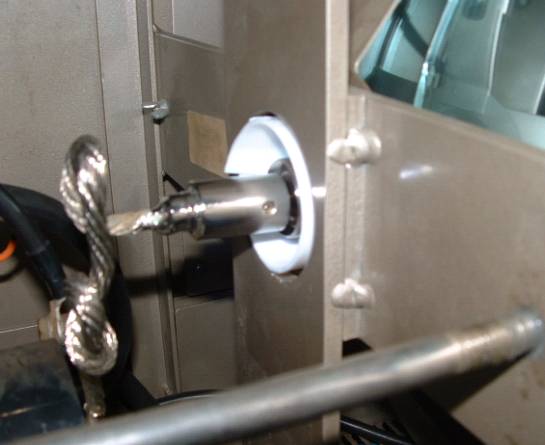
(The white ring is the curled teflon strip)
As for ventilation, IMO the stock exhaust fans on
the Xenex 1 & II's are pretty wimpy. This Xenex 1 has
been modified with xtra blowers for operation at 3K.
(or, more accurately: a 3K bulb running a 2.8k)
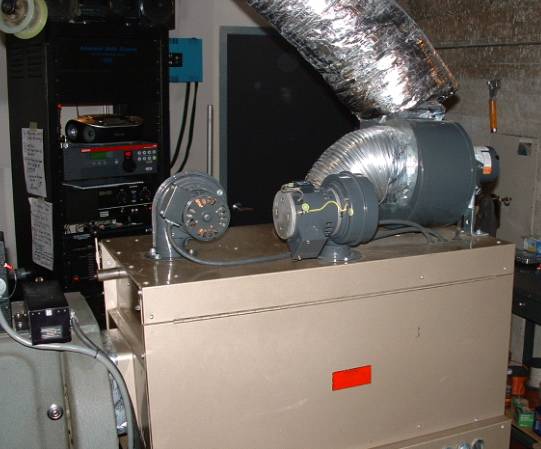
Additional internal 'plumbing' directs the air flow
to cool the cathode & anode ends of the bulb.
This modification was made over two years ago and
enabled a great improvement in light output without
sacraficing bulb life.
(They were formerly running a 2k bulb at 2800watts !)
Posted by Mark Gulbrandsen (Member # 72) on 10-08-2009, 08:46 PM:
Jim,
Good idea! That mirror in there is actually pretty dam good... I once had one putitng out more light with a 3kw lamp installed then the Strong Futura running at 135 amps sitting on the projector nest to it could muster out.
Regarding the RA relay... I replaced a couple of them in the locations I had problems and that was not the cure...
Mark
Posted by Richard May (Member # 2627) on 10-09-2009, 09:36 AM:
Well that relay is one of the few things that I have not checked yet. As Steve said, you could lose the arc at times when this happens. That is exactly what happens. Like I said, there have been days when they say it lights right up on the first strike for a couple shows. Then it will not light so I'll try the relay next.
Posted by Jim Cassedy (Member # 4115) on 10-09-2009, 09:42 AM:
Thanx Mark.
While cleaning up a storeroom behind the booth several
months ago, I found these teflon insulator tubes, which
I beleive were shipped with the Xenex lamhouses and were
indended to be installed in that 'hole' behind the mirror
to keep the negative end of the bulb from arcing on startup.
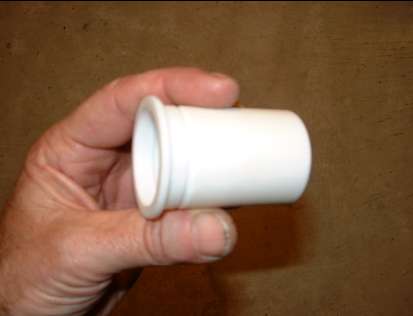
I'm not sure why they were never put in place when the
lamphouses were installed. Mabye next time I need to
change a bulb I'll put one in; but my teflon strips are
working well, and I'm a big beleiver in the old addage that
says: "if it works,. . don't fix it"
Posted by Richard May (Member # 2627) on 10-09-2009, 04:21 PM:
Mine had a black o-ring on it that fit in the groove on the outside of that white sleeve. I hope I was supposed to leave it on.
Posted by Mark Gulbrandsen (Member # 72) on 10-09-2009, 08:33 PM:
I believe the O ring is the newest idea of holding it in place. Used to be a 360 degree spring.
Posted by Richard May (Member # 2627) on 10-14-2009, 08:37 PM:
Okay. So I swapped the RA relay and still no good. Looks like the low voltage, like a couple of you guys said, WAS the problem. I swapped the staring cap between 2 screens and that was the problem. Originally I was getting 76 volts. With the one I swapped, I was getting 84 volts. It seems that the 8 volts was the difference. I put the bad cap into the other screen and it's doing the same thing. Thanks for all your help guys.
Posted by Mark Gulbrandsen (Member # 72) on 10-14-2009, 09:23 PM:
Glad you found the problem! Whats interesting about these older rectifiers is if you have them in an area that's prone to brown outs then your lamp striking problems happen all over again. AC voltage sags and so does the DC!! Thats another reason for installing the Neumade booster box.
Mark
Posted by Richard May (Member # 2627) on 10-15-2009, 09:19 PM:
That may be why they have some striking issues in the summertime.
Posted by Mark Gulbrandsen (Member # 72) on 10-16-2009, 11:24 AM:
No doubt there! I had those troubles at the same time of the year. The booster is about 500 bucks list... The thing that was happenning at the theaters I had troubles at was that the ignotors would eventually fail fomr attempting to strike so many times. Now Irem Ignotors cost way more than a booster does which is another reason we went the booster route. You'd have to see if Neumade still has any, ar ethey even still in buisness?. I probably still have the schematic if they are gone. They would be easy to build.
I saw you are loooking for an autostrike board... They are easy to build! One 48 vdc coil relay and an appropriate zener try (54 volt +/-) in series with the relay's coil. N.O. contacts wired across the manual start button...
Mark
Posted by Richard May (Member # 2627) on 10-16-2009, 12:44 PM:
Thanks Mark. So let me get this straight. N.O. across the manual ignition button. I'm assuming that the relay coil terminals go to the rectifier + and -. Does the zener go across the coil terminals or inline with the + coil terminal?
Posted by Mark Gulbrandsen (Member # 72) on 10-17-2009, 02:54 PM:
Zener goes in line with the coil... Rectifier reaches a certain voltage and the zener conducts... lamp lights then voltage drops and zener no longer conducts.
Posted by Richard May (Member # 2627) on 10-17-2009, 04:54 PM:
Thanks Mark. The bad cap was all faded and I couldn't read the specs. I found a few at home that are the same size. Do you know if these are the right specs.......
4200 uf
75VDC
max surge 95VDC
Thanks again
Posted by Mark Gulbrandsen (Member # 72) on 10-17-2009, 11:46 PM:
They will probably work because I don't think the DC no load will exceed the capacitors surge voltage rating and most electrolytics like that are +/- 20% on the rating. 4700 uf is correct at least for the larger Irem rectifiers but they spec 160 volts DC rating... the new Irems do have about 130 volts no load!! Install one and just to be safe measure the no load DC just to be sure it doesn't go over the 75 volt rating by more then a few volts. If it does I reccomend a larger DC voltage rating and same capacitance.
Mark
Posted by Richard May (Member # 2627) on 10-20-2009, 08:10 PM:
Thanks again everyone. That was the correct cap. All is fine now.
Powered by Infopop Corporation
UBB.classicTM
6.3.1.2