This is topic Curtains do you use them? in forum Film Handlers' Forum at Film-Tech Forum ARCHIVE.
To visit this topic, use this URL:
https://ft-forum.com/ft/cgi-bin/ubb/ultimatebb.cgi?ubb=get_topic;f=1;t=010125
Posted by Michael Voiland (Member # 5386) on 10-09-2009, 11:02 PM:
So I am wondering do any of you use curtains in your theaters and how do you integrate your pre-show with them. One of the places I work at has a huge red curtain covering the largest screen but they use a slide projector so what do you do?
Posted by Andy Bajew (Member # 5330) on 10-09-2009, 11:09 PM:
At my work our preshows are through a DVD-we just adjust the digital to fit the screen(and on a very rare occasion we will use a conversion lens to fit the preshow snug with the curtains). Our curtains are always left open--they don't fly shut. The projectionist is expected to adjust curtains properly at the end of the night for the film that will be played in that theater the next day(only happens for a scope to flat change, vice verse).
Posted by Michael Voiland (Member # 5386) on 10-09-2009, 11:11 PM:
I guess I should have made my statement clear Does anyone use full curtains with a pre-show? Ones that cover the whole screen.
Posted by Scott Norwood (Member # 30) on 10-09-2009, 11:27 PM:
The usual way to do this is to close the curtains on the last slide in the show, turn off the slide projector as the curtains touch, raise the footlights/curtain lights, wait for a minute or so, fade the non-sync music, dim the lights, and then start the show, with the curtain opening right when the picture starts.
At the end of the film, you close the curtains and bring up the footlights for a few minutes, then dim the footlights, open the curtains, and turn on the slides.
Some mid-1990s-vintage ex-General Cinema houses have a nice automation system that does all of this without operator intervention.
If you want to get fancy, you can close and re-open the main curtain between trailers and the feature.
Posted by Mike Olpin (Member # 1115) on 10-10-2009, 12:01 AM:
Exactly what Scott said. The idea is to seperate your show into acts, each with a curtain call.
Curtain up
Act 1: Pre-show
Curtain down
Curtain Up
Act 2: trailers
Curtain down
curtain up
Act 3: The Feature
Curtain down
The idea is also to never show the audience a blank screen, although my curtain has a 35 second lift and isn't fast enough for this.
Posted by Brad Miller (Member # 2) on 10-10-2009, 02:25 AM:
Andy, you are describing masking, not curtains.
Posted by Steve Guttag (Member # 268) on 10-10-2009, 06:52 AM:
Curtains = Grand Drape too.
They are a must for me.
Lift curtains (Waterfall, Roman...etc) are always a bit slow since their mechanism is a wench with a smaller drum than a draw curtain.
Ideally, one has a title curtain behind the lift curtain. Lift curtains are much more difficult to integrate into curtain calls, as Mike has pointed out.
Steve
Posted by Bernie Anderson Jr (Member # 410) on 10-10-2009, 08:43 AM:
Although people complain that it can muffle the sound, the curtain should be closed when the image hits the screen then opens and should start to close before it goes off screen, ideally, when the changeover closes the curtain should finish its travel. This is a very old tradition going back to vaudeville Nickelodeon days and carried through for decades. Movies were just part of the vaudeville show and the managers treated them no different than any other act, using the curtain in between scenes. Radio city had two sets of curtains, as did most of the picture palaces. one being the main drape which went bottom to top and then in the music hall's case a set of movie sheers that were used primarily for dividing up the feature and the shorts and trailers which went side to side.
I still use curtains when I can, I even have one in my screening room, but I most people don't understand why they're there in the first place. With the exception of a few, most people don't understand the history nor care.
One theatre that still uses them for every show, but they're even automated is the Roxy Theatre - Northampton, PA
Posted by Caleb Johnstone-Cowan (Member # 3710) on 10-10-2009, 09:35 AM:
We have curtains at our flagship, they come up only once when the programme starts, no drops for feature etc. Cannot be sure if they are still used all the time though.
Posted by Jonathan M. Crist (Member # 413) on 10-10-2009, 09:36 AM:
What's a curtain?
Posted by Bill Enos (Member # 440) on 10-10-2009, 11:02 AM:
We still use the curtain, a waterfall. These days it's up for the screen ads thru the end of the feature when it comes down. We used to raise and lower separate the preshow from the feature but due to failing stitching holding the guide loops on the curtain we had to reduce ups and downs to the minimum, when we complete repairs we'll resume the extra operations.
Posted by Damien Taylor (Member # 4255) on 10-10-2009, 11:07 AM:
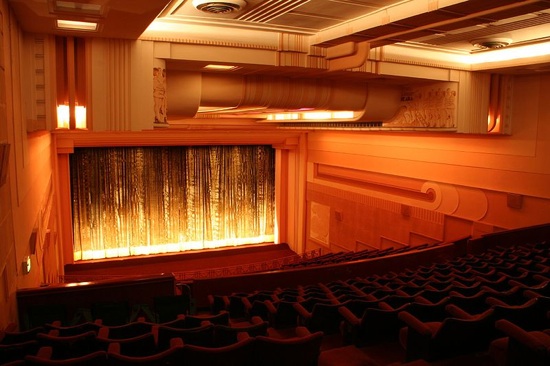
We still have the original curtain that came from New York in 1937. When the cinema was tripled, the balcony was all that remained of the art deco themed cinema. The original proscenium was recreated in sheet metal and the curtain motor was mounted in such a way that the arch amplifies the motor noise, so I only raise on preshow logo and close on studio logo on the credits. Our curtain opens up and down rather than to the sides.
Posted by Jeremy Weigel (Member # 4208) on 10-10-2009, 01:48 PM:
We used our curtains (2 Draw and 4 waterfall) up until 2 years ago.
Had one of the draw curtains' guides get jammed and split the curtain when it went to close after a show. Had a waterfall curtain motor go out halfway up during the start of a show. This was not fun since I had to hand crank it up the rest of the way. That took about 15 minutes. There were several other issues that would pop up. Although they do add a certain showmanship, they began to be too much of a maintenance issue and it was decided to stop using them.
Posted by Tony Bandiera Jr (Member # 2365) on 10-10-2009, 01:58 PM:
quote: Steve Guttag
<snip> Lift curtains (Waterfall, Roman...etc) are always a bit slow since their mechanism is a wench with a smaller drum than a draw curtain.
Yes if you have a woman from the 15th century operating your curtains they would be slow. ![[Big Grin]](biggrin.gif)
They use winch mechanisms on more modern curtains.
Sorry Steve, couldn't resist busting your chops on this one. ![[evil]](graemlins/evil.gif)
My new screening room install at UC Ivine (first one totally designed and installed by me, yea!) is going to have a curtain. I wanted a waterfall for that room but the mechanical space above the ceiling was taken up by HVAC. ![[Frown]](frown.gif)
I will put up pics in the gallery here when it's done.
Posted by Martin McCaffery (Member # 37) on 10-10-2009, 01:58 PM:
We have a single curtain that also serves as masking (black edges, red curtain). We have it open for the preshow slides, close, start trailers, open, close on the no smoking notice, open on feature, close at end of credits, lather rinse repeat.
Posted by Mike Olpin (Member # 1115) on 10-10-2009, 02:01 PM:
Curtains need to be maintained like any other piece of equipment. Catastrophic failure at showtime is usually preventable. Each week, we walk behind the curtain and inspect the hoist cables, travel loops, and the motor to ensure that there is no wear. Spare cabling is kept on hand and cables are replaced immediately upon the first sign of wear.
Posted by Joe Redifer (Member # 3) on 10-10-2009, 03:13 PM:
Michael, I got your PM asking me the same question you are asking here, so I will answer it here.
I used curtains at the Mann Chinese 16 in Aurora Colorado. It was awesome. We would close the curtains 2 minutes before the trailers started and after the movie ended. I also used them once for the movie Man on the Moon where Jim Carrey pops on at the beginning and acts as if he is leaving (which he does for nearly a minute). I closed the curtains during that part and turned up the stage lights. The curtains would begin to open again right before Jim popped back onscreen. I programmed the automation to do this for each show. The audience loved it and it really added to the effect of the movie, too bad the audience was so small for that film.
Most late 90's Mann Theater builds in Denver used curtains for most if not all screens. The Bowels Crossing 12 and Colony Square 12 have waterfall curtains on all screens and the Chinese 16 has side-moving curtains on 8 screens (not sure what the proper term for that type of curtain is). I also used curtains in a similar manner for the short time I worked at The Continental in Denver during its grand "reopening". I was probably one of the few if not the only UA theater ever to make use of the curtain close barcode cue. Unfortunately all of these theaters are owned by lesser, wimpier companies now and none of them use curtains any more.
Posted by Vern Dias (Member # 5241) on 10-10-2009, 03:39 PM:
quote: Joe Redifer
has side-moving curtains on 8 screens (not sure what the proper term for that type of curtain is).
Commonly called a traveller.
Vern
Posted by Victor Liorentas (Member # 5272) on 10-10-2009, 08:38 PM:
Joe that's GREAT what you did for Man On The Moon!!
We have curtains at the Hyland Cinema in London and i am very proud of it! I grew up watching curtains open and close!
In fact these curtains did that for about 50 years at the now demolished Capitol.
I saved them in 2006 just before the demolition!
The Hyland was built in 1933 with 600ish seats, closed in 1989, reopened in 2005!
Jarret and i got the curtains up and running in 2007!
The only theater in London with working curtains and stage lighting!
Showmanship lives here!
Posted by Jarret Chessell (Member # 5077) on 10-10-2009, 09:03 PM:
stupid installing a reverse contacting relay! (still bitter about that)
Posted by Victor Liorentas (Member # 5272) on 10-10-2009, 09:17 PM:
You know you loved it, i have pictures!
Getting the curtains to clear the bigger screen was tough too!
Posted by Bernie Anderson Jr (Member # 410) on 10-11-2009, 07:56 AM:
Can you guys post some of your pictures? I would love to see some of these theatres.
Posted by Damien Taylor (Member # 4255) on 10-11-2009, 09:23 AM:
Cinema one, and quite well recreated metal proscenium at the Piccadilly. Originally a 1100 seater, this pictured auditorium (originally the balcony) now seats just over 450. Left hand side of stalls and area behind this screen converted to a further two characterless boxes.
Posted by Caleb Johnstone-Cowan (Member # 3710) on 10-11-2009, 02:11 PM:
That is so nice, and it looks like a really sympathetic conversion unlike some of the carvery done in the UK.
Posted by Rick Raskin (Member # 1561) on 10-11-2009, 05:44 PM:
quote: Jarret Chessell
stupid installing a reverse contacting relay! (still bitter about that)
Educate me. What is a reverse contacting relay? Are you referring to a normally closed (NC) set of contacts as opposed to normally open (NO)? In Telco land they call 'em Make for NO or Break for NC and many variations thereof.
On Topic: Practically every house I worked had curtains up until they began installing those with shadowbox screens. But even those screens had colored lights on dimmers. Most houses I ran had traveler curtains and only one or two had the waterfall. I never worked a house that had both. It was a sin to let the audience see a blank screen.
Posted by Paul Mayer (Member # 355) on 10-11-2009, 07:13 PM:
quote: Rick Raskin
It was a sin to let the audience see a blank screen.
That's what the ads are for!
Posted by Michael Voiland (Member # 5386) on 10-11-2009, 11:02 PM:
The company I work for has 2 locations. one is an older general cinemas 4 or 6 or 5 plex i am still debating as theaters have been rearranged. One theater has full travelers with masking behind it the other has no curtains and is a late 80s cineaplex oden location 8 plex. I am hopefully going to be transferred back to the older location with the curtain. It needs help but it would be great to use it again.
Posted by Jarret Chessell (Member # 5077) on 10-12-2009, 12:24 AM:
reverse contactor relay... It's two contactors together (they're mechanically joined so that only one contactor can operate at a time). The point of this is to be able to reverse your polarity to change the direction of the motor. One contactor is used for curtain open, the other is for close (we have micro switch stoppers to stop the motor or you can manually stop it during open and close). Depending on your type of motor you need to reverse the starting winding (as we did). Without the starting winding the motor just hums (60Hz) and doesn't know which way to turn.
The installation was very difficult (for me anyways), as the original unit was nothing like the replacement we acquired, and I had to actually wrap my head around it while trying to install it lol.
Posted by Thomas Moore (Member # 3427) on 10-12-2009, 12:48 AM:
you know if it wasn't for venetian blinds, it'd be curtains for all of us
Posted by Ron Curran (Member # 3631) on 10-12-2009, 01:38 AM:
We have draw curtains and we recently installed down lights to replace the spots that used to illuminate them. They look great but most people don't see them coz they come late to miss the ads we don't show. They do require maintenance just as our projection and sound equipment does.
I was brought up in an era when all theatres had curtains. Some theatres understood the impact of the punctuation possibilities on their audience.
A few weeks ago, we hosted a group of high school kids from a deprived area where they only have multiplexes. The teachers wrote to say how impressed the kids were. Our curtains formed a part of that impression.
Our home cinema has curtains too. Unfortunately, the little motor burnt out in a storm and we are saving our pennies to buy a proper one.
They don't make economic sense. Neither does parenthood. We love our kids and we love our curtains.
Posted by Larry Zuverink (Member # 1483) on 10-12-2009, 07:11 AM:
I loved curtains. With adds and preshows we quite using them exept on theatre rentals that were not using the screen. We only have one location that has one theatre with them anymore.
Posted by Mike Blakesley (Member # 26) on 10-12-2009, 01:49 PM:
quote: Ron Curran
They don't make economic sense. Neither does parenthood. We love our kids and we love our curtains.
Every time our lack of curtains begins to bother me less, a thread like this comes along and reaffirms my determination to get them again sometime.
Posted by Tony Bandiera Jr (Member # 2365) on 10-12-2009, 01:50 PM:
quote: Vern Dias
Commonly called a traveller.
Vern
Also known as a bipart drape. ![[Smile]](smile.gif) (I believe that term is used mainly by the riggers who install them though.)
(I believe that term is used mainly by the riggers who install them though.)
Posted by Tony Ratcliff (Member # 1196) on 10-12-2009, 04:35 PM:
Like many of the others here, we close the curtains after the pre-show is over, make announcements, welcome, policies, etc., over the mic, then open the curtains for the movie while the film company logo is showing.
Curtains are especially nice when showing classic films.
Posted by Scott Jentsch (Member # 1681) on 10-12-2009, 04:43 PM:
Curtains are a classy touch that pretty rare nowadays.
When a theater is considering how to differentiate themselves from the competition, I can think of few things that would make as much of an impression as having curtains would.
They protect the screen from flying concessions, and closing them between the pre-show and the movie makes a very clear distinction between the two. My guess is that customer satisfaction would rise if a survey were taken before and after curtains were installed and used.
The bad part is that curtains must cost a million dollars, because no one has them anymore...
Posted by Steve Guttag (Member # 268) on 10-12-2009, 08:40 PM:
They don't cost millions BUT they do cost money...more money than any of the other colored fabric hanging in the theatre (by the sq. foot). Then you might deck them out a bit...add tassels to the bottom...have a nifty valance. Then...you had motor and rigging. That adds into the 1000s again and now you have a potential for failure. I think the potential for failure has killed as many curtains as the $$$$s have.
Think about it...you have this expensive drape that has the potential to prevent a show from starting/running and you can't ever show on a spreadsheet how it generates any revenue.
That said...if you don't have curtains...you are at best a second rate theatre, at least in my book. Put in good stuff, well rigged and keep it up like all other parts of the theatre and you WON'T have problems.
Steve
Posted by Jack Ondracek (Member # 1466) on 10-12-2009, 08:50 PM:
quote: Steve Guttag
now you have a potential for failure. I think the potential for failure has killed as many curtains as the $$$$s have.
That's a great point, Steve.
The theatre I grew up with went without a curtain from 1947 to 1970. Curtains were installed when they remodeled and automated. Except for replacement of a motor that shouldn't have been there in the first place, they worked with no problems for some time.
That all stopped around 12 years ago, when the cables slipped off of a pulley and jammed. The owner was 10 miles away at his drive-in. They did get the curtains opened manually, but that one occasion was enough that he didn't fix the problem and never used the curtains again.
They're still there, along with a lightly-used motor, and no pre-show advertising... but I don't see them being used anytime soon.
Posted by Jesse Skeen (Member # 586) on 10-13-2009, 12:01 AM:
I had a negative view of curtains for a while, because at the theater near me (which I ended up working at later, and is now gone) some jerk would often close the curtains during the end credits, making them hard to read! It ruined the post-credits scene at the end of "Planes, Trains and Automobiles" too, since you couldn't tell what the hell was going on. They do look nice when you use them properly and close them during the rating card at the end.
Posted by Steve Guttag (Member # 268) on 10-13-2009, 06:43 AM:
quote: Jack Ondracek
That all stopped around 12 years ago, when the cables slipped off of a pulley and jammed. The owner was 10 miles away at his drive-in. They did get the curtains opened manually, but that one occasion was enough that he didn't fix the problem and never used the curtains again.
And there it is...cables don't just "slip off the pulley" cables are not maintained. Cables stretch with all of the weight/friction they have to overcome.
Have you all ever noticed that even on maskings...the stops seem to drift or the image seems to no longer be centered? It isn't a mystery. Cables stretch, pulleys get tugged out of position or also wear out. Anything that is mechanical and moves is also aging.
All motorized drapery should be checked regularly. Slack needs to constantly be taken out of the cables (ideally checked once per month)...check pulleys and such once a year. Lubricate the carriers and pulleys once per year (you'd be amazed how much quieter they run...none of that "clack, rrrrrr, clack, rrrrr, clack....etc" as they open/close.
Also, pay attention to the grand drape...it is GOING TO STRETCH and possibly hit the ground (Depending theatre design). The grand drape can NEVER drag on the ground. That puts unbelievable stress on the system. Not only are you pulling the weight of the curtain but now you are pulling the friction of the curtain...it can more than double the load of the system. The curtains stretching is also an indicator that the grommets at the top are likely also starting to pull loose from the fabric...they should be checked over.
Again, put in good stuff (good fabric, good motor, good rigging) and keep it up, just a little bit, and it isn't going to be a problem. If you "set it and forget it" you have a disaster coming your way, and it will be your fault.
Steve
Posted by Scott Jentsch (Member # 1681) on 10-13-2009, 10:43 AM:
It's not the same, but I wonder if anyone has created a "digital curtain" animation for Digital Cinema shows?
I'd be curious to see if the effect was decent or not...
Posted by Jeremy Weigel (Member # 4208) on 10-13-2009, 11:15 AM:
Animated Curtian
Posted by Scott Jentsch (Member # 1681) on 10-13-2009, 01:20 PM:
I should have known that YouTube would have something!
This one has better movement on the opening:
http://www.youtube.com/watch?v=Xa5y1tCTOtQ&NR=1
But the closing is actually just the opening in reverse, and the bottom of the curtain doesn't move correctly.
The original video has a variation which looks better as well:
http://www.youtube.com/watch?v=50AF-uFpRtc&feature=related
The idea is sound. If I had a digitally-equipped theater, I'd be trying to put something like this in place to see how it looked. If the motion was correct and you add a little foley for the curtain pull, I think it has possibilities!
I might try it with the intro video in my home theater...
Posted by Michael Voiland (Member # 5386) on 01-27-2010, 12:51 AM:
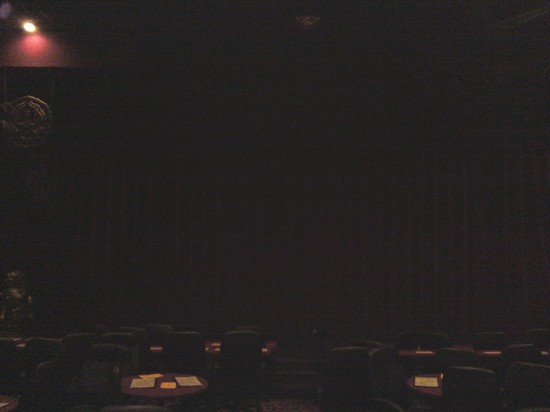
After years of not running for years our biggest theater had the curtains close... Granted I had to yank and shake and tug a little then manually turn the gearbox to get them the rest of the way open again but they close smoothly except there is a ton of crap in their way. They sit about 5 inches off the ground.
Posted by Monte L Fullmer (Member # 2797) on 01-27-2010, 02:03 AM:
Anybody still have, or heard of "fire curtains?" - those curtains that had advertising on them that would fall just behind the title or traveller curtain, but before the screen or open stage?
The theatre that I worked at in my home town as Head Projectionist contained all three: Massive red velvet waterfall, lime green title and the fire curtain (which was manually raised or lowered..this was more for advertising and was just fire-proofed canvas).
In olden days, this curtain was made of asbestos..
-Monte
Posted by Edward Havens (Member # 4715) on 01-27-2010, 03:09 AM:
The Beverly Center still has curtains in all houses, and they all work... it's just that when the people who were running the place at the time had the slide ads put in, they disconnected all the leads from the automation to the motors, and now we're having a bitch of a time trying to get it all back in working order again. I really want to have the curtains working again, especially in House 1 and 3, which are the only ones that are not waterfalls.
Posted by Warren Dewey (Member # 3609) on 01-27-2010, 06:17 AM:
quote: Tony Ratcliff
Curtains are especially nice when showing classic films.
Most classics' beginnings and endings were designed for this. Many modern movie openings look great under curtains too, especially the Fox "Cinemascope Extension" logo and the Disney logo that pulls back to reveal the castle as the curtains open.
quote: Monte L Fullmer
Anybody still have, or heard of "fire curtains?"
There were 2 classic asbestos fire curtains in Pasadena CA, one (now destroyed) that was in the Raymond Theatre of a twenties Oldsmobile, and a great Vaudeville-style curtain with ads for 10-cent breakfasts and $2 valve jobs in an Egyptian style theater that is now a warehouse.
Posted by Alan Plester (Member # 852) on 01-27-2010, 07:09 AM:
Im with Mike O on this one, the show is in segments, sorry, but i think the magic is lost without them, if you have them, please use them.
Posted by Bruce McGee (Member # 131) on 01-27-2010, 09:59 AM:
In the business plan, we dont use the curtains in our theatres, but in my spare time, I have gone around and gotten the curtain controls all cleaned up and lubricated. I let them all down and we vacuumed the fronts. I was amazed at how much stuff had been thrown at the curtain over the years... popsicle sticks, straws, popcorn... I do wish we could use them. If for no other reason, use them at night to protect the screens from the ravages of our night-time cleaning crews using leaf blowers in the auditoriums!
When I run one of my own prints, I use the curtains. Makes the old place look really snazzy. One day, I will actually be in the auditorium and get to see one of my prints actually start instead of a few minutes in...
Posted by Jim Cassedy (Member # 4115) on 01-27-2010, 11:34 AM:
I recently repaired the giant "waterfall" curtain in the
largest (formerly70mm) auditorium at one of my theaters.
It had been 'stalled' in the "up" position for several
years and it required a lot of climbing and crawling
around on top of the stage to get everything working
again. But it was well worth the effort!
It adds so much more 'class' to the presentation.
Although I have automation in that auditorium, I usually
go totally "manual" at show start and handle the non-sync
fade, house & stage lights, curtain open & projector start
myself. (I also like to 'fade in' with the manual dowser)
I then kick everything back to the automation for show
close, since I can't always be there at the end of the film.
Posted by Bill Enos (Member # 440) on 01-27-2010, 03:26 PM:
We got a guesstimate from a specialist in theatrical curtains on replacing our waterfall, it's about 39' wide by 23' high, reusing as much of the rigging as possible. $21,000 = or - 10%.
Posted by Michael Voiland (Member # 5386) on 01-27-2010, 05:25 PM:
Anyone know what type of oil the gear box takes. This was an old general cinema from the 80's that had 70mm in this auditorium. We use slide projectors now and we have them turned off. Unfortunately looks over presentation is at play here I would love to run them shut when we start a movie or when we play classic films, we have a 35mm print of easy rider this weekend.
Posted by Scott Norwood (Member # 30) on 01-27-2010, 09:17 PM:
Pretty much every house with a stage will have a fire curtain. It's essentially standard issue, and (almost?) always required by code. What do they make the new ones out of? I've only seen older asbestos fire curtains.
Posted by Monte L Fullmer (Member # 2797) on 01-28-2010, 02:43 AM:
....a local theatre's fire curtain... 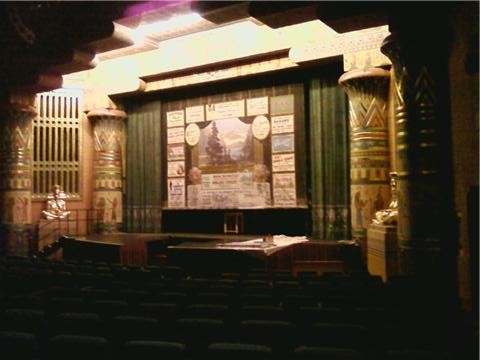
-Monte
Posted by Bill Enos (Member # 440) on 01-28-2010, 11:22 AM:
All the curtain and masking motor gearboxes we have take #90 gear oil.
Posted by Mike Blakesley (Member # 26) on 01-28-2010, 11:27 AM:
I have been wanting to put a curtain in the Roxy for about 20 years. It would be the icing on the cake. But it's looking more and more like I'm gonna need to pay for my own ![[dlp]](graemlins/dlp.gif) -- basically zero help is on the horizon for single screens.
-- basically zero help is on the horizon for single screens.
So, the curtain is still on the list, it's just a little farther down for a while.
Posted by Tony Bandiera Jr (Member # 2365) on 01-28-2010, 11:52 AM:
Mike, screw the D-Crapema and put the curtain in first...film is gonna be around long enough for you to still get product and save up for the ![[bs]](graemlins/bs.gif)
A curtain is a change your customers WILL notice and appreciate!! The ![[puke]](graemlins/puke.gif) is just a gimmick and doesn't enhance a presentation enough to justify the cost and operational headaches.
is just a gimmick and doesn't enhance a presentation enough to justify the cost and operational headaches.
And you said it yourself..ZERO help for single screens on ![[sex]](graemlins/sex.gif) !!
!!
Posted by Mike Blakesley (Member # 26) on 01-28-2010, 12:04 PM:
Tony - Good sentiments which I agree with, but I admit to being a little stymied about the 3-D "juggernaut." I am very curious about what will happen post-Avatar...studios are talking now about pure 3-D releases. If it really does catch on and become a "given" for certain types of movies, it may be necessary to put with 3-D in to even get product in some cases.
Posted by Paul Mayer (Member # 355) on 01-28-2010, 02:11 PM:
For Scott, some of the stages here use water deluge systems instead of fire curtains. Code here allows for this. I imagine a modern fire curtain is made from the same stuff used for current stage electrical cable insulation (the stuff used to wire the "pigtails" on lighting fixtures).
Not a single movie house here has curtains. If I ever get to build my dream "ImaginAsian"-style screening facility, the budget will certainly include curtains. It would be a novelty. Everything old is new again.
Posted by Matt Gress (Member # 5377) on 02-08-2010, 07:07 PM:
I use them between the slideshow and the trailers and close them as the show ends.
Also, films with overtures really benefit from a curtain presentation.
As more new technology enters our booth, with controls at various levels of arms-length convenience, it gets more difficult to do this correctly. You really have to want it. I've been at this about 13 years and have the benefit of working in some beautiful old houses with curtains and I've also benefited from good training.
We have a strange booth - automated changeovers on two screens. Lots of archival prints mixed in with the regular stuff. Every film starts with a short subject on video. If you snooze you lose. I think the curtains keep everyone sharp.
Posted by Frank Angel (Member # 248) on 02-09-2010, 11:56 PM:
Yup, we have them in all three of our theatres. In our biggest house, we have two -- the grand curtain that flies and also a beautiful cream satin curtain on the screen frame itself.
Radio City Music Hall has the same thing and uses them the same way we do -- the main waterfall raises a few seconds before the screen curtain begins to split. In fact, our Walt Whitman Theatre is a faux art-deco design and the curved coves in our ceiling were designed to mimic the curved coves in that Grand Lady. Of course they hardly ever run film any more at RCMH. Our cinema activity has slowed down substantially as well.
I don't always use both curtains when showning movies in the Whitman because the main rag flies and can't be motorized (or at least ours isn't) so we need a separate stagehand just to do that pull. I don't like it when I don't have direct control and have to rely on someone to be at his post exactly when he's supposed to be (I've gotten burned with that more than once -- they could hear me cursing as far as the front balcony), but occassionally I have used both and it sure is impressive.
Can your presentation be spot-on without curtains? Of course. But as I have said many times, a naked screen without a curtain, sitting there, staring back at the audience is like a 5 star restaurant without any table cloths on the tables. Can the food still be superb? Sure, but as for a certain level of class and civility -- patrons will be walking away snickering. There just are some things that you do because they add character to the place; not everthing has to be utilitarian.
Posted by Stephen Furley (Member # 1277) on 02-10-2010, 06:25 AM:
quote: Scott Norwood
Pretty much every house with a stage will have a fire curtain. It's essentially standard issue, and (almost?) always required by code. What do they make the new ones out of? I've only seen older asbestos fire curtains.
Usually steel plates here, and very heavy. I did once see an illustration in an old book of an asbestos cloth roller type, but I've never actually seen one. there were two and three piece ones with overlapping sections for places wthout the height to fly a one-piece one. I did see one of those long ago.
Posted by Frank Angel (Member # 248) on 02-10-2010, 09:15 PM:
We have "fire curtains" -- frames that are a bit larger that than the prosceniums opening in two of proscenium theatres. They basically are foot thick metal frames over which asbestos had been hung. The frames rode in a metal trough so that when the asbestos covered frame was lowered in its trough, it created a fire proof barrier between the fire (presumably on stage) and the audience. Ours weren't anything fancy like in the old days, with artistic paintings on, ours were just painted the exact same color as the proscenium. Where as the fancy painted ones were intended to be seen by the audience when they came in, ours are never in sight when an audience comes into the theatre. In fact, even when the theatres are dark, they are only flown to the deck when the last of the crew locks up at night.
When the city decided to conform it's buildings to meet asbestos abatement rules, they stripped all the asbestos material from the frames and replaced it with some new fire resistant stuff. I have no idea what it is. The thing weighs a tone and is lifted and lowered hydrolically. It also has a trigger safety rope line with a knife hanging right next to it so you can presumably cut the rope and that releases the weights and the thing falls like a ton of bricks to the stage. Theoretically, it is SUPPOSE to stop 8 feet from the stage so that it doesn't kill anyone who might be in the way, and then hydrolic fluid is SUPPOSE to let it come in the rest of the way gently. Although gently or not, if someone were unconscious laying there under it, it would surely crush them.
A fire inspector came in one day and made us cut the rope. The thing fell straight to the floor....no hydrolic break stopping it. Evidently the oil had leaked out. It hit the deck with incredible force, dust and bits of flooring flying out from under it, the metal guides pulling cement out of the bricks. Concrete dust bellowed like a cloud all over the stage.
We keep the oil resoviour full now as part of regular maintenance. Even so, I wouldn't stand anywhere near that thing when someone is about to cut the safety rope.
Posted by Amir Zohourian (Member # 5321) on 02-11-2010, 01:44 PM:
The asbestos curtains were replaced mostly by Zetex which is the same fabric as high heat gloves are made out of. The regular version support up to 1000F, there is the steel core stuff that is much heavier. Usually its mounted on a pipe batten in a fly stage, although i have seen it on rollers as wide as 50-60' wide. Grand Olde Oprey should have one of the biggest ones. I doubt anybody spends the money to paint murals on fire curtains any more, the original intent was to distract the patrons in case of fire on stage.
Hall out of the UK makes the best of the lift systems you mention here, and they do have the hydraulic plunger. You should replace the knife with a fusible link that melts at high temperature. By the way, yes Hall is of the Harkness Hall fame although the screen company is separated from the stage company these days.
This is my first post!! Yipee
Amir
Posted by F. Hudson Miller (Member # 5318) on 06-10-2010, 08:16 PM:
In UK legit houses the fire curtain has been required, by code, to be dropped at intermission. This proved to the audience that it was in fact in working order. A fire in a theater has always been a very dangerous thing. Before electrification of theatrical lighting fires were more common than today.
Powered by Infopop Corporation
UBB.classicTM
6.3.1.2