This is topic How to block 6vdc on an RF coax in forum Film Handlers' Forum at Film-Tech Forum ARCHIVE.
To visit this topic, use this URL:
https://ft-forum.com/ft/cgi-bin/ubb/ultimatebb.cgi?ubb=get_topic;f=1;t=010152
Posted by Frank Angel (Member # 248) on 10-27-2009, 08:46 AM:
I need to send 6vdc down an RF coax line to activate a relay on one end. And of course I need to block that DC from being seen by the equipment on either end. Can anyone give me a formula so I can get the proper caps values to do this?
Thanks
Posted by Mark Gulbrandsen (Member # 72) on 10-27-2009, 09:06 AM:
You need an isolated but also tuned circuit to accomplish this. Otherwise in applying DC straight away to the RF feed you might also kill or lower the level of the RF itself. I wouold reccomend consulting a reputable 2-way radio ship near to you to see if they can help you with the calculations and aquire the correct parts.
Mark
Posted by Tim Reed (Member # 137) on 10-27-2009, 09:38 AM:
quote: Mark Gulbrandsen
I wouold reccomend consulting a reputable 2-way radio ship
A maritime station won't help him. Depending on the frequency and nature of the RF circuit, it may not even see the DC to begin with, as it may already have a high-pass filter on the input.
I would be concerned with keeping the RF out of the DC circuit, too. The relay coil will present some reactance.
Pi filter calculator.
What is your RF circuit, what is the coax (e.g., RG-8), and what is the frequency?
Posted by Mark Gulbrandsen (Member # 72) on 10-27-2009, 11:29 AM:
Tim,
Actually if you stop to think about it a two way radio ship may indeed be able to help him since those guys are ever the more resourceful are even more experienced than most 2-Way shops or you or I...
Mark
Posted by Kenneth Wuepper (Member # 1174) on 10-27-2009, 12:02 PM:
Make friends with your local cable TV guy. They distribute the power to operate their amplifiers on the same coaxial cable as the two way internet, telephone and television signals.
Posted by Rick Raskin (Member # 1561) on 10-27-2009, 01:43 PM:
Depending on the frequency, the relatively low reactance of a relay coil might tend to shunt down the RF signal. You could use the DC to toggle a logic gate which in turn would operate the relay but I think you'd save yourself a lot of hassle by running separate signal and power leads. I believe in the KISS principle.
Posted by Frank Angel (Member # 248) on 10-27-2009, 09:12 PM:
This is standard broadcast RF Channel 3/4 coming down on RG58. And of course Kenneth is right -- the cable co. does this all the time, sending power up the coax to power pole amps. It should be the same thing for what I need to do -- turn on a video camera and mic preamp in the projection booth which looks at and hears the stage. That video/audio system in the booth sends down Ch 3 RF and it is distributed to monitors in the lobby and back stage. The house manager needs to turn the system on without going up to the booth.
Up till now I was using the X10 Data-Over-AC power line system and it worked quite well for a time. The great advantage is that using the X10 Telephone Transponder unit, the video camera system could be turned on and off by telephone from anywhere, even from home if staff forgot to turn it off before leaving the theatre. The system could also be turned off automatically with an X10 timer module; that was a nice added bit of protection to protect the system should front of house personnel forget to turn it off at the end of a show.
As much as I loved the broad variety of different control modules X10 offers which can be configured to almost any situation that requires control of multiple devices from multiple control points (X10's ability to control up to 16 different channels individually by making a telephone call is totally awesome).
The fly in the X10 ointment is that the very noisy electrical environment of the theatre makes the X10 receivers, at least in our old theatre, somewhat unreliable. After more that a year of installing filters and noise blockers and AC line amps (Leviton makes filters and booster amps for the X10 systems too) to make the system reliable, I have just about given up as the receiver units will work most of the time, but at critical moments when untrained house personnel need to turn the system on, they will fail to respond more on first try. Their reliability is degraded in our environment. Telling student staff to just continue to send the ON signal until the system responds is just not an option. I need it to work the very first or at least second time or I need another solution.
Dropping a control cable along with the coax is just not option. Using the existing coax seems to be an elegant and simple as well as cheap solution, but not as elegant as being able to control it with the telephone from anywhere. None the less, as long as there is a place in the front of house where the House Manger can throw a physical switch his monitor will all come on the first time -- THAT will be good enough.
Posted by Tim Reed (Member # 137) on 10-28-2009, 01:51 AM:
Try this, Frank:
Power Blocker
Posted by Bruce Hansen (Member # 281) on 10-28-2009, 08:13 PM:
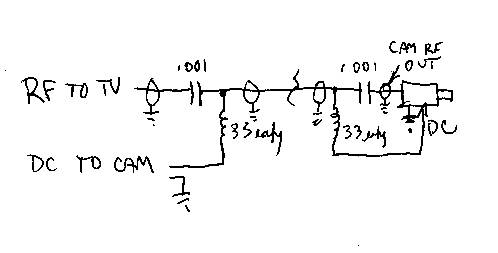
You need a capacitor at each end to pass the RF and block the DC, and a coil at each end to pass the DC and block the RF. Looking back at an MDS down converter I built years ago, the capacitors were .001ufd and be able to handle the voltage the camera uses, the coils were 33uhy (I don't think this is very critical) and be able to handle the current that the camera is drawing. Because the input to the converter was 2.4Ghz, the converter was mounted at the antenna. DC was sent up the coax to run the converter, and RF (CH 3) was sent down the coax. This works with RF due to the large difference between RF and DC. This will not work with base band video. Video uses freqs. down close to DC.
Posted by Bruce Hansen (Member # 281) on 10-29-2009, 07:47 PM:
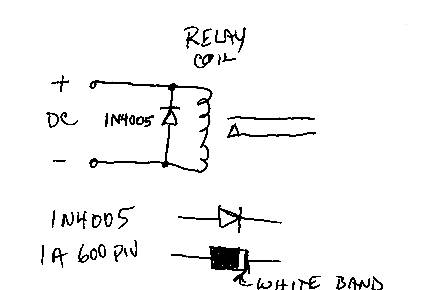
If you are using a relay, be sure to put a reverse biased diode across the coil of the relay. When current flow is removed from the relay coil, the magnetic field that was built up around the coil will colapse, generating a reverse high voltage spike. The diode is used to "short out" that spike, so that it will not get into your equipment, and cause problems. A 1 amp 600 PIV diode, such as the 1N4005 should do. Mount it close to the coil. Right on the coil is best.
Posted by Frank Angel (Member # 248) on 10-30-2009, 01:47 AM:
Thanks guys -- Bruce, that looks like it will totally do the trick. And yes, this is for RF, not BB video.
Posted by Mark Gulbrandsen (Member # 72) on 10-30-2009, 09:31 AM:
Good job Bruce! I believe that would work just fine...
Posted by Steve Guttag (Member # 268) on 10-30-2009, 05:01 PM:
I'm still trying to figure out what CAD program Bruce was using!
Posted by Demetris Thoupis (Member # 833) on 10-30-2009, 05:48 PM:
Hand Cad Steve. It works wonders especially in tight spots.
Posted by Bruce Hansen (Member # 281) on 10-30-2009, 05:57 PM:
Did Steve just call me a cad? Well, I didn't think he knew me that well. It's normaly women who... Well, I won't go there.
The CAD program I am using is FREE. I like it! It can be used without a computer, even without power! Top that AutoCAD. I always have it with me. I can make the drawing any size I want. I can CAD into the side of a building. With a special (attached) tool, I can even CAD onto snow. Eat your heart out, AutoCAD, just don't eat the yellow snow.
Powered by Infopop Corporation
UBB.classicTM
6.3.1.2