This is topic Can anyone identify the object between the lamp and projector here? in forum Film Handlers' Forum at Film-Tech Forum ARCHIVE.
To visit this topic, use this URL:
https://ft-forum.com/ft/cgi-bin/ubb/ultimatebb.cgi?ubb=get_topic;f=1;t=010237
Posted by Sean Weitzel (Member # 244) on 12-27-2009, 11:30 PM:
I saw these photos on ebay. I'd like to know what the item between the lamp and projector head is. The seller's description does not reference it specifically. I've never seen this before.
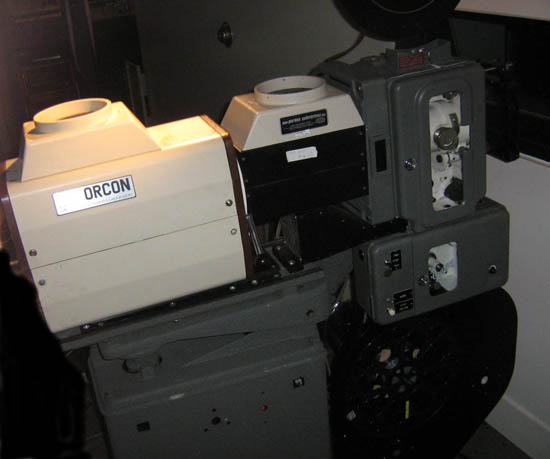
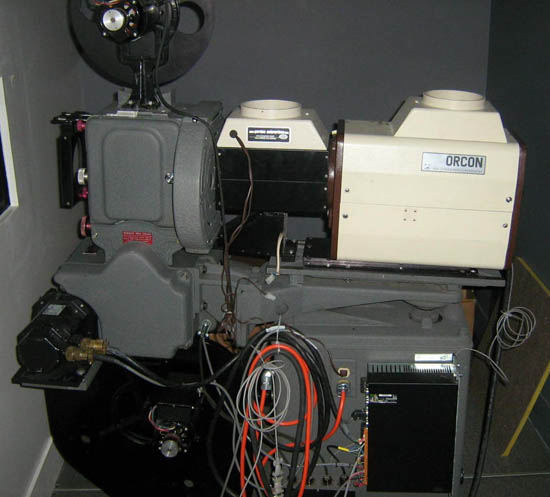
The motor on the upper reel arm is interesting as well. Could this machine run in reverse?
Posted by Richard Hamilton (Member # 321) on 12-27-2009, 11:36 PM:
Not sure what that item is. As far as running in reverse, could be. It looks like the motor is hooked up to a controller. By the way that is the cleanest wiring job I think i've ever seen ![[Razz]](tongue.gif)
Posted by Cameron Glendinning (Member # 3516) on 12-27-2009, 11:47 PM:
I'm also curious about the filter and rails infront of the lens. Is it some sort of 3D or special venue 70mm projector?
Posted by Ian Parfrey (Member # 5122) on 12-27-2009, 11:54 PM:
My guess would be either a dichroic heat filter or a lens assembly to change the focal length of the Orcon mirror. This would likely mean that the mirror in the lamphouse isn't of the standard Orcon dimensions. The vent at the top would be just an extraction duct for the waste heat.
Still, its a weird way of doing both of those things and I might be way off the mark.
......UNLESS...... its just a spacer between the lamphouse and mechanism so there is no need to rotate the lamphouse to change xenons. These lamps rotate about a centre pivot and the lamp is changed through the snood with the lamphouse at 90 degrees to the table. Then it would be easy to just lift the "box thing" off and reach in through the snood and hey presto!..lamp changed.
Bartender! A double please. ![[beer]](graemlins/beer.gif)
Posted by Stephen Furley (Member # 1277) on 12-28-2009, 09:05 AM:
What's the cable for going into the back of it? It's near to the top, so it might just be for a fan I suppose. There's another cable near the bottom which looks like it might be going into this box, but it seems to have been unplugged.
I did think of another lamphouse, possibly a halogen one, so that prints could be projected by either light source, but that wouldn't make much sense with 35mm. I could understand it with 16mm where both light sources are widely used, and you might want to do test screenings with both.
Another idea I had was that it might contain dichoric filters and a mixing box, to enable the colour of the light to be changed, like the lamphouse on a colour enlarger, or some types of film printer I believe. Might be useful for grading test prints, or somewhat improving faded material during film restoration, but I can't see any way to operate such filters.
How about some sort of additional heat filtering/extraction to enable the film to be run at very low speeds, or stopped on a still frame. It does look like it might be designed for some sort of rock and roll system, in a dubbing theatre maybe?
It has a strange lower spoolbox; looks like one of those cloverleaf things for running double band on 1000 foot spools, though only one take-up system seems to be installed. Definitely looks like some sort of studio or laboratory machine.
I'm out of ideas at this point.
Posted by Jim Cassedy (Member # 4115) on 12-28-2009, 09:57 AM:
I don't know what the 'little box' between the projector
and lamphouse is, but the motor on both the feed and takeup
and the fact that this machine is equipped with a "preview
magazines" would definately indicate that its' configured
to run in forward and reverse. The size of the lamphouse
and whole set-up in general looks like machines I've run
in some screening rooms or editing houses where you
needed both forward/reverse and preview magazines to
run dailies or to check non-composite prints.
UPDATE> A friend who worked in a film lab for many
years says he THINKS (but isn't sure) that this
device might be similar to a device they had in their
screening room which had sort of graduated neutral
density filter wheel inside so that they could
control the intensity of the light when running
untimed or over exposed dailies.
It's just one more possibility.....
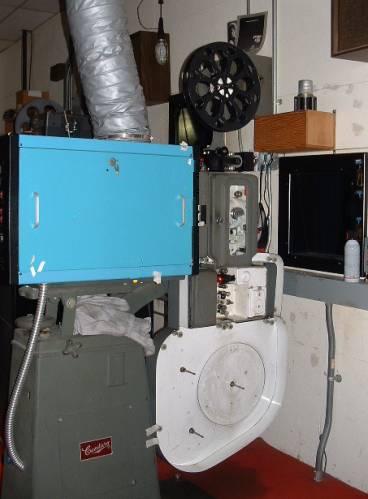
I've run many many forward/reverse "preview projectors"
set up with double system sound-heads. Here's one of them.
(In fact, I'm running film at this screening room tomorrow)
Posted by Robert E. Allen (Member # 1351) on 12-28-2009, 02:07 PM:
Hey guys, are we sure it couldn't be something as simple as an additional exhaust fan?
Posted by Gordon McLeod (Member # 33) on 12-28-2009, 02:34 PM:
My suspicison is that it is a set of controlable colour filters for colour print timing
Posted by Stephen Furley (Member # 1277) on 12-28-2009, 03:45 PM:
quote: Robert E. Allen
Hey guys, are we sure it couldn't be something as simple as an additional exhaust fan?
We're not sure of anything Robert, but why the need to install an extra fan for quite a small lamphouse, when projectors with larger lamps manage without? Also, it puts the lamp a long way back from the film gate, and therefore would probably need to contain a lens to correct this.
quote: Gordon McLeod
My suspicison is that it is a set of controlable colour filters for colour print timing
One of the ideas I came up with Gordon, but I'd expect to see either three knobs for local control, or some sort of electrical interface for control from the auditorium. None of the cables looks like that.
Posted by Robert E. Allen (Member # 1351) on 12-28-2009, 07:19 PM:
I was just thinking Stephen if it's a reversible projector used in some phase of production perhaps it is stopped on a an illuminated single frame.
Posted by Stephen Furley (Member # 1277) on 12-28-2009, 07:54 PM:
Robert,
It's possible; at the moment we have no firm evidence at to what this is, only speculation. I'm a bit surprised that nobody here has yet been ab;e to positively identify it. Whatever it is, they can't be very common.
I don't think it's my first idea, a second lamphouse, nor the suggestion of it being just a means of gaining access to change the lamp, but I think all the other ideas are still in the running. Or maybe it's something that none of us has thought of yet.
Posted by Bernard Tonks (Member # 809) on 12-29-2009, 04:37 AM:
Here's my guess.
The top spool box is for reversable projection.
The frame on the front of the projector is an iris for stopping down the lens.
The second lamphouse holds a Philips type 500 watt xenon bulb with built in mirror. The Orcon lamphouse is installed only for it's use as the rectifier.
Posted by Mitchell Dvoskin (Member # 751) on 12-29-2009, 12:54 PM:
Whatever that gizmo is between the lamphouse and projector, it has an Alan Gordon Enterprises logo on it. They are still in business in LA, I suppose somebody could call or email them to find out what it is.
Alan Gordon Enterprises
My GUESS is that it is some sort of heavy duty heat shield to allow for freeze framing the image.
Posted by Jack Theakston (Member # 4484) on 12-29-2009, 01:00 PM:
Have you tried asking the seller?
Posted by Robert E. Allen (Member # 1351) on 12-29-2009, 05:51 PM:
quote: Mitchell Dvoskin
My GUESS is that it is some sort of heavy duty heat shield to allow for freeze framing the image.
Well that makes two us. Wonder if we'll ever really know?
Posted by Stephen Furley (Member # 1277) on 12-30-2009, 06:31 AM:
I've just typed a reply, hit the wrong button, and lost it. ![[Frown]](frown.gif)
quote: Mitchell Dvoskin
Whatever that gizmo is between the lamphouse and projector, it has an Alan Gordon Enterprises logo on it. They are still in business in LA, I suppose somebody could call or email them to find out what it is.
Alan Gordon Enterprises
My GUESS is that it is some sort of heavy duty heat shield to allow for freeze framing the image.
I tried saving the pictures and zooming in on the nameplates, but couldn't make out what it said. It probably helps if it's a name and logo that you know.
So far we have:
Two suggestions that it's a lamphouse. It certainly looks like one, but I don't think my idea that it's for a halogen lamp really makes sense with 35mm. Bernard's suggestion that it's for a small xenon is interesting, but if it's for a smaller lamp wouldn't the Orcon rectifier over-run it? If the lamp in the Orcon is the same size then why use the other lamphouse? It's possible that the Orcon has failed, but it looks in good condition, almost new, as does the rest of the equipment.
One suggestion that it's to correct for non-standard mirror. Wouldn't it be easier to replace the mirror? It's a standard lamphouse, and standard-size film. I think this would be more likely if it was illuminating something non-standard like 28mm film, or the works from a video projector, which somebody was trying to get more light into. Also, the cables look rather too thin for a lamp.
Two suggestions that it's for adjustable colour filters. Sounds plausible, but I can't see any way to adjust the filters, either three knobs to do it locally, or some means for remote control, a thickish cable with multi-pole connectors maybe, or even mechanical cables as used on bicycle brakes; can't think of the name for them now.
One suggetion that it's for neutral density filters. Again, sounds plausible, and the same arguments apply as for colour filters.
One suggestion that it's a spacer to facilitate access to the lamp. I think this is unlikely; what are the wires for? Changing the lamp the conventional way isn't difficult, and doesn't have to be done very often, unless this is used for some portable application, in which case the extra box itself is a nuisance anyway. The lamp would be in the wrong position, which would require a lens to correct it; this might explain the wires if they were for a fan to cool it, but this itself might then require re-alignment after changing a lamp. It really doesn't seem to make life any easier.
Five suggestions that it's some sort of cooling device. Three of the people who suggested this mentioned still-framing, which would make sense, since this seems to be some sort of studio machine; motor on top spool and cloverleaf bottom spoolbox. It wouldn't be needed for running film normally with such a small lamp, or all projectors would need one, which they clearly don't.
I'm still surprised that nobody here has been able to positively identify it. Of course it's possible that it's some one-off set-up that somebody has put together, e.g. a small lamphouse that somebody has stripped out and used to hold filters of some sort, in which case asking the maker may not help. Zooming in on this thing the black side plates do not look original. I can't be sure, but they also look like plastic, which would suggest that there's probably not a lamp in there, since they'd get rather hot.
I think at the moment I'm leaning towards the cooling device, with the colour filters as the next most likely, but I still can't see any way to operate them.
If it does turn out to be a cooling device then Ian was the first to suggest it, and indeed, it was the first suggestion made.
Posted by Ian Parfrey (Member # 5122) on 12-30-2009, 07:56 AM:
Stephen.
I've had another look at this thing and from what I can tell, the top piece of the "box-thing" is off another Orcon lamphouse like the one behind it. Inside these are a large computer fan used to cool the power supply and for xenon heat extraction in the Orcons, so at a guess the wires - instead of dropping down from underneath the fan housing and into the original supply- are in this instance brought out the side and to the outboard power supply.
I'm leaning towards a 45 degree, angled dichroic filter in that box which would reflect the IR out the top and through the fan to be exhausted, similar to the Xebex HiBeam IV lamphouse setup.
With that said, then what stock would be so sensitive to heat that it would require a 1000w max lamp with dichroic filtering apart from nitrate? As there aren't any magazines on the Century, then it would be madness to even try and run nitrate on that setup.
And anyway, the Century has water cooling so why the dichroic filtering if any? Surely it would be far easier to cool the gate with the water jacket in the projector head than go to the expense of fabricating a seperate unit?
The manual for the 1600B model lamphouse states that the aperture to bulkhead distance should be approximately 8" ( 20.3 cm), and it appears that the present position of the Orcon far exceeds that recommended distance. This particular model lamphouse doesn't appear to be the 1600B model but the 1000 model. In which case, the aperture to bulkhead distance is likely to be shorter, not longer which is where it resides now.
Additionally, I doubt that the "box-thing" would be a beam expander as the Century doesn't appear to be a 35/70mm model.
This is turning out to be quite the puzzler!
The game's afoot, Watson.
Posted by Stephen Furley (Member # 1277) on 12-30-2009, 08:26 AM:
Now somebody has made another post I can correct the error in my previous one. The sentence 'Also, the cables look rather too thin for a lamp' should of course be at the end of the previous paragraph, not where I actually inserted it.
quote: Ian Parfrey
With that said, then what stock would be so sensitive to heat that it would require a 1000w max lamp with dichroic filtering apart from nitrate? As there aren't any magazines on the Century, then it would be madness to even try and run nitrate on that setup.
And anyway, the Century has water cooling so why the dichroic filtering if any? Surely it would be far easier to cool the gate with the water jacket in the projector head than go to the expense of fabricating a seperate unit?
Ian, to answer the second point first, water-cooling would reduce the temperature of the gate, but would not reduce the direct radiant heat on the film itself. As to what sort of stock would be so sensitive as to need this, three people have suggested stock which is not moving. Given that this seems to be some sort of studio machine, with rock and roll facilities, I'm leaning towards this being the most likely explanation, and it's to enable a still frame to be held in the gate, but we still don't know for sure. You're right, that does look like the top of an Orcon, mounted in reverse. I hadn't noticed that.
By the way Ian, are you posting this in the middle of the night? It was 14:26 in London when it arrived.
Posted by Ian Parfrey (Member # 5122) on 12-30-2009, 08:55 AM:
Stephen.
Good call on the "rock and roll" capability. I had read those suggestions but it didn't click till I read your post.
Now that you mention it, the motor on the Century appears to have two supplies running to it which could point to the studio/lab projector theory.
Yes, it's 12:53AM Thursday morning here and I'm wondering about "box-things" and Orcons.
I have no life. ![[Big Grin]](biggrin.gif)
Posted by Sean Weitzel (Member # 244) on 12-30-2009, 11:38 AM:
I emailed the seller and asked about it but have not heard back. The actual auction has higher resolution photos, but not quite high enough to read the nameplate. For those interested it is ebay item: 200407710569
http://cgi.ebay.com/ws/eBayISAPI.dll?ViewItem&item=200407710569
Posted by Stephen Furley (Member # 1277) on 12-30-2009, 11:45 AM:
No optical sound, doesn't look like it's got any mag sound either, and it's in a screening room in Los Angeles. Sounds even more like a studio machine. It's in nice clean condition.
Posted by Robert Throop (Member # 61) on 12-30-2009, 12:44 PM:
The cutout in the projector door seems to indicate that it was an early Cine-Focus conversion.
Bob
Posted by Stephen Furley (Member # 1277) on 12-30-2009, 01:04 PM:
quote: Robert Throop
The cutout in the projector door seems to indicate that it was an early Cine-Focus conversion.
![[Confused]](confused.gif)
What's that Bob?
Posted by Tony Bandiera Jr (Member # 2365) on 12-30-2009, 01:24 PM:
Ok gang, since I'm local I have put in a call to the seller to get the answer to this mystery. I may also arrange to go see it in person if possible and will let you all know what I find out.
Posted by Richard Hamilton (Member # 321) on 12-30-2009, 02:02 PM:
It's got a switch labeled "home". I assume that you click your heels together and push that button and wind up at home?
Posted by Sam D. Chavez (Member # 1841) on 12-30-2009, 08:42 PM:
It appears that the black metal duct? coming into the bottom of the picture head is an air inlet/outlet. Why I have not a clue, but perhaps this was part of the "Cine Focus" style cooling or maybe to cool the film frame when it is in still frame or slow frame rate mode.
There is no stock water cooling shown.
Posted by Ken McFall (Member # 845) on 12-31-2009, 11:33 AM:
Given that the lamphouse is going to be miles out of focus in relation to the gate could it be some sort of defuser to improve the uniformity of the light.
That would take care of the focus of the lasmphouse. It would also account for the exhaust fan on the top of the box as the static optics inside would have to deal with all of the heat.
As the projector is used to run rushes and un married prints the best possible image would be required.
Regards.
Posted by Robert Throop (Member # 61) on 12-31-2009, 11:44 AM:
quote: Stephen Furley
What's that Bob?
Cine Focus was a device developed by Century for controlling the position of the film in the gate. It used air pressure supplied by a blower to prevent film flutter. The later versions after about 1966 had knockouts in the projector casting for the hose fittings. The early version had a modified lens holder and a cutout in the projector door for the fitting.
Bob
Posted by Stephen Furley (Member # 1277) on 12-31-2009, 12:45 PM:
Did it work?
Posted by Jack Theakston (Member # 4484) on 12-31-2009, 01:11 PM:
It occurred to me that there is something hanging off the front of the lens or on the port. Could that have something to do with it?
Posted by Fred Georges (Member # 505) on 12-31-2009, 01:14 PM:
quote: Stephen Furley
Did it work?
You betcha. I consider it almost an essential on Century's with 4K & up lamphouses. But, it works extremely well with low watters too. Example, I have a reel of "My fair Lady" IB tech that is incredibly warped. You cant keep this thing in focus no mater how hard you try. I ran it on my JJ & ORC 1000 with Cinefocus on & Damn if it didn't keep it in focus start to finish. You have to be careful though as the fiberglass air filtration on the blower can still let small dust particles be blown onto the base side of the film. This can be replaced with a much better foam filter though.
Posted by Sam D. Chavez (Member # 1841) on 12-31-2009, 01:43 PM:
I used Cine Focus and concur about it's efficacy and the problem of keeping the filters clean. Cine Focus like devices were also used on at least some American versions of the DP70. It required sealing of the gate area to maintain air pressure.
I had one for a while and returned it back to stock condition before I sold it.
Back to the topic;
Anyone agree the device going into the bottom of the projector is an air duct?
Posted by Mitchell Dvoskin (Member # 751) on 12-31-2009, 01:48 PM:
I figured it out. It is a Popcorn Popper for the projectionist. You pour the seed and oil in the top, and the heat from the rear Xenon lamp not only provides light for the picture, but the heat pops the corn... ![[Wink]](wink.gif)
Posted by Gordon McLeod (Member # 33) on 12-31-2009, 03:07 PM:
Yes I saw that air duct
Posted by Sam D. Chavez (Member # 1841) on 12-31-2009, 06:11 PM:
The fact that someone went to the trouble to run the duct to that specific location must mean something.
Powered by Infopop Corporation
UBB.classicTM
6.3.1.2