This is topic what projector is this in forum Film Handlers' Forum at Film-Tech Forum ARCHIVE.
To visit this topic, use this URL:
https://ft-forum.com/ft/cgi-bin/ubb/ultimatebb.cgi?ubb=get_topic;f=1;t=010239
Posted by Jeremy M Smith (Member # 4913) on 12-29-2009, 12:14 AM:
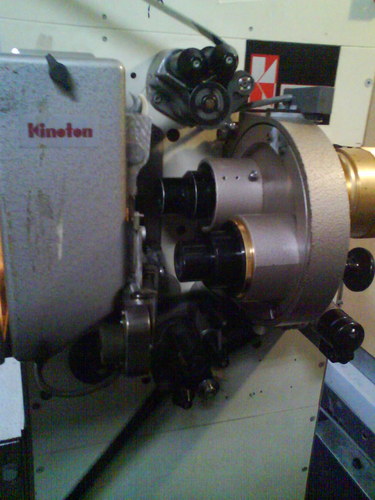
can someone tell me what type of projector is this and where I can find a manual ?
THanks
Posted by Joe Redifer (Member # 3) on 12-29-2009, 12:26 AM:
It's probably a Kinoton.
Posted by Brad Miller (Member # 2) on 12-29-2009, 12:28 AM:
You can trust Joe. He is a sharp guy with an amazing knack for attention to detail. ![[Wink]](wink.gif)
Posted by Robert E. Allen (Member # 1351) on 12-29-2009, 12:30 AM:
Joe can read???
Posted by Ian Parfrey (Member # 5122) on 12-29-2009, 12:34 AM:
Looks like a Philips/Kinoton/Norelco FP20.
The manual for the FP20 is in the "Manuals" section to the right.
Posted by Randy Bowden (Member # 587) on 12-29-2009, 02:03 AM:
It's a 35mm projector ![[Razz]](tongue.gif)
Posted by Jeremy M Smith (Member # 4913) on 12-29-2009, 02:17 AM:
thanks Ian right on the money
Posted by Joe Redifer (Member # 3) on 12-29-2009, 02:46 AM:
quote: Ian Parfrey
Looks like a Philips/Kinoton/Norelco FP20.
The manual for the FP20 is in the "Manuals" section to the right.
WRONG!!!!
It's on the left.
Posted by Ian Parfrey (Member # 5122) on 12-29-2009, 03:08 AM:
quote: Joe Redifer
WRONG!!!!
It's on the left.
Well I remembered about Philips, so there....and...and ..Norelco, too yeah!
Anyway, I'm taller than you so I win.
(Looks for "crybaby graemlin- can't find one so chooses this one.....) ![[Moon]](graemlins/moon.gif)
Posted by Joe Redifer (Member # 3) on 12-29-2009, 03:39 AM:
I am 7 feet tall.
Posted by Ian Parfrey (Member # 5122) on 12-29-2009, 03:45 AM:
I'm 9'11".
...not blue though...or a Smurfcat.
Posted by Stephen Furley (Member # 1277) on 12-29-2009, 06:12 AM:
Any idea of a date on this one? It's got the later type column, as on the FP-30, but the old style hat shaped inching knob, though it's in a slightly different position to I've seen it on other machines. It doesn't have the sort of crescent shaped rocker switch below the sound head, nor the buttons in the same position, for start/stop and changeover, so presumably it has the still later version, with the buttons in the stupid position on the front of the column. The turret looks newer than the rest of the machine, and the shutter housing is unlike any I've seen, and what's that thing beneath it, automatic aperture plate changer? I've never seen one on a Kinoton, nor a turret, but I do know that they're available. If that is what it is, then presumably it was fitted from new, since the old looking shutter housing seems to be shaped to avoid it, but I doubt that you'd have one of these fitted unless you also had a turret, and the turret looks new.
Is this an intermediate version of the machine, between ones which I've seen, or one that's been assembled from various parts?
Difficult to believe that the FP-20 design is now 50 years old.
Posted by Steve Guttag (Member # 268) on 12-29-2009, 08:40 AM:
It is not an FP20 it is an FP30...look at the length of the unit. Another "tell" is that the beige plates, all of them, span the length of the machine. The FP20 is more slender and often its golden/brown color is predominate with the beige plates only in select areas, on some versions.
The model number is obstructed by the turret controller in the picture.
The turret makes me want to say it is an '80s or '90s version. The FP30 mechanical machines didn't change all that much over the years (except features specific at the time of order)...the film path remains pretty much the same. With the Direct Drives, you loose the separate inching knob as it moves to a sprocket shaft....the direct drives were standard by the late '90s.
Steve
Posted by Stephen Furley (Member # 1277) on 12-29-2009, 09:25 AM:
The pair of FP-30Ds at Croydon which I used to run went in new in May '94 I think; I don't know how long the model had been available at that time. I don't think I've ever run a non-direct FP-30; how long an overlap was there between the models? I've run quite a few FP-20s, both pairs and single machines with a tower. Strange machines when you first see them, but they seem to work well. Must have seemed revolutionary when they were introduced, especially the ones with the pulsed lamps.
I don't like the inching knob on the top sprocket shaft; much stiffer to turn than the old ones. I also don't like the position of the control buttons on the front of the column now, seems a really stupid place to put them. In fact, in many ways I think I prefer the older FP-20 to the newer machines.
Maybe it's just the photograph, but the shutter housing in the picture looks like the older, greyer colour, while the turret seems to be the later, more golden one.
Has anybody used the new FP-20a? How do they compare eith the other Kinoton machines? What do you lose for the cheaper price.
Posted by Steve Guttag (Member # 268) on 12-29-2009, 12:29 PM:
You can have the controls mounted facing the operator on any current Kinoton...including the FP30D (The "D" series came out in '92 or so). I don't know what the "overlap" years were. I know we were putting in conventional FP28s (non-direct drive) in 1993 for sure.
This picture is from an installation we did in 2007 with FP30Ds. Note the control panel facing the operator. Furthermore, we augment that with additional motor/changeover controls mounted on the front wall of the booth (to the left of each CP650 remote) so the critical controls during a changeover are right at your fingertips without having to take your eyes off the screen.
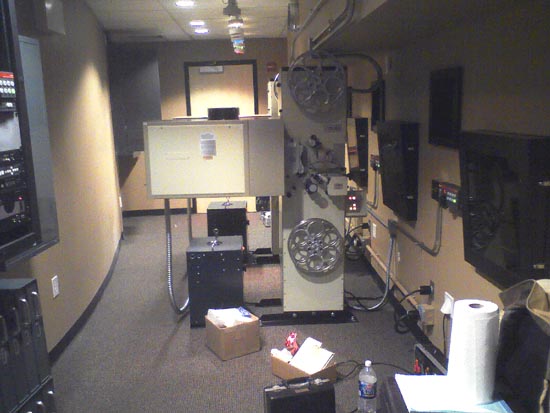
The shutter box for the FP20 or FP30 hasn't changed in forever other than the original was a nicer rolled piece the current one has sharp corners.
The inching knob on the sprocket shaft came about since the old inching knob was right on the motor itself. With the Pabst direct coupled motor, there is no shaft to grab onto. It suppose it would be possible to put a gear reduced shaft in the chain path, if they wanted to. I think there was such an option, once upon a time. If you want to give Kinoton a headache...order your next FP30D with a 8990 242 500100 "Drive unit with handwheel built-in projection unit." It will probably make them scratch their heads ![[Smile]](smile.gif) In their mind, once they gave you the "POS" button, there was no need for the inching knob.
In their mind, once they gave you the "POS" button, there was no need for the inching knob.
The FP20A is mislabeled, in my opinion...it has zero relationship to the FP20 line but they couldn't use the FP30A designator since that had been taken. The "A" line is their "Affordable" line, as some call it. On the FP20A...like all As the turret does not move out for easier film threading. The rear door isn't a door but a cover so you have to unscrew the panel to service the unit rather than just opening it up. You also do not have as many choices on accessories...just the basics and popular items (cue sensors and such). With the A series you loose the inverter drives (hello capacitors)...and I believe the control boards are different too.
Steve
Posted by Stephen Furley (Member # 1277) on 12-29-2009, 01:27 PM:
Steve, those machines look very much like the ones at the Clocktower. The main differences seem to be the larger lamphouses, the reverse scan readers and, as you say, the controls in a sensible position. Is the inching knob on the bottom sprocket? On ours they were on the top.
Actually, the whole box is quite similar in shape, and the door is in the same place. The sound rack used to be where the roll of paper towel is, but was moved further right to make room for the digital, and beyond that is the projectionist's desk. Along the back wall are two rewind benches, the hand one being mounted on a cupboard for spares, the lens cabinet and the 6k spools; the 2k ones go underneath the powered rewind bench. In the corner behind the desk is the fire escape, a hole in the floor with a ladder going down. There are railings around it, and now a gate, but I've almost had an accident with it more than once.
The box was fitted into a difficult existing space; there's very little space to squeeze between the benches and lens cabinet on one side, and the lamphouses and rectifiers on the other.
The controls are really odd, there are panels on the wall for most things, but no motor start and stop, so you have to use the silly ones on the front of the column. The problem is that you cannot reach them while looking through the viewing ports, so you have to look through the projection ports to start the motors; it is then possible to move up to the viewing ports and use the panels on the wall to do the changeover if you want to. You also have to hold out the knob on the red roller for a few seconds when starting, or the film tends to jump out of it, so the ACOP trips when you do the changeover. It's not too bad once you get used to it. They don't use the machines much now, most features are on digital, and the last time I saw a film there a few weeks ago, so were the adverts. There were no trailers on that show, but I suspect they're digital as well now.
Posted by Steve Guttag (Member # 268) on 12-29-2009, 04:33 PM:
This was an installation photo...you may have noticed another port near the paper towel roll...that is where the video projector now lives. There is a desk to the right of where the picture was taken...I seem to recall the lighting board is there.
As for lamphouses...I use the larger lamphouse for 2-7K. I only use the smaller one for 1-1.6K.
The inching knob is on the lower sprocket on this one, yes. However, they added idler gears to ensure a good wrap on it. On earlier ones, you HAVE to use the upper sprocket. The chain only its about 4 teeth on the lower sprocket on its way to the take up gear and if you have "accelerated frictions" then it is more like 2 teeth! The upper sprocket always gets 180-degree wrap of the chain. Much more robust.
As for the controls...they are simple enough for any installer to put up...just passive switches. I use a toggle for the motor and a push button for the changeover.
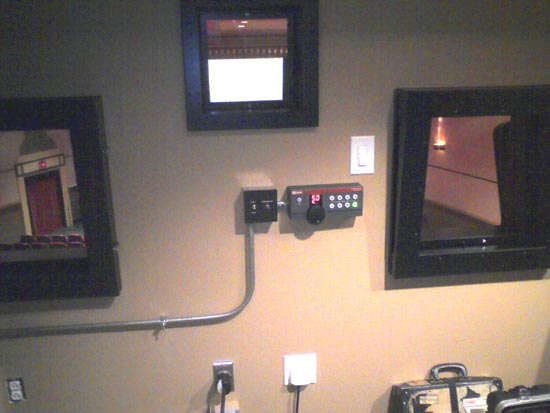
I started doing that once I saw someone blow a changeover because they hit the wrong button on the control panel...with this simple device you can do it all by feel and just what you need is there. I have one customer that wants toggle switches on both the motor and changeover but other than that, this has worked most everywhere with great success. In fact, when the AFI/Silver photos are posted (I hear it may be as soon as this Friday 1/1/10) you will see the same theme but on a Crestron panel...hard buttons for Start, Stop and Changeover and again, the operator need never take their eyes off the screen for a changeover.
Kinoton makes it so easy to add these switches too with their interface boards.
Steve
Posted by Scott Norwood (Member # 30) on 12-29-2009, 05:09 PM:
No footpedals? Seriously, though, that's a great-looking installation.
The problem with the Kinoton control panel thing is that every button looks and feels exactly like every other button, and there are usually some buttons that do nothing. If the motor start and c/o buttons were physically separate and different sizes and/or shapes, the concept would work fine.
Posted by Jeremy M Smith (Member # 4913) on 12-30-2009, 12:55 AM:
is the threading any different between models I have to give a training shift on one of these next week and I have never threaded one myself.
Posted by Steve Guttag (Member # 268) on 12-30-2009, 06:27 AM:
Nope, the threading is essentially the same for the FP10, FP20 or FP30 or FP40 and FP50.
Posted by Stephen Furley (Member # 1277) on 12-30-2009, 06:55 AM:
Steve,
What's the 40; I've never heard of that?
Are you talking about the new FP-10A portable(ish) machine, or was there an old FP-10?
The 20 and 30 are the column machines, the 25 is the all-in-one thing with the large spools underneath, rather like the old Fedi machine. Might suit the lady with the very small cinema and one machine. The 50 is the console type setup; never seen one, consoles are not that common here, and were rare until quite recent times.
The FP-3 was the old Philips portable with the spools on the back wasn't it, and I think the FP-5 was an older, more conventional, Philips machine before the 20 came out.
Were there any others?
Posted by Demetris Thoupis (Member # 833) on 12-30-2009, 08:22 AM:
FP40
Although in Russian it still gives you a good idea what it looked like. Somewhere in the office I have a brochure of even a portable Kinoton the 25P or 28P if I remember correctly which was discontinued.
Demetris
Posted by Stephen Furley (Member # 1277) on 12-30-2009, 08:55 AM:
Cпасибо товарищ (Thank you comrade). I think I've spelled that right; somebody tell me if I haven't.
It looks almost the same as the 50, and my Russian isn't good enough to be able to read the text. I don't think it's on the English site.
The long-closed MOMI in London used a couple of portable Kinotons, with incandescent lamps, feeding off an endless loop platter, projecting on small screens in the documentary and French cinema sections. I think these were the first Kinotons I ever saw.
Posted by Damien Taylor (Member # 4255) on 12-30-2009, 08:57 AM:
quote: Stephen Furley
The FP-3 was the old Philips portable with the spools on the back wasn't it
Correct, they are great little machines.
Posted by Stephen Furley (Member # 1277) on 12-30-2009, 09:09 AM:
The Projected Picture Trust had one in their collection at Bletchley Park.
35mm portables have always been a bit of a problem. First there was the nitrate issue; by the time that was solved 16mm was well established for many portable applications, and unless you were only running shorts you needed to carry two projectors around. Some of the later portables in the '70s could run 6k spools. Platters don't really lend themselves to portable working, and towers are more transportable than portable.
Posted by Damien Taylor (Member # 4255) on 12-30-2009, 09:35 AM:
My FP-3 has what appears to be some original nitrate running measures. There is a loop of burnable thread above the gate holding wires linked to a spring loaded guillotine over the hole where film enters/exits. I have a 6K magazine for my unit, so I could never really tell its age.
sorry for being OT
Posted by Stephen Furley (Member # 1277) on 12-30-2009, 10:00 AM:
How do you use 6k with a FP-3? The original was a sort of reversed 'B' shape thing on the back containing both spools wasn't it? Does the 6k one replace this, or sit behind it, or what? Is it attached to the projector or free-standing? Made by Philips, or third-party? Do you have a picture?
Even with such precautions on the projector a fireproof projection room would still be required in most places. I've even seen pictures of a sort of metal shed, which could be erected inside a hall for this purpose. In the event of a fire which did spread beyond the projector I'm not sure if the projectionist is supposed to burn, or open the door of the shed thing, and let the fire get to the audience; either ways it doesn't seem like a good idea.
Until quite recent times organisations which hired out halls for events sometimes had a condition which expressly prohibited the use of 35mm film; presumably in case somebody brought in an old nitrate print.
I'm also aware of somebody who once, many years ago now, knowingly ran a nitrate print in a hall, with the projector at the back of the audience. I was in the audience, and didn't realise at the time. I would certainly have said something if I had done.
Even more OT, let's get back to talking about Kinotons.
Posted by Steve Guttag (Member # 268) on 12-30-2009, 10:04 AM:
The FP40 came before the FP50 and it was a very big boy. Rack space on both sides of the console! But yes, essentially the same as the FP50...particularly in the projector.
Steve
Posted by Demetris Thoupis (Member # 833) on 12-30-2009, 10:23 AM:
Truly portables were the Cinemeccanica Portacine, the Pion Pion, Prevost makes one the PX86, Microcine and when I get back in the office I try to scan and post the pic of the Kinoton baby portable brochure I have. I know Fumeo made a Portacine replica and another and also some Russian one. Westar did and also a chinese company did but I would stick with Portacine or Prevost or Microcine.
Demetris
Posted by Stephen Furley (Member # 1277) on 12-30-2009, 11:15 AM:
There was the Micro-Kino, I wonder if that's the same thing as the Micro-cine, just different names in different places. Then there was the one with the 'T' shaped spool arm on top; somebody posted here who was having a problem with one a year or so ago. Or was that one the Micro-kino? There were two different ones around in the '70s and I can't remember which was which. The other one had the spools on top, and at the front, like an old Ampro 16mm. I used a Russian one once, probably '60s, but I don't know what it was called.
There's the old Simplex portable, built into a square black metal box, with the take-up spoolbox inside and the feed one on top. I only ever saw one running once; the light output wasn't up to much. In between, date wise, there was the De Vry portable.
Wasn't there a Cinemeccanica/Fumeo one, made by one and branded by the other I think.
I'd forgotten the GBN portable, wartime, could also be used with an arc lamp on the back. They were the main machines seen in the film 'This Film is Dangerous'.
I doubt that I've ever seen more than about ten 35mm portables. In my day 35mm was used in cinemas, which had permanent projectors. Almost any other type of venue in which film was shown was 16mm.
Posted by Steve Guttag (Member # 268) on 12-30-2009, 11:45 AM:
The Cutest 35mm portable was the Kinoton FP23T. They even had a mating dubber for it. It was around in the mid '90s.
Historically, they had the FP23 (no suffix) that was on a tripod like thingy
Posted by Demetris Thoupis (Member # 833) on 12-30-2009, 11:47 AM:
EDIT: Steve beat me to it. Stephen the following is for your post. Steven yes you are correct. Is the 23T and not 25 or 28P as I said above. I will post a pic when I get in the office after new year.
Stephen, Yes it was the PortaCine. The portacine was done by Cinemeccanica and rebranded by Fumeo for a while. It was the V12 projector before it became V12. Only in production for 5 years though. 500Xenon and 1000WHalogen was available.
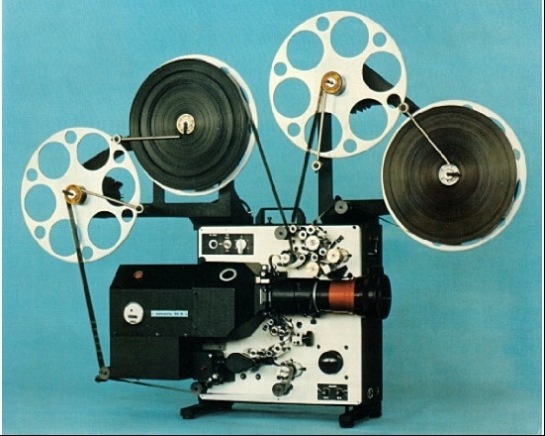
Here are some pictures of the Portacine.
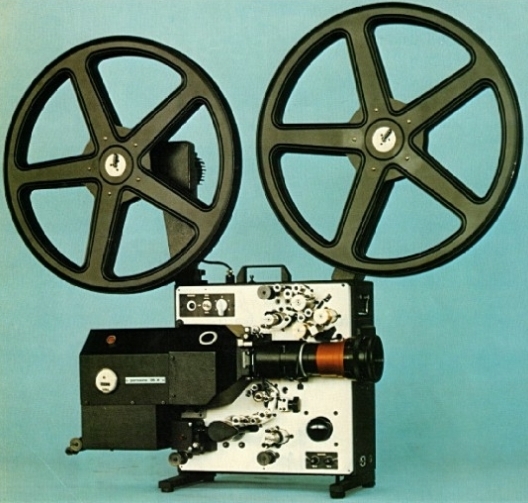
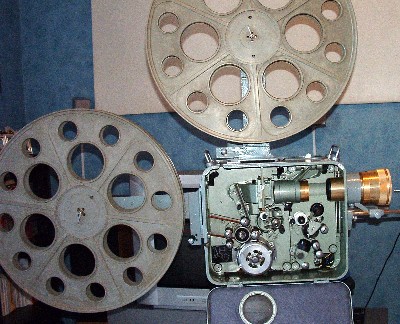
Stephen was the Russian portable you used this one?
CARL ZEISS TK35
Posted by Stephen Furley (Member # 1277) on 12-30-2009, 12:12 PM:
I'm not sure; it was a long time ago, early '70s I think. It had 2k spoolboxes rather than 6k arms, but it was a box type thing like that, and I think it did have the lamp on the side with the mirror, like this one seems to have. I also seem to remember there being a carbon arc lamphouse available which bolted on the side, though the one I ran didn't have this; it was heavy enough without it, I remember carrying the thing up many flight of stairs.
I've just noticed the two handles, front and back, which also seems familiar, but your one says CARL ZEISS. Were they made for Carl Zeiss in Russia, or did the Russians make a copy of it or something?
I'd also forgotten the rather nice little Chinese made one which was being sold a few years ago, with halogen or xenon lamp. Somebody has used one at the BFCC (British Film Collector's Convention) in Ealing, and I think one of our members here had a pair of them that he was doing portable shows with. Very small, not much bigger than a 16mm machine, and reasonably light. Only 2k spools though, but probably adaptable
Posted by Damien Taylor (Member # 4255) on 12-30-2009, 06:48 PM:
OK you guys are still talking about portables so I guess I'm not derailing anymore
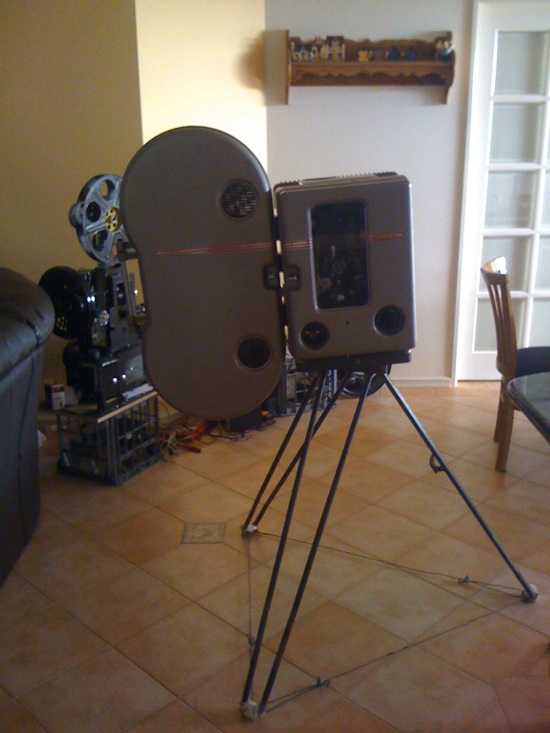
Here is my FP3 in 2K/tripod config
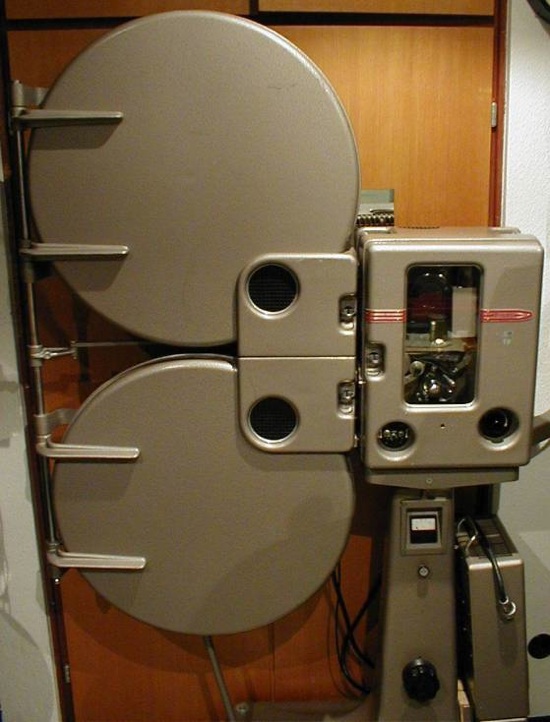
And here it is with the Cast base and 6K reels. This is someone else's picture but they have the same vintage unit.
Posted by Demetris Thoupis (Member # 833) on 01-08-2010, 03:03 PM:
quote: Stephen Furley
Wasn't there a Cinemeccanica/Fumeo one, made by one and branded by the other I think
Here is the Cinemeccanica rebranded as Fumeo.
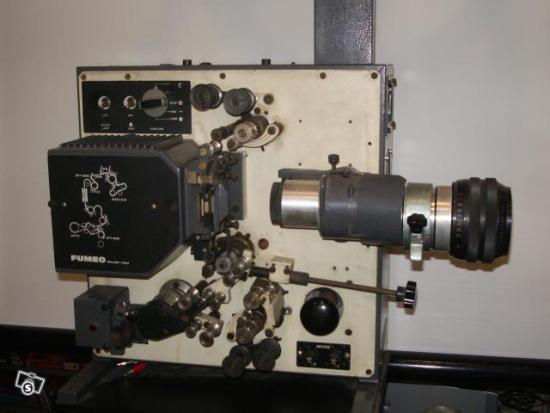
Demetris
Posted by Mitchell Dvoskin (Member # 751) on 01-08-2010, 04:07 PM:
And then there was the Marin MP-30 from Spain, which was widely imported into the USA.
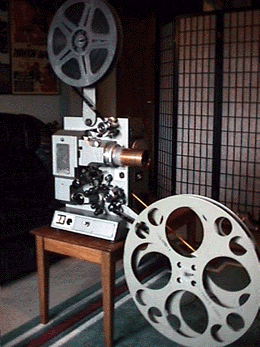
Posted by Stephen Furley (Member # 1277) on 01-08-2010, 04:27 PM:
That was the other one that I couldn't remember the name of Mitchell.
Posted by Christian Appelt (Member # 1067) on 01-08-2010, 04:30 PM:
quote: Stephen Furley
I've just noticed the two handles, front and back, which also seems familiar, but your one says CARL ZEISS. Were they made for Carl Zeiss in Russia, or did the Russians make a copy of it or something?
There were two Zeiss brands after WW2, Zeiss Jena (East Germany) and Carl Zeiss of West Germany. The TK35 portable was introduced around 1948. In East Germany, mobile units with double TK35 changeover setups brought the movies to small towns which had no regular cinema.
There is a Russian clone called the KN19 (there are more models, but I've never seen them) with small alterations. In the 1990s, a company from India had a 99% TK35 lookalike, they proudly told me they had developed it just some time ago...
Film collectors have done any modification you could imagine on TK35s, from 6000-ft.-spools to red light conversions and of course new lamp systems using quartz or xenon bulbs.
It is the smallest professional 35mm machine I know, and if handled well, it is gentle enough on film as long as you don't depend on the framing mechanism (just an idle roller below the intermittent). In East Germany, the state film distributor gave a bonus payment to travellings projectionists who could handle more than 2 million meters of film without breakage or torn sprockets, and they did it using TK35s.
In West Germany, Bauer's Sonolux portable machines (using a solid B5A projector head, but weighing three times more than a TK35) were used for mobile operation.
Here are some nice pictures of the original TK35 setup, complete with tripods and sound equipment:
TK35 setup
Powered by Infopop Corporation
UBB.classicTM
6.3.1.2