This is topic Lamphouse wire size and type in forum Film Handlers' Forum at Film-Tech Forum ARCHIVE.
To visit this topic, use this URL:
https://ft-forum.com/ft/cgi-bin/ubb/ultimatebb.cgi?ubb=get_topic;f=1;t=010247
Posted by Richard May (Member # 2627) on 01-02-2010, 11:06 AM:
So what is the right or best type of wire to use for the DC connections of a lamphouse? Also, what is the proper wire size? I know it depends on amperage and length. What is the best way to determine this?
Posted by Steve Guttag (Member # 268) on 01-02-2010, 11:38 AM:
Welding cable...can't beat it...it is high strand count for flexibility...available in most sizes in black or red. The longer the run, the higher the amperage, the larger the gauge.
Without commenting further, Strong uses 4awg for 2500-Watts and smaller and 2awg for 150A and smaller...on runs less than 10-feet.
We will often use 1/0 for larger lamps (4KW-7KW).
Steve
Posted by John Hawkinson (Member # 1135) on 01-02-2010, 11:42 AM:
"Ask an electrician."
Size of the cable should be determined by the maximum allowable voltage drop you are willing to tolerate, which should be primarily dictated by length of the run, but also has to do with what your rectifiers can support. Length (and current) dictates voltage drop, which dictates the wire gauge. Look this up in the NEC, or your favorite table.
For short runs that flex, welding cable is expensive but nice. For long runs (unlikely in modern booths, but possible), THHN is cheap and reasonable.
(Hmm, I see Steve posted while I was typing. Well, I'll post this anyway...)
--jhawk
Posted by Tom Sauter (Member # 616) on 01-02-2010, 11:45 AM:
Once in a pinch where a loose lamphouse connection overheated and burned all the wiring, an auto parts store was able to supply me with battery cables of the correct guage and stranding. They even had nice shiny new terminals! Its important to note that insulation that is UV and high heat resistant is important inside a lamphouse, so read specifications carefully.
Posted by Mark Gulbrandsen (Member # 72) on 01-02-2010, 11:46 AM:
Welding cable is not that expensive for what it is. #4 is good for 100 amps continous. Note also that N.E.C. specifies that wire feeds for Arc Light or Xenon circuits should be the next larger size than one might ordinarily use for a given circuit. So be sure to use the next larger size wire for that feed so you pass inspection.
Mark
Posted by Steve Guttag (Member # 268) on 01-02-2010, 02:22 PM:
Yeah...I've never had welding cable be a cost issue. Many places will sell you cut-lengths so you only need buy what you need. THHN is a poor choice, I my opinion, as the connection to a typical lug in the lamphouse or rectifier is not likely to be optimal. Welding cable just plain works well.
Steve
Posted by Richard Fowler (Member # 893) on 01-02-2010, 02:27 PM:
Typical welding cable has a 60 degree C jacket. I usually dress that type cable at high temperature points with 3M #27 glass tape. Better is 90 degree C rated HOFR welding cable. Best is 150 degree C silicon/glass jacket cable or thermal / U.V. resistant cable such as Cobra X-Flex 150.
Posted by John Hawkinson (Member # 1135) on 01-02-2010, 02:34 PM:
The case where we used THHN was a 50' run from rectifiers to lamphouses. That's probably atypical. But THHN was substantially cheaper than welding/battery cable. Though looking at the pricing now, they are closer than I recall.
--jhawk
Posted by Ian Parfrey (Member # 5122) on 01-02-2010, 03:04 PM:
John.
Do you know what kind of voltage drop you had over that 50' run?
Posted by John Hawkinson (Member # 1135) on 01-02-2010, 03:28 PM:
This was 4AWG and 2k bulbs, and I think the 4AWG was undersized. My notes (fragmentary, I might be misreading) suggest we saw about a 4V drop under load (way too much!). On the other hand, it (90C THHN 4AWG) was much better than what it replaced (60C TWG 6AWG).
Why do you ask? I guess we can measure it easily enough.
--jhawk
Posted by Louis Bornwasser (Member # 3063) on 01-02-2010, 04:01 PM:
For longer runs "code" diameters are not large enough. Poor lamp life can be attributed to voltage drop (only during ignition) across long lengths of cable.
Inrush current at 4000 watts is easily over 1000 amps; for that reason, Strong has specified up to #000 for high wattage bulbs. This makes the case for having the rectifier nearby, like in a console.
You will note that Christie uses wire on the smallish size. Part of their regulation is that very voltage drop. Louis
Posted by Richard May (Member # 2627) on 01-02-2010, 04:22 PM:
Since I'm only dealing with 2K lamps and the runs are no longer than 5 or 6 feet, #4 welding cable sounds good.
Posted by Steve Guttag (Member # 268) on 01-02-2010, 04:42 PM:
Yeah...do a google search...you'll find suppliers that supply red and black by the foot.
Posted by Mark Gulbrandsen (Member # 72) on 01-02-2010, 06:54 PM:
Note though that welding cable is not 600 volt cable so it should be ennclosed in flex, conduit or what ever. If you need cable with 600 volt rating as a few local codes specify then locomotive cable is the only route you can go. It's identical to welding cable except for it's 600 volt rating.
Mark
Posted by Gordon McLeod (Member # 33) on 01-02-2010, 10:40 PM:
actually welding cable must be in free air as its insulation is not rated for in flex
we buy what is CSA rated entertainment cable now days for our dc leads
Posted by Steve Guttag (Member # 268) on 01-02-2010, 10:51 PM:
The Coleman brand cable we use is indeed 600V rated and is "welding" cable.
Posted by Ian Parfrey (Member # 5122) on 01-03-2010, 01:10 AM:
John.
quote: John Hawkinson
Why do you ask? I guess we can measure it easily enough.
I'm just interested in how far a high amperage DC run can be without too much drop.
One cinema I worked at had Irem's on the back of Bauer U3's and 4's. The run there was around 55-60' but I can't recall the drop over that distance.
Posted by John Hawkinson (Member # 1135) on 01-03-2010, 02:27 AM:
Well, I'm not totally sure what you mean. You can go as far as you want to go and take as much drop as you want to drop. Problems you run into:
#1 (obvious) if you get too much drop, then the voltage required on your rectifier to make the voltage you need at the lamphouse may be too much, and your rectifier can't support you.
#2 (subtle) if you have a lot of drop, that means you have ohmic heating (I^2*R) in your conductors, and as their temperature rises, then their resistance rises, leading to greater voltage drop. And for a typical rectifier, that is essentially maintaining a fixed output voltage, that means as the resistance changes, the effective voltage seen by the lamp drops over time, and that means the current draw from the lamp drops over time. So you could see, e.g., a lamp that spikes to 90A for the first two minutes and then falls back to 70A once the wires start cooking. (Obviously this is not a great place to be.)
Louis: I'm a little puzzled by your inrush concerns. What's the problem with overcurrenting the conductors for a few milliseconds? They won't heat up enough to be a problem, nor will they appreciably limit the current. At least, that's not been my experience and I don't see why it should happen fro ma theoretical standpoint. I assume you've seen a practical example of this behavior?
--jhawk
Posted by Frank Angel (Member # 248) on 01-03-2010, 09:30 AM:
I have no idea what the cable electricians used in our park installation other than it looks to be about #04, very flexible so I am assuming fairly high count strands with the run being about 50 ft from the IREMs to the lamphouses. They use twistlocks on at the rectifiers. We are burning 4500w.
Thing is, this wire does get warm to the touch and it stays that way as a kind of steady-state, never getting hot. This always worried me figuring there's more resistance than there should be, but it has never caused any problems -- voltage reads fine pulling correct amperage and it's been running that way since the installation so my assumption is that it ain't broke.....
No indication anywhere along the away that there is heat deterioration at the contact points, either in the lamphouse or at the large twist pigtails (it's all portable so the lamphouse has to be able to disconnect easily for break-down).
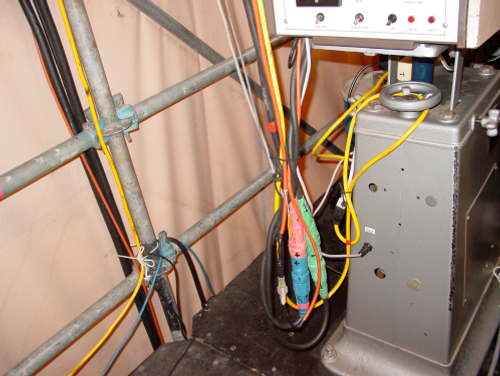
The pigtail connections get warm as well. Do you think I should be concerned? Should this cable be replaced with a larger guage?
Posted by Steve Guttag (Member # 268) on 01-03-2010, 10:23 AM:
The cables will get warm...I would definitely get it to #2 or larger though for 4500 watts. Ask your electrician what he should use on 155A DC....likely he won't think #4.
Steve
Posted by John Hawkinson (Member # 1135) on 01-03-2010, 11:38 AM:
Frank: you should measure the voltage drop under load and see...measure the DC voltage at the rectifier, measure again at the lamphouse. How much do they differ?
Also, measure across connection points...remember that if you have 0.1 ohms of resistance, well at 155A amps that'd be 15 volts! So a little adds up. And it's easy to get a hundredth of an ohm here or there with a loose connection...
Cables should have their designation printed on the exterior. It can be tough to tell wire gauge by diameter, though. For instance, #4 THHN is .318" outside diameter. But #4 welding cable might be .380" from one manufacturer or 0.420" from another. And while you got there #2 THHN was was 0.378"...
When you say pigtails, you mean the Cam-Loks in your picture? It sounds worrysome to me if those are warm, yeah...
--jhawk
Posted by Mark Gulbrandsen (Member # 72) on 01-03-2010, 03:16 PM:
quote: Gordon McLeod
actually welding cable must be in free air as its insulation is not rated for in flex
we buy what is CSA rated entertainment cable now days for our dc leads
In nearly 35 years I've only encountered a handful of locations in the USA where open DC cables were allowed. Even the Imax and Iwerks 400 amp cables(welding type)were installed in flex or conduit.
Mark
Posted by Phil Hill (Member # 371) on 01-03-2010, 03:23 PM:
Mark is correct. All 1570 15kW installs that I did with a "remote" Rectifier, code required the cables to be in metal conduit.
I used 4/0 600V Carol SUPER VU-TRON WELDING CABLE cable.
Ummmm, jhawk... NO THHN! HA! ![[Razz]](tongue.gif)
Posted by Richard May (Member # 2627) on 01-03-2010, 07:14 PM:
In almost every theater here on Long Island, they are NOT installed in any kind of covering.
Posted by Frank Angel (Member # 248) on 01-04-2010, 11:49 PM:
Yah, John, the cam-locs in the pic -- they do get warm, but as I said, nothing seems unusual, such as any discoloration you might find if there were excessive heat at the contact points either in the lamphouse or at the cable connection clamps in the rectifiers. Although, you might recall we did have that relay in one of the IREMs blow up on us a few summers ago.
After that little fun evening, now when we pull everything out of storage in June, I routinely check the all the contacts there and in the lamphouse for any oxidation and corrosion -- everything lives in storage all year round except for the summer festival.
No idea about the voltage drop -- it will have to wait until next summer for me to test it.
Posted by Mark Gulbrandsen (Member # 72) on 01-05-2010, 08:22 AM:
quote: Richard May
In almost every theater here on Long Island, they are NOT installed in any kind of covering.
I think codes were more a little more liberal with allowing that not even too long ago. It was also common in the Chicago area on locally installed rectifiers. Codes regarding arc and xenon have tightened up a bit in the last 5 to ten years or so. It is also highly likely the inspector had no clue as to what he was looking at...
Frank,
They will get warm... that is ok... hot is not ok!
Posted by Frank Angel (Member # 248) on 01-05-2010, 12:10 PM:
Never had an inspection at that site, Mark, it's all "portable" and that seems to allow for great leeway. Plus, it's city owned & operated. The city, unfortunately, doesn't inspect itself, or when it does, it might write up a violation, but it go nowhere; it simply vanishes.
In our theatre we had a major fire that gutted our entire office complex of 10 offices and a work islands and conference rooms. This suite has exits directly into one of the theatre's lobby and directly on top of another theatre. In a building housing four theatres which had a major fire, you would think there would be even a modicum of attention paid to the building's fire alarm system.
Not so -- The announciator system has every trouble light lit and the alarm siren and strobe were going off routinely two and three times a week giving false alarms. The solution that they came up with? They disabled the system....in a building that had already had a fire. The system has been disabled for at least two years now.
And the Fire Department KNOWS about it because I personally went out to a fire truck that was parked outside our theatre one day and ask one of the firemen who was standing outside the truck, who do I speak to about a serious violation, pointing to the building that still had smoke marred bricks above each of the windows. The captain stuck his head out of the truck and said, "You talk to me. Dave and Tommy, you go with this guy." I took them to the fire control panels, showed then all those pretty red LEDs lit up and the key switch set on DISABLE. They wrote it up and seemed very concerned, but that was the last I heard of it.
My solution? -- I just keep a fire extinguisher next to my desk at all times & know exactly what exit door closest to me I'll be running out of the minute I smell the slightest wiff of smoke. clear the place in 5 minutes.
Posted by Richard Hamilton (Member # 321) on 01-05-2010, 01:47 PM:
quote: Frank Angel
I'll be running out of the minute I smell the slightest wiff of smoke
![[uhoh]](graemlins/uhoh.gif) pussy!
pussy!
Posted by Phil Hill (Member # 371) on 01-05-2010, 03:58 PM:
Rick, you're terrible! HA! ![[Wink]](wink.gif)
Posted by Ian Parfrey (Member # 5122) on 01-05-2010, 04:54 PM:
Now, a REAL TECH would smell the smoke, empty the corporate drinks cabinet, consume contents of said cabinet, personally extinguish the conflagration using expended contents of cabinet contents, ensure the safe evacuation of all the cute co-workers and bask in the glory and physical adoration from the womenfolk in the building.
But hey, we can't all be Angels. ![[Big Grin]](biggrin.gif)
![[beer]](graemlins/beer.gif)
Seriously, Frank has done all that is possible and within his power to bring his concerns to the appropriate authorities, and it is no reflection on Frank that his concern for safety is overwritten by the dumb-ass inanity of governmental institutions...these same institutions, co-incidently, that would come down like a ton-of-bricks should any of us even think of doing the same thing that they allow themselves to do (and get away with). If I was Frank, his own actions would be safely diarised and stored offsite for possible future use when the going gets nasty.
So, on to my movie review for this all-action crash bang wallop 3D spectacular....
CINEMA: Frank's Theatre
AUDITORIUM: 1, if still standing.
PRESENTATION: 35mm (Yay- real sprockety-type perforated plastic type stuff) Dobly Digital audio - "Does that sound like flames!?"
PRESENTATION PROBLEMS: None, except some smoke haze in the projection beam.
MANAGERIAL PROBLEMS: Now, where do we start!
RATING: Technician's concern for safety aspect - 8 stars out of 4
RATING: Management's concern for safety aspect - 0.1 stars out of 8
Comments: What can one say about the progress 3D has made to the Disaster genre of movie making? The visual effects of the flames licking the ceiling, the density of the smoke in the office alcoves, the charred remnants of co-workers all meld to produce an extremely powerful experience that makes one want to leap into the screen and grab those moronic, brain-dead beaurocratic dum-asses and throttle them.
One can only hope that this plot will remain the imagination of a creative filmmaker and never cross that third wall into the realm of reality.
Posted by Mark Gulbrandsen (Member # 72) on 01-05-2010, 08:26 PM:
Frank,
That is legal for portable equipment. So are the twist locks. I did it for all too many movies over way too many years... Now my back is paying for it!
quote: Ian Parfrey
Now, a REAL TECH would smell the smoke, empty the corporate drinks cabinet, consume contents of said cabinet, personally extinguish the conflagration using expended contents of cabinet contents, ensure the safe evacuation of all the cute co-workers and bask in the glory and physical adoration from the womenfolk in the building.
Hey, I really like that idea Ian! I might just apply to be Frank's relief projectionist.
Posted by Frank Angel (Member # 248) on 01-08-2010, 09:43 AM:
You guys are a laugh riot -- Ian, send that script to Irwin Allen and we've got ourselves a blockbuster. And it definately should be in two projector 3D (Mark, you'll have to align so it's perfect -- flames surrounding the audience....what great 3D special effects. Oh, wait....those are real flames! ![[Embarrassed]](redface.gif)
Posted by Louis Bornwasser (Member # 3063) on 01-08-2010, 11:15 AM:
You MUST watch Matinee, a send up of William Castle. Louis
Posted by Steve Guttag (Member # 268) on 01-08-2010, 08:33 PM:
Matinée should be required watching of any theatre person...and if you don't get it...watch it again (and again) until you do!
It is a great movie in its own way.
Steve
Posted by Mark Gulbrandsen (Member # 72) on 01-09-2010, 11:24 AM:
Have seen it many times... I still prefer "Smallest Show On Earth"!
Mark
Posted by Rick Raskin (Member # 1561) on 01-09-2010, 11:46 AM:
I'm not familiar with Matinee. IMDB lists several versions. Which are you referring to?
Posted by Steve Guttag (Member # 268) on 01-09-2010, 01:53 PM:
Why with John Goodman, of course!
It has "Rumblerama" and "Atomovision" and much, much more.
Steve
Posted by Louis Bornwasser (Member # 3063) on 01-09-2010, 04:39 PM:
Very effective, too, judging by the condition of the balcony! Louis
Posted by Rick Raskin (Member # 1561) on 01-09-2010, 04:41 PM:
Of course.
Posted by Steve Guttag (Member # 268) on 01-09-2010, 04:47 PM:
...except the balcony, we'll put a second theatre up there...the wave of the future...
Powered by Infopop Corporation
UBB.classicTM
6.3.1.2