This is topic Modern B&W sound tracks in forum Film Handlers' Forum at Film-Tech Forum ARCHIVE.
To visit this topic, use this URL:
https://ft-forum.com/ft/cgi-bin/ubb/ultimatebb.cgi?ubb=get_topic;f=1;t=010300
Posted by Jeff Else (Member # 4063) on 01-31-2010, 07:33 PM:
how do modern black and white soundtracks compare with their cyan counterparts? we are running a print of "american astronaut" from 2001 in SR and, subjectively it sounds as good.
Posted by Monte L Fullmer (Member # 2797) on 01-31-2010, 07:44 PM:
Really, there is no basic difference in B/W "silver" soundtracks compared to cyan (why cyan is that the entire print can be developed intead of the older high magenta style which had to be developed separately then the picture .. it's an enviornment thing) soundtracks ...
It's the reverse scan LED readers that made the difference in optical reproduction and cyan added to that difference since red light passing through the cyan soundtrack creates a total black background which is great stuff for optical playback.
-Monte
Posted by Jeff Else (Member # 4063) on 01-31-2010, 10:06 PM:
i see. modern b & w soundtracks don't have silver in them, do they?
Posted by Damien Taylor (Member # 4255) on 01-31-2010, 11:03 PM:
Most of the black tracks I have seen in the last couple of years are actually very dark purple or red, the red prints being of german manufacture (red bull commercials)
Posted by Ian Parfrey (Member # 5122) on 02-01-2010, 12:26 AM:
If the "modern B&W print" is printed on B&W stock, the entire image and soundtrack will contain silver.
I have seen some "B&W" films printed on colour stock, and if this is the case and it has a cyan track, then there will be no silver in the track- just dye. If it's printed on colour stock and has a hi-magenta or regular deep blue/purple track then there will be some silver in the track.
Posted by Jeff Else (Member # 4063) on 02-01-2010, 12:59 AM:
i see... not knowing much about the whole process i was unsure if silver had been eliminated or just reduced.
Posted by Jonathan Smith (Member # 5609) on 02-01-2010, 02:33 PM:
I think it was reduced in high magenta (not eliminated) but is just dye now that cyan tracks are used.
Obviously, a real B&W print is made up of black metallic silver in the areas that aren't clear, so it is about 40-50% of the silver left from the original raw-stock in the developed print.
So, modern prints in just about every country on the Earth are now completely free of silver in their finished form.
I know Japan phased out silver soundtracks 3-4 years after the U.S. did, but am not sure if there aren't a few holdouts still left somewhere. . .
Posted by Ian Parfrey (Member # 5122) on 02-01-2010, 03:19 PM:
quote: Jonathan Smith
I know Japan phased out silver soundtracks 3-4 years after the U.S. did, but am not sure if there aren't a few holdouts still left somewhere. . .
I handled a print of the Bollywood film "Jab We Met" recently and it had the usual, older style deep-blue/purple type re-developed soundtrack so there are some still being made in Mumbai labs.
Posted by Jonathan Smith (Member # 5609) on 02-01-2010, 03:33 PM:
Is that high-magenta, Ian?
It's been so long since I've dealt with anything but cyan optical tracks (being a first-run projectionist mostly), that I forget exactly what the progression was.
If I recall correctly, at least in the United States, they went from silver-only soundtracks in the early '90s, to High magenta (color developed, but still retained silver too) which could work with old analog lamps but also the new red LEDs, to cyan (dye only) in the early 2000s.
Silver doesn't work well with red LED lamps, and cyan doesn't work well with the old analog lamps either.
So high-magenta was sort of a cross-compatible stopgap that wouldn't compromise the sound too much on either the old lamps or the new LED systems.
The big advantage of getting rid of silver is that it is an expensive precious metal, a non-renewable resource, & a biohazard if it gets in the groundwater.
Since all camera and print films use silver to form the color dyes, it's in the best long-term interest of motion picture film manufacture if the labs can recover practically 100% of the silver from color film. It's cheaper to recover silver than to keep mining it.
And, of course, eventually, we'll run out of silver if we can't recover a good percentage of it that we use. Before digital photography and cinema, in the late 1990s, I remember reading that silver and silver-halide photo imaging systems (camera film, X-ray, graphic arts) consumed eight or nine million troy ounces of silver PER YEAR. I'm sure it has gone down since then, but the film companies probably still go through at least half of that now.
Posted by Ian Parfrey (Member # 5122) on 02-01-2010, 05:16 PM:
Johnathon.
The "Jab We Met" print definitely wasn't a Hi-Magenta print. It was a pre-Hi magenta track which is what I found strange for a 2007 film and something I hadn't seen for 3-4 years at least. The analogue track didn't sound all that good either with high levels of distortion but that may have been because it was recorded very hot and compressed heavily.
Posted by John Hawkinson (Member # 1135) on 02-01-2010, 06:46 PM:
Remember, labs can screw up. I had two recent prints of Annie Hall, which had its soundtrack remastered as SR High Magenta. But one was printed as conventional analog, and one was printed as high magenta -- from the same negative.
You can't do that. The conventional analog one sounded like crap, no matter what you did....
--jhawk
Posted by Carsten Kurz (Member # 5396) on 02-02-2010, 06:02 AM:
'Das weisse Band', a german/austrian production which just received a Golden Globe, is distributed in germany in two versions - a monochrome print on colour material with a cyan track, and a 'real' B/W print with a silver sound track.
One cinema actually got one of the B/W prints - with a very faint, unusable SR and SRD track. The image had proper dark blacks. My thought was that they ran it through the same printer as the monochromatic colour version, but forgot to take out the filter for the cyan track? They later received a replacement, which was again a real B/W version with well exposed/developed SR/SRD tracks.
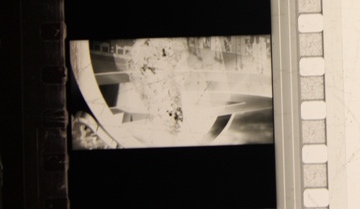
- Carsten
Posted by Damien Taylor (Member # 4255) on 02-02-2010, 05:41 PM:
quote: Jonathan Smith
Silver doesn't work well with red LED lamps
Wasn't the big sell for converting that silver tracks would "sound better than ever"?
Posted by Jeff Else (Member # 4063) on 02-03-2010, 01:37 PM:
the print that sparked this question is real black and white, with an sr-d track and it sounds great
Posted by Ian Parfrey (Member # 5122) on 02-03-2010, 04:35 PM:
quote:
Silver doesn't work well with red LED lamps,
This is surprising. I was under the impression that silver analogue soundtracks were the gold standard in all regards bar one - that of track noise.
As I understand it, the silver retained in the track in pre Hi-Magenta (deep blue/purple) tracks was to increase the opaque density of the image to wide-band white light, IR light source wavelengths and longer (red) wavelengths with a corresponding increase in cell output.
Sound degradation can occur with red led soundheads from chromatic aberrations and astigmatisms in white light sound lenses being used to focus narrow bandwidth red light.
It's my bet that this is why some red light installations don't cut the sound quality cloth when running silver tracks- although I have yet to run a B&W silver track that didn't sound good with properly aligned and calibrated rear scanning red light soundheads.
Posted by Jeremy Weigel (Member # 4208) on 02-03-2010, 05:29 PM:
quote: Carsten Kurz
One cinema actually got one of the B/W prints - with a very faint, unusable SR and SRD track. The image had proper dark blacks.
Our print of "Bandits" came in with a SRD and SDDS tracks that look like those in your pic. I actually kept a frame, because it was so odd to me. It is still the only print that I have seen like this. Both digital tracks did work though.
Posted by Mitchell Dvoskin (Member # 751) on 02-03-2010, 05:37 PM:
quote: Jonathan Smith
Silver doesn't work well with red LED lamps
Totally not true. Red readers work fine with silvered tracks.
The only silvered tracks that have an issue with Red readers are magenta density tracks, either because it is an old print that faded to red, or a reprint in high magenta. Variable area tracks play fine, as do density tracks that are black & white.
Posted by Ian Parfrey (Member # 5122) on 02-03-2010, 06:26 PM:
Mitchell.
Thats what I thought. ![[thumbsup]](graemlins/thumbsup.gif)
Powered by Infopop Corporation
UBB.classicTM
6.3.1.2