This is topic What can cause a missing tooth on a sprocket? in forum Film Handlers' Forum at Film-Tech Forum ARCHIVE.
To visit this topic, use this URL:
https://ft-forum.com/ft/cgi-bin/ubb/ultimatebb.cgi?ubb=get_topic;f=1;t=010306
Posted by Joe Redifer (Member # 3) on 02-05-2010, 08:10 PM:
Twice in as many weeks, an employee has informed me of missing teeth on a sprocket. For now I will just assume that he notices such things and is not somehow the cause. But the rest of the sprocket seems to be in good condition, no hooked teeth or anything. I have noticed no damaged leader or film. So what could cause a random tooth to go missing?
Both sprockets came from the same vintage machine, Simplex XL circa late 60's or so. One of them was the lower constant feed sprocket (which is very kind to film, by the way) and the other was the feed-out sprocket in the 5-star soundhead (which is impartial to downright rude to film).
Posted by Tony Bandiera Jr (Member # 2365) on 02-05-2010, 10:18 PM:
#1 cause is the use of a toothbrush on a running machine. Which in my theatres has resulted in loss of employment when the perp is found.
Or any contact with a tool or object other than film.
Posted by Monte L Fullmer (Member # 2797) on 02-06-2010, 01:24 AM:
? Which sprocket, the intermittent sprocket - caused by the shoes hitting the teeth if closed while running ?
Posted by Louis Bornwasser (Member # 3063) on 02-06-2010, 06:40 AM:
Must be a "foreign object."
You would know if there was something internal to the machine because of a unique sound.
Notice, also, that the tooth missing is ALWAYS on the sound track side of the sprocket. Louis
Posted by Joe Redifer (Member # 3) on 02-06-2010, 11:30 AM:
Actually no. The missing tooth on the lower constant feed was on the soundtrack, but the one on the feedout sprocket in the 5-star soundhead was on the inside. We don't have any toothbrushes lying around. Not sure what could have come into contact with a moving sprocket or why.
Posted by Stephen Furley (Member # 1277) on 02-06-2010, 12:04 PM:
They don't wear anything like a pendant or a cross around their neck do they, or even something like a security pass in a plastic holder?
Posted by Tony Bandiera Jr (Member # 2365) on 02-06-2010, 12:46 PM:
quote: Joe Redifer
We don't have any toothbrushes lying around.
Then how do you clean any crud off the sprocket teeth when it gets there? ![[Wink]](wink.gif)
(Of course, religious use of Film Guard will prevent any buildup on sprocket teeth, but even during the first pass of a non-Film Guard(ed) print enough crud can still build up... )
In any event Joe, there is really no way the teeth "just fell off"....someone contacted those sprockets with something other than film!
Posted by Joe Redifer (Member # 3) on 02-06-2010, 03:38 PM:
It doesn't get there! When it does a simple wipe with a shop rag is enough.
And I know they don't fall off, that's why I am asking what the common causes are. More investigation is in order.
Posted by Louis Bornwasser (Member # 3063) on 02-06-2010, 04:29 PM:
I would first suspect PEOPLE (or what passes for people these days.) Louis
Posted by Mark Gulbrandsen (Member # 72) on 02-06-2010, 07:24 PM:
That is bizarre! Those sporockets are hardened to nearly Rockwell 60! Thats some dam hard metal there Joe. They almost have to be ground off.
Mark
Posted by Bill Enos (Member # 440) on 02-06-2010, 09:34 PM:
A jammed toothbrush would damage gears but I can't see a plastic toothbrush breaking a sprocket tooth, just too hard and small.
Edit.....After the above post I took an old sprocket from the junk box and tried to break a tooth using pliers, very difficult to get a grip and couldn't break one. Then using a screwdriver as a chisel, tried to chop a tooth off whacking the screwdriver with a hammer, no luck with that either.
Posted by Ian Parfrey (Member # 5122) on 02-06-2010, 10:07 PM:
Joe.
Grab a jeweller's loupe or a lens of some sort and take a real close look at the missing tooth position under a bright light.
What does the site look like? Is it a clean break? Is there a jaggered appearance to the tooth remains?
If the missing tooth is due to metal fatigue, you will see a very thin dense line around the perimeter of the tooth base and a dull metal interior with some sort of crystallisation. The dark line is the case hardening of the metal.
If the missing tooth is due to trauma, you will find a rolling over of the edge of the tooth remains where it was impacted. It looks much like a bar of sheared steel does where the shear deforms the metal before it fractures.
Posted by Joe Redifer (Member # 3) on 02-07-2010, 05:31 PM:
quote: Ian Parfrey
What does the site look like? Is it a clean break? Is there a jaggered appearance to the tooth remains?
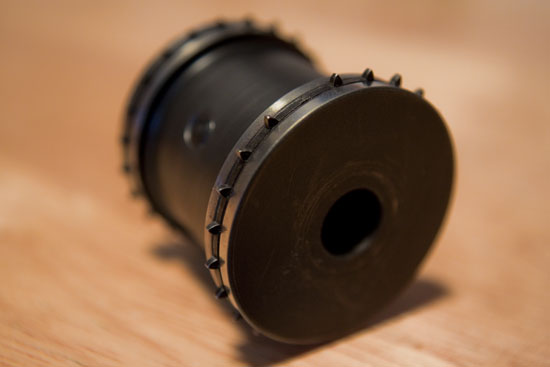
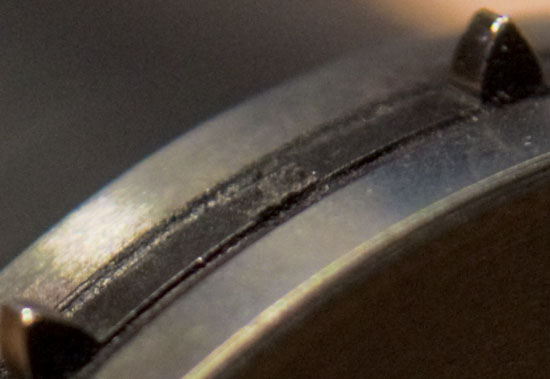
See for yourself:
Posted by Damien Taylor (Member # 4255) on 02-07-2010, 08:16 PM:
![[Eek!]](eek.gif) WOW that's amazing!
WOW that's amazing!
Posted by Bill Enos (Member # 440) on 02-07-2010, 08:47 PM:
It looks like the tooth was a separate piece attached over the black band around the center which is intact except at the edges where the tooth was secured.
Posted by Monte L Fullmer (Member # 2797) on 02-07-2010, 09:21 PM:
No, the entire sprocket is turned and cut from one piece of steel.
Granted, it's an old "foxhole" sprocket where the steel is thinner than a VKF sprocket...
could it be just metal fatigue that caused the tooth to break off?
But, more looking at it, with the engouged area in the outside groove, it looks like the sprocket was cleaned with a blade in that groove, snagged on the tooth causing the tooth to break off.
But, some guesses here ..
-Monte
Posted by John Wilson (Member # 269) on 02-07-2010, 10:25 PM:
I've never known a tooth to just 'fall off'. Someone's jammed something into it to make that happen.
Posted by Tony Bandiera Jr (Member # 2365) on 02-07-2010, 10:55 PM:
I second what John said.
Monte, that looks to be the VKF sprocket as the tooth profile on the tip is too rounded to be the older foxhole sprocket, and the teeth appear to be somewhat wide as well.
Either way, that's NOT a normal failure or metal fatigue.
Joe, time to seriously grill some employees as someone stuck something into that sprocket.
Posted by Joe Redifer (Member # 3) on 02-07-2010, 11:42 PM:
Nobody's fessin' up. I don't know what or why anyone there would do. I talked to the guy who just happened to notice both teeth missing on the two separate sprockets, kind of wondering out loud what would cause such a thing hoping he would tell me ina roundabout way what happened, and he was "well maybe the pad rollers closed on it too hard". Uh, no way. He either is hiding something or honestly has no clue what happened. I will give him the benefit of the doubt.
Posted by John Wilson (Member # 269) on 02-08-2010, 12:59 AM:
Using titanium pad rollers?
How many do you have on roster in the booth? At this point it seems you need to let them know (since no-one's 'fessing up') that obviously mistakes can be made and you don't want anyone's head...you just want to make sure it stops.
Posted by Ian Parfrey (Member # 5122) on 02-08-2010, 02:09 AM:
At last a use for all those metallurgy classes at Tech School!
Here's my take on this....
Monte is right in that a blade of some sort-possibly a screwdriver- was bought into contact with the sprocket tooth.
Reasons for this assumption are -:
Screwdriver blades are hardened and as such can deform hardened steels- depending of course on how hard the impact.
The size, shape and position of the two indentations on the right hand side of the tooth base indicate a blade wide enough to bridge the groove in the sprocket.
If the photo Joe supplied is enlarged sufficiently, it is possible to see on the side closest to the viewer a "rounding" of the broken edge of the tooth. This rounding effect indicates a "stretching" of the tooth as it was bent rearward. The tooth then tapers off to the rear following a line of least resistance (indicated by the sloping tooth wear on the following tooth) down to the far side of the tooth which is the fracture site. The ease at which the tooth fractures depends on the hardening process used, and to the level of hardness obtained. Very hard metal is usually very brittle.
The tooth looks like it was struck from the front to the rear with a hardened blade in 2 if not 3 places (I'm not sure if there are other impact sites on the other two teeth) and this is the cause of the tooth fracturing. Age may have a bearing on the brittleness of the metal as will the level to which it was hardened and the rate of impact but it is difficult if not impossible to prove if metal fatigue has played a part without microscopic examination.
Either way it seems the sprocket suffered blows strong enough to deform hardened metal.
It's also my guess that the tooth either side of the broken one will also be a candidate for tooth fracture judging by the similar deformities on the tooth face.
As to why a hardened blade was near a sprocket is anybody's guess. The forward groove appears to be cleaner that the rear groove which may indicate the blade was used to clean out the groove - possibly while the machine was running- the blade impacted the tooth and fractured it.
Posted by Joe Redifer (Member # 3) on 02-08-2010, 05:40 PM:
OK, here's some facts:
-The sprocket tooth was likely broken/damaged while it was in motion.
-The Simplex XL and 5-Star soundhead has doors that everyone who operates in this booth keeps closed unless the projector is being threaded.
Maybe a screw holding up a hinge or the little plastic light guard inside came loose and fell inside the projector at one point or somehow a screw from elsewhere found its way inside. That is the only thing I can really think of. I will have to look for missing screws on the inside next time I get a chance. I don't know why anyone would be messing around with a screwdriver near a running projector.
Posted by Randy Stankey (Member # 64) on 02-08-2010, 09:08 PM:
I deal with a lot of students who don't know much about projection, much less anything else. One thing I always tell them is my policy on damaged equipment.
I always tell them, if something breaks... even if it breaks because they fucked up... they will not get in trouble as long as the damage is reported to me right away. The worst that will happen is that I will cuss about it. Then we'll fix the problem and make some more movies.
However, if they break something and try to ditch it and I find out about it they will get in trouble TWICE! Once for breaking it and once for lying about it.
The exception is for gross negligence or willful acts.
I have had this policy in place for almost 10 years and I have only had one or two big disasters. The last time I can remember was when one student was breaking down a print. One of those stupid plastic Technicolor film reels broke in two and the whole reel got dumped on the floor. The student called me on my cell phone just minutes after the film fell on the floor. I said something like, "Aw Shit!" Then I told him to just pick the film up as carefully as he could and leave it on top of the rewind bench so I could come in and fix it in the morning.
It turned out that the damage wasn't too bad. I carefully untangled the film and gave it a coat of film guard using the bench winder and it was as good as new.
I often get notes left in the booth or phone calls at night apologizing because they didn't know how to solve a problem. It's always something minor. The worst thing I ever said was something like, "That was a stupid thing to do." I believe that one reason I don't have very much damage is because of this policy.
The thing is that it is probably a lot harder to enact this policy with people who already work for you. It's a lot easier if this policy is in place right from the start. It's not going to work for you in this situation because the damage is already done. Whoever it is who is responsible is obviously covering it up. A "Don't get in trouble" policy isn't going to work in this situation.
That's a kind of policy you would have to work on for the future but you also have to have the right kind of atmosphere for it to work in the first place.
Posted by Monte L Fullmer (Member # 2797) on 02-09-2010, 01:33 AM:
I just thought of something to add .. wonder if the eccentric shaft came out on that pad roller arm striking the rotating sprocket...for you know, them things love to work loose at times..
..or worse, it snapped off and found its way in the rotating sprocket...
..just guesses - Monte
Posted by Mark Gulbrandsen (Member # 72) on 02-09-2010, 09:30 AM:
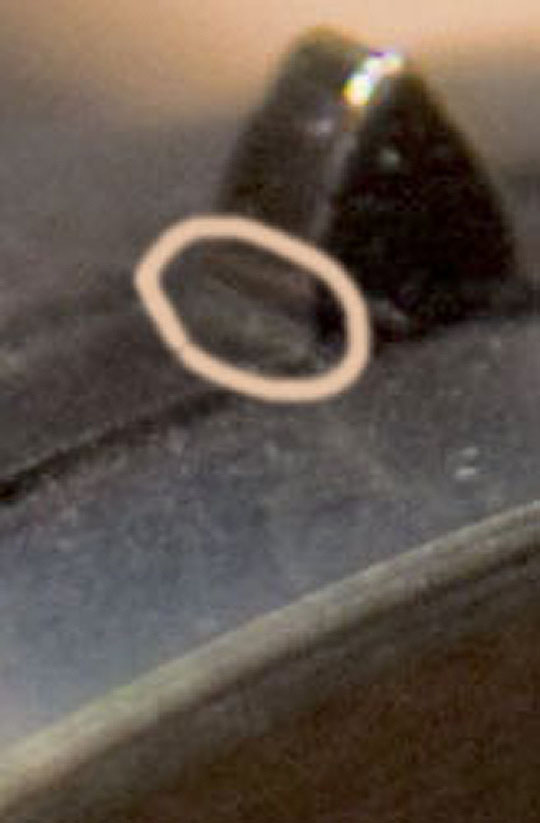
I'm amazed you are rrunnig CS type sprockets, especially one that even has undercut teeth. Those undercuts actually make the teeth weaker. Those are tiny film damaging teeth there! CS type film and perfs went the way of the garbage dumpster several decades ago... even though CS type perfs are actually stronger than KS type perfs. VKF sprockets are a must these days because of booth mongers like the ones you work with...
Note the circled area which is undercut or also known as a hooked sprocket! Causes alot of extra dirt to accumulate in the projector. You should call in a booth tech and get these projectors updated!
Mark
Posted by Brad Miller (Member # 2) on 02-09-2010, 11:52 AM:
Mark, I doubt the owners will buy Joe new sprockets, but Joe can certainly reverse them to use the other side of the teeth.
Posted by Joe Redifer (Member # 3) on 02-09-2010, 01:19 PM:
If you look at the picture, the missing tooth is on the soundtrack side. The "hook" that Mark points out is on the opposite side that pulls the film since the sprocket rotates clockwise. That means this sprocket was already reversed some time ago unless the sprocket was initially manufactured like this like Mark kind of alludes to.
Posted by Mark Gulbrandsen (Member # 72) on 02-09-2010, 04:10 PM:
Ya know Brad, I had thought of that... In fact I flipped the photo around and took a look at the other side of the tooth... almost worse than the side Joe showed...
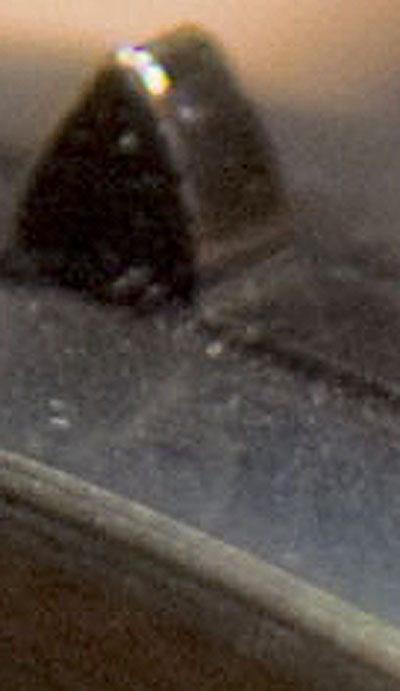
The pisser is that the case hardening at the base of the tooth is now gone... worn away... and the wear will only be accelerated by the estar film itself which is much harder on sprockets than acetate was. Sprockets are not all that expensive, especially at Brads normal highly discounted pricing!! They'll also be the last ones that projector will ever receive...
Mark
Posted by Joe Redifer (Member # 3) on 02-09-2010, 04:24 PM:
LOL, Mark! Even you should know that flipping photos doesn't move you around in 3D space to see the other side of the sprocket! ![[Big Grin]](biggrin.gif)
Posted by John Wilson (Member # 269) on 02-09-2010, 05:15 PM:
Joe, I think you just fell for something you shouldn't have.
Posted by Joe Redifer (Member # 3) on 02-09-2010, 07:06 PM:
Well, thanks for providing an explanation of what I fell for in your post, Mr. Cryptic... unless it was you who fell for something. ![[Razz]](tongue.gif)
Posted by Mark Gulbrandsen (Member # 72) on 02-09-2010, 07:18 PM:
I was waiting for someone like Louis to comment on that... ya know ya change the density, angle, and sharpness just slightly and anyone can fall on that one... ![[Smile]](smile.gif) .
.
Of course the part I said about estar film and sprockets is true though...
Mark
Posted by Joe Redifer (Member # 3) on 02-09-2010, 07:25 PM:
I don't think anyone fell for it, though. John Seems to think I did for some reason.
Posted by Mark Gulbrandsen (Member # 72) on 02-09-2010, 08:14 PM:
I'll bet that at first John fell for it!
Posted by Monte L Fullmer (Member # 2797) on 02-09-2010, 09:40 PM:
quote: Mark Gulbrandsen
about estar film and sprockets is true though...
...looks like foxhole prockets are on their way out then. Best get converted over to VKF's so they can handle this added wear then.
Posted by John Wilson (Member # 269) on 02-09-2010, 10:32 PM:
quote: Mark Gulbrandsen
I'll bet that at first John fell for it!
Get your hand off it, Mark...
Wait...no...Mark, you are a comic genius. Of course I fell for it.
![[Roll Eyes]](rolleyes.gif)
![[uhoh]](graemlins/uhoh.gif)
Posted by Mark Gulbrandsen (Member # 72) on 02-10-2010, 09:40 AM:
I'm about 70% sure that VKF prockets can handle filum with cs type perfs as well but the filum can't be at all shrunken.
Mark
Posted by Eric Robinson (Member # 2966) on 02-12-2010, 08:32 PM:
Actually if you flipped the photo around, you are looking at the other side of the tooth on the other side of the sprocket, at least as it is portrayed in your fictitous analysis; therefor, it was twice as wrong as it was supposed to be.
Powered by Infopop Corporation
UBB.classicTM
6.3.1.2