This is topic Dropping Prints!!!!! Help!!!! in forum Film Handlers' Forum at Film-Tech Forum ARCHIVE.
To visit this topic, use this URL:
https://ft-forum.com/ft/cgi-bin/ubb/ultimatebb.cgi?ubb=get_topic;f=1;t=010362
Posted by Zack Strickland (Member # 5503) on 03-05-2010, 11:06 PM:
My theatre has a problem with dropping prints. No one seems to know the proper procedure for using the clamps. please post replies with clamps procedures and any other solutions you may have for us (ie. small cart for prints)
Posted by Manny Montes (Member # 5639) on 03-05-2010, 11:28 PM:
Take a clamp, put the long side and push it from the outside of the print to the center, then place the short end (with the knob) in the centerpiece and connect to the other side of the clamp. Kind of confusing I know
I've also used a "Print Donut" and cart, where its a little cart with a flat surface about as big as a print, the donut is just a big disc made out of some material thats pretty strong (wood perhaps?), it has holes in the middle so the centerpiece can go on, you simply slide that under the centerpiece for the last show, thread as normal and move.
For more stability no matter which way you choose I'd always Z-wrap a print before you move it. For the last show simply thread the elevator (yo-yo, dancer, etc) from the lower guide roller to the top 2 rollers on the elevator (left to right) then to the bottom left roller, then to the bottom right roller on the elevator. So instead of making a "W" shape, the film should make a "Z" shape. This causes the print to wind tighter.
Posted by Frank Angel (Member # 248) on 03-06-2010, 12:02 AM:
Zack, commendations to you for being smart enough to seek help, but, just how many prints have been dropped so far? How is it that a theatre is allowing people to handle prints don't know what they are doing? How come the theatre hasn't been blacklisted by the distributors? How is it still in business? ![[Mad]](mad.gif)
Posted by Sally Ann Burgess (Member # 4746) on 03-06-2010, 12:24 AM:
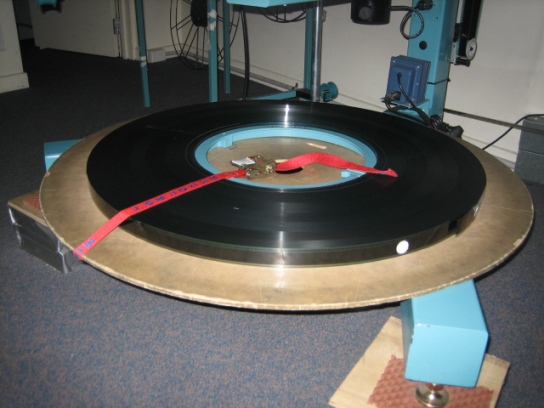
We use a 'donut' which is made of wood with a handy hole in the centre. The platter ring pins fit into two holes each side of the handy hole, and we use a ratchet tie-down to secure the print on one side. When picking up the print, the ratcheted side is facing the floor, the platter pins are to the left and right, and my arm is securing the top half.
No drops in the last 2 years.
Posted by Monte L Fullmer (Member # 2797) on 03-06-2010, 03:14 AM:
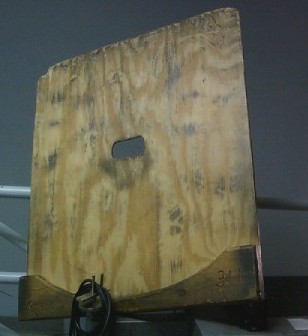
We use a board. Made of 1/4" plywood sheet with the dimensions of 36" long by 32" wide. On the back end of the board is a 2x6x32 with a gradual circular cutout that begins 4inches from each end of the 2x6 and the narrow part of the cutout being only 2 inches from the center edge of the 2x6 .. and attached to the end of this plywood by drywall screws.
In the middle of the board is a 3x6 cutout for hand grab.
We've had this board for over 15 years, move tonnage of prints with this board, moved prints from one theatre to another theatre amongst neighboring cities, and never dropped a print with this board.
We also have a few sets of clamps if needed.
Now, if you got a huge print to move and you system has removable brains: just move the entire deck, but be careful that you have helpers lifting and settling down the deck at the same time.
-Monte
Posted by Justin Hamaker (Member # 2165) on 03-06-2010, 05:05 AM:
Monte and Sally, could you post a picture of your boards?
I use clamps for moving most prints and a 1/8" particle board with a large space in the middle for sliding around the brain. This works well and prevents print drops.
Posted by Jim Cassedy (Member # 4115) on 03-06-2010, 11:17 AM:
Mabye you need to drop a few employees! ![[Wink]](wink.gif)
If prints are being dropped due to inexperience, then
they need to be trained in the right way to move prints.
If they're being dropped due to constant carelessness or
neglegence, than maybe they should be seeking work elsewhere,
if you get my drift. . .
Posted by Jake Spell (Member # 5294) on 03-06-2010, 12:17 PM:
I always use 4 clamps and get help from someone I can trust. Not dropped prints, and no close calls
Posted by Michael Voiland (Member # 5386) on 03-06-2010, 03:56 PM:
Get some masking tape if you are cheap.
What you need to do is tape the end then get 2 people
one on each end of the print. slide it off the platter, the goal is to form an X with your arms almost holding the the inside ring in place.
This works well with strong rings.
Christie rings I would suggest using clamps.
Are your brains removable. Do you have a flight of stairs to go up / down.
If so then I would recommend using the clamps in an X pattern then using 2 people to support under the clamps.
Posted by Monte L Fullmer (Member # 2797) on 03-06-2010, 09:26 PM:
For the interested and curious:
Supplies needed for construction:
1-36"x32"x1/4" sheet plywood preferably one side finished (or what's called "sand shop" grade)
1-2x6x32 for the end piece
1.5" drywall screws and optional construction adhesive to glue the piece down and add screws right after the piece is glued down.
the 2x6 has to have that circular cutout so the print can have something to lay against and to help keep the print centered on the board. Best wood would be redwood for that end piece since its lighter and easier to cut if you have to use a jig saw instead of a band saw.
The open hand grab in the middle is 3 x 6 cutout and about in the middle, but towards a bit to the front nose piece so when you carry it on you side, the end piece isn't hitting the floor.
The nose piece of the board needs to be trimmed to a taper so it can scoot under the prints better. Plus, round the front nose corners to help prevent splintering, even though, after many years of use, the nose end will still splinter out some.
An optional usage is to adhere duct tape to the sides of the board to prevent side splintering, but if you do a good sanding job on the sides to a good finish, then the splintering will be extremely rare.
Some picts of our board we made back in 1992 and still doing great even though it's showing it's age and I might have to build another one down the road:
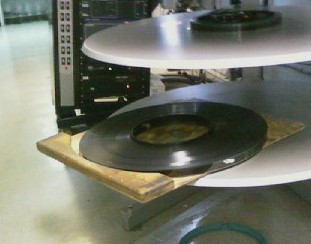
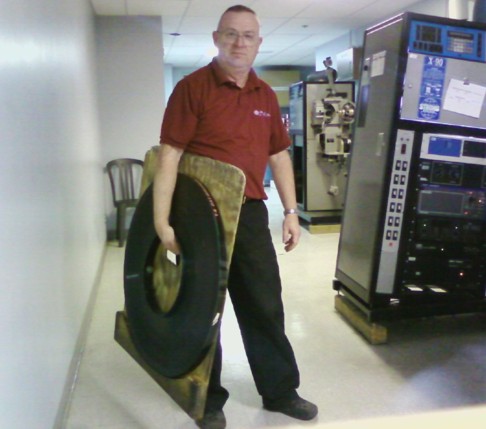
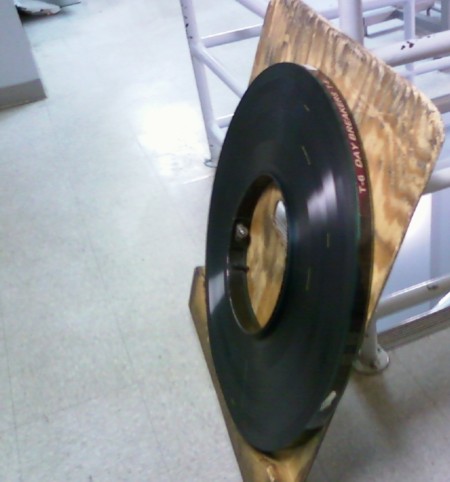
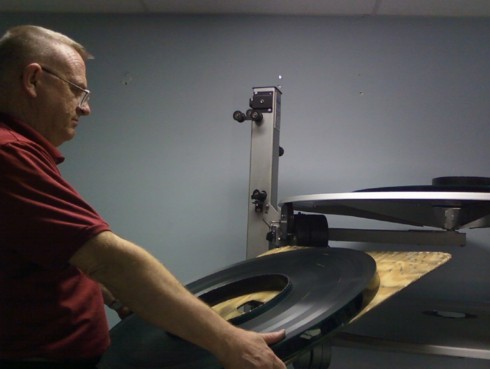
Also, you can make a 3ft square board for those larger prints, esp the ones that hits over 150m and even up to 180 plus minutes.
Also, there is a variant to this board design for those who have solid brain platters, and that is to make the board the 3ft square, but cut out from the front edge to a bit past the middle of the board, an opening the same width of the brain so you can still slide the board under the print, and lift up the print over the brain.
Thx and good luck all -Monte
Posted by Zack Strickland (Member # 5503) on 03-06-2010, 10:40 PM:
NICE!!! thanks so much monty...i'm going to home depot tomorrow!
Posted by Chris Slycord (Member # 4239) on 03-07-2010, 01:55 AM:
Used to move prints all the time with something pretty much just like what Sally described. It was a circular disk of plywood with a rougher bottom-side to allow it to stay fairly stuck to the deck and there was a smaller circle cut out in the middle plus two holes punched for the ring. You could either use it to slide a print onto there or take up the movie onto it. On the ones I used, it was cut to the size of the platter so anything we could play could be moved easily on it which is an advantage over the above (though the disadvantage is you'd probably need a lathe).
Posted by Monte L Fullmer (Member # 2797) on 03-07-2010, 03:21 AM:
I can see your point there, Chris and it would be a nice advantage for just the one cinema as an in-house print mover, (to do a circular cut, would be to use a pencil and string to draw the needed circle, and jig saw to cut the circle out of the plywood. Then a belt sander to smooth the edges to make such a device..) but with this design we can move any film from any other make of platter unit - be it STRONG, Christie, ORC, et.al. , since we do tonnage of print circuits from other theatres..
Sure beats the 6k reel transfers. But, once in a while, we have to do the 6k transfers since some theatres are a little gamey on doing board transfers and want their platter equipment to remain on their premises...but that's a rare situation since I've made prior arrangements to show these other theatres the advantages of this method of circuiting prints.
-monte
Posted by Jean-Marc Toussaint (Member # 4784) on 03-07-2010, 01:06 PM:
It seems that a few people go the donut way. We have a couple of these that are the flanges of a former cable roll. I removed the core and sanded both "donuts". I've bolted segments of cut broomsticks on what is now the lower part.
Monte, I really like what you did.
Posted by Chris Slycord (Member # 4239) on 03-07-2010, 01:53 PM:
quote: Monte L Fullmer
but with this design we can move any film from any other make of platter unit - be it STRONG, Christie, ORC, et.al. , since we do tonnage of print circuits from other theatres..
Wouldn't be all that hard to have multiple sets of holes punched for the various ring sizes.
Posted by Monte L Fullmer (Member # 2797) on 03-07-2010, 07:50 PM:
Agree, but we managed without the holes and simply learned to be careful.
I thought about punching holes in the board a while back, but figured we've done this for so long, why bother.
Posted by Mark Gulbrandsen (Member # 72) on 03-07-2010, 09:52 PM:
Monte... You are destined to get that Technical Oscar!
Posted by Sally Ann Burgess (Member # 4746) on 03-07-2010, 11:48 PM:
Hi Zack
This is how we carry our prints using a ratchet tie-down. Around the print, we don't use tape to secure the end but we make up a label out of old film that wraps around and we velcro the ends together.
Posted by Monte L Fullmer (Member # 2797) on 03-08-2010, 12:34 AM:
quote:
You are destined to get that Technical Oscar!
Thx! .. When you have worked for "band-aid and ductape" cinema companies when their main habits are counting multi-colored beans in a big jar, you definitely do your best to make work fun. ![[Big Grin]](biggrin.gif)
But, Sally has the right idea in using that 'ComeAlong'
-Monte
Posted by Chris Slycord (Member # 4239) on 03-08-2010, 01:24 AM:
Only difference between what I used and Sally's pic was the center hole bigger so that it could fit reasonably around any size brain/payout-doohicky.
Posted by Phil Ranucci (Member # 3820) on 03-08-2010, 02:05 PM:
Sally, why does it look like your platter is up on blocks?
Posted by Sally Ann Burgess (Member # 4746) on 03-08-2010, 03:28 PM:
Hi Phil,
That platter has always been on those blocks, bit odd as the other two are not!
I was told it was because of the wooden floor and vibrations coming through it. I didn't know any better so I said "Urm, OK"
Posted by Monte L Fullmer (Member # 2797) on 03-08-2010, 05:14 PM:
"Plywood Palaces" True, the vibrations from the machinery can really hum through the wood flooring and people in the building can really hear it.
I worked in a dinky 3plex where plywood was the major substance used, esp with booth flooring. We either had to wear slippers or go in stocking feet since the people in the houses can hear us walking across the floor...
Posted by Justin Hamaker (Member # 2165) on 03-08-2010, 07:10 PM:
quote: Monte L Fullmer
I thought about punching holes in the board a while back
I would think a couple parallel slots on either side of the middle would be more appropriate since the position of the pins would be different with virtually every print.
I'm thinking about asking my boss if he could have one of these made. I would do it myself except I don't have access to wood working tools.
**EDIT**
Thinking about this further, this wouldn't work for my theatre because half of our platters have fixed brains.
Posted by Monte L Fullmer (Member # 2797) on 03-08-2010, 08:51 PM:
quote: Justin Hamaker
Thinking about this further, this wouldn't work for my theatre because half of our platters have fixed brains.
Yo - Justin: Don't give up this idea, for it has worked before (excuse the rough traceout of an alternative way to move prints with a board)
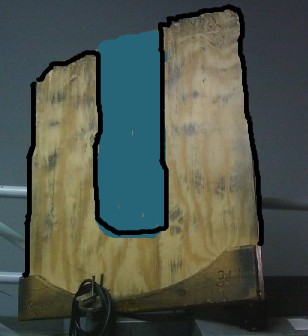
You make the same pattern on the plywood, but use 3/8" plywood to make it a bit thicker to compensate for the cutout in the middle to keep the strength, but make the center cutout the width slightly larger than the width of the brain so the print can be lifted over the brain with the board.
-Monte
Posted by Justin Hamaker (Member # 2165) on 03-08-2010, 09:34 PM:
I have one like you show without the board on the end. It works fine for moving within the same booth, but your design would be more useful for moving prints to our drive-in. Except the drive-in platter has a fixed brain. Once you take that slice out to slide around the brain, it sort of defeats the purpose of having that board on the end to support print because you can't really carry it the same way.
Posted by Monte L Fullmer (Member # 2797) on 03-08-2010, 10:04 PM:
..and that is when you prob clamp the print then instead of the board... For when we did have that forked board, it was used as an in-house board.
Good luck-Monte
Posted by Justin Hamaker (Member # 2165) on 03-08-2010, 11:10 PM:
After having a clamped print of "Cars" fall apart in transit to the drive-in, I started breaking everything down onto 6000' reels. It's time consuming, but better than having to spend 2-3 hours fixing a print that falls apart.
Posted by Dustin Mitchell (Member # 372) on 03-09-2010, 02:39 AM:
How many prints have you dropped? I would think after the first people would have gotten the idea that more care needs to be taken. Film clamps are a pretty self-explanatory device; I would question if the issue is really that people don't know how to use them or if they simply AREN'T using them. Another isue of course is if you have enough film clamps. Mininum is 2, 3 is better, 4 is best.
A secondary cause could be a loose wind in the print. What model platters do you have? If the prints aren't being wound tight enough they would be much harder to move. I wouldn't reccomend it, especially with all the problems you've had, but when a print is wound properly it can be moved short distances even without clamps, IF you know what you are doing.
Posted by Jonathan Smith (Member # 5609) on 03-09-2010, 08:23 AM:
I have never dropped a print, though I have come close, twice.
I use a U-shaped print moving board. They are great for sliding under prints easily, with the edge at the front thinned down to allow for easy sliding under the film at the edge of a platter.
Posted by Eric Robinson (Member # 2966) on 03-16-2010, 12:42 AM:
Monte, how do you slide the print onto the board? Doesnt the print scratch along the leading edge when you slide it on?
For the print drop problem, if you dont have a board, use at least 4 film clamps and have two people carry it with their forearms completely flat under the film.
Monte, I dont agree with moving entire platters. I dont think most booth staff would perform it gingerly enough. Also with AW3's the washers and bearings sometimes stick to the platter when pulling them up off the platter axle...they may get lost or stack up on another platter.
Posted by Monte L Fullmer (Member # 2797) on 03-16-2010, 01:16 AM:
quote: Eric Robinson
How do you slide the print onto the board? Doesnt the print scratch along the leading edge when you slide it on?
With the film roll being so tightly wound there is might be such - but, why worry on that part of the film being scratched since it's not being shown on the screen anyway? Also, it's really not even being scratched, but just a bit of a abrasion since that surface of the board is been planed smooth up to even having a finish on it anyway.
quote: Eric Robinson
I dont agree with moving entire platters. I dont think most booth staff would perform it gingerly enough. Also with AW3's the washers and bearings sometimes stick to the platter when pulling them up off the platter axle...they may get lost or stack up on another platter.
I should have said STRONG platters are more easy to do this than the AW3r units, even though I've done it with AW3 units with no problem with a little help along with making sure the bearing race remains on the spindle.
Guess I don't believe nor think about the K.I.S.S. operation - but see your point though cuz they're out there in full force.
-Monte
Posted by Eric Robinson (Member # 2966) on 03-16-2010, 01:19 AM:
Thanks Monte I have a theatre that could use one of your board design film movers.
Powered by Infopop Corporation
UBB.classicTM
6.3.1.2