This is topic Question about speaker lines in forum Film Handlers' Forum at Film-Tech Forum ARCHIVE.
To visit this topic, use this URL:
https://ft-forum.com/ft/cgi-bin/ubb/ultimatebb.cgi?ubb=get_topic;f=1;t=010600
Posted by Tom Wienholt (Member # 1510) on 09-08-2010, 11:00 PM:
Is it possible to "pair up" two 16 gauge wires for the positive and two 16 gauge wires for the negative speaker wire runs? Obviously, 16 gauge is not sufficient for stage speaker line runs but I was curious if pairing up the smaller gauge wire would work. I have plenty of 16 gauge speaker wire to do the job this way in order to avoid buying new. Any thoughts?
Posted by Tony Bandiera Jr (Member # 2365) on 09-09-2010, 01:19 PM:
Is it possible? Yes.
Will it work? Probably.
Is is wise? No freakin way.
Several issues come to mind:
Keeping the "pairs" together properly. Cross up on any of the pairs and you can easily fry an amplifier. Same if you accidently cross the polarity on any set.
It will be a bitch to pull in those pairs (remember that for a basic, passive crossover system you'll have 8 wires or four sets. Bump that to 14 wires or seven sets for bi-amp. And what are you gonna do about spares?)
Unless the wires in a "set" are EXACTLY the same length you can end up with measurable and perhaps audible artifacts. Besides, the NEC (National Electrical Code) prohibits the use of parallel sets of such small conductors.
Your local building inspector/fire marshal may red tag you for this. Do you want to be shut down to change it out and pay even more money to have it done in an urgent situation?
Finally, a roll of 12/2 speaker wire can be had in 1,000' length for around $400-500. And if you're running conduit and buy regular THHN wire it'll cost less than that.
If you have that much 16ga laying around, either sell it on fleabay or take it to the scrapyard and help defray the cost of getting the right wire and doing it right.
Posted by David Stambaugh (Member # 1102) on 09-09-2010, 01:38 PM:
Bi-wiring is common in high-end home audio setups, though what they're trying to do isn't exactly the same as your scenario.
quote:
"Bi-wiring uses two separate sets of speaker cables to connect a single pair of loudspeakers to an amplifier. Coupled with a crossover designed specifically for bi-wiring, it offers many of the advantages of bi-amplifying the speakers with two separate amplifiers without the cost and complexity of two amplifiers."
Posted by Richard Hamilton (Member # 321) on 09-09-2010, 01:53 PM:
The way I read it, he's not talking about Bi-Amping the system.
Posted by Tony Bandiera Jr (Member # 2365) on 09-10-2010, 11:06 PM:
Richard, I agree.
David, I hope you don't buy into that malarkey of "biwiring" as there would be NO audible or measurable benefits to the method as described. It most definitely will NOT offer "many of the advantages of bi-amplifying the speakers with two separate amplifiers.... " ![[Roll Eyes]](rolleyes.gif)
The "High-end audio world" are the same crackpots who brought us $400 gold-plated cyrogenically frozen AC receptacles and other such expensive nonsense.
Posted by Gordon McLeod (Member # 33) on 09-11-2010, 12:42 AM:
There was a method used by a person who's name and system cannot be mentioned that used 12/3 Romex with cross pairs used
Posted by Frank Angel (Member # 248) on 09-11-2010, 03:32 AM:
quote: Tony Bandiera Jr
The "High-end audio world" are the same crackpots who brought us $400 gold-plated cyrogenically frozen AC receptacles and other such expensive nonsense.
I just came from a fellow's listening room --very sweet man and an accomplished piano player/tuner -- and he truly believes that covering all his AC cables with sheets of magazine paper (it must be the clay coated type) improves the sound of his system. He has built a kind of cardboard and shiny magazine paper maze around his components which sit in the middle of his livingroom floor. He uses cinder blocks on top of his preamp and amps which are buried in this maze of paper goods. You should see the machinations he has to go thru just to get at the controls of the components.
He has some standard PVC pipe of varying lengths standing about the room around the maze; I am assuming in his mind he thought he was mimicking the REAL tube traps which are used in studios and listening rooms, but which, of course, are not anything at all like 3 inch PVC pipe. Tube traps have defusing material on the surface and attenuating material inside and they must be placed strategically at standing wave nodes and pressure zones along the walls in the room. You can't just stand ASC tube traps up willy nilly in a room, you have to do some serious testing with MATT burst test tones in order to figure out where precisely to place them so they will function as they should and produce positive results. Place them incorrectly and you can do more harm than good. But an ASC Tube Trap -- PVC pipe definitely it is not.
He also believes that when certain metal weights placed on (or under....I am not sure which) his CD player, they will enhance its ability to decode the data stream. These same blocks of brass and stainless steel (some in the shape of a pyramid) also enhance his beautiful grand piano when they are placed on the plate and sounding board. Again, I didn't point out the obvious -- if this actually did improve the sound of a grand piano, one would think Steinway, Yamaha, Weinbach, Bechstein, et al, would put blocks of metal on their plates and sounding boards long ago.
Even though this man has turned his living room into what looks like some frightening modern sculpture gone bad, and has made it so that even turning components on or off becomes a major chore as they are buried there in, I still hesitated to dishearten him by telling him that not any of it has one iota to do with the precision or clarity of the sound he is listening to. I figure, if he thinks he can hear a difference after he lays down magazines over his extension cords, more power to him....I just hope that power never shorts and sparks or his whole place will go up like a tinderbox.
Posted by Randy Stankey (Member # 64) on 09-11-2010, 09:57 AM:
I once had a guy come to me at work and ask all sorts of questions about the kind of speaker wire he should use to hook up his new home theater system. He spent all this time telling me about the things he bought and how he wanted to arrange all the speakers and things.
He gave me a look like I had just killed his puppy when I told him to go to Lowes or Home Depot and buy 12 AWG. wire off the roll.
Posted by Louis Bornwasser (Member # 3063) on 09-11-2010, 03:28 PM:
Yes, but. . . . the loonies make the rest of us seem sane! Louis
Posted by Marco Giustini (Member # 4544) on 09-11-2010, 04:31 PM:
A former boss of mine asked me to go into an auditorium. He told me he would replace the MAIN cable of CP650 with a special one, that came from Sweden, shielded with graphite.
He pretended that the sound would improve, just replacing that cable (not all the amps, crossover...).
I was downstairs listening to a CD played back by a cheap CD player through a below the average sound system, but I was not actually listening. I was actually thinking "what can I say! If I say he's right, I'm not telling the true. If I say he's wrong, he'll be angry with me"! I went for the latter one. But then he made the same test, and he told everybody that the difference was huge (he explained me that this cable would cut "noise" over 40.000Hz. I wish I could be able to hear 20.000!!!)
Posted by Randy Stankey (Member # 64) on 09-11-2010, 05:34 PM:
My usual answer to people who insist that expensive cables make a difference is to offer them $500,000.00 if they can prove it in a double blind scientific test.
You see, the James Randi foundation has had a standing offer of a $1,000,000.00 prize to anybody who can substantiate such a claim. I would simply submit the person's cables to James Randi for testing and, if they won, I would split the million dollar prize with the person.
I have never had a person take me up on the offer. Neither has Randi ever had a serious contender for his prize.
Posted by Louis Bornwasser (Member # 3063) on 09-12-2010, 11:02 AM:
I use #12 stranded building wire up to 150 ft, normally and then go to #10 for individual subs, all in conduit..
Getting good connections on each end is a bit more troubling.
At home, almost anything will do if over #16. Louis
Posted by Richard Hamilton (Member # 321) on 09-12-2010, 11:43 AM:
here you go Have fun!
Posted by David Stambaugh (Member # 1102) on 09-12-2010, 12:27 PM:
quote: David Stambaugh
Bi-wiring is common in high-end home audio setups, though what they're trying to do isn't exactly the same as your scenario.
I clearly said "they" not "me" and was merely pointing out that what was being described by the OP is similar to bi-wiring. Sheesh.
Posted by Tony Bandiera Jr (Member # 2365) on 09-12-2010, 12:41 PM:
David, why are you getting your panties in a bunch? No one was arguing with you at all. ![[Confused]](confused.gif)
If you're referring to my post after yours then you need to quote what I said if you think that was the problem. I wasn't arguing with your statement but rather the belief of "they" ("them") who think it has any kind of benefits.
Posted by Martin McCaffery (Member # 37) on 09-12-2010, 04:12 PM:
quote:
here you go Have fun!
Heh, heh. Amazing the amount of time some people have on their hands. I hope they sold enough cable to make up for all the effort they put into the site ![[evil]](graemlins/evil.gif)
Posted by David Stambaugh (Member # 1102) on 09-13-2010, 09:04 PM:
Sorry if I overreacted but it seemed like I was being called out as a golden-eared wacko for mentioning bi-wiring. I actually own Vandersteen 2C speakers which support bi-wiring, but I don't have them bi-wired. ![[Razz]](tongue.gif)
Posted by Tony Bandiera Jr (Member # 2365) on 09-14-2010, 04:27 PM:
No problem David. ![[Big Grin]](biggrin.gif)
![[thumbsup]](graemlins/thumbsup.gif)
Posted by Mike Blakesley (Member # 26) on 09-14-2010, 06:11 PM:
I always thought it would be fun to sneak into some golden-ear's house, replace one of his $200 speaker wires with some standard grade 16 gauge, and then come back a month later and see if he noticed.
Posted by Robert Koch (Member # 3728) on 09-16-2010, 11:28 PM:
Oh Mike, you cruel one.
Posted by Michael Barry (Member # 237) on 09-17-2010, 04:36 AM:
Randy: James Randi is one of my heroes! I had the pleasure of meeting him at the annual skeptics meeting TAM (The Amazing Meeting) in 2009 in Las Vegas.
TAM7 in 2009 was noteworthy for hosting the first Million Dollar Challenge that was open to the public. Danish 'psychic' Connie Sonne was tested for her ability as a douser.
She didn't pass.
Posted by Randy Stankey (Member # 64) on 09-17-2010, 10:59 AM:
I've quietly been a fan for years.
My parents owned a bar when I was a kid. It was attached to the house. I spent a lot of time in the bar when I was growing up.
I remember reading a lot of books by guys like Harry Blackstone Jr. and James Randi and using the stuff I read to win a lot of crazy bar bets.
I don't know how many people I've met who think they can read minds, tell the future or some other weird stunt but when I tell them that I know where they can get a million dollars, they just clam up.
Growing up in a bar, I've seen all kinds.
Posted by Ian Parfrey (Member # 5122) on 09-17-2010, 04:31 PM:
Psychics. Don't ya just love 'em.
One time, at a psychic convention here in rural Queensland, a psychic was claiming to be able to foresee the future - amongst other things, such as 'talk to the other side' &tc. He then asked for a member of the audience to come up to the stage. One man, obviously tipsy from frequent visits to the onsite bar, came up to the stage where the psychic proceeded 'look' into the man's future.
The psychic, a man of about 25, told the audience member a brief encapsulation of his history and then began the future-seeing proper.
After about 3 minutes of the usual psychic ramble the audience member clenched his fist and flattened the psychic, bent over him and said "Ya didn't see THAT coming, did ya?"
He then staggered off the stage to many nervous mumblings and eventual applause from the disbelievers in the audience.
So cool.
Posted by Frank Angel (Member # 248) on 09-18-2010, 03:54 PM:
Here's the thing....of all the thieves who call themselves psychics -- those who are outright opportunistic thieves like that disgusting sow-of-a-whore Sylvia Browne and her enabler Montel Williams, as well as some of the poor delusional fools who actually believe themselves to be psychics -- not a single one anywhere in the world predicted 9/11. Even my 10yr old nephew can tell you, that pretty much wraps it up -- END OF STORY.
Anderson Cooper grinds up Sylvia Browne for dog food
Posted by Rick Raskin (Member # 1561) on 09-18-2010, 05:32 PM:
When I was a teenager I knew a doctor in Falls Church Virginia who was studying ESP. Among those I personally met were Jeanne Dixon and Peter Herkos, neither of whom impressed me. The Doc said that in his opinion most psychics were fakes and that there were only 12 known true ESP people in the world.
The Doc mastered many of the tricks the physics use and would put on his own shows just to show how much of a fake it is.
Of the 12 known "real" psychics I also knew an old lady named Lilly Winston who had been my father's babysitter in the 1920s. I remember her coming to our house and people freaking out at what she would tell them. One woman told my mother she would not come in the house if "that witch" was there.
Around 1962 we took her over to meet the Doc. On the staircase was a wall of photos of his family. Lilly had never been in the house but proceeded to identify the people in the pictures and tell him of their history. Of one old photo of a young woman, Lilly told the Doc that the she had disappeared and they found her drowned a few day later. All of what she said was true.
I personably saw this happen. Lilly told me stuff too.
Unfortunately the Doc and Lilly are long gone.
Posted by Jarret Chessell (Member # 5077) on 09-18-2010, 09:03 PM:
I love this thread... psychic bi-wiring! ![[Smile]](smile.gif)
Posted by Chris Slycord (Member # 4239) on 09-18-2010, 09:16 PM:
quote: Rick Raskin
The Doc mastered many of the tricks the physics use and would put on his own shows just to show how much of a fake it is.
Damn those evil physicists... ![[Wink]](wink.gif)
Posted by Rick Raskin (Member # 1561) on 09-19-2010, 07:47 AM:
Gotta love spell check.
Back on topic:
At audio frequencies there is absolutely no compelling reason to use anything other than plain old wire. In my opinion, the only requirement is to gauge it correctly. Also, I'd use stranded wire to minimize the skin effect and protect against tight bends.
Posted by Louis Bornwasser (Member # 3063) on 09-19-2010, 10:02 AM:
I'm with you, Rick. Stranded also has a better chance to make a permanent connection in a wire nut or speaker terminal. Louis
Posted by Robert Koch (Member # 3728) on 09-28-2010, 07:07 PM:
Does anyone use twisted pairs for stage lines anymore.Used to go out in the parking lot with the electricians and a drill motor and twist away. Some of these runs were long as they were in 20`snd 30`s movie palaces. My oldest friend and competitor, Al Lewis, taught me to do this. Boy I miss him.
Posted by Gordon McLeod (Member # 33) on 09-28-2010, 07:46 PM:
yup we just did a nine plex that way
Posted by Steve Guttag (Member # 268) on 09-28-2010, 07:48 PM:
We still use twisted pairs (good to prevent crosstalk) but not the improper drill method of twisting.
Belden has some excellent speaker cable with a high strand count too. It has red/black pairs down to 10awg. (1313A). They also have it in 4-cond versions (down to 12awg).
Posted by Sam D. Chavez (Member # 1841) on 09-28-2010, 09:58 PM:
Pray tell what is wrong with using a drill? Half the idea is the keep track of the pairs, the other half is hum rejection.
Posted by Tony Bandiera Jr (Member # 2365) on 09-28-2010, 10:11 PM:
quote: Sam D. Chavez
Pray tell what is wrong with using a drill?
I was wondering the same thing..I have done many installs using that method with never a problem.
Posted by Randy Stankey (Member # 64) on 09-28-2010, 11:06 PM:
There's no guarantee that the twisting is even or not too tight, thus breaking the strands, but doesn't it also fuck up the lay of the strands inside the insulation or something?
Posted by Tony Bandiera Jr (Member # 2365) on 09-29-2010, 12:20 AM:
Randy, "even" twisting is not a mandatory thing, (there are some who claim that varying the degree of twist over the length actually helps in noise rejection, I say it doesn't matter) but yes too tight can break strands, but my own tests have proven you REALLY have to overdo it to even get to that point..and the resulting over tight twist makes the pair "kinked" which is obvious.
And the average degree of twist will NOT affect the lay of the strands within the insulation, which is extruded tightly over the strands anyways..any such event would cause visible damage.
Like anything else it has to be done right but it's not rocket science.
Posted by Randy Stankey (Member # 64) on 09-29-2010, 01:34 AM:
I see what you're saying.
The reason I thought of it is because, if you take a microphone cable and twist it the wrong way, against the lay of the conductors inside the jacket, you can cause them to kink. Thus the reason why, if you want to coil a microphone cable well, you'll wrap it over/under.
Of course, a microphone cable is different. It's not tightly bound in its jacket and it's got other things wrapped up inside like the paper packing and the strand for strength. There are a lot more things to get twisted up inside the relatively loose jacket of a mic cable.
I was just extrapolating what happens when you twist a mic cable to what might happen when you twist speaker wires.
Posted by Steve Guttag (Member # 268) on 09-29-2010, 06:44 AM:
Randy is correct. There is no way to use the drill and not mess up the lay and start over twisting the strands. It is absolutely an improper method of twisting cables.
To visualize....take a length of cable you want to twist...use a marker and put a straight line down one of the cables (like the red one). Then twist the cables via your drill. Even after the very first twist you will have rotated the cable by 1 revolution (and started stressing the conductors inside).
To get a proper lay, you have also rotate the cable at the same rate as the twist such that the line you draw remains straight, even after the twist.
The drill method, though easy and common, is absolutely wrong and harmful to the cable. Just get it pre-twisted, properly.
Posted by Sam D. Chavez (Member # 1841) on 09-29-2010, 09:51 AM:
Oh Piffle, this is just anal retentention to an extreme. There are laxatives for this condition you know.
We don't really know how Belden twists them do we? For all we know they are using some automated version of a drill to do the twist before slipping the jacket over them.
The real issue is whether the twist does any real good.
Posted by Tony Bandiera Jr (Member # 2365) on 09-29-2010, 12:57 PM:
Thank you Sam for putting that reply a lot nicer than I would have.
Steve, FYI the FACTORY makes its twisted pairs using a method just like using a drill but on a bigger scale, which BTW would be MORE likely to damage the wire. It was shown on the "How It's Made" TV show. (The actual twister was like a super long lathe with a special chuck.)
Unless you're a gorilla and keep twisting beyond tight there is ABSOLUTELY NO WAY you're gonna even come close to damaging the inner stranding of THHN 14 or 12ga wire.
And like I said before, any damage you would cause would be visible.
I have done literally hundreds of installs over the years with that method and NEVER had a line fail.
Posted by Randy Stankey (Member # 64) on 09-29-2010, 02:06 PM:
How is it Made: Electrical Wire
http://www.youtube.com/watch?v=svgW0YYSSOA
Posted by Sam D. Chavez (Member # 1841) on 09-29-2010, 02:25 PM:
I've done this with solid wire, THHN stranded, and with fine stranded machine cable that has 56 strands or so and never had an issue. The wire at the drill end tends to be more tightly wrapped and sometimes kinked but I waste the first few feet of that end anyway.
Posted by Richard Hamilton (Member # 321) on 09-29-2010, 03:10 PM:
quote: Sam D. Chavez
I waste the first few feet of that end anyway.
What??
Just kidding. When I worked for Megasystems, I would do site visits and meet with the electrical contractors. When I would arrive for the install, there would be an extra 25 feet of cable for each channel both behind the screen and in the booth. It was partially our fault because we would supply them with 1 or 2 1000' wooden spools of 2 conducter cable, and they had to pre cut it before pulling it thru conduit. I don't know how many feet of cable I've had to trash. A lot of the electricians took the scraps I had to cut off! 18 to 20 runs each install of 2 conductor 12AWG.
Rick
Posted by Andy Frodsham (Member # 4061) on 09-29-2010, 03:35 PM:
As a student, I worked in a Hi-Fi shop where the owner, and at least one loudspeaker cable supplier, subscribed to the idea that cables were directional and should only be made-up in the specified way!!
Posted by Scott Norwood (Member # 30) on 09-29-2010, 04:02 PM:
The "directional" thing actually does apply to 2-conductor shielded cable used for unbalanced lines. The shield would typically be connected at only one end, and one would want the shields of all cables to be uniformly connected to either the sending or receiving ends.
That said, pretty much all the other "audiophile" cable talk seems like a total load of crap. As soon as I hear about a recording studio, postproduction house, or broadcast facility that uses anything other than "normal" (Belden, Canare, etc.) cables, I will start to take things like $400 power cables and $1200 speaker cables seriously. I've never heard differences in cables except at the "total crap" level.
Posted by Randy Stankey (Member # 64) on 09-29-2010, 04:07 PM:
I think he was talking about the lay of the wires.
When cables are made the twist (usually right-hand) aligns with the pins on the connectors when the cable is run one way as opposed to the other way.
When you are making up XLR audio/mic cables, if you run the cable the right direction, when you are cutting and soldering, the black, white and shield conductors will line up with Pin-2, Pin-3 and Pin-1 respectively and you won't have to untwist them in order to make the joint.
Since you are only supposed to strip the shield back for 1 inch or less and because you are only supposed to untwist the conductors for 1/2 inch or less, the better you do the job, the better the cable will be.
And, if you cut and solder the connectors on according to the lay of the calbe, you will have a better end product.
The wire, itself doesn't give a rat's ass which way the electricity goes. It actually goes both ways, really. The "direction" you speak of is only due to the twist of the conductors inside the jacket of a piece of cable.
Posted by Louis Bornwasser (Member # 3063) on 09-29-2010, 04:31 PM:
I use thhn stranded, do not twist any wire, and not only never have hum "issues," but usually get the appropriate curve within 2 db without touching a single third octave control.
I know that I am blessed and annointed. Thank goodness I don't have the problems others do with hum and response. Louis
Posted by Andy Frodsham (Member # 4061) on 09-30-2010, 05:12 AM:
No, I am talking about 'standard' (unshielded) 2 core loudspeaker cable!!
The manufacturer specified that it should only be used in one direction (from amp to loudspeaker)!!
Needless to say, I couldn't hear any difference whichever direction was used (and I did REALLY try)!!!!
Posted by Randy Stankey (Member # 64) on 09-30-2010, 08:47 AM:
There is no electrical reason why wire needs to be used in one direction versus the other. Wire doesn't care which way the electricity goes. In fact, with audio, the electrons are traveling in both directions, virtually simultaneously.
The only reason I know that wire might be used in one direction or another is, like I said, to make it easier to put the connectors on the right way or, like others have said, to make sure the shields are connected on the upstream end.
If somebody is telling you that the electrons flow better in one direction than the other, unless they have a solid reason which I've never heard of, they are full of it.
Posted by Louis Bornwasser (Member # 3063) on 09-30-2010, 09:11 AM:
Snake oil for sale. Louis
Posted by Richard Hamilton (Member # 321) on 09-30-2010, 10:21 AM:
When I was at Syn-Aud-Con , the instructor told us years ago that a company was selling a device that "charged" your speaker lines before you hooked them up, then you would have to recharge them from time to time. It was marketed for audiophiles. I guess if you're paying 10 to 20 grand for your home stereo, what's another few bucks you can show off to your friends
If anyone is interested in sound reinforcement, I highly recommend taking the Syn-Aud-Con course. I took mine over 20 years ago and it was a week long class and cost about $600 plus hotel expenses. It's in Indiana across the river from Louisville. It looks like they have training classes in different places now.
Rick
Posted by Andy Frodsham (Member # 4061) on 09-30-2010, 12:00 PM:
You'll be telling me next that putting my turntable under a pyramid shaped cover doesn't improve the sound!!!
Posted by Randy Stankey (Member # 64) on 09-30-2010, 03:10 PM:
No, it's supposed to be a parabolic dish, hung by a single silk thread directly over the exact center of the turntable but the focus of the dish must align EXACTLY with the very tip of the spindle in the center of the turntable.
Posted by Rick Raskin (Member # 1561) on 09-30-2010, 03:57 PM:
Yes Randy, I agree but remember that only works on the Vernal Equinox.
Posted by Randy Stankey (Member # 64) on 09-30-2010, 05:31 PM:
If the thread is made from oxygen free silk it doesn't have to be on the vernal equinox.
I sell oxygen free silk for $100 per inch. If you need some, send me a PM. I think I can get you a 20% discount.
Posted by Tony Bandiera Jr (Member # 2365) on 09-30-2010, 05:45 PM:
Randy and Rick, youse guys are too much!!
Posted by Eric Robinson (Member # 2966) on 09-30-2010, 05:51 PM:
quote: Randy Stankey
If somebody is telling you that the electrons flow better in one direction than the other, unless they have a solid reason which I've never heard of, they are full of it.
Can you say "Monster Cable", they have the magic arrows ![[Eek!]](eek.gif)
Posted by Tony Bandiera Jr (Member # 2365) on 09-30-2010, 06:02 PM:
quote: Eric Robinson
Can you say "Monster Cable", they have the magic arrows
And remember if you're in Australia or New Zealand that the electrons flow in the opposite direction so turn the cable around.
Posted by Ian Parfrey (Member # 5122) on 09-30-2010, 07:00 PM:
So THAT'S what I'm doing wrong!
..and here I am thinking that turning the cable to face TOWARDS the amp would fix the problem! Ya learn something everyday.
Now, what am I going to do with all this 60 Hz cable I have left over???
Posted by Andy Frodsham (Member # 4061) on 09-30-2010, 09:48 PM:
The electrons in European cable produce the best sound!
Seriously though, we should start another dedicated thread listing some of the wacky ideas being advocated by hi-fi enthusiasts.
I've come across some very strange analogue-device tweaking ideas in the past!
Posted by Richard Hamilton (Member # 321) on 10-03-2010, 10:58 AM:
quote: Randy Stankey
When you are making up XLR audio/mic cables
Randy, I was going through some old files and this is a good read on making cables. RANE It has very good drawings on the last 2 pages. Luckily it's still online, I printed it quite a few years ago.
Rick
Posted by Steve Guttag (Member # 268) on 10-03-2010, 01:58 PM:
Okay...so I've been contacted about a response to my post...I have not been on line too much this past couple of weeks due to a heavy work load...
quote: Sam D. Chavez
Oh Piffle, this is just anal retentention to an extreme
Not really...it is just getting the concept of not adding additional rotations to a conductor. You are trying to twist the pairs relative to each other, not unto itself.
quote: Sam D. Chavez
We don't really know how Belden twists them do we
I can not say that I've been in the Belden cable plant...this is true...but I can guarantee you, they don't do it via a drill. In fact, no cable machine in commercial use (that I've searched for) uses a drill or drill like apparatus.
Quite frankly, the notion is plain stupid, in a mechanical sense. One would have to to know the metallurgy of the cable to know just what forces may be exerted upon it. Cable manufacturers will provide bend radius and possibly tinsel strength. They don't provide "over-twist amount" as one is NOT supposed to add additional twists to cable. That is the cable manufacturer's job.
quote: Tony Bandiera Jr
Steve, FYI the FACTORY makes its twisted pairs using a method just like using a drill but on a bigger scale, which BTW would be MORE likely to damage the wire.
Tony, you don't have a clue as to what you are talking about, on this one. They don't use drills and they don't add twists to the individual conductor as they make twisted pair cable. It is only your perception that they do. A cable manufacturer can add a twist if they know what the effects are as they can tightly control the twist-per-inch of the final product. They also have the information on the metallurgy of the conductors that you and I do not have to know if/when the limits are reached. Heck, the making of the conductors often is from the stretching, pressing...etc of larger material.
quote: Tony Bandiera Jr
Unless you're a gorilla and keep twisting beyond tight there is ABSOLUTELY NO WAY you're gonna even come close to damaging the inner stranding of THHN 14 or 12ga wire.
Again, you speak knowledge that you do not have.
quote: Tony Bandiera Jr
And like I said before, any damage you would cause would be visible.
Wrong again...and there is a visible damage to the drillers out there...the springy ends they end up with that most cut off...the rest is sprung but usually less so.
quote: Tony Bandiera Jr
I have done literally hundreds of installs over the years with that method and NEVER had a line fail.
You've done it WRONG hundreds of times and I suspect you will continue to do so...no matter how many times you do it wrong, it doesn't make it right.
quote: Sam D. Chavez
The real issue is whether the twist does any real good.
It is good for noise (not necessarily hum) immunity. The noise is often inductance from its neighbor wire running in close proximity on a long run in a parallel fashion (in conduit). I've witnessed where two theatres shared a common conduit (electrical ran one large conduit and T-ed off at the screen end)...one theatre's sound played out of the other theatre's speakers (at a reduced level, of course). While it is a completely different discussion about the stupidity of using th single conduit, it does show that one will get crosstalk between channels within the same theatre if non-twisted cable is used. You are MUCH less likely to pick that off since if the center speaker is playing loudly, you are much less likely to hear some minor crosstalk in the Left, Right or Sub channels. Twisted cable will likely stop that.
Twisted cable gets its noise immunity by increasing the likelihood of any "noise" impressing itself on BOTH conductors about identically...thus the potential difference between the two conductors, with respect to the noise, is approximately zero. In long parallel runs, it also increases the spacing between conductors, further reducing the chance of inductance between adjacent cables.
quote: Randy Stankey
When you are making up XLR audio/mic cables, if you run the cable the right direction, when you are cutting and soldering, the black, white and shield conductors will line up with Pin-2, Pin-3 and Pin-1 respectively and you won't have to untwist them in order to make the joint.
Randy is correct again. Furthermore...when making up electrical plugs...getting the lay right will also have the conductors line up with their respective terminals...easier than making one conductor pull tightly over and stressing the whole connection.
quote: Louis Bornwasser
I use thhn stranded, do not twist any wire, and not only never have hum "issues," but usually get the appropriate curve within 2 db without touching a single third octave control.
See above...if you use grounded conduit...you are less likely to get hum issues...but you do have measurable crosstalk. Frequency response has little to do with stranding or twist at audio frequencies. If your cable is too small such that resistance becomes a factor...aside from heating up the cable, you will get bass anomalies from under-damping.
-Steve
Posted by Tony Bandiera Jr (Member # 2365) on 10-03-2010, 03:04 PM:
quote: Steve Guttag
Tony, you don't have a clue as to what you are talking about, on this one. They don't use drills and they don't add twists to the individual conductor as they make twisted pair cable. It is only your perception that they do. A cable manufacturer can add a twist if they know what the effects are as they can tightly control the twist-per-inch of the final product. They also have the information on the metallurgy of the conductors that you and I do not have to know if/when the limits are reached. Heck, the making of the conductors often is from the stretching, pressing...etc of larger material.
Steve, I resent your attitude in your responses...you HAVE NO CLUE what my experiences are, just as I have NO CLUE what YOUR experiences are.
I have seen first-hand how twisted pair wire is made and the machine that does it (more like a lathe than a drill I will concede) puts no more or less twist force than one could do by hand carefully. It has the advantage of course of maintaining a constant rate of twist and tension.
And by clamping BOTH conductors into a drill you are NOT adding individual twists to each conductor within the twist.
Finally we are not talking about adding a twist to a twisted pair.
quote: Tony Bandiera Jr
Unless you're a gorilla and keep twisting beyond tight there is ABSOLUTELY NO WAY you're gonna even come close to damaging the inner stranding of THHN 14 or 12ga wire.
quote: Steve Guttag
Again, you speak knowledge that you do not have.
Attitude again...how do you know that? I have been doing this for 29 years and have been working for electrical contractors as well during that same time frame. We have done our own tests to PROVE that unless you make a VISIBLE overtwist you are NOT harming the inner conductor in any way.
quote: Tony Bandiera Jr
And like I said before, any damage you would cause would be visible.
quote: Steve Guttag
Wrong again...and there is a visible damage to the drillers out there...the springy ends they end up with that most cut off...the rest is sprung but usually less so.
The rest is NOT sprung to any degree that would cause damage. Again, I and various EC's I have worked with have done tests to prove it. Of course the ends do get overtightened which is why they get cut off.
quote: Tony Bandiera Jr
I have done literally hundreds of installs over the years with that method and NEVER had a line fail.
quote: Steve Guttag
You've done it WRONG hundreds of times and I suspect you will continue to do so...no matter how many times you do it wrong, it doesn't make it right.
Then I was also taught the wrong way by a very well-known tech who I am sure you wouldn't dare challenge publically like you're doing here.
Just because someone doesn't do it YOUR way doesn't make it wrong (or worse or better than) your way.
On a lighter note, Richard, thank you for that link. Very handy information in that document. ![[beer]](graemlins/beer.gif)
Posted by Steve Guttag (Member # 268) on 10-03-2010, 03:12 PM:
Tony...sorry you are offended...you and ANY tech...no matter how publically known, I would challenge...it is just plain wrong...you can get around the physics of it.
Again...put a line on any conductor such that it is on the same side for its length...when you are done with the twisting...that line better not spiral. If it does, you have stressed the cable, period. With a drill, you are going to spiral the cable.
With a proper machine, you are not.
Believe what you want...there are a lot of guys that coil up cable by coiling up over their shoulder and hand...and don't see the harm either.
Sorry again, that you are upset...but it makes you no less wrong.
Posted by Brad Miller (Member # 2) on 10-03-2010, 04:03 PM:
There exists NO tech that is right about everything. Also age and number of years doing the job has nothing to do with whether that person is doing a job the best way or not. Sometimes that boils down to opinion, other times it is flat out wrong. I know of some techs who have been doing this sort of work since forever, and yet I will see them do completely bonehead things. All I can do is turn my head the other way and pretend I didn't see what they just did because there comes a point when someone has been doing a job for a long time...particularly their entire life...that you cannot tell them they are wrong, no matter how badly they are fucking up.
Steve is technically correct here. I say technically because I've never seen it affect (at least to what I have seen) the performance of the wire, but then again I've also never bothered to do any critical testing. That being said, my installations use pre-twisted wire.
Posted by Steve Guttag (Member # 268) on 10-03-2010, 05:01 PM:
quote: Tony Bandiera Jr
And by clamping BOTH conductors into a drill you are NOT adding individual twists to each conductor within the twist.
I think that is where you are missing the point and the physics of the problem. You are clamping, effectively, both ends. It is the clamping in the drill where you get into the problem.
To prove the point...take the other conductor out of the drill and leave just the one...all else the same...turn the drill on with just the one conductor...and then examine what you are doing...you are merely twisting the one conductor tighter than the factory. The addition of the second conductor didn't change that...it only added an additional dynamic of the conductor interaction.
If you MUST use a drill...you can fake what a professional twisting machine does by making a mandrel and plate. Use the bar stock included with most any Potts/Strong platter. Cut it so it is about 6-inches long. Drill three holes. One in the middle and one near either end but evenly spaced off of the middle. On the middle hole, either tap it for a proper mandrel or use a screw and nut. On the outer holes polish them smooth and chamfer them so the wire will not chafe going through. Chuck this up in your drill. Feed each wire through its respective hole. and tie a knot in each so that the wire can not come back through the hole.
Now, since each wire is allow to rotate freely as it is coiled and is not held in the chuck, it will greatly reduce the amount of extra twisting that is done along its length. Again, a proper twisting machine will add no extra twists to the individual wires but this will will approximate it (depends on the stiffness of the individual wires. The stress will be less as you get near the end (with the drill) as the "fixed" point (Where the twisting is occurring) gets closer to the apparatus, the wire will more easily be able to untwist.
Steve
Posted by Eric Robinson (Member # 2966) on 10-03-2010, 05:09 PM:
quote: Brad Miller
There exists NO tech that is right about everything.
Yes...true...just when I think I've mastered something, I learn something new about it that had not anticipated. It's more beneficial to be open and listen and ask about things.
That of course is just my opnion, and I am right about everything, so you should believe it
Posted by Sam D. Chavez (Member # 1841) on 10-03-2010, 05:12 PM:
Steve is always technically correct and he has a lot of science behind him, but the relative importance of some of what he is correct about varies a lot, as in "much ado about nothing". Tony and others like me have common sense on our side and have been known to do pretty good work over a long period of time.
As a practical matter, it is very difficult to damage wire typically used for speakers to any degree worth mentioning. It is made to be pulled thru a pipe with a winch after all, and should save our ammo to discuss something of some importance.
There is the issue of assuming the wire making companies use good science in the making of copper cable. They do a pretty good job of torturing the wire in the making of it and the welded joints are not always perfect I'm sure. About on a par with lab splices I would guess. We are talking about wire that sells for $50.00/1000 Ft. retail. How good can it really be?
Posted by Steve Guttag (Member # 268) on 10-03-2010, 05:23 PM:
Sam,
It is the common sense that is failing here, in my opinion. It is clear that the wire is being stressed or it wouldn't "spring" at any end.
Wire is indeed designed to be pulled and has a rated tensile strength for that...which is diminished if improperly twisted as you will have used some of that by torturing it in your drill.
I'm just amazed that some will see a cable get all sprung and also watch how the cable twists using the typical drill method and not think anything is wrong there. Common sense should dictate otherwise.
As I said, I don't think I'm going to sway a person that thinks there is no problem...but there is right and wrong...give a choice, do it right.
As a side note...I'm not always technically correct...but I will admit when I'm wrong...sometimes my own "common sense" will get the best of me. I do, generally, try to think things out.
Steve
Posted by Randy Stankey (Member # 64) on 10-03-2010, 10:19 PM:
This conversation really reminds me that being a theater technician really has very little to do with having specific knowledge on how a piece of equipment works or, in this case, things like how to hook up wires. It's really more about how to look at a certain situation and make a decision how is the best way to get the results you are looking for.
Your employer isn't paying you to know that the flux capacitor needs 1.21 gigawatts of electricity to function. He's paying you for your experience and your ability to size up a situation and come up with an answer to solve his problem.
Example... For years I soldered microphone cables together whichever way the cable happened to end up. Then, one day, I was making up a bunch of XLR cables and discovered that the cables were a lot easier to solder together if I ran the wire one way versus the other. Now, I always make them up the same way. I don't know which way is the right way from memory. I just know that I need to check the lay of the conductors and put the ends on in the right order.
This is not something that a lot of people know. Those who do know it probably don't know exactly when and where they learned that unless they were taught as part of a technical course. To be honest, there aren't a lot of technical courses in theater technology. Yes, there are some but not a lot.
So, the bottom line is that it is the technician's job to decide whether things like cable twist are important to the task at hand and how much time and trouble are necessary to deal with the problem. At minimum, I would certainly consider it as a factor.
On the other hand, there are so many things I have done in the past that have come back to bite me in the ass later on, even if it's only a minor inconvenience.
An example that I use often is wrapping microphone cables for storage. Most people think I'm being picky about wrapping cables in "over/under" fashion but I don't know how many times I have had to set up a microphone at the last minute before a show and had to struggle with a tangled cable or troubleshoot twisted, broken conductors. As far as I am concerned, that extra 30 seconds it takes to wrap a cable properly for storage will be more than made up for in time saved troubleshooting later on.
Even though I don't think twisting wires in a drill will cause the end of the world, I'll certainly file that in my "mental Rolodex" and consider it the next time I have to wire up some speakers.
Posted by Sam D. Chavez (Member # 1841) on 10-04-2010, 09:19 AM:
The reason ordinary #14 or 12 wire was used back in the day is cost and ease of pulling thru a pipe. Wrapped and/or twisted Belden takes more space in a pipe and costs more. So we go back to twisting to keep track of channel pairs. This is important as I have come across the +/- pair being misidentified and causing some strange problems trouble shooting systems.
It all falls into the category of practical.
Posted by Steve Guttag (Member # 268) on 10-04-2010, 12:20 PM:
I've definitely seen the wrong identified pairs. Particularly on the "black" as most amplifiers use a common "-" terminal and it is often referenced to ground in solid-state amps. It having the wrong black wire will often work but, as Sam states, odd results can ensue...especially if an amplifier is pulled for repairs...you may "think" you still have Center connected!
Posted by Robert Minichino (Member # 3495) on 10-04-2010, 01:17 PM:
You can buy pre-twisted THHN without an overall jacket. The jacketed stuff is nicer to work with (finer strands, plus it's easier to identify), but it's way more expensive and eats into conduit fill. Regardless, my time is worth too much to bother twisting it myself, although I doubt the drill method is going to hurt the wire too much.
Posted by Louis Bornwasser (Member # 3063) on 10-04-2010, 01:52 PM:
The ONLY wire I've ever twisted is small diameter solid hookup wire to avoid cable ties. The drill is common with this. I see no point to twisting stranded cable.
I have seen Belden video showing cable twisting. The system is similar to the system that weaves a woven shield on better cables like #8412, the reference standard heavy duty microphone cable (no Beld-foil). Louis
Posted by Sam D. Chavez (Member # 1841) on 10-04-2010, 01:56 PM:
I never pull jacketed speaker cable through a pipe as it's a waste of money and a real hassle to pull without wire lubricant AKA, "love butter".
Also, the jacket tends to stick to the conduit and it's a real pain if you ever need to add more wire or pull it back out of the pipe. I've actually had jacketed audio wire stick so bad it broke off somewhere inside the pipe leaving me up the creek.
Posted by Demetris Thoupis (Member # 833) on 10-04-2010, 02:00 PM:
Sam at your age you still pull wires through pipes?! I thought you had a young assistant doing this work for you
Demetris
Posted by Richard Fowler (Member # 893) on 10-04-2010, 02:56 PM:
Cable lube is so cheap.....I usually supplied the lube as part of our cable shipment for penny pinching electrical contractors. Most of our jobs had 12/4 jacketed cable....you guys can play with your twisty wire stuff
Posted by Steve Guttag (Member # 268) on 10-04-2010, 04:21 PM:
I've gone from untwisted THHN stranded all of the way to pre-twisted/jacketed cables. Size the pipe correctly...observe code on the number of 90s before a pull box and yes, use lube...it isn't that bad.
Belden has different jacket colors for their "speaker" cables so one can have everything pretty much IDed.
Then again...if you don't mind Cobranet...using something like QSC's Basis will make pulling speaker cables a snap...just pull a Cat5 cable between the boxes...leave the amps behind the screen and run short speaker lines. It will be hum/noise free and the speaker runs will be short and cheap.
Steve
Posted by Sam D. Chavez (Member # 1841) on 10-04-2010, 08:09 PM:
Demetris,
I'm going from memory here and it's a good one even at "my age". I have not pulled speaker wire for some time.
Richard,
It's not the price of the lube, it's the mess.
Steve,
In a perfect world you get to size the conduit; in real life where we all have to live, we are working with what is already there as in a remodel.
Posted by Steve Guttag (Member # 268) on 10-04-2010, 09:40 PM:
Sam...I work in the real world too and have worked with pre-existing to installed as per spec. I also acknowledge that some customers will not pay for a better job...they are normally not worth the time spent too...but that is another topic all together.
A most recent job I did use the Cobranet solution due to, in part, conduit limitations. It worked perfectly! (QSC Basis). The system had three 4-way stage speakers and four subs. It was really cool not having to pull all of the heavy wire. And, as luck would have it...it also saved us hum issues since the building didn't have a real ground (found that one out, after the fact when it showed itself in other areas).
Steve
Posted by Sam D. Chavez (Member # 1841) on 10-04-2010, 10:39 PM:
Steve,
You always need to have the last word as do I, and now you're changing the subject, but OK by me.
Posted by Brad Miller (Member # 2) on 10-05-2010, 12:05 AM:
quote: Steve Guttag
A most recent job I did use the Cobranet solution due to, in part, conduit limitations. It worked perfectly! (QSC Basis). The system had three 4-way stage speakers and four subs. It was really cool not having to pull all of the heavy wire. And, as luck would have it...it also saved us hum issues since the building didn't have a real ground (found that one out, after the fact when it showed itself in other areas).
Well I get the last word now.
Steve, its about time you listed to me you silly boy!
Posted by Manny Knowles (Member # 1171) on 10-06-2010, 09:38 AM:
quote: Sam D. Chavez
It's not the price of the lube, it's the mess
I don't have anything to add. I just thought it was quote-worthy!
Posted by Richard Hamilton (Member # 321) on 10-06-2010, 10:24 AM:
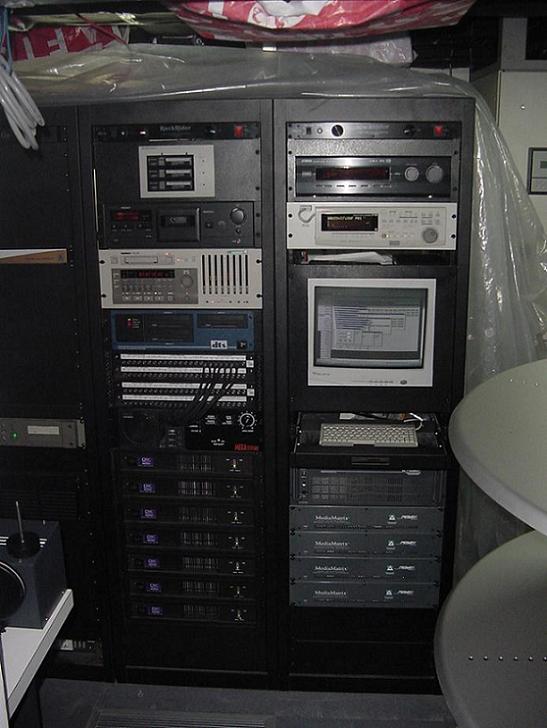
The first out of country (first time I left the States) system I installed. Not sure the brand of wire, but it was 4 conductor, twisted pair 12GA. This was before I was finished, so I hadn't finished cleaning up all the wiring yet, plus the video guys were running cables through my racks. After I identified the lines, I would just use a sharpie and mark the cables.
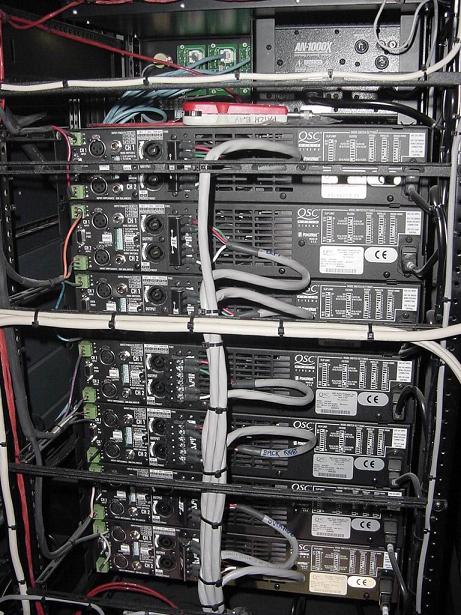
Front of rack. It was during construction, and I would cover the equipment when I wasn't working on it.
Posted by Richard Hamilton (Member # 321) on 10-07-2010, 04:19 AM:
Here is an Article in Systems Contractor News in July 2002 about the system from my previous post.
Rick
Powered by Infopop Corporation
UBB.classicTM
6.3.1.2