This is topic Stadium seating vs non-stadium seating in forum Film Handlers' Forum at Film-Tech Forum ARCHIVE.
To visit this topic, use this URL:
https://ft-forum.com/ft/cgi-bin/ubb/ultimatebb.cgi?ubb=get_topic;f=1;t=010650
Posted by Tom Petrov (Member # 1534) on 10-12-2010, 03:05 AM:
What do you prefer?
I absolutely HATE stadium seating.
My reasons are as follows:
*screens are sometimes too large for the size of theatre
*no room to stretch out legs under the seats in front
*BIGGEST ISSUE...no angled seating (seats are always pointed straight and not at the center of the screen)
*non stadium feels more intimate
Also, most ofter the new theaters have no character. Older theaters usually have different designs and feel to the layout. Y
For example when you watch MLB baseball, do the stadiums all look the same? Why does every AMC or cineplex have to feel identical?
Stadium seating is a gimmick IMHO....theaters with stadium seating have been around for decades, usually they were the 2nd floor of balcony theaters...most times the new movie played in larger downstairs theater. Nobody really cared about that back then....why now?
I almost always watch my movies in non-stadium seating auditoriums....I found myself a little gem today in downtown Hamilton Ontario
What do others prefer?
Posted by Thomas Dieter (Member # 2507) on 10-12-2010, 03:46 AM:
My personal preference is for slopped seating. I agree with Tom about the screens being to big for the auditorium, and the seat constantly facing front, and not the center.
A perfect example of this, and the lack of design in the cinema structure itself would the in Yakima, WA. the recently built Majestic. From the outside it looks like a huge cinder block with a slice of sheet metal sticking out the middle of it. And inside reminds me more of a warehouse rather a cinema. This cinema replaced the old Mercy 6-Plex which was less than a quarter mile from the new location of the Majestic. The 6-Plex was beautifully built, and added onto (originally a twin, then a quad, then a 5-Plex, and finally a 6-plex). The Largest Auditorium while I worked there sat over 585 patrons when sold out and was slopped with handicap seating strategically positioned on each aisle way. I will never forget when the movie Hannible came out and the movie did nothing over the weekend, but come valentines day, (on a week day at that) sold out. All the other auditoriums was lucking to have 10 people in them.
Posted by Steve Guttag (Member # 268) on 10-12-2010, 07:04 AM:
Sloped floor theatres got a bad rap from bad architects. If properly designed, a sloped floor theatre has no visibility problems. However, in the '70s and '80s...a LOT of poorly designed theatres were constructed and there were a LOT of visibility problems. With a stadium seating theatre, it became harder for the architects to get the visibility wrong.
Stadium seating also allows a shorter theatre since the pitch of the floor is greater. Shorter theatre means less real estate. You only have to pay for the risers once...the land you have to pay forever.
Personally, I dislike stadium seating theatres too. They are an inherent trip hazard and, to me, offer no benefit to watching the movie.
It is possible to have angled seats in a stadium seating theatre but again, it is trickier as the risers must also be on a curve or angled.
I prefer "center loader" stadium theatres. Stadiums tend to be front loaders (you walk the length of the theatre, enter at the screen and then climb your way back into the stadium. A center loader puts you in the middle of the theatre and then you either go down or up. This is more ADA friendly too as wheel chairs spots tend to be in the middle of the theatre rather than in just the front row or rear.
Posted by Martin McCaffery (Member # 37) on 10-12-2010, 08:22 AM:
quote: Tom Petrov
Why does every AMC or cineplex have to feel identical?
The same reason every McDonald's does. ![[Wink]](wink.gif)
I hate stadium seating also, it always gives me a literal pain in the neck. And I can assure you the little old broads hate them because they loathe climbing those stairs, not that multiplexes are going for the little old broad audience.
However, I've been in one theatre that has perfect handicap seating row. It is right in the middle, seats are in pairs with lots of legroom and space on either side of the pair. I sit there as long as they're unneeded.
Posted by Christian Appelt (Member # 1067) on 10-12-2010, 09:33 AM:
I prefer well-designed sloped floor theatres because in many stadium seating theatres, you look DOWN on the screen unless you sit in front half of the auditorium.
Looking UP (slightly) to a big screen is quite another thing. During a recent film festival, I watched different formats from 1.85 to 70mm in a former single film Cinerama theatre (level projection, slight screen curve, sloped seating) and was surprised how impressive the image looked from every angle, especially from the last row.
But, having spent my youth in badly designed 1970s theatres or twinned older theatres with stupid seating arrangement and bad viewing angles, I can understand that the McDonald's-type multiplex stadium was perceived as a good thing when it arrived.
Posted by Demetris Thoupis (Member # 833) on 10-12-2010, 10:43 AM:
I too don't like extreme stadium seating. Sloped seating gives a cosiness to the place and I agree with the idea of looking UP to the big screen!
Demetris
Posted by Jeremy Weigel (Member # 4208) on 10-12-2010, 11:04 AM:
I only like stadium if the auditorium is much wider than it is deep, otherwise it just feels like I'm sitting in a box. Cleaning stadium style is also a pain in the ass, especially when the seats are placed too close the riser making it difficult to clean behind the seats.
Posted by David Stambaugh (Member # 1102) on 10-12-2010, 11:12 AM:
It's interesting that everyone here hates stadium seating, while the general public obviously loves it. When stadium seating came to Eugene it killed a couple other "sloped" theaters and the one that remained just barely hung on. Everyone I know prefers stadium seating. That's probably because the sloped theaters had the seats too close together, no legroom.
I'm pretty sure the rows of seats at the Regal 15 here are curved, not straight (screens also have a slight curve). Cinemark's seat rows are straight. Both are "center-loaded" as Steve refers to it. Cinemark actually has two entry points in most auditoriums: center, and top. Only the 2 largest at Regal have entry at the top (and an elevator).
Posted by Victor Liorentas (Member # 5272) on 10-12-2010, 11:27 AM:
I prefer sloped,i find the surrounds to be more effective in a sloped theater and i agree with every other post above.
Posted by Tom Petrov (Member # 1534) on 10-12-2010, 11:31 AM:
@ David.
I actually find you have less legroom in a stadium seating theater. My feet can go under or to the side of the chair in front in a sloped theatre. Stadium forces you to sit straight and upright.
Posted by Mitchell Dvoskin (Member # 751) on 10-12-2010, 11:38 AM:
I prefer stadium seating. With only 2 exceptions, both old historic single screen theatres, I will not see a movie in a slopped floor theatre.
I want to view on a "big" screen. I don't want someones head in my picture. All the stadium seating theatres around here have more than sufficient leg room, more than I can say for sloped floor theatres. Most of the stadium seating theatres around here have very comfortable rockers, more than I can say for sloped floor theatres. Don't care if they curved the rows, the benefits far out way the negatives.
Posted by Bobby Henderson (Member # 840) on 10-12-2010, 11:46 AM:
I don't have the audio engineering expertise to prove this, but I'm certain traditional sloped floor movie theaters can deliver significantly better quality sound than a stadium seated theater.
It seems like bigger and bigger cubic areas of space do a lot to harm audio quality. Certain frequencies seem to disappear and echo becomes an ever bigger concern. More powerful speaker enclosures are required, yet only IMAX seems interested in installing hardware powerful enough to do that job on any sort of consistent basis. Additionally, most IMAX theaters are pretty short in length which reduces the amount of cubic air space in that really tall room. Still, I've never heard an IMAX theater sound as good as the best traditional sloped floor theaters.
Other things I don't like about stadium seated theaters:
• They encourage use of fixed width screens.
• Projector ports may be set at extreme downward angles.
• It's easier to be distracted by mobile phone displays.
• Not very wheel chair friendly; easier to trip.
• Nearly all are front load, making it socially strange if you arrive late. You kind of feel like the whole audience is looking at you and grumbling, "can't you get your lazy butt to the theater on time?" Of which my internal response would be, "I would have arrived early, but my drag-ass friends piddled around up to the last minute leaving me just as irritated as you."
The improved sight lines are the only real selling point for stadium seated theaters.
Posted by David Stambaugh (Member # 1102) on 10-12-2010, 11:54 AM:
Are these theaters with front-load stadium seating conversions from sloped seating, or were they originally built with stadium seating? I can only comment on what's in this area. One built in 1999, the other 2007, both stadium from day 1, both use center-load.
Posted by Bobby Henderson (Member # 840) on 10-12-2010, 12:00 PM:
I'm not 100% sure, but it seems like all the new theaters in my region built originally with stadium seating are all front load. From a construction standpoint the foundation would be easier to build; not so much digging.
Posted by Manny Knowles (Member # 1171) on 10-12-2010, 01:46 PM:
quote: Bobby Henderson
Certain frequencies seem to disappear and echo becomes an ever bigger concern
I don't know if I can agree with this.
The first part is vague. Which frequencies seem to disappear?
As for echo, it will always be a problem if surfaces aren't treated. For example, the Hitchcock dubbing stage at Universal Studios is plenty big and it is not plagued with either of these problems. I'd say the same is true for any IMAX theatre I've been to.
Is size an issue? Yes. Can it be overcome? Yes.
Posted by Brad Miller (Member # 2) on 10-12-2010, 02:01 PM:
Its not difficult to create "center-loading" stadium auditoriums, although I would say that the loading point should be 1/3 back from the screen, not halfway, or the architect ends up killing some of the best seats to the aisle.
Its also easy to compare sloped vs. stadium legroom, but in reality either can be the same. Few new theaters are sloped anymore, so there isn't much comparison. Also as was stated above, there are indeed a LOT of badly designed sloped auditoriums, in particular those from the 70s and 80s.
As far as cleaning stadium auditoriums, yes they are more difficult, but chairs can be purchased that are riser mounted, not floor mounted. That makes it easy to sweep UNDER the chairs without constantly banging the broom on the leg of the chair. Note that comes at a price, because the chairs are a little more costly and the bracing and mounting to the vertical riser can be more too.
The screen problems are typically due to stadium seating (and as Steve points out, poor architects that don't really know what they are doing). There is a general misconception that the stadium must be steep, and there becomes a point where it is prohibitively expensive to build super wide auditoriums due to the structural columns and bracing needed. But if a normal width auditorium is created with overly steep seating, suddenly the screen looks too small. So what is the inexpensive (and flat out wrong) solution? Why common width masking, of course!
For those not following the terminology, common width means the masking is controlled from the top, bottom, or both. The side masking never moves. This is the worst concept ever brought to movie theaters.
Now lets analyze this for a minute before anyone dares reply stating that common width masking is anything but foolish.
Common width masking disappoints customers. Yes there I said it. Almost every movie out these days is scope. (At least the filmmakers are finally getting it right.) Case in point, I have several complexes that have no flat movies at all playing except for a weekend kiddie show! So as a customer, you walk into the auditorium and low and behold some awful in-your-face preshow advertising "entertainment programming" is being forced upon you. Lets not worry about that too much for now. What happens is that you take your seat. Now some will argue that customers will take their seat not paying ANY attention to the distance to and/or size of the screen. I say that is absolutely incorrect (except for those people that ALWAYS sit on the back row), but regardless of that, the fact remains you take your seat somewhere comfortable to you. Most people will seat based upon a comfortable viewing distance to the screen presented. That right there becomes the problem because the show starts and the damn masking closes down. Suddenly you are watching a scope presentation and the picture just got smaller! I can't tell you how many complaints I've had to field over the years due to this. Customers don't understand the term aspect ratio and quite honestly don't give a shit even if you try and explain it to them. They just know their picture got smaller. So why are so many new theaters installing common width masking when they know DAMN GOOD AND WELL that almost all movies they run WILL BECOME A DISAPPOINTMENT WHEN THE FEATURE STARTS???
Common width masking usually = cheap exhibitor who crops the image. In digital cinema, there are people specifically installing common width because they think they can make out like bandits without paying for some sort of motorized lens. (Sadly there is at least one fairly well known company that is using this anti-SMPTE tactic as a sales tool, to try and convince future prospective customers that if they buy through them, they can show them all sorts of little tricks to save them money.) Sure the customer has a one time savings of a few bucks, but it comes at the cost of cutting the sides of the picture off for every scope movie they ever run! Ummmm, that's sort of the point of scope movies is that wider aspect ratio and how it more closely approximates the human field of vision, geniuses. ![[Roll Eyes]](rolleyes.gif)
Common width masking with stadium seating generally creates screens that are too large for the room. This is because people are so hung up on the catch phrase "wall-to-wall screens". While wall-to-wall screens can be a great thing, it shouldn't mean that you make the screen so large people have to sit in the back row to be able to properly see the entire image. With stadium seating comes excessively tall ceilings. Once that tall ceiling has been created, there is a new panic to make the screen big enough so the screen doesn't appear to be too small. Of course that's a nice idea for the commercials nobody wants to pay to watch, but then we end up back at the disappointment issue when the masking closes down as the movie starts. Fail.
Common width masking with stadium seating generally creates dim pictures. This one is easy and everyone knows why...because its all about "how small of a bulb can we run in that projector that most people won't complain about". When you then try to blow that image up on a huge wall of screen, you have certified blah that could have been better delivered at home on the flat panel tv. At that point the only thing you've got going for you is the fact you can play the movies before cable and dvd...at least so far.
Common width masking with stadium seating helps to assure the picture isn't as sharp and detailed as it really is. Come on guys, this is just a fact of lensing. Go throw up a target pattern on a 40 foot wide screen from 80 feet away using a 1.45-2.05:1 zoom lens...and then move the projector back 50 feet and use a 2.15-3.6:1 zoom lens and compare the difference. (That difference in lens and projector position will create the same sized picture.) The shorter the throw, the worse the picture. With stadium seating theaters, often the throw isn't even this generous, and external lensing must be added on top to be able to fill the screen making things even worse! The chromatic abberration and general fringing and flare on today's high brightness lenses (to be able to use that smaller bulb, remember) gets worse and worse the shorter the throw and it destroys the picture quality. But its all about running with the smallest bulb possible. Never mind that awesome sounding press release you wrote for yourself about your dedication to "only the highest quality". Nobody reads that fluff anyway. ![[Razz]](tongue.gif)
Common width masking with stadium seating generally causes lousy sound. Its true, creating these overly tall auditoriums due to all of the reasons above creates acoustical nightmares that often even the best sound technicians can never truly get to sound awesome because the theater owners don't want to pay all that extra money to properly treat the room acoustically (or they hire someone who doesn't really know how to handle the job, but accepts the money anyway). The tech's test equipment may SAY it sounds perfect, but trust me, it often doesn't. EQ can only do so much to a room. It can't help major design flaws like echo (and the test equipment can't separate out echo like our brains do).
There are plenty of other issues with stadium seating other than the typical use of common width masking too. Think about that pesky aisle and step lighting for a minute. Very few people understand the concept of reflected lighting, and as a result there are usually constant distractions to the left and right because of all of the lights that were not designed to offer reflected light only for safety.
Cell phones in stadium theaters do the same thing. If anyone picks up a cell phone, odds are everyone behind them will know about it even if they can't hear it. ![[Mad]](mad.gif)
I'm tired of typing right now, but suffice to say a stadium seating theater CAN be designed to be awesome. Its just that most people don't put forth enough effort into it to achieve it.
Posted by Richard Hamilton (Member # 321) on 10-12-2010, 02:17 PM:
Bobby, I'm gonna have to agree with Manny on this. A properly spec'ed and EQ'd room won't have "echo" problems.
Rick
Posted by Tony Ratcliff (Member # 1196) on 10-12-2010, 03:47 PM:
I much prefer sloped over stadium.
Most stadium houses are too steep.
And like Brad said, the screen seems too big.
I move farther back so the screen feels the "right size" for me, but then I'm farther up in the seats, which makes me feel like I'm looking down at the screen.
And I can't imagine what it is like to watch a movie from the top row where you can practically touch the ceiling.
I remember one cinema, built in the 70's (but since gone), that had sloped for about 2/3 of the way, then a gently angled stadium part in the back. It was a large house, probably 500 or more seats. I actually liked sitting in the stadium part in that house.
Posted by Mike Blakesley (Member # 26) on 10-12-2010, 04:43 PM:
Tony, the Montana Theatre in Miles City, MT and the (I forget the name but only) theatre in Livingston MT have auditoriums like you describe. Both were built in 1936. The biggest problem they have is lack of legroom -- rows too close together.
My theatre is a slope floor and was built in 1930. Originally the main floor had 425 seats, but over the years we have increased the legroom and the seat width to the point where we now have about 150 seats on the main floor (plus 44 in the balcony). Between the seat offset and the distance between rows, we virtually never hear a "I wish you had stadium seating" comment.
Posted by Victor Liorentas (Member # 5272) on 10-12-2010, 05:09 PM:
The stadium theaters around here have mostly one note bass and the surrounds seem very muffled,canceled out perhaps even blocked by the high back seats.
The shape of these theaters is very square which is i believe helping to cause cancellations or worse cancer?
The common width masking assures dim grainy flat and small scope pictures with softer focus thanks partly to the steep ,short throw!
Our newest Cineplex Odeon has very little legroom.
Posted by Joe Redifer (Member # 3) on 10-12-2010, 05:25 PM:
I definitely prefer a properly designed sloped auditorium. It makes the movies feel more like a spectacle whereas a stadium seater makes it feel more like an amusement park ride. One thing that really scrapes my scrotum about most stadium seating auditoriums are the steps. No, not the fact that they're there, but the fact that they aren't even. You have a small, short step from the aisle above and then a much longer step that is on the aisle level of the row below. I prefer all of the steps to be the same exact size. That way there is far less chance of tripping and you can get into a rhythm while navigating said steps. Any theater that has varying step sizes is a shitily designed theater. Only morons could possibly disagree. And yes, I know shitily is not a real word, but it applies.
Posted by Jeremy Weigel (Member # 4208) on 10-12-2010, 06:09 PM:
Oh and the last (back) row is usually set too high such that customers can simply raise their hands and block the picture or even worse block it by merely standing up (auditorium #11 at the former Regal Crossroads 16 is this way). I was constantly cleaning off finger prints on that port window, even caught one guy in the act and made him clean it. Embarrassed the hell out of him in front of girlfriend. ![[evil]](graemlins/evil.gif)
Posted by Tom Petrov (Member # 1534) on 10-12-2010, 06:22 PM:
What does anyone have to say about THX stadium seat theaters?
Posted by Manny Knowles (Member # 1171) on 10-12-2010, 06:50 PM:
What are we defining as "stadium seating" ?
Is it ANY theatre where the seats are on risers? Or does the steepness of the riser give stadium seating its particular character?
For example, those of you who were familiar with it -- would Brad's screening room (in Rockwall) be considered "stadium seating"?
Also several of you are citing screen size as a deciding factor in why you don't like stadium seating. Why are you automatically linking "seats on risers" with "issues pertaining to screen size and aspect ratios" ? This is not a given situation.
Posted by Louis Bornwasser (Member # 3063) on 10-12-2010, 08:48 PM:
There are "bad" sloped floor theatres and there are "bad" stadium theatres. There are many more "bad" architects now than before.
I built the first modern stadium in Goshen Indiana about 17 years ago. I can assure you that none of these problems are in that theatre. (no architect.) Imperfect copies by hacks is what you are seeing. And, yes, for them, I agree with you. Louis
Posted by Manny Montes (Member # 5639) on 10-12-2010, 09:21 PM:
I loved being an usher in a sloped theater, it was so easy to clean. But in terms of preference I love stadium seating, if its done right, AMC does it wrong, at least where I live, plus they have common width masking which as brad shows, there is a huge hatred for.
and i also vote for "there are bad architects around now", who in their right mind builds a delivery/loading dock to have STAIRS, so I can't wheel the pallets/equipment around, I have to carry it up 5 steps to be level with the rest of the theater.
Posted by Frank Angel (Member # 248) on 10-13-2010, 03:32 AM:
The two larges theatres in our complex were designed with slopes in the front and stadium in the back half. In the George Gershwin Theatre, the house is pretty much evenly split -- 250 in the slope section and 250 in the stadium section. This is a very sweet house with a warm sound (side walls are angled outward and also fanned like roof tiles. Best of both worlds. Our large house -- Walt Whitman Theatre is a 2500 seater with about 1500 in the sloped orchestra and behind that about 350 stadium. The balcony, which over hangs the same area as the stadium mezannine is also stadium with 500.
The smaller 160 seat Sam Levenson Recital Hall is only 150 and it's totally stadium. In a smaller house like this one, the negatives of stadium seating don't manifest themselves to any great degree -- no seats get that far from the screen. In the larger houses the stadium sections function to keep people in closer to the screen than they would be if that slope kept going back to those last rows. They would be in the next county.
Funny thing is, these theatres were designed and built at the same time in 1955! There was no such thing as "stadium seating" back then, but this architect used it to good advantage. Back then I think they call what we know as stadium seating as "the loge" -- usually in the first half of the balcony.
Our 150 seater is stadium seating only because it was originally designed to be a lecture hall and the stadium seating was common with those. It was converted into a recital hall and theatre in the early 80s. Was there stadium seating that far back? Anyway, both the Gershwin and Levenson theatres are going to be demolished soon, so it's moot.
Posted by Joe Redifer (Member # 3) on 10-13-2010, 03:53 AM:
You name your auditoriums after people instead of numbering them? That seems a bit pretentious to me. It was bad enough when I worked for Madstone and they called the auditoriums by letters instead of numbers, but actual names?
-"We gotta move prints. OK where's this one going? Oh it's moving from Samuel Adams down to Wilford Chesire?"
-"We got a complaint that the volume is too loud in Bartholomew H. Hooverstein."
-"Can we interlock Being John Malkovich from Shaniquia Imani Chukwumereije Onwuatuegwu to Mikhalis Zephaniah Eibenschütz?"
-"Can you please rewind the movie in 鈴木 裕 because the patron showed up a bit late?"
If you're going to name your auditoriums, name them something fun instead of after stuffy old people. Maybe one of them could be "The House of Much Slap Echo". Another could be "Underspec'd Lamphouse". Yet another could simply be "Keystone".
Posted by Ian Parfrey (Member # 5122) on 10-13-2010, 04:24 AM:
How does Sam Levenson feel about being so small?
Posted by Richard Hamilton (Member # 321) on 10-13-2010, 08:52 AM:
quote: Joe Redifer
Can you please rewind the movie in 鈴木 裕 because the patron showed up a bit late
Joe, you have an auditorium named Suzuki Hiroshi (鈴木 裕)? Thats awesome ![[beer]](graemlins/beer.gif) . I once owned a Suzuki 350 Enduro bike
. I once owned a Suzuki 350 Enduro bike ![[thumbsup]](graemlins/thumbsup.gif)
Rick
Posted by Alex Shultz (Member # 5027) on 10-13-2010, 10:23 AM:
Brad,
I have two auditoriums that I am looking to do lighting for the aisles. What do you mean at the end of your comment, about reflected lighting?
Posted by Larry Zuverink (Member # 1483) on 10-13-2010, 10:47 AM:
No one has discussed ADA. With some of the new restrictions, the slope is so slight that a good slope design in new construction is out of the question.
Personally I like a well designed theatre slope or stadium.
Posted by Gordon McLeod (Member # 33) on 10-13-2010, 10:56 AM:
Actually stadiums have even bigger ADA issues with providing seating in more than one location in a unrestriced fashion
Posted by Scott Norwood (Member # 30) on 10-13-2010, 01:19 PM:
Sloped all the way. I also don't especially like the high-back seats that are popular with new construction.
I can only echo what others have said: stadium designs are a poor answer to complaints about bad sightlines. Fix the slightline problems, and the need for tiered seating disappears.
That said, I can sort of understand the economic advantages to stadium designs where the risers are not a permanent part of the building, and could be removed at a later date to easily convert the space to another use (or, conversely, installed in an existing space to convert it into a cinema).
The irony in all of this is that tiered seating was tried in some places up through the mid-1920s, but sloped floors were eventually determined to be superior.
Posted by Bobby Henderson (Member # 840) on 10-13-2010, 03:09 PM:
quote: Manny Knowles
What are we defining as "stadium seating" ?
I consider an auditorium "stadium seated" if the aisles utilize stair steps for reaching most or all of the rows in the room. If the aisles don't have any stairs then obviously the auditorium is a traditional "sloped" room.
It's kind of funny to imagine a stadium seated theater with aisles that have no stairs, only steep ramps instead. Ah yes, the slapping thud of someone plotzing on the floor and spilling his snacks all over the place. Better yet, put a rise down at the bottom of the ramp right in front of the exit. Someone in a wheel chair could leave the room pretty damned quick! Weeeee!
quote: Richard Hamilton
Bobby, I'm gonna have to agree with Manny on this. A properly spec'ed and EQ'd room won't have "echo" problems.
Yet many of them do have echo problems. It's a common feature at a lot of AMC's theaters.
I have to repeat my complaint about many stadium seated theaters being under-equipped in terms of speakers and amplification. Lots of multiplex sites use the same surround enclosures in every auditorium from very small rooms to really big. They just use more of the tiny enclosures in the biggest houses.
It seems like the bigger the stadium seated room is designed the more shitty the sound will be. The larger cubic areas of air space seem to filter out some of the mid and upper frequency registers. A lot of the bass just falls dead as well. If the sound is turned up to an adequate volume it often sounds boomy and harsh. More often than not the sound is just pretty weak, particularly on the bass end.
IMAX typically installs more powerful sound systems appropriate to handle a large cubic area of air space. You get good and even powerful bass response in such theaters. However, I have never heard an IMAX auditorium sound excellent. And what I mean by excellent is very clean, clear response from bottom to top. The best sloped theaters I've visited have accomplished that task. Small auditoriums (with the right equipment) can accomplish that regardless of seating style, but at the cost of low seat count and a small screen.
This reminds me of the similar principle of how live concerts in various arenas usually don't sound so good.
By the way, a sloped auditorium delivers a better surround sound field than stadium seated theaters can manage. Some of this has to do with the shitty choices and shitty placement of surround array speakers in stadium seated auditoriums.
quote: Tom Petrov
What does anyone have to say about THX stadium seat theaters?
I think THX watered down their specs or something. The best stadium seated theaters I've visited don't sound nearly as good the best sloped theaters I've visited, particularly when it comes to comparing THX certified sites.
Properly maintained/equipped sloped THX theaters could feature an accoustically "dead" air space. The quiet nature of the room would give it a tight feel, even if you were standing in a big auditorium like the long gone GCC Northpark #1 house. And then if the sound system was well designed and maintained it could deliver one hell of an experience. Theaters originally built with stadium seating, the high ceilings, etc. just don't have that acoustic character.
Posted by David Stambaugh (Member # 1102) on 10-13-2010, 05:22 PM:
With sloped seating, even with seats staggered and with plenty of legroom, how do you mitigate the possiblity of 1 or 2 people sitting in front of you with their heads blocking part of the screen? I like sloped seating too but even the best sloped design will have this problem. With stadium seating it's virtually impossible to have a head blocking part of your view. What am I missing? If you ask 100 regular moviegoers why they prefer stadium seating, I bet most will say 1) More legroom, and 2) No heads blocking the screen.
Posted by Joe Redifer (Member # 3) on 10-13-2010, 06:37 PM:
quote: Gordon McLeod
Actually stadiums have even bigger ADA issues with providing seating in more than one location in a unrestriced fashion
This is very true. Once your seating capacity goes above a certain number (I don't know exactly what that number is), you need to have an upper mezzanine with elevator access for the cripples. Although they don't directly address this issue, I recommend watching the Penn & Teller Bullshit episode about the ADA.
Posted by Kenneth Wuepper (Member # 1174) on 10-13-2010, 06:39 PM:
Our 1927 Theatre has sloped floors in the orchestra and balcony seating. The orchestra has ramped aisles and step risers beneath the chairs. The main floor is barrier free.
The 1970 theatre across the street has sloping floor beneath the chairs and irregular steps in the aisles. They also have "continental seating" in the front of the orchestra section. If you have a seat in the center of the continental row you will have to ask lots of people to let you pass to your seat. Yes, people fall in the aisles there regularly even with full house light levels.
Posted by Manny Knowles (Member # 1171) on 10-13-2010, 07:19 PM:
quote: Bobby Henderson
Yet many of them do have echo problems. It's a common feature at a lot of AMC's theaters
you're conveniently overlooking the plain fact that many sloped (or raked) houses exhibit the same problem. i think it's possible to do both auditorium styles correctly AND incorrectly.
and you have not answered my other question -- which "certain" frequencies "seem" to suffer? (and where's the data that proves the theory?)
Posted by Scott Norwood (Member # 30) on 10-13-2010, 07:43 PM:
Personally, I haven't been able to correlate sound quality with tiered vs. sloped seating. Some rooms sound great and some don't (and I am sure that some of this is the room itself and some is the quality of the sound system and installation). And the rooms that sound worst for film usually sound great for live music (and vice versa).
I'm still a bit clueless on proper room design, but wouldn't the room dimensions and overall shape have more of an effect on sound quality than the presence or absense of tiered seating? Or is the problem that the steps add extra reflective surfaces (unless carpted)? Is there a measurement for a room's "liveness"? If so, is there a cinema standard (other than "as dead as possible")?
One thing that I really don't understand is this: some rooms have problems with particular frequencies (which are the same in all parts of the room), while other rooms sound different everywhere (and will give radically different measurements on an RTA depending upon microphone placement). I assume that this has something to do with how "live" the room is, correct? If not, then what causes this? (Admittedly, most of the rooms that I know best are older theatres and are, to some extent, "problem" rooms. I haven't had the chance to take RTA measurements in a well designed modern multiplex auditorium. There may be something else going in in those houses.)
What is sort of interesting is that different rooms in the same multiplex can sound radically different. Assuming that the same person did the installation and alignment, this leads me to believe that the difference is in room design (or, perhaps, equipment selection).
Posted by Manny Knowles (Member # 1171) on 10-13-2010, 08:47 PM:
I don't know about "as dead as possible" -- i've known a few rooms to be declared "too dead" and i've actually seen acoustic treatment, installed during construction, removed during tuning to bring some "life" back to the room -- and those rooms ended up sounding great to my ear.
dimensions do play a role -- i don't know if dolby still recommends a trapezoid shape (where the side walls are not parallel) to mitigate effects of standing waves -- that's more to do with shape, but in terms of dimensions, larger rooms will have longer reverberation times, which will render speech less and less intelligible -- so acoustic treatment becomes more critical in larger venues -- note that this has nothing directly to do with whether an auditorium has stadium seating or not -- for example, Mann's Chinese Theatre (in Hollywood) has raked seating whereas the cinemas around the corner at the Arclight are much, much smaller, with stadium seating -- Arclight is not perfect (even though they THINK they are) but their rooms DO (at least) APPEAR to be deader -- I would attribute this to the combination of room size and level of acoustic treatment applied.
As for why some rooms in the same complex sound different -- most obviously, some rooms are larger and some are smaller -- differences in shapes -- different equipment installed -- tuned by different people -- or by the same person at different times -- inconsistent approach to tuning -- whether by multiple techs or even the same one -- i know a few people who don't do it the same way each time.
Posted by Peter Castle (Member # 1997) on 10-14-2010, 06:09 AM:
I agree with all the comments about stadium seating regarding extreme slope and excessively large screens.
But the one thing I hate is the fact that in most stadium cinemas the seats obscure all the patrons in front of you from view. It then seems you are on your own in the theatre. There's no atmosphere at all. I enjoy seeing a movie with a crowd and stadium seating means you seem to be just with those in your row.
Could this also contribute to annoying behaviour because it seems like you're at home?
Posted by Steve Guttag (Member # 268) on 10-14-2010, 06:57 AM:
quote: David Stambaugh
With sloped seating, even with seats staggered and with plenty of legroom, how do you mitigate the possiblity of 1 or 2 people sitting in front of you with their heads blocking part of the screen? I like sloped seating too but even the best sloped design will have this problem. With stadium seating it's virtually impossible to have a head blocking part of your view. What am I missing?
What you are missing is an understanding of the physics of the problem. If you do a sight-line drawing, you will find that what is in play are the screen height, the slope and the seated eye-height of the particular patron.
It IS possible to design a sloped floor theatre without any obstructed views. It is also possible (and easy) do design a stadium theatre with obstructed views.
Depending on the risers of the stadium and depending on the screen height, a stadium theatre will indeed have some questionable rows...about 2/3rds back...typically. The key being to ensure your screen height is high enough so that your risers can overcome the effective lowering of the screen as the individual is raised by sitting in the rear portion of the theatre. A sloped floor does not raise the person as much and thus the screen high need not be as high for all persons to have an unobstructed view. When you get a stadium, typically, the front row is HORRIBLE with neck strain too excessive because the screen is SO high relative to that row
Again, do a sight-line study (preferably in CAD) and by moving the bottom of the screen you can quickly see the dynamics of how that screen height and riser height inter-play with each other.
As for acoustics...I have not found a distinct trend other than the ceiling gets much closer at the rear of the typical stadium. This can and has compromised the surround placement by simply not having any more ceiling height to raise them up. It also brings up the need to have the rear surrounds high/far enough away from the rear listeners yet be heard further down in the stadium.
As others have noted, is REAL important to allow for the stadium height and ensure the projection beam is not going to be obstructed by patrons either maliciously or accidentally as well as to allow for the surround speakers to be properly placed. The overall ceiling height must allow for that...then again, as the ceiling is raised...in the front you are going to have a harder time controlling the reverberation between the tall ceiling and the floor in the front of the room.
-Steve
Posted by Frank Angel (Member # 248) on 10-14-2010, 09:52 AM:
quote: Joe Redifer
You name your auditoriums after people instead of numbering them? That seems a bit pretentious to me. It was bad enough when I worked for Madstone and they called the auditoriums by letters instead of numbers, but actual names?
Hey, what can I tell you -- we are a performing arts center -- pretention is our middle name. ![[Big Grin]](biggrin.gif)
Besides, we only have 4 theatres, and only three of them have names -- each named after a famous Brooklyn "son." The forth is a black box called The New Workshop Theatre. So it's easy to remember....even for the mentally challenged administrators with their barely functioning frontal lobes, although I must say, it would be fun seeing how they'd handle a megaplex of say 25 screens...heh heh.
And Ian, yah, the Sam Levenson may be the small one, but as everyone will tell you, it's not the size that matters, but knowing how to use it (everyone, that is, who've got small ones).
Actually, Sam performed on our big stage many times in the day and to sold out houses too; he and the Levenson family were our more famous supporters. They were subscribers and donors for many seasons and when he passed, the family totally refurnished what was a lecture hall (hence the stadium seating) into this really sweet, intimate theatre space:
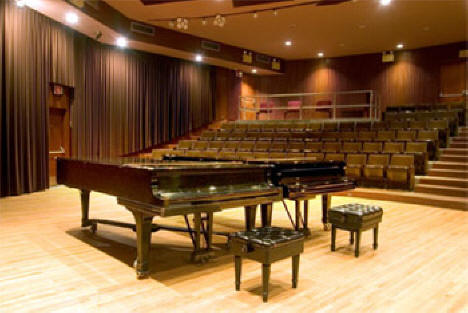
Only problem with it -- the projection booth is not centered and it's a short throw too, so there is sideways keystoning that I don't think even digital could fix....if we had digital (we don't).
Sadly, this theare will be demolished within a few months along with the George Gershwin -- two perfectly viable, functioning theatres...as well as our entire office complex.
Bureaucratic imbeciles.
Posted by Bobby Henderson (Member # 840) on 10-14-2010, 10:15 AM:
quote: Manny Knowles
you're conveniently overlooking the plain fact that many sloped (or raked) houses exhibit the same problem. i think it's possible to do both auditorium styles correctly AND incorrectly.
I have heard echo problems much more often in stadium seated auditoriums than I have in traditional sloped auditoriums. Stadium seated auditoriums typically have a much larger volume of cubic airspace due to the really high ceilings. Add to that a giant, wall to wall fixed-width screen. That may aggravate the problem.
quote: Manny Knowles
and you have not answered my other question -- which "certain" frequencies "seem" to suffer? (and where's the data that proves the theory?)
I'll repeat what I said in my first post in this thread. I'm not an audio engineer and I don't have reams of data conveniently on hand to prove what I am saying. Nevertheless, I am not imagining things. Stadium seated theaters at their best never sound as good as the best sloped theaters.
Surround imaging has obvious problems in stadium auditoriums because of the extreme differences in vertical space from one speaker to the next. The back wall speakers have to be stuffed up close to ceiling height. Transient fly-by surround pans end up sounding far less convincing.
I've never heard a large stadium seated theater do sub-bass with excellent quality (tight punchy, clean bass that can move the air in your chest but not sound sloppy and boomy). Bass sound waves are gigantic, but perhaps the geometric shape of the stadium seated room is doing something to mess up those bass waves. Maybe the greater tendency of echo is causing reflection and cancellation problems. I don't know. At most newer multiplex sites whatever needs to be done in terms of proper speaker choices, wall treatment, room design, etc. is not happening. They can make these rooms sound loud, but not great.
Brad also repeated some of my same complaints about crappy sound in stadium seated theaters. He might have a little more detail on the specifics in how a big, cubic stadium seated auditorium design can mess up audio quality.
Posted by David Stambaugh (Member # 1102) on 10-14-2010, 11:07 AM:
In my limited experience I would tend to agree with Bobby's statement that stadium houses often sound loud but not necessarily really great, esp. at the lower end of the frequency range.
I fully understand what Steve is saying but to pick out "corner cases" like the front rows of the stadium house being useless is missing the point. Regal and Cinemark are actually very careful here to warn ticket buyers when there's a near-sellout that they will probably end up in the front row. And if you do end up there and don't like it, you will get a refund on request. So that seems like a non-issue. Yes, stadium seating probably results in a higher percentage of "less than optimal" seats but that doesn't change the fact that the majority of seats provide (or are perceived to provide) better viewing conditions and improved comfort over typical sloped seating. I don't think I've ever seen a commercial movie theater with sloped seating where they had both adequate legroom and no issues with heads of people in the row in front of me partially blocking my view of the screen. Maybe such a theater exists but I've never seen it.
Ya gotta consider the entire experience when comparing sloped vs. stadium and not just highlight the worst features of stadium as a reason to be opposed to it. Overall stadium is a plus and the ticket buying public votes with their dollars.
Posted by Steve Guttag (Member # 268) on 10-14-2010, 12:14 PM:
Sorry David...too much hand waving there....there are PLENTY of well designed sloped floor theatres...perhaps just not in your area?
Again, it is often the case that even in a stadium theatre, thre are a couple of questionable rows about 2/3rds back. And by front row, I was not just meaning the very first row but that area...there are limits on human head motion and eye motion and when pain sets in...stadium seated theatres CAN often excite that more since they NEED to get their screens up higher to offset the riser height...No matter how you cut it, with a stadium you are trying to fit people in with less depth so thing move more rapidly.
As for people feeling stadiums are better...it has to do with poor designed theatres in the 70/80s...they grew up with the crappy theatre so stadiums are associated with better designs. It could have gone the other way. Once sightlines became and issue people paid more attention. Remember too, in the '70s many theatre put a single aisle down the middle of the theatre...leaving the best seats as a walkway...then the rage became "continental" seating with two side aisles. Of course this showed off poor screen height to slope problems (the desire for stadiums) and also created the annoyance that if one gets up, they walk past a great many people. The old traditional 3-section theatre was the best, in my opinion...and they didn't have sightline issues either.
It is all in how you lay it out.
Posted by David Stambaugh (Member # 1102) on 10-14-2010, 12:54 PM:
My hands never waved, not once. I'm not denying that good slope designs exist. I'm thinking through the "standard" commercial theaters I've been to in 50+ years (living in California and Oregon) and I can't come up with any that stand out as not having the issues I mentioned. Of course I can't recall every single detail about every theater.
As for the "pit" in local stadium designs, which includes more than just the first row, I would never sit down there by choice. Very bad. But people do it anyway, even when they don't have to. Go figure. When I said "front row" I didn't mean literally only the front row.
Posted by Joe Redifer (Member # 3) on 10-14-2010, 02:58 PM:
I have never been in a stadium seater that had enough legroom.
Posted by Louis Bornwasser (Member # 3063) on 10-14-2010, 07:12 PM:
Joe: EVERY stadium theatre near me has a 48" pitch. Lots of legroom and no need to get up if someone needs to get "out."
I think some of these problems are regional or specific to a particular (misguided) circuit. Louis
Posted by Edward Havens (Member # 4715) on 10-14-2010, 08:43 PM:
(Let me preface that I have not read any of the other responses yet.)
I don't mind stadium seating at the movies, and I don't say that because I manage an all-stadium seating theatre. For me, I care more about the quality of the sound and picture. I want a picture that is neither too dark nor too bright, masking that is set properly, a properly cut aperture plate that doesn't leave fuzzy black edges on the ends of the screen or allow some of the image to bleed on to the masking, proper balance between speakers, not too loud or too soft, and a subwoofer that does not overpower.
For Mr. Petrov, most of your complaints are not specific to stadium seating. I've been to, and even managed, a number of older theatres where the screens were too large (or too small) for the size of the theatre. Many of the theatres built in the pre-stadium seating era had no room to stretch out your legs under the seats. And ditto on the angled seating. These are bad design issues, immaterial of whether the auditoria have sloped or stadium seating.
Also, most MLB stadiums built in the past twenty years were designed by a firm called HOK Sport Venue Event, which built Orioles Park at Camden Yards in Baltimore, which made many owners rush to them and go "I want that!" PacBell Park in San Francisco, Jacobs Field in Cleveland, Petco Park in San Diego, Coors Field in Denver, Nationals Park in Washington DC, Target Field in Minneapolis, Great American Ball Park in Cincinnati, PNC Park in Pittsburgh... all slight variations of the basic Camden Yards design. But then, I go to the ballpark for the game, not the stadium.
Posted by Tom Petrov (Member # 1534) on 10-15-2010, 01:01 AM:
quote: Edward Havens
And ditto on the angled seating. These are bad design issues, immaterial of whether the auditoria have sloped or stadium seating.
I will agree with you, but oftern the theatre with non-angled seats is the smallest at the location, usually sloped non angled seat theatres are hard to find. I have never seen a newer angled stadium seating theater...not sure if one exists.
quote: Edward Havens
For Mr. Petrov, most of your complaints are not specific to stadium seating. I've been to, and even managed, a number of older theatres where the screens were too large (or too small) for the size of the theatre. Many of the theatres built in the pre-stadium seating era had no room to stretch out your legs under the seats. And ditto on the angled seating. These are bad design issues, immaterial of whether the auditoria have sloped or stadium seating.
My biggest complaint is angled seating, where all seats regardless of location are pointed at the centre of the of the screen. I have yet to see a movie theatre in the greater Toronto area that offers this feature. My 500 seat lecture hall in University was angled.
The only theater I ever remember was the Runnymede Theatre #2 and Humber Theatre #2 were balcony seating which where angled at the centre of the screen. I think the Hyland was like this as well. What is ironic is that, back then the newest hit never opended in the stadium/balcony theatre...it was always in the downstairs theatre which was sloped.
quote: Edward Havens
Also, most MLB stadiums built in the past twenty years were designed by a firm called HOK Sport Venue Event, which built Orioles Park at Camden Yards in Baltimore, which made many owners rush to them and go "I want that!" PacBell Park in San Francisco, Jacobs Field in Cleveland, Petco Park in San Diego, Coors Field in Denver, Nationals Park in Washington DC, Target Field in Minneapolis, Great American Ball Park in Cincinnati, PNC Park in Pittsburgh... all slight variations of the basic Camden Yards design. But then, I go to the ballpark for the game, not the stadium.
Yes, the movie/game is important, but in my mind, the actual theatre is vitally important as well. I would rather see a movie in a theatre that has character, is interesting, is unique and different than any other theatre.
On the other hand, every Cineplex Odeon, or AMC looks exactly like one another whereas you have no idea which theatre you are once you are inside.
The lasest trend in the GTA is to call the theatre by the most obvious street it is on, I think this sucks, we have the Queensway, Winston Churchill,Elgin Mills, Yonge/Dundas. We still have theatres named after the mall or what not...but what ever happened to the days of the Sussex, Westwood, Oakvile Mews, Skyway 6, Hollywood, Skyline, Cedarbrae, The Uptown 3, the Plaza, The Madison, THE HUMBER 1 & 2(which was named after the river that was flowing next to it)
We always did have theatres named after the road it was on and there is nothing wrong with it, but the name of the theatre is so cool when it has a really cool meaning...The Skyway was named that way because it was next to an airport and you could often hear the planes flying overheard during the movie
To bad there was no river flowing next to my newsest favorite theatre, the Jackson Square...but I guess I will live with the name Jackson Square as it is located in a mall with a box office that is on a lower lever with flashing bulbs and the old style letters...
Posted by Manny Knowles (Member # 1171) on 10-15-2010, 06:00 PM:
quote: Edward Havens
I don't mind stadium seating at the movies, and I don't say that because I manage an all-stadium seating theatre. For me, I care more about the quality of the sound and picture. I want a picture that is neither too dark nor too bright, masking that is set properly, a properly cut aperture plate that doesn't leave fuzzy black edges on the ends of the screen or allow some of the image to bleed on to the masking, proper balance between speakers, not too loud or too soft, and a subwoofer that does not overpower.
the aperture plate will always yield a fuzzy edge because it does not share the same focal plane as the film -- a small portion of the image is SUPPOSED to spill onto the masking -- it is the MASKING that provides the crisp edge.
as for the "not too bright, not too dark" and "not too loud or too soft" -- who set up your system? Goldilocks?
Powered by Infopop Corporation
UBB.classicTM
6.3.1.2