This is topic Is THX still relevant? in forum Film Handlers' Forum at Film-Tech Forum ARCHIVE.
To visit this topic, use this URL:
https://ft-forum.com/ft/cgi-bin/ubb/ultimatebb.cgi?ubb=get_topic;f=1;t=010671
Posted by Tom Petrov (Member # 1534) on 10-28-2010, 01:04 AM:
Its been on my mind for a while now. With AMC ETC, Cineplex Ultra AVX, digital this, 3D that, is THX still relevant?
In my area, I have not seen a theatre advertise THX for years now. Its seems it does not really matter.
On the home video side, I love THX mastered LDs, DvDs and Blu-rays. It just seems that there aren't many DvD and very, very blu rays that get the THX treatment.
For the record, I love THX, so this is not a bash on it. .
Posted by Mike Blakesley (Member # 26) on 10-28-2010, 01:21 AM:
This is another of those topics, if you do a search you'll find tons of writing about it.
The bottom line is that it costs so much to license THX that a lot of chains can't justify the cost; and, their standards (for some chains, apparently) have been relaxed enough to render it less meaningful than in the past.
Posted by Manny Knowles (Member # 1171) on 10-28-2010, 08:30 AM:
In a sense, THX is still relevant. It is a standard of excellence that cinemas should strive to attain, whether or not they actually intend to license the THX name.
Yes, it's expensive, but pursuing certification ensures that corners don't get cut. I've been involved with projects that start out with the best intentions and end up being merely average because a corner gets cut here and another gets cut there. And corner-cutting or "value engineering" happens because (a) it makes the installation cheaper and (b) without real THX certification on the line, there's nothing tangible at stake. It's a slippery slope and all those little cuts add up. In my opinion, the real value of THX is that the threat of flunking the certification/testing phase keeps everyone honest.
The problem I have with something like AVX is that it's basically the theatres THEMSELVES declaring their own excellence. I'm a little skeptical of this because I believe in that old adage that says "self praise is no recommendation." Or, if you prefer, "the fox is guarding the henhouse."
And, I can't help but notice that AVX is another 3 letter acronym ending in "X" -- it strongly suggest that THX is still relevant. There's another old saying: "imitation is the sincerest form of flattery."
Poor THX. A misunderstood child.
THX was introduced at a time when there was a real problem to solve. Movie theatres weren't capable of accurately reproducing film soundtracks. Arguably, managers and installers weren't fully aware of everything that could be done to maximize the quality of the sound in their cinemas -- or maybe they just didn't care about sound quality. Upon its introduction in 1983, THX made a *noticeable* difference in how movies sounded.
This translated into a box office trend that proved THX theatres earned more money than non-THX competition (same movies and/or same catchment areas).
But, while the average moviegoer could hear a difference, few people truly understood what the heck THX actually was. For example, there was a widespread (mis)understanding that it meant "loud" or that it had something to do with the surrounds. This was parodied on The Simpsons and, subsequently, "spun" into an actual THX logo trailer. The trailers were such a powerful marketing tool that consumers confused the actual soundtrack to be THX (as opposed to the venue).
And so, in 1993, when "digital" became the new buzzword, THX (already 10 years old) got lost in the alphabet soup, suddenly dominated by SRD, DTS and SDDS. And, like THX, digital sound made a *noticeable* difference in sound quality -- and it didn't seem to matter anymore if a theatre was THX or not. If it was digital, it was great. It wasn't widely understood that THX could make any of these formats sound their best. To the average listener, there wasn't a *noticeable* difference between digital sound with or without THX. Box office receipts supported this. And cinema operators exploited the confusion.
THX cinemas stopped getting re-certified, opting instead to simply promote the fact that they had "gone digital" (and eliminate the annual expense of the per-screen marketing license from THX).
THX gets "pimped out."
One of the problems I have with THX is that they've diluted their message in the interest of becoming too commercial:
THX quality on VHS tapes? Really?
THX computer speakers? Really?
THX car stereos? Wow! I'll bet it sounds just like being at the movies.
THX home theatre? OK, it's *technically* possible, but not likely.
And, IIRC, they make allowances (read: lower the standard?) for historic buildings that can't be architecturally modified to meet the spec. Somebody correct me if I'm mistaken on this point.
"Bitch better have my money!"
--Pimp of the Year, from I'M GONNA GET YOU SUCKA!
quote: Mike Blakesley
their standards (for some chains, apparently) have been relaxed enough to render it less meaningful than in the past.
The term "courtesy certification" comes to mind...
Oh, and good luck trying to get THX training for cinema applications -- they only offer home theatre training now.
Posted by David Stambaugh (Member # 1102) on 10-28-2010, 09:26 AM:
quote: Manny Knowles
And, IIRC, they make allowances (read: lower the standard?) for historic buildings that can't be architecturally modified to meet the spec. Somebody correct me if I'm mistaken on this point.
When Act III Theaters renovated the McDonald Theater back in the mid-90s, they claimed to be striving for THX certification but couldn't quite get there due to issues with the balcony. They also renovated Cinema World 8 around the same time with all 8 getting THX certification. Apparently in this case the historic nature of the McDonald didn't help it get THX approval even though that was their goal.
I guess if you think of THX as meaning "The best that this specific product technology can deliver" then it might be relevant but that's a pretty nebulous standard of quality when applied to things like computer speakers.
Posted by Manny Knowles (Member # 1171) on 10-28-2010, 10:00 AM:
quote: David Stambaugh
I guess if you think of THX as meaning "The best that this specific product technology can deliver" then it might be relevant but that's a pretty nebulous standard of quality when applied to things like computer speakers.
Exactly my point.
But note that I started by saying,
quote: Manny Knowles
In a sense, THX is still relevant.
The CINEMA standard remains an excellent one, and it is actually well-defined.
Posted by Gordon McLeod (Member # 33) on 10-28-2010, 10:36 AM:
The important work they did
1 A set of criteria that in most cases were really not the onerous if one wanted to do it right
2 A set of testing criteria to ensure that they were met in a uniform fashion
3 A analyzer that met that requirement
Posted by Sam D. Chavez (Member # 1841) on 10-28-2010, 10:48 AM:
To the point that installers did not understand what was involved in getting "best practices" implemented;
The best installers did understand what was involved but were not able to get cinema owners to focus and agree to make it a priority, All the unsolicited advice in the world would not convince owners to improve the audio just for the sake of a better presentation.
"Free advice" seems to be disdained as in the great line from "Putney Swope", "take a walk, we can get anyone for nothing." {Anyone remember this film?}
Once the specs were codified by Tom Holman and kudos to him for coming up with realistic, no nonsense criteria; there was a movement toward THX, partially because there was a program with teeth and a mystique was quickly developing.
And, behind all of this was the implicit "carrot" to the owner that they stood a better chance to get a booking of a movie from Lucasfilm which was making blockbusters back then.
And that boys and girls, is how sausage is made.
Posted by Martin McCaffery (Member # 37) on 10-28-2010, 11:22 AM:
"You can't Eat a refrigerator"
Putney Swope was one of the great satires of the sixties from Robert Downy, Sr. I would go and see it almost everytime it returned to the Rep houses when I was in High School.
Now back to your regularly scheduled topic.
Posted by Scott Jentsch (Member # 1681) on 10-28-2010, 01:36 PM:
I'm a big fan of what THX tried to do, and barring the situations that seem to be the case where THX bent their rules and allowed theater chains to certify themselves, I believe in what THX was intended to do and what it can bring to the admission-paying moviegoer. Unfortunately, those missteps diluted the brand to a certain degree.
The fact that THX probably saw the writing on the wall in the theatrical market and expanded to other things doesn't bother me. The intention was a good one, even if the execution didn't always work out. We can laugh at the thought of a THX-certified videotape, but if that meant that all of the steps of the process were monitored for quality, then why not? A THX computer speaker should perform better than a Chinese knockoff sold for $3. I don't have a problem with the brand showing up in multiple places. Look at Dolby for a brand that can be seen just about anywhere...
That said, I think the intent of THX is still relevant. Solid construction, decent equipment, and regular tuning are all very good things. From some of the comments on this site about some theaters being way out of whack sound and picture-wise, it shows that third-party certification should still be done, but for the most part, isn't. When 3D dims the screen, wouldn't it be nice to know that a theater has been checked to make sure that the brightness hasn't gone down so far that the movie is nearly unwatchable?
Anyone that says that the intent of THX doesn't matter either wants to pull a rug over the eyes of the unknowing public or is oblivious to what should be done to provide a quality presentation. In the ideal situation, THX certification meant that the theater had been tested every 6 months and met the requirements of the certification.
No other program, certification or marketing program, does that.
Posted by Jake Spell (Member # 5294) on 10-28-2010, 01:52 PM:
Regarding computer speakers, I bought a 5.1 set for my computer about 5 years ago from Best Buy and chose it (Logitech Z-5.00) because it was THX certified. I was EXTREMELY impressed by it, both is sound quality and clarity. Are these the best speakers ever made? no. Do they sound kick ass on my computer, hell yes. In this case the THX certification holds very true.
Posted by Manny Knowles (Member # 1171) on 10-28-2010, 02:48 PM:
The fact that the question has come up time and again -- "is THX relevant?" -- points to the fact that something went wrong.
This is a question that would not have come up 15 years ago but, for some reason, it comes up today.
I have done my best to outline what I believe to be the responsible factors. Ultimately, it all boils down to "dilution of the message." That is, average moviegoers don't know what it does and can't tell a difference.
Do you think theatre owners adopted THX because they cared about good sound? No! They did it because they wanted to show RETURN OF THE JEDI and it was a proven fact that THX theatres sold more tickets.
Let's not pull the rug over our eyes -- It was all ultimately all about money. Which, by the way, is how we end up with THX in the home (and in the car). THX makes more money that way.
Bottom line: I think people came to the conclusion (perhaps subconsciously) that THX sold out. And when companies are perceived as selling out, their credibility gets called into question.
Posted by Joe Redifer (Member # 3) on 10-28-2010, 02:48 PM:
I did not appreciate how THX measured for ambient room noise with the projectors off. When the Mann Bowles Crossing 12 theater opened over 15 years ago, it had THX in each auditorium. The sound was OK (the optical sound was distorted) but what really chapped my ass was that I could hear the projector running during the movie CLEARLY even in the front row. It was like there was no port glass at all. This affected each auditorium. I complained to THX a few times. What happened? They put noise-reducing foam around the inside of the port holes. That helped a little, but the problem still plagued the place until THX was finally canceled a few years later.
Posted by Manny Knowles (Member # 1171) on 10-28-2010, 02:49 PM:
so THX was canceled...and then the problem went away?
Posted by Joe Redifer (Member # 3) on 10-28-2010, 02:52 PM:
The problem having anything to do with THX went away.
Posted by Marco Giustini (Member # 4544) on 10-28-2010, 04:03 PM:
as you guys say, I think THX mistake was to become "too soft". I understand their point of view: chain XYZ would like to certify xxx theatres, but they also would like to cut some corners, or they won't go on with the certification. So, instead of losing xxx cinemas, let's ignore some issues here and there. But within the years those corners became more and more and at the end the difference between a THX and a non-THX theatres was not huge anymore.
I reckon if they had kept their strictness in certifying screens, they would have lost some contracts in the short term, but not in the long term.
Haven't seen any more THX theatres lately.
Posted by Greg Anderson (Member # 235) on 10-28-2010, 04:07 PM:
It is significant that when THX started all theaters we analog. When DTS entered the fray in a big way with Jurassic Park a lot of patrons and even theatre operators thought that "digital" and THX were competing formats. "We don't need THX anymore because we have DTS." How many patrons thought that THX was some kind of extra booster that could be turned on or off at the projectionist's whim?
So THX suffered from a poorly-informed public AND poorly-informed owners. But, yes, it DID seem like digital sound systems didn't need as much maintenance as analog systems. And paying for that recertification didn't seem to be worth the price anymore if audiences thought DTS was better.
Posted by David Stambaugh (Member # 1102) on 10-28-2010, 04:34 PM:
Speaking only of movie theaters, if THX certifications were still objective, impartial, based on high standards, and performed on a regular schedule, then yes it would still be relevant.
Posted by Louis Bornwasser (Member # 3063) on 10-28-2010, 07:17 PM:
THX had two problems:
1. As Scott said, they sold out. The first THX contracts were limited to cinema only, not to be used in any other venue or platform. When THX did tyhis, one large chain attempted to renegotiate the contract (money-wise) and failed. Said circuit used this as an excuse to cancel circuit wide. The architects had learned how to properly design a building by then and it did not matter much. Also, our identical non-THX screens had identical equipment except for the crossover, which had become somewhat dated.
2. Other circuits began to self certify. The equipment was not on the approved list, which itself was quite lame. I can name a chain theatre where audio from FIVE screens can clearly be heard in the THX room.
It just didn't mean anything anymore. Tom Holman had left anyway. Louis
Posted by Bobby Henderson (Member # 840) on 10-28-2010, 08:26 PM:
In the early 1990s THX made a decent effort of trying to educate customers about why THX and digital sound were important. They had a good tri-fold flyer, buttons saying things like "THX and Dolby Digital, the perfect combination," etc. I liked the analogy they made about a digital audio track being like a CD and THX being a really great sound system on which to play the CD.
I agree THX "sold out," but I think what they did in consumer circles happened after the theatrical effort was seriously wounded.
I don't think 5.1 digital sound did anything to hurt THX. Between 1993 and 1995 I think the digital formats did a lot to encourage THX installs. The real thing that screwed THX up good was stadium seating.
I think it is more difficult to build a modern stadium seated auditorium and have it fully comply with the THX spec when it was really demanding. The rooms are quite a bit bigger in terms of cubic air space. That means greater demands for air conditioning (and a harder time trying to eliminate AC noise). The rooms are more prone to echo. The problem is worsened when those common width wall to wall screens are used. I suspect it would be more difficult and costly to get all the right equipment and appropriate acoustical treatments installed. Lots of theater circuits balked at it.
I think THX watered down their specifications to make it easier to plaster the THX logo on stadium seated theaters. Even then the vast majority of new stadium seated builds weren't featuring THX even when they could do it under an easier set of standards. And then the theaters that did bother to do THX and stadium seating (and digital sound) weren't doing it very well. Audiences just shrugged instead of being blown away like they would have been if they had visited a THX theater that did THX right (such as the old Northpark #1 in Dallas).
Posted by Aaron Garman (Member # 1653) on 10-28-2010, 10:57 PM:
To answer the topic's question: yes, it is still relevant. Do average consumers notice or even care? Most likely not.
THX certainly did suffer from getting lost in the alphabet soup, and I'd love to see it perhaps bring order to that mess. If they rethought the spec, and made it stricter, it could help the consumer. Instead of going to a 4K DLP with 3D, stadium seating, and mega super duper ultra fantastic sound, just sum it up with one name: THX. There is definitely a great branding opportunity there.
As for consumer gear, I was very excited to see THX certified displays because it was starting to get extremely confusing when looking at different display devices. Now when I see a THX display, I know that it can perform certain tasks up to a certain standard.
And I concur, THX certified VHS tapes was not a step in the right direction.
AJG
Posted by Marco Giustini (Member # 4544) on 10-29-2010, 05:13 AM:
I could name another (former I guess) all-THX 5-screen cinema where the sound of all 5 screens could be heard in all other screens.
Posted by Joe Redifer (Member # 3) on 10-29-2010, 09:38 AM:
That's not at all surprising as they do not measure for ambient noise with the other auditoriums on and running.
Posted by Steve Guttag (Member # 268) on 10-30-2010, 12:47 PM:
I think Manny summed it up the best.
THX was always supposed to be a "seal of approval" to a theatre and patron. By attaining THX certification, the theatre was supposed to meet specifications normally reserved for dubbing stages and thus a theatre would have a similar experience, sound wise, to what the person heard when they mixed the movie.
They absolutely suffered a branding issue when the patron thought of THX as a "sound system" or a "format" rather than a quality. They also did EVERYONE a disservice when they allowed in-house techs to recertify their own theatre. Regardless of the integrity of the tech, their livelihood could be put in jeopardy by failing their boss' theatre! And with that, allowing theatres, that happen to be part of a lucrative or high-profile deal pass when they shouldn't. They damaged their reputation.
We still re-certify theatres for THX. And most know, I have no problem failing one that does not meet spec. I have not had a problem getting folks to fix their HVAC or whatnot in order to pass. In a sense, this is THX at its finest...the annual recertification process allows one to track a theatre that is aging and address problems that will not be noticed on a day-to-day situation. One such screening room we handle I noted that each year, a little more boost was needed to meet spec (our mics are recalibrated annually to avoid our test equipment from entering into that equation). After 10 or so years, really, the diaphragms needed to be changed because they didn't have the response they once did. That sort of thing gets missed in most theatres since one has no point of reference. The change is so small on any time period, one wouldn't even pick off that the performance had lessened. Likewise with the HVAC stuff where the noise increase is gradual as the equipment ages.
THX also is more than a collection of equipment. It is not enough to merely put in THX-approved equipment to get the full benefit of the design. How the equipment interacts with its surroundings also plays into it.
I'm not sure I've ever seen a conventional theatre, without THX actually go through will all of the design required for THX certification, including spacing of the stage speakers off of any boundry surfaces, the baffle wall construction...etc.
Joe does bring up a good point about the noise from the booth. I know that when I went for training, they made a point of stressing to use double ports to minimize it and to seal them tight to the wall as well as other openings (electrical boxes...etc) to keep booth noise down. At the AFI/Silver, a THX Certified facility, to this day, the booth walls are VERY impressive...despite having theatres back-to-back...you can't hear the booth or the other theatre. I think there should be a test, like the HVAC test to verify that the booth also does not bring the theatre above NC-30. The projector should be threaded with a loop that has several splices in it too! For DCinema, the projector, with all of its fans, should be on too.
On the consumer side...well, that is a source of revenue, for sure...and again, THX is a certification that one either believes in or they don't.
Steve
Posted by Scott Jentsch (Member # 1681) on 11-01-2010, 12:50 PM:
Some of this sounds like a company I used to work for. We needed to attain ISO9000 certification in order to get a particular contract. The officers of the company got on board with the idea of becoming ISO9000 certified, until they found out how hard it was going to be. Then they decided to become ISO9000 "compliant" which is a euphamism for not doing everything the certification required, just most of it (or at least the parts that they wanted to do). It become such a protracted issue, I don't even remember if they got the contract that originally required them to get the certification.
Can ISO9000 be blamed for the company watering down the spec? No. From what people say here, THX did just that, and for that, they should be blamed for the mess they created. But the theaters certainly sound like they had a hand in it, as they were trying to skirt the requirements because they were too onerous. It's too bad that THX didn't stick to its guns and say that the spec was the spec, but most companies follow the money...
It's odd that a THX screen would have sound leakage issues from adjacent auditoriums, as I'm certain that such isolation was part of the spec (as was isolation from the projector). In the half-dozen THX auditoriums that I've been in, I've never experienced those issues, but I believe those here that say that it exists/existed.
As far as relevance of THX certification and of the THX brand, I think both are still relevant.
No one here has said that if the THX spec were followed completely, you would end up with a poorly performing theater. Therefore, a THX certification should be a stamp of approval that the consumer can count on. There is a salient point that a theater could build an auditorium that would meet or exceed the performance of a THX-certified auditorium, but no one paid the money for the THX plaque for the wall. That's all well, fine, and good, and it's possible that the public might notice without any prompting or marketing by the theater.
That's where the marketing strength of the THX brand comes in. I have absolutely no data to support this, but I would wager that the THX brand still has meaning with the moviegoing public. If you had a movie playing in two auditoriums, and one was branded THX, I'll bet that the THX auditorium will sell better. That's just simple marketing. Now, you might be able to switch out THX and put in ETX or XD as the brand, and maybe get the same results, but the end result is that by marketing something as special, it draws attention that it wouldn't normally get. It's a competitive advantage.
If you had two auditoriums, and one was THX and the other was ETX, the natural thing for the customer to ask is "what's the difference?" If the answer was that the THX auditorium was built to a set of rigid performance specifications, using equipment that has been approved for its performance, and it was checked by a third-party every six months, vs. the ETX auditorium which was built with the same intentions, but it wasn't certified or checked by a third-party, my guess is that a majority of people would steer towards THX. Especially if the THX presentation is regular price, and the ETX presentation is 30-45% more.
I'm less confident than the THX vs. nothing argument, but the effect of the marketing and the impact that using the THX brand could have still resonates with the public. That THX trailer is part of the show, and when you put that before a movie, people are going to sit up and take notice. That makes a theater playing Harry Potter in a THX house more attractive than the theater down the road not having anything additional to advertise about.
Even ignoring THX as the linchpin, if theater chains were to set up a certification program that would provide the public with some additional confidence in the performance of the presentation they experience, it would have an impact.
For example, if Marcus Theatres were to come up with a new program, let's call it "Gold Standard" This new program would outline to the public that there are a certain set of performance guidelines that they were checking their own theaters against, such as sound performance, image brightness, focus, steadiness, noise levels, etc. and each auditorium would be checked on a regular basis for these factors, that would instill confidence on the part of the consumer. Even bathrooms at WalMart have a sign on the back of the door that says when it was last cleaned and the name of the manager to contact if you find something that needs attention. Why can't a theater have the same thing? At the door, a small sign that reads "This auditorium checked by S. Johnson on 10/31/2010. Gold Standard Certification -- PASSED" would all that is needed.
In the consumer's mind, the THX certification already does that, and it's a universal standard that is easy for people to understand and lots of marketing has already been put into it (not so much anymore, but that's another issue).
The THX spec matters. Digital Sound matters. Film/Digital Cinema done right matters.
Consumers have to be educated so that they know what it is that they're experiencing, so that they can appreciate the difference. These things are completely up to the theaters, and unfortunately, many fail at the job. Small wonder that the audience is either confused or apathetic about the differences!
Posted by Tom Petrov (Member # 1534) on 11-01-2010, 02:14 PM:
I was in a former THX auditorium yesterday and you couldnt really tell that the theatre was a cut above the rest of the theatres in the complex.
It was so upsetting to see that the seats were not pointed directly to the centre of the screen. The seats at the edge of the rows was pointed to the edge of the wall. How can people watch a movie like that?
quote: Aaron Garman
As for consumer gear, I was very excited to see THX certified displays because it was starting to get extremely confusing when looking at different display devices. Now when I see a THX display, I know that it can perform certain tasks up to a certain standard.
And I concur, THX certified VHS tapes was not a step in the right direction.
I have a whole bunch of consumer gear. Usually the THX stuff is built better. Also, I have noticed my THX receiver is silent when running while my non-THX receiver has slight hum to it.
As for the tapes, I have noticed that THX Laserdiscs, tapes,dvds are usually a step above the nonTHX media, especially for the picture quality.
Posted by Manny Knowles (Member # 1171) on 11-01-2010, 02:30 PM:
Just about every THX cinema I've been in suffered from low-end bleed from adjacent theatres. (Free-standing, single-screen theatres excluded.)
This may have been less of an issue with analog but with the digital LFE channel (with in-band +10dB gain and higher overall SPL in all channels) the problem becomes that much more pronounced.
I could allow that it may have been an unforeseeable issue, if the theatre was constructed during the analog era.
Posted by Joe Redifer (Member # 3) on 11-01-2010, 05:20 PM:
quote: Scott Jentsch
It's too bad that THX didn't stick to its guns and say that the spec was the spec
The other problem with this is that THX specs were NEVER good enough to begin with. Like I said before, they only measure for ambient noise coming from the HVAC. They do not measure for projectors running in the booth or noise coming from adjacent auditoriums.
Posted by Tom Petrov (Member # 1534) on 11-01-2010, 05:44 PM:
quote: Manny Knowles
Just about every THX cinema I've been in suffered from low-end bleed from adjacent theatres. (Free-standing, single-screen theatres excluded.)
I remember when I saw "War of the Worlds" at the Queensway theatre 18. They were doing some construction outside and I could hear in during the quiet moments of the film.
Posted by Louis Bornwasser (Member # 3063) on 11-01-2010, 09:47 PM:
I can tell you that National Amusements THX was rigorous and noise was measured during normal operating hours with all adjacent theatres running and with film running in the projector. Rigorous enforcement.
There were two problems:
1. Other competitive cinemas were passed even when not good.
2. Other auditoriums in the same NA plex were as good or better than the THX installations. (identical equipment and rooms)
Rationally, why pay for something that was devalued by its owner (THX)?
Secondly, the public came to identify THX with echo sound and noise because of the other theatres. It became a liability, not an asset, so it was cancelled. Louis
Posted by Bobby Henderson (Member # 840) on 11-01-2010, 10:24 PM:
quote: Joe Redifer
The other problem with this is that THX specs were NEVER good enough to begin with.
There's a couple key factors to consider in this. The original THX spec was drawn up in, what, 1982 or very early 1983? Back in that day what sort of theaters were targeted for THX certification? I don't think the neighborhood multiplex was seriously considered. The big "flagship" class standalone theater design in big cities was the preferred target.
Technically the GCC Northpark 1-2 theater in Dallas (one of the first THX sites) was a multiplex. However, the #1 THX house was on the south side of the building while the #2 non-THX house was on the north side. There were no issues of sound leakage between the two auditoriums. Audiences in house #1 would have had a much better chance of hearing a CO2 tank explode in the snack counter than hear any sound at all coming from house #2.
Then we have to consider the nature of film soundtracks back in the early 1980s. They weren't quite as dynamic as soundtracks became at the end of the 1980s on into the 1990s. Dolby mag SR on 70mm and 35mm digital both had lower noise floors and more headroom than Dolby A magnetic on Format 42.
Theater builders underestimated the amount of sound-proofing required to contain sub-bass between multiplex auditoriums. I don't think they've really done it right with modern stadium seated theater designs with high ceilings and common width screens (lots of echo and frequency band robbed audio). It's pretty funny to consider how you can hear the rapid rat-a-tat-a-tat of the film projector in most auditoriums, THX certified or not. I don't think I ever heard the projector rattling in Northpark #1, but that was a huge 1000+ seat auditorium too. When you grabbed a chair in that auditorium's sweet spot you were pretty far forward from that projector port.
Posted by Louis Bornwasser (Member # 3063) on 11-02-2010, 02:53 PM:
My first "twin split" was 1974. There was no issue of sound leakage, since my background was broadcasting. I used "studio" techniques to stop the bass. The only theatres that I installed that had leakage were those where the owner & architect refused to comply.
Moreover, thx, if you read the specs, did require no leakage and decent reverb times, right from the start. Indiana Jones, one of the loudest films ever mixed, played perfectly with no leakage into the other rooms. Stadium theatres are not necessarily bad by design, in fact there is a demonstratable evenness from front to back; more so than a normal auditorium. A normal room rarifies from front to back and the sound drops off. In a room with a smaller area in back (such as the Fox in Atlanta) the distance reduces the level, while the smaller volume compensates. i do not feel my rooms are perfect, but sound (& sight lines) was the driving force behind the original stadium cinemas. Louis
Posted by Joe Redifer (Member # 3) on 11-02-2010, 05:48 PM:
What are "studio" techniques?
quote: Louis Bornwasser
Indiana Jones, one of the loudest films ever mixed
No, Close Encounters is louder according to Screenvision's careful and exhaustive research. Of course, either being one of the loudest makes no sense.
Posted by Manny Knowles (Member # 1171) on 11-03-2010, 02:22 PM:
CE3K was said to be the loudest mix -- up to that point in time -- I question if that was still true when Temple of Doom was released.
Posted by Steve Guttag (Member # 268) on 11-03-2010, 08:03 PM:
The 70mm True Lies was the hottest mix I've heard.
Posted by Martin Brooks (Member # 1269) on 11-08-2010, 10:30 PM:
I saw Close Encounters at the Ziegfeld in NYC in 70mm 6-track Dolby and again for the special edition. Extra subwoofers were added for the original presentation.
The mix and overall sound quality were absolutely superb and IMO at the time, far superior to Star Wars in 70mm seen at the Loews Astor Plaza.
I did not sense that the mix was over loud and there was certainly plenty of dynamic range. There were peaks that were very loud (although not distorted or pain causing) and that may account for the legend that it was the "loudest mix."
In the original mix, when the ship plays the first sound and blows the glass out in the observation booth, the sound of the glass breaking came out of the right surrounds and was so realistic, everyone turned their heads (which actually is a mixing no no.) The special edition did not have as impressive a sound, IMO, but this could have been because it played back through the ordinary b-chain (no extra woofers).
Posted by Sam D. Chavez (Member # 1841) on 11-08-2010, 11:36 PM:
"Altered States" was way over the top.
Posted by Victor Liorentas (Member # 5272) on 11-09-2010, 12:10 AM:
Yes i saw Altered States at Toronto's Famous University theater and it was advertised in 70mm Mega sound!
It had the most aggressive surrounds i have ever heard to this day!
Posted by Sam D. Chavez (Member # 1841) on 11-09-2010, 01:20 AM:
I set up some of the screenings including one at the Stanley in Vancouver.
Only almost 30 years ago.
Posted by Frank Angel (Member # 248) on 11-09-2010, 04:04 AM:
Martin, we could have been sitting watching the same show at the Ziegfeld; I was so incredibly impressed with the sound when I went to see it there, that I insisted in dragging my entire family out from Smithtown to the city specifically to see it there. And I saw it three more times after that at the same grand old lady, with her SINGLE screen, grand curtain and all -- and still going strong today.
Yes, the extra subs (I was told Columbia paid to have them installed) made this thing sound better than any film I had seen up until that time. It had the power of Sensurround, only much cleaner. Indeed, it was the inspiration that lead to my saying which is posted on the wall in my office -- You Can't Have Too Many Subs -- E=MC2, +/- 2db
Posted by Ron Lacheur (Member # 1126) on 11-16-2010, 02:07 AM:
Sam,
Do you remember any specifics about the Stanley installation?
Posted by Robert Throop (Member # 61) on 11-16-2010, 06:29 AM:
Didn't the Stanley have one of the first CP200 installations?
Posted by Sam D. Chavez (Member # 1841) on 11-16-2010, 10:27 AM:
The Stanley had a CP100 and SA5 stereo surround decoder at that time. Norelco A11's.
The sound system was scattered over a couple of wall racks, not my favorite method but nicely done as always by General Sound.
That is about all I remember.
It did have the Megasound Cerwin Vega subs as well.
Posted by Ron Lacheur (Member # 1126) on 11-16-2010, 12:20 PM:
quote: Robert Throop
Didn't the Stanley have one of the first CP200 installations?
Unless THX approved the CP100, it probably got one in 1985 when it was certified.
quote: Sam D. Chavez
The Stanley had a CP100 and SA5 stereo surround decoder at that time. Norelco A11's.
The sound system was scattered over a couple of wall racks, not my favorite method but nicely done as always by General Sound.
That is about all I remember.
It did have the Megasound Cerwin Vega subs as well.
Thanks for sharing Sam! It's hard to get information about a place that hasn't run film in almost 20 years! The building still stands today, but as a Live Theatre.
Posted by Edward Havens (Member # 4715) on 11-17-2010, 06:46 AM:
Getting back on topic... the answer is clearly "NO!" Let's remember the #1 thing about THX: it was, and will always be, a for-profit company that carved out a niche in developing high-quality standards for operating procedures and practices concerning audio production, and for the equipment to play back that audio in a movie theatre. You had to pay for specific THX-certified equipment (from sound baffle and speaker wire to processor) to be installed in your theatre. You had to pay to have someone make sure your theatre was compliant. And then you had to pay for the right to have that screen THX-logo'd, $10,000 or so, each and every year. Just 100 screens would cost you a million dollars every year for the right to play that Deep Note before your movies. And when your profit margins are already razor thin, dropping that cost is easy to do.
THX, at least for movie theatres, is the past. I'm not saying it's right, and I'm not saying I like it. I'm just saying it is.
Posted by Bobby Henderson (Member # 840) on 11-17-2010, 01:43 PM:
quote: Edward Havens
And then you had to pay for the right to have that screen THX-logo'd, $10,000 or so, each and every year.
I know the annual THX licensing fee per screen wasn't real cheap, but I don't think it was $10,000 either. I thought the annual fee was closer to $1,000.
Posted by Manny Knowles (Member # 1171) on 11-17-2010, 01:59 PM:
I dunno...the number I kept hearing was $10K back in the day for the licensing.
Maybe it was $1K for the annual testing..?
Posted by Steve Guttag (Member # 268) on 11-18-2010, 01:18 AM:
I don't think it was EVER $10,000...that is WAY too high. The rates have always been more variable...depending on screen count, the type of certification (theatre vs screening room, vs dubbing stage). The initial certification was always higher than the annual fee...which is closer to $1K-$3K.
Is it "for profit?" Yeah...so? That is how companies stay in business.
Posted by Joe Redifer (Member # 3) on 11-18-2010, 01:24 AM:
Yeah, I always thought THX was a charity, too.
Posted by Scott Jentsch (Member # 1681) on 11-19-2010, 04:25 PM:
quote: Edward Havens
Let's remember the #1 thing about THX: it was, and will always be, a for-profit company
You say that like it's a bad thing. You expect all their costs for talent, research, et al. to be absorbed by magic?
quote: Edward Havens
that carved out a niche in developing high-quality standards for operating procedures and practices concerning audio production, and for the equipment to play back that audio in a movie theatre. You had to pay for specific THX-certified equipment (from sound baffle and speaker wire to processor) to be installed in your theatre. You had to pay to have someone make sure your theatre was compliant. And then you had to pay for the right to have that screen THX-logo'd
Wasn't this the whole point of the certification process? If you could buy any odd speakers out of the J.C. Whitney catalog, how would that set a standard for performance?
Certifications have never been free. Take a look at the back of any electrical/electronics product, and you'll see the UL logo. The manufacturers don't get to use that logo for free. They have to pay Underwriters Laboratories to burn up their equipment (that they have to send at no charge) and submit to a process in order to just see if their product passes. It's only when they pass that they get to display the logo on their product.
I can't speak for the mis-steps that THX has taken in the past, but I fail to see the logic in bitching about the costs involved in gaining a certification that proved to the public that you've done something that is probably above and beyond what other theaters have done, and that a third party says so, and comes back on a yearly basis to tweak things and make sure that everything is performing up to the standard.
In return, theaters get to display the THX logo and other marketing materials, and take advantage of the reputation and the marketing efforts that the THX brand represents/represented.
Say the cost is $1,000 per screen per year. How many bodies in the door does it take to recoup that cost?
Does the cost of using THX-certified equipment and adhering to certain design principles during construction add that much to the total cost of construction?
By the way, that means the cost of the THX certified equipment and design requirements that would be over and above what would generally be considered high performance theater design and equipment (which many who pick on THX certification say they're doing already anyway and don't need any stinkin' logo to make them feel good about themselves).
Even though the THX brand isn't as powerful as it once was, it is still a differentiating factor that could be used to a competitive advantage. One would hope that the design principles and the specified equipment list still represents at least a minimum level of quality and performance, so following those requirements should result in a very good theater.
At a time when there are literally dozens of movie theaters with dozens of screens within 10-15 minutes of just about any densely populated area in the country, anything that can be done to differentiate your theater from the dozens of competitors gives a theater a leg up against the competition.
I'd be very interested to hear what other investment can do the same that makes THX certification unreasonably expensive in comparison.
Posted by Louis Bornwasser (Member # 3063) on 11-19-2010, 07:43 PM:
Scott: You would be right IF thx cert meant anything. Unfortunately in KY and Tennessee, it means BAD. Neither the equipment, the building or the certifying people have any standards. We left them since it was best NOT to be thx. Get it? Louis
Posted by Mark Gulbrandsen (Member # 72) on 11-19-2010, 09:57 PM:
When I was doing THX the certification and recertification rate WAS 10K for the first screen and I believe it was 8K for the second screen. A sliding scale for each consecutive screen in the same complex after that down to something like 4K per screen after 6. The THX screens were very good to excellent in my installs and they created a problem at the complex's they were installed in. Some customers wouldn't buy a ticket to a given movie UNLESS it was on the THX screen. So we stopped doing them and just built future systems to THX spec.
Mark
Posted by Tom Petrov (Member # 1534) on 11-20-2010, 12:02 AM:
quote: Scott Jentsch
Even though the THX brand isn't as powerful as it once was, it is still a differentiating factor that could be used to a competitive advantage.
It has always been a differentiating factor for me at home until most recently.
I always notice that my THX laserdiscs have a better picture than my non THX laserdiscs. Same thing with early DVD, the later dvds look fine to me.
As for Blu-ray, I notice that very few blu rays are offering THX.
THX has workshop that costs $1500
JVC host THX workshop
Posted by Marco Giustini (Member # 4544) on 11-20-2010, 06:34 AM:
Scott
I would agree if the recertification meant something. A colleague of mine used to work in a chain where - at the beginning - two or three screens per site were usually THX certified. Sure, the help designing the screen was precious (and as told, it probably depended on who was looking after you) but when THX allowed in-site technician to do the re-certification job, the THX brand became useless. They failed to be strict because they feared to lose customers and this way the moviegoers stopped feeling the difference between a THX and a non-THX screen. So eventually the managements were happy to scrap the extra cost.
In 1997 I had my first THX experience: it was amazing! Existing Cinemas in town were far from that movie experience, even though that auditorium was definitely not perfect.
Then new cinemas were built, with much better audio/video quality simply because the industry had learnt how to 'do it right' without the need of a THX engineer.
Posted by Scott Jentsch (Member # 1681) on 11-24-2010, 10:44 AM:
quote: Mark Gulbrandsen
When I was doing THX the certification and recertification rate WAS 10K for the first screen and I believe it was 8K for the second screen. A sliding scale for each consecutive screen in the same complex after that down to something like 4K per screen after 6.
So, using those numbers, to make and keep a 10-screen location all-THX, it would cost around $58,000 - $60,000 per year. As far as initial cost goes, that doesn't seem all that bad when compared to the total construction budget.
I'm surprised that recertification was the same amount, but even at that, the weekly per-screen cost is just $115. If a theater is able to leverage it, that doesn't seem to be a cost that would be difficult to overcome by getting a few extra bodies in the door as a result of the investment.
quote: Mark Gulbrandsen
The THX screens were very good to excellent in my installs and they created a problem at the complex's they were installed in. Some customers wouldn't buy a ticket to a given movie UNLESS it was on the THX screen. So we stopped doing them and just built future systems to THX spec.
This was the case at Star Cinema in Johnson Creek, I think. The THX screens were very good, and the other screens were also good, but unremarkable for the most part. While I enjoyed the performance differences, I think many people were swayed by the THX branding alone, and made their decisions based on that. That meant that the THX certification was working, and possibly the only downside of it was that the theater didn't certify every screen instead of just two.
quote: Louis Bornwasser
Scott: You would be right IF thx cert meant anything. Unfortunately in KY and Tennessee, it means BAD. Neither the equipment, the building or the certifying people have any standards. We left them since it was best NOT to be thx. Get it? Louis
That's an unfortunate mistake made by THX, then. Is this an isolated case, or did THX just give up and resort themselves to just cashing checks?
As far as the differentiation between nearby theaters goes, here's an example of what I'm talking about. For the movie Tangled in Disney Digital 3D in the Anaheim area, here is a screenshot of today's showtimes:
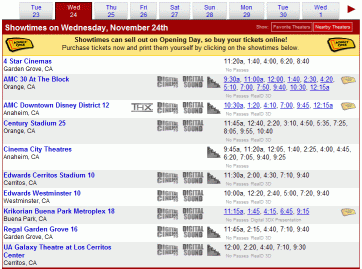
View Showtimes full-sized
The AMC Downtown Disney District 12 stands out from the rest due to the THX branding.
Assuming that the THX-branded screen doesn't suck, and at worst, it is of equal performance to all other screens playing that movie, my opinion is that the THX brand brings a value to that theater that attracts people to that theater instead of its nearby competitors. If it only brings in an extra 2 people per day, it's paid for itself.
I don't know if THX can be defended, because I'm not familiar with their current approach to things. I know that they used to give a damn, that they used to specify equipment with high performance characteristics, and that I was impressed when I saw the level of care taken in certifying the Johnson Creek THX screens (my first and only time seeing a baffle wall!).
If not the THX brand, what other brand can convey to the buying public the differentiating factors that make a good theater stand out over and above its competitors? Theaters are doing the upcharge thing with ETX, XD, et al, but are those screens performing any better than the other screens in that same location? Are they any better than other nearby theaters?
I'll bet the marketing efforts behind ETX and the others are paying off, and as a result, the theaters are also getting the upcharged admissions.
Personally, I don't need the screen to be "wall-to-wall" but I do want the picture and sound to be excellent. I'm not sure that ETX is going to guarantee that, but I haven't been to one yet. In contrast, every THX screen I've been to has been impressive (although it's been quite some time).
Posted by Frank Angel (Member # 248) on 11-24-2010, 07:20 PM:
quote: Scott Jentsch
Assuming that the THX-branded screen doesn't suck, and at worst, it is of equal performance to all other screens playing that movie, my opinion is that the THX brand brings a value to that theater that attracts people to that theater instead of its nearby competitors. If it only brings in an extra 2 people per day, it's paid for itself.
Problem here is, what "branding" is THX actually doing? I did a quick search on Moviefone and Fandango and as far as I can see, there is no indication at all of any THX theatres. They list all kinds of stuff -- Hearing Assist, Stadium Seating, Enhanced Sound (WeverTF that is) and Handicap Access, but no THX. So they are not spending a lot of money promoting the brand. And the thing about THX, while this may have been different when THX started, it is far from true now that going to a THX theatre (presuming you can find one) assures you of the best presentation. You yourself admit that it is possible to go to a THX theatre that has presentation no better or worse than its competitors. So why would you single out a THX labled theatre as the deciding factor?
In my opinion, the THX brand is pretty meaningless for the majority of the moviegoing public. And those of us who are more particular than the average, we are perfectly capable of determining what theatres we attend that will give us top draw presentation and which ones are the schlock theatres. We don't need to see a logo in order to make that determination just by watching a movie in a given theatre.
And to be quite honest, with today's level of equipment sophistication, how much difference will there be between the few makes of digital projectors out there? I assume THX will give cert to a house using a 2K digital projector just as it will to a 4K projector, yes? So the THX branding is not telling me which image is going to be better. A theatre running 5.1 can be certfied just as easilyl as one running 7.1. So the information that really would help me make a decision isn't forthcoming from the THX brand. Aren't ALL digital projectors THX certified....are any not?
Also a lot goes into what makes me prefer a theatre; all the stuff that has to do with cleanliness, staff attitude, comfortable seating....stuff that only I can quantify myself and which a THX brand can't tell me.
As an exhibitor, I want a program such as this to give me two things: 1) the better presentation than my competitor whose not certified, but equally important, having an ongoing, EFFECTIVE promotional campaign pushing that brand so the public actually see it regularly and recognizes it as a value added product. Without the latter, it's pretty useless to me. I am not saying they need to advertise as much as say McDonnald, but can you imagine how angry a McDonnald franchise owner would be if the McDonnald brand were advertised on TV only as much as THX is? If THX is not hawking its brand to the public, then its worth to me is next to nothing. Without the brand recognition factor is does me little good. And I am convinced there are many installers who could design and set up my equipement and theatre to meet all the THX specs (they are not a secret, are they?).
As for the cost, I don't see how only bringing in 2 extra people a day can pay for the yearly cert costs. And as far as upcharge goes, as far as I know, I have never seen a surcharge at a THX theatre.
Posted by Todd Cornwall (Member # 2205) on 11-24-2010, 10:27 PM:
quote: Scott Jentsch
This was the case at Star Cinema in Johnson Creek, I think. The THX screens were very good, and the other screens were also good, but unremarkable for the most part.........
This is incorrect. I worked at the Johnson Creek theater and one of its "THX" auditoriums was so bad that there was a shadow from the exit door guard rail projected onto the screen. I was AMAZED that was THX certified. Now, it is possible that the theater was certified and the guard rail was installed after the fact since Star Cinema stopped re-certifying their auditoriums, and it was then converted to stadium seating. The other auditoriums were pretty similar to the THX ones. In fact, I would guess that if you removed the THX trailers, the general public couldn't tell the difference. Either Star Cinema did a great job installing high quality equipment, or THX Certification was more of mind game than anything else.
RIP Star Cinema...I miss you. Kerasotes.... ![[fu]](graemlins/fu.gif)
Posted by Scott Jentsch (Member # 1681) on 12-01-2010, 01:40 PM:
Admittedly, my last experience with the THX screens at Johnson Creek was a long time ago, so I don't recall everything about them. I do recall something about an exit light that was shining on the screen, but I thought that was something they were going to address with a shroud that prevented the light spill.
quote: Frank Angel
You yourself admit that it is possible to go to a THX theatre that has presentation no better or worse than its competitors. So why would you single out a THX labled theatre as the deciding factor?
My comments in that regard were in deference to the people on this board that have stated that, in their experience, THX screens have not been consistently better than non-THX screens.
My personal experience with THX screens has been very positive. I've not been to a bad presentation in a THX-certified auditorium, but since such screens are few and far between in the Milwaukee area, my recent experience is quite limited.
quote: Frank Angel
As for the cost, I don't see how only bringing in 2 extra people a day can pay for the yearly cert costs. And as far as upcharge goes, as far as I know, I have never seen a surcharge at a THX theatre.
I was taking $10,000 per year for certification and dividing by 730 people (2 people * 365 days), which would come to less than $14 per person in needed additional revenue. The numbers get better if you have a 10-screen all-THX location, with an average per-screen cost of $6,000 per year ($8.21 per person).
I've never seen an upcharge on a THX presentation, but upcharges are all around with the new ETX, XD, RPX, and UltraScreens that are popping up with great frequency. Quite a bit of capital investment and marketing is being put into these efforts, and they are charging upwards of 30-40% more per ticket to deliver what one could argue is an experience that should be the norm, not the exception.
Why aren't all auditoriums outfitted with the best screens and best sound systems possible? Why should I have to pay to get it?
People seem to be willing to pay for a better experience. Whether that experience is branded with the THX name, the ETX name, or something else, the marketing efforts put forth are drawing people to that theater over another.
It's that cause and effect that is the second part of my argument about whether the THX brand is relevant. Effective marketing will draw people to the item being marketed. Whether they come back is going to depend on the actual experience once they get there.
quote: Frank Angel
I did a quick search on Moviefone and Fandango and as far as I can see, there is no indication at all of any THX theatres.
I can't speak for the motivations of the companies behind Moviefone and Fandango. As far as The BigScreen Cinema Guide goes, we feel that it adds value to our readers, and that's why we publicize those presentations (as long as the theaters bother to flag the THX shows). That may change in the future as the THX brand is less important than it once was, but for right now, we make a point of flagging those shows for special attention.
quote: Frank Angel
Also a lot goes into what makes me prefer a theatre; all the stuff that has to do with cleanliness, staff attitude, comfortable seating....stuff that only I can quantify myself and which a THX brand can't tell me.
This is one of the biggest reasons why we created the Reader Comments section for movie theaters. So much factors into the moviegoing experience that we thought it was important for our readers to be able to share their experiences.
It's been moderately successful so far, but personally, I'd like to see dozens of comments for every theater on our site. ![[Smile]](smile.gif) Please feel free to add your comments, as I would definitely welcome them!
Please feel free to add your comments, as I would definitely welcome them!
Posted by Lionel Fouillen (Member # 1475) on 02-14-2011, 09:31 AM:
I just found in my archives this document which I got from a theater installer in Belgium in the early 1990s. It shows the cost of THX installation and renewal back then. Prices are in US dollars. The figures are old but official.
THX fees
[ 02-14-2011, 09:55 AM: Message edited by: Adam Martin ]
Posted by Bobby Henderson (Member # 840) on 02-14-2011, 09:50 AM:
Thanks for posting that PDF; the figures in it make a lot more sense. If it really cost $10,000 per year to keep a screen certified for THX very few theaters would have ever bothered. The $1000 re-certification fee sounds a little more reasonable. Still, when that $1000 fee is multiplied across multiple screens and dozens or even hundreds of sites the fee really grows.
RealD is in a potentially worse position when it comes to saddling theaters with yearly re-occurring costs. If the public's desire for 3D really starts to tank we'll see a lot of theaters pull out most of these RealD installations to cut annual licensing costs. I don't remember the actual licensing fees ($10,000? $15,000?), but I am pretty sure they're a lot higher than the cost of THX re-certification. Maybe those big licensing fees help pay to get the RealD brand spammed on so many movie trailers, movie posters and TV commercials. Dolby 3D sure isn't getting any advertising help.
Posted by Frank Angel (Member # 248) on 02-14-2011, 10:18 AM:
Seems you could benefit economically by alternating THX certification -- one year on, two years off. If I were a commercial exhibitor (THX doesn't seem to be courting non-theatrical exhibitors -- museums, performing arts operations, etc.), I would be able to certify for a year and then drop it. For the year I am certified, I would promote to the hilt, the fact that I'm a THX theatre. That would establish my theatre to my patrons as an operation that is more attractive than my non-certified competitors -- at least that's what THX branding is supposed to do. After I establish that, why keep paying for the right to use the logo once I've got association in my patron's minds with the THX brand and my operation? Let it go for a year, maybe two, and then once again pay to reestablish the branding.
This strategy is born, as mentioned already, my belief that I could be able to easily meet THX specs once my facility has been designed that way. From that point on, the THX specs won't all of a sudden evaporate at the end of the year simply because I can't put a THX logo on my advertising. I believe it would be fair to say that the public will remember my quality of presentation during my THX non-certified periods. Again, to an exhibitor the THX brand, once specs are established, is simply a marketing strategy, nothing else.
Posted by Louis Bornwasser (Member # 3063) on 02-14-2011, 10:33 AM:
Nice idea, but they make you send in the crossovers, which belong to them. Louis
Posted by Chris Slycord (Member # 4239) on 02-14-2011, 12:41 PM:
But didn't THX stop making the crossovers, giving an official list of approved crossovers that you could buy yourself?
Posted by Lionel Fouillen (Member # 1475) on 02-14-2011, 02:58 PM:
As previously said, THX definitely made a difference in audience consideration many years ago, when THX really meant something superior. From my archives again, this scanned leaflet from Lucasfilm analyzing Indiana Jones and the Last Crusade's box office results in THX theaters (Northern America) -- and also announcing THX coming to some New York City theaters.
"THX Update", Volume 9, Summer 1989.
Funny to see how the megaplex phenomenon already had taken over the movie palaces, as in Los angeles the Cineplex Odeon Universal City outperformed the Chinese and the National on week #1.
Posted by Tom Petrov (Member # 1534) on 02-14-2011, 03:28 PM:
THX per screen averages kind of reminds me IMAX Digital today. Those IMAX screens out perform the regular real D ones.
Posted by Chris Slycord (Member # 4239) on 02-14-2011, 03:32 PM:
Lionel,
You're comparing apples to oranges.
The location is at the Universal Studios lot, so they'd get lots of tourists coming in to there. And working with the studio, they'd get lots of premieres and such as well. Plus, since it was a studio venture where they wanted those premieres, they've also got one huge auditorium with balcony (or at least would've at the time) so people wanting an experience comparable to the big-single-houses could still get it. Plus, 1989 the place would still only be a couple years old which tends to help...
Posted by Lionel Fouillen (Member # 1475) on 02-14-2011, 03:44 PM:
Chris,
It surprised me because tourists usually visit Universal Studios and the Chinese (see how millions of them spend hours checking out if their hands/feet/ears/nose ![[Razz]](tongue.gif) fit their favourite star's prints in the courtyard). I would expect them to prefer a show at the prestigious Chinese rather than at this cold megaplex which indeed had 2 big auditoria but with not-so-big screens...
fit their favourite star's prints in the courtyard). I would expect them to prefer a show at the prestigious Chinese rather than at this cold megaplex which indeed had 2 big auditoria but with not-so-big screens...
Posted by Michael Coate (Member # 757) on 02-14-2011, 04:35 PM:
I believe the Universal City 18 had Indiana Jones and the Last Crusade opening on several screens, and so I imagine the #1 gross that was reported was based on a collective figure from all the screens playing it in that complex. Collectively, I bet all the screens at Universal showing Indy III had more seats than did the single-screen National (1,100 seats) and Chinese (1,500 main auditorium seats), so landing in first place shouldn't be a surprise.
Boasting about the THX grosses seems like nothing but marketing. A better comparison, in my opinion, would've been to compare the grosses of Indy III's 70mm presentations (204, of which 50 were in a THX-certified house) to the 35mm presentations (2,123, of which 75 were in a THX house). Paramount did that very comparison five years earlier following Indiana Jones and the Temple of Doom's debut, where the studio reported the film's 70mm engagements (13% of the bookings) accounted for 30% of the first-week gross.
Posted by Louis Bornwasser (Member # 3063) on 02-14-2011, 07:20 PM:
Statistics. . . . damn statistics. Better theatres spent money. It should be no surprise that high grossing cinemas always spent on ANYTHING. THX included.
As I said earlier, we REMOVED thx from National Amusement theatres when they were unable to prove an increase in grosses. Reason? All auditorium were built identically. All equipment was the same, except the crossovers. All could pass thx specs. It was impossible to market thx since films were moved from house to house from hour to hour. Making this even more complicated was the belief that thx was shrill compared to the others houses.
70mm Dark Crystal prints were distorted and played terribly in the (overly bright) thx house. (I set up all houses identically to start, but thx raised the hf in "their" houses.) Louis
Posted by Michael Coate (Member # 757) on 02-15-2011, 04:14 PM:
quote: Louis Bornwasser
Statistics. . . . damn statistics. Better theatres spent money. It should be no surprise that high grossing cinemas always spent on ANYTHING. THX included.
As fascinating as statistics, data, figures, etc. may be, and as much as I like to post them to support whatever point I'm making, ultimately, I think stats are deceptive at best and useless at worst. It seems a no-brainer that the highest-grossing/best-performing theaters tend to be the ones in highly-populated areas.
quote: Louis Bornwasser
70mm Dark Crystal prints were distorted and played terribly in the (overly bright) thx house.
The Dark Crystal (1982) was released before the introduction of THX. The Black Cauldron, maybe?
Posted by Steve Guttag (Member # 268) on 02-15-2011, 04:57 PM:
Yes, it is true that the highest populated areas are the highest grossing. However, things like 70mm and the BIG SHOW tend to let some cinemas within that population to take more than their fair share. The pie is but so big but how big a slice one gets can be affected by what is put into the theatre and perceived by the patrons.
-Steve
Posted by Brian Guckian (Member # 1678) on 02-15-2011, 06:08 PM:
Another aspect to this is that one could argue that the low-margin, expansionist nature of the multiplex business model was not conducive to the recurring annual costs involved in THX Certification.
Scott's sample figures earlier are very interesting - on the face of it, the re-certification costs are / were low in terms of weekly cost per screen. But now consider those figures in terms of low profit margin, and even more so in terms of the 1990s expansion frenzy, where presumably a healthy cash surplus was needed to help leverage funds.
Hence there would probably have been little room to pay say c. $ 60,000 a year per site for re-certifications.
In theory, there could (and should) have been a surcharge for presentations in THX houses, but of course that revenue would probably have found its way into "other areas", unless ring-fenced (in titanium ).
Posted by Scott Jentsch (Member # 1681) on 02-16-2011, 01:51 PM:
The cynical part of me places the responsibility upon the steady erosion of showmanship in the theatrical exhibition industry. Perhaps that erosion was a result of, or a result of the same forces of, the multiplex expansion. Theaters went from showplaces to virtual stockyards, interested primarily in getting as many bodies in and out as quickly and as cheaply as possible.
I do agree with the low-margin argument, though, as most theater managers that I talk to are always telling me that the elements of showmanship that I think are important are never going to happen unless they have a proven return on investment. Problem is, if you never try, you never know if the investment will bear fruit.
I know of one small chain in Michigan that is always trying new things to see what works for them and for their audiences. While some of their ideas are a little odd, I applaud them for always trying something to try to improve their business.
If there's anything that the ETX/RPX/XD/UltraScreen onslaught is showing us, is that people are willing to pay for an enhanced moviegoing experience. Whether it's the better seating, bigger screens, upgraded sound systems, food choices, alcohol choices, 21+ exclusivity, and/or seatside service that drawing them, it's hard to tell.
Mark's comment about theaters that installed only a couple of THX houses and finding that their audiences only wanted to see movies in the THX houses means that they made a mistake in not building every auditorium so that it could be THX-certified.
When you use the bathroom at WalMart, there's a sign that tells you when the last time was that anyone cleaned/inspected it. Too bad there wasn't something similar on the doors at movie theaters. The next time I see a movie, I'll have to ask the manager when the last time was that the screen I'm going into was checked and calibrated. I'll bet I get a blank stare.
If it was done right, THX certification did that. It gave people the confidence that, sometime in the past year, that theater was checked out and given the stamp of approval. I have yet to hear of any effort or program that provides that same assurance to the paying public.
Posted by Mitchell Dvoskin (Member # 751) on 02-16-2011, 02:23 PM:
The splitting of the consumer side of THX from the theater side was the final nail on the THX coffin. On the consumer side, THX is now a virtually meaningless emblem on various types of equipment of varying quality, trashing it's value in the public's eyes (ears).
Posted by Brian Guckian (Member # 1678) on 02-17-2011, 07:03 AM:
quote: Scott Jentsch
Even though the THX brand isn't as powerful as it once was, it is still a differentiating factor that could be used to a competitive advantage. One would hope that the design principles and the specified equipment list still represents at least a minimum level of quality and performance, so following those requirements should result in a very good theater.
At a time when there are literally dozens of movie theaters with dozens of screens within 10-15 minutes of just about any densely populated area in the country, anything that can be done to differentiate your theater from the dozens of competitors gives a theater a leg up against the competition.
This is why it is still very relevant. "Market differentiation" has a value that can be quantified in terms of additional box office revenue, and a small ticket surcharge could cover the annual re-certification fee where that is perceived to be a deterrent. Such a charge would more than cover the cost of bringing in an outside, independent engineer / tech, so the integrity of the work isn't compromised.
![[dlp]](graemlins/dlp.gif) doesn't make THX Certification less relevant, because will not improve poor acoustics, background noise levels, bleed-thru, viewing and projection angles, etc. Granted, uncompressed sound gives even a bad theatre an improvement, but think of how much better that would be when the acoustics (and overall theatre design) are optimal too.
doesn't make THX Certification less relevant, because will not improve poor acoustics, background noise levels, bleed-thru, viewing and projection angles, etc. Granted, uncompressed sound gives even a bad theatre an improvement, but think of how much better that would be when the acoustics (and overall theatre design) are optimal too.
Posted by Manny Knowles (Member # 1171) on 02-18-2011, 05:08 PM:
I don't know about y'all but I'm pretty much done with the theoretical, academic, historical and aesthetic part of this discussion.
THX made a difference, it was a great thing to do -- No question there -- but now I want to hear from the folks who make the business decisions nowadays: How relevant is THX today?
And I'm curious if ANY of your customers are begging you to pursue it.
What is the MAIN technological enhancement your customers talk to you about? D-cinema? 3D? THX? Something else..?
And, no -- I don't mean to imply that THX can't improve any of these technologies -- I'm trying to find out if CUSTOMERS still ask for THX. Because I'm SURE that's ultimately what made it "relevant" in the past, and I have a hunch that's what makes it (...umm...) "less relevant" today.
Posted by Marco Giustini (Member # 4544) on 02-19-2011, 06:40 AM:
I do believe THX today is marketing only. Back in 90's THX made the difference. A THX sound system was light years ahead on others. Today the know how is - IMHO - better then it used to be and it is easier to design and build a well-sounding auditorium without THX.
But how can you tell your patrons that your theater is better then others, particularly today where sound is just "PCM", with no more difference between SRD/DTS/SDDS?
THX logo could do the trick. You show your patron a THX logo with a very well sound system and they will associate "your theatre" with "THX" thinking "the sound is better then the competitors because they have THX installed". We all know that that is not the point, but patrons don't.
Posted by Tom Petrov (Member # 1534) on 02-20-2011, 10:58 PM:
quote: Manny Knowles
I don't know about y'all but I'm pretty much done with the theoretical, academic, historical and aesthetic part of this discussion.
THX made a difference, it was a great thing to do -- No question there -- but now I want to hear from the folks who make the business decisions nowadays: How relevant is THX today?
And I'm curious if ANY of your customers are begging you to pursue it.
What is the MAIN technological enhancement your customers talk to you about? D-cinema? 3D? THX? Something else..?
And, no -- I don't mean to imply that THX can't improve any of these technologies -- I'm trying to find out if CUSTOMERS still ask for THX. Because I'm SURE that's ultimately what made it "relevant" in the past, and I have a hunch that's what makes it (...umm...) "less relevant" today.
I don't think THX means anything anymore to customers. IMAX IMO has replaced THX in a way. Lucasfilm was caught with their pants down, just imagine if "a 3D THX Experience" etc were available where THX re-masters source and presents it in a THX cinema. That would of been lovely.
THX always had good DVD/LDs/VHS releases and these release were always better than a non-THX mastered disc or tape.
Also, the fee for THX has to go, instead, charge a sur-charge like IMAX/ETX etc.
To become relevant again, THX would need to present the films just IMAX or AMC ETX etc etc.
Posted by Mitchell Dvoskin (Member # 751) on 02-21-2011, 02:26 PM:
> To become relevant again, THX would need to present the films just IMAX or AMC ETX etc etc.
To become relevant again, THX would need to mount a massive advertising campaign so the public knows that seeing a film in a THX certified auditorium means that they are hearing the film exactly the way the director and sound mixers intended. They need to educate the public that the THX stamp of approval means that all the auditorium's equipment meets specifications and plays well together for a better theatre going experience.
Unfortunately, I think it is too late. When consumer THX was sold off to Creative Sound Labs, and they started licensing the logo to every manufacturer who would pay the fee, the public's image of THX became one of deep booming bass rather than accurate sound reproduction. Deep booming bass is not appropriate for all types of films, and certainly not something unique to THX.
Posted by Bobby Henderson (Member # 840) on 02-21-2011, 03:47 PM:
I think the fundamental problem is movie studios and movie theater chains really don't know how to market things like good sound properly. The more I think about it I believe the theaters should be selling customers on the overall experience.
The central problem is various aspects of the presentation are sold separately as some sort of gimmick. I think that's a big mistake. The assumption is only one gimmick is needed per auditorium, and maybe perhaps only install these gimmicks in just a couple of the theater's 10 or more auditoriums. I saw this a lot in the 1990s. One house would be THX-certified yet only have Dolby SR capability while the next house had DTS. Dolby Digital or SDDS might be found in a couple other booths just to have all the logos covered. Stadium seating turned into a big deal in 1995. At that point many new stadium seated theaters ditched THX because one gimmick, stadium seating, was enough.
Would any of us like to live with only one arm and no legs? Or how about one leg and no arms? Do we really need two eyes? Or maybe we need to make a choice between being able to see or hear but not have both. Lots of movie theaters are being operated in just such a manner. Let's install digital projection, perhaps even digital 3D and push that in the ads while letting other aspects of the show quality slide.
THX had the best chance out of any theater "gimmick" to be the seal of approval on overall great presentation quality, but Lucasfilm primarily sold it only as a sound system. THX was really just a certification process on sound systems but did affect some other aspects of the presentation. Audiences were confused by this. So were executives at theater chains, which explains the mindset that THX wasn't needed since things like DTS or Dolby Digital was enough. They didn't think theaters needed both when in fact they really did.
I like to bring up how successful restaurants are operated as an analogy to how theaters should be operated. People are visiting good restaurants for more than just the food. The overall dining experience is the key and many factors go into delivering a good experience. The same thing applies to movie theaters. That's especially important today considering the ever growing sophistication of home theater.
quote: Marco Giustini
Today the know how is - IMHO - better then it used to be and it is easier to design and build a well-sounding auditorium without THX.
Theater chains can do just as good a job on their own with sound without involving THX. Unfortunately, when they're doing it on their own they're free to make cost cutting compromises at any point in the design and installation phase. Once the theater is in operation the bosses can choose to neglect the sound system instead of making any effort to maintain it. And why bother? The movie is in "digital 3D," why say anything about "digital sound" especially if the sound isn't very good?
quote: Tom Petrov
I don't think THX means anything anymore to customers. IMAX IMO has replaced THX in a way.
IMAX and THX aren't the same thing. To say IMAX has replaced THX is like saying steak has replaced ice cream as a favorite dessert. The only thing IMAX and THX have in common is brand names associated with movie theaters. That's where the similarity ends. The idea that any customer would see both as gimmicks and not really understand each process past the gimmick label is yet another confirmation of the bigger overall problem.
quote: Tom Petrov
THX always had good DVD/LDs/VHS releases and these release were always better than a non-THX mastered disc or tape.
As fun as it was to see a THX trailer on a DVD, I think the commercialization of THX into home theater did more to hurt the brand than help it. The whole enterprise really jumped the shark when it got into certifying computer speakers.
quote: Tom Petrov
Also, the fee for THX has to go, instead, charge a sur-charge like IMAX/ETX etc.
I believe new things like these IMAX also-ran efforts, like Cinemark's XD, Carmike's Big-D, ETX, etc. are making a bad situation even worse. They're legitimizing sub-par presentation quality as "standard" in regular theaters and then charging a ridiculous premium to see the same 2K movie file projected on a somewhat bigger screen and with surround sound that actually works to some degree.
IMHO, commercial movie theaters need to be getting presentation quality right on ALL of the screens in the theater, not just one or two premium priced houses. And they need to be doing so without the wallet-busting price premium.
I might be willing to pay an extra premium for an experience that provides plush luxury seating, waiter service at the press of a call button, a 21 and over aged crowd, etc. I am not willing to pay a high premium merely just for the sound and picture to be done right. Good sound and picture is part of the basics. That should be delivered in any theater.
This compartmentalization of different quality levels of auditoriums will only work to give people more excuses to stay home and watch the movie in the living room. Waited a week too long and missed the movie while it was on the big "XD" screen? Guess I'll see it on Blu-ray instead. Don't feel like paying an arm and a leg above normal ticket price for audio that actually works? Guess I'll see it on Blu-ray and listen to the audio on home speakers I know aren't blown and also where I can control the volume level.
Posted by Tom Petrov (Member # 1534) on 02-21-2011, 04:11 PM:
quote: Bobby Henderson
As fun as it was to see a THX trailer on a DVD, I think the commercialization of THX into home theater did more to hurt the brand than help it. The whole enterprise really jumped the shark when it got into certifying computer speakers.
I dunno. My THX laserdiscs and dvds almost alway look better than non THX laserdiscs and dvds.
Posted by Bobby Henderson (Member # 840) on 02-21-2011, 06:02 PM:
THX made a difference early on in mastering video for Laserdiscs, winning acclaim for titles like The Abyss: Special Edition. THX made less of a difference on DVD. I have plenty of DVD videos lacking the THX brand which look every bit as good as "THX certified" DVDs.
Some companies who regularly used the THX program for DVDs dropped out of it eventually. Pixar is one example. Their DVDs from Toy Story 2 up to Cars were THX certified. They dropped it after that. None of Pixar's releases on Blu-ray are THX certified.
I'm not familiar with THX certified VHS tapes. That seems a little like spraying Channel No. 5 perfume on a turd. The pretty fragrance doesn't hide the feces underneath.
Movie studios have largely ignored the whole THX branding thing when it comes to releasing movies on Blu-ray (or even the dead HD-DVD format). Even without a THX program mandating certain standards, the home theater press and vocal consumers have forced movie studios to up their game to a new level. They can't simply dust off a wobbly, old HD telecine master and dump it onto Blu-ray.
Posted by Louis Bornwasser (Member # 3063) on 02-21-2011, 10:06 PM:
When you find a way to have excellence in all auditoriumd and keep it non political, you will have a good situation, you will have success.
Something-for-nothing managements who do not know they have to pay a fair cost will always subvert quality.
We had it good (relatively) with National Amusements and Glenn Terrell in the 1990-2010 era. DD in all cinemas with subs. Louis
Posted by Manny Knowles (Member # 1171) on 02-21-2011, 11:31 PM:
First of all - Please note - The TOTAL SILENCE from management who would pay for THX certification today is DEAFENING.
quote: Mitchell Dvoskin
seeing a film in a THX certified auditorium means that they are hearing the film exactly the way the director and sound mixers intended.
In theory...but probably not in practice. First of all, good luck sitting through a movie playing at "7.0" volume. IMHO playing a movie at anything other than reference level (even if it's necessary) is a compromise. Not that this is the end of the world since I don't think today's directors have much of a "vision" anyway. If we're upholding anyone's vision, it is that of an executive somewhere. And, I assure you, he doesn't know what the movie is really supposed to sound like. He was probably on his cel phone during the mix (if he was even around at all).
And I have to say...digital *did* go a long way to solving the same problem. I could argue that it went further, because it made even non-THX cinemas sound much better, simply because we were no longer subjected to neglected A-Chains. And I don't know of any digital (sound) theatres that don't have the full complement of speakers. Many analog houses were mono or center+surround only.
I'm not saying that digital+THX together is a bad idea. Just that my guess is the added benefit of THX on top of digital isn't enough to "register" with most people.
Personally, if I was forced to choose one over the other, I'd have to go with digital and then take my best shot at making the room as good as I could with the available budget. I can't fake digital, but I could probably give THX a run for its money.
quote: Tom Petrov
I don't think THX means anything anymore to customers. IMAX IMO has replaced THX in a way.
quote: Bobby Henderson
IMAX and THX aren't the same thing. To say IMAX has replaced THX is like saying steak has replaced ice cream as a favorite dessert. The only thing IMAX and THX have in common is brand names associated with movie theaters. That's where the similarity ends. The idea that any customer would see both as gimmicks and not really understand each process past the gimmick label is yet another confirmation of the bigger overall problem.
I agree with both statements -- and FWIW I didn't read that as though Tom was mixing his metaphors -- after all, he added "...to customers...in a way."
I think it's highly likely that most consumers back in the day believed that THX was the actual track format. So, just as THX appeared to have "replaced" Dolby (analog), the digital formats came along and appeared to "replace" THX.
Actually, this business of working with a limited set of crayons pervades the entire movie business, going back to mid-century. Instead of just adding more crayons, we arrive at a point where there can be only so many of them. Features replace shorts, sound replaces silent, narrative fiction "wins" over documentary, color totally replaces black-and-white, cinemascope "wins" the widescreen war, stereo replaces mono, optical replaces mag, 70mm loses to 35mm, "center-only" replaces panned dialogue, digital replaces film (soon), 3D replaces 2D (at least at Disney)...
This is the total opposite of the formative years from turn-of-the-century through to just after WWII. In the first 50 years, we see technological and aesthetic expansion.
quote: Bobby Henderson
I'm not familiar with THX certified VHS tapes. That seems a little like spraying Channel No. 5 perfume on a turd. The pretty fragrance doesn't hide the feces underneath.
Anytime I wanted to get Tom Holman upset, I'd just ask him about THX on VHS. And then stand back. ![[Eek!]](eek.gif)
![[evil]](graemlins/evil.gif)
![[Big Grin]](biggrin.gif)
Posted by Tom Petrov (Member # 1534) on 02-22-2011, 12:03 AM:
quote: Manny Knowles
after all, he added "...to customers...in a way.
When I say that IMAX has in a way replaced THX, yes to the customers I am talking about. People who work in the industry will know otherwise.
IMO, THX has always kind of blurred the line in their advertising. I am looking at my:
THX broadway trailer and it states "LUCASFILM LTD, THX, SOUND SYSTEM"
Jurrasic Park THX laserdisc states "THX laserdisc, mastered and duplicated for optimal video and audio performance"
Speed 2 DVD states "Digitally Mastered for Superior Sound and Picture Quality"
Unbreakable DVD states "THX Certified"
Avatar blu-ray says just "THX"
Pioneer Elite machine says "Lucasfilm THX"
All of the above can be taken a great number of ways. It is very easy for one to think that THX monitors or has standards for 35mm printing etc.
IMAX re-masters the source material for their Hollywood presentations and projects them digitally on calibrated machines that are monitored in real time by head office in Mississauga Ontario. You are also using IMAX equipment.
Sounds very similar to THX marketing.
THX dropped the ball and missed out on the AVX, RPL and IMAX craze. I would pay for a "THX 3D Experience" if I knew the source material was optimized for the moviegoer. I already know the benefits of a THX theatre, but I would like to see THX get into mastering and remastering of source material.
I also find it intersting that some of these UltraAVX theatres in the Greater Toronto Area are former THX theatres.
Posted by Brad Miller (Member # 2) on 02-22-2011, 02:00 AM:
Tom, Manny really has his head on straight regarding the whole THX issue. THX mastering really isn't going to do anything in today's world of DCPs. Now back with 35mm, they did a nice job keeping the labs on their toes, but those days are long gone and 35mm prints today are quickly getting worse. (I saw something a month or so ago that looked absolutely AWFUL, even though the print was in mint condition. It is really sad.)
Its also too late for THX to mean anything to the masses anymore. They blew it by certifying everything under the sun from toilets to human babies (just ask Joe).
From a sound standpoint, as critical as room acoustics are, I've found the tech tuning the room has far more influence over the final sound. The problem with THX is that there are 2 schools of thought to sound tuning. Either the system is calibrated "to the line" and that's that, or the system is calibrated and then a very careful bit of fine tuning is performed on a reel of sample material that the tech has seen hundreds of times.
The second way is the proper way, but it requires the tech to REALLY know how that reel is supposed to sound or they will cause more damage than good!
For example, I can go into a multiplex and calibrate every auditorium and they will all play at 7 for the features (except Michael Bay movies) and they will all sound near identical. However any other tech can come in and calibrate one of those rooms and it simply will not sound the same. That's not to say it will sound better or worse, and of course it will probably sound similar, but it certainly will not sound the same.
So if it doesn't sound the same...
Posted by Joe Redifer (Member # 3) on 02-22-2011, 02:29 AM:
quote: Tom Petrov
Speed 2 DVD states...
I surely hope you found that example online and not in your personal collection, because if you own the Speed 2 DVD then anything you say or anything you have ever said is automatically rendered invalid.
Posted by Tom Petrov (Member # 1534) on 02-22-2011, 03:48 AM:
quote: Joe Redifer
I surely hope you found that example online and not in your personal collection, because if you own the Speed 2 DVD then anything you say or anything you have ever said is automatically rendered invalid.
Joe-I have over 2000 titles in my collection. I see everything!
I have been known to have two movies on the go at the same time. Right now I am half way thru Signs and 1/2 way through Sex, Lies, and Laserdiscs. I have even been known to watch my movies like one would read a book.
quote: Brad Miller
Its also too late for THX to mean anything to the masses anymore
Well I do not agree with this. There is still a chance for THX but they to change at the Cinema front, THX needs to re-master the source material and play it exclusively in their cinemas (you probably would agree, 35mm prints suck and Real 3D is dark). Do not pass the certification on the owner but instead pass on the certification on the consumer.
IMO, if it wasn't for THX, we would not see AVX, ETX, Empire Extra etc.
IMAX started all of this with their retrofit d-cinemas and DMR process.
New York Times THX
According to Lucasfilm, the 400 T.H.X. screens took in an average of $34,499 during the opening week of ''Indiana Jones and the Last Crusade,'' compared with $21,582 for the average theater industrywide.
The above sounds very similar to the periodic annoucements that the 300 IMAX screens brought in this amount of dollars.
In my area, when you open up the paper you see, AVX, ETX, Empire EXTRA and the IMAX Experience....nowhere do you see THX and I live in a major market. Sometimes you even see "A Dolby Digital Cinema" above the cinema doors.
Don't get me wrong. I love a THX cinema. I still remember which theatres were THX back in the day. The Uptown, Eglinton, The York, and The Sussex Centre ring a bell. All of these closed but there were THX cinemas at the Coliseum, Sherway, Canada Square, Square One, and The Queensway. Sherway had three THX cinemas back in 1987.
There is not one THX Advertised Cinema in the Greater Toronto Area. There are five IMAX megaplex theatres and a whole number of AVX/ETX cinemas.
From the home video front. I have always found for the most part that THX products looked and sounded better than non THX products. My THX laserdiscs sure look better than my non THX discs, same thing with DVDs.
I think it would be amazing to see movie ads say "A 3D THX Experience" and then see it in a THX theatre...
Rant over~
Posted by Joe Redifer (Member # 3) on 02-22-2011, 04:11 AM:
quote: Tom Petrov
I have been known to...
So people tell tales about you around the campfire or something?
Posted by Tom Petrov (Member # 1534) on 02-22-2011, 04:12 AM:
Joe-You would never believe some of tales that have be told about me.
Posted by Scott Jentsch (Member # 1681) on 02-22-2011, 10:05 AM:
No brand is truly dead, it's just resting while it's waiting to be resurrected by a benefactor who finds value in it. Even though THX has lost its luster with the industry, there is still marketing value in it. However, as with any marketing effort, the amount of value it brings is going to be directly relational to the money and effort put into it.
I agree that THX has done next to nothing in the marketing of the brand for many years. Its peak was probably the Simpsons trailer, and it has been coasting ever since. But as a mark, as a brand, as a marketing hook, I would bet that THX still has lots of miles left on it. Resurrecting the recognition of the brand in the minds of the audience would take very little, but it's the education of what the brand means that would take some concerted effort.
There would have to be a clear and consistent message about what it means to be THX certified. Certification wouldn't be something that would be a web form that a chain would fill in where they hit the "Pay Now" button at the bottom. Branding, marketing, education, and delivery on the promise would all have to happen for it not to ring hollow with audiences.
Unfortunately, THX followed the money and concentrated on the consumer market. Like DTS, they saw the cash flow heading to the home instead of the theater.
Bobby's post about the overall experience and comments about only one gimmick being all that theaters thought they needed are right on the mark. Theaters created a situation where people bought into THX, but it backfired when audiences didn't want to see a movie if it wasn't in the few THX screens that theater had. When DTS and Dolby Digital were introduced, they were doled out like precious candies at a party, which was then exacerbated when stadium seating came along. Instead of being able to get your movie in the THX auditorium with digital sound and stadium seating, you more than likely had to choose between them. Mutually exclusive features suck, and audiences will show that.
Give me a perfectly tuned auditorium with a perfect picture coming from a perfectly adjusted projector using the best source material possible. Make sure the seats are comfortable and the crowd behaves itself. Put some effort into the design and upkeep of the auditorium and the theater in the general. Keep the bathrooms clean, and offer good quality concessions that aren't priced out of line with concessions at other events. Charge reasonable prices without surcharges for things that don't include above and beyond services (seat-side service, etc.)
Make the overall experience enjoyable, and I'll be glad I came no matter how bad the movie ends up being.
Call that THX or call it Fred, I don't care. Do that, and they will come. That is my manifesto.
Posted by Bobby Henderson (Member # 840) on 02-22-2011, 10:08 AM:
quote: Manny Knowles
I'm not saying that digital+THX together is a bad idea. Just that my guess is the added benefit of THX on top of digital isn't enough to "register" with most people.
It's very easy to do digital sound wrong, and it's often done wrong. Theater chains skimp on certain details to save some money on construction and then they skimp on maintenance to save more money. In the end they can still put the Dolby Digital logo on the marquee if they like, but the sound is still crappy nonetheless.
To get that "THX Certified" label theaters were forced to spend a lot more money on wall treatment, the baffle behind the screen, the design of the air conditioning system and other room details. That was in addition to installing THX approved gear. Those points were not negotiable, unlike the situation where the movie theater is trying to peddle its own take on THX.
Much more often than not, a non-THX theater will not have a baffle behind the screen and lack a lot of other details typical to a room built for THX standards. I find echo and an overall hollow character to audio to be very common to most stadium seated theaters. Sound leakage between auditoriums is also common if the volume is raised anywhere near reference level; it's often running much lower. On top of that, blown speakers and dead amplifiers contribute to poor quality audio. It may be "digital" but it's still crap.
It takes a serious investment of money to do theater sound well. Both in terms of auditorium design and construction as well as continued attention and maintenance. I agree it is fully possible for a movie theater to match or surpass what THX does with an auditorium without involving THX certification. Unfortunately this is just not happening in the overwhelming majority of theaters.
The impression I get is this: if the theater was really willing to spend all the money needed to get acoustics and sound containment just right they would spend a little more to stick the THX logo on it so the effort would at least be somewhat recognizable to the public. Right now they're not bothering.
quote: Tom Petrov
There is still a chance for THX but they to change at the Cinema front, THX needs to re-master the source material and play it exclusively in their cinemas (you probably would agree, 35mm prints suck and Real 3D is dark). Do not pass the certification on the owner but instead pass on the certification on the consumer.
THX doesn't need to get into re-mastering anything. If a movie production intends for the movie to be seen on giant sized screens and presented properly on such screens they should make serious changes to the gear they use in production and post production. Post-processing the movie after it is finished is really a non-starter. It's just another cheap-ass compromise.
I was never sold on the IMAX DMR process when it was dealing with 35mm film. I think it's a laughable waste when dealing with 2K digital intermediate material. HD quality material blown up on a full sized 15/70 IMAX screen just looks like a big giant blur. It's awful. No amount of post processing can overcome the lack of native resolution in the 2K material.
These XD, ETX, blah blah fake IMAX also ran theaters are another laughable waste. They're really not delivering a product that's remarkably different from what a standard theater should be able to deliver.
If I really want to see 2K video blown up on a giant sized screen, I can watch the movie on one of the two 80' wide screens at the Warren Theaters Moore 14. THX Dolby Digital Cinema. And no surcharge above standard ticket price! Still, 2K video blown up that big really isn't so hot. Gotta sit way back up in the balcony (which costs extra) or just watch the show on a more modest sized screen.
Posted by Scott Jentsch (Member # 1681) on 02-22-2011, 10:43 AM:
I have not been to any of the RPX, ETX, or XD screens, because they don't exist within 150 miles of my location. I do have experience with the Marcus UltraScreen, which I understand to be pretty much the same concept rolled up in a different brand name.
In the case of the UltraScreen, the screen is big; usually around 72-75 feet wide. The auditoriums are nicely sized; around 100 feet deep. Sound systems are quite good, and while they had problems with the picture on first-generation UltraScreens, the ones they've installing in the past 3-4 years haven't had those issues. The back of the auditoriums have VIP reserved seating, but they are too far back and too high for my taste.
They do add an upcharge for the UltraScreen shows, but it's minimal. Normal price for a non-3D adult evening ticket is $10, and the UltraScreen adds a $1 surcharge. The reserved seating adds $5, for a total of $16, but it comes with a $5 voucher to put towards food and drinks.
Considering the 30% upcharges that other chains are tacking on to their ETX/RPX/XD/etc. shows, Marcus is presenting us with a real bargain!
The problem is, that there are only two UltraScreens at most at a theater that has them. In Marcus' hometown of Milwaukee, WI, there are only two locations that have UltraScreens, for a grand total of three in the entire metro Milwaukee area. For the most part, the rest of the screens are standard, run-of-the-mill auditoriums with unremarkable appointments and performance, and seeing a movie that is not on one of the UltraScreens is like going to McDonalds to eat. It's food, but it's not a spectacular experience.
So, a lot of effort and expense went into the UltraScreens, and they are good screens, but they make the difference between them and Marcus' standard screens all that much more unimpressive. Once a movie leaves the UltraScreen, I wonder how many people think that they might as well wait for the home video release? I know I do.
I think it's great to have these showcase screens, especially when the upcharge isn't very high. But I don't need a 72-foot screen to enjoy myself. I can't help but lament that perhaps they shot their budget on the UltraScreens and the rest were just equipped with selection #4 out of the catalog because the price was right.
It gets back to the gimmick thing. UltraScreen is a great marketing gimmick, but were they at the cost of getting better performance into the rest of the screens in that location? What about the other dozen or so locations that don't have UltraScreens? If it's going to cost me an extra dollar to get decent performance, I'm happy to pay it. It's just unfortunate that the selection of movies available is so limited.
Posted by Frank Angel (Member # 248) on 02-22-2011, 11:17 AM:
Scott, are these UltraScreen locations using film or digital? 75ft is probably bigger than 35mm should be expected to fill -- especially with today's print quality. Probably right on edge of having an illumination problem too. I don't know what digital can do with 75ft. Did you find the picture bright enough on that size screen with digital?
Posted by Mark Lensenmayer (Member # 134) on 02-22-2011, 01:23 PM:
Two Ultrascreen rooms are in Central Ohio. One is a re-purposed IMAX room, and it is 35mm. At the Pickerington location (far-east of city), they built a new room specifically for UltraScreen. They are running 3-D digital at that location.
The 3-D image is about 50' wide on the Ultrascreen..I haven't seen 2-D there.
At the 35mm location, sound is excellent but image is a bit dim. They are faced with a rather short throw in there.
Posted by Bobby Henderson (Member # 840) on 02-22-2011, 03:38 PM:
I've never been a big fan of projecting 35mm onto giant sized screens. The results are just too dim. Screens in the 70' wide to 80' range, and perhaps down to around 60' widths, really need 5-perf 70mm projection. The image is brighter, more uniform and noticeably more steady.
Digital projection has no issues with image steadiness. However the native resolution limits of 2K make it useful for only small to medium sized screens. The limitations show up too obviously on giant sized screens. Digital projection at least needs to go to 4K native resolution (with native 4K material) for giant screen use if not push the resolution levels higher. Of course brightness is another issue.
These are all points THX could have covered both in production/post production as well as exhibition. Too bad things these days are merely certified "good enough."
Posted by Louis Bornwasser (Member # 3063) on 02-22-2011, 06:37 PM:
The REAL answer is out proprietary thy sound system.
thx is so. . . . . eighties! Louis
Posted by Steve Guttag (Member # 268) on 02-22-2011, 08:30 PM:
There is plenty to agree and disagree with to go around.
Let go for Manny, at the moment, since he has expressed some definite thoughts that seem to come from an exhibitor's and a patron's point of view.
quote: Manny Knowles
First of all - Please note - The TOTAL SILENCE from management who would pay for THX certification today is DEAFENING.
That is certainly accurate. Quality is not what is desired by the majority of exhibitors. It is the perception of quality. Why pay for and deliver quality when you can fool some of the people some of the time?
quote: Manny Knowles
In theory...but probably not in practice. First of all, good luck sitting through a movie playing at "7.0" volume. IMHO playing a movie at anything other than reference level (even if it's necessary) is a compromise.
This was an answer to a statement to the effect that a THX theatre will let one of the audience hear what the mixers heard. Depending on the movie, one can indeed listen comfortably at "7" I even have a T-shirt from Oceans 11 that stated (to the effect of) that the system was tuned and played at reference and nobody complained. The T-shirt was made by the person who recorded the film (Larry Blake). His films really can be played at reference without a pain in the ear.
However, the point is that THX theatres most closely reproduce what it sounded like to the person that mixed the film.
quote: Manny Knowles
And I have to say...digital *did* go a long way to solving the same problem. I could argue that it went further, because it made even non-THX cinemas sound much better, simply because we were no longer subjected to neglected A-Chains. And I don't know of any digital (sound) theatres that don't have the full complement of speakers. Many analog houses were mono or center+surround only.
You can argue it...but it would be the wrong argument. Believe it or not, THX is MORE about getting the room right and THEN using equipment that can take advantage of that. Digital is neither here no there in that equation. If the room sucks, digital won't fix that at all. And, just prove a point...Carmike has indeed, with D-Cinema, no less, done MONO with a PCM digital track. You can lead an exhibitor to quality, but you can't make him deliver it!
Digital did take most of the A-Chain out of problem...but that was but one part of the problem. Digital did create its own and MOST people designing systems don't know how much demand there is now on Subwoofer and Surrounds. THX rooms won't have that issue.
quote: Manny Knowles
I can't fake digital, but I could probably give THX a run for its money.
Actually, Dolby-SR has "faked" many a person. And faking THX...YOU probably could not unless you know more about sound and designing the system than I have been able to perceive...For heaven's sake, you cut out poor defenseless Tantalum capacitors on CP200 boards!
That said, the bulk of what Manny has expressed, I agree with.
quote: Brad Miller
From a sound standpoint, as critical as room acoustics are, I've found the tech tuning the room has far more influence over the final sound. The problem with THX is that there are 2 schools of thought to sound tuning. Either the system is calibrated "to the line" and that's that, or the system is calibrated and then a very careful bit of fine tuning is performed on a reel of sample material that the tech has seen hundreds of times.
This one I'll disagree with you on...to a point. That is, room acoustics are THE most important factor in obtaining good sound. There is no question that the tech tuning can make better, or worse, the sound but if the room sucks...so will the outcome. I've done many "tricks" in mitigating bad acoustics but it is always a compromise.
Nothing is going to beat a perfect room with perfect equipment...no tuning is necessary. Does that room exist? I have not found it but I have had time were little to no tuning was required. They always come out sounding best and most intelligible.
One thing that THX still does is help with the design phase of a theatre to get the room as good as possible. It isn't enough to just use equipment that is good...you HAVE to get the room right FIRST.
Another nifty thing about THX rooms and the equipment used to tune them...more often than not, even if a different tech checks the room, I found that they read the same on the analyzer. It debunks the idea that one is EQing for just the sweet spot...the mics were in different places yet the results were nearly identical. A bad room/equipment won't get you that.
THX is a worthy thing to have (or to go through)...I do question the license fee if it is too high. However, if it isn't licensed, there is nothing to keep the theatre for letting things fall apart. An annual check up (by someone that DOES NOT WORK FOR THE COMPANY) should be done to ensure all is good.
-Steve
Posted by Louis Bornwasser (Member # 3063) on 02-23-2011, 06:29 AM:
There is nothing to add to Steve's post. Perfect! Louis
Posted by Manny Knowles (Member # 1171) on 02-23-2011, 02:03 PM:
SR has faked me out (at least) once -- in one of my own theatres. I think it was CHICAGO. So, yes, it's possible. But I wouldn't defend it as the norm. Given the same room (unchanged) upgrading from analog to digital is a huge, noticeable change that the average customer would notice. Is anyone in their right mind really going to try and deny this? Please let's not lose our way with anecdotal trivia. Focus, people. Focus!
It is possible that digital can be "done wrong" but those same theatres were probably doing analog wrong too. Again, I'm not going to waste time defending/arguing anomalies such as this.
There is no denying that a lot goes into creating a THX room -- and I certainly believe that it's worth the trouble to construct a theatre correctly -- but I don't think most listeners can tell the difference. The average customer never had a clear understanding of what was behind THX. I'm not sure whose "fault" this is -- I've tried explaining THX to friends and family members -- and even film students -- and it seems too complicated or too boring for them. Most people I have talked to were sure that "it had something to do with the surrounds."
Even in the 80's (when I wasn't working in cinema) I had a pretty good grasp of what THX was -- but I stopped seeking out THX theatres when the logo started appearing in the home and in the car and on computer speakers and...did I already mention...VHS tapes!? For me, THX had become a standard that had lowered its standards.
Complicating matters -- former THX cinemas had stopped paying for the branding privilege. They were still well-constructed, good-sounding theatres. And, then, digital sound came along. For me, it became more about trusting my ears rather than seeking out those three letters.
Note that I've never said that constructing a theatre to THX spec is a waste of time -- but the only way we are going to see an increase in THX certifications is if the brand starts to mean something to customers again. If it can once again be proven that THX houses earn more at the box office then theatre owners will see value in it and they'll be more inclined to pursue it.
But, first, some education is going to have to happen. Customers aren't going to ask for something if they don't know what it is. Digital gives plenty of surround sound. So, for those who believe(d) that was what THX was all about, the problem is solved.
Rather than churn out another logo trailer, I'd like to see THX produce a series of shorts (about 3min each) designed to educate moviegoers on what the heck a THX Cinema really is. I think the "take home message" should be that it takes more than just THX-Certified gear to make a THX-Certified Cinema. This would go a long way toward bringing the brand back into focus.
quote:
And faking THX...YOU probably could not unless you know more about sound and designing the system than I have been able to perceive...For heaven's sake, you cut out poor defenseless Tantalum capacitors on CP200 boards!
Tom Holman has vouched for my sound skills on more than one occasion. And those capacitors had it coming. Don't get me started, Steve! They had it coming!!!
Posted by Bobby Henderson (Member # 840) on 02-23-2011, 03:17 PM:
THX came close to communicating the right idea back in the early 1990s with that tri-fold flyer of theirs which stated "a digital soundtrack is like a CD. THX is having a great sound system on which to play the CD."
That's a pretty simple way to put it, but the THX concept is more than that. It's more like putting the environment of a recording studio into a commercial movie theater. Most people understand a recording studio must have great acoustics as well as top notch gear to yield professional quality recordings. The holds true for presenting high quality audio. Lots of live concert halls give plenty of attention to room acoustics. Not so many theaters do so.
IMHO, most people have never heard movie sound in what qualifies as "high quality." That even goes for a lot of theaters boasting the THX logo. This is why I keep banging the drum about sound system maintenance. You can't just build it and be done with it. A good sound system demands at least some frequent attention, especially if the system is going to be run at reference level.
One thing I find pretty contradictory about the decline of THX is that it has declined at a time when the approach is more badly needed than ever.
Sound containment wasn't such a big deal in single screen movie palaces or twinned environments like the Northpark 1-2 in Dallas where the two theaters were divided by the lobby. I remember waiting in line at the Loews Astor Plaza to see Indiana Jones and the Last Crusade in 70mm Dolby SR. I could hear that movie booming from the lobby. Once a customer was sitting in one of those theaters he didn't have to worry about a movie in the next room bleeding its audio into that auditorium. I did wonder if I was going to be able to hear the subway trains running near the Astor Plaza room, which was underground.
Multiplex theaters have lots of auditoriums butted up right next to each other. Not only must the wall treatment get acoustics right within the auditorium, but it also must prevent the audio from leaking into adjacent houses -particularly the sub-bass audio.
The uncompressed 24-bit linear PCM audio tracks are better in terms of quality potential than anything theaters have used previously. They also present greater challenges to theaters in terms of sound containment between auditoriums as well as placing more wear and tear on components.
Posted by Joe Redifer (Member # 3) on 02-24-2011, 02:19 AM:
I almost forgot about this video I made years and years and years ago. I put it on Youtube because most of you jokers can't figure out how to play a Quicktime.
http://www.youtube.com/watch?v=0wZtH-lm7Fw
Sorry for the low-res, I don't have the original assets.
Posted by Aaron Garman (Member # 1653) on 02-24-2011, 02:22 AM:
What Bobby said.
I'd love to see the THX brand make a comeback in the cinema, and bring order to what I like to think of as relative chaos when one goes to the movies. As a patron now, I want to be assured that when I'm seeing a movie in a cinema, that the presentation justly represents whatever was supposed to be seen. As it stands, I never know what the hell I'm going to get, even with DCinema. Am I getting 5.1 still, or did the jackass tech forget to setup the subs? Is this 2K or 4K? Is a speaker blown? Are the center and right channels reversed? Was this movie shot on video and blown-up?
Of course, we know how stupid the average movie goer is, and they don't always seem to care about the same things we all do. I don't think it gives cinemas the right to slack on presentation, but its probably something that would not even occur to many.
THX could help solve this if they could start to beef up their branding, set some further standards pertaining to DCinema, and of course prove that branding yourself THX will make a theater owner more money.
Case and point my trip to Chicago to see Tron in IMAX. It was at Navy Pier, a 15/70 installation. The image was not as bright as I remember 15/70 being, even on the trailers, the sound was not that impressive, and overall the experience wasn't as engaging as the screenings I saw in 2K. Of course IMAX is whole other can of worms, but to me, the IMAX branding COMPLETELY failed.
THX, on the other hand, has branding that DID work for me. The first instance was in NYC at the Loewe's auditorium at Lincoln Square. I saw the Dark Knight there back in 2008, and the image was solid and the sound the best I've ever heard in the past 10 years. Loved it so much, I went and saw it again 2 days later.
I also work in a facility that has a THX cinema, and can tell you that it has made me believe in the brand more and more each time I screen something, and we screen a wide variety of content: mono, Dolby A, SR, and SRD on films as old as Metropolis and Psycho to modern fair like Iglorious Basterds and (just tonight) The Adjustment Bureau. On all occasions, excellent image and sound that suck you into the film rather than piss you off.
In other words, long live THX.
AJG
Posted by Frank Angel (Member # 248) on 02-24-2011, 08:25 PM:
THX is now certifying TVs and vidprojectors -- Runco, Panasonic, JVC, etc. for home theatre. So how come they don't certify digital projectors for movie theatres? Or are they just doing home theatre, home anything nowadays (as Joe's most excellent and hilarious spoof spot says)? I guess who can blame them; it is where they can make the big bucks. I guess their CEO figures, what's more likey to make us grow -- get a cut out of certifying some 3000 digital theatre screens or get a cut of the 240,000,000 home theatre TVs video projectors and stereo gear? Not difficult to understand why they are putting their name on home theatre electronic products.
Then again, I am more confident in relying on Consumer Reports' evaluations of electronic products than looking for the THX label. Not only does CR compare a huge range of models, but to them, it doesn't matter if a brand like LG has a THX logo plastered on it or not -- they will rank it wherever it lands compared to all other makes and models in the same class, regardless of the logos and certifications or awards. Plus, they also tell you what the repair rate is for that make and model and how well it stacks up in terms of reliability. The THX cert doesn't mean diddly to me if the damn thing's failure rate is way above the mean.
Posted by Mitchell Dvoskin (Member # 751) on 02-25-2011, 08:55 AM:
> THX is now certifying TVs and vidprojectors -- So how come they don't certify digital projectors for movie theatres?
Because they are now 2 separate unrelated companies. One handles cinemas, the consumer products.
Posted by Scott Jentsch (Member # 1681) on 02-25-2011, 02:48 PM:
quote: Frank Angel
Scott, are these UltraScreen locations using film or digital? 75ft is probably bigger than 35mm should be expected to fill -- especially with today's print quality. Probably right on edge of having an illumination problem too. I don't know what digital can do with 75ft. Did you find the picture bright enough on that size screen with digital?
They are a mix of digital cinema and 35mm. Illumination wasn't a huge problem, but it's probably not helped any by the fact that, in my last experience there (Iron Man 2 last summer), they've had the house lights up way too high (like they were afraid of people tripping on the stairs). I prefer it quite dark, so if they're going to have the ambient light that high, they need more light on the screen to compete.
re: THX
The education problem that THX had back in the 90's would be largely a non-issue these days with the ease of which people can find information.
A well-stocked web site with easy-to-understand language, fun trailers posted on YouTube ripe for viral spreading, with an effective marketing campaign in theaters could provide more information than people would know what to do with.
Aside from the construction issues, theaters could achieve some of the benefits of what THX tried to accomplish without THX lifting a finger. The primary problem is that there isn't a consistent way for customers to know what they're going to get when they go to a theater. The bad theaters aren't going to do anything anyway, so this is a way for good theaters to communicate to their customers that they're good and why.
A good auditorium should exhibit certain characteristics, right?
- A certain amount of light on the screen using XYZ test material and a calibrated light meter.
- Sound check - SPL metering that shows that all channels/speakers are working and are leveled correctly.
- Sound calibrated - ideally, the auditorium would be analyzed for its audio quality and treated to address problem areas
- Rattle test - any light fixtures rattling when a subwoofer sweep tone is played?
A plaque on the door going into every auditorium would display the last time that all these items have been checked, along with the name and phone number of who to contact if you discover a problem. Just like on the bathroom door at WalMart.
Give this program some fancy, marketable name, and communicate it. Put it up on your pre-show slides. Put it on your web site. Do a nifty trailer that talks up the features of this program and maybe even does a real quick IMAX-style demo. Tell people why you're better than the next guy, and they'll start to respond. You could even do customer surveys before and after to measure that response.
This would have the double benefit of having high performance auditoriums and the marketing bump that would come from educating the customers about it. It's not only a competitive advantage over nearby theaters, it would be a way to increase customer satisfaction and stem the competition from other forms of entertainment.
Any reasons why this is a bad idea?
Posted by Victor Liorentas (Member # 5272) on 02-25-2011, 03:05 PM:
It seems to be a great idea and a THX comeback at theaters would give the home electronics a higher profile!
Posted by Manny Knowles (Member # 1171) on 02-25-2011, 03:12 PM:
quote: Scott Jentsch
Any reasons why this is a bad idea?
Yeah - it's called "the fox guarding the hen house." ![[Roll Eyes]](rolleyes.gif)
Posted by Victor Liorentas (Member # 5272) on 02-25-2011, 05:10 PM:
I think the fox is already guarding the hen house,we need a wolf to guard the fox and hen house!
Posted by Steve Guttag (Member # 268) on 02-25-2011, 05:22 PM:
It is worse than that...you can have someone, whose salary is tied to the "success" of the system. That is, if a tech is strict and "requires" things to be fixed before certifying it...then said tech will be dismissed and more tolerant tech found.
If, however, a tech is assigned to do the testing by a 3rd party, say THX...then the theatre HAS to comply if they want/value the three letters and if the customer perceived the value in them.
So yes, it is an education thing to get customers to want the value of THX and then theatres that would then pay for and expect to see an increase in business as a result. The previous attempts at THX in cinemas seemed to fail on all counts by the time the '90s hit. They let chains have their own techs do the recerts (how many failures do you think they got?), there was no education of the consumer to want THX, theaters didn't see any revenue improvement and this ceased paying for it.
-Steve
Posted by Tom Petrov (Member # 1534) on 02-27-2011, 03:27 PM:
quote: Frank Angel
THX is now certifying TVs and vidprojectors -- Runco, Panasonic, JVC, etc. for home theatre. So how come they don't certify digital projectors for movie theatres? Or are they just doing home theatre, home anything nowadays (as Joe's most excellent and hilarious spoof spot says)? I guess who can blame them; it is where they can make the big bucks. I guess their CEO figures, what's more likey to make us grow -- get a cut out of certifying some 3000 digital theatre screens or get a cut of the 240,000,000 home theatre TVs video projectors and stereo gear? Not difficult to understand why they are putting their name on home theatre electronic products.
Then again, I am more confident in relying on Consumer Reports' evaluations of electronic products than looking for the THX label. Not only does CR compare a huge range of models, but to them, it doesn't matter if a brand like LG has a THX logo plastered on it or not -- they will rank it wherever it lands compared to all other makes and models in the same class, regardless of the logos and certifications or awards. Plus, they also tell you what the repair rate is for that make and model and how well it stacks up in terms of reliability. The THX cert doesn't mean diddly to me if the damn thing's failure rate is way above the mean.
I completely disagree with some of what you and many others on here have said about THX in the home theatre area.
THX in the home is wonderful. I have a THX reciever and it is a great idea. I am not sure for others but when my THX Cinema mode is engaged, it means it is set with pre-sets for the speaker/sound set up. My machine cannot turn off the sub if the THX is on. This is a great feature.
As for the movies, THX is another great thing. I have some extensive use of the THX laserdiscs/DvD/Blurays and I love it when I pick up a disc that is THX certifed. They almost ALWAYS look better and sound better than a non THX disc. I just watched 48hrs on LD and the sound blows away the dvd version of 48hrs which is non-THX. The picture will give the dvd a run for the money.
There are also so many more THX laserdisc of a title than there were of the same title of dvd.
Example: Robocop Criterion, 48hrs, Dragonheart, Pulp Fiction. Even smaller titles like The Trigger Effect, and the Money Train were THX certified.
As for the DVDs, most of the dvds look better thanks to THX's standard recommendations. Even the menus have recommended setting from THX.
Posted by Edward Havens (Member # 4715) on 02-27-2011, 03:42 PM:
I'm sorry, Tom, but this isn't about what Tom Petrov likes or wants. You asked a question, and you have gotten a plethora of extremely intelligent, reasoned and well researched answers. Yet a number of your responses to these extremely intelligent, reasons and well researched answers have been roughly "I don't agree because my brain doesn't see or hear the difference."
THX could be relevant again, if it wanted, but for now it is not. Like the Weinsteins, they need to stop trying to put themselves in their non-core businesses and get back to the basics, being a quality assurance system for movie theatres. Until then, it'll never be relevant again.
Posted by Tom Petrov (Member # 1534) on 02-27-2011, 03:46 PM:
Edward-I think it is great to have a THX mode that sets the parameters of the sound system so that you don't need to adjust anything. Also, THX according to their site recommends setting the receiver to "0" for playback. This is great stuff compared to the non-THX equipment.
Don't you think?
THX doesn't always certify everything. Some laserdiscs such as Stargate got a THX certification of the AC3 disc but did not get THX on the DTS. Another one is Con Air
quote: Edward Havens
extremely intelligent, reasoned and well researched answers
I am not saying they are wrong. I just disagree with them, I can see the difference between THX and non THX stuff in the home.
Posted by Brad Miller (Member # 2) on 02-27-2011, 04:30 PM:
quote: Tom Petrov
I think it is great to have a THX mode that sets the parameters of the sound system so that you don't need to adjust anything. Also, THX according to their site recommends setting the receiver to "0" for playback. This is great stuff compared to the non-THX equipment.
Tom, no offense here, but it is obvious you know nothing about professional cinema sound. There does not exist a THX cinema in the world that has a predetermined fader setting with all of the parameters for the room set. Implying that such a thing is even possible is a bit of an insult to cinema sound technicians.
Posted by Tom Petrov (Member # 1534) on 02-27-2011, 04:33 PM:
Brad-I am talking about "Home Theatre" when I talk about the parameters and fader setting.
Posted by Brad Miller (Member # 2) on 02-27-2011, 04:35 PM:
Yes I know, and there is no such thing. No two people's living rooms have the same acoustics and speaker/screen placement. The idea is simply ridiculous from the start.
Posted by Tom Petrov (Member # 1534) on 02-27-2011, 04:37 PM:
Not really. When I put home THX on, I can't tweak the settings and that is a good thing. How many people are watching movies with their surrounds at +10db. THX on will not even give you the option of playing a movie with a sub. That is great!
Any knowing that some of the discs are being mastered at certain standard is a great thing.
Posted by Louis Bornwasser (Member # 3063) on 02-27-2011, 04:47 PM:
I'm sure we can all name quite a few absolure s--t thx home units. This is not to say that there are not some good ones as well. thx, itself, is no guarantee of anything; only merely just a name. . . . . a shadow of its former self.
btw: I was in the "first wave" of certified techs; 11 or 12 trained at "the ranch. Louis
Posted by Tom Petrov (Member # 1534) on 02-27-2011, 04:54 PM:
quote: Louis Bornwasser
I'm sure we can all name quite a few absolure s--t thx home units.
Dollar for dollar, I bet it will be better than a non THX machine at the same price point.
Posted by Joe Redifer (Member # 3) on 02-27-2011, 05:30 PM:
Tom, how will the receiver know how loud the surrounds or whatever should be? It can't. It has no idea what brand of speakers you use or the efficiency of them. The receiver can't just lock it in to "0db" and call it perfect. By the way, I think your receiver is messed up as mine is also THX and I can adjust any parameter I want when THX modes are engaged. I don't use the THX modes, though. I like setting everything up myself. Turning on the THX modes actually makes it sound a bit worse. I know how movie theaters are supposed to sound and have the ability to set my home theater up so it can sound as close to that as possible, room size, acoustics and whatnot permitting. It goes a lot further than just setting the levels as I EQ each individual speaker. The THX EQs make it sound worse than my EQ. THX has no clue how the EQ in my room should be, how the hell would they? My receiver does have an auto-EQ function, but it is only good for a starting point. The best part of the auto-EQ function is that it determines speaker distance (it is very accurate at this) and makes slight adjustments for reverb on each speaker. But the EQ and levels are all me and I know how to set that crap up better than THX does over 1,000 miles away for a room they know nothing about.
PS - for Brad - The sound system you heard last time you were over did not allow for any kind of EQ or even course bass/treble adjustments and only had one sub.
Posted by Tom Petrov (Member # 1534) on 02-27-2011, 05:54 PM:
quote: Joe Redifer
Tom, how will the receiver know how loud the surrounds or whatever should be? It can't. It has no idea what brand of speakers you use or the efficiency of them.
THX receievers/products are based on square footage of the room, there are different levels for different size rooms. Ideally, you would be wanting to use THX certified speakers.
quote: Joe Redifer
I think your receiver is messed up
I will double check and report back.
Posted by Manny Knowles (Member # 1171) on 02-27-2011, 06:57 PM:
Unbelievable!
Oh, Tom. ![[Frown]](frown.gif) I was just starting to have an appreciation for you.
I was just starting to have an appreciation for you.
BTW -- I interpreted this thread to be about professional cinema applications of THX -- mainly since it's in the Film Handler's Forum.
Posted by Tom Petrov (Member # 1534) on 02-27-2011, 07:05 PM:
quote:
Oh, Tom. [Frown] I was just starting to have an appreciation for you.
I don't get what is so wrong about THX in the home.
So the average joe with a large room goes into Futureshop and buys an average $499 receiver for his very large living room of 3000 cubic feet or more...meanwhile his receiver can't run a room that big. The guy has no idea how to calibrate his system so he starts doing it. I have heard from so many people "DTS is better beacause you can hear the rears etc, etc" from friends at work. So he starts messing away with it. My brother has a a giant projection screen in his basement maybe 10 feet or more wide, too bad he has one of those "kit" speaker systems built into his bluray player that gives him 5.1 and has speakers the size of drink coasters.
Another guy comes along and can buy a THX receiver for large room that is certified Select2 or whatever and he can rest assured that his receiver has been tested for room that size.
I don't see what is so wrong with it?
Posted by Bobby Henderson (Member # 840) on 02-27-2011, 07:33 PM:
quote: Tom Petrov
THX receievers/products are based on square footage of the room, there are different levels for different size rooms.
No they don't. I have examined a LOT of Home THX receivers and surround controllers over about 20 years. I have never seen any of them built or sold according to room size. The choice is up to the customer and/or installer to pick a receiver or surround controller/amplifier combination that will best fit a certain room.
Regarding speakers, I've never been a big fan of the home THX concept for speakers, particular the surrounds. The bipole radiator concept of reflecting surround sound was designed for 2 channel Dolby Pro Logic sound tracks. Multi-channel digital sound doesn't need this. Since then some THX speaker designs have incorporated tri-pole radiators. Still, the reflecting concept does more to diffuse the audio than it does to allow audio effects to be steered into specific areas of the room, like effective surround pans from the front stage to the back wall.
The "THX circuit" thing is another item arguably not needed in a receiver. It was originally developed to counteract the effect of the "X Curve" cooked into theatrical mixes of movies. The X Curve dealt with the large cubic area of air space in movie theaters and adjusted Dolby Stereo tracks to sound better in those environments. With more powerful sound systems playing 5.1 tracks in theaters those theatrical mixes don't have to be attenuated so much. Many movies are re-mixed specifically for home theater. Using the X Curve on those near field mixes will actually screw up the sound quality.
Home THX does nothing to address room acoustics in the viewing environment. Acoustics are the biggest thing about THX, but you only see that handled in THX certified commercial movie theaters. Acoustical wall treatment in the home theater environment is completely left to the end user. To me, that makes the whole idea about Home THX pretty pointless.
Posted by Scott Jentsch (Member # 1681) on 03-01-2011, 09:12 AM:
At the risk of sending this thread even further off the track it originally started on, there are some misconceptions about THX in the home that I feel compelled to attempt to clarify.
(This went long, so feel free to skip to the bottom if your eyes start to glaze over. I bring the discussion around on-topic at the end!)
When I first got into the home theater hobby in the early 90's, I followed THX's home theater efforts closely, as I was already a fan of their efforts in the movie theater market. I sought out and purchased THX speakers, and my current dedicated home theater still uses the first ones I bought, and I added to them when I designed and built my dedicated room.
VHS, LD, and DVD's were certified by THX through a process that monitored the quality of the audio and video signal through the various steps of the mastering process. Much like what was happening in theaters in the early 80's, LucasFilm saw a deficiency in the process of creating home video releases that they could help with (and probably make some money in the process). I don't remember all the specifics (I'd have to go digging through my archives), but it had to do with some test signals that were injected into the first step of the transfer, and then they were able to monitor the quality of each of the steps by watching those signals to make sure they weren't corrupted somewhere along the way.
This introduced more consistency in the quality of the releases, and just as with commercial movie theaters, their efforts raised the bar of the industry, and their services weren't as necessary as they once were.
THX-certified home theater speakers were designed specifically to work in the smaller home theater environments, where challenges of near-room reflections were making it difficult for "musical" speakers to reproduce movie soundtracks effectively.
Front channel THX speakers were designed to have very minimal vertical dispersion, so that their sound was not reflecting off the floor and ceiling. Think of a flashlight with a narrow vertical beam. This worked very well, but required that the speakers be aimed properly so that the listener wasn't off the vertical axis of the speakers. I used a laser level on the top of my speakers to aim them properly, which worked very well.
Surround THX speakers probably caused the most angst of anything they did, because of the dipolar radiation pattern that THX advocated. Purists got their undies in a bundle (especially Gary Reber from Widescreen Review) because the dipolar speakers diffused the sound so that it wasn't directly sent to the listener's position. That pattern included a null area in the middle, so if you positioned the speakers immediately to the left and right of the listening position (their recommended placement), no sound would reach your ears directly.
Some people prefer that approach, while others insist that the surrounds must be fired directly, just as with the front channels. Bipolar designs were created by some home theater manufacturers that were a compromise between the two (but only dipolar surrounds are Home THX certified). I have my THX-certified left and right surrounds positioned to the left and right and just above the listening position, and two additional THX-certified surrounds are mounted on back wall for the rear surround channel.
My experience with this setup has been phenomenal. I'm very happy with it, and I've never felt like the surround sound is muddy in any way. I am able to enjoy split surround effects, and the demo tracks that show off all the different channels do not sound indistinct when the effect heads off into the surrounds and around the back. In a perfectly-controlled environment (such as the primary home theater room that Widescreen Review created at much expense), I think that direct radiating speakers at perfectly positioned angles and heights have the potential of creating a great multi-channel surround field with the perfect source material. However, we don't live in that perfect world, and I think the THX surrounds do a great job fitting into the world most people live in. Even then, some living rooms don't have surfaces on which the surrounds can bounce off of, so direct radiating speakers are going to be the best situation for those environments. I try not to get too wrapped up in theoretical maximums when the practical reality is more important.
THX-certified home theater receivers started out as a single certification. At a time when manufacturers were taking all kinds of shortcuts with multi-channel sound, and the high-end music-oriented companies were trying to deny that anything beyond stereo was ever necessary, THX came in and set some pretty strict standards for performance in the receiver market. A lot can go wrong when you have 6 channels all sharing the same transformer, and 6 channels of sound can get pretty screwed up if people aren't paying attention to the way they design their circuitry.
THX also developed their Re-EQ requirements, which modified the sound for the smaller home theater environment. As far as I know, engaging Re-EQ was always optional (it was on my receiver), as it was not always needed in all situations.
These strict standards meant that THX-certified units were expensive, and out of the reach of many people. THX saw this, and either through a desire for more of the licensing potential or for honest reasons, they created the "THX Select" certification. This was done for equipment that was going into smaller rooms (less than 3,000 cu. ft., I think), and the watts per channel requirements were relaxed in the amplifier section, as well as a few other things that I don't recall off-hand. I think this is what Tom is referring to.
While some may scoff at THX certifying computer speakers, it's the same situation. Computer speakers sucked when they first became popular. Many were tinny single-driver models that did fine with the blips and boops of computer programs, but they weren't going to do very well with higher quality material, and if you wanted 5.1 sound, good luck finding a woofer box that didn't sound like a kick drum.
THX saw the opportunity and came in and did the same thing they've done in all the other markets they entered. They developed specs, set standards, and the results were pretty good. I have a set of Altec Lansing computer speakers that I bought in the 90's and still have today. I know Logitech made some nice units as well.
As with everything that THX has done in the past, one must appreciate the past to understand why THX was important at the time. Many commercial theaters weren't up to playing Return of the Jedi, so THX helped improve that situation. LD's and early DVD's weren't as good as they could have been, so THX came in and helped improve that. The same goes for home theater equipment and even computer speakers.
Has THX raised the bar in those categories to the point where they've put themselves out of a job? Perhaps, and if so, we should all be very grateful for their efforts.
To bring this thread back on topic, I still think that THX is relevant. No other program exists that does what it sets out to do. Sure, some theaters may take some of the same steps during construction, they may use good equipment, they may even do some calibrating of their sound system.
But how is the public supposed to know? Many in the public cannot appreciate the finer points of what makes great sound or a great picture unless they are shown the difference and are exposed to the higher quality long enough to then be able to notice when it isn't there anymore.
I can't appreciate what a really good wine offers all by myself. But there is a whole segment of the population that are very wrapped up in the subtle differences between vintages and areas of the world that the grapes came from. I would miss all of that by picking up a glass of the good stuff and not knowing any better.
However, if someone bothered to educate me on the differences, and if all I drank was the good stuff, my guess is that the $5 bottle of Zinfandel that I used to think was good would hardly be drinkable after knowing what good wine can taste like.
That, my friends, is how THX can still be relevant. Set good standards, stick to them, and educate the public as to why it's so good. It's said time and time again, that an informed consumer is best kind. It creates a win-win scenario for theaters that deliver the really high quality presentations.
People can learn with time what makes for a good presentation. Bad theaters will suck no matter how much time passes.
Posted by Manny Knowles (Member # 1171) on 03-01-2011, 06:41 PM:
Scott, you're actually bringing us back on track.
My guess is you'd have a very good room even if you didn't put the THX stuff in it. I say that because it seems you have the interest, knowledge, patience and financial wherewithal to do it.
The average customer does not.
Tom Petrov, for instance, seems to believe all he had to do was buy the stuff and push the THX button.
And, back in the day, I used to have customers that would say "the THX isn't turned on" and, when pressed to explain what they meant, they would say "we can't hear the surrounds."
Back to you, Scott: As good as your home theatre may sound, my second guess is that it is probably not a THX theatre. Even if it is -- and there's an outside chance that it is -- yours would be the exception, and not the rule.
Whatever.
Here's why I question THX in the home: It took a lot for a real movie theatre to meet the THX spec. So, if the average consumer did not know what THX was, how it worked and how much it would really cost to implement properly, what chance did they have of getting those results in the home? Practically zero.
Whatever improvement THX might bring to the gear and software -- and I question some of this, too -- I seriously question whether most "THX Home Theatres" would pass an honest-to-goodness THX certification test. (Do they even bother testing them?)
And this, I believe, is where THX stumbled into the land of marketing confusion:
If consumers are encouraged to believe that their home theatres come anywhere near the (real) THX standard, then we have a problem because anything with a bigger screen and louder speakers (than what they have at home) will likely suffice.
What ends up happening is that the very fans of THX actually lower their standards, and they -- the consumers who arguably have the best shot at appreciating THX -- end up appreciating something less than THX which, (in)conveniently enough is called...THX.
Hence -- for a real movie theatre -- there is no financial incentive to obtain THX certification. Just make it bigger and louder than what they've got at home and "call it something fancy."
And that, my friends, is real.
Posted by Steve Guttag (Member # 268) on 03-01-2011, 07:01 PM:
That last paragraph describes LieMax vs IMAX!
If the surrounds are not playing then clearly "the Dolby" isn't turned on. Such ignorant boobs.
Then again, I had a person from Universal on a large premier exclaim to me about how fantastic the movie was going to sound "When the DTS kicked in."
You expect that sort of thing from patrons...even marketing (that is what they do..."dazzle them with bullshit")...but not from anyone technical. The DTS Kicking IN was a line used for quite a while between a few of us.
Please note...just like with commercial cinemas, there is a difference between THX certified equipment (meets a set performance level) and a THX certified installation (used THX approved equipment and is installed in a THX approved manner tuned to THX specifications). There are THX home certified installations just like for cinemas. The difference being, THX home certifications are not for masses (the ones that may desire such a nice set up but can't afford it) but for the people that are being SOLD on a THX system as a level of quality or ego. And a THX home certification training does NOT translate into THX Cinema certification training...or vice-versa.
Posted by Manny Knowles (Member # 1171) on 03-01-2011, 07:04 PM:
And that's a problem.
I don't know about you, but if I shelled out THX money for a THX home installation then I'm going to buy into the notion that I've got a THX Theatre in my house -- PERIOD!
So the audience may be listening...
...but with what ears?
Miscalibrated ones!
(BTW, I added another paragraph so my guess is you're referring to my next-to-last paragraph...or "somewhere near the end")
Posted by Joe Redifer (Member # 3) on 03-01-2011, 07:13 PM:
Manny's last paragraph (actually, second to last) also describes the nonsense that chains are doing with their ETX, RPX, MSX, QTX, HVX, and DVX auditoriums where they charge a higher price but adhere to no official standard other than their own (which are not publicly available).
Posted by Per Hauberg (Member # 529) on 03-01-2011, 07:13 PM:
THX, SR-D, DTS, Widescreen, Cinemascope, 3-D, even Feature Films themselves would all be relevant for cinemas, if just cinemas could be allowed to have all these nice things for themselves, but as soon as the greed takes over, and the same stuff is available for the home cinema consumer market - Puff ! The End is near !
Don't expect the average cinema-goer to see the difference (remember, they often even find it OK to watch a whole movie on YouTube). Why pay big money to watch a film in the cinema, when there is THX in the living room back home....
Soon, even 3-D will be standard on the TV, and similar release has allready proved its worth for the cinema.
Much of, what we have been working with and for, may soon not be relevant...
Posted by Steve Guttag (Member # 268) on 03-01-2011, 09:09 PM:
quote: Manny Knowles
(BTW, I added another paragraph so my guess is you're referring to my next-to-last paragraph...or "somewhere near the end")
See now...I tried to be good by not quoting the guy right above me and it backfired! Those effin' blue capacitors.
I was referring to this statement:
quote: Manny Knowles
What ends up happening is that the very fans of THX actually lower their standards, and they -- the consumers who arguably have the best shot at appreciating THX -- end up appreciating something less than THX which, (in)conveniently enough is called...THX.
quote:
I don't know about you, but if I shelled out THX money for a THX home installation then I'm going to buy into the notion that I've got a THX Theatre in my house -- PERIOD!
If you shell out the dough for an actual installation by a THX certified installer...you SHOULD get the very experience in the home...if not better (smaller room...already starting with something more workable).
If your claim is if you use THX equipment you should have the THX experience then you are retarded (well, at least ignorant)...that is like saying if I use the same shoes as Michael Jordon, I'll play basketball like him. The THX equipment is a necessary but not sufficient situation.
Mind you, for many (maybe not Manny) are only seeking for THX to be their laboratory to "certify" a piece of equipment is "good enough". There nothing wrong with that any more than theatre chains have bought equipment partially due to its THX certification (or used it as a justification that this amp is as good as that amp or that the amp was good enough to pass THX...in the LAB...the amp met the criteria set out for all amps doing that function).
All kidding aside (with Manny)...it really is a problem of education (failure on THX's part) that there is confusion about what the three letters are all about.
-Steve
Posted by Manny Knowles (Member # 1171) on 03-01-2011, 09:18 PM:
quote: Steve Guttag
that is like saying if I use the same shoes as Michael Jordon, I'll play basketball like him.
Exactly. I tried to come up with an analogy of this sort but nothing "fit" (pardon the pun).
New question: How often does a "THX project" fail to pass inspection?
Put another way: Does THX have a conflict of interest? If a project doesn't pass, they don't get their payday.
Does anybody have any information on this?
Posted by Tom Petrov (Member # 1534) on 03-01-2011, 09:36 PM:
quote: Manny Knowles
Does THX have a conflict of interest? If a project doesn't pass, they don't get their payday.
Is this referring to home theatre component?
quote: Steve Guttag
If your claim is if you use THX equipment you should have the THX experience then you are retarded (well, at least ignorant)...
THX is not saying you are going to get a THX Cinema Experience in the home. They have never really said this.
Take the video tv for instance:
THX Movie Mode offers the closest thing to a pre-calibrated setting out of the box. This reproduces the Rec.709 color gamut, luminance levels and other settings used by filmmakers in the mastering studio—with the push of a button. And, if you want further fine tuning, all THX Modes can be accessed by THX Certified Professional Calibrators.
What so wrong with having a setting like this?
Posted by Aaron Garman (Member # 1653) on 03-01-2011, 09:48 PM:
quote: Steve Guttag
Then again, I had a person from Universal on a large premier exclaim to me about how fantastic the movie was going to sound "When the DTS kicked in."
Maybe the timecode was jacked up and the discs didn't sync until the next reel change.
In all honesty, if I heard an executive say that, I'd puke.
I also own a THX receiver, and it is definitely better than the non-THX one I had that was in a similar price range. Of course, I blame this more on it having Audyssey and possibly a better amplifier. I perhaps have bought into the notion that if it is THX select, then it will perform "well" in a room my size. With my old receiver, I had no idea if it was really designed for a room my size or not.
I also know that having a THX receiver does not mean I'm going to get what a true THX room would get me. Is it nice for the home? Sure.
If anyone has it laying around, Tom Holman gives a nice overview of the home THX system on the THX Wow LaserDisc from way back when. I just watched it recently, and it was pretty enlightening.
AJG
Posted by Joe Redifer (Member # 3) on 03-01-2011, 09:52 PM:
Yeah, I have that disc laying around.
quote: Guttag
Then again, I had a person from Universal on a large premier exclaim to me about how fantastic the movie was going to sound "When the DTS kicked in."
I don't really see what's wrong with that statement. DTS is not "always on". Now if he said "When the THX kicked in", you'd have a point, but as it is the statement seems accurate to me.
Posted by Manny Knowles (Member # 1171) on 03-01-2011, 10:11 PM:
quote: Aaron Garman
Of course, I blame this more on it having Audyssey and possibly a better amplifier.
Audyssey -- Another innovation that Tom Holman helped develop. Actually, he was the inspiration. The initial challenge -- to the USC Engineering Department, where he also has tenure -- was to make it unnecessary for him to personally tune the Norris Cinema Theatre at USC. Around the Sound Dept. we nicknamed it "Tom in a box."
I've been trying to dig up an interview he gave for Audyssey and/or 10.2 where he was asked if THX was still state-of-the-art (or something along those lines) and his response was: "Good heavens! That technology is two decades old!"
If anybody has read this interview and knows where to find it, please post a link here. I will keep searching.
Posted by Steve Guttag (Member # 268) on 03-02-2011, 11:21 AM:
Joe...it was a premiere...there were no trailers or other anythings but the movie. The inflection/tone of the statement definitely was something to effect when it "got loud and subwoofers were boomin'" The person definitely did not mean there was some transition from non-DTS to DTS in the real sense.
-Steve
Posted by Joe Redifer (Member # 3) on 03-02-2011, 01:31 PM:
Ah... I see.
Posted by Louis Bornwasser (Member # 3063) on 03-02-2011, 07:10 PM:
There is certainly a religious aspect to thx. (YOU gotta BELIEVE!!!!) Louis
Posted by Scott Jentsch (Member # 1681) on 03-03-2011, 11:32 AM:
quote: Manny Knowles
Here's why I question THX in the home: It took a lot for a real movie theatre to meet the THX spec. So, if the average consumer did not know what THX was, how it worked and how much it would really cost to implement properly, what chance did they have of getting those results in the home? Practically zero.
Whatever improvement THX might bring to the gear and software -- and I question some of this, too -- I seriously question whether most "THX Home Theatres" would pass an honest-to-goodness THX certification test. (Do they even bother testing them?)
I don't think it's possible to accommodate for all the ways that people can misunderstand things because the number of possible combinations approaches infinity!
My room, like most dedicated home theaters, is a compromise between performance, price, and practical limitations. Where I placed my priorities dictated the results I got, and while it's not going to pass a true Home THX certification test, I think it's pretty darn good. Some day, I would love to have an audio engineer come in and do some testing, tuning, and recommend some steps I could take to improve things, but I'm happy with what I have, and I can always do that someday when I have the desire and the money to do so.
I chose THX components for two reasons. I believe the design choices that they bring to the table (esp. when it comes to the speakers), and I believe that there wasn't a race to the bottom when it came to construction and design. The fact that I'm still using the same speakers I bought all those years ago is a testament to their build quality. Could I get better performance from something new (even if it wasn't THX-certified)? I would hope that things have improved in 15 years, but what I have is working really well for me, so I don't feel any need to change it.
All that said, I don't have any delusions about my setup being a THX home theater. I didn't have the room designed by a qualified sound person, it hasn't been tested, and it hasn't been tuned. The construction methods did not isolate the room nearly enough to meet those standards, but I did the best I could with what I had to work with.
Is there a possibility that people think that there's a THX button to push, and that's all there is to it? Yep. But my kids believe in Santa Clause, but that doesn't make him true. With time, they'll figure it out when they're ready. Anyone the least bit interested in home theater as a hobby would do the same.
The fact that THX is associated with quality, even a little bit, means that the brand still has value. Theaters should have learned long ago that you can't just slap the THX plaque on the wall and expect people to understand. Comments similar to "turn the THX on" is evidence of that.
It all falls on the theater to educate their customers. Give them a show! Make them aware of why your theater rocks and the one down the road probably doesn't. Make every show the absolute best it possibly can be. Then you have extracted the value that the THX brand can provide to you. If all you do is put a little THX logo on your ads and pay the money every year, you should not be surprised with disappointing results.
Making the effort (whether by drinking the THX koolaid or making your own) without marketing and educating reminds me of this oft-paraphrased/modified quote:
quote:
"It's like wearing dark pants and peeing down your leg. It gives you a warm feeling, but no one knows you did it."
Posted by Aaron Garman (Member # 1653) on 03-03-2011, 12:22 PM:
Tom Holman explains home THX
This is from the WOW LaserDisc.
AJG
Posted by Louis Bornwasser (Member # 3063) on 03-04-2011, 01:09 PM:
omg, that's OLD!
Last time I spoke with him, he was unwilling to say anything (good or bad) about anything Lucas. louis
Posted by Tom Petrov (Member # 1534) on 03-05-2011, 01:48 AM:
omg.
Just watched the video. Tom looks like a baby Ebert.
Great video nonetheless.
Posted by Edward Havens (Member # 4715) on 03-05-2011, 12:32 PM:
Tom... do you not get where you are posting? You are posting at a website called FILM-Tech, in a folder called FILM Handlers' Forum. You have a lot of cinema operators and projectionists giving you the most incredible quality information, one that you would never get anywhere else due to the amazing wealth of experience that exists here and only here, and you keep going away from your original question by bringing in home entertainment to support your viewpoints. Home entertainment systems are irrelevant to whether THX is still relevant when there is ETX and AVX and digital this and 3D that.
Seriously, dude, get with the program already. You've been here nearly eight years. You should get it by now.
Posted by Manny Knowles (Member # 1171) on 03-05-2011, 03:41 PM:
Eight years! Holy Smokes, Indy!
Somehow, I totally missed that. Probably because I don't remember Tom from my previous life on here. Based on these posts and some others I just assumed he was a newbie.
Home-Video is *part* of the discussion, but only to the extent that IMHO it's where they "jumped the shark." When THX got into consumer stuff they lost some credibility with people who saw it as a sell-out move. A company that is advocating a high standard should not put itself in the position where it appears they have lowered their standards.
When THX put their mark on a lesser product, it was no different than what we see today where theatres simply give their systems their own fancy-sounding stamp of approval (ETX or whatever) or IMAX switching from 15/70 to digital and allowing it to keep the "IMAX" name (which, if you ask me, implies a very specific film format). The reality is, at this point, it's just marketing. And that goes for IMAX, ETX and THX.
Is IMAX still relevant? If those screens have proven earning power over/above 35mm or DCI then I'd have to concede. It doesn't mean I think they have standards, though.
Getting back to THX -- as Holman himself explains, THX Home Cinema incorporates different technology. So IMHO it should've been called something else, and maybe they could've said "from the makers of THX" if they wanted to tap into the branding power that THX had at the time.
Here's the thing -- and then I'll try not to say anything more about THX consumer stuff -- a THX Cinema is set up to be essentially identical to a THX dubbing theatre. A home theatre is not. It employs a different set of technology and methodology and there are more variables. Nobody at THX knows very much about YOUR living room versus mine, or anybody else's. They're guessing. But you can be 100% sure that THX has a blueprint of our cinema here at Indiana University, and someone from THX has been here to verify that the "as built" situation reflects what was on the drawings. That's a HUGE factor that is missing from the home.
One could argue that "attention to engineering the space" was the biggest contribution THX made. Much of everything else is culled from pre-existing standards.
I don't think that THX is irrelevant in a general sense -- but I don't think it means much to moviegoers anymore. They don't seem to be seeking it out like they once did. So, perhaps my position is:
THX remains a relevant standard for cinemas. Economically speaking, however, THX lacks the marketing appeal that once provided a powerful incentive for theatre operators to adopt the standard. Alas, less expensive technologies like digital sound have also proven to have strong marketing appeal -- without the great expense associated with THX.
It also doesn't help that THX isn't new anymore. The movie business has ALWAYS been about showing off the latest-and-greatest technology. How do you marked a "technology" that's almost 30 years old to an audience that's largely in their 20s?
Posted by Louis Bornwasser (Member # 3063) on 03-05-2011, 04:09 PM:
Manny: In the initial thx contracts that the cinemas signed, thx was "not to be offered to any other platform." That and other problems (financial, not architectural) are the reasons that one of my large customers pulled out the crossovers in 48 cinemas and sent them back to thx.
Note that in all other ways the room still met thx specs. Louis
Posted by Manny Knowles (Member # 1171) on 03-05-2011, 04:10 PM:
Now, THERE'S something I never knew. Thanks, Louis.
Posted by Aaron Garman (Member # 1653) on 03-05-2011, 05:54 PM:
How DVD gets THX certified
AJG
Posted by Joe Redifer (Member # 3) on 03-05-2011, 06:03 PM:
I'm more curious how VHS gets THX certified.
Posted by Tom Petrov (Member # 1534) on 03-06-2011, 12:46 PM:
Does anyone have an estimate of how many THX theatres are still around?
We have not one in the GTA.
Posted by Bobby Henderson (Member # 840) on 03-06-2011, 01:47 PM:
At its peak during the 1990s, I think there was at least a couple thousand THX certified theater screens in the United States. Obviously there's a lot less now, but I don't know the exact number.
In the late 1990s several theater locations in Oklahoma had at least one or more screens that were THX certified. Now there's only two locations, the Warren Moore 14 in Moore, OK and the Washita Theater in Cordell, OK.
Carmike had at least a couple hundred or more screens certified for THX but dropped support for it a couple years ago.
According to the THX web site there are no longer any THX certified theaters in the Dallas Fort Worth area.
Century Theaters was a big THX supporter. Since Cinemark took over the chain those THX certifications may be disappearing if they have not already been removed; Cinemark doesn't make any mention of THX at those Century location in the Cinemark web site.
This same story is playing out in many other theater chains across the country.
Posted by Edward Havens (Member # 4715) on 03-06-2011, 02:05 PM:
It appears less than 150. I went to THX.com and did a 500m search from various major metropolitan areas, and this is what I came up with...
500m from:
Los Angeles - 53 results, ranging from Los Angeles to Tucson to San Francisco
Seattle -
Denver - 8 results, ranging from Denver to Salt Lake City to Wichita KS to Cordell OK
Dallas - 9 results, ranging from Midland TX to Corpus Christi TX to Springfield MO... but four of those results are in the same 500m range as Denver, including the aforementioned Cordell OK
Minneapolis - 13 results, ranging from Minneapolis to Des Moines to Milwaukee to Chicago to St. Louis to Grand Rapids MI to South Bend IN
Cincinnati - 27 results, from Cleveland to Greenville SC to MIssissauga ONT to Washington DC, but several results that are in the same 500m range as Minneapolis and one result that is shared with Dallas
Boston - 23 results, from Boston to the New York tri-state area, but again matching several results from the same 500m radius as Cincinnati. Bonus factoid: there is only one THX certified theatre left in the five boroughs of New York City, the Bay Plaza in the Bronx.
Orlando - 5 results, from Orlando to Miami to Montgomery AL, but including two results from the Cincy search
Anchorage - One result, in Anchorage
Honolulu, Hilo and Lihue HI - All zero results
It also appears that the theatre in MIssissauga is the only THX certified theatre left in Canada. Searches from Edmonton, Winnipeg, Thunder Bay and Montreal all show either American installations or the one in MIssissauga.
Posted by Bobby Henderson (Member # 840) on 03-06-2011, 02:44 PM:
One downside to using that search method is it doesn't list the number of THX certified theaters per site.
For example, Oklahoma has only 2 sites with THX. The theater in Cordell is a single screen theater. The Warren site in Moore is a 14 screen multiplex where all 14 screens are THX certified.
Posted by Tom Petrov (Member # 1534) on 03-06-2011, 03:03 PM:
quote: Edward Havens
It also appears that the theatre in MIssissauga is the only THX certified theatre left in Canada.
That is an error. The theatre in question is the Empire Theatre Square One cinemas. The theatre is a former certified theatre when it built by Cineplex Odeon about 8-10 years ago. It is no longer advertised as THX or promoted.
Right across the street is the Famous Players Coliseum which had 4 THX theatres back when it was first built.
Across the street the other was the Sussex Centre 4 which was on the second floor of a professional building, that had one THX theatre but it was closed in 2002.
Posted by Michael Coate (Member # 757) on 03-06-2011, 10:32 PM:
Back when THX was relevant...
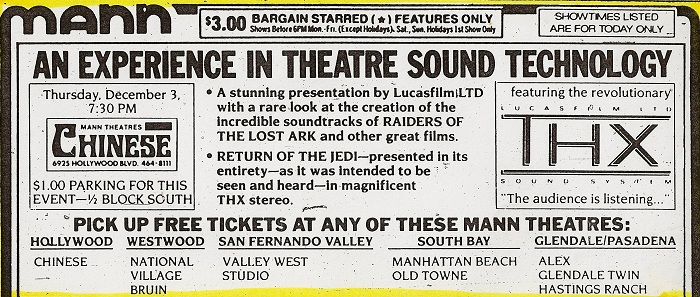
Los Angeles Times; November 29, 1987
Posted by Brad Johnson (Member # 6206) on 04-06-2011, 06:56 PM:
well, there are some cinemas near my house (I live in south orange county in the city of Laguna niguel) that were originally built by MANN that (@ the time) was THX certified (not anymore for years since though) I'd seen INDIANA JONES & THE LAST CRUSADE in 70mm THX (the first film though was in fact BATMAN shown there) I think that those cinemas @ that time had darn good sound & projection, but now since REGENCY has taken over I cant say since I hardly ever go there anymore.
Posted by Tom Petrov (Member # 1534) on 05-11-2011, 04:33 AM:
Anyone else horrified near the end!
All from the The Toronto Star
1983
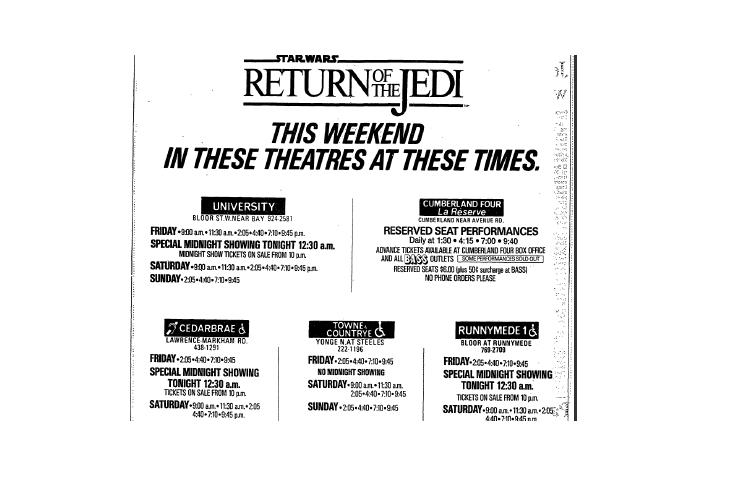
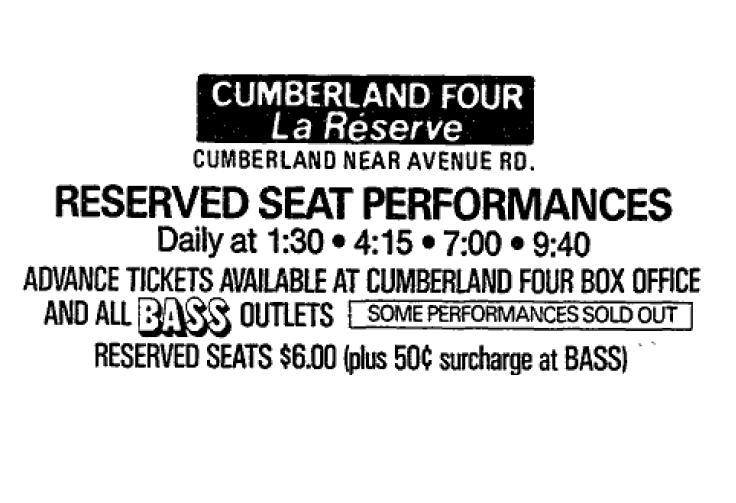
All five of these screens were 70MM....just an FYI. The Cumberland and University were a stones throw away.
1997

1999
I guess you can call this the greatest day for THX in the Toronto market. A total of 10 cinemas advertising THX
2005
The way it was meant to be seen
Posted by Brad Miller (Member # 2) on 05-11-2011, 11:55 AM:
That's hilarious. Somebody should point out to Lucasfilm that the DMDs on DLP projectors are not of a wide aspect ratio, unlike 70mm film.
Posted by Aaron Garman (Member # 1653) on 05-11-2011, 03:35 PM:
Brings up a good point: why don't they utilize anamorphic lenses on digital projectors?
AJG
Posted by Louis Bornwasser (Member # 3063) on 05-12-2011, 08:50 AM:
Cost, but it would be better if they did. Louis
Posted by Edward Havens (Member # 4715) on 05-12-2011, 01:02 PM:
Because a digital file doesn't need to have the image "squeezed" to fit "the frame."
Posted by Aaron Garman (Member # 1653) on 05-12-2011, 03:52 PM:
But couldn't you apply some squeeze to scope presentations, and thus utilize more resolution?
AJG
Posted by Joe Redifer (Member # 3) on 05-12-2011, 06:47 PM:
Aaron, you're just being logical. Stop that! How dare you even say that it was not perfectly right to begin with.
Posted by Ron Funderburg (Member # 4561) on 05-12-2011, 07:04 PM:
quote: Aaron Garman
But couldn't you apply some squeeze to scope presentations, and thus utilize more resolution?
How does squeezing the picture increase pixel density? The only way to increase the resolution on a digital picture is to increase the pixel count.
Squeezing the picture on film didn't increase the resolution either it just gave you a wider view. It also gives you some amount of distortion.
Posted by Mark Gulbrandsen (Member # 72) on 05-12-2011, 07:31 PM:
quote: Aaron Garman
Brings up a good point: why don't they utilize anamorphic lenses on digital projectors?
They could have and might of... still can be done and somewhat improves scope light levels but may actually lower resolution and certainly would reduce contrast range.
Posted by Steve Guttag (Member # 268) on 05-12-2011, 10:35 PM:
On film...CinemaScope definitely did increase resolution. One used more film area.
In digital, the source image for scope is actually smaller than for flat. So scope in theatres with a wider scope image (as the format was intended but not necessarily how it is installed in "modern" theatres" has a smaller image, less resolution, than flat. The Scope image in digital is a mere 2048x858 pixels in size.
DCI prohibits a file having non-square pixels. Now I don't know if that would preclude using an anamorphic lens on the camera since the pixels would actually be square, it is the image that is non-square.
A common misconception is that DCI somehow precludes using anamorphics in projection...that is not the case. It is required that if you use an anamorphic lens (or any multi-lens system) that the change be "automatic" (I wonder how Real-D got out of that one...though Strong does make a motor system that works with Real-D...either Z or XL). The other section that deals with anamorphics (more specifically, though not called out by name) is that any scaling to deal with constant-height screens must not introduce visible artifacts (it doesn't specify where the "visible" part is to be judged). I would contend that any keystone, barrel distortion from curved screens and even lens shifting causes greater visible artifacts (note, on a lens shift, you inherently create non-square pixels as the linearity of the image changes with the shift).
I have not seen an anamorphic on a 4K but on a 2K, the resolution is not diminished as all pixels are clearly reproduced...however one can tell, under close inspection, that they are no longer square and that some amount of softening has occurred, depending on the lens and how well it is set up.
What anamorphics bring to DCinema on the projection side is light efficiency. On the order of 23%. Which is huge and can often change what size lamp one needs, particularly on 3D. Again, this would apply to those with constant HEIGHT screens. No advantage can be had on constant width screens.
-Steve
Posted by Aaron Garman (Member # 1653) on 05-13-2011, 12:00 AM:
That resolution is just abysmal for scope in a cinema. Yikes!
Sad because I love the scope ratio for most films and the only time I have seen DCinema do it really nice was at an AMC (formerly a Kerasotes) that had a curved screen running Rango. It was a phenomenal image.
AJG
Posted by Louis Bornwasser (Member # 3063) on 05-13-2011, 06:34 AM:
Yep, too bad that d-cin did not acccount for more image quality in the preferred format. Louia
Posted by Frank Angel (Member # 248) on 05-14-2011, 03:11 AM:
Aaron, you need to see IMAX Digital do scope (be sure they are using dual projection -- I have heard more than one person say they were at IMAX-D presentations where they were using only a single projector. The dual system gives a beautiful full scope image.
Posted by Aaron Garman (Member # 1653) on 05-14-2011, 10:11 PM:
I did see Inception in a former 15/70 multiplex house that went digital: it was a great image. Too bad I was anticipating 15/70!
Oh, and no masking really annoys me on those blow-ups.
AJG
Posted by Eric Robinson (Member # 2966) on 05-16-2011, 01:41 PM:
In my humble opinion I think THX is very relevant.
Whilst we professionals know everything and every standard of THX, we can not say that of the up and coming professionals or new theatre designers.
Fortunately the THX standard is available for those just coming into the Cinema industry. Otherwise...who knows, there may be reversion to the good old days of painted concrete walls and any other number of acoustical tragedies.
I do agree, unfortunately, that the public might have seen this as a fad...and I'm sure 90% of them had no idea what the Tomlinson Holman Experiment was about... its origins, its applications, or its benefits.
Possibly the audience would get deathly bored or confused if they were instructed on the standard. They would probably all whip out the cell phones and start texting so they wouldn't feel too awkward about being so ignorant.
Posted by Tom Petrov (Member # 1534) on 11-09-2011, 11:02 PM:
Can anyone recommend a THX Certified cinema in the Raleigh North Carolina or Washington DC area? I will be in the areas next week.
Posted by Mark Lensenmayer (Member # 134) on 11-10-2011, 05:57 AM:
THX Cinema Locator
Enter location in box at bottom of page.
Posted by Steve Guttag (Member # 268) on 11-10-2011, 10:42 AM:
AFI/Silver is in the Washington, DC area and is THX certified on all three screens.
-Steve
Powered by Infopop Corporation
UBB.classicTM
6.3.1.2