This is topic New York Times Profiles Projectionist in forum Film Handlers' Forum at Film-Tech Forum ARCHIVE.
To visit this topic, use this URL:
https://ft-forum.com/ft/cgi-bin/ubb/ultimatebb.cgi?ubb=get_topic;f=1;t=010727
Posted by Donald Brown (Member # 5427) on 11-30-2010, 04:06 PM:
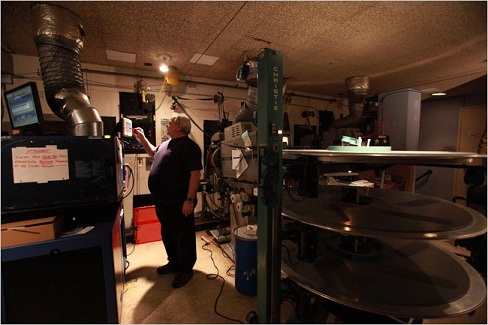
Since my paper always comes at least a few days late, I only spotted the article today: On Thanksgiving Day, November 25, the Times profiled the man behind the scenes in the booth at the Ziegfeld Theatre in New York City. When I noticed what appeared to be a platter in the accompanying photo, I took a second glance and read the article! Congrats to our colleague featured in the profile! It is noteworthy when someone in this field receives a measure of recognition!
Don Brown
Posted by John Wilson (Member # 269) on 11-30-2010, 04:34 PM:
Link to article
EXPERIENCE NECESSARY
The Film Projectionist Who Looks Away
By ROBIN FINN
Published: November 24, 2010
On day one of a recent vacation, Joseph J. Micherdzinski was home in Yonkers with his wife, Mary Ann, watching the original black-and-white version of “The Night of the Living Dead.” Mr. Micherdzinski, 67, has been a film projectionist since 1968, so this seemed a bit like a pizza-maker going out for a holiday meal and wolfing down a dozen slices of Sicilian, but no.
Suzanne DeChillo/The New York Times
“The sad part is that projectionists are going the way of the dinosaurs and reel-to-reel,” Mr. Micherdzinski said.
According to him, there is nothing innovative coming out of Hollywood, hence his home library of go-to classics. He has worked at the Ziegfeld Theater for 17 years but says he rarely bothers sneaking a peek at the big screen.
Last movie watched at work: “The American” with George Clooney. I thought it was slow. But I enjoyed the story. I saw “Avatar” at a theater where one of my buddies is a projectionist. “Inglourious Basterds” I’ve seen several times; there’s a scene that shows what’s so dangerous about the old silver nitrate film that’s no longer used by the industry.
Look at it cockeyed and it explodes in your face. It’s very flammable.
Speaking of flammable ... In my whole career, I’ve only had one fire break out during a movie, but once was enough. It was at the Ziegfeld — some wiring behind the booth caught fire and it spread. First the assistant manager and I cleared out the theater. Then we fought the fire with extinguishers until the Fire Department got there. The movie we were showing that night was “Vertigo.”
Intro to cinema: I grew up in Parkchester in the Bronx; we had two theaters, the Palace and the Circle. On Saturday afternoons you could see 2 features, 10 cartoons and one part of a serial, all for 50 cents. The first movie I remember going to at night was “Mister Roberts.” It was my mother’s sister’s husband who got me into this business; he was a projectionist on Broadway and at Lincoln Center.
In the Navy: I was assigned to the U.S.S. Ticonderoga, an attack aircraft carrier stationed out of San Diego. I was an internal communications electrician; part of my job was taking care of the projection equipment on the ship.
In-flight entertainment: My uncle told me they were hiring at Bell & Howell airline services company out at J.F.K. airport, a union job. We serviced the projection equipment when the aircraft were at the gate or in the hangars; all a stewardess had to do was press a button at movie time. It was 16 millimeter film. I was there 15 years. For training, I went to something called motion picture operators’ school.
The big screen: I wanted to work in a theater, and in 1983 there was an opening for a projectionist at the Riverdale, part of the Loews chain. I was there a couple years, then it closed. When it reopened as an independent, the new owner twinned it and threw me a few extra shifts.
Endangered species: The sad part is that projectionists are going the way of the dinosaurs and reel-to-reel. Everything went digital. At the Ziegfeld I can show digital movies, I can show 35 millimeter, and I can show 70 millimeter, but I’m down to 25 hours a week. My daughter-in-law was a projectionist in Co-op City for 10 years; she just got laid off.
Favorite movie: Anybody who says they have a favorite movie, it is one big fat lie. There’s too many out there. O.K., the original “King Kong” is one of the best; for Westerns, “The Searchers.” James Cagney in “Public Enemy.” “Some Like it Hot” was a great comedy. I thought “The Hangover” was funny. I saw it on cable.
A version of this article appeared in print on November 25, 2010, on page A36 of the New York edition.
So, Joseph...where are you brother? Join Film-Tech man.
Posted by Tom Petrov (Member # 1534) on 11-30-2010, 05:14 PM:
What a sad story
Posted by Dustin Mitchell (Member # 372) on 11-30-2010, 05:58 PM:
Yeah, note the empty platter and what looks like a Christie digital projector tot he left.
Posted by Tim Asten (Member # 4051) on 11-30-2010, 06:38 PM:
I think thats an NEC projector.
Posted by Mike Blakesley (Member # 26) on 11-30-2010, 07:09 PM:
I get tired of people saying there's nothing good coming out of Hollywood. It must be an age thing -- the same way people over 40 or 50 don't think there's any good music today.
What's funny is that people 10 or 20 or 30 years ago were saying the same thing.
50 years ago, the movie industry was all but written off as a victim of the TV revolution. But here we are today.
A lot of the movies we call classics today were flops in their time....because nothing good was being made then, either, according to the "older" generation at the time.
Posted by Caleb Johnstone-Cowan (Member # 3710) on 11-30-2010, 07:35 PM:
Yes that's an NEC. Although it's sad his skills seem to be wasted on the digital age, he has had an interesting string of projection-related jobs. I didn't realise 16mm got played on airplanes, were they full-length recent features?
I agree with Mike, Hollywood usually makes at least a few good films a year that stand the test of time. People will naturally only recall the more memorable past titles.
Posted by Tom Petrov (Member # 1534) on 11-30-2010, 07:52 PM:
quote: Mike Blakesley
I get tired of people saying there's nothing good coming out of Hollywood. It must be an age thing -- the same way people over 40 or 50 don't think there's any good music today.
What's funny is that people 10 or 20 or 30 years ago were saying the same thing.
50 years ago, the movie industry was all but written off as a victim of the TV revolution. But here we are today.
A lot of the movies we call classics today were flops in their time....because nothing good was being made then, either, according to the "older" generation at the time.
I 100% agree. I am also tired of people saying nothing good is coming out. The thing about old movies is that there were so many bad films that nobody knows about.
Same thing for music.
Posted by Martin McCaffery (Member # 37) on 11-30-2010, 07:58 PM:
quote: Mike Blakesley
I get tired of people saying there's nothing good coming out of Hollywood. It must be an age thing -- the same way people over 40 or 50 don't think there's any good music today.
Sturgeon's Law: 90% of everything is crap.
Go dig up a Boxoffice magazine from the 1940's and just look at the sheer volume of movies produced that year. Then see how many you've ever heard of, much less seen. It would be a pretty good year if even 10% of them were good. The only thing different now is the volume of features produced. Fewer movies produced, fewer good movies.
Posted by Bill Gabel (Member # 1105) on 11-30-2010, 08:38 PM:
quote: Caleb Johnstone-Cowan
I didn't realise 16mm got played on airplanes, were they full-length recent features?
They were edited for content and cut versions of features. They were fairly recent on the flights. In-Flight Entertainment was a good union job, they were at all the major airports.
Posted by Sam D. Chavez (Member # 1841) on 11-30-2010, 11:05 PM:
For those too young to know, one 16mm print was played on multiple screens sequentially.
Posted by David Kilderry (Member # 142) on 12-01-2010, 03:02 AM:
.......and Super 8 optical prints were common too. Mag sound could be wiped and also required a larger reel so Super 8 went optical for airlines.
How many projectionists worldwide find themselves in the same position as Joseph?
Posted by Richard May (Member # 2627) on 12-01-2010, 05:10 AM:
Pretty much everybody here in NYC. ![[Frown]](frown.gif)
Posted by Tom Wurz (Member # 42) on 12-01-2010, 09:01 AM:
Hello everyone,
Does anyone have pictures of these inflight systems?
Tom
Posted by Jeff Taylor (Member # 443) on 12-01-2010, 11:15 AM:
Years ago they dumped tons of those inflight systems when video came in. As I recall they were generally modified Bell & Howell 500 series units with marc 300 lamps and lamp changers working off a 5,000 foot reel. They were built into blisters in the plane's ceiling at least on jumbos. There are still lots of airline prints around, especially of somewhat later titles and films that weren't licensed for syndication television back when most movies for tv originated on 16mm.
Posted by Jim Cassedy (Member # 4115) on 12-01-2010, 01:43 PM:
quote: Jeff Taylor
Years ago they dumped tons of those inflight systems when video came in. As I recall they were generally modified Bell & Howell 500 series units with marc 300 lamps and lamp changers working off a 5,000 foot reel.
Some years ago, I acquired a number of 16mm "airline prints".
Many of them were still mounted on the "Inflight" reels.
Here's one of them:

They were made out of lightweight aluminimum
The mounting hole is 3.5in in diameter.
The reel hub is 8.5in in diameter.
The reel itself is slightly larger than a
standard large capacity 16mm reel:

quote: Tom Wurz
Does anyone have pictures of these inflight systems?
Somewhere around here I have the complete set of operations
and service manuals for the INFLIGHT systems. I'll see if I
can dig them out and post a picture.
Posted by Tom Wurz (Member # 42) on 12-01-2010, 02:10 PM:
Thanks Jim.
Posted by Scott Norwood (Member # 30) on 12-01-2010, 02:20 PM:
I, too, would be interested in a picture of these things.
The "Automated Theatres 16mm projector systems" manual in the manuals section has some information about how they work. This was the application that led to the development of the MARC-300 lamp.
Note that these systems would have all been designed to use 400Hz aircraft power and wouldn't be especially useful in any other environment.
Posted by John Wilson (Member # 269) on 12-01-2010, 02:39 PM:
In my experience as a 16mm collector, 'Airline Print' generally meant 2 things...
1. Highly sanitized version of the original.
2. Scratched to the shithouse.
Posted by Jim Cassedy (Member # 4115) on 12-01-2010, 03:32 PM:
We're getting far off the original projectionist article topic but:
quote: Jeff Taylor
As I recall they were generally modified Bell & Howell 500 series units with marc 300 lamps
Interesting, as my recollecton is that they used a highly modified Kodak Pagent mechanism, as these were much lighter than the B&H's.
(Unless there was more than one type of system or they evolved over the years)
But we can agree on the Marc 300 lamps.
And I'm not sure about the 400hz power. I think only the lamp and amp power supplies ran off the 400hz. I beleive there was a converter to run the projector motor at 60hz.
I moved over the summer and some of my 'stuff' is still in boxes, so it may take me some digging to find those manuals,and get some answers to all these issues!!
Posted by Steve Guttag (Member # 268) on 12-01-2010, 05:32 PM:
While I agree that it isn't true that there are NO good movies coming out nowadays...there are always good movies coming out...however in the last 15-20 years, the quantity of those...as a percentage sure feels like it has diminished a great deal.
Yes, looking back into the pre-1960s got you a great number of movies that most have never heard of...you are also reaching back to a time when most homes did not have TV and also the illiteracy rate was far higher. The theatre was often the newspaper and also the equivalent of the TV of today (and even the internet of today). There were "B" pictures that were pretty much throwaways...TV has negated the need for that and the internet perhaps even more so.
And while it is true that Hollywood remaking movies is not a modern conception...typically, a remake also meant it had SOUND too. The remake was more than just an obvious "Gee, we are out of original ideas...lets redo a movie that did well 20-years ago" (or so).
Hollywood has definitely earned its "knocks" on issuing more crap movies that it used to. Don't get me wrong...there is nothing wrong with a mindless movie every once in a while that just takes you away from reality without altering your life, but the constant remakes and sequels and generally low production values of todays movies is beneath where Hollywood should be.
As for the music. While I don't think the music of today is as good, on the whole, of some of the more pioneering versions of each particular category...there are indeed some great stuff coming out. The ability for the people of today to not depend on an expensive studio to get decent results is great and allows for a much greater variety of styles and creativity. The downside...those don't tend to have the ability to get the same level of penetration as the recording industry of yesteryear.
-Steve
Posted by Rick Raskin (Member # 1561) on 12-01-2010, 05:53 PM:
Back on topic...
Its good to see an unsung hero noticed these days. I remember in DC when the Washington Post did an article on the projectionist at the Biograph on occasion of his running "Pink Flamingos" for two years of midnight shows.
Posted by Vern Dias (Member # 5241) on 12-01-2010, 09:59 PM:
quote:
As I recall they were generally modified Bell & Howell 500 series units with marc 300 lamps
--------------------------------------------------------------------------------
Interesting, as my recollecton is that they used a highly modified Kodak Pagent mechanism, as these were much lighter than the B&H's.
(Unless there was more than one type of system or they evolved over the years)
The reason for the confusion here is that there were two competing systems. Inflight Motion Pictures was the originator of movies on aircraft. They used Kodak projectors, with horizontally mounted stacked 6000' feed and take up reels. MARC 300 lamps were used, but with only a single lamp. They could handle roughly two hours of film using mylar stock.
The newer longer range aircraft needed two movies, so Bell and Howell created a competng system that used larger reels capable of holding two movies. That is the reel shown in the picture posted earlier.
American airlines did use a system that ran a single print through multiple projector heads, but they were the only airline that I recall using it.
I was a technician at the Hilo HI airport for 3 years or so, working the Saturday shift. We had a delivery van outfitted with rewinds and spare parts that we drove out to the aircraft. The narrowbody aircraft had 3 projectors, the two of us on a shift could service the aircraft in about 10 minutes or so. Each station was held accountable for any failed shows, our station was consistently at a 99%+ successful showing rate.
We serviced United, Western, and Braniff airlines. Continental, the United DC-8 series 62 long range flights and 747 widebodies used the competing B&H systems.
Vern
Posted by Jim Cassedy (Member # 4115) on 12-01-2010, 10:20 PM:
Thanks for the very interesting info Vern, and for
clearing up some of the confusion.
I did some searching online, and I did find this PATENT for the
inflight system which clearly shows the projector
to be a Kodak Pagent, but I also found other patents
for another company that showed a Bell & Howell
mechanism. Your post clears up the eveloution of
the different systems.
Just FYI, here's an image detail from the INFLIGHT
patent, which clearly used a Pagent projector.
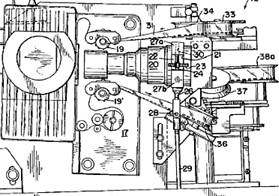
You can see the complete patent (#3262358, July 1966)
and all the diagrams at the patent link in my post.
Posted by Jesse Skeen (Member # 586) on 12-04-2010, 01:38 AM:
There was an episode of (I think) "The Lucy Show" where she's a flight attendant and tries to start the movie only to have the film spill out everywhere.
Powered by Infopop Corporation
UBB.classicTM
6.3.1.2