This is topic 6 Track Magnetic vs 6 Track Digital in forum Film Handlers' Forum at Film-Tech Forum ARCHIVE.
To visit this topic, use this URL:
https://ft-forum.com/ft/cgi-bin/ubb/ultimatebb.cgi?ubb=get_topic;f=1;t=010760
Posted by Tom Petrov (Member # 1534) on 12-28-2010, 06:32 PM:
I have recently gotten into 70mm films. I am wondering if it is worth it to make it Ottawa for the 70mm festival.
A lot of the movies will have 6 track magnetic.
Wondering what people's thoughts are on this?
Posted by Mark J. Marshall (Member # 1409) on 12-28-2010, 06:55 PM:
SR has a wider frequency range and a wider dynamic range than digital. If done correctly, six tracks of SR analog will sound awesome compared to six tracks of digital. I think the only 70mm six track SR print was Star Trek 4, but I might be wrong. If they have the ability to play six tracks of SR sound and they're doing it with a great sound system, then I bet that would be pretty awesome to hear.
The rest are probably Dolby "A" or something similar and will still sound REALLY good if done right - assuming the tracks are in good shape. Lossless DTS sound should give magnetic tracks a run for their money, but I doubt that's being used.
Posted by Daniel Schulz (Member # 1881) on 12-28-2010, 06:59 PM:
I think the single best sounding thing I've ever heard was a 70mm 6-track mag print of Apocalypse Now. The print was in pristine condition, and the sound was simply glorious.
The more recent restorations have gone through a digital remix, but in the earlier days of DTS 70mm, the 6-track DTS discs were a straight transfer off the 6-track mag masters.
Posted by Monte L Fullmer (Member # 2797) on 12-28-2010, 07:57 PM:
What we are comparing in this topic is the difference between analog sound and digital sound in which you'll get a lot of reverbs from hi end audiophiles collectors on how analog sound is tonnage better than any digital out there.
..since you're actually hearing the entire audio waveform as it's reproduced, not scrunched into "bits and bytes" to make it come close to the actual waveform no matter how high the sampling or frequency rates are.
In short, analog is what we hear (and see) now. When you "digitize" (a.k "Tron) analog information, you're not getting the full spectrum of the original source.
You take 6 track mag audio from a 70mm print and it will blow away any digital reproduction since the encaptured wavefrom on those magnetic tracks are so spread apart due to the film speed of 20ips going across those magnetic headstack reproducers.
For recording and playback comparison: Stock analog tape studio recorders sped the tape across the headblocks at 15ips....and they were hitting 22kHz on the top end and down to 30hz with dynamics close to CD quality at around 70dB before distortion sets in .. in which this is the only thing that saves digital is that the digital can hold higher dynamics - which is over 100 plus dB -(why there is a lot more lower frequencies due to the wider dynamic range that digital can hold compared to analog), but they lose it in the top end where analog wins this area hands down.
Sadly, also with DTS processes, it chops off the HF's above 9kHz were you don't get that chop with analog.
I'll stay with a 6trk mag analog 70mm print more than a print being reproduced with DTS..
-Monte
Posted by Sam D. Chavez (Member # 1841) on 12-28-2010, 09:17 PM:
I'm not sure I agree with Monte's stated numbers, but IMHO, pound for pound, 6 track 70mm mag simply sounds better than a digital version of the same material, regardless of type of noise reduction used.
We are talking of material recorded and mixed in the 60's, '70's and '80's for the most part here. Live orchestras and all the rest of the recording techniques used back then have something to do with it as well.
Posted by Gordon McLeod (Member # 33) on 12-28-2010, 09:43 PM:
If my memory serves 70mm 6 track with SR has the same dynamic range as digital and maybe a bit more namely because it will soft clip if over modulated
Also i question this 9K issue on DTS
Lawrence of Arabia had SR 70mm prints as well
a 35mm 6 track fullcoat mag has better sound than digital
the big issue over time is print though, head wear and oxide flaking and slow demagnitization of the track
Posted by Tom Petrov (Member # 1534) on 12-28-2010, 09:57 PM:
quote: Monte L Fullmer
between analog sound and digital sound
Wow! Its looks like older timeers have chimmed in. And that is great.
Thanks for responding. Why is it called magnetic?
Posted by Chris Slycord (Member # 4239) on 12-28-2010, 10:27 PM:
Because the soundtrack is stored on a magnetic strip? ![[Wink]](wink.gif)
Posted by Ian Parfrey (Member # 5122) on 12-28-2010, 10:29 PM:
quote: Gordon McLeod
a 35mm 6 track fullcoat mag has better sound than digital
Gordon.
Do you mean 35mm 4 track or 70mm 6 track? I may be wrong here bit I seem to recall 35mm 4 track with surround steering by tones. Can anyone verify this?
Tom.
Magnetic sound refers to actual magnetic oxide stripes applied to the film print post processing. In 70mm, these reside thus- 4 tracks in two stripes (1 stripe per side) outside the perforations and 2 tracks in two stripes inside the perforations.
Just like magnetic tape, these stripes have to be 'sounded" after the stripes have been applied, then played back to check the quality of the soundings and for Q.C. Just one reason why 70 mm mag prints are so expensive.
It seems apparent that as the volatile chemicals used in stripe application also hasten the fading of Eastman prints and possibly other manufacturers too. This volatility has also been outlawed as it is considered a pollutant and therefore there will no longer be any magnetic prints made-hence the uptake of DTS optically timecoded 70mm prints.
IMHO. NOTHING beats a well kept 70mm mag print. I remember hearing South Pacific in 70mm mag and it was stunning! Considering the recording equipment used, and at some parts over 120 separate analogue audio tracks mixed with valve technology, it just shows the care and attention to detail those engineers used to make an experience never to be forgotten.
Posted by Tom Petrov (Member # 1534) on 12-28-2010, 10:41 PM:
quote: Ian Parfrey
Tom.
Magnetic sound refers to actual magnetic oxide stripes applied to the film print post processing. In 70mm, these reside thus- 4 tracks in two stripes (1 stripe per side) outside the perforations and 2 tracks in two stripes inside the perforations.
Just like magnetic tape, these stripes have to be 'sounded" after the stripes have been applied, then played back to check the quality of the soundings and for Q.C. Just one reason why 70 mm mag prints are so expensive.
It seems apparent that as the volatile chemicals used in stripe application also hasten the fading of Eastman prints and possibly other manufacturers too. This volatility has also been outlawed as it is considered a pollutant and therefore there will no longer be any magnetic prints made-hence the uptake of DTS optically timecoded 70mm prints.
IMHO. NOTHING beats a well kept 70mm mag print. I remember hearing South Pacific in 70mm mag and it was stunning! Considering the recording equipment used, and at some parts over 120 separate analogue audio tracks mixed with valve technology, it just shows the care and attention to detail those engineers used to make an experience never to be forgotten.
Thanks for the elaborate write up Ian. Much appreciated! I didn't know any of this.
So it is similar to a cassette tape?
Posted by Darryl Spicer (Member # 711) on 12-28-2010, 10:44 PM:
quote:
quote: Gordon McLeod
--------------------------------------------------------------------------------
a 35mm 6 track fullcoat mag has better sound than digital
--------------------------------------------------------------------------------
Gordon.
Do you mean 35mm 4 track or 70mm 6 track? I may be wrong here bit I seem to recall 35mm 4 track with surround steering by tones. Can anyone verify this?
I think he may be referring to the full coat magnetic on 35mm base used in Imax theaters. Full coat magnetic 35mm was also used on Cinerama and I think it had 7 tracks of sound.
Posted by Mitchell Dvoskin (Member # 751) on 12-28-2010, 10:51 PM:
quote: Ian Parfrey
I may be wrong here bit I seem to recall 35mm 4 track with surround steering by tones.
I am unaware of any 35mm mag stereo with surround steering, although I would not rule anything out. Many 35mm mag tracks had a tone on the surround track that caused the preamp to cut out the surround channel when present. This was done to eliminate hiss on that track, as mag stereo pre-dates Dolby by 2 decades.
Posted by Chris Slycord (Member # 4239) on 12-28-2010, 11:02 PM:
quote: Tom Petrov
So it is similar to a cassette tape?
Yes. Cassette tape is a type of magnetic tape.
Posted by Bobby Henderson (Member # 840) on 12-29-2010, 12:10 AM:
It's not so easy to say which type of audio (analog or digital) is better. Lots of variables are involved.
Using proper recording and mastering techniques in conjunction with the best of what's currently available in technology, "digital" can handily beat the quality levels of analog.
Unfortunately, the best techniques are often not used when recording and mastering digital audio.
Movie soundtracks are often put together pretty fast. The music score, ADR, sound effects, etc. are among the very last elements produced in a movie production. Quality is going to be only so good when things are done in a hurry. Lots of canned audio effects of varying ages and quality levels are used.
With popular music the quality bar is all over the place. Most rock and dance pop music is horribly mastered. The high end of the wave form is often badly clipped and the remaining wave form dynamically compressed so everything sounds loud and punchy rather than natural and clean. This isn't a fault of digital technology. Rather it's a fault of listener ignorance and the tendency of record producers to cater to that ignorance.
I can play an old CD carefully mastered from analog material, such as the 24K gold "Ultradisc II" version of Pink Floyd's Dark Side of the Moon. None of that audio is clipped. The wave form is preserved, even though it's only in standard music CD resolution. That disc plays at a very noticeably lower volume level than just about any newer music disc I own.
Digital has weaknesses in areas like analog to digital and digital to analog signal conversion. A/D and D/A converters have greatly improved over the years. The live audio is "analog" but must be converted into digital data at some point. When the audio is played back through your speakers it has to be converted back into an analog signal so it can be amplified for the speakers.
Analog has its own weaknesses. The tape width and recording speed used are big quality factors. Lots of other variables play a part. Analog tape can stretch, "sweat," shed or just wear out over time.
Basically neither system is perfect. Both analog and digital audio can sound exceptional or horrible.
With either digital or analog audio sources, the sound system itself plays a giant part in determining audio quality.
quote: Mark J. Marshall
SR has a wider frequency range and a wider dynamic range than digital.
Dolby SR magnetic has a wider dynamic range than 16-bit digital. But it doesn't have a greater dynamic range than 24-bit digital.
Bit word length is one quality factor with digital. Sample rate is another.
Music CD supports 16-bit depth with 44,100 16-bit samples per second. Most movie discs have audio running at 48,000 samples per second, often in 20-bit or 24-bit sample depths. Blu-ray commonly delivers lossless 24/48 audio but can also deliver up to 8 channels of 24-bit 96kHz audio or even 2 channles of 24-bit 192kHz audio.
The combination of increased bit depth and sample rates can smooth out any of the harshness associated with digital audio. The audio creators just have to use the technology properly. Many of them aren't. They're treating digital audio the way many wannabe graphic designers are treating their fonts: disgraceful abuse.
quote: Mark J. Marshall
I think the only 70mm six track SR print was Star Trek 4, but I might be wrong.
Star Trek IV: The Voyage Home was the first movie to use 70mm Dolby SR prints. But it wasn't the only 70mm SR release. I'm pretty sure the 1989 restored version of Lawrence of Arabia had 70mm SR prints -at least it was advertised that way in New York. Indiana Jones & the Last Crusade had 70mm Dolby SR prints; I saw the one that played Loews Astor Plaza in Times Square. I thought Born on the Fourth of July sounded pretty damned good at the Ziegfeld theater. There's at least a couple dozen or so other movies released with 70mm Dolby SR prints between 1987 and into the 1990s.
Posted by Sam D. Chavez (Member # 1841) on 12-29-2010, 01:45 AM:
"Wow! Its looks like older timeers have chimmed in. And that is great."
Oy!
This old tmer was lucky enough to learn the craft at a time when cinema sound was reaching the state of the art and I still make a very good and enjoyable living at this game.
IMHO, you really do come off as a total jerk if this matters to you. Thoughtless and mispelled posts do not earn much respect.
Posted by Tom Petrov (Member # 1534) on 12-29-2010, 01:52 AM:
quote: Sam D. Chavez
IMHO, you really do come off as a total jerk if this matters to you. Thoughtless and mispelled posts do not earn much respect.
Please don't take things the wrong way. I am glad you responded. I was looking for some of what the older fellas had to say. I was wrong in other threads on my opinion of 70mm and that is why I am asking these questions.
Again, thanks for responding! Didn't mean to offend.
quote: Bobby Henderson
With either digital or analog audio sources, the sound system itself plays a giant part in determining audio quality.
I agree with you. But from what I understand, if you play either digital or analog on a well equipped sound system, you are not likely going to hear the difference.
Posted by Monte L Fullmer (Member # 2797) on 12-29-2010, 04:07 AM:
For Tom and his curiousity on 70mm (and my apologies on the owner of this clip to whom I can't remember the name...)
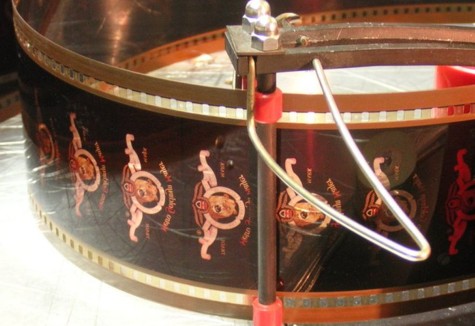
-Monte
Posted by Damien Taylor (Member # 4255) on 12-29-2010, 04:13 AM:
To make things even more confusing, as well as magnetic striping applied to the actual film and read by the projector, you can also have magnetic full-coat film run separately but interlocked on a dubber.
quote: Sam D. Chavez
mispelled posts
E might be a SL for Tom, Sam. Terms of affection may have also transposed badly.
Posted by Tom Petrov (Member # 1534) on 12-29-2010, 04:39 AM:
quote:
For Tom and his curiousity on 70mm (and my apologies on the owner of this clip to whom I can't remember the name...)
-
-Monte
Thanks Monte. Much appreciated! This is valuable information.
Now, in absence of a magnetic track. What would be in place on the print? Play Time and 2001 looked similar as they had something printed there but not exactly the same.
Also, are there four tracks there? Or is it just the outside of the frame?
quote:
ou take 6 track mag audio from a 70mm print and it will blow away any digital reproduction since the encaptured wavefrom on those magnetic tracks are so spread apart due to the film speed of 20ips going across those magnetic headstack reproducers.
The older folks that I have talked who come into my store always remember the advertisments of Dolby when we talk about 70mm. Most are fond of the sound. Also, everyone remember where the theatre was.
Posted by Mark J. Marshall (Member # 1409) on 12-29-2010, 04:59 AM:
Basically, the thicker mag stripes outside of the sprocket holes each hold two tracks. The thinner stripes inside of the sprocket holes each hold one track.
Which track goes where is a whole other discussion as there are several different mag formats. Some have five channels across the stage, some have stereo surrounds... There was a discussion here recently on which 70mm titles had which format.
To answer your question on what appears on 70mm when there is not mag striping, there is a DTS time code running along the print next to the sprocket holes on one side. This is picked up by a 70mm version of the DTS reader and sent to the DTS unit exactly the same way a 35mm DTS reader does.
For what it's worth, there was another 70mm sound format back in the early 90s called CDS which printed six track digital audio directly on the film in the place of the magnetic stripes. CDS existed on 35mm also and was printed in place of the analog track. That format had a VERY high bit rate compared to Dolby SRD and even DTS, but it didn't last very long, and it's doubtful that any theaters still have the equipment for CDS laying around. Nor are there going to be many prints left. Even if there were, I don't think many would have the nerve to run it. It's pretty much dead. Do a search here if you are interested. There are plenty of threads about CDS here.
quote: Bobby Henderson
Dolby SR magnetic has a wider dynamic range than 16-bit digital. But it doesn't have a greater dynamic range than 24-bit digital.
Bit word length is one quality factor with digital. Sample rate is another.
Thanks for clarifying that, Bobby! And thanks to everyone who filled in the blanks on the other 70mm SR titles! ![[Smile]](smile.gif)
quote: Darryl Spicer
I think he may be referring to the full coat magnetic on 35mm base used in Imax theaters. Full coat magnetic 35mm was also used on Cinerama and I think it had 7 tracks of sound.
It's also used on very early screening prints if I'm not mistaken. When directors bring their work out to show to critics or at film festivals, sometimes a 35mm full coat mag print is synced with the print that has the picture... as there is no sound track on the film yet.
Posted by Gordon McLeod (Member # 33) on 12-29-2010, 07:10 AM:
Full coat mag had many different track configurations
4 track striped 35mm prints had a small track area than 70mm tracks especially the surround track so a control tone was used on some titles to turn it off (in effect act as a noise gate) The only 4 track i handled with NR was Yentel with A type on it
Also there were what was called cinestage prints that used perspecta sound control tones on the surround track to give L R and back surrounds
Also Quintaphonic used QS matrix on the L and R track to do a Ls and Rs surround track
Posted by Robert Throop (Member # 61) on 12-29-2010, 07:25 AM:
quote: Tom Petrov
I am wondering if it is worth it to make it Ottawa for the 70mm festival.
Will there be another 70mm festival in Gatineau this year?
Posted by Michael Barry (Member # 237) on 12-29-2010, 08:06 AM:
I could be wrong, but I would think that given sufficient encoding/decoding resolution a digital soundtrack should be indistinguishable from a magnetic soundtrack in double-blind tests using the same source material for both media.
Posted by Mark J. Marshall (Member # 1409) on 12-29-2010, 09:03 AM:
You're probably right, Michael. Except that those encoding/decoding resolutions do not exist in the cinema film sound processors today with the exception of possibly lossless DTS. Unfortunately that only seems to be in use in special venues.
Posted by Bobby Henderson (Member # 840) on 12-29-2010, 09:37 AM:
Unfortunately, for film-based presentations in standard movie theaters lossy compressed digital (DD, DTS, SDDS) is still the norm. The DTS-XD10 and XD20 processors can play uncompressed audio, even in 24-bit 96kHz resolution and up 8 channels of it. The systems can be modified to add more channels of audio. That capability is going unused. If you want uncompressed audio you typically must visit a digital cinema equipped installation to get it.
quote: Mark J. Marshall
CDS existed on 35mm also and was printed in place of the analog track. That format had a VERY high bit rate compared to Dolby SRD and even DTS, but it didn't last very long, and it's doubtful that any theaters still have the equipment for CDS laying around.
I was pretty shocked when I finally learned the actual bit rate for CDS, around 6 million bits per second. I always assumed CDS ran at a lower bit rate. Considering the state of CCD scanning technology in 1990 it's amazing CDS could even work at all. Dolby Digital and SDDS had plenty of problems early on and those systems had much larger data spots on the film prints and lower bit rates (especially Dolby Digital) compared to CDS. The film readers could reliably see only so small a "digital" pixel recorded onto the film print.
I don't know how many CDS prints still exist; it would be a shame if all the 70mm CDS prints of movies like Dick Tracy or Terminator 2: Judgment Day have been trashed.
It would be interesting to see how the system could work with a new, custom built film reader using the latest technology. It probably wouldn't take too much programming work to modify the firmware in something like a DTS-XD20 to where it could understand and process the CDS data. Lawyers and patent issues would be the biggest obstacle for such an effort to go anywhere.
Posted by Sam D. Chavez (Member # 1841) on 12-29-2010, 10:38 AM:
The basic problem with CDS is the optics had very low depth of field so any mechanical problem with film would put the image out of focus; even a little chad of splicing tape.
If you can't read the data, you're screwed, and there is no back up.
Oh the irony of misspelling the very word while being critical of others. I looked closely to avoid this, but it got my me. In my defense, spell check stopped working on both of my laptops.
Posted by Gordon McLeod (Member # 33) on 12-29-2010, 10:47 AM:
small correction yentyl was dolby aNR but Tommy was DBX
There were 35mm Atype mag prints for Logans Run but i didn't handle it
Also Earthquake and Midway used DBX on the magtracks for some of the sensuround prints
Posted by Sam D. Chavez (Member # 1841) on 12-29-2010, 10:57 AM:
The Sensurround system used DBX on the optical prints as well.
Posted by Jack Theakston (Member # 4484) on 12-29-2010, 11:53 AM:
Just throwing in my two cents, but some of the 3-track fullcoat stuff that I've heard are nothing short of incredible (particularly when you consider that the oxide has held up as long as it has).
Posted by Bill Gabel (Member # 1105) on 12-29-2010, 12:02 PM:
quote: Mark J. Marshall
I think the only 70mm six track SR print was Star Trek 4
Some of these 70MM prints had Dual Inventory of Dolby A & SR prints at depots. Some markets played the film in Dolby A and other markets got Dolby SR prints. Some theatres had to rent extra Cat. 280 cards for their engagements.
- 1986
Star Trek: The Voyage Home (Dual)
1989
Lawrence of Arabia
Indiana Jones and the Last Crusade (Dual)
Star Trek: The Final Frontier (Dual)
Black Rain (Dual)
Born on the Fourth of July (Dual)
1990
Gremlins 2: The New Batch (Dual)
Days of Thunder (Dual) plus CDS
Fantasia (Dual)
The Godfather Part 3 (Dual)
1991
Spartacus
The Doors
1992
Aliens 3
Hoffa (Dual)
1993
Gettysburg
In the Line of Fire (Dual)
Cliffhanger (Dual)
Last Acton Hero (Dual)
Geronimo (Dual)
1994
True Lies
Miracle on 34th Street
1999
TRON
The last 6-Track Full Coat Dolby SR print I ran was "There Will Be Blood".
Posted by Manny Knowles (Member # 1171) on 12-29-2010, 12:10 PM:
In defense of the current digital systems:
1. They made it practical to deliver 6-track mixes to everyone.
2. No special handling required in projection.
3. They are far superior to analog optical which, for most of us, is what they replaced.
AFAIK it was never the intention of the studios to bring 6-track magnetic to the masses, so I don't want people to read this thread and think "Gee! If only digital hadn't come along - we'd have better sound today." Because that is just not the case. If digital had not come along, we'd still be listening to analog optical through uncalibrated A-chains. Maybe in stereo. Maybe.
Mag was a format that was created and used for select (upscale) markets. The limitation was due to (a) the expense of the sounding process, (b) added cost of shipping, and (c) the special handling required in projection. It just wasn't practical or cost-effective to ship a 70mm mag striped print to every market.
So, I'm sorry if digital came along and ruined it for everyone living in the big cities. But, this "island boy" is VERY happy that digital came along and thinks it made movies sound better than they otherwise would sound for millions of people.
I would also argue that just as Dolby A made it possible for Ben Burtt to do everything he did with the "Star Wars" soundtrack, DTS made it possible for Gary Rydstrom to do what he did with the sound of "Jurassic Park." It is also worth raising the point that, given the transition to a digital post-production process (and now an all-digital workflow), a digital release provides an exact copy of the original whereas an analog copy would be something else.
Digital sound also helped to bring order to what was turning into a hot mess - look at all those different mag formats (see previous pages) and the dual-inventory (triple inventory if you also count 35mm).
Parting shot - I drove over an hour to see "Willow" in 70mm in its opening weekend when I lived in Detroit. The final reel had dropouts during the big climax when the evil queen is defeated. Very disappointing. As with CDS (previously mentioned) 70mm/mag has a great potential problem in that there is no backup track.
...and now, we wait for the flames! ![[evil]](graemlins/evil.gif)
Posted by Bobby Henderson (Member # 840) on 12-29-2010, 02:00 PM:
quote: Manny Knowles
It is also worth raising the point that, given the transition to a digital post-production process (and now an all-digital workflow), a digital release provides an exact copy of the original whereas an analog copy would be something else.
Excellent point. I forgot all about generational loss. A 70mm Dolby SR mag audio track can sound fantastic, but its quality may be slightly different from the master mix tape and the master stems.
quote: Manny Knowles
Mag was a format that was created and used for select (upscale) markets. The limitation was due to (a) the expense of the sounding process, (b) added cost of shipping, and (c) the special handling required in projection. It just wasn't practical or cost-effective to ship a 70mm mag striped print to every market.
Standard 35mm release prints are produced at high speed. The image and audio is all duplicated in one shot. That's not the case with a mag striped 35mm or 70mm print. The image is duplicated to the print, the mag striping is added (and it has to cure, which takes more time), and then the print has to be "sounded," which is done in real time, not high speed.
The cost for producing the mag stripe print is really high, but the extra time required to produce the print is very costly as well. It's one thing to create a couple dozen or so 70mm mag stripe prints for key movie theaters. It's asking too much to create 2500 or more such prints for a general release. Some movie releases did have a lot of 70mm prints. Dick Tracy, Hoffa, Indiana Jones & the Last Crusade and Far and Away are a few movies I remember having 70mm engagements in many theaters.
Still, a movie with a couple hundred 70mm prints never was going to get its 6-track mix into as many theaters as a movie using one of the 35mm oriented digital processes.
Dolby was short-sighted in pricing and marketing 35mm Dolby Digital merely as a replacement for 70mm mag in "flagship" theaters. DTS had the philosophy that 6-track audio should be in every neighborhood theater. That gave the company a permanent foothold in the market. The downside to that philosophy is many neighborhood theaters couldn't present 6-track audio well. The 70mm equipped sites were able to do a better job with it. IMHO, many commercial movie theaters aren't doing their sound right today, even when the system is being fed an uncompressed 24-bit 5.1 d-cinema track.
Posted by James Westbrook (Member # 3690) on 12-29-2010, 02:00 PM:
Flames.
*wooosh*
(just kidding).
I recall when UA was putting 70mm equipment in their cookie-cutter 8 plexes in the Dallas area, like the Bowen 8, the South 8 and the Northstar 8. Prestonwood had it as well, but I can only recall Prestonwood being the one that actually RAN 70mm.
But I agree with Manny that digital sound did improve the quality of sound to the areas - like mine - that seldom saw 70mm.
Posted by Ben Wales (Member # 92) on 12-29-2010, 02:50 PM:
quote:
Star Trek IV: The Voyage Home was the first movie to use 70mm Dolby SR prints. But it wasn't the only 70mm SR release. I'm pretty sure the 1989 restored version of Lawrence of Arabia had 70mm SR prints -at least it was advertised that way in New York. Indiana Jones & the Last Crusade had 70mm Dolby SR prints;
Also should add Kenneth Branagh's "Hamlet" (1996) at least it was filmed in true 65mm!.
Posted by Sam D. Chavez (Member # 1841) on 12-29-2010, 02:52 PM:
Full Coat is the best of the mag film formats for any number of reasons, but more or less in order; it is a manufactured product where you can apply the oxide all the way across the film and then polish it instead of trying to lay down liquid oxide on top of a finished film print. It can be tested and tossed if not to spec. as you are not destroying a finished print.
The base material is thick enough to prevent print through and pliable enough to lay on top of the mag heads.
Of course this is all obsolete knowledge at this point.
No question you are correct in the wider context Manny.
Posted by Tony Bandiera Jr (Member # 2365) on 12-29-2010, 03:03 PM:
Ben: Thanks for mentioning "Hamlet." I ran that film in 70mm for a week at the Laemmle's Royal theatre in West L.A.
The Norelco AAII there was so smooth it literally purred when running 70mm, I would be lulled to sleep!
Other than my relief on one night having a brain wrap and damaging the opening logo and title, the print was in perfect condition when it left.
Sam:
Tell me about it. After lugging a dubber into UC Irvine (and having its mate taking up space in my garage) pic/track screenings are pretty much done with as far as fullcoat mag is concerned.
Posted by Steve Guttag (Member # 268) on 12-29-2010, 04:53 PM:
I've come to the firm conclusion that the analog vs digital debate is best left alone (particularly on audio...where even analog vs analog or digital vs digital can take on violent arguments).
As a point of reference on the CDS 70mm...its "optical" sound area was INSIDE the perforations and wider than the inside mag track it replaced. As such, it encroached into the picture area. Since CDS was co-developed by ORC, which distributed Century projectors, at that time, they came out with a specail version of the 70mm runners that did not scuff the CDS track because they were milled thinner on the CDS side. Unless he has pitched it, Brad Miller had/has a fully functional CDS system. There would likely not be any patent issues with CDS, at this time as the patents have or will expire very soon (most likely have expired).
70mm in its modern form (5/70) always had 6-channels of sound available on the magnetic tracks. With the exception of an odd run of 2001 prints (or possibly one print) in the '90s, which had a 5.1 sound configuration (same track layout as on a 6-channel dubber), they all had the same track configuration. It was the processor that played those tracks differently. Track 1 (closest to the projectionist) was Left, track 2 was Left-Center, Track 3 was Center, Track 4 was Right-Center, Track 5 was Right and Track 6 was Surround.
Format 40 (all of the format NUMBERS were coined by Dolby for their CP200 processor that call up formats in that manner...yet the format numbers are still with us...long after the CP200's demise)...played the tracks in that way (5-screen channels and mono surrounds). Format 41 was the same but with NR applied (mostly type A but starting in the late '80s and into the '90s SR was used).
Format 42, which was probably the most popular Dolby Stereo format...aka baby boom...used the same track configuration as above but encoded a compressed bass track on tracks 2 and 4. If you have a non-Dolby theatre...aside from the lack of noise reduction, the compressed bass fed the LC and RC speakers. If you had a Dolby processor (CP100 w/Cat 105D or CP200), then LC and RC received the bass signals but the signal was expanded back to its proper dynamics and improved bass response as well as the LC/RC speakers could provide. In typical cinemas of the day, they would be Altec A4s...which could, with their bass-wings play reasonably flat down to 40Hz...with their 108dB 1-watt/1-meter sensitivity and by combining both speakers on just the bass, could decently augment the system with more bass level without distorting the dialog/music and also without blowing themselves up! With the CP200, the notion of a dedicated subwoofer channel came about though some had already started to connect subwoofers to the LC/RC outputs prior to the CP200 to extend the bass response below 40Hz.
Prior to the CP200's debut in 1980, format 43 came about which was 70mm's version of stereo surrounds. It was quite clever and fully backward compatible. It used tracks 2 and 4 for both Ls/Rs and for the "bass enhancement" or "baby-boom." Track 6 still contained the full mono-surround track. What allowed it to work was the Cat 158 which was really a purpose built crossover and summer. It took the signals below 250Hz on LC and RC and sent them to the LC/RC outputs and the signals above 500Hz (note the significant gap between the two cutoffs so little to no leakage between the channels) were sent to Ls/Rs (aka P and Q) respectively. However, the Cat 158 also took the mono-surround information off of track 6 and mixed that onto BOTH Ls and Rs for the frequencies below 500Hz (thus making them full-range but only stereo above 500Hz). So lets say this print shows up in a "non stereo surround" theatre. No problem, if it has a Dolby processor, LC/RC only play below 250Hz so the Ls/Rs information is ignored and track 6 plays as normal. If the theatre lacks any Dolby equipment...all one need do is disconnect the HF drivers on LC and RC since, at that time, all cinema crossovers were at 500Hz and again, only the bass information will play from the LC/RC speakers (though it will be compressed). It was quite elegant for what it was. They took advantage of the fact that we mostly hear higher frequencies directionally.
So yes, the modern 70mm (from 1954 onward) always had the option of 6-channels of sound (minimum). DTS-70 has, depending on the title offered 5.1 mixes or, in the case of films like Playtime the original 6-track mix.
As to panned dialog...it is severely lacking in modern movies but it was the norm in the '50s and '60s. I, personally, find it VERY distracting to have the sound separated from the actor (or object) by very much distance. I mostly fault Dolby with this as the hard-center dialog seemed to coincide with the arrival of the SVA system that could not pan dialog well. Dolby definitely discouraged its use. One problem panned dialog had/has is a lack of screen channels. With 5, the screen is pretty well covered. With three, the norm in most stereo movies, the holes in the coverage are pretty great. A phantomed LC/RC speaker will have issues and the effect will be greatly affected by where one is sitting, unlike when it is a physical speaker. Unfortunately, I don't think there are many out there now that know how to pan the dialog properly (there are techniques to panning dialog just like there are techniques on filming an image...like the 180-degree rule) to bring out its benefits without its issues. If you want good examples of panned dialog, listen to The Sound of Music and 2001:A Space Odyssey (the original 6-track mix). Heck the panned HAL into every channel! A good scene in 2001 to listen to is on the Orbiting space station while Heywood is in the phone booth talking to his daughter...you will see some cuts where the dialog does NOT suddenly shift since the character is off-screen...this keeps the timber constant and does not call attention to the shift...but, if the character is on-screen, the dialog follows.
-Steve
Posted by Frank Angel (Member # 248) on 12-29-2010, 05:33 PM:
Full coat dual/interlock was used on any number of productions and with 35mm and as far back as THE HOUSE OF WAX (early 50s). True, these were not done in conventional houses, but only in certain markets and in flagship venues, but it is not a new idea and has been used through film history from the 50s on. All Cinerama presentations used 35mm full-coat interlock.
Also two points, the 12k trigger tone was used to turn ON the surround channel in 35mm mag prints -- not to turn it OFF. Nor was it used as a toggle as I have heard some (not here) claim. When the tone was present, the preamp was switched ON -- a HORRIBLE design. Horrible! as anyone who ever had to work with 35mm 4trk mag in a theatre will attest.
It could always be heard, no matter how good the 12kHz notch filter was, and if you DIDN'T hear it, that usually meant that the overall system wasn't reproducing the high end of the audio spectrum. To make it worse, it was recorded at full modulation - 0db. Even if you could filter it out of ch4, it would bleed into the coils of the adjacent heads in the playback cluster. Heads did get better, but not in the early penthouses. Later on 4trk mag's short life, the last of the 35mm 4trk releases did drop the trigger tone on the surround channel.
I have never heard it used to steer surround, although there is no reason why a Perspecta type system of tone controls couldn't easily have been adapted to steer track 4/surround on 35mm mag prints; but I never heard of the 12kHz tone being implemented in that way, and I have played many many Fox sprocket, 4trk mag prints.
And not to nit-pic, but it's called magnetic, not because the sound is "recorded on a magnetic strip" or because the film has "magnetic oxide stripes;" those stripes laid down on the film are IRON oxide - they are magnetically inert, if you will --they have no magnetism at all -- instead, they are a magnetism receptor. The soundtrack itself is imposed as magnetic variations onto the oxide in the recording process, magnetizing it as audio modulation. We call them mag stripes the same way we call recording tape "magnetic tape,' but to be clear, blank magnetic tape has no magnetism until something is recorded onto it -- same with the "mag" stripes on the film.
Posted by Stephen Furley (Member # 1277) on 12-29-2010, 07:20 PM:
quote: Mitchell Dvoskin
I am unaware of any 35mm mag stereo with surround steering, although I would not rule anything out. Many 35mm mag tracks had a tone on the surround track that caused the preamp to cut out the surround channel when present. This was done to eliminate hiss on that track, as mag stereo pre-dates Dolby by 2 decades.
Mitchell, haven't seen you for a long time. I was over there during the snow in February, but I didn't see you then.
It depends on what you mean by '35mm mag stereo with surround steering', are you talking about fullcoat or striped prints, but what about the mag striped 35mm prints of 'Around the World in 80 days' which used Perspecta on the mono surround track? I think that the infamous 34mm print of this film which ran at the Astoria Theatre Charing Cross Road in London also used Perspecta on the surround channel, but I'm not absolutely certain. There is a picture of the box as equipped for that film, and an integrator can be seen, but I'm not sure if it was used for that film. The 34mm print didn't leave enough room for conventional stripes, so the sound was run on interlocked sep-mag, but Idon't know if that was also 34mm, or 35mm.
Strangely, it seems that this wasn't used on the 70mm prints.
After many years as a night club that theatre was demolished a year or so ago.
quote: Frank Angel
Full coat dual/interlock was used on any number of productions and with 35mm and as far back as THE HOUSE OF WAX (early 50s). True, these were not done in conventional houses, but only in certain markets and in flagship venues, but it is not a new idea and has been used through film history from the 50s on. All Cinerama presentations used 35mm full-coat interlock.
Frank,
Some of the 3-D shorts shown in the 'Telekinema' at the Festival of Britain in 1951 originally had stereophonic magnetic tracks, but these are thought to no longer exist, and the films when occasionally shown now have only the mono optical backup tracks. Also, these were not feature films, and were basically just demonstration of the process.
quote: Frank Angel
Also two points, the 12k trigger tone was used to turn ON the surround channel in 35mm mag prints -- not to turn it OFF. Nor was it used as a toggle as I have heard some (not here) claim. When the tone was present, the preamp was switched ON -- a HORRIBLE design. Horrible! as anyone who ever had to work with 35mm 4trk mag in a theatre will attest.
I remember it well. One advantage of my hearing loss with age is that I probably wouldn't be able to hear it now.
Posted by Monte L Fullmer (Member # 2797) on 12-29-2010, 07:52 PM:
Isn't this amazing that the world of the 70mm presentation still contains the wonder and awe after all these years compared if the same feature (if so available) is advertised to be presented in digital 3D,which now contain the "whatever" attribute?
Big thing being no upcharge for seeing either a 35 or 70mm release...and you got the better presentation with 70mm.
-Monte
Posted by Tom Petrov (Member # 1534) on 12-29-2010, 08:08 PM:
quote: Monte L Fullmer
Big thing being no upcharge for seeing either a 35 or 70mm release...and you got the better presentation with 70mm
Tiff Lightbox does charge an upcharge on tickets for 70mm presentations. $12 for 35mm, $15 for 70mm.
quote: Monte L Fullmer
Isn't this amazing that the world of the 70mm presentation still contains the wonder and awe after all these years compared if the same feature (if so available) is advertised to be presented in digital 3D,which now contain the "whatever" attribute?
Well, I won't lie. I was amazed by 2001 and Play Time re-affirmed my amazement. Last time I saw a 70mm was a blow up back in 1993.
I do have to add that part of the amazement and thrill was of the rarity, making a special trip and going down by train, having a projectionist run the show reel-to-reel, having curtains opening up while the theatre is dark and you are awaiting the first image etc. Also, like I mentioned earlier, the sound mix was impressive, or more important was the clear seperation of the channels, its been a long time since I heard a 35mm print sound as impressive.
Lastly, I should add that Tiff Cinema #1 is state-of-the-art and the closest thing it reminds me of is a classic THX sounding theatre, Tiff #1 is perhaps the best screening room in the GTA.
You notice right as you enter the cinema how all outside sound is non existent in the hallways of the theatre. The acoustics are impressive.
It is just the overall design that is impressive. To see every single seat pointed towards the centre of the screen is worth price of admission IMO, new stadiums seatings do not get this right. Also, the stadium rises very gently, its more like a slope with steps, very mild rise. All seats are fabric with no exposed plastic parts except for the the circle cupholder part. Armrests are padded.
All of these things (including 70mm) add up to an incredible movie going experience that a Silver City or Cineplex just can replicate.
I will be seeing two 35mm films at Tiff next week. I will let everyone know how they go.
Posted by Sean Weitzel (Member # 244) on 12-29-2010, 08:50 PM:
I now posses Brad's CDS processor and two readers. Unfortunately the power supply is toast. I gave it to an electrical engineer friend to look at but he probably won't get to it for a while. For what it's worth, the power supply is an off the shelf switching supply made by Power One systems. Model SPL400-5001p
Should I get the system running, I know of the whereabouts of some CDS prints and test films that I can use to test the system and hope to do so someday.
Posted by Bobby Henderson (Member # 840) on 12-30-2010, 12:05 AM:
Very interesting. Although I am curious as to how difficult it would be to modify a standard digital sound film reader or basement reader to "see" the CDS sound and properly send the data to the processor or even a computer pretending to be the processor. The situation is probably more difficult than I imagine. Nevertheless there has to be some way how to "revive" CDS using other gear just in case the stock gear cannot work.
Those CDS film readers were big and bulky. Kind of like a white TV set floating above the film setup.
Posted by Sam D. Chavez (Member # 1841) on 12-30-2010, 12:42 AM:
CDS won't work in the basement reader area as the audio is in direct sync with the picture.
You would need to delay the picture to wait for the audio.
Nice trick even today.
Posted by Bobby Henderson (Member # 840) on 12-30-2010, 09:48 AM:
If the CDS data was in direct sync with the picture then a penthouse reader with adjustable audio delay would be mandatory. That would leave some room for the system to do error correction as it read data off the film print.
Posted by Sam D. Chavez (Member # 1841) on 12-30-2010, 10:23 AM:
Yep.
Posted by Louis Bornwasser (Member # 3063) on 12-30-2010, 11:53 AM:
In many ways the CDS and the sdds are alike. Even the recording camera is the same one.
Perhaps that is a likelier path than reinventing the wheel. Louis
Posted by Bobby Henderson (Member # 840) on 12-30-2010, 01:18 PM:
Some of the folks at Optical Radiation Corp (the company behind CDS) went to work at Sony to create SDDS.
Posted by Daniel Schulz (Member # 1881) on 12-30-2010, 02:22 PM:
We have a few of the ORC folks who went on to work at DTS and now Datasat. One of the big lessons that CDS taught was the importance of existing alongside the analog tracks, both for failsafe and also to eliminate the need for dual inventory of prints. There was an infamous instance of the CDS player overheating for a Days of Thunder premiere and sinking the presentation.
Posted by Ian Parfrey (Member # 5122) on 12-30-2010, 04:46 PM:
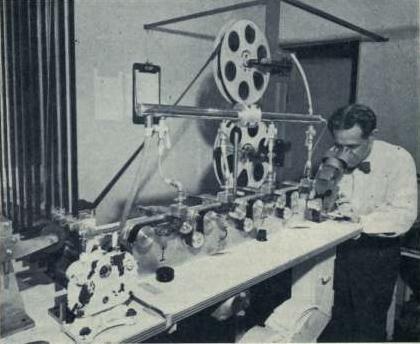
ref: The Journal of the Society of Motion Picture and Television Engineers Vol 62 Jan-June 1954
For those who have never seen a mag stiping plant, here is one from the early mag sound era.
It's easy to see why the costs of mag striped prints were so expensive, but as far as sound quality goes the improvement was well worth the extra expenditure.
Posted by Gordon McLeod (Member # 33) on 12-30-2010, 05:45 PM:
considering that the ORC and Kodak engineers moved to SDDS when CDS was dropped would explain the similarities
Posted by Gordon McLeod (Member # 33) on 12-30-2010, 08:03 PM:
Also as of last year there was still to labs that would do limited stripping of prints
but considering the number of recorders that have been showing up on ebay the sounding may be a bigger issue than striping
Posted by Sean Weitzel (Member # 244) on 12-31-2010, 12:45 AM:
The CDS bitrate and track photography created their own problems at the time, but the other big issue was the electronics in the processor. The processor was essentially a miniature mainframe computer with a huge backplane and numerous large plug in cards filled with microcomputer components. I could see how this setup could create immense heat. Coupled with inadequate cooling which is laughable from what I see with the example I have here, it's not a mystery that hard driven components failed early.
I believe it will be rather simple to repair the power supply, but what concerns me is the onboard firmware. There has been a few postings over the years that seem to indicate the the CDS processor has firmware that is maintained by coin cell batteries and once those die the programming is gone. I have looked very carefully at what I have here and I don't see any battery or other power cell anywhere on the boards. Hopefully if I get a good supply the system will power up and we'll be good to go, but we won't know until the power supply is functional.
One other challenge is that the CDS reader featured a drum coated with a thin rubber layer that the film drove - kind of like a pinch roller in a tape deck. In both of the readers I have here, the rubber has turned to a sticky goo and will have to be removed. The question that remains is whether or not the film can drive a bare steel drum and read the CDS track adequately.
Posted by Michael Coate (Member # 757) on 12-31-2010, 01:14 AM:
quote: Daniel Schulz
One of the big lessons that CDS taught was the importance of existing alongside the analog tracks, both for failsafe and also to eliminate the need for dual inventory of prints. There was an infamous instance of the CDS player overheating for a Days of Thunder premiere and sinking the presentation.
quote: Variety, July 4, 1990
"New Digital Sound System Snafus At 'Thunder' Sites"
A glitch in a heralded new sound system forced several theaters to pull prints of "Days of Thunder" over the weekend.
Officials of the joint venture of Eastman Kodak and Optical Radiation Corporation could not be reached for an explanation of the failure of their Digital Cinema Sound [sic]. But film's distrib, Paramount, confirmed that the much-advertised digital prints were pulled from at least three theaters.
Key houses lost were Mann's Chinese Theater in Hollywood and its National in Westwood, and Pacific's Cinema Theater in Corte Madera in Northern California. It's understood the same problem may have developed at Pacific's Lakewood house, but no one at the exhibitor's office could confirm.
A Cinema staffer said some "Thunder" dialog began dropping out in the sixth screening after the Wednesday opening. Par quickly arranged for the houses to switch to 70mm Dolby prints.
Digital Cinema Sound [sic] also is used on "Dick Tracy," but a Buena spokesman said that film has had no troubles, suggesting to some that the "Thunder" blunder may have been due to the rush to get pic ready for its opening.
Posted by Brad Miller (Member # 2) on 12-31-2010, 02:13 AM:
quote: Sean Weitzel
The question that remains is whether or not the film can drive a bare steel drum and read the CDS track adequately.
For 35mm, I'll bet if you pull the film through an SDDS 3000 series reader before it hits the CDS reader, I'll bet you it will work just fine. For 70mm...not so much.
Posted by Bobby Henderson (Member # 840) on 12-31-2010, 02:39 PM:
quote: Sean Weitzel
I believe it will be rather simple to repair the power supply, but what concerns me is the onboard firmware.
This issue is one example of why I am wondering how hard it would be to put together some other kind of setup that could actually play the CDS sound data off one of those film prints.
That existing CDS gear could be "dead" for a number of reasons. Any piece of computing or electronics gear is going to eventually die for various reasons. Certain pieces of hardware break or wear out over time through use. At some point you can't buy replacement parts to get it fixed. Then you're forced to buy something new.
It may be possible to revive CDS through use of software in a computer system and a more up to date film reader that works much better than the old circa 1990 models. Some of this reminds me how people are using MAME to play old coin operated video games without the actual game cabinets. Of course, this approach isn't quite the same as having a fully functional CDS system. But the audience wouldn't know the difference.
SDDS is already a near-dead format, at least in terms of hardware. What does someone do if an existing reader or piece of hardware in the processor breaks? I'm not sure if you can still buy any of that stuff brand new. Probably have to cannibalize parts of another SDDS unit. The same may hold true for first generation DTS players. I doubt Toshiba still makes those 2X speed SCSI CD-ROM drives. What is Datasat able to do to support three drive DTS-6D machines, or the 6AD cinema processor? Can someone repair a broken Dolby Digital DA-10 system from 1992?
Commercial movie theaters have been transitioning to digital cinema for a few years now. That's putting a lot of Dolby Digital, DTS and SDDS players out of service. Eventually those three lossy compressed digital formats will be "dead." Many thousands of movies with film prints encoded in those formats will still be around and be playable if there is any compatible hardware to do the job.
Wouldn't it be cool to have a system that could play all of those audio formats? One reader that can see all the digital audio formats for 35mm and 70mm. One piece of rack gear that can process all the audio codecs. It sounds silly at first, but CDS is dead, SDDS is near dead, Dolby Digital and DTS are still viable but their parent companies have shifted focus away from 35mm/70mm to digital cinema efforts, etc. The various patent holders could cooperate to allow a new, even more precise film reader to be developed. It might be possible to use a computer to process the audio and then somehow send it to a cinema processor. The idea of using a computer instead of a dedicated piece of rack mounted gear is that it could cut costs and also allow the all purpose system to have a much longer life span. When one computer breaks and can no longer be serviced, just replace it and reinstall the software.
I don't know. It's kind of fun thinking about those possibilities. But the obstacles in making such hardware are obvious. And then you have the movie studios who own the rights to the movies. If you're running a revival house and want to play a certain classic title the studio may prefer to just send a digital cinema hard disc or Blu-ray instead of shipping an old 35mm film print.
Posted by Tom Petrov (Member # 1534) on 12-31-2010, 05:59 PM:
quote: Bobby Henderson
. What does someone do if an existing reader or piece of hardware in the processor breaks? I'm not sure if you can still buy any of that stuff brand new.
Any new SDDS product will have parts available till 2014. Anything that is discontiuned will have parts available for 10 after the date of discontinue. The info is on the SDDS.com website in a PDF
Posted by Louis Bornwasser (Member # 3063) on 01-01-2011, 11:47 AM:
fyi: There are no DA-10's; Dolby exchanged them all for DA-20s at no charge. A classy thing to do. Louis
Posted by Edward Havens (Member # 4715) on 01-01-2011, 02:13 PM:
quote: Bobby Henderson
DTS had the philosophy that 6-track audio should be in every neighborhood theater. That gave the company a permanent foothold in the market.
Forgive me for disagreeing, but what got DTS a permanent foothold in the market was cost and George Lucas. DTS was half the cost of Dolby Digital and SDDS, and when Lucas demanded theatres be equipped with digital sound in order to book the Star Wars Special Editions in 1997, that's when they exploded. Houses in smaller markets like the one I was managing at the time (one of two theatres in a town of 44,000) went with the least expensive option.
Strangely, Lucasfilm didn't inspect the theatres it demanded digital sound from, and my competitor in town bought a $350 Dolby Home Theatre system, set it in their booth and told Lucasfilm they had set up a Dolby Digital system, stealing Jedi away from my theatre. Not set the home theatre system up, but just set it in the booth. Still boxed up. Never installed. But then, they went out of business less than a year later, so they were never that much of a threat to begin with.
Posted by Frank Angel (Member # 248) on 01-01-2011, 04:57 PM:
quote: Louis Bornwasser
fyi: There are no DA-10's; Dolby exchanged them all for DA-20s at no charge. A classy thing to do.
Yah, but Louis, they discontinued the DA-20s, effectively putting everyone else who made a processor out of business. Either you get a CP650 & > or you don't play SRD. Not so classy; in fact, a pretty shabby.
Posted by Tom Petrov (Member # 1534) on 01-01-2011, 05:20 PM:
quote: Edward Havens
Forgive me for disagreeing, but what got DTS a permanent foothold in the market was cost and George Lucas. DTS was half the cost of Dolby Digital and SDDS, and when Lucas demanded theatres be equipped with digital sound in order to book the Star Wars Special Editions in 1997, that's when they exploded. Houses in smaller markets like the one I was managing at the time (one of two theatres in a town of 44,000) went with the least expensive option.
That is not true at all. George Lucas had nothing to do with getting DTS in every cinema.
Universal Pictures was the driving force. The only way to get digital sound for a Universal Pictures release was with DTS. I think the first four years, Universal was exclusive to DTS. This changed later on.
So for example. Jurassic Park: The Lost World was a DTS only movie. If you wanted to play it and play it in digital, you had to get a DTS player.
I am not 100%, but Warner Bros was the first studio to support all three sound formats.
George Lucas was good at getting older THX theatres re-certified. At least it was required for the THX cinema I worked at to get Star Wars Episode I.
Posted by Bobby Henderson (Member # 840) on 01-01-2011, 06:02 PM:
quote: Edward Havens
Forgive me for disagreeing, but what got DTS a permanent foothold in the market was cost and George Lucas. DTS was half the cost of Dolby Digital and SDDS, and when Lucas demanded theatres be equipped with digital sound in order to book the Star Wars Special Editions in 1997, that's when they exploded.
That's incorrect on many points.
Like Tom said, George Lucas had nothing to do with DTS. Further the SE versions of Star Wars were released years after DTS cemented its position in the marketplace. Supposedly Lucas wanted his new Star Wars special editions playing only in THX certified theaters. The only thing he was able to do was give THX certified theaters priority in booking the films.
If George Lucas wanted to give DTS any sort of priority he could have released his movies exclusively in DTS. However, by that time quad format SR/SRD/DTS/SDDS prints were being used more and more often. Even Sony and Universal dropped their exclusive use of SDDS and DTS respectively to go quad format.
Steven Spielberg (not George Lucas) and Universal Studios backed DTS either in late 1992 or early 1993. DTS' debut with Jurassic Park put nearly 900 systems into theaters. That dwarfed the install base of Dolby Digital systems. DTS carved out an even larger lead over the next three years. Dolby Digital made up that ground and eventually overtook DTS in worldwide install numbers after they developed the CP500 integrated cinema processor/Dolby Digital player.
Cost was a big difference between Dolby Digital and DTS. The first Dolby Digital systems were priced at over $20,000. In the DTS roll out the DTS-6 players cost $3500 and the DTS-S systems cost only $2500. The regular price for a DTS player was $5900. I think DTS ran the pricing special again for the release of Stargate. Dolby Digital cut its price in half with the release of the DA-20 system. When the CP500 debuted in the late 1990s it had a cost advantage with integrating a cinema processor and Dolby Digital player into one unit. Dolby initially only planned for Dolby Digital to be used in major theaters in big cities; the system was originally priced that way. DTS saw the situation differently. Dolby was forced to answer DTS' challenge rather than play things conservatively.
quote: Tom Petrov
I am not 100%, but Warner Bros was the first studio to support all three sound formats.
I think Fox was actually the first to do it with Die Hard With A Vengeance. Warner Bros. had released a few movies with Dolby Digital and DTS in 1994, but shifted to supporting Dolby Digital and SDDS until 1996 when Twister was released. Then they went quad format.
Posted by Joe Redifer (Member # 3) on 01-01-2011, 07:41 PM:
I can't recall with 100% accuracy, but I'm pretty sure Lost Workd had Dolby Digital on the print. JP 1 did not, however.
Posted by Bobby Henderson (Member # 840) on 01-01-2011, 08:01 PM:
I'm pretty sure The Lost World was DTS only. The Boxer was the first film Universal studios released with multiple digital audio formats on the same print (DTS & SDDS). That was near the end of 1997. In Feb. 1998, Blues Brothers 2000 was Universal's first quad format release and their first to support Dolby Digital since their release of Dragon in May of 1993.
Posted by Joe Redifer (Member # 3) on 01-01-2011, 08:28 PM:
Yeah, I may be a bit confused about things. I do remember running the Lost World trailer synced with DTS strobe lights. But I also remember interlocking the movie in two of our Dolby Digital houses opening weekend. We had movable DTS units, but I recall only having 3 or 4.
Posted by Tom Petrov (Member # 1534) on 01-01-2011, 09:12 PM:
quote: Bobby Henderson
Steven Spielberg (not George Lucas) and Universal Studios backed DTS either in late 1992 or early 1993. DTS' debut with Jurassic Park put nearly 900 systems into theaters.
quote: Bobby Henderson
I'm pretty sure The Lost World was DTS only. The Boxer was the first film Universal studios released with multiple digital audio formats on the same print (DTS & SDDS). That was near the end of 1997. In Feb. 1998, Blues Brothers 2000 was Universal's first quad format release and their first to support Dolby Digital since their release of Dragon in May of 1993
Lost World was DTS exclusive. And the second big wave for install was the Lost World, to book the Lost World, theatres in most markets were required to install DTS. This was the new system without the CD Rom caddies and the new ones that the three disc drives.
We installed four additonal dts units the night before JP2 opene for a total of 6 prints.
Posted by Joe Redifer (Member # 3) on 01-01-2011, 09:24 PM:
Come to think of it, I do remember getting a DTS 6D for the Lost World trailer as the 2 disc units couldn't handle it. The 6Ds werent required for Lost World, however.
Posted by Brad Miller (Member # 2) on 01-01-2011, 09:38 PM:
I'm almost certain Lost World was dts only. The trailers however did have SRD.
Posted by Ron Curran (Member # 3631) on 01-02-2011, 08:40 PM:
I thought that Fox intended all CinemaScope pictures to have all prints with 4 track mag. Magoptical was introduced to cope with ill-equipped cinemas and to save double inventory. The American Widescreen Museum chronicles the event.
Also, I was so overwhelmed with stereophonic sound in the 1950s that I never noticed any deficiencies such as hiss. When I finally had my own cinema and equipped it with 4 track mag in the 1970s I don’t recall hearing any hiss, so all the early problems had been sorted. However, when Dolby stereo was introduced, people were telling me that it was superior to mag because there was no tape hiss. I thought it was a highly inferior cheap substitute and was saddened to see it overtake mag as a sound format.
One of the joys of mag was that it protected the image from scratches; older prints ran with perfect picture and sound.
Posted by Joe Redifer (Member # 3) on 01-02-2011, 09:00 PM:
How does mag protect the image from scratches?
Posted by Monte L Fullmer (Member # 2797) on 01-02-2011, 10:22 PM:
quote: Ron Curran
I thought that Fox intended all CinemaScope pictures to have all prints with 4 track mag
There was one oddity: "Snow White and the Three Stooges" (1961)
If we remember the wrap bands from Fox that were color coded: Green was flat (the old term was "Regular"), Red was Scope optical, and Black was Scope mag/optical.
..and they also had blue: Scope, optical only, but had CS sprocket (fox) holes. the above "Snow White/Stooges" movie was printed on Eastman stock with the CS sprocketholes.. and I do believe that was the only film that FOX released with this configuration...
quote: Joe Redifer
How does mag protect the image from scratches
Mag striping was like the raised center and edges of a vinyl record: the striping, being an add-on substance, actually would keep the two layers of film from laying against each other..
Posted by Sean Weitzel (Member # 244) on 01-02-2011, 11:04 PM:
Were there any prints ever released with SDDS as the only digital track? I have seen a print of the re-release Willy Wonka and the Chocolate Factory that had only an SRD track... What about DTS only?
Posted by Joe Redifer (Member # 3) on 01-02-2011, 11:05 PM:
There are tons of SDDS-only movies. Tons of DTS only as well (even more so). In fact, I bet if you look above you may find secret information about prints of Jurassic Park: The Lost World.
Posted by Frank Angel (Member # 248) on 01-02-2011, 11:25 PM:
quote: Ron Curran
I thought it was a highly inferior cheap substitute and was saddened to see it overtake mag as a sound format.
You thought exactly right, Ron. The difference between DISCRETE tracks as opposed to MATRIXED tracks was/is palpable. Going matrix, that alone was a significant step backwards. The matrix is incapable of playing back audio in one specific channel without it bleeding into the other channels.
Had Dolby abandoned the insistence of including a surround track and designing a system as a discrete, two track stereo system with a derived center, they could have avoided all that matrixing nonsense and time delay trickery which was only accurate for very limited seating locations. If they had settled on a discrete, two channel system (with a derived center), then if the mix required a sound to emanate from JUST the left channel or JUST from the right channel it could do that without the compromises a matrix design required. It is because their 4.1 system cannot do that (mag, of course, can), that Dolby mixes are relegated to having dialog locked to the center channel only, lest dialog wind up coming from behind the audience with a surround bleed. Dolby matrix cannot effectively localize dialog to the image on the screen. Dolby was quick to spin this inability as a positive, claiming that localized dialog was "distracting." Bullshit.
Like Ron, we played practically every 4trk mag release. Hiss never was even a minor issue. We have a Conservatory of Music attached to our facility and a TV Center populated by some very talented and discerning audio engineers,many of them AES, SMPTE and NARAS members and when I installed our mag system I was just a green pup and enlisted their help in calibrating and aligning the system. We did hours of testing and listening to both test loops and reels of film -- 2001, to be exact -- and the final sound was clean and hiss so unobtrusive that it could not be heard over the ambient noise contained on the film soundtrack.
Also remember, mag predated noise reduction by a decade. If mag had the advantage of Dolby A applied to the tracks of 35mm 4trk mag, hiss would be below the noise floor of the preamps themselves. Hum is more of a problem than hiss.
And say what you will about 4trk mag, but a study was done at some point and published in the SMPTE Journal that found that the smaller Fox sprocket holes ("Fox holes") actually wore better than the larger standard holes. When I heard that, it sounded counter-intuitive, but there it was and I found it odd then that the industry never changed over completely to the CinemaScope print configuration. As far as I know, a majority of theatres in the country replaced standard sprockets with the Fox sprockets even if they didn't have stereo equipment.
And yes -- less scratches as the film did not have as much contact with surrounding layers. A reel of striped 35mm and a reel of non-striped film of the same length would fill the reel to a greater diameter. That is why when 8mm and 16mm film is striped for mag on one edge they have to apply a "balance" stripe on the opposite side so the film will lay flat and evenly on itself. Without the balance stripe, a full reel would be a mess.
Posted by Ron Curran (Member # 3631) on 01-02-2011, 11:26 PM:
The mag tracks formed rails so at least one side of the print was running on rails instead of the film proper if a print was misthreaded.
At the time we ran mostly subrun and the only prints that were clear of scratches were mag prints.
Posted by Michael Coate (Member # 757) on 01-03-2011, 12:11 AM:
quote: Tom Petrov
I am not 100%, but Warner Bros was the first studio to support all three sound formats.
quote: Bobby Henderson
I think Fox was actually the first to do it with Die Hard With A Vengeance. Warner Bros. had released a few movies with Dolby Digital and DTS in 1994, but shifted to supporting Dolby Digital and SDDS until 1996 when Twister was released. Then they went quad format.
Over the years I've kept a journal and a lot of notes, especially during the 1990s when digital sound was introduced. Digging into that data, I'd like to present the following:
I think Bobby is correct about Fox and Die Hard With A Vengeance being the first film to be released with all three digital audio formats. I'm not so certain that it was released with a single inventory of quad-format prints, though; it may have been multiple inventory. What was the first quad-format, single-inventory release? Perhaps Twister as mentioned. But...there were a handful of other releases with all three digital formats in between the May '95 release of Die Hard and the May '96 release of Twister, including, if my data is correct, Fox's Strange Days and New Line's Mortal Kombat.
Continuing on the subject, I thought it might be interesting to identify the first film each of the major studios offered with a digital soundtrack followed by the first quad release to illustrate how much time elapsed between each. The purpose of this, of course, would be to point out how long each studio stuck to their idiosyncratic ways and/or political preferences in regard to supporting one (or two) formats before conceding that releasing in quad format was practical and beneficial for everyone involved.
The first entry is the studio's first release with any digital sound. The second entry is same studio's first quad release. The data concerns only the United States and Canada. Test releases have not been included, nor have any Cinema Digital Sound releases from 1990-91 been included.
BUENA VISTA
July 1992 (Dolby Digital) - Honey, I Blew Up The Kid
June 1997 - Con Air
COLUMBIA
November 1992 (Dolby Digital) - Bram Stoker's Dracula
July 1997 - Air Force One
DREAMWORKS
September 1997 (Quad format from the get-go) - The Peacemaker
MGM/UA
May 1994 (DTS) - That's Entertainment III
December 1995 - Cutthroat Island
NEW LINE
August 1993 (Dolby Digital) - Jason Goes To Hell: The Final Friday
August 1995 - Mortal Kombat
PARAMOUNT
November 1993 (DTS) - Flesh & Bone
May 1996 - Mission: Impossible
TRI-STAR
October 1993 (SDDS) - Rudy
May 1998 - Godzilla
TWENTIETH CENTURY FOX
December 1992 (Dolby Digital) - Toys
May 1995 - Die Hard With A Vengeance
UNIVERSAL
January 1993 (Dolby Digital) - Matinee
February 1998 - Blues Brothers 2000
WARNER BROS.
June 1992 (Dolby Digital) - Batman Returns
May 1996 - Twister
Posted by Bobby Henderson (Member # 840) on 01-03-2011, 09:20 AM:
Die Hard With A Vengeance was a dual inventory release. One set of prints was SRD/DTS; the SDDS prints were separate. I first saw the movie at the AMC Grand 24 in Dallas (in SDDS) then visited Rich Petersen at his Casa Linda 4 theater and watched parts of it again (and all of Crimson Tide) in Dolby Digital. His Die Hard III print was SRD/DTS.
Strange Days may have been single inventory, but a print I personally saw of it here in Lawton did not have SDDS audio on all of its reels. I suspect Fox may have had to send out replacement reels to a number of theaters. It would be interesting to know if they made a separate inventory of SDDS prints.
Edit: I almost forgot I posted frame images years ago about the Strange Days quad format glitch:

Posted by Edward Havens (Member # 4715) on 01-03-2011, 09:36 AM:
Gentlemen, read my words again. I never said Lucas had anything to do with DTS. I said Lucas helped DTS to get a foothold in cinemas when he demanded digital sound for any theatre that wanted to play the Star Wars Special Editions in 1997. And it is true. Let's follow the steps...
1) Lucas demands all theatres that want to play the Special Editions get THX certified.
2) There is a mad rush to get theatres THX certified, only for most theatres (especially older theatres with balconies or with balconies that have been converted to additional auditoria) to discover there is nothing they can do to get certified.
3) Lucas demands all theatres that want to play the Special Editions get some kind of digital sound system.
4) Cheap theatre owners, looking to make more money without spending a lot, overwhelmingly choose DTS over DD or SDDS, due to its incredibly low sticker price in comparison to the other two systems.
Lucas doesn't benefit directly from the installation of any one specific digital sound system. He simply says "If you want this, you must have that," leaving it to the individual theatre owners to decide for themselves which that they get.
Posted by Bobby Henderson (Member # 840) on 01-03-2011, 10:07 AM:
Edward, the SE versions of Star Wars did not help DTS gain a foothold in commercial movie theaters. DTS already had a GIGANTIC foothold in the market. The SE versions of Star Wars were released four years after DTS was introduced.
DTS was first used commercially in 1993. At its debut it rolled out onto nearly 900 screens. By 1997 DTS was installed in thousands of theaters around the country. At the time DTS was the overwhelming market leader. The format didn't need any helping hand from Star Wars. DTS was already securely established in movie theaters. SDDS was rolling out onto lots of screens and was in 2nd place on screen count in the US at that time, thanks to volume deals made with AMC, United Artists theaters and Cinemark. Dolby brought out the CP500 and slowly began closing the gap. In 1997 the main contest between DTS and Dolby was in home theater with Laserdisc and then with DVD.
Jurassic Park is the movie that gave DTS its foothold in the market. Star Wars: SE did not do that at all; it was a neutral, quad format release that gave no favoritism to any format -other than giving THX theaters priority on bookings.
BTW, I disagree about there being any "mad rush" to get theaters THX certified in 1997. If anything, THX was already suffering a serious decline. Mid 1995 marked the beginning of the stadium seated theater building boom. The overwhelming majority of new theaters built since then have not been THX certified. Star Wars: SE made virtually no difference with that situation. Worse still, many traditional seated theaters were closed in the mid to late 1990s due to competition from the new stadium seated "megaplex" builds. Some great theaters, such as the GCC Northpark 1-2 in Dallas, one of the original 1983 THX debut sites, fell as causalities to the stadium seated theater building boom. IMHO, when theaters like the Northpark 1-2 were closed THX lost most of its relevancy as well.
Posted by Michael Coate (Member # 757) on 01-03-2011, 10:55 AM:
If my last post didn't bore the shit out of you this one surely will. It's a year-by-year comparison (for the decade of the 1990s) of first-run U.S. theatrical releases in 70mm vs. those released with digital sound. You can figure out for yourselves what the numbers mean.
1990
70mm: 23
Digital: 3
1991
70mm: 11
Digital: 4
1992
70mm: 9
Digital: 10
1993
70mm: 8
Digital: 41
1994
70mm: 3
Digital: 85
1995
70mm: 1
Digital: 119
1996
70mm: 2
Digital: 161
1997
70mm: 1
Digital: 190
1998
70mm: 0
Digital: 211
1999
70mm: 0
Digital: 242
Posted by Gordon McLeod (Member # 33) on 01-03-2011, 11:29 AM:
There was no requirement to get THX certified for SE only if you were a THX house it had to be recertified
But he required that almost all theatres have a TAP alignment done as a condition there is a big difference between a TAP alignment and HX certification
Posted by Steve Guttag (Member # 268) on 01-03-2011, 12:04 PM:
Alright Michael...lets get to the crux of this DTS thingy.
What are the stats of DTS installations for the '90s. Lets see if there is a "blip" in '97 as predicted by others. You might also want to list the other two digitals as a comparison.
-Steve
Posted by Manny Knowles (Member # 1171) on 01-03-2011, 08:16 PM:
quote: Frank Angel
If they had settled on a discrete, two channel system (with a derived center), then if the mix required a sound to emanate from JUST the left channel or JUST from the right channel it could do that without the compromises a matrix design required.
How would you propose they "derive" this center channel without a matrix?
If you are alluding to a "phantom" center, the problem is that the effect only holds up in the "sweet spot." If you not equidistant between left and right, then the primacy effect (law of the first arriving wavefront) takes over, and you perceive the sound as coming from the speaker nearest to you. This is why there has to be an actual center channel loudspeaker.
Posted by Steve Guttag (Member # 268) on 01-03-2011, 09:04 PM:
The truth in the matter is that Dolby DID just have two discrete tracks with a derived Center...no surround. It was the INDUSTRY that forced the surround issue.
Look at the CP100...It started without an optical surround.
The surround channel, when it came on line, was via a Surround Adapter. I believe it was the Cat 82 that was the first SVA decoder in the CP100. The Cat 116 (surround decoder) lived in the SA1-SA3.
CP50s used the Cat 110 to "derive" a Center. It was later when the Cat 116 came along, that the surround channel was added to the SVA "matrix" and it wasn't really a matrix in the sense we have today. There was minimal steering between L/R and Center (more like ducking) and nothing for steering to the surrounds...it was just an off-the-shelf QS-Matrix decoder (from the Quad days of phonograph records) with a modified "B-type" decoder from Dolby to keep the hiss/noise down in the surrounds. The delay was to keep the leakage in the surrounds from being apparent using the "Haas effect."
It really wasn't until the Cat 150 debuted that we have the SVA matrix that most would recognize today. At that point, the sound can be steered to any desired channel. Over the years, the ability to provide a more discrete matrix, though still not a true discrete mix where one can have different, unique signals coming out of the four channels with full fidelity and no leakage.
-Steve
Posted by Frank Angel (Member # 248) on 01-03-2011, 10:06 PM:
Only problem is, even with the best matrix, and I think the Panastereo comes closest to mimicking discrete channels, if the sound designer actually demands that unique sounds emanate from extreme locations within the soundfield, what happens is the apparent stereo separation collapses and the unique sounds don't stay in the corners of the room.
Dolby themselves admit this and even demonstrated the effect when they unveiled Dolby SRD at a NY SMPTE Meeting when SRD was ready to launch.
The Dolby moderator first played four individual sounds -- piano, violin, male dialog and female dialog. They were played individually in only the left, center, right and surround channels. The matrix did indeed keep them fairly well located in their desired positions as he played each one, one at a time in their respective locations. But then for the second part of the demo, he began with one sound in only the left channel, then added each "voice" until all four were playing simultaneously. The effect was that as each voice was added, it became more and more difficult to localize each sound. When all four were playing, their locations became indistinct, almost like they were now all coming from somewhere near the center of the theatre. The moderator admitted this was a serious limitation of any matrix and the sound designer had to be aware of it and try to avoid such sound configurations, at least not for any extended time.
Next he played the same demo with the same voices (plus adding a fifth -- I think it was a flute) via SRD and of course they stayed rock steady, locked into the four corners of the soundstage. And he rightly lauded the fact that Dolby Digital now allowed the sound designer the freedom to place sounds in any location he pleased without fear of compromising localization.
We were all duely impressed with digital. But of course I had to quip that, except for the split surrounds, the sound designer had that same freedom with 4 channel mag as well -- that even got a smattering of applause. I followed up asking if he thought given what digital now allowed, would they then go back to localized dialog to follow the actors, and he said it all depended on the sound designer; they could if they wanted to. Someone in the audience added, "Depends if there are any left who still know how to do it!"
Posted by Manny Knowles (Member # 1171) on 01-03-2011, 10:52 PM:
quote: Frank Angel
Next he played the same demo with the same voices (plus adding a fifth -- I think it was a flute) via SRD and of course they stayed rock steady, locked into the four corners of the soundstage. And he rightly lauded the fact that Dolby Digital now allowed the sound designer the freedom to place sounds in any location he pleased without fear of compromising localization.
Nice to know that it's possible but, still, the funny thing is that I've never even once seen a movie where that was even remotely necessary.
Studios have, to my ear, expressed a far greater interest in making the most (too much?) out of the extra headroom that digital affords. (Case in point: TASA)
The better point, though, is that what I said (much) earlier in this thread applies here also - Dolby's matrix solution provided a much-improved sonic experience for neighborhood theatres. Without it, most of us would've heard Star Wars -- and so many other great-sounding movies -- in mono.
There was NEVER a chance that every theatre would have 70mm. Never!
By ignoring the **intended** application of the technology, you are not comparing apples to apples.
Part of the problem with panning dialogue is that a movie will live out most of its years on video - i don't know about you but MY left/right speakers are not behind my screen. I don't want voices of on-screen characters emanating from an off-screen point.
Posted by Tom Petrov (Member # 1534) on 01-03-2011, 11:29 PM:
quote: Gordon McLeod
if you were a THX house it had to be recertified
quote: Edward Havens
1) Lucas demands all theatres that want to play the Special Editions get THX certified.
Not true at all. My theatre was former THX and was not re-certified for Star Wars SE.
It was re certified for the release of Episode I complete with Dolby EX
quote: Bobby Henderson
In 1997 the main contest between DTS and Dolby was in home theater with Laserdisc
It wasn't much of contest. DTS really had no chance as it was generally too expensive for most laserdisc fans.
At the time, laserdiscs such as Daylight, Jurassic Park, The Jackal, Out of Sight, Lost World etc were release in Dolby Digital even if it was a DTS only in theatres.
Posted by Bobby Henderson (Member # 840) on 01-03-2011, 11:36 PM:
quote: Manny Knowles
Part of the problem with panning dialogue is that a movie will live out most of its years on video - i don't know about you but MY left/right speakers are not behind my screen. I don't want voices of on-screen characters emanating from an off-screen point.
The center channel isn't behind most home TV screens either, rather it's usually above or below. Maybe I'm splitting hairs.
The decades long practice of locking dialog into the center channel is more of a convention rather than any real rule. And that convention can help speed up the process of mixing a 5.1 channel film soundtrack which is often produced very late in the production, perhaps a couple or so weeks or maybe only a few days before the movie hits theater screens.
Sound designers could use the modern editing/mixing tools available to them right now to image dialog left or right of center and even pan it across the screen. Most home 5.1 setups have the speakers placed reasonably close together. Various "fly by" surround panning effects often work just fine in a home theater setup. Why should dialog panning between three speakers near a TV set not be able to work?
What's really funny is some 5.1 mixed movies will place dialog in the surrounds, but still stick with locking the dialog on the front stage in the center channel. Weird.
quote: Tom Petrov
It wasn't much of contest. DTS really had no chance as it was generally too expensive for most laserdisc fans.
Huh? First of all Laserdisc was very much a niche market product, not a mainstream format like DVD grew to be. Most LD collectors weren't in the penny pinching crowd.
DTS on LD wasn't really anymore expensive than Dolby Digital. If you had a Laserdisc player with a standard digital output DTS Laserdiscs would have played just fine. An outboard DTS decoder was required. But Dolby Digital required the same thing. Further Dolby Digital required LD players with a compatible RF output. DTS had a pretty respectable number of Laserdisc releases so I wouldn't regard it as a failed format or not having had much of a chance against Dolby Digital.
Posted by Tom Petrov (Member # 1534) on 01-03-2011, 11:59 PM:
quote:
Huh? First of all Laserdisc was very much a niche market product, not a mainstream format like DVD grew to be. Most LD collectors weren't in the penny pinching crowd.
DTS on LD wasn't really anymore expensive than Dolby Digital. If you had a Laserdisc player with a standard digital output DTS Laserdiscs would have played just fine. An outboard DTS decoder was required. But Dolby Digital required the same thing. Further Dolby Digital required LD players with a compatible RF output. DTS had a pretty respectable number of Laserdisc releases so I wouldn't regard it as a failed format or not having had much of a chance against Dolby Dig
What do you mean huh? Dolby Digital on laserdiscs out numbered 7-1 compared to DTS. Also the cost of DTS laserdisc were almost ALWAYS more money than the same movie on Dobly Digital. It was common for DTS to be a premium over the Dolby.
The other big issue for DTS was that it almost alway required an external decorder which meant you had to have an receiver that had a 6 channel in. 6 channel in was very rare in 1995-1997 (thus was yet around). And if you had one, it was usually very top-end.
It was rare to find a DTS/RF/Dobly Digital machine early as most already had adopted DoblyRF/DVD with no 6 channel in.
Now Dolby had a huge advantage, a lot of Dolby units were DVD/SAT Dolby Digital ready in 1995 (can't remember the EXACT date). By the time DTS really entered laserdisc it was all over as most folks already owned RF laserdisc players (which required and upgraded machine from earlier unit), a Dolby Digital RF machine (which always carried an on board DVD input) and rarely would these machines have 6 channel in.
The cost of getting DTS laserdisc was way too much for the average laserdisc consumer.
Optical laserdisc out machines were NEVER cheap. To get an RF/Optical out machine, $800 was the minimum if I remember correctly.
Almost in all circumstances, when DTS enter the laserdisc market, you required a very high dollar upgrade to your sound equipment which was already done long ago with Dolby Digital LDs. DTS entered very late in the game.
You can look at some of the original pricing on this website below.
Dolby/DTS LDS
Posted by Joe Redifer (Member # 3) on 01-04-2011, 12:59 AM:
quote: Tom Petrov
The other big issue for DTS was that it almost alway required an external decorder which meant you had to have an receiver that had a 6 channel in.
The hell are you talking about? I've never even seen an external DTS decoder, though I'm not saying they didn't exist. The first receiver I bought that was 5.1 capable had coaxial in and RF in. It did the Dolby Digital decoding itself as well as the DTS decoding. DVDs weren't yet around at the time. The next receiver that I bought did not have RF in, but it still did the DTS and Dolby Digital decoding itself. There weren't too many receivers with RF inputs. You had to buy an external RF demodulator to get proper Dolby Digital from LaserDisc on most receivers.
Posted by Tom Petrov (Member # 1534) on 01-04-2011, 01:05 AM:
quote: Joe Redifer
The hell are you talking about? I've never even seen an external DTS decoder, though I'm not saying they didn't exist. The first receiver I bought that was 5.1 capable had coaxial in and RF in. It did the Dolby Digital decoding itself as well as the DTS decoding. DVDs weren't yet around at the time. The next receiver that I bought did not have RF in, but it still did the DTS and Dolby Digital decoding itself. There weren't too many receivers with RF inputs. You had to buy an external RF demodulator to get proper Dolby Digital from LaserDisc on most receivers.
If you wanted DTS/RF/DVD all internal. The very first unit was $1300, that was 1997. There were a ton of RF machines.
quote: Joe Redifer
Dolby Digital decoding itself as well as the DTS decoding. DVDs weren't yet around at the time.
There was no way you had a RF in/DTS in without having a DVD in. .
Posted by Joe Redifer (Member # 3) on 01-04-2011, 01:06 AM:
I wouldn't say "a ton". Like I said, RF inputs were dropped fairly quickly. The price of the receiver is irrelevant. Like Bobby said, LD owners were not penny pinchers.
Posted by Michael Coate (Member # 757) on 01-04-2011, 01:06 AM:
quote: Steve Guttag
Alright Michael...lets get to the crux of this DTS thingy. What are the stats of DTS installations for the '90s. Lets see if there is a "blip" in '97 as predicted by others. You might also want to list the other two digitals as a comparison.
Okay, here goes...
INSTALLATIONS AT FORMAT LAUNCH
Dolby Digital (June 1992): 11
DTS (June 1993): 876
SDDS (June 1993): 4
INSTALLATIONS AFTER ONE YEAR
Dolby Digital: 314 (U.S.) / 671 (worldwide)
DTS: 1,505 / 2,089
SDDS: 4 / 4
INSTALLATIONS AS OF DECEMBER 1994
DD: 382 / 890
DTS: 1,821 / 2,881
SDDS: 336 / 389
INSTALLATIONS AS OF DECEMBER 1995
DD: 722 / 1,978
DTS: 3,310 / 5,725
SDDS: 1,320 / 1,581
INSTALLATIONS AS OF DECEMBER 1996
DD: 1,701 / 4,607
DTS: 4,527 / 7,921
SDDS: 2,572 / 3,153
********
INSTALLATIONS AS OF FEBRUARY 1997
(The STAR WARS Special Edition re-issues began in January '97)
DD: 1,907 / 4,872
DTS: 4,720 / 8,173
SDDS: 2,646 / 3,223
********
INSTALLATIONS AS OF DECEMBER 1997
DD: 2,930 / 7,775
DTS: 6,624 / 11,409
SDDS: 3,944 / 4,687
INSTALLATIONS AS OF DECEMBER 1998
DD: 7,378 / 17,782
DTS: 8,543 / 15,301
SDDS: 5,357 / 6,100
INSTALLATIONS AS OF DECEMBER 1999
DD: 11,210 / 23,871
DTS: 9,653 / 18,416
SDDS: 5,911 / 7,292
And, for comparison, Cinema Digital Sound (CDS), during its brief run during 1990-91, never made it past 50 installations.
Posted by Tom Petrov (Member # 1534) on 01-04-2011, 01:11 AM:
quote: Joe Redifer
I wouldn't say "a ton". Like I said, RF inputs were dropped fairly quickly. The price of the receiver is irrelevant. Like Bobby said, LD owners were not penny pinchers.
RF was around for about 5 years. Still is offered in one very high end receiver. DTS LD was about a 12-15 month failure.
There were many cheap LD players in the mid 90s that only had analog out and composite without S-Video.
Only high end LDs owners who were into DD/DTS were not penny pinchers. You couldn't afford to be as the tech was pricey.
Posted by Joe Redifer (Member # 3) on 01-04-2011, 01:17 AM:
Any LD player with a digital output could play DTS LDs. You didn't need a special player, unlike Dolby Digital. Most home players had the SPDIF output. The only ones (at the time) that didn't were ones used in non-home theater settings like when we ran movies via LaserDisc at the theater (with changeovers). Things may have been different in wacky Canada, but that's how it was here in Denver (which is better than Canada).
Posted by Tom Petrov (Member # 1534) on 01-04-2011, 01:20 AM:
quote: Joe Redifer
Any LD player with a digital output could play DTS LDs. You didn't need a special player, unlike Dolby Digital. Most home players had the SPDIF output. The only ones (at the time) that didn't were ones used in non-home theater settings like when we ran movies via LaserDisc at the theater (with changeovers). Things may have been different in wacky Canada, but that's how it was here in Denver (which is better than Canada).
Optical out players always started at a lot more than a standard LD player. Also, there were many mid-level LDs players with RF out and no opitcal out. To get both was an easy $800.
Going LD Dolby Digital was always cheaper than DTS. When DTS came around you pretty much required for a upgrade to your receiver which was never cheaper, or you had to get an external 6 channel DTS decorder with a 6 in receiver, the DTS decoder was alway uber-high end.
Around 1998 DTS receiver became more prevalent, these were for DTS DVD/LD, but by they, LD DTS was done.
Posted by Joe Redifer (Member # 3) on 01-04-2011, 01:23 AM:
I've never seen one with an RF out but no digital out. That would just be insane!
Anyway, I've never heard of anyone NEEDING an external DTS DAC unless they just didn't want to buy a new receiver and already had one with 6CH analog in (which is what I was arguing about, not the price vs Dolby Digital). Of course the high-end hoity-toity people would definitely buy them because they felt that external peripherals ALWAYS had superior DACs in them. But in no way did you "almost always" need some sort of external decoder for DTS like you said. I'd change "almost always" to "barely ever" in your post.
Posted by Tom Petrov (Member # 1534) on 01-04-2011, 01:38 AM:
quote:
I've never seen one with an RF out but no digital out. That would just be insane!
There are some. Pioneer 504 comes to mind. There are also a few high-end Elite machines with optical but no RF out.
quote: Joe Redifer
But in no way did you "almost always" need some sort of external decoder for DTS like you said. I'd change "almost always" to "barely ever" in your post
Well done, you've made your point.
Posted by Thomas Hauerslev (Member # 566) on 01-04-2011, 02:30 AM:
70mm Dolby SR prints: http://www.in70mm.com/library/process/dolby/index.htm
Early use of mag sound for cinema use: http://www.in70mm.com/cinerama/archive/sound/index.htm
and finally the picture of 70mm and MGM Lion is mine seen early in this thread ;-)
Dates back to 2005: http://www.in70mm.com/schauburg/2005/reviews/thomas/index.htm
happy New 70mm Year everyone
Posted by Tom Petrov (Member # 1534) on 01-04-2011, 03:20 AM:
quote: Thomas Hauerslev
70mm Dolby SR prints: http://www.in70mm.com/library/process/dolby/index.htm
Thats a lot more 70mm titles than I would of imagined.
Posted by Frank Angel (Member # 248) on 01-04-2011, 04:20 AM:
Manny, funny you should mention the extended dynamic range of the digital over analog optical, because it just so happened that in the very same SMPTE demo I was talking about, they also wanted to demonstrate the wider dynamic range/headroom of the new digital system. To do this, Dolby used a reel of THE FUGATIVE (1993 - Harrison Ford) in SR-D. They played the second reel (I think) -- the one with that massive train crash. I am sure that was meant to impress everyone, but what an embarrassment -- it was WAY too loud. The sound of the screeching metal against metal was excruciating. I mean people were holding their ears it was so painful.
The positive impression the demo made up till then with the great channel separation got totally wiped out with the dynamic range portion of the demo. Thing is, it WAS clean and undistorted....just WAY too loud -- a complaint people have often made about digital sound in theatres.
As for the intended purpose of the matrix technology, I agree -- if it wasn't for Dolby SVA, you are right -- the exponential spread of stereo into local theatres would not have taken place and we would still have the majority of houses playing mono and the very few playing he even fewer 4trk mag roadshow titles. I was just pointing out that with the demise of 4trk 35mm, we did loose discrete channels and that necessitated center dialog pretty much as a universal practice, something I miss. I was in no way denigrating the host of positives that SVA gave us.
Posted by Manny Knowles (Member # 1171) on 01-04-2011, 07:54 AM:
quote: Bobby Henderson
The center channel isn't behind most home TV screens either, rather it's usually above or below. Maybe I'm splitting hairs.
Yeah, you are.
At least the center speaker isn't (usually) above or below by more than a few inches, whereas left/right speakers are often displaced by more than a few feet to either side of the screen edges.
I'd bet almost nobody is going to cluster their LCR speakers to fit under their TV screens to mimic proper theatrical placement. (Even if I was willing to do that, I couldn't. My LCR speakers would still be wider than my TV.)
Posted by Steve Guttag (Member # 268) on 01-04-2011, 08:33 AM:
My left/right speakers are indeed behind my perforated screen ![[Big Grin]](biggrin.gif)
However...what is the argument? Because homes are inferior places to present big screen movies we should deliberately diminish the theatre experience by having a hard-center dialog? How stupid. The home versions often get remixes anyway...have the home version of the mix with the hard center, if you so desire...however, there is often MUCH time between the home and theatrical release as compared to the completion of the film and the theatrical release.
Moving back to the absurd position that somehow George Lucas pushed DTS sales in some manner...
Looking at Michael's information...(only taking into account USA installations)
The DTS increase in sales between 96 and 97 (the time of the Star Wars SE versions), DTS had a small increase of just 4% (193 installations). Dolby Digital, on the other hand, had a larger increase of 12% (206 installations). Dolby was gaining ground on DTS starting in 97.
Lets see if there is the "Lucas Bump" in here. Looking at the 95-96 years. DTS increased 37% (1217 installations)...so, if anything the Lucas "bump" was actually a pot hole for DTS...they did better without the Special Editions the previous year. Note, Dolby was on the rise that year too since they saw a 136% increase in sales or 979 units.
Go back another year (94-95) Dolby and DTS are seeing similar percentage increases Dolby at 89% and DTS at 82% In real numbers, Dolby sold 340 systems to DTS' 1489.
The REAL story was as stated by others...DTS' numbers were huge due to Jurassic Park being released exclusively in DTS AND that DTS was VERY cheap (in comparison to other formats). Furthermore, DTS did an EXCELLENT job of ensuring their players would mate to most any processor on the market. With Dolby, you almost had to have a Dolby processor and, more often than not, upgrade it to mate up. While it was certainly possible to mate a DA10 to another processor...Dolby did not go out of their way to make it easy for you...DTS did.
Several factors have lead to Dolby ultimately surpassing the others in installed systems but it was NOT the Star Wars SE movies. YOUR theatre may have bought a DTS player in the hopes of influencing Fox...but it is more of an isolated or localized incident that not a reflection of the industry as a whole.
And bringing this back to SVA...35mm 4-track was in MANY towns...small ones too. However, there is no way that 35mm 4-track would have ever made the penetration that SVA did, for sure. However, it was at the expense of quality of the mix. Again, it is a case where the quality level was lowered to accommodate some. The alternative would have been to do a 4-track mix on magnetic and then do an SVA mix. And then convince exhibitors/studios to keep paying for a more expensive/better system that didn't sell any more tickets.
The argument about 70mm never reaching as many people is a non-starter. It was NEVER designed to reach everyone...it was always supposed to be special...most folks had to come to it.
-Steve
Posted by Mark J. Marshall (Member # 1409) on 01-04-2011, 10:31 AM:
quote: Frank Angel
I mean people were holding their ears it was so painful.
That's called the Dolby Threshold of Pain.
Man, has this topic gone all over the place!
Posted by Robert Throop (Member # 61) on 01-04-2011, 12:42 PM:
Thomas,
In your list you have "Dances with Wolves" as a 70mm SR release. Where did this play in 70mm?
quote: Steve Guttag
35mm 4-track was in MANY towns
4-track was installed in many towns but I think that when exhibitors realized the expense of head replacement they refused to do it contributing to the decline and eventual demise of 35mm mag.
Posted by Bobby Henderson (Member # 840) on 01-04-2011, 03:49 PM:
Wow, a lot of posts were made in this thread over the past day.
Regarding DTS on Laserdisc and Tom's assertion doing DTS was terribly expensive a number of different companies had outboard decoders or "surround controllers" that didn't cost all that much money. I remember Technics selling a DD/DTS decoder that cost only a couple hundred bucks. Couple that to a "Dolby Digital ready" receiver with 5.1 channel inputs and you were all set for 5.1 in DD and DTS at an affordable price.
I could have sworn Audio Design Associates sold an outboard DTS-only decoder as well as DD-only decoders. But a lot of ADA's stuff wasn't exacly cheap. But like I said earlier, LD collectors weren't cheapskates either.
***
Onto center channel dialog:
quote: Manny Knowles
At least the center speaker isn't (usually) above or below by more than a few inches, whereas left/right speakers are often displaced by more than a few feet to either side of the screen edges.
My L and R channel front tower speakers are positioned around 12" to 15" from the left and right edges of my TV set. They were very near the left and right edges when I had my larger 52" TV set. That might not be just like everyone else's setup, but it's not rare either.
The point remains that it is possible to pan dialog in the three front stage channels both in home theater and commercial theaters. Dialog doesn't have to stay permanently locked in the center channel. I don't think anyone is suggesting dialog come from a hard left or hard right channel position either. If the moment in the movie is right to position dialog somewhere besides hard, front center then the director and sound designer should have the latitude to be creative. A purist philosophy of "dialog must always be in the center channel" can easily be taken farther and father until you're Woody Allen funneling 100% of the audio out of the center channel.
***
Going to Dolby Digital:
quote:
To do this, Dolby used a reel of THE FUGITIVE (1993 - Harrison Ford) in SR-D. They played the second reel (I think) -- the one with that massive train crash. I am sure that was meant to impress everyone, but what an embarrassment -- it was WAY too loud. The sound of the screeching metal against metal was excruciating. I mean people were holding their ears it was so painful.
The specs on Dolby Digital boasted 144db of dynamic range. But when the bit rate of that 5.1 track was crushed down to 320kb/s I imagine it had to contribute some to the harshness of the experience. Digital cinema and Blu-ray are doing much to get rid of lossy compressed sound. Now if only things could get better in the way most movie theater sound systems are managed. Then the improvement might be really worthwhile instead of hardly making a difference.
***
Now, onto DTS and Star Wars: SE.
quote: Steve Guttag
Lets see if there is the "Lucas Bump" in here. Looking at the 95-96 years. DTS increased 37% (1217 installations)...so, if anything the Lucas "bump" was actually a pot hole for DTS...they did better without the Special Editions the previous year. Note, Dolby was on the rise that year too since they saw a 136% increase in sales or 979 units.
A great deal of that credit goes to the introduction of the Dolby CP500 cinema processor in 1996. That, in conjunction with the then on-going stadium seated theater building boom, helped Dolby Digital overtake DTS on installation count by the end of the 1990s.
When DTS built up its installation base it was typically doing so only a screen or two at a time at lots of theater sites, often in existing theater sites. The stadium seated theater building boom was giving Dolby Digital a 12, 16, 20 or 24 screen pop at many new movie theater sites. The stadium seated theater building binge eventually plunged several major chains into bankruptcy. But Dolby Digital benefitted big time. It was more simple and straight forward to select a CP500 for every house in the new "megaplex" rather than mix and match various digital sound formats with various cinema processor models.
I remember some circuits like Century Theaters installing all three digital sound formats on every screen and doing THX certification. But quad format prints, corporate buyouts, etc. brought a lot of that nonsense to an end!
***
Then 70mm, which is getting closer to the original topic:
quote: Steve Guttag
The argument about 70mm never reaching as many people is a non-starter. It was NEVER designed to reach everyone...it was always supposed to be special...most folks had to come to it.
More than just a few people were willing to do that. When I lived in New York City, I preferred commuting into Manhattan to see movies in 70mm rather than see them in 35mm at some multiplex much closer to home on Staten Island. Big fans of 70mm often wind up traveling significant distances to see the show. I've driven 200 miles each way to see 70mm movies in Dallas. Some people will fly across the country for the pleasure.
Not every venue is worthy of a 70mm print. If one goes out of his way to see a movie in 70mm the customer kind of expects to see the movie on a pretty big screen and encounter a better than usual movie-going environment.
quote: Robert Throop
In your list you have "Dances with Wolves" as a 70mm SR release. Where did this play in 70mm?
I seem to remember hearing about a 70mm SR print being shown at a few places in Europe. I certainly do not remember any 70mm SR engagements here in the US during that movie's original run. I watched Dances With Wolves in Manhattan (at Loews Paramount Plaza); it was a Dolby SR optical show. NYC didn't have any 70mm prints, much to my disappointment.
There's others on that list that are bigger head-scratchers. I know Robocop was one of the first 35mm Dolby SR optical releases. But I don't remember it ever having 70mm prints. I certainly never saw any NY or LA movie stack ads suggesting it. IMDB says Robocop had 70mm Dolby mag prints. If it did, maybe those 70mm played in Europe or somewhere else. I know there were no 70mm prints of Robocop in New York during its original run.
The asterisk in all of this may be a difference in archived print masters versus release print orders. There may be more than a few movies from the 1980's and early 1990's that have 6-track Dolby A or SR 35mm full coat print masters yet no 70mm blow up prints.
Posted by Joe Redifer (Member # 3) on 01-04-2011, 06:00 PM:
quote: Bobby Henderson
The specs on Dolby Digital boasted 144db of dynamic range. But when the bit rate of that 5.1 track was crushed down to 320kb/s I imagine it had to contribute some to the harshness of the experience.
Sure, but it could have been a bad EQ as well. Or someone turned the volume knob up further than it was supposed to be set at to try and "impress".
Posted by Sam D. Chavez (Member # 1841) on 01-04-2011, 07:45 PM:
For Michael Coate,
The numbers you posted look quite accurate. What is the data source?
Dolby won that war for all sorts of reasons. It was already dominant and made a complete cinema processor, not just an adaptor. DTS could not touch that advantage but as Steve said, they did do a superb job of interfacing to every procoessor; they had no choice if they wanted to do an inexpensive unit. Duh!
SDDS was not as much a real threat as it was even more expensive on paper than Dolby. SDDS specifically made it difficult to use their cinema processor unit as an adaptor to feed other cinema processors already in place. Perhaps a tactical mistake as it didn't work out too well that time.
Still, it was a real challenge for me to go to UA Denver to sell a few DA20's only to find a warehouse full of SDDS provided to UA as some sort of quid pro quo film deal.
The CP500 came about at a very good time for sure.
Posted by Bobby Henderson (Member # 840) on 01-04-2011, 09:18 PM:
Funny thing is I remember seeing various complaints about the CP500 and later the CP650 as to how it handled Dolby SR optical. Some people preferred pairing a Dolby CP65 with a digital sound processor, be it a Dolby DA-20 or DTS-6D.
quote: Sam D. Chavez
Dolby won that war for all sorts of reasons.
"Win" is not how I would characterize it. Stalemate is more accurate.
The term "win" would imply Dolby eliminating its competition. Dolby didn't do that at all. Even with SDDS being a near dead or at least comatose audio format dozens of new movies have prints encoded with it today. DTS and SDDS both put together installation bases of thousands of screens each, something that could not be ignored. Even though Dolby Digital grew well beyond a 10,000 count of installed screens in the United States, DTS surpassed that number as well even if it had to settle for 2nd place when the 35mm digital sound format war ended in stalemate. The quad format 35mm print allowed the stalemate to take place. It seemed like a foregone conclusion to me before the end of the 1990s.
The only thing that really poses a threat to Dolby Digital, DTS and SDDS in movie theaters now is digital cinema. It has those formats beat with its uncompressed linear PCM digital track. And it's still LPCM even if Dolby tries to brand it as Dolby Surround 7.1.
The latest sound format war seems to be taking place on Blu-ray. This time DTS seems to be "winning." I can't believe how many new BDs are being released with DTS-HD Master Audio. The last new BD I bought with Dolby TrueHD audio might have been, what, Iron Man?
***
Another point on Robocop and my doubts about it having a 70mm print or even a 6-track mix in its original production: the Criterion Collection DVD. I paid nearly $40 for that thing. The video was non-anamorphic. The audio was Dolby Surround 2.0. It was still a decent disc for the unrated director's cut and excellent commentary track. If that movie had a 6-track print master in the vault one would think Criterion would have been able to use it as a source for a new 5.1 or discrete 4.1 audio track.
Posted by Steve Guttag (Member # 268) on 01-04-2011, 10:06 PM:
Bobby,
Certainly there are opinions on which processor sounds better. As to the CP500 and SR versus the CP65...they used the SAME CARDS for that. Either could be ordered with the dreaded Cat 222SR/A (the most popular) or the Cat 300s (the superior). I always found the CP500 a bit harsh sounding and the firmware glitches on firmwares between 1.31 and 1.65 were quite annoying (there were also some nasty board failures on it early on...ticking sounds in the surrounds and such).
The CP650, on the other hand, is pure SR emulation in the digital domain. I've never really heard any complaints about it and I must admit, it does a pretty credible job though with almost all of my CP650s playing digital...one rarely gets to hear the SR version.
I would say Dolby definitely did "win" the war...not just stalemate. I see prints today that are just Dolby digital...I can't say that for the other two anymore. It is the "Defacto" digital format. SDDS is definitely coasting to the end. DTS/Datasat is certainly supporting the format and they "won" the ADA part of bringing "sound" to the disabled. However, I doubt there are many theatres still putting in new DTS systems, compared to Dolby digital. The XD20 is there, for sure but it just isn't going in like its predecessors. Conversely, the CP650 is still doing well since one need not worry about DCinema with it...there is a path forward. The XD20 is primarily a film sound adapter (though it can also do pre-show duties).
Except for 70mm...I foresee a day when reissues are just with Dolby Digital (and I see it some already in venues like the AFI/Silver...which can play all three of the digitals...and tries to use all three whenever possible)
-Steve
Posted by Tom Petrov (Member # 1534) on 01-04-2011, 11:57 PM:
quote: Steve Guttag
I would say Dolby definitely did "win" the war...not just stalemate. I see prints today that are just Dolby digital...I can't say that for the other two anymore. It is the "Defacto" digital format.
There is absolutely no doubt whatsoever that Dolby won the digital war for theaters, lds, DVD and home satelite. Folks at home can make there own Dolby Digital tracks on a PC (not sure if you can do this at home with DTS). The key to winning it all was that Dolby was compressed where DTS was not as compressed, although DTS DVDs were eventually half the bit rate as the earlier dvd and LDS.
DTS on the other hand did very well at the theatres, failed on LD, flopped on DVD and has only recently made a comeback with blu-ray as it compatible with older DTS units whereas TrueHD is not.
I do have to say that everything DTS did release on DVD/LD was of good quality.
quote: Bobby Henderson
Another point on Robocop and my doubts about it having a 70mm print or even a 6-track mix in its original production: the Criterion Collection DVD. I paid nearly $40 for that thing. The video was non-anamorphic. The audio was Dolby Surround 2.0. It was still a decent disc for the unrated director's cut and excellent commentary track. If that movie had a 6-track print master in the vault one would think Criterion would have been able to use it as a source for a new 5.1 or discrete 4.1 audio track.
The Criterion DVD was from the same source as the Laserdisc transfer. The aspect ratio should be 1.66.1 it came from the 35mm interpostive. The sound was sourced from the two track Dolby Surround stereo magnetic master. This is why there is no 6 track Dolby Digtial track.
Posted by Thomas Hauerslev (Member # 566) on 01-05-2011, 03:48 AM:
Bob,
I saw "Dances with Wolves" in Kinepolis in Bruxelles in 70mm.
Posted by Ben Wales (Member # 92) on 01-05-2011, 04:48 AM:
quote: Steve Guttag
Except for 70mm...I foresee a day when reissues are just with Dolby Digital (and I see it some already in venues like the AFI/Silver...which can play all three of the digitals...and tries to use all three whenever possible)
Looking into the future with let's say "35mm Legacy Prints", when Dolby and other Providers totally withdraw their support for backup service/parts support for Cinema Decoding Processors, won’t these Processors be totally obsolete, components you can't replace or repair?.
Would we end up with Cinemas just be able to Screen 35mm Prints in Analogue Sound as that Format will survive the longest on the Print and Equipment can be easily designed to play it back?
Posted by Steve Guttag (Member # 268) on 01-05-2011, 08:22 AM:
Perhaps...however...the quantity of Dolby Digital capable processors out in the world, combined with Dolby digital capable readers out there would tend to give it longevity for a VERY long time...unless EVERY DA20, CP500 and CP650 made it into the landfill. Certainly many, if not most will end up there...but there should be ample supply to keep a legacy room going for the foreseeable future.
Whereas the patents have probably already have expired and it is quite possible that such a decoding can or will be able to be done in software, it would almost be strictly a capture issue...which is relatively stale technology (video).
DTS technology would actually be the easiest to keep in the future as it is the simplest to keep on the film and also "read" off of the film. At that point playing back the discrete version of the sound becomes little to no issue for even a "basic" computer of today. So I guess, DTS has a future in film cinema after all. It will likely be the only 70mm player too. DTS can also play any track configuration that may have existed and resides in a vault somewhere.
One thing is for sure...SDDS will not be the legacy format...it is the most difficult to lay down and pick up. It also has the smallest of the installed base and has already seen many units go to the landfill. Support of it (both electrical and mechanical) has been minimal and will likely cease all together pretty soon. After all, what does it have to offer to the film house of the future that Dolby or DTS does not provide better?
As for Dolby "winning" due to compression...that is wrong. Dolby "won" for many reasons...not the least of which was full studio backing as well as trading on Dolby brand name...which had built up a deserved reputation. Also, do not miss on what Sam had posted earlier...the CP500 was very instrumental in this. Look at the sales pre and post CP500. With the CP500 you got a more modern processor that handled analog and digital and cost LESS than buying them separately. Add in that you could buy most ANY brand projector with the Dolby Digital reader built in for less than a Penthouse (particularly the pricey Cat 699 that the system debut with)...it pretty much made it VERY easy for Dolby to capture new-builds...you order the Dolby processor and have your projector equipped with Dolby digital from the factory...there was no extra effort for an exhibitor to put in Dolby digital. The other two brands had to play catch-up on having their own "single-box" solution. DTS' 6AD probably cost them more sales than it got...aside from audio quality issues, it has severe reliability issues...all it could really offer was "low-cost." SDDS, with the DFP-R3000 did offer a credible processor that was decent on the sound...except for NR2 (SR) but kept SDDS as the most costly system to install. The R3000 reader, when it first came out had tracking issues and like the 2000 reader has wear problems with its sprocket. At least with the R2000 reader, one could use a Hardcoat sprocket...the R3000 decided to use magnets to "stabilize" the film instead of somethine easy...like a flywheel...thus their sprocket has stress all over it. It doesn't take long for it to start to "sing" from being undercut.
There...except for this sentence, I don't think I mentioned 6-track magnetic or even 6-track digital, specifically!
-Steve
Posted by Ben Wales (Member # 92) on 01-05-2011, 09:04 AM:
quote: Steve Guttag
DTS technology would actually be the easiest to keep in the future as it is the simplest to keep on the film and also "read" off of the film.
I agree with you on that comment, that assumes Datasat will continnue to support it long term for the future or will someone else?.
Regarding 70mm Mag prints, should the Mag Sound be damaged they could had been recorded if such equipment was still around and cost effected and the other problem is Fading Eastman 70mm Prints which we have all seen!.
Long term, I wonder what the future holds for any venue that will be able to screen any 35mm & 70mm Legacey Prints, I suspect we will be only looking at handfull places in most countries, once the switch to Digital is completed.
Posted by Tom Petrov (Member # 1534) on 01-05-2011, 12:59 PM:
quote: Steve Guttag
As for Dolby "winning" due to compression..
Acutally compression gave the Dolby a big advatange. Prints came with the soundtrack (no need to change disks, move disks, make disks or ship disks), DTS laserdisc took up both digital tracks so DTS discs were useless to those who wanted digital sound on laserdisc unless they had DTS (add in a commentary to the disc and DTS laserdsics have a very limited range for consumers), DVD with DTS had to compromise of some space to include the DTS tracks, Dolby Digital 5.1 could be made by the consumer on a home computer (not sure if DTS could do this
Does anyone remember the DTS dvds that had 3hr plus movies placed on two discs. Dolby 5.1 movies usually were on the one disc
Dolby was all over the place in autombiles for sound, home computers, satelite HD tv, video game etc. Dolby even had headphones with the Dolby 5.1 on it.
This happened because it was easier to implement.
DTS on the other hand has now become more maintstream but early on, Dolby was everywhere.
Posted by Bobby Henderson (Member # 840) on 01-05-2011, 01:58 PM:
quote: Ben Wales
Long term, I wonder what the future holds for any venue that will be able to screen any 35mm & 70mm Legacey Prints, I suspect we will be only looking at handfull places in most countries, once the switch to Digital is completed.
I wonder about this as well, especially with 2K digital being blown up on giant sized screens. The highest end theaters seem to be installing digital projection capability alongside the legacy film projection gear. The run of the mill multiplex sites are replacing their film projection gear with digital. Small, independent theater operations are trying to get on board with digital out of fear 35mm film print availability will vanish. At some point soon, movie distributors will just start sending only digital virtual print hard discs (or beaming the movie via satellite) rather than shipping a print.
A lot of of "catalog" movie titles are being scanned and mastered for Blu-ray release. But those video masters can be dubbed off as DCI compliant virtual prints for digital projection equipped theaters. Someone wanting to show The Bridge on the River Kwai as a revival screening may soon only be able to rent a 4K digital virtual print rather than a 35mm print.
quote: Tom Petrov
There is absolutely no doubt whatsoever that Dolby won the digital war for theaters, lds, DVD and home satelite. Folks at home can make there own Dolby Digital tracks on a PC (not sure if you can do this at home with DTS).
Again, "winning" would imply putting the competition out of business and taking over as the sole standard. Coca-Cola is the world's most popular soft drink, but there are many other choices in the market. Windows is the world's dominant computer operating sytsem. The MacOS is a popular alternative with an extremely loyal fan following.
DTS remains as a viable alternative in movie theaters and in home theater. Yes, it is possible to create DTS or even DTS-HD Master Audio surround tracks on a Mac or PC.
For a long time Minnetonka Audio Software has sold software encoders for Dolby Digital and DTS under the SurCode brand name. Neyrinck sells a variety of encoders including a SoundCode DTS encoder. DTS has its own DTS-HD Master Audio suite that works with a number a Blu-ray authoring systems (like Sony Blu-print). The SurCode DTS-HD plug-in works in Apple's Final Cut Studio. The DTS-HD software suites and plug-ins aren't cheap, but they're meant for professional use. DTS does sell a DTS Surround encoding application that does all the old lossy compressed formats for DVD and music CD for $249.
A lot of different video editing packages include Dolby Digital 5.1 encoding, but that encoding capability is typically very basic in nature. People who need better quality results will usually buy better quality third party solutions.
quote: Tom Petrov
DTS on the other hand did very well at the theatres, failed on LD, flopped on DVD and has only recently made a comeback with blu-ray as it compatible with older DTS units whereas TrueHD is not.
It would be very easy to say the entire Laserdisc format was a failure. LD is certainly dead now, but it was an excellent alternative to VHS until DVD came along. I think it's silly to characterize DTS as a "failure" on LD, given the niche status of LD itself. Dozens of LDs were released with DTS audio. In the early days of DVD plenty of LD fans extolled the virtues of their DTS LDs over some of the new DVDs with DTS. That opened the controversy about different audio masters being used.
DTS is still used frequently on DVD, particularly on titles with a lot of music content. Far more DVDs have had 5.1 tracks encoded in Dolby Digital than DTS. Yet Dolby Digital gained an image of being a generic, default audio format. Many DVDs have been released with the main audio track described in audio menus and disc packaging as "English 5.1" and leaving out the Dolby brand name. I've seen plenty of movie DVDs where "English 5.1" was the default track and DTS 5.1 English was an alternative. DTS has always been seen as a higher quality alternative to Dolby Digital. It was that way in movie theaters, on Laserdisc and on DVD. The situation even carried over to Blu-ray.
The funny thing is DTS-HD versus Dolby TrueHD doesn't appear to make as much of a difference on Blu-ray. Both are lossless audio codecs. For whatever reason DTS-HD Master Audio has grown into what now seems to be the dominant audio format on Blu-ray. One puzzling thing is the variable audio bit rates on various 24-bit 48kHz tracks encoded in DTS-HD or Dolby TrueHD. Why does the bit rate vary from one movie to the next? To illustrate this, here's some titles with listed audio bit rates from the DVD Beaver web site:
The Social Network DTS-HD Master Audio
English 5.1, 24-bit 48kHz, 2923kbps, 1509kbps core
A.I.: Artificial Intelligence DTS-HD Master Audio
English 5.1-ES, 24-bit 48kHz, 3917kbps, 1509kbps core
Iron Man 2 DTS-HD Master Audio
English 5.1, 24-bit 48kHz, 3897kbps, 1509kbps core
Inception DTS-HD Master Audio
English 5.1, 24-bit 48kHz, 3678kbps, 1509kbps core
Sin City DTS-HD Master Audio
English 5.1, 24-bit 48kHz, 4281kbps, 1509kbps core
Toy Story 3 DTS-HD Master Audio
English 7.1, 24-bit 48kHz, 5506kbps, 1509kbps core
A Bug's Life DTS-HD Master Audio
English 5.1, 24-bit 48kHz, 4617kbps, 1509kbps core
Seven DTS-HD Master Audio
English 7.1, 24-bit 48kHz, 5447kbps, 1509kbps core
Monsters vs Aliens Dolby TrueHD
English 5.1, 24-bit 48kHz, 3379kbps & DD 640kbps
Star Trek Dolby TrueHD
English 5.1, 24-bit 48kHz, 3603kbps & DD 640kbps
Star Trek II: The Wrath of Khan Dolby TrueHD
English 7.1, 24-bit 48kHz, 4509kbps & DD-EX 640kbps
Pretty weird isn't it?
It makes me wonder if these bit rates are perhaps averages of some sort. Even though Dolby TrueHD and DTS-HD are essentially lossless, my understanding is the compression techniques in both have variable bit rates that adjust according to the content. A 24-bit 48kHz 6-channel audio track with flat 2:1 compression would have a 3456kbps bit rate. All those bit rates above are different.
quote: Tom Petrov
Dolby was all over the place in autombiles for sound, home computers, satelite HD tv, video game etc. Dolby even had headphones with the Dolby 5.1 on it.
Dolby Digital has really never been a music only format. Dozens of music CDs were released with DTS 5.1 audio. Certain pieces of car stereo equipment incorporated DTS decoding capability for DTS music CDs. And plenty of in car DVD systems could play discs with DTS tracks.
The first surround sound setups for computers were Dolby Digital only. But it didn't take long for manufacturers of sound cards, speaker systems and software DVD players to incorporate DTS capability. Some games for PC, PS2, PS3 and XBox360 have featured in game DTS audio.
The one area where Dolby has clearly won is in TV broadcasting over the air, cable and satellite due to DD 5.1 being the mandated broadcast audio standard.
quote: Tom Petrov
The Criterion DVD was from the same source as the Laserdisc transfer. The aspect ratio should be 1.66.1 it came from the 35mm interpostive. The sound was sourced from the two track Dolby Surround stereo magnetic master. This is why there is no 6 track Dolby Digtial track.
In the late 1990s lots of DVD used non-anamorphic video masters previously used for Laserdisc, yet many of those DVDs had Dolby Digital 5.1 audio. If a 6-track master was made, either for 70mm or for 35mm digital the DVD usually (but not always) got something better than mere 2.0. The first Bladerunner DVD was one of the notable exeptions.
The Criterion folks were more picky than most video outfits on how they produced their titles. They made an effort to use the best elements available. Their LDs and DVDs typically cost quite a bit more as well. Given the price premium I strongly doubt the company merely rubber stamped a DVD only from Laserdisc elements. They wouldn't do that unless they had no other choice.
If Robocop had a 6-track Dolby SR print master and/or multichannel stems archived I'm pretty sure that audio would have been used to make a Dolby Digital 5.1 track. Instead, the DVD merely received a 2.0 Dolby Surround track. The subsequent DVD and Blu-ray releases had 5.1 audio, but audio that was unremarkable in terms of dynamics and channel separation as compared to movies specifically mixed for 70mm or 35mm digital presentation. The dynamics are constrained as if the movie was only recorded and mixed for 2 channel optical stereo.
quote: Thomas Hauerslev
I saw "Dances with Wolves" in Kinepolis in Bruxelles in 70mm.
I believe you, Thomas. I just wish American theaters had 70mm prints of the movie during its original release. My DTS DVD of Dances With Wolves had pretty impressive 5.1 audio. It sounded like the movie was recorded and mixed specifically for SR mag. Robocop doesn't sound nearly as dynamic.
Posted by Joe Redifer (Member # 3) on 01-05-2011, 02:37 PM:
quote: Tom Petrov
Folks at home can make there [sic] own Dolby Digital tracks on a PC (not sure if you can do this at home with DTS).
They can. It's all about the software and there is no physical reason why it couldn't be used in someone's home. Cost a lot more? Hell yeah... I have made DVDs with both Dolby Digital and DTS soundtracks made from the same master mixed by me and there was very little difference in the playback quality (both bitrates maxed out for DVD).
quote: Tom Petrov
I do have to say that everything DTS did release on DVD/LD was of good quality.
I disagree. The DTS tracks on many Disney-released DVDs (like Pirates of the Caribbean, for example) sound way too harsh and over-bright. The Dolby Digital sounds fine. I prefer the Dolby Digital track on said DVDs. It has nothing to do with the compression, it's all in the mix. So the DTS track used a different mix. This is why a lot of people think that DTS sounds better. It's not the codec, it's that they were encoded from sweetened mixes. A higher bitrate does not make the source sound louder, brighter and have a different EQ. It's like back in the days when CD audio was new and a lot of studios maxed out the treble to make the disc sound "more clear".
Posted by Bobby Henderson (Member # 840) on 01-05-2011, 03:17 PM:
It's obvious at least some discs featured DTS and Dolby tracks encoded from different masters. With some the differences are subtle and with others they're very obvious. A couple very obvious ones:
Close Encounters of the Third Kind Blu-ray. This is one of the few releases on Blu-ray where the primary English 5.1 track is available in Dolby TrueHD and DTS-HD Master Audio. The bass level is a LOT louder on the DTS track. Check out the scene where Richard Dreyfuss is put under the alien heat lamp while his pickup is stalled in front of the railroad crossing. The sub-bass is normal sounding on the Dolby track and exaggerated on the DTS track.
Peter Gabriel's Play: The Videos is a collection of his music videos with audio in three formats, DTS 5.1 24/96, Dolby Digital 5.1 and Dolby Surround 2.0. All three audio tracks are noticeably different from each other. The music on the 2.0 track sounds like the standard music CD mixes. The DTS and DD tracks don't have the same arrangements. They're not really sweetened or anything like that; they're just different mixes. The differences vary from one song to the next, but the differences are pretty obvious.
Posted by Aaron Garman (Member # 1653) on 01-05-2011, 04:46 PM:
DTS only Decoder
The legendary Millenium unit. I remember as a young but passionate collector back then just lusting over this thing: I wanted DTS so bad!
I kind of agree with Tom: DTS Lasers were a little bit more exclusive than Dolby, and it was easier at that time to find an A/V receiver with AC3. I would argue that more players, including pre-1995 models, had SPDIF for DTS but it was harder to come by a processor to take advantage of that. I remember Pioneer and Denon really pushing out a good selection of A/V pre/pros or receivers that were AC3 only at the time. I know when I got into those sexy big discs, I could only afford some cheap Sony outboard processor that was AC3 and PCM only. I would argue you did not really see DTS become accessible for more folks until it his DVD towards the end of the decade.
I think the only reason Dolby took off more on LaserDisc was that it was there first: DTS discs didn't start hitting the market until what, 1997? By then, DVDs were introduced and the rest was history. AC3 on LaserDiscs became available in 1995 I do believe.
Either way, both were awesome and still are: I love listening to some of those mixes, even if some of them were cooked a bit. I've always wanted to a/b a 5.1 LaserDisc mix to a theatrical print but I haven't really had the chance to ever do so.
AJG
Posted by Sam D. Chavez (Member # 1841) on 01-05-2011, 04:52 PM:
Bobby,
"Again, "winning" would imply putting the competition out of business and taking over as the sole standard."
This is only your definition of winning.
The Allies clearly won World War 2, but Germany, Japan and Italy are still very much in evidence. Maybe winning is only a point in time. The world currency is in $$, but who knows for how much longer.
Posted by Tom Petrov (Member # 1534) on 01-06-2011, 12:13 AM:
quote: Bobby Henderson
The Criterion folks were more picky than most video outfits on how they produced their titles. They made an effort to use the best elements available. Their LDs and DVDs typically cost quite a bit more as well. Given the price premium I strongly doubt the company merely rubber stamped a DVD only from Laserdisc elements. They wouldn't do that unless they had no other choice.
There are lot of DVDs that were lifted straight from the LD. The reason why there is not 5.1 track on the DVD has nothing to so with the absence of a 6 track mag or rubber stamping anything. The LD Criterion of Robocop is director approved, the 35mm transfer/2 track mag/1.66.1 are all approved by Paul Vernhoven.
The Criterion DVD of Robocop is the extact same tranfer as used on THX approved laserdisc. This is fact!
There are hundreds of DVDs which have the laserdisc transfer.
quote: Bobby Henderson
If Robocop had a 6-track Dolby SR print master and/or multichannel stems archived I'm pretty sure that audio would have been used to make a Dolby Digital 5.1 track.
Six magnetic print and 5.1 mean nothing and assumption is wrong. The Criterion 2001: A Space Odyssey uses a 6 track magnestic source which is then matrixed into a Dolby Stereo mix, however they used the 35mm for the picture.
As for 70mm/Robocop. The first Robocop in fact had a 70mm/6 track mag print. They used the 6 track and remixed it into the 5.1 Dolby Digital track for the Blu-ray.
On to DTS
quote: Aaron Garman
DTS only Decoder
The legendary Millenium unit. I remember as a young but passionate collector back then just lusting over this thing: I wanted DTS so bad!
I kind of agree with Tom: DTS Lasers were a little bit more exclusive than Dolby, and it was easier at that time to find an A/V receiver with AC3. I would argue that more players, including pre-1995 models, had SPDIF for DTS but it was harder to come by a processor to take advantage of that. I remember Pioneer and Denon really pushing out a good selection of A/V pre/pros or receivers that were AC3 only at the time. I know when I got into those sexy big discs, I could only afford some cheap Sony outboard processor that was AC3 and PCM only. I would argue you did not really see DTS become accessible for more folks until it his DVD towards the end of the decade.
I think the only reason Dolby took off more on LaserDisc was that it was there first: DTS discs didn't start hitting the market until what, 1997? By then, DVDs were introduced and the rest was history. AC3 on LaserDiscs became available in 1995 I do believe.
Either way, both were awesome and still are: I love listening to some of those mixes, even if some of them were cooked a bit. I've always wanted to a/b a 5.1 LaserDisc mix to a theatrical print but I haven't really had the chance to ever do so.
AJG
While I am glad someone on here has some common sense and just doesn't make things up. Thanks for the post.
If anyone reads the link this is what is says
"As the only stand-alone DTS decoder on the market, this is the least expensive way to upgrade to this exciting new format, at a mere $699. Unless you are ready to ditch the digital processor or A/V preamp you currently own and spend thousands of dollars on a new high-end processor incorporating DTS, the Millennium 2.4.6 is your best upgrade choice."
$699 was the cheapest way to get into DTS laserdisc.
"While the company states this decoder can be integrated into just about any current multi-channel sound system, we discovered a huge exception. A/V receivers must have both preamp inputs and outputs to accommodate this piece. While top Denon and Yamaha A/V receivers are promising these inputs for 1998 units, this simple interface problem eliminates the Millennium for millions of people who own 5.1 systems driven by Dolby Pro Logic and or AC3 receivers"
quote:
I think the only reason Dolby took off more on LaserDisc was that it was there first:
That is exactly the reason, and most people who invested thousands into the receivers were not able to upgrade to DTS without upgrading their receivers at the time which would cost a minimum of $1300 for a Sherwood machine. Most 5.1 Dolby Digital/RF receivers at the time did not have 6 channel input, there was no reason for it, thus the $699 DTS decoder was useless.
quote: Joe Redifer
I disagree. The DTS tracks on many Disney-released DVDs (like Pirates of the Caribbean, for example) sound way too harsh and over-bright. The Dolby Digital sounds fine. I prefer the Dolby Digital track on said DVDs. It has nothing to do with the compression, it's all in the mix
When I say high quality, I am talking about the bit rates. DTS LDS were always the full bit rate, early DVDs were full bit rate as well while this eventually changed to 1/2 bit rates for DVDs. Dolby is all over the board on their bit rates for DVDS.
quote: Bobby Henderson
My DTS DVD of Dances With Wolves had pretty impressive 5.1 audio.
Your Dances With Wolves DTS is a full bit rate DVD, very rare to get one of those.
Posted by Aaron Garman (Member # 1653) on 01-06-2011, 01:00 AM:
DTS even screwed up their arrival on DVD by not launching until at least a year after the first players hit in 1997. At that time, DTS wasn't even officially part of the DVD spec, and no players could utilize it in 97. Arguably, for the purpose of DVD, it would have had a hard time ever coming out on top. With such limited space, Dolby really designed a pretty damn efficient codec. I wouldn't say DTS sucked, but it sure did suck up the disc space.
Like Joe mentioned, even some DTS mixes weren't as good as their Dolby counterparts. If DTS wanted more success on DVD, I think they should have just went balls out, done everything at the full bit rate and use the best mixes possible for their tracks. I know for sure that several Dolby mixes were just atrocious on DVD: Mission: Impossible, Twister. Of course, my only comparison were my AC3 Lasers, but to my ears, my Lasers sounded better. The full bitrate DTS was capable of may have helped it, but more importantly, a solid mix was necessary. Again, I'd love to see someone mix a soundtrack and then encode it for both AC3 448 and DTS 1509 to see if there is any sort of difference.
Now I am glad that DTS has seemed to prevail on Blu-ray because, like Dolby on DVD, it is the smarter choice: it has excellent backward compatibility with old processors so that those with older gear can still get excellent results. I'm also very happy to see some older films coming out in DTS-MA mono or 4.0 to preserve original mixes. This is light years ahead of DVD's shitty 192kbps mono/stereo nonsense.
AJG
Posted by Tom Petrov (Member # 1534) on 01-06-2011, 01:32 AM:
quote: Aaron Garman
Dolby really designed a pretty damn efficient codec. I wouldn't say DTS sucked, but it sure did suck up the disc space.
You are 100% correct and I agree with you, space is exactly why Dolby was the standard for all DVD. It is much more efficient than DTS for both print and dvd.
quote: Aaron Garman
I think they should have just went balls out, done everything at the full bit rate
DTS did go balls out on DVD and was full bit rate at first.
quote:
Now I am glad that DTS has seemed to prevail on Blu-ray because, like Dolby on DVD, it is the smarter choice:
IMO, I would like to see both, I like having the choice of choosing DTS/DD on DVD, most times I choose the DTS because not all dvds have them.
quote: Aaron Garman
older films coming out in DTS-MA mono or 4.0 to preserve original mixes
There are a number of DTS dvds that have 4.1 soundtracks. Never yet seen a mono DTS dvd. Do you know of one?
Posted by Aaron Garman (Member # 1653) on 01-06-2011, 08:25 AM:
I've noticed a lot of Warner Bros. titles doing this. Recently, the original Oceans 11 and Mutiny on the Bounty did it. Psycho has a 2.0 DTS track, but I forget it it was lossless or not.
I will say as far as branding goes, DTS still has my heart though: it was the first digital sound system I ever heard and the first to come to my hometown en masse. For me, seeing that logo or the old trailers brings back a lot of memories of that wonderful summer of 1993. I've always associated Dolby with sound at home, and while cool, it doesn't conjure up the same sentimentality that DTS does. Is that a bit geeky or what?
AJG
Posted by Scott Norwood (Member # 30) on 01-06-2011, 09:25 AM:
Interestingly, I feel the opposite way about the various sound formats. I remember growing up in the early/mid 1980s when the better theatres always had "In Dolby Stereo" listed on their marquees. It was "new" and generally impressive in a period where most theatres were still mono-only.
At the time, the only home product that would have been associated with Dolby would have been type-B and type-C noise reduction for tape recorders. More often than not, though, cassettes sounded better without NR (which I now know is largely because the NR is level-dependent, and most cassette machines have no way to set NR levels for recording and playback).
Still today, I have been involved in film exhibition on a part-time basis for the last dozen years or so, and the majority of venues where I have worked have had Dolby equipment, from the CP50 through the CP650 (though I have never worked anywhere with a CP100). I have always found their equipment to be well made and reliable, and the company has extremely helpful on the few occasions when I have called them with questions. Their products still set the standard by which others are measured.
DTS (now Datasat) has also been helpful to me, and the 6D is (was) a very good product. I also respect the company for its interest in supporting digital sound for 70mm and 16mm prints. However, the reality is that many prints arrive without disks, making the entire system useless. If they had figured out a way to allow downloads of their ISO images (for both new and old films), I would have a more positive view of the system.
Posted by Sam D. Chavez (Member # 1841) on 01-06-2011, 10:05 AM:
The discs allowed a quick, low cost adaptor and the coup of getting an exclusive on Jurrasic Park was the best free marketing one could hope for.
The disc ultimately is also what brings it down. Simple as that.
Posted by Tom Petrov (Member # 1534) on 01-06-2011, 12:53 PM:
quote: Aaron Garman
I will say as far as branding goes, DTS still has my heart though: it was the first digital sound system I ever heard and the first to come to my hometown en masse. For me, seeing that logo or the old trailers brings back a lot of memories of that wonderful summer of 1993. I've always associated Dolby with sound at home, and while cool, it doesn't conjure up the same sentimentality that DTS does. Is that a bit geeky or what?
quote: Scott Norwood
Interestingly, I feel the opposite way about the various sound formats. I remember growing up in the early/mid 1980s when the better theatres always had "In Dolby Stereo" listed on their marquees. It was "new" and generally impressive in a period where most theatres were still mono-only.
I hear what both of you are saying. For me it was different. We had Cineplex Odeoon and Famous Players while growing up. Both chains would not get the same movies and both chains had a very different movie going experience.
Cineplex was Fox/UNI/Colombia/Alliance
Famous Players was Warner/Disney/MGM/Paramount.
Cineplex was mostly DTS (they had ties with Universal, partly owned) and a small number of SDDS, the only way to see early films in SDDS was at Cineplex as Cineplex only played Colombia films. . Famous on the other hand was mostly Dolby Digital.
So, I associated the sound with particular movie company. Another thing, Famous Players was the only chain in my area that promoted the use of THX. We had the Uptown, Eglinton and Sussex Centre, all three usually were Dolby Digital so I also associated THX and Dolby Digital together as that was pretty much the only sound that would play in a THX theatre.
I also remember 70MM DTS at the Cineplex Odeoon York for My Fair Lady, this way big-time promoted for the re-release
This all changed in the late 90's
Posted by Gordon McLeod (Member # 33) on 01-06-2011, 01:26 PM:
Many famous houses also had DTS and some SDDS
The Uptown THX #1 had all three as well as 70mm and the 2 downstairs had DD and DTS
Susex had 2 DTS as well as DD and in fact the big THX house was 70mm
Posted by Bobby Henderson (Member # 840) on 01-06-2011, 06:51 PM:
quote: Tom Petrov
There are lot of DVDs that were lifted straight from the LD. The reason why there is not 5.1 track on the DVD has nothing to so with the absence of a 6 track mag or rubber stamping anything. The LD Criterion of Robocop is director approved, the 35mm transfer/2 track mag/1.66.1 are all approved by Paul Vernhoven.
If a 6-track mix was available in the movie's original release it would have been used on the 1998 Criterion DVD. Paul Verhoeven didn't limit the first DVD release of Total Recall in 1997 to 2 channel stereo. It was Dolby Digital 5.1. Same thing goes for the 1997 Artisan/Live DVD release of Basic Instinct. And Basic Instinct was a 35mm only theatrical release.
quote: Tom Petrov
As for 70mm/Robocop. The first Robocop in fact had a 70mm/6 track mag print. They used the 6 track and remixed it into the 5.1 Dolby Digital track for the Blu-ray.
I have searched on and off over the years for proof this mysterios 70mm print of Robocop even exists at all. The only thing that points to any proof at all is talk of a 70mm print being circulated in Japan (something Michael Coate told me). Dolby's site and IMDB credit the movie having had 70mm engagements, but the fact remains Robocop never did have 70mm prints during its original release here in the United States.
Additionally, just because a movie was blown up to 70mm doesn't necessarily mean it had a 6 channel mix.
Edward Scissorhands is a good example. Its 70mm CDS and 70mm Dolby mag prints were really 4.0, not 4.2 or 5.1. Likewise, the movie's DVD and Blu-ray releases have 4.0 tracks. The scenario of studios blowing up movies to 70mm that were only mixed for 4:2 stereo matrix presentation may have happened more often than we know. So this is another wrinkle that has me doubting further that Robocop had a 6-channel mix in its original production. The liner notes in the Criterion DVD cast doubt on that as well.
Criterion released Robocop twice on Laserdisc, CAV in May of 1995 and CLV in November of 1996. The DVD was released in Sept. of 1998 still bearing the audio from the "original 35mm 2-track Dolby Surround stereo magnetic master." If a 6-track master existed at all there was no reason for Criterion to avoid using it then, especially for the premium being charged for the DVD. The 2001 MGM/UA DVD sounds obviously like the 5.1 track was derived from a limited range 2.0 channel source, not a magnetic 6-track print master.
quote: Tom Petrov
While I am glad someone on here has some common sense and just doesn't make things up.
Somehow I get the feeling that comment is pointed in my direction. The Millenium unit was one of the first outboard decoders on the market that did DTS decoding, but it was not the only one. The Technics SH-AC500D DD/DTS decoder is not a figment of my imagination. It listed for $300 and was often sold for well under that.
quote: Tom Petrov
Your Dances With Wolves DTS is a full bit rate DVD, very rare to get one of those.
The 2-disc Dances With Wolves DTS DVD from Image Entertainment is definitely a collector's item. I'd like to sell off a lot of the DVDs in my collection, but that's one I plan to keep. BTW, I don't mind swapping out discs in the middle of the movie. It provides an opportunity for a bathroom break! Whenever that Lawrence of Arabia Blu-ray is finally released I'm actually hoping Sony spreads the movie across 2 discs and preserves the intermission. They'll be able to max out the video bit rate and make the Blu-ray look even better.
quote: Tom Petrov
IMO, I would like to see both, I like having the choice of choosing DTS/DD on DVD, most times I choose the DTS because not all dvds have them.
Given that both Dolby TrueHD and DTS-HD Master Audio are lossless, I see no reason to have both formats used for the primary track on a Blu-ray movie disc. It's a duplication of efforts. There was some tangible difference between lossy DTS and lossy Dolby Digital. There's little if any difference at all on results between the lossless codecs. The only reasoning I could see with including both formats is if two noticeably different movie mixes were used. Put together a sensibly balanced 5.1 mix and encode it in Dolby TrueHD. Then do a balls to the wall, head pounding 7.1 mix in DTS-HD. But really one could swap formats for the different purposes or just go with one audio format.
DTS-HD Master Audio seems to have a more vocal fan following. Some of the Sony people even took part in an informal poll at Blu-ray.com to decide which direction to take on Blu-ray audio codecs. They were doing uncompressed LPCM 5.1, then went Dolby TrueHD for awhile. By popular demand they started supporting DTS-HD Master Audio on their discs.
Out of movie studios getting on the DTS-HD bandwagon for Blu-ray discs, I'm most surprised by Warner Bros. going that route. WB has arguably been the biggest Dolby supporter. Every Warner Bros. theatrical release featuring 5.1 digital surround has used Dolby Digital either exclusively or alongside SDDS and/or DTS. I think all of the other major studios have had digital sounded releases that didn't use Dolby Digital.
quote: Aaron Garman
I will say as far as branding goes, DTS still has my heart though: it was the first digital sound system I ever heard and the first to come to my hometown en masse. For me, seeing that logo or the old trailers brings back a lot of memories of that wonderful summer of 1993.
Chances aren't good of it happening, but I hope Universal Studios will stick the original DTS flying disc trailer on the Blu-ray version of Jurassic Park whenever it is released. The movie and DTS both will be celebrating their 20th anniversary in a couple of years. That might be a good occaision to ressurect the flying disc thingie.
The first Dolby Stereo Digital "train" trailer was pretty impressive. But I saw it for the first time on the 1,000+ seat #1 THX screen at General Cinemas Northpark 1-2 theater in Dallas (same place I watched Jurassic Park for the first time). It doesn't get much better than that.
Posted by Jonathan Goeldner (Member # 4854) on 01-06-2011, 10:46 PM:
speaking of Criterion - what was the story on their release of 'The Last Emperor' - I thought at one point it was being advertised that the sound was supposed to be DTS HD MA 5.1, but as it turned out it was 4-channel sound - could they not mix the 70mm/6-track channel soundmix to 5.1 - where the surrounds in the 70mm engagements split surround or five front speaker configured?
Posted by Bobby Henderson (Member # 840) on 01-06-2011, 11:02 PM:
I don't know all the particulars about The Last Emperor. The 70mm prints were not format 43 split surround (5.1), rather they were either 4.2 "baby boom" or just 4.0. I think the 2.0:1 aspect ratio image is the more unfortunate drawback. There's no telling when the movie will have a 2.35:1 presentation on Blu-ray. But I think there's at least some hope that will happen since Apocalypse Now had a new transfer made and hit Blu-ray in 2.35:1 rather than 2.0:1.
Posted by Aaron Garman (Member # 1653) on 01-07-2011, 12:41 AM:
quote: Bobby Henderson
Chances aren't good of it happening, but I hope Universal Studios will stick the original DTS flying disc trailer on the Blu-ray version of Jurassic Park whenever it is released. The movie and DTS both will be celebrating their 20th anniversary in a couple of years. That might be a good occaision to ressurect the flying disc thingie.
I'd kill for this too: it'd be a nice touch of nostalgia and film history. I was pissed that the DTS DVD of Jurassic Park had "Sonic Landscape" on it. I've since burned custom versions with "Digital Experience" instead. I also slapped on a THX Grand, which I believe was the de facto DTS THX trailer.
I also would hope that they could just take the original 5.1 mix and slap it on there too instead of doing a re-mix for home theater.
You're also correct about that Technics processor: that was a steal when it came out.
AJG
Posted by Tom Petrov (Member # 1534) on 01-07-2011, 12:50 AM:
quote: Aaron Garman
I've since burned custom versions with "Digital Experience" instead. I also slapped on a THX Grand, which I believe was the de facto DTS THX trailer.
It makes that much of a difference to you?
quote: Bobby Henderson
If a 6-track mix was available in the movie's original release it would have been used on the 1998 Criterion DVD. Paul Verhoeven didn't limit the first DVD release of Total Recall in 1997 to 2 channel stereo. It was Dolby Digital 5.1. Same thing goes for the 1997 Artisan/Live DVD release of Basic Instinct. And Basic Instinct was a 35mm only theatrical release.
Woah! Let's hold on a second here, like I said earlier, it really makes no difference if there was a 6 track magnetic print, what is more important was what was the original source was and what the director wants. Criterion tries to preserve the original way the film was made, this is because it is directors approved.
For the Criterion release of Robocop, they used the original 2 track magnetic master. For the release of 2001: A Space Odyssey Criterion, they used the original 6 track magnetic master. for the Close Enounters of the Third Kind, they used the original 35 magnetic track. In contrast, Tarantino conceived the release of Pulp Fiction and the soundtrack was remastered from the original for specific use for home theatres, they used an original 5.1 source and modified it for home use. For the film Seven, the surround sound was remixed to become a new mix for home theatres which was supervised by the sound designer, it was 5.1. Criterion is all about what the director wants in most circumstances.
Basic Instinct, Totall Recall and even Starship Trooper really can't be compared because these are not Criterion films and they were not director supervised transfers.
You can however compare the Basic Inctinct Stereo laserdisc and the 6 track Dolby Digital Basic Instinct laserdisc released by the same company.
Posted by Bobby Henderson (Member # 840) on 01-07-2011, 10:16 AM:
quote: Aaron Garman
I was pissed that the DTS DVD of Jurassic Park had "Sonic Landscape" on it. I've since burned custom versions with "Digital Experience" instead. I also slapped on a THX Grand, which I believe was the de facto DTS THX trailer.
I was really annoyed by the boring piano DTS trailer being tossed onto the Jurassic Park DVD as well. The flying disc trailer should have been used. It would be nice to see it again on Blu-ray. Actually, a history of DTS short documentary might be an interesting feature to put on a Blu-ray of Jurassic Park. Then they could probably show the original version of the flying disc trailer that didn't have the "this theater is equipped with DTS" thing tacked onto it. The 1994 flying disc trailer worked better for DTS' marketing. However, I liked how the original sounded when the disc exploded. The disc explosion and wind just whooshed off into absolute quiet before the Universal logo hit the screen.
The THX "Grand" trailer was produced in time for the Jurassic Park release. That trailer packed a whallop at GCC Northpark #1 in Dallas. Still, "Cimarron" is my favorite THX trailer. There just never was a DTS mix of it. "Cimarron" was pretty good to see in 70mm!
quote: Tom Petrov
Let's hold on a second here, like I said earlier, it really makes no difference if there was a 6 track magnetic print, what is more important was what was the original source was and what the director wants.
I find it impossible to believe that if Robocop originally had a 6-track mix that Paul Verhoeven would only want a 2-channel presentation despsite the capability of DVD to deliver a 6-track result.
My own feeling, based on seeing lots of movies made intentionally for 70mm or 35mm digital presentation versus many others made only for 35mm stereo optical, is that Robocop was only originally produced for stereo optical release. I don't believe it ever had a 6-channel master (at least not until a faux 5.1 mix was created about 10 years ago). I think the 2 track master is the only source Criterion had available to them. The unimpressive nature of the 5.1 track on the MGM/UA DVD suggests it was derived from those 2 channel source tapes rather than real multichannel stems.
Movies that have been intentionally mixed for 70mm Dolby mag release or 35mm 5.1 digital all have 6-track stems (separate 6-track mixes for dialog, effects and music) as well as a 6-track 35mm mag full coat print masters or some other 6-track archival master. I think Robocop only had a stereo master. Even with some mysterious Japanese 70mm print floating around that still doesn't mean a six track mix was ever produced for theatrical release.
While it's true movie sound mixes from the 1980s don't have quite the level of pulse pounding dynamics as modern mixes today, certain movies from the 1980's did have pretty aggressive audio. Die Hard was released 1 year after Robocop and its audio on DVD and Blu-ray sounds great. IMHO, the "Fox Fanfare" thing has never sounded better than it did on Die Hard.
quote: Tom Petrov
Basic Instinct, Totall Recall and even Starship Trooper really can't be compared because these are not Criterion films and they were not director supervised transfers.
Criterion hypes "director approved" on its product packaging more than other studios. Nevertheless, filmmakers are often involved with DVD and Blu-ray releases whether the title is being distributed by Criterion or the home video arm of a major movie studio.
Basic Instinct was recorded and mixed in a manner where it would have been good on 70mm Dolby mag blow-up prints. I was surprised the movie didn't get 70mm blow up prints when it was originally released considering Verhoeven's previous movie, Total Recall got a good number of 70mm prints. Basic Instinct was even shot in 'scope, which made the lack of 70mm an even bigger surprise. On top of that, I remember all the media hype surrounding Basic Instinct over its strong sexual content and Sharon Stone showing her muff. With so much publicity surrounding it I figured the movie would have a few dozen 70mm prints in its inventory. But nope. Just 35mm.
quote: Tom Petrov
Tarantino conceived the release of Pulp Fiction and the soundtrack was remastered from the original for specific use for home theatres, they used an original 5.1 source and modified it for home use.
Pulp Fiction was originally produced and released only in 35mm 2-channel Dolby SR optical. Due to the movie's popularity some Dolby Digital prints showed up at some theaters in the Los Angeles area during the fall of 1994. I never saw any Dolby Digital engagements for Pulp Fiction advertised outside of LA.
Pulp Fiction is one of those examples of a movie where I suspect the sound mix being revisted again during various home video release cycles. You have the basic 35mm Dolby SR inventory being produced and then some Dolby Digital prints. When the DTS Laserdisc was released that opened a good opportunity to beef up the 5.1 track. The movie has been on DVD in Dolby Digital only and then DD/DTS in the 2-disc SE DVD. I wonder if the mix will be altered whenever the Blu-ray version is released.
Posted by Damien Taylor (Member # 4255) on 01-07-2011, 10:23 AM:
quote: Bobby Henderson
I wonder if the mix will be altered whenever the Blu-ray version is released.
It's out mate.
Posted by Bobby Henderson (Member # 840) on 01-07-2011, 10:35 AM:
There certainly is no North American "Region A" release of Pulp Fiction on Blu-ray. Mike Lang, the new CEO of Miramax films says Pulp Fiction on Blu-ray is a high priority for the company.
Buena Vista Home Video (Disney) had previously announced a 2009 Blu-ray release of Pulp Fiction but that never materialized.
The only BDs of Pulp Fiction are odd-ball foreign releases from TFI (Region B locked, PAL, forced French subtitles when the English track is chosen) and Panorama (Hong Kong, Region A unlocked but no extras). Fans of Pulp Fiction who want a good quality BD release with decent extras will be stuck waiting on what Miramax Home Video delivers.
Posted by Brad Miller (Member # 2) on 01-07-2011, 01:17 PM:
quote: Bobby Henderson
Pulp Fiction was originally produced and released only in 35mm 2-channel Dolby SR optical. Due to the movie's popularity some Dolby Digital prints showed up at some theaters in the Los Angeles area during the fall of 1994. I never saw any Dolby Digital engagements for Pulp Fiction advertised outside of LA.
Wrong. I handled A, SR and SRD prints of this title during first-run engagements at "normal" theaters (not big LA locations, GCC Northpark, etc). It was a triple inventory release.
Posted by Aaron Garman (Member # 1653) on 01-07-2011, 01:57 PM:
quote:
The THX "Grand" trailer was produced in time for the Jurassic Park release. That trailer packed a whallop at GCC Northpark #1 in Dallas. Still, "Cimarron" is my favorite THX trailer. There just never was a DTS mix of it. "Cimarron" was pretty good to see in 70mm!
Really jealous of anyone who was able to see anything at the Northpark. Is there anything even remotely close to the sound there anymore?
The DTS documentary would be a sweet special feature, and if done right, extremely relevant to have on a release of Jurassic Park. I would love to see that original DTS trailer again too.
quote: Tom Petrov
It makes that much of a difference to you?
Absolutely! To me, it is part of Jurassic Park: watching JP without that trailer just doesn't feel the same. On that particular film, it's just as important as Universal logo it uses: it just sets some sort of psychological tone for the film. Even more than that, to me, DTS was like the holy grail when I was a kid. After seeing that trailer and JP, I fell in love with the cinematic experience, and was always trying to recreate just how awesome it was. It is what fueled me to love cinema exhibition. I'm sure many of us on this forum have a similar film or experience like that.
AJG
Posted by Bobby Henderson (Member # 840) on 01-07-2011, 02:02 PM:
There either must not have been very many SRD prints of Pulp Fiction at all or it was a monumental "ads that confuse" pooch screw or perhaps both.
I remember looking at newspaper stack ads for Pulp Fiction in the NY Times, LA Times and Dallas Morning News not seeing anything listed for digital sound in the movie's first weeks of release in Oct. of 1994. Then some Dolby Digital notations popped up in some of the LA Times ads weeks later. I never saw Pulp Fiction listed as playing in Dolby Digital anywhere else. If the SRD tracks were on some Pulp Fiction prints opening day then the ad companies working for Miramax did a terrible job of getting out the word about the Dolby Digital screenings.
During the early 1990s I looked at quite a lot of movie stack ads in newspapers around the country to track the rise of the theatrical digital sound formats as well as track the decline of 70mm use. It was easy to see the vast majority of movie theaters playing Pulp Fiction showed the movie with analog sound.
quote: Aaron Garman
Really jealous of anyone who was able to see anything at the Northpark. Is there anything even remotely close to the sound there anymore?
Brad Miller's previous screening room in Rockwall, TX was pretty good. I haven't been to the new one.
As far as commercial movie theaters go, I don't think there's any theaters in my region of the country that compare well to the GCC Northpark 1-2. The #1 screen had over 1000 seats. There's a certain "whoa" scale that gets hit when an auditorium goes over the 1000 seat mark. The screen was big but not too big. The sound was at least as good if not better than any premiere class theater I visited in New York City or anywhere else.
IMHO, Warren Theaters' Moore Warren 14 is the best multiplex in Oklahoma. However, despite all auditoriums being THX certified their sound quality isn't up to the level of Northpark. It's not bad, but it's not noticeably great either. And 80' wide screens need something a little better than 2K projection.
Posted by Tom Petrov (Member # 1534) on 01-08-2011, 12:09 AM:
quote: Bobby Henderson
I remember looking at newspaper stack ads for Pulp Fiction in the NY Times, LA Times and Dallas Morning News not seeing anything listed for digital sound in the movie's first weeks of release in Oct. of 1994. Then some Dolby Digital notations popped up in some of the LA Times ads weeks later. I never saw Pulp Fiction listed as playing in Dolby Digital anywhere else. If the SRD tracks were on some Pulp Fiction prints opening day then the ad companies working for Miramax did a terrible job of getting out the word about the Dolby Digital screenings.
I remember the ads very well and Pulp Fiction was in digital sound at a few locations in my area. In 1994, digital sound was on less than 25% of the screens in my area. There was still the format issue where Universal would only release on DTS and Sony would on have SDDS, Cineplex did not have Dolby Digital in the early years because most of their films were DTS/SDDS as they were the sole distributor of SONY/UNI. Alliance Altantis who released the film was a Cineplex Odeon distributed film, we played it in Cinema #1 at Sherway Cinemas which was a (former) THX cinema with DTS. There was a lot of talk about it playing in Cinema #1 without DTS because all through mid-1993 and 1994, DTS was played on just about every film which was almost always Universal. So it was rare to see a non-DTS feature in this house.
Let's keep in mind that Pulp Fiction did not have a massive financial opening although it placed number #1 on opening weekend, and films such as The Specialist/Wes Craven's New Nightmare/River Wild were in wide release at the time and would of taken up many of the digital theaters over the small independent Pulp Fiction which was Dolby Digital only.
quote: Aaron Garman
Absolutely! To me, it is part of Jurassic Park: watching JP without that trailer just doesn't feel the same. On that particular film, it's just as important as Universal logo it uses: it just sets some sort of psychological tone for the film. Even more than that, to me, DTS was like the holy grail when I was a kid. After seeing that trailer and JP, I fell in love with the cinematic experience, and was always trying to recreate just how awesome it was. It is what fueled me to love cinema exhibition. I'm sure many of us on this forum have a similar film or experience like that
Well I can respect that. For me, having the flying disk makes no difference, my first home video experience of Jurassic Park was that of a JP Dolby Digital laserdisc, while the THX trailer was always present Dolby was all over the place so I got used to getting an LD and the THX trailer was there but no Dolby Digital.
I will say that the very first time I saw the flying disk trailer in front of JP, I too was amazed.
quote: Bobby Henderson
Criterion hypes "director approved" on its product packaging more than other studios.
Not exactly, keep in mind that during the laserdisc area, movies were generally released as movie only. Criterion was the way to get extra features.
There were a good number of box sets that were released but these usually were very successful pictures that were Hollywood movies. Later in 1994, Universal got into the game with the Signature Collection laserdiscs...these Signature Collections of the movie were almost always director approved. I think there a couple of Signature DVDs.
Pioneer Special Edition Laserdiscs also come to mind.
Compare that to the DVDs of today, you will be hard pressed to find much Clint Eastwood (Warner) stuff with any supplements on laserdisc, on the other hand DVDs such Mystic River/Million Dollar Baby have a ton of extras.
It usually is expected that a dvd has supplements.
Posted by Mark J. Marshall (Member # 1409) on 01-08-2011, 06:02 AM:
The DTS Flying Disk had nothing on the original Dolby Digital Train in my opinion.
Posted by Damien Taylor (Member # 4255) on 01-08-2011, 10:35 AM:
quote: Bobby Henderson
odd-ball foreign releases
Sorry Bobby, there's at legit blu of PF officially released in B region, the distributor was Roadshow. Good looking copy too, hope they don't make you A guys wait too long.
Posted by Ben Wales (Member # 92) on 01-08-2011, 11:28 AM:
quote: Mark J. Marshall
The DTS Flying Disk had nothing on the original Dolby Digital Train in my opinion.
Me too with 35mm Dolby Digital.
For 70mm must be "THX Broadway" in Full Dolby Stereo in Mag in a Large Cinema like the Empire Theatre in London back in the 1990's first with a Sound Effect Lazer show and then the screen tabs opens wide for 70mm is an Experience not be missed!.
Posted by Tom Petrov (Member # 1534) on 01-08-2011, 11:56 AM:
quote: Mark J. Marshall
The DTS Flying Disk had nothing on the original Dolby Digital Train in my opinion.
The Dolby Train logo was good, not the best but better than the flying disc. The flying disc was cool in 1993-1996 but is dated and cheesy today.
The flying disc and the Dolby flying city helicopter were good back in the day.
Dolby's new stuff in the theatres is pretty good.
Posted by Bobby Henderson (Member # 840) on 01-08-2011, 12:16 PM:
Part of what Mark is talking about is the mix on the Dolby "Train" logo. The very first one had an incredibly dynamic mix to it. The following ones (a longer "Dolby Stereo Digital" trailer with some strange flute stuff in it and then the 1995 version with the "Dolby Digital" logo) had mixes that were toned down.
When I watched The Lion King at GCC Northpark #1 the original Dolby "train" trailer was used. It scared some of the kiddies pretty good!
Posted by Frank Angel (Member # 248) on 01-08-2011, 12:22 PM:
I take it those Dolby Digital snipes are no longer available from Dolby and only on ebay if one is lucky?
Posted by Tom Petrov (Member # 1534) on 01-08-2011, 05:10 PM:
quote: Frank Angel
I take it those Dolby Digital snipes are no longer available from Dolby and only on ebay if one is lucky?
I have a few of them around something, also a whole bunch of THX trailers somewhere
Posted by Scott Smith (Member # 4762) on 01-08-2011, 08:09 PM:
Fascinating thread-I haven't had a chance to read all of it, but I did notice this quote:
quote:
To do this, Dolby used a reel of THE FUGITIVE (1993 - Harrison Ford) in SR-D. They played the second reel (I think) -- the one with that massive train crash. I am sure that was meant to impress everyone, but what an embarrassment -- it was WAY too loud. The sound of the screeching metal against metal was excruciating. I mean people were holding their ears it was so painful.
I made a big point of this with the director (Andy Davis) during the mix, as I felt that the dialogue for the rest of the film was going to be compromised. Andy loved the huge effect though, so it stayed.
In some ways, I actually think the balance plays a bit better in the analog version, where the dynamics had to be a bit more controlled.
I have so say, that as a mixer, there is a lot that I miss about analog. Sadly, there were few scenarios where the full quality of the medium was exploited, mostly due to poor maintenance, shortcuts in production and post-production, etc.
Regarding differences between analog and digital prints: back in 1989, I distinctly recall watching a print of the first "Batman" at the Dolby screening room in SF, and was appalled at how bad the opening score sounded compared to the 70mm mag version. (The 35mm wet gate studio print looked glorious however).
While there are plenty of places where problems could of occurred in producing the SR-D digital version, it was really a disappointment.
On the other hand, there are certainly also plenty of areas where things can go wrong in production of 70mm prints. Among the issues were QC of print mag striping, head wear and misalignment, EQ and level issues and wear of the print master copies used for sounding the prints. Every once in a while though, all the planets would line up, and the end result was truly astounding.
I also recall that many scoring mixers were absolutely enthralled with the quality of 3, 4 and 6 track full coat mag for scoring work. Many of them preferred it over tape, and I remember sitting in on a few playbacks at the old Fox scoring stage where the mixer A/B'ed some material that had been recorded to both 8 track 1" tape and 6 track 35mm. The difference between the two was quite noticeable, especially in terms of dynamics and LF response. Too bad that most audiences will never get the chance to appreciate it...
(As far as high points for 70mm mag films; I was fortunate enough to have been working on the Warner-Hollywood lot when the prints for the restored version of "Lawrence of Arabia" were being sounded and checked. At night, I would walk over to dub stage B and sit with the QC engineer, just for the opportunity to see an absolutely pristine print in it's first run. Yeah, the reels were all out of order, but it didn't matter. It was undoubtedly the best sounding and best looking version of "Lawrence" I have ever experienced).
Scott Smith C.A.S.
Posted by Mark J. Marshall (Member # 1409) on 01-09-2011, 12:07 AM:
quote:
It scared some of the kiddies pretty good!
Oh, it scared some of the parents too! ![[thumbsup]](graemlins/thumbsup.gif)
Posted by Tom Petrov (Member # 1534) on 03-28-2011, 02:52 AM:
Can one of you experts comment.
Am I correct here.
Is channel LC/RC of six track mag low frequency. I was under the impression that starting with Close Enounters, the LC and RC tracks contained low frequency effects.
Star Was EP I did not.
Is this correct?
Posted by Louis Bornwasser (Member # 3063) on 03-28-2011, 04:55 AM:
That was the Dolby version of 70mm and everything that conformed to that standard would be "Baby Boom" on those channels.
Many, many earlier 70mm films channel 2/4 were only just a mix of L/R and center. Once I determined this to be true, I switched off the channel 2/4 amps when running 70mm; seperation improved, especially in long/narrow cinemas. Louis
Posted by Rick Raskin (Member # 1561) on 03-28-2011, 06:31 AM:
At my age it all sound good to me. It would be a blessing to be able to tell the difference.
Thanks Bobby for the clarification of sample rate and bit density.
Posted by Bobby Henderson (Member # 840) on 03-28-2011, 11:02 AM:
quote: Louis Bornwasser
That was the Dolby version of 70mm and everything that conformed to that standard would be "Baby Boom" on those channels.
Dolby's Format 42 "Baby Boom" was by far the most used arrangement on 70mm prints from 1977 up to the end of the 1980s. The 5.1 channel Format 43 was interesting in how it was backward compatible with Format 42. The three stage channels were full range. But cross over filters separated the mid/high range audio and sub bass of the other three channels. Format 42's two "baby boom" sub bass channels held the split-surround audio of Format 43 and then the one sub-bass channel in Format 43 had the mono-surround audio for Format 42. The only drawback with this approach is you couldn't have full range speakers in the surrounds, but very few theaters had that anyway. I think most surround speakers being installed in theaters even today are limited to mid/high range.
Digital surround sound formats can have full range surrounds, although lossy DTS theatrical used limited range surrounds and encoded the sub-bass audio into those channels.
Posted by Louis Bornwasser (Member # 3063) on 03-28-2011, 07:51 PM:
Bobby: the bass for the surrounds was stripped from ch 6 (mono surround). This was added to the ch 2/4 mid highs for the l/r split surrounds. The bass was non-directional (for the most part) anyway.
Known around here as Max Bell's format. louis
Powered by Infopop Corporation
UBB.classicTM
6.3.1.2