This is topic Where can I find specs for component engineering analog reader. in forum Film Handlers' Forum at Film-Tech Forum ARCHIVE.
To visit this topic, use this URL:
https://ft-forum.com/ft/cgi-bin/ubb/ultimatebb.cgi?ubb=get_topic;f=1;t=010790
Posted by Eric Robinson (Member # 2966) on 01-14-2011, 09:47 PM:
I'm attempting to start a gain structure analysis of a projector sound system. The first component is the analog reader. I'm trying to figure out where I can get the specs for the maximum output and the impedance.
This is for a component engineering analog reader which is being used in the basement of an Apogee projector.
And I'm also curious if the reader has two output levels which can be accessed by cutting a jumper on the analog reader board.
Additionally supposing a piece of film has an over modulated soundtrack. That is to say that the soundtrack exceeds the confines of the area designated on the film (due to excessive amplitude modulation). Does the analog reader simply read this and pass it on, or would it likely be clipped off at the upper and lower rails of the reader?
Posted by Sam D. Chavez (Member # 1841) on 01-14-2011, 11:03 PM:
"Additionally supposing a piece of film has an over modulated soundtrack. That is to say that the soundtrack exceeds the confines of the area designated on the film (due to excessive amplitude modulation). Does the analog reader simply read this and pass it on, or would it likely be clipped off at the upper and lower rails of the reader?"
The analog optical track being variable area will clip the physical boundries of the film at about 8 dB over Dolby level. The film soundtrack will clip before the reader electronics even with the gain jumpers cut for 6dB more gain.
Posted by Tony Bandiera Jr (Member # 2365) on 01-15-2011, 03:55 PM:
And a film with a clipped optical track will sound like ass as Joe would say.
I have a print of the "Addams Family Rap" trailer where the track is clipped several times, you can actually see the center separation of LT/RT disappear completely. On a solar celled machine the sound became oddly "mushed" at those points, on reverse scan with internal optical separation of the two channels of reader the sound gets very grating and crackly when it clips.
Next time I get a hold of the trailer (it's at UC Irvine right now) I'll try to get a picture of the track to post here.
Posted by Manny Knowles (Member # 1171) on 01-15-2011, 05:01 PM:
I love the term "optical clash"
Posted by Martin Daian (Member # 1779) on 01-15-2011, 07:03 PM:
Hello Tony, i also have a print of Adams Familly Music Video Clip, is the same of that you have?, i note that the Lt and Rt signals on the optical space both are very wide and looks like exced the normal size, this will give a bad sound on a solar cell?, will be better readable with reverse scan?, some people say that the old silver tracks read better with white light from exiter lamps as original designed and not with red light, i know that reverse scans have better separation channels and maybe on this exceded tracks the reverse scan reads completelly, on solar cells i assume that when a exceded track are present will be exced the solar cell size capacity and the solar cell will not receive the correctly modulation of the soundtrack on the moment that the higher modulation traspassing the slit.
Is possible to use the Analog Reverse Scan with a white led to read the old silver tracks? or also a exciter lamp will be used on reverse scan systems?
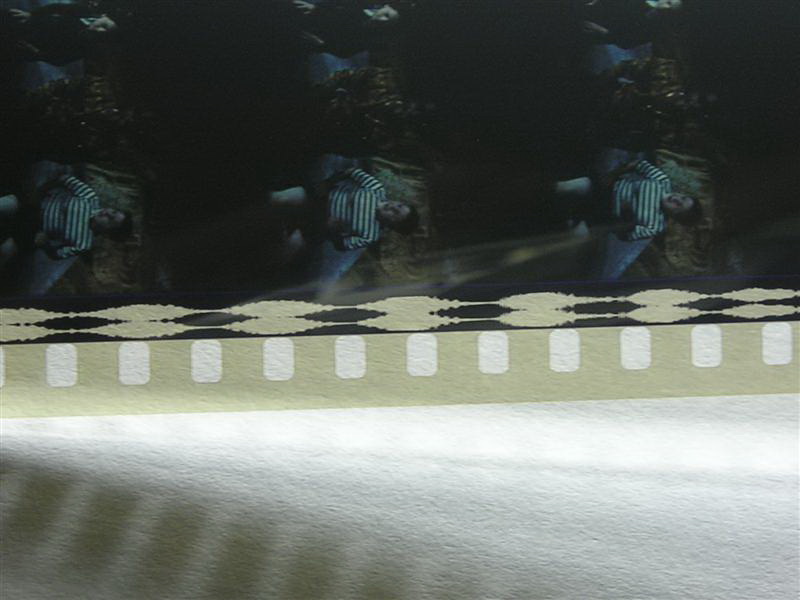
I have this picture form my Adams Familly Video Clip where the soundtrack are exceded the normall size:
See at the center of the soundtrack the big wide have flat limits of the soundtrack film space, so the sound are recorder exceded and in the moment that this occurs the soundtrack lost information, only receive a flat response saturated.
Posted by Sean McKinnon (Member # 612) on 01-15-2011, 07:41 PM:
quote: Manny Knowles
I love the term "optical clash"
I love the song "radio clash" ![[Wink]](wink.gif)
Posted by Tony Bandiera Jr (Member # 2365) on 01-16-2011, 12:49 AM:
quote: Martin Daian
Hello Tony, i also have a print of Adams Familly Music Video Clip, is the same of that you have?, i note that the Lt and Rt signals on the optical space both are very wide and looks like exced(sp) the normal size, this will give a bad sound on a solar cell?, will be better readable with reverse scan?,
Yes Martin, that is the one and thanks for posting the pic, that is exactly what I am talking about.
And it will sound bad on solar cell and worse on reverse scan readers.
quote: Martin Daian
Is possible to use the Analog Reverse Scan with a white led to read the old silver tracks? or also a exciter lamp will be used on reverse scan systems?
White LED may not work well (or cause either way too much or not enough gain) from a reverse scan and why the hell would you want to use an exciter lamp? ![[Big Grin]](biggrin.gif) You would have to construct an incredibly complex light pipe to use an exciter lamp with a reverse scan reader. (Exception was of course the Norelco AAII projectors which had reverse scan optical with an exciter lamp. But the solar cells used were designed to be used with white light.)
You would have to construct an incredibly complex light pipe to use an exciter lamp with a reverse scan reader. (Exception was of course the Norelco AAII projectors which had reverse scan optical with an exciter lamp. But the solar cells used were designed to be used with white light.)
Posted by Eric Robinson (Member # 2966) on 01-16-2011, 08:43 PM:
quote:
I have this picture form my Adams Familly Video Clip where the soundtrack are exceded the normall size:
OK...that just pisses me off. No matter how precisely you set up your system, it will sound like "ass" (as Joe would say) when these types of trailers are shown.
Plus, you might waste your time trying to figure out a problem that is non-existent.
Posted by Martin Daian (Member # 1779) on 01-16-2011, 10:42 PM:
"why the hell would you want to use an exciter lamp? [Big Grin] You would have to construct an incredibly complex light pipe to use an exciter lamp with a reverse scan reader"
Hello Tony, hehehe, yes i want to adapt a Component Engineering Reverse scan with a white light to read correctlly the standard silver soundtracks, some technicians say that silver soundtracks will not sound better with red light, Cyan will not sound ok with white light so as i have a big collection of old films pre 2000 all with silver tracks i like to read the better possible, i will maintain the old slit lens with the old exciter lamp and old stereo solar cell on my Ernemann X projectors but as everybody know that reverse scan have perfectlly crosstalck separation chanels and better HF response that old slit lenses and old stereo solar cells, i don't know if is true about white light for standard silver tracks instead red light,
Thank you,
Martin
Posted by Sam D. Chavez (Member # 1841) on 01-16-2011, 11:28 PM:
The IR LEDs that came out with the original reverse scan readers output the spectrum of light passed by silver sound tracks. The white light exciter lamps put out a wide spectrum of light but only the IR portion is used by the silver sound tracks.
BACP make a reader with interchangeable red or IR LEDs so it is possible to get "white light sound" from a reverse scan reader.
Posted by Brad Miller (Member # 2) on 01-17-2011, 12:09 AM:
And I can vouch that it is nice. Unfortunately you DO have to adjust focus if you interchange the red and IR led, but that's not a fault of the design.
Posted by Martin Daian (Member # 1779) on 01-17-2011, 02:34 PM:
Dear Sam and Dear Brad, Thank you for the information, is true that the IR light gives better sound quality readance in Standard Silver tracks instead the late Red light commonlly used today? or is the same quality and i am concerned about a differece of sound that not exist?
about to adjust the focus of the reader when change the led from IR to Visible Red or viceversa i assume that this is caused for the different spectrum nanometers of light, with Red have one focus distance and with IR other focus?
Thank you
Posted by Sam D. Chavez (Member # 1841) on 01-17-2011, 06:40 PM:
The IR reader will sound a little better with silver tracks. Not a lot of difference on most soundtracks, but if you want the best possible sound on silver tracks, a reverse scan reader with an IR LED is the best choice.
Posted by Steve Guttag (Member # 268) on 01-17-2011, 07:47 PM:
It really depends on the track and the Crossmod distortion. I've found many '80s and '90s tracks to sound HORRIBLE with red-light readers. It isn't that you don't have sound...it is like the amplifier is clipping or something...very harsh. Which might give some people the wrong impression that those tracks were just inherently noisier or not mixed as well.
Note, when switching between IR and visible red, there is a significant focus readjustment due to the difference in the index of refraction between the two wavelengths.
-Steve
Posted by Martin Daian (Member # 1779) on 01-17-2011, 09:20 PM:
Hello again, Thank you Sam and Thank you Steve,
Martin
Powered by Infopop Corporation
UBB.classicTM
6.3.1.2