This is topic NEWBIE ALERT: I just bought a Theatre, advice needed... in forum Film Handlers' Forum at Film-Tech Forum ARCHIVE.
To visit this topic, use this URL:
https://ft-forum.com/ft/cgi-bin/ubb/ultimatebb.cgi?ubb=get_topic;f=1;t=010838
Posted by Jonathan Peirce (Member # 5364) on 03-12-2011, 03:53 PM:
Hi All: I have just purchased an old twin theatre. We are in the process of converting it to a single. There are 2 extron lamphouses, but no lenses. There are 2 small screens, which we would like to replace with one large screen. I am looking for any advise, links, books, etc...
Thanks in Advance for your help!
JP
Posted by Jake Spell (Member # 5294) on 03-12-2011, 04:05 PM:
Be forewarned, running a profitable single screen is difficult. You MUST be unique or have the whole market covered. You also ca't afford to get bad movies. If the single screen I work at get a bad movie were screwed, no way to move it to the small house and get something else.
The other recommendations are doing alternate content, theater rentals, parties, concerts,ect. They keep the money coming in the slow months.
Posted by Robert E. Allen (Member # 1351) on 03-12-2011, 04:16 PM:
I agree with Jake. A single screener can be profitable but you need to be different than the competition. Hire yourself a booker at least for the first year. Try foreign, classic, inspirational, independent and strong move-over films. A good booker can be very helpful here. Find a booth tech in the area and have him check out the equipment and tell you what you need. Good luck.
Posted by Jonathan Peirce (Member # 5364) on 03-12-2011, 05:32 PM:
Thanks for the replies... We are looking at doing concerts, rentals, etc., but I would like to utilize the projectors that are there.
Posted by Frank Angel (Member # 248) on 03-13-2011, 05:35 AM:
Look to retrospective, foreign, independent titles -- those small gems that don't get play at the multiplex, festivals, packaged themed programs that you promote individually -- combine this type of specialized, carefully selected film content with other income like rentals -- parties, dance recitals if you have a stage area that can accomodate them, rehearsal and performance space for local theatre groups, music ensembles, dance troupes who need a home locally -- they will keep the place going between film events. Our theatre is big enough to accomodate large audiences so we rent to schools every June for wall-to-wall graduations. We've even rented the theatre for a weddings.
Thing is, you cannot compete with the multiplex on their turf; as it has already been said, a single screen simply can't do what the multiplex does in terms of flexibility and playing first run on first run terms. If you can book the occassional blockbuster that has long legs and get a good deal on the break, you can do that occasionally, although always choose current tiltes that are in keeping with a distinctive character that you create for your theatre. For the most part, however, first run may just be impossible to be profitable since the terms will lock you into a run that you might not be able to sustain.
Check what other non-muliplex operations are doing in other areas and see if you can struture your operation similarly. I think you will not find any that try to play first run only.
Posted by Bernie Anderson Jr (Member # 410) on 03-13-2011, 08:04 AM:
Talk to Richard Wolf at The Rox Theatre in Northampton, PA. 40+ years in the same single screen theatre in PA. He can definitely give you pointers.
Posted by Louis Bornwasser (Member # 3063) on 03-13-2011, 09:38 AM:
Robert is dead on here.
Do not "take on" the big boys; you cannot win.
What you can do is be an individual, develop a following, cater to several specialized markets.
Best of all: do it well. Have the best picture, sound, hot dogs, hot cider, hot chocolate, etc.
Most of all: the best of luck to you. Louis
Posted by Tom Petrov (Member # 1534) on 03-13-2011, 12:58 PM:
quote: Jonathan Peirce
There are 2 small screens, which we would like to replace with one large screen.
I am curious to know why you are doing this? What rationale or business plan is making you think one screen will do better than two?
The theatre was a twin for a reason, (even worse: It was twinned from a single for a reason). Filling one screen and 500 seats of one movie is harder to do that filling two different movies on two different screens with half the seats in each. If worse comes to worse and it is really going to be busy, then you can book the same movie on both screens.
Posted by Mitchell Dvoskin (Member # 751) on 03-13-2011, 12:59 PM:
What theatre did you buy?
Posted by Brad Miller (Member # 2) on 03-13-2011, 02:00 PM:
You guys forgot to mention the most important part. Don't put much money into repairing your 35mm system. It will be obsolete in a couple of years.
Posted by Mitchell Dvoskin (Member # 751) on 03-13-2011, 02:38 PM:
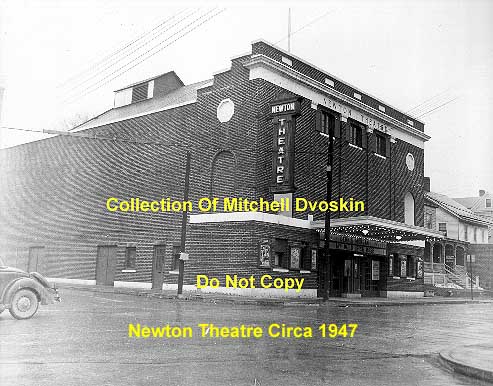
I figured out the answer to my own question. The Newton Theatre in Newton NJ. I was very briefly an assistant manager & projectionist there around 10 years ago.
I can understand why he wants to un-twin it. When it was twined back in the early 1980's, they made two very long "hallway" style auditoriums that are far to long for the size of the resulting screens. Not sure how it will do as a concert facility, but it has proven to be nonviable as a first run movie theatre in recent years. I would expect the projectors to be in good condition, as the last operator has a reputation for maintaining his theatres.
Posted by Frank Angel (Member # 248) on 03-13-2011, 03:08 PM:
Tom, let me take a wild guess as to why he wants to un-twin it --because the twin job was abomination. As Mitchel said, long, narrow hallways with small screens at the end which acted as echo chambers with practically zero intelligibility. And I'll bet they didn't install new seats or even reposition the old ones so after the twin-ing, the seats were aimed at where the center of the old screen used to be which was the left and right hand corner respectively of the twined rooms. More than likely the booth ports were not recentered either so now the angle of the projectors to the right and the left gave rediculous keystoning on both screens. I've seem more that one of these nightmares during the 80s when owners realized they couldn't compete with their single screen with the growning new multiplexes. They ruined beautiful single screens only to fund out that even after twin-ing and in some cases quad-ing, they STILL couldn't compete with multiplexes, ESPECIALLY given the frankenstein horrors that they creaded with these conversions. Most of these failures closed. It's amazing that a few still stand and in the right hands can be restored and made workable again, but of course, not as a conventional first run commercial house.
Posted by Caleb Johnstone-Cowan (Member # 3710) on 03-13-2011, 03:08 PM:
This lot do very well, it's a model to follow for single-screeners in the right upmarket/suburban area:
http://www.therexberkhamsted.com/
Probably helps having this in the old foyer and cafe (assuming they're the same owners):
http://www.thegatsby.net
Posted by Jonathan Peirce (Member # 5364) on 03-13-2011, 08:39 PM:
Thanks again for all the advice. The main reason we are 'un-twinning' it is to be able to present concerts. That being said, there are 2 projectors there, and if I can figure out how to have a portable screen (removable for concerts) I would LOVE to show film there. Like a lot of us, I grew up going to the local single screen theatre
The Uptown
which converted to an art house in the 80's. At this point I am trying to figure out if the projectors work, what lenses to buy ( there are none) etc, etc.
The photo of the theatre in 1947 is great, I would kill to find that old sign!
JP
Posted by Mike Blakesley (Member # 26) on 03-13-2011, 08:51 PM:
Well as a one-screen owner I can tell you, we would kill to have two screens. If your main revenue stream is going to be from concerts, I can see your point but if you want to make money with movies, you really should try to figure out a way to keep it a two-screener.
Maybe you could "re-twin" in such a way that you'll still have two auditoriums and could use one of them for concerts.
Posted by Louis Bornwasser (Member # 3063) on 03-13-2011, 09:03 PM:
Point taken on bad twinning.
I had some success back in the 70-85 period twinning. A balcony split is great since it leaves the main floor untouched (almost.) Lacking a balcony? Sometimes a front/back split can work with a very small cinema on the extreme left back, for example. Again, the main room is retained, full width with the idea of preserving what you can.
The business model will require 2 screens, somehow. (next door? Office space turned into a "screening room?"Remember: sound counts, too. Isolation from room to room as well as echos. Louis
Posted by Jonathan Peirce (Member # 5364) on 03-13-2011, 09:07 PM:
There are some interior photos where you can see the long hallway type rooms. The Newton Theatre
Thanks again
JP
Posted by Mitchell Dvoskin (Member # 751) on 03-14-2011, 09:07 AM:
If I were to redo the multiplexing, I would pull down the center wall, and put a wall up in front of the rear "stadium seating" back section, and make 2 small movie theatres back there to support the venue when it would otherwise be closed. That would leave the slopped floor section of the main auditorium intact as one big auditorium. Of course, that would mean spending big bucks.
The problem you face as a concert venue is that even with the auditorium restored, there is not enough seating for the "big" acts, and too many seats for the small intimate performances. The owners of Roy's Theatre (or whatever they are calling it these days) down the road in Blairstown tried converting to a concert facility, and as far as I know, were not overly successful.
Posted by Scott Jentsch (Member # 1681) on 03-14-2011, 10:38 AM:
Is there any chance of keeping two screens, but making the auditoriums smaller to correct the length problems? How wide are the two screens now?
My first reaction was that going from two screens to one would be a risky move, mainly for the reasons that have already been made. I would think it would be quite difficult to fill a 600-seat theater for just about any movie unless you were the only theater in the area (which doesn't seem to be the case). I could see how that would not apply if the theater has some historical significance and has a very loyal customer base. However, if the previous owner couldn't make it go with two screens, I think making it go with one screen would be an even bigger challenge.
My thought was by sticking with two screens, but shortening the auditoriums so that the geometry gets back into the proper dimensions, you would be able to keep the ability to offer two different movies and absorb the misfortune of a stinker release. Since the original capacity was 600, and I would imagine that the twin rooms had capacities near 250 or so, shortening the rooms might reduce your seating down to 100 in each. While that's much less than what you would have in a single screen, I think that's a tradeoff that I'd make.
Is the auditorium deep enough to go to four rooms (two in the front, two in the back)? If so, that might get you up to 240-320 range if you can get 60-80 seats in each. If you need a wider, larger space for concerts, maybe doing one larger room in front and two smaller rooms in back?
I don't think an auditorium needs to be large to be good, but the proportions need to be right and the performance of the picture and sound needs to be top-notch. Whether you have two rooms or four, the quality of your presentations can differentiate your operation, and help you compete with the much larger multiplexes. I would attend a really good 50-seat "screening room" style theater before going to an average/mediocre 200-seat theater.
Posted by James Wallor (Member # 6154) on 03-14-2011, 01:57 PM:
quote: Jonathan Peirce
Thanks again for all the advice. The main reason we are 'un-twinning' it is to be able to present concerts. That being said, there are 2 projectors there, and if I can figure out how to have a portable screen (removable for concerts) I would LOVE to show film there.
The room we use as a theater is a lecture hall at my university, so the screen we use is a 30-foot screen on a roller that we lower each weekend for shows. We're getting a new 32-foot motorized screen to replace it, however.
The one issue we have with the manual roller is the roller wasn't made stiff enough so it's starting to sag in the center... and people love to throw popcorn kernels at the screen which are out of view for the projectionist and these can get caught in the roller and puncture more holes into the screen.
Posted by Troy Powell (Member # 5505) on 03-14-2011, 05:04 PM:
I agree with brad miller. After hanging onto my film theatre equipment for over 2 years like an idiot I am now scraping everything out for metal since scrap metal prices are high right now. Hell I even tried to give the equipment away but to no avail.
Posted by Robert E. Allen (Member # 1351) on 03-14-2011, 11:15 PM:
Jonathan: Theatre sized roll up screens are available. I used one in a single-screener when I had live performances. The speakers were on wheels and just rolled into the wings. Contact a theatre supply dealer.
Posted by Robert Carnino (Member # 5633) on 03-15-2011, 11:25 AM:
Go Digital!!!
Posted by Scott Norwood (Member # 30) on 03-15-2011, 12:13 PM:
You really don't want a roll-up screen if you don't have to have one. They eventually sag in the middle and can get damaged easily.
The better option would be to have a complete screen frame that can fly as one piece. You then order a normal perf screen and lace it to the frame. Screen replacements are cheaper and easier with this method, and the screen stays flat. Unfortunately, the rigging is more difficult and requires a fly space that is at least as tall as the procenium.
With either system, you will need side (and possibly top) masking that can be flown in as close to the screen as possible (a few inches in front of the screen is idea). The masking fabric needs to be sound-transparent and needs to be able to mask the screen down to an aspect ratio of 1.33:1 and open as wide as 2.39:1. The masking movements should ideally be automated, but a manual curtain-rope system works for occasional one-off shows.
Loudspeakers can be flown or rolled in. A modern system requires three behind the screen, along with surround speakers mounted on the side and rear walls. The horns on the stage speakers are supposed to be about 2/3 of the way up the screen, so you might need stands for the speakers if you put them on wheels. Do not try to use the same speakers for both films and live events. This never works right and also compromises sound quality for both systems. You will also probably want a heavy black drape that can be flown in behind the stage loudspeakers to cut down on reflections that can be seen through the perf screen; this will probably also improve sound quality.
You will need a cinema sound processor and quality amplifiers. You may also need to do acoustical treatment to the room. You will have to find a cinema dealer to look at your room and advise you on this. Unfortunately, very few rooms have top-quality acoustics for both live music and film.
The good thing about screens and sound systems is that they will be the same for all types of projection systems (except for 3D, which typically requires a specific screen surface).
As for 35mm vs. D-cinema (vs. 16mm vs. 70mm): you need to decide what types of film programs you will be showing. D-cinema won't help much if you want to show classics or most art-house titles. D-cinema becomes more attractive if you need a quality video projector anyway and will be showing recent mainstream features. If you already have 35mm equipment that is in good shape, you can start with that. D-cinema or not, you will want some sort of video projector that can fill your screen with an acceptably bright image from a DVD or Blu-Ray (with guest inputs for other formats). This is important for rentals and other events (think birthday parties, video conferences for businesses, etc.). Unless you have specific programming needs that require it, don't worry about 16mm or 70mm. Regardless of projection system, be sure to have an extra porthole in the booth for some other format, should it ever be needed.
If you are just getting started, look for used equipment, with advice from your equipment dealer or someone else knowledgeable about projection and sound.
Posted by Darryl Spicer (Member # 711) on 03-15-2011, 02:35 PM:
I would not put one penny into D-Cinema for this location until I knew that the operation would show stability and maintain a profit margin. If you can not do a fly method on the screen try to frame it normaly with enough room for the speakers behind it then have a curtain that can cover the entire screen when you are using the stage for concerts. Not really sure how much room you will have or your seat counts but we have a theatre here local that does movies and the occasional concert.
Kentucky Theater
Posted by Robert E. Allen (Member # 1351) on 03-15-2011, 03:55 PM:
Scott:
The roll-up I used was six years old by the time I got there and did not have a wrinkle in it. It was a perforated screen and did not move when hanging opened.
Posted by Jack Theakston (Member # 4484) on 03-15-2011, 10:15 PM:
What amount of stage space do you have? Fly space for a screen?
I know the Albany area pretty well—there are already a number of venues down there that already do concert and art cinema. What's your niche? What makes you different? Plan around that.
Posted by Jonathan Peirce (Member # 5364) on 09-08-2011, 01:19 AM:
Well, 6 months of renovation later, and opening night is in a couple of days! 600 seats sold out, lots of buzz, the town behind us, makes for a great opening....
I still would like to have someone local (NJ, NYC) come in and tell me what I need to show film... I have 2 35mm projectors, just not sure who to talk to as far as bookings, and projections...
Thanks
Jon Peirce
The Newton Theatre
973-383-3700
Posted by Paul Gordon (Member # 3320) on 09-08-2011, 09:35 AM:
You should take some pictures of the gear you still have in the booth, projectors, sound processor etc... the stuff may be junk. It might be better to start fresh with good used gear considering how cheap 35mm equipment has become.
Posted by Mike Blakesley (Member # 26) on 09-08-2011, 11:56 AM:
Jonathan - do you have a website or a Facebook page? We want to see pics!
Powered by Infopop Corporation
UBB.classicTM
6.3.1.2