This is topic elevator music... in forum Film Handlers' Forum at Film-Tech Forum ARCHIVE.


To visit this topic, use this URL:
https://ft-forum.com/ft/cgi-bin/ubb/ultimatebb.cgi?ubb=get_topic;f=1;t=010901

Posted by Frank Cox (Member # 6258) on 05-14-2011, 02:05 PM:
 
What do you folks use to play your before-and-between-shows music on? CD's? Tape? MP3's? Something else? Nothing at all?
 
Posted by Jake Spell (Member # 5294) on 05-14-2011, 02:32 PM:
 
We just have a dvd player that plays a cd mix tape we make on a loop. Just something to avoid awkward silences.
 
Posted by David E. Nedrow (Member # 4981) on 05-14-2011, 03:17 PM:
 
We use an original AppleTV. With the original ATV, the media is stored on the box itself. Even better, we control it via our iPhones.

There are a number of media boxes out there that can play just about every digital format you'll run across.

I've got a system I'll be replacing the ATV with. It's built around VLC and I'm writing an iPhone interface to manage it. The same machine will handle kicking off the automation, switching video inputs, etc.

Oh, but you need licensing before you can play most music. At the minimum, you'll need ASCAP and BMI licenses. That'll cover 90% of what you're likely to play.

Another theatre in town here didn't get licenses, and got pinged by ASCAP for something like $3,000. The licensing cost itself varies with the venue size. For theatres, it's usually the total number of seats.
 
Posted by Ian Parfrey (Member # 5122) on 05-14-2011, 03:32 PM:
 
Seeberg 1000 Background Music System discs burnt to cd.
We get many requests for the title of the discs we use.
 
Posted by Monte L Fullmer (Member # 2797) on 05-14-2011, 03:33 PM:
 
I've seen internet radio feeds from computers to the BMS setups for lobby/house music.

Some large circuits uses CinemaSounds, or similar sanctioned BMI/ASCAP main feeds to their network systems for BMS usage.
 
Posted by Frank Cox (Member # 6258) on 05-14-2011, 04:19 PM:
 
quote: Ian Parfrey
Seeberg 1000 Background Music System
Now that's really cool, but doesn't it sound a bit "lo-fi" for this day and age? I'm just thinking that a recording on a low-RPM record can't be all that great.. or am I wrong? (Never heard one that I'm aware of so I have no experience with it at all.)
 
Posted by Brad Miller (Member # 2) on 05-14-2011, 04:25 PM:
 
The Seeburg Background Music System is reserved only for VERY high end audio systems due to its awesomeness.

 -
 
Posted by Monte L Fullmer (Member # 2797) on 05-14-2011, 05:35 PM:
 
..with those records turning at 16-2/3 rpm, and with the audio signals with the RIAA curve enabled and prob reduced for the cutting stylus on the lacquers to keep within the freq range, the output from this unit can sound pretty good for an old mono system..
 
Posted by Paul Mayer (Member # 355) on 05-14-2011, 06:14 PM:
 
Just an MP3 player with the stuff I like to use loaded on it. Since I screen nothing but unadvertised private member screenings of Japanese films these days, and the content of the MP3 player is nothing but Japanese soundtracks, licensing for playback in this country is a non-issue.
 
Posted by Ian Parfrey (Member # 5122) on 05-14-2011, 08:46 PM:
 
Frank.

Those old Seeburg discs can sound ok but first need some processing to get the very best. I use Sound Forge to fudge around and the result is perfectly ok for background or non-sync use.
 
Posted by Scott Norwood (Member # 30) on 05-14-2011, 09:20 PM:
 
Are the Seeburg recordings PD? If so, could someone post WAV files of them?

As for non-sync, I used CDs for years. Lately, I've been using losslessly compressed files an Ipod that I use only for non-sync music (my home listening is CDs and vinyl; in the car, I mostly listen to news). The Ipod is easier to carry around to different venues than a stack of CDs. (Of course, I now need to carry an assortment of 1/8" mini-phone to RCA, 1/4", and XLR adapter cables....)

For non-sync music, I tend to favor a mix of movie soundtracks, jazz, classical piano recordings, and vintage production music. The exact selection depends on the film and the venue, but the common theme is that it has to be background music which does not have a wide dynamic range or call too much attention to itself. I don't generally play anything with vocals.
 
Posted by Ian Parfrey (Member # 5122) on 05-14-2011, 09:51 PM:
 
Here is a link to an online 'broadcast' of the Seeburg 1000 Background Music System. Not to sure on the PD rating of these but as they are available here I guess they are considered to be in the P.D.

Live Stream of the Seeburg 1000

Let me know what you think.
 
Posted by John Wilson (Member # 269) on 05-14-2011, 09:58 PM:
 
So Ian, do you just record off the stream?
 
Posted by Ian Parfrey (Member # 5122) on 05-14-2011, 10:18 PM:
 
John.
Yep, just do an analogue copy into Sound Forge and fool with it a bit then out to a CDA.
There are also some mp3's available already converted online somewhere. If I find them I'll throw up the link. These need a bit more noise reduction but are a good start.
 
Posted by Frank Cox (Member # 6258) on 05-14-2011, 10:34 PM:
 
Seeburg MP3 downloads
 
Posted by Frank Angel (Member # 248) on 05-15-2011, 12:45 AM:
 
Good gawd this is aweful. This is the DEFINITION of elevator musak. Who would play this mono Lawrence Welk-ish stuff for preshow? I even heard surface pops and clicks in a few of the cuts which immediately catapults your audience back to the 50s and makes them feel like they are in some sleazy smoke-filled bar/lounge.

Naw, I'll pass on this; even that it's free doesn't make is sound any better.
 
Posted by Brad Miller (Member # 2) on 05-15-2011, 01:23 AM:
 
Frank, try listening to these selections posted on youtube...

Perky (This one is a favorite)

Holiday for Strings

Cabaret

Girl From Ipanema

Seeburg BMS demonstration record

How anyone could not like this stuff is beyond me. It is so awful it is wonderful! There is something about it playing quietly in the background in the screening room with the curtains closed that just works. People sit waiting for the show to start tapping their foot and tipping their head in enjoyment.

Probably the favorite song I have is a Seeburg version of "Hound Dog". [Razz]

At some point I plan on converting what I have to mp3 and will post them here.

Here and here are selections from the industrial library.
 
Posted by Tom Petrov (Member # 1534) on 05-15-2011, 01:28 AM:
 
I am amazed there isn't an actually "movie" theatre channel you can subscribe to. One that would say "visit the concession" stand etc.
 
Posted by Frank Angel (Member # 248) on 05-15-2011, 11:47 AM:
 
quote: Brad Miller
How anyone could not like this stuff is beyond me
Brad, I LOVE the titles they play -- lots of movie themes and as you list, plenty of popular titles. BUT, their hokey arrangements have a cheap 50s style and many are downright lounge band -- this is real elevator music.

I have been listening to the stream for a few hours and find there may be 1 out of every 10 selections that sound decent enough that I would consider including them in my preshow library. But I also find that on quite a number of selections you can here scratches -- the bane of analog mechanical transcriptions. That will scream low-tech to an audience.

Putting the question of style aside, who wants to play mono preshow music? We even process our preshow 2 channel stereo music with a 4 channel Sansui Pro decoder so we can extract ambience from the stereo channels for the surround channels.

Sorry, while no one can claim they love Lenny's West Side Story medley with more passion than I; the Seeburg elevator arrangement of it with a 6 piece ensemble instead of a full orchestra and replete with surface scratches and compression pumping is downright embarrassing and I would never subject my audience to it. And BTW, I am listening right now to horrid version of I Remember It Well from GIGI -- nice song if it didn't have a good dose of WOW. Sounds like one of their discs was punched slightly off center or they have turntable problems.

As I said, free doesn't cover hokey style....in mono with scratches no less. No thanks -- I don't want to drive everyone under 75 out of the theatre.
 
Posted by Brad Miller (Member # 2) on 05-15-2011, 02:23 PM:
 
quote: Frank Angel
Putting the question of style aside, who wants to play mono preshow music?
Me, and lots of others. This is a trick from GCC Northpark in Dallas I still use to this day. The non-sync is center mono at a low background level, but enough to hear it without it being background noise. Trailers are LCR stereo (no sub or surrounds) at a comfortable "tv volume" (fader typically at 4 for current-era trailers). Then the feature kicks in full throttle with all channels playing and fader at 7.

Anyone who has seen such a presentation can attest it really makes a presentation. It is similar to curtains. You don't need them, but it certainly says "the show is starting" as they open. I am simply creating a similar thing with the audio system.
 
Posted by Robert E. Allen (Member # 1351) on 05-15-2011, 03:16 PM:
 
Good for you Brad! Showmanship isn't dead yet. (Even without curtains.)
 
Posted by Scott Norwood (Member # 30) on 05-15-2011, 03:25 PM:
 
What Brad said. I usually do L/R stereo (no surround) for non-sync music (depends on the venue and sound system...a few places are still mono-only for everything, including film), but the effect is the same.
 
Posted by Frank Cox (Member # 6258) on 05-15-2011, 06:51 PM:
 
I get the impression that records for the Seeburg 1000 aren't terribly uncommon, yet. It would be wonderful if someone who had access to these things would create an organized series of rips of the available records, similar to what is on that webpage posted here the other day.

1. It's useful. Even today there are many venues that could and would use this content for background music.
2. It's of historical interest, and stands a greater-than-zero chance of having at least some of the content disappear unless steps are taken to preserve it.
3. The music is good and some of it is really exceptional. (My opinion, don't shoot me.)
4. And it's just damn cool overall.
 
Posted by Bill Enos (Member # 440) on 05-15-2011, 06:57 PM:
 
We keep all the licensing fees paid and play what ever we want from CD, etc.
 
Posted by John Wilson (Member # 269) on 05-15-2011, 08:08 PM:
 
quote: Brad Miller
At some point I plan on converting what I have to mp3 and will post them here
Well, it's been 19 hours since you posted this...where are they? [Wink]
 
Posted by Eric Robinson (Member # 2966) on 05-16-2011, 01:45 PM:
 
All I can say about the Seeburg tunes is WOW

Wow and flutter that is... [uhoh]

It is kind of fun to listen to though in a perverse sort of way...and it would be fun to torture some audience members to see their reaction.
 
Posted by Frank Cox (Member # 6258) on 05-16-2011, 01:50 PM:
 
Seeburg Christmas Album

Seeburg 1000 - The Sound & Colour of Christmas
 
Posted by Bill Enos (Member # 440) on 05-16-2011, 04:16 PM:
 
The purpose of this music is to have noise so the customers won't annoy each other chomping food to drown out the farts. You guys are supposed to be at work not listening to the music.
 
Posted by Andres Briano (Member # 4621) on 05-24-2011, 10:44 AM:
 
quote: Brad Miller
Trailers are LCR stereo (no sub or surrounds) at a comfortable "tv volume" (fader typically at 4 for current-era trailers). Then the feature kicks in full throttle with all channels playing and fader at 7.


I do the same thing but I got it from somewhere else. Actually I did the same thing. The company that does our on-screen advertising got into a fight with me. They demanded that their ads be played in SR-D. I wouldn΄t hear of it. They ended up going to my boss. I lost the battle. [fu]

Andrιs
 
Posted by Tony Bandiera Jr (Member # 2365) on 05-24-2011, 02:33 PM:
 
Andres, this is one of those situations where you nod, smile and say "No problem, boss" then as soon as they leave the booth go back to doing it your way. [Big Grin] [evil]

Most theatre owners/managers are so stupid they wouldn't notice a good presentation if was tatooed on their pecker.
 
Posted by Jeff Taylor (Member # 443) on 05-24-2011, 03:11 PM:
 
Just for chuckles, Steve Krams has a Seeburg 1000 listed currently on ebay. Check it out if curious.
 
Posted by Andres Briano (Member # 4621) on 05-24-2011, 03:15 PM:
 
What is the point in listening to an olive oil ad in Dolby Digital anyway?? Seriously!
 
Posted by Tony Bandiera Jr (Member # 2365) on 05-24-2011, 03:37 PM:
 
quote: Jeff Taylor
Just for chuckles, Steve Krams has a Seeburg 1000 listed currently on ebay. Check it out if curious.


Post a link, dammit!! [Big Grin] [Big Grin]

Don't tease us!! [Big Grin]
 
Posted by Jeff Taylor (Member # 443) on 05-24-2011, 06:36 PM:
 
I hope this works Tony--haven't tried to post ebay auctions before. Anyhow, the item number is in the address if all else fails. He's got it at Buy it Now $995 or BO, supposedly working with half a dozen or so records. Who wants to bet he saw this thread and pulled this antiquated piece of [bs] out of the warehouse! Smart Move!

http://cgi.ebay.com/ws/eBayISAPI.dll?ViewItem&item=250760054130&ssPageName=STRK:MEWAX:IT
 
Posted by John Wilson (Member # 269) on 05-24-2011, 06:52 PM:
 
quote: Jeff Taylor
Who wants to bet he saw this thread and pulled this antiquated piece of [bs] out of the warehouse
One man's trash (etc.)

BTW, he may be slightly overpriced.

A previous sale.
 
Posted by Jeff Taylor (Member # 443) on 05-25-2011, 08:14 AM:
 
...wouldn't be the first time!
 
Posted by John Wilson (Member # 269) on 05-25-2011, 04:35 PM:
 
quote: Frank Angel
Good gawd this is aweful.
Agreed Frank! I'm full of awe at it also! [thumbsup]

[Wink]
 
Posted by Bill Duelly (Member # 3612) on 05-25-2011, 09:17 PM:
 
Absolutely Fantastic! Part of the magic of stepping back to another era.
 
Posted by System Notices (Member # 2357) on 08-28-2012, 03:04 PM:
 

It has been 460 days since the last post.

 
Posted by Jeff Taylor (Member # 443) on 08-28-2012, 03:04 PM:
 
FWIW, another one apparently working with 67 records has surfaced. Interesting video of it playing and changing records also posted. NOT CHEAP: http://www.ebay.com/itm/1963-Seeburg-1000-Background-Music-System-BMS2-Jukebox-/160863496191?pt=LH_DefaultDomain_0&hash=item25743627ff
 
Posted by Damien Taylor (Member # 4255) on 09-04-2012, 05:37 PM:
 
I really need to get one of the jukeboxes soon.

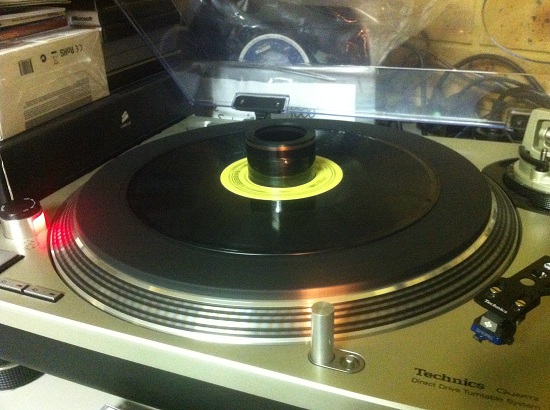
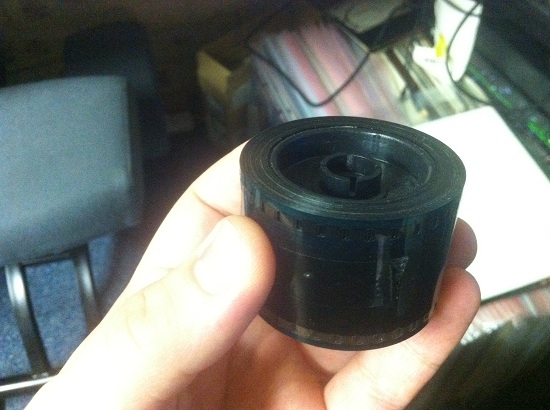
Currently I'm playing them into my computer and slowing them down digitally. But it would be really nice to have them back where they belong. Here's how I'm dealing with the 2" centre hole.

 -
 -
 
Posted by Kenneth Wuepper (Member # 1174) on 09-05-2012, 06:59 AM:
 
And a perfect analog answer it is!
 
Posted by F. Hudson Miller (Member # 5318) on 03-18-2013, 05:53 PM:
 
Just glad to hear all you guys are paying all proper BG MX licensing fees. Musicians/composers/recoding engineers have kids to feed too!
 
Posted by System Notices (Member # 2357) on 09-24-2015, 07:22 PM:
 

It has been 920 days since the last post.


Posted by John Wilson (Member # 269) on 09-24-2015, 07:22 PM:
 
quote: Brad Miller
At some point I plan on converting what I have to mp3 and will post them here.
Tick... Tick... Tick...

[Wink]
 
Posted by Paul Dorobialski (Member # 7536) on 10-23-2015, 07:36 PM:
 
Some years ago there was a sale on ebay for a Muzak PB-16C playback unit in the entire 6 foot rack from a radio station in Wappingers Falls NY. I called a amp customer of mine in Mayfield NY and asked if he wouldn't mind picking it up & delivering it to the Chicagoland jukebox show where I could pick it up with a rented box truck. Well for $9.99 I bouight this unit with its Langivin amp, 2 service manuals , some extra parts. I have since restored the playback amp. It now sits in one of my showroom windows at my place of business entertaining passerby. I even had 2-14 inch reel flanges chrome plated to cover the beat up 14 inch tape reels.
 
Posted by Scott Norwood (Member # 30) on 10-23-2015, 08:36 PM:
 
This really has nothing to do with movie theatres, but seeing the title of this thread again reminded me of it, and it is too good (awful) not to share:

Sounds for the Supermarket

This is a collection of 1970s grocery-store music.

The entire tape is on Youtube, in case anyone else is just as morbidly fascinated by this genre as I am.
 
Posted by Jesse Skeen (Member # 586) on 10-24-2015, 03:58 PM:
 
Wow- and it says there are subliminal messages in the music! I'd gladly buy a CD of this stuff. I remember hating Muzak and the radio stations that had that format (called "Beautiful Music" in the industry) but now that they're all gone, I miss them!
 
Posted by Aaron Garman (Member # 1653) on 10-24-2015, 04:09 PM:
 
I listen to that Scott and all I can here is Rod Roddy:

"It's the classic blue box that started it all. These traditional macaroni & cheese classics are sure to smile-ify your family's faces. Pick your favorite flavors for different ways to enjoy the cheesy greatness." Ok Bob!
 
Posted by Buck Wilson (Member # 5885) on 10-24-2015, 04:33 PM:
 
Wow. Sounds for the Supermarket is strangely addictive. I'm diggin it.
 
Posted by Paul Dorobialski (Member # 7536) on 11-04-2015, 03:50 PM:
 
OK, can anyone use a NEW never installed SMART DA 226 music distribution unit. It has 4 input ports. The original box is gone but the unit is still in the shipping bag. No cords with this unit.
 
Posted by Dave Bird (Member # 490) on 11-04-2015, 05:05 PM:
 
This is fantastic! I grew up in grocery stores and as an 8 or 9 year old, used to get to change the reel-to-reel Muzak player. We only used it for a few years from the mid-70's through very early 80's, by which time they came on cassette. I want to say they were a different speed, because I don't think you could play them on a regular cassette player, but it's a foggy old memory....this delights me to no end though!
 
Posted by Kenneth Wuepper (Member # 1174) on 11-04-2015, 05:15 PM:
 
Muzak in this area used a sub carrier on the local FM radio station. There was a receiver for the station and then an adapter for the decoding of the sub carrier FM music signal.

In Detroit there was a station WLDM - High Fidelity Detroit. They transmitted sub audible tones to turn various receiving equipment on and off remotely. The music and commercials were just sent on the regular station carrier but only the music was heard in offices with the decoders. The idea was that the commercials were removed and certain music styles were eliminated for a specific customer. The source was vinyl LP records. If there was a single "pop" in the playback (called a "hit") the record was demolished.
 
Posted by System Notices (Member # 2357) on 12-12-2016, 01:33 AM:
 

It has been 403 days since the last post.


Posted by Frank Cox (Member # 6258) on 12-12-2016, 01:33 AM:
 
My cd player is getting tired -- I have to tap it to get it to start spinning the disk.

So I just spent the past few day ripping my cd's to mp3's using this program, which is slick as all get-out.

I loaded everything onto a tiny sandisk mp3 player and hooked that up to the theatre sound system. The dinky little thing looks rather lonely sitting on top of the sound rack where the cd player and a big rack of disks used to sit.

I set up playlists for the different genres that I like to play before the shows and boy, is ever a slick setup. I'm currently playing a random selection of 141 standard Christmas songs, and next week I'm playing Bad Santa 2 so I'll play my Arrogant Worms "Christmas Turkey" cd for that. I now have a big band playlist, a pop instrumental playlist, a hard rock playlist (I play that sort of thing before the blood-dripper movies), and so on. Got everything covered, all in a little gadget about the size of half of a credit card.
 
Posted by Buck Wilson (Member # 5885) on 12-12-2016, 02:11 AM:
 
That is fantastic!

Oh to be an independent....
 
Posted by Louis Bornwasser (Member # 3063) on 12-12-2016, 07:34 AM:
 
When I was Chief at a serious Beautiful music station, music was stereo and all else was mono. If you were clever, you built a "mono mute" which had the effect of letting the music only through. It helped that the music had 3 seconds of silence around it.

Preachers on Sunday were mono, voices were mono: muted. When stereo was sensed, a 2 second fade in occurred. Worked great!
 
Posted by Harold Hallikainen (Member # 5405) on 12-12-2016, 08:17 AM:
 
When I worked at an AM/FM that ran automated "beautiful music" (from a Broadcast Automation AR-2000), I created a separate mix bus for the reel to reel tape machines. This music only output was sent by phone line to the Madonna Inn here in San Luis Obispo for their background music. This station ran everything in stereo, including the commercials. It had 6 Sonomag cartridge carousels, each holding 24 tape cartridges. Music came from 6 Revox A77 reel to reel tape machines.

Finally, I seem to recall an FCC rule prohibiting the use of subcarriers to delete commercials in receivers, but I can't find it now.

Harold
 
Posted by Kenneth Wuepper (Member # 1174) on 12-12-2016, 09:46 AM:
 
My favorite Detroit radio station was WLDM High Fidelity. They used LP records on RCA turntables. They transmitted a sub-audible tone before and after commercials to mute the background receivers. There were also different pitched tones that coded the type of music for clients. When the sub carrier authorization came about, Muzak had a sub carrier on the local country western station.

There is a satellite service that can be licensed for background use. I think it was Cirrus and you could put the antenna outside of the booth for better reception.
 
Posted by Jack Ondracek (Member # 1466) on 12-12-2016, 10:47 AM:
 
quote: Harold Hallikainen
Finally, I seem to recall an FCC rule prohibiting the use of subcarriers to delete commercials in receivers, but I can't find it now.
You may be right, Harold. Otherwise, if the station was selling their main-channel content, there would be little motivation for them to use the lower quality subcarrier.

Before satellite took over as the dominant means of background music delivery, we had one of those stations in Seattle. Given the number of FM radios out there in the '60s and early '70s, it was assumed the station made far more money from their subcarrier than from actual advertising sales.
 
Posted by David Buckley (Member # 2600) on 12-12-2016, 11:14 PM:
 
quote: Harold Hallikainen
It had 6 Sonomag cartridge carousels
I've heard horror stories about these things...

Pictures here for the interested.
 
Posted by Scott Norwood (Member # 30) on 12-14-2016, 08:36 AM:
 
quote: Louis Bornwasser
When I was Chief at a serious Beautiful music station, music was stereo and all else was mono. If you were clever, you built a "mono mute" which had the effect of letting the music only through.
Out of curiousity, how would this work? Would it just unmute the sound when the "ST" light on the radio came on (in which case the DJ or automation system would need to switch the station from stereo to mono when playing commercials)? Or was it more complicated (actually checking for L-R information and unmuting when the signal was different on both channels)? What if they played a song that was mixed in mono?
 
Posted by Louis Bornwasser (Member # 3063) on 12-17-2016, 09:33 AM:
 
My on air job led to installing background music speakers/tuners during off hours. Later I became Chief Engineer there; first job: remove the subcarrier generator and maximize quality on main channel. Schulke (SRP) beautiful music. Nice Scully 270 decks and new Ampro board with first Optimod. We were #1 adult station for nearly a decade. New owners killed it; I quit. Last radio job.

Scott: it looked for an audio signal on the L-R. If it found one it slowly faded up over 2.5 seconds. If nothing heard for 5.6 seconds, it muted. At the end of a music block there was silence, followed by "Music from WVEZ, Stereo 107." (mute)
 
Posted by Jack Ondracek (Member # 1466) on 12-17-2016, 11:19 AM:
 
quote:
quote: Louis Bornwasser
When I was Chief at a serious Beautiful music station, music was stereo and all else was mono.
Guess you had to make sure all of your music was stereo then, huh?

Interesting concept. The 270s were great machines. Most early stations I was around passed on stereo commercials, mainly due to problems with phasing. Most carts (and cart machines) did a horrible job at high frequencies.
 
Posted by Harold Hallikainen (Member # 5405) on 12-17-2016, 11:58 AM:
 
One station I worked for ran mono carts through an Orban stereo synthesizer to spread out the commercials a bit. Another (the one with the Somomag Carousels) ran stereo carts. I'd align the heads every week. The Sonomags were interesting machines. Sometimes they would not eject the cart and the carousel would get stuck trying to turn. The pinch roller was brought up by a solenoid pulling on a pin on a shaft. As the shaft rotated, the pinch roller would come up. But if you set the pinch roller pressure too high, the roller would not go back down when current through the solenoid was dropped. After rotating the shaft so many degrees, the pin was pretty much parallel to the solenoid core, so there was force to pull the core back out. The system would try to eject the cartridge. The pinch roller on its shaft would act like a hook and catch the cartridge as it tried to move away. The system would then not play any more carts from that machine. When one showed up in the schedule, the system would silence sense (sounding an alarm and moving on). But, if you had the Sonomag preamp gain too high, the preamp would oscillate at some frequency above 20 kHz. The silence sensor would detect this and say there's no silence, so the system would just sit there playing silence (the high frequency did not get broadcast since it was blocked by the low pass filters in the stereo generator). It was fun to get everything just right so it would play reliably.

Then there were the reel to reel decks (Revox A77). They proved reliable, but sometimes someone would put a twist in the tape so the back side of the tape instead of the oxide would played. This resulted in muffled music being played. Also, since the end of song was indicated by 25Hz on the left channel, which ends up on the right channel if you flip the tape, the song would never end. A full 10 inch reel of muffled music would play, then the system would silence sense.

Radio in the 1970s!

Harold
 
Posted by Scott Norwood (Member # 30) on 12-17-2016, 12:53 PM:
 
Louis (et al.)--was "beautiful music" really that popular of a format? I believe that "news/talk" and "country music" are now the most popular formats by number of stations in the US (though I am not sure if/how that translates into number of listeners). No doubt, there are significant regional differences.

Who was listening to "beautiful music" and why? Was it mostly businesses that wanted background music, or did people actually spend time listening to this format at home or in their cars?

Edit: here are the most popular US radio formats in 2013, from these people :

Country — 14.8
News/Talk — 11.3
Top 40 — 8.0
AC — 7.3
Classic Hits — 5.5
Classic Rock — 5.2
Hot AC — 4.8
Urban AC — 4.0
Top 40/R — 3.3
Sports — 3.1
Urban Contemporary — 3.1
Contemporary Christian — 3.1
Mexican Regional — 2.8
Adults Hits/+80S Hits — 2.1
Active Rock — 1.9
Alternative — 1.9
All News — 1.5
Classical — 1.4
Oldies — 1.4
Spanish Contemporary — 1.4

Beautiful music doesn't even rate now, it seems. Also, I believe that "classic rock" now includes songs from the '90s and "oldies" now includes songs from the '80s, which is making me feel old.
 
Posted by Harold Hallikainen (Member # 5405) on 12-17-2016, 01:46 PM:
 
I have not yet found any ratings numbers, but Beautiful Music was quite popular on FM in the 1960s and 1970s. I worked for someone who came from KABL ("In the air everywhere in San Francisco") which was a Beautiful Music station. He kept top 40 on our AM and we put up a new FM station (KUNA) that was automated Beautiful Music. A history of Beautiful Music is at http://www.percyfaithpages.org/A%20Brief%20History%20of%20Beautiful%20Music%20Radio.pdf .

Harold
 
Posted by Louis Bornwasser (Member # 3063) on 12-17-2016, 07:51 PM:
 
In the 1970s my station in Louisville was #1 in adults. McDonalds, and every dentist, doctor and law office in town ran us. My local hi-fi dealer became the #1 MacIntosh dealer in the world using only my station. He stopped selling turntables and tape decks unless pressed. My call letters and graphics were 8 feet high on his MacIntosh wall.
 
Posted by Jesse Skeen (Member # 586) on 12-17-2016, 11:16 PM:
 
In Sacramento we had one of the nation's premiere "Beautiful Music" stations, KCTC. Around 1990 it changed to adult contemporary which it's been ever since; I heard they were still getting respectable ratings when they changed the format but it was hard to sell ad time as the people in their primary demographics were always dying!

These stations "don't even place" in the ratings anymore because there doesn't seem to be a single one left anywhere. Most have gone to adult contemporary while a few have switched to country. I was eating lunch at a place playing the former KCTC, and laughed at the concept of hearing muzak versions of the songs being played currently- if I had the money I'd commission someone to record a few! [Razz]
 
Posted by Bradley J Sime (Member # 9423) on 12-18-2016, 07:27 PM:
 
I usually try to make a playlist that compliments the film. Often times I will open YouTube in two different windows and "mix" so one song can fade into another. Depends on the crowd, though.
 
Posted by Frank Angel (Member # 248) on 12-19-2016, 02:52 PM:
 
"Beautiful music" was quite a joke in the industry; when I worked for the LaBrie FM Network, it was called "easy listening" or our version, Lush Au Go-Go, and laughed our asses off (we said it sounded like a drunk stipper but of course, we were snotty, hippy-type, barely 20 year olds, so of course we thought it as old people's music. Little did we realize how fast we would get old!

And yes, Scott, that sappy, "old people's" format was very popular on both FM and AM stations during those years. There were easy listening stations in every major market...kind of the antidote to rock for old people.

What the format basically did was to take pop and rock songs and take all vibrance and sensuality and anything else that resembled excitement and life out of it so all that was left was music sludge to make it palatable for old folks; yes it was a very popular format predating "talk radio."

Lush Au GoGo was carried on, I believe, 24 stations in major markets (WLS-FM in Chicago, for one). New York had WPAT which was always a station Gene LaBrie tried to gte to buy us, but they actually had an LP library of even a sappier LPs than our format. It dominated the NY market.

LaBrie's whole idea with our Lush-au-Go-Go service was to make it more up-beat so it could get past the "elevator music" stigma to capture a more hip, slightly older but still conservative audiences. We programmed hour "shows" with 25hz pulses every block of 4 songs (not like this article in Billboard claims after every cut --
Bilboard on LaBrie Lush Au GoGo ATP - Automation Trigger Pulse
so the stations could automate announcer, commercial and news break inserts.

I must say, for the time, (late 60s to early 70s) when the FCC mandated that the broadcasters separate their FM stations from AM (up till then, they were allowed to simulcast whatever was on their AM station to their FM transmitters), simply buying a music service rather than needing to hire a whole staff and buying skads of LPs and programming a format, buying a finished service was a quick and relatively cheap way of complying with the FCC mandate.

In the beginning, LaBrie was making money hand over fist until the stations realized that they actually needed to program to their own demographic and audience tastes in order to see any real profit.

Even though we mocked the "easy listening" format, it was a VERY sophisticated format with all kinds of variables that went into the formula -- time of day, geographical location, ratio of male to female listeners, age groups, income levels and, believe it or not, whether a rock or pop song had been featured on any of the major talk shows like Johnny Carson, Mike Douglas, Phil Donahue, etc. If, say, an upbeat, brassy rock number that normally would not be allowed according to the formula was performed on one of those TV shows within a week of the show we were programming, then we could program it into a segment as long as it was couched on either side by slow-tempo, string-dominant songs so as to, what, I don't know...keep the old people's heads from exploding? Anyway, the research that went into it was quite impressive, even if the result was something none of us would ever listen to on purpose. And I must say, when we came in at night to master the programs that the day guys packaged and left for us, the whole place wreaked of pot smoke. They claimed it was the only way they could get thru 8 hours of "easy listening Lush Au Go-go".

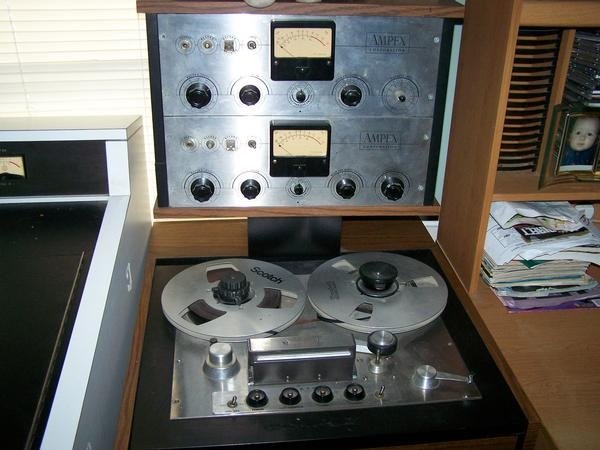
We mastered tapes on those beautiful Ampex 300 two track stereo transports at 15ips. Holes were drilled holes the head cowals so we could easily align the record head to Ampex alignment tape every night. The stations could then easily align their playback machines to the tapes we sent them, making it less likely that mono receivers would get flanging distortion. And there were X/Y scope above every machine we could see the azmuth line.
 -

As for the dreaded pops from LPs that might have a scratch here or there, we didn't have the luxury of throwing out the disk; instead, as you recorded from the LP, you would have a magic marker in one hand -- you heard a pop, you would mark the tape as it moved past the head, then you would need to go back and find the spot and rack that pop back and forth until you were perfectly aligned, mark it, and then VERY carefully, SPLICE IT OUT -- no digital editing program to do it in seconds like you could today, but you could get it so that missing fraction of a second was not audible. I got very good at that, but every pop you heard was alike a stab in the back as it meant longer hours spent on a master hour, until finally KLH came out with a Transient Spike Eliminator that did it as good as the humans. Before that, though, I put my foot down and told the stoners in the front office that I would just reject any package that had more than to pops per LP. They knew a rejected package meant lots of extra work for them. They were pretty good at keeping the pop count down.

We also had a last ditch trick to deal with albums which had dirty noise that couldn't be eliminated with the vacuum cleaner machines we used. It was a mixture of KY jelly (I kid you not) and distilled water. You squirted that on the track that you needed to record until until all the grooves were wetted with no breaks and the stylus and capillary action held a bubble of the solution between the record surface and the needle. That reduced the friction and some of the surface noise. This method was in place when I got there so I didn't question it, but to be honest, I never thought it actually did anything significant to improve a bad sounding LP. When I got to be chief recording engineer, I stopped using it myself, but the two other guys insisted it did work. My solution was to just rejected an LP that was too noisey. We had somewhere like 4 thousand LPs so there were going to be some that were not perfect.
 
Posted by Scott Norwood (Member # 30) on 12-19-2016, 03:15 PM:
 
Umm...wow. Thanks for the description, Frank.

In case it isn't obvious, I find this genre of music (or "musical sludge," as Frank puts it) fascinating. I was born in the mid-1970s and just barely remember it as a mainstream radio format (often on crappy low-power AM stations), but I always assumed that it was the sort of thing that one might put on as background music at a dinner party or retail store or something, not as music actually intended for listening. I do get why the format makes sense for background music (limited dynamic range, unlike classical, and generally inoffensive and often unrecognizable), and I have an odd appreciation for it in that context.

I suppose that the modern replacement is the "classical's greatest hits" format that seems to be popular in many markets now. These are the stations that play Vivaldi's Four Seasons at least once an hour and have a very thin catalog that they play repeatedly with minimal announcing (because their listeners don't really want to learn anything about the music to which they are listening). This is perfectly reasonable for background music, but gets annoying if one listens to it for any length of time. "Real" classical stations that actually play a wide variety of material with announcers who actually know and love the music seem to be rather rare at this point.

Where all of this gets weird to me is that so much radio listening is done in cars, and I don't see either beautiful-music or classical's-greatest-hits as being especially car-friendly. I would think that most people would rather listen to news/talk or "real" music in the car. I know that I would.
 
Posted by Jack Ondracek (Member # 1466) on 12-19-2016, 05:48 PM:
 
During its heyday, "sappy" was not a word connected to the "beautiful music" format, nor was the serious application produced in rooms full of pot smoke. During the '60s, up through the late '70s, production companies, such as Bonneville (yes, the Salt Lake City folks), Schulke (Shul-kee) and TM Productions were fierce competitors for the young-to-middle-aged "housewife" market. Not only was there intense research into tempo, title, composition and commercial ratios, but some very strict contractual rules regarding acceptable tape deck models, preamp electronics, and processing and clipping levels (in Schulke's case... none). Overlap (segue) was generally not allowed. In some cases, 1 to 2 seconds of silence was required between cuts, including commercials. Some of the best technical performance came out of these FM stations, mainly because they understood how sensitive women were (are) to distortion, clipping and nonexistent dynamic range. Maintaining the format subscription involved, in some cases, mandatory submission of periodic airchecks that were reviewed by the production companys' engineers for quality and adherence to the format's "rules".

In the mid 70s, I worked as chief engineer of such a station. The format was important enough to the company that they put the automation in the engineer's office... or maybe they put my desk in the automation room! The format consistently outbilled our live, co-owned country station.

During this same period, local TV stations ran programs, aimed at the homemaker; full of recipes and tips on how to pull stains out of your (stereotypical) husband's shirts. Afternoon movies and bingo games were also popular.

Yes... the audience is old now, but it wasn't then. "Dad" may have been the breadwinner, but "Mom" ran the house and (mostly) raised the kids. She had a healthy lock on the checkbook and these formats were all about suggesting ways for her to use it.

<HAROLD>: Thanks for the memory jog about the A77 and flipping the tape. I'd forgotten about that.
 
Posted by Frank Angel (Member # 248) on 12-19-2016, 07:57 PM:
 
Jack, I didn't mean to imply that the technical standards of the big stations like WPAT or our production house or any other production house using the easy listening format was less than top-draw -- you didn't get away with sloppy production when you are selling product to WLS or other the big boys.

In our studios we produced promotional music program specials for Fortune 500 companies and I can tell you, the technical quality of the work was as good as you could get. LaBrie came from Columbia Records and was a maniac for tech standards and over-all production quality.

The man who was the head technical engineer when I got there was Keith Lacy who had worked with Henry Kloss at MIT and mentored me at LaBrie. I also worked with Alan Meyerson who now mixes the scores for the biggest blockbuster films. The technical standards were top of the class regardless of whether or not any of us happened to like the musical content. It's like you get your projection systems tweaked to the best picture and sound the equipment is capable of -- you don't have to like the movie that it will be running. And of course, there was NEVER smoking of any kind in the recording studios part of the building.

As for the pot-smoking programmers in the front rooms and LP library, these weren't the engineers -- they were the music programmers and statistician who worked out those complicated formulas, and then had to choose the cuts to meet the requirements -- when women are home along, no brass (evidently women and brass or horn instruments are like oil and water, oh, and ABSOLUTELY NO saxophones...who knew), when the guys came home after 5, more percussive sounds could be mixed in. These guys could go right to an album on one of the block long floor-to-ceiling shelves, pull out an LP practically without looking what bin it was in, put it on the turntable and would know exactly what cut to play without looking at the index on the jacket. I would watch them before my shift and I was constantly in aw. LaBrie got the best talented, youngish guys (and one girl) that he could find in NYC and remember, this was the late 60s -- pot was considered by this generation much safer than alcohol and of course all of us except the girl had the Damocles Sword of the Vietnam draft hanging over our heads which could fall at any time...dulling that edge with a little friendly weed was no big deal. These people happen to be great at what they did, two of them musicologists (one a PhD I recall) from Julliard and NYU; the boss pretty much looked the other way when it came to certain of their smoking habits.
 
Posted by Buck Wilson (Member # 5885) on 12-19-2016, 09:11 PM:
 
Thanks for sharing your stories gents, I am endlessly fascinated!
 
Posted by Jack Ondracek (Member # 1466) on 12-19-2016, 09:44 PM:
 
Yep... certainly interesting. Different places at the same time. I must have been in the "uptight" part of the country... having to listen to those tapes, though, given my age now, I guess I have to admit to actually liking some of it...

As much as anything, I was impressed at the background music industry's talent for performing a song that sounded just enough like a commercial artist's version so that it was familiar, yet not close enough that you had to pay royalties on it.

In Frank's defense, he is correct about the production houses being finicky about quality. To the companies already listed, I'd add Drake-Chenault, the distributor of many of the formats aimed at the younger audiences of that time. One of their former engineers works in the Portland, Oregon market, and tells similar stories about excising clicks with grease pencils and splicing blocks. Much of the music that was dubbed to those automation reels came from the same records you or I might have bought back then... but the defects were not allowed to make it to the production copies.

Imagine what we could have done with Audition or Protools back then.
 
Posted by Louis Bornwasser (Member # 3063) on 12-20-2016, 10:02 PM:
 
Jack; I was the nut case Schulke engineer who thought Schulke was too lax. After I had removed any possible extra equipment from our program path, I determined that there was distortion on the violins. I spent months trying to eliminate it. My wife, a professional musician, finally took me to a dinner club featuring violins. Violins are SUPPOSED to be distorted; that is why you need at least 10 of them. To cover up the distortion. This distortion was only audibile on my station. The others were not good enough.
 
Posted by Kristo Nalo (Member # 9748) on 01-03-2017, 05:58 AM:
 
Me I used CD.


Powered by Infopop Corporation
UBB.classicTM 6.3.1.2