This is topic Lotsa Sloppy 'Lab Work' Lately! in forum Film Handlers' Forum at Film-Tech Forum ARCHIVE.
To visit this topic, use this URL:
https://ft-forum.com/ft/cgi-bin/ubb/ultimatebb.cgi?ubb=get_topic;f=1;t=010923
Posted by Jim Cassedy (Member # 4115) on 05-29-2011, 02:41 AM:
I seem to be encountering a lot of sloppy film lab work lately.
>One of my "Hangover 2" prints has a 3min section in Reel
4 where the color balance gets goes 'in & out" followed by
another 250ft or so where the picture goes almost completely
dark. It looks like the film got partly light-struck at the lab.
The color balance was "off" from the begining of the reel,
but then, about 800ft in, I start getting blotches like this:
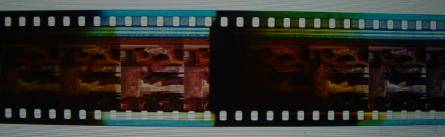
That goes on for about 50ft, and is then followed by this:
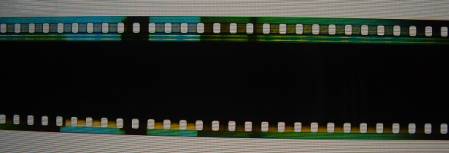
And this goes on for almost another 200ft.
Eventually , the picture & sound comes back to normal.
(and, "no", there are no lab splices in this reel)
I've had a couple of other recent issues too:
> All the SCOPE copies of an "American Express" ad
from Screenivsion I'm supposed to be running this
week are unwatchable. There appears to have been
some problem with the video-to-film transfer,
making it look on screen like a VHS tape with
a bad tracking error. It looks horrible!
> I've also had trouble with two Technicolor 3D
ads in the past two weeks. In both of them it
looks like the film slipped in the printer. The
framelines are "not where they are supposed to be."
For example, note how in this TARGET ad,
the frame lines are each bisecting a
perforation, instead of being BETWEEN
the perf holes, where they should be,
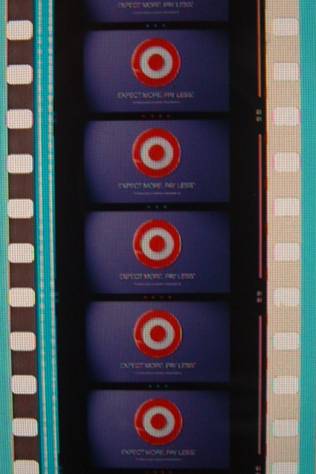
(3D Print- The framelines are delineated
by the two small dots on the right, which
are 1/2 perf off from the proper position.)
A 3D 'FORD' ad I had last week had the same problem,
only worse- - the frame lines were actually MOVING,
as the film was apparantly slipping in the printer.
The effect on screen was that it looked like someone
was constantly trying (unsuccessfully!) to 'frame'
the projector and,since this was a 3D print, it meant
the the 3D was going in-&-out of correct left/right
'phase'. It all looked very interesting on screen,
but I'm sure it's not what the advertiser intended.
I pulled all 3 ads off screen since they looked so awful.
Are the lab guys actually trying to kill off film entirely?
Posted by Richard P. May (Member # 3598) on 05-29-2011, 11:10 AM:
Jim,
Instead of generalizing that "the lab guys are getting sloppy", can you specify which lab made the prints at fault?
You are right, but let the guilty be flagged.
Posted by Frank Angel (Member # 248) on 05-29-2011, 01:43 PM:
Jim, that's just a bad reel and needs to get a replacement going ASAP. As for the others, quote: Jim Cassedy
Are the lab guys actually trying to kill off film entirely?
Nah, they are just trying to kill off ads on theatre screens. ![[thumbsup]](graemlins/thumbsup.gif)
Posted by John Wilson (Member # 269) on 05-29-2011, 05:48 PM:
quote: Frank Angel
Jim, that's just a bad reel and needs to get a replacement going ASAP.
I would imagine he realizes that already.
Posted by Julie Fundenberger (Member # 6319) on 06-07-2011, 11:26 AM:
I've only been a projectionist for about a year now and have been noticing this type of stuff a lot more in the last few months. One of our X-Men copies had an extra sprocket hole (forgive me if my terminology isn't quite right yet) in a splice melted together by the lab. Is this something that happens once in awhile? Or have I experienced a once in a lifetime type of thing? Want to know if I should be expecting it more often. ![[Big Grin]](biggrin.gif)
Posted by Bryan Parkhurst (Member # 6072) on 06-09-2011, 07:24 PM:
I've been noticing similar problems lately also.
The 2D print of Thor we received this week had several bad optical sound spots where the track diminished and a loud humming gradually took its place. There were several sections like this lasting between 10 or 20 seconds and it was not isolated to a single reel.
Another problem was with the splice markings between the head of reel 1 and the attached trailer for the Hangover 2. there's usually that little triangle/arrow in the sound bar that points where to cut to remove the trailer on a frame line. Both prints of Hangover 2 came with the arrow 1 sprocket hole off.
Posted by Bajsic Bojan (Member # 4928) on 06-10-2011, 10:26 AM:
-ignore-
Posted by Michael Brown (Member # 890) on 09-19-2011, 10:31 PM:
quote: Julie Fundenberger
One of our X-Men copies had an extra sprocket hole (forgive me if my terminology isn't quite right yet) in a splice melted together by the lab.
Had something like this in a Harry Potter trailer earlier this year. Although the opposite way round - in the lab join they had lost a sprocket hole, instead of gaining one. (the two frames on eith side of the splice were spread out over 7 holes, instead of 8)
Posted by Leo Enticknap (Member # 534) on 09-20-2011, 08:55 AM:
quote: Julie Fundenberger
One of our X-Men copies had an extra sprocket hole (forgive me if my terminology isn't quite right yet) in a splice melted together by the lab. Is this something that happens once in awhile? Or have I experienced a once in a lifetime type of thing? Want to know if I should be expecting it more often.
Release print stock is supplied to labs in rolls of 6,000 feet (about three and a half 20-minute reels). The end of an outgoing reel is ultrasonically spliced to the start of the incoming one on the printer, while the source negative(s) being printed from are still laced up, hence the reason you sometimes get lab splices in the middle of a reel of release print.
In the past, labs would try to use up the short ends of these 6k reels to print trailers, unusually short last reels of features (so any lab splice would end up in the end credits) or other situations in which they didn't have to put a lab splice in the middle of anything important. But as 35mm winds down as a mainstream release format, quality control is becoming less of a priority with the shrinking market and as a result, lab splices in the middle of reels of feature film prints are becoming ever more common. The lab technicians making these splices have to do so in absolute darkness, so I guess it's not surprising that they're not always on the frame line.
Posted by Bob Bregazzi (Member # 5623) on 09-20-2011, 05:31 PM:
in reply to the last post. surely the film would be joined before it goes through the printer, that would explain why joins are more than likely out of rack. you are joining to blank pieces of film together.
Posted by Randy Stankey (Member # 64) on 09-20-2011, 07:18 PM:
Lab splices might not occur on a frame line. In fact, there is only one chance in four, that a splice will occur on-frame. However, regardless of the location of the splice, the sprocket holes should be in registration. The film should run continuously through the projector without jumping out of frame.
The prudent operator should always inspect all his film to check for lab splices and cut them out. Even if they are on-frame, they should still be cut out.
I would think that the fact that digital projection is becoming more prevalent would make the people who still process film should be MORE attentive to their work, not less.
I said it before, there is a real lack of craftsmanship in society today and this is just one more bit of evidence to prove that.
Posted by David Mann (Member # 4917) on 09-20-2011, 10:54 PM:
In addition to all this, I am increasingly getting calls from our theatres about digital soundtracks dropping out into SR. I have run test film on 99% of these complaints, and found nothing wrong with the readers. Are the soundtracks suffering as well?
Posted by Leo Enticknap (Member # 534) on 09-21-2011, 06:07 AM:
quote: Bob Bregazzi
in reply to the last post. surely the film would be joined before it goes through the printer, that would explain why joins are more than likely out of rack. you are joining to blank pieces of film together.
Exactly. If you were able to do this in the light, you could use a synchroniser (or some other way) to count back from the contact printer's gate to ensure that your join would go through on the frame line. In pitch darkness (or working with your arms stuck through the light trap of a change cabinet next to the magazine holding the new roll of stock, a bit like a changing bag you use for taking 35mm still film out of its cartridge and winding it onto the spiral magazine of a developing tank), you can't.
quote: Randy Stankey
The prudent operator should always inspect all his film to check for lab splices and cut them out. Even if they are on-frame, they should still be cut out.
I'd guess that the issue is not so much imprudent lab technicians, but rather squeezed budgets: for example, labs are simply not willing to have the money tied up storing a room full of unused short ends of print stock until an order comes through for 3,000 trailers or 1,500 copies of the last reel of a feature that is only 700 feet long and all credits.
Posted by Bob Bregazzi (Member # 5623) on 09-21-2011, 07:41 AM:
irrespective of hows labs assemble prints, what happened to quality control?
Posted by Gordon McLeod (Member # 33) on 09-21-2011, 10:06 AM:
Since the stock hasn't been printed yet it has no defined frame line
The lab standard has always been a maximum of 2 raw stock splices per 2000' reel but many studios will ask for more short ends to be used to get a cheaper price
I know one distributor that asked if they could use short ends of different brands to get a cheaper price on a low budget release
I havent seen many soundtrack issues yet
Posted by Mike Blakesley (Member # 26) on 09-21-2011, 11:47 AM:
quote: Randy Stankey
I would think that the fact that digital projection is becoming more prevalent would make the people who still process film should be MORE attentive to their work, not less.
Nope. If you're on a sinking ship, you're too busy bailing water or lowering the lifeboats to worry about swabbing the decks.
Posted by Leo Enticknap (Member # 534) on 09-21-2011, 12:11 PM:
quote: Gordon McLeod
Since the stock hasn't been printed yet it has no defined frame line.
It does in effect because the outgoing reel, the end of which you are splicing to the incoming one, is already in the picture gate of the printer and (assuming it's a continuous or step contact printer) therefore its position is fixed in relation to the negative it's being printed from. When you've made the splice, both the unexposed print stock and the source negative stock will start to move through the printer gate in sync together, as they were before, as the splice goes through the gate.
Posted by Gordon McLeod (Member # 33) on 09-22-2011, 09:17 AM:
Yes but the splice must be made with the film still in motion with only a loop absorber to allow a stop of motion at the splicer
Posted by Richard P. May (Member # 3598) on 09-22-2011, 10:02 AM:
The initial complaints were about out of frame splices made in release prints. These are physical splices in already made prints, not raw stock splices. If unexposed film is spliced together, it could result in a mid-frame splice once in a reel, but not out of frame. It could also cause some fogging by a too-long exposure under the safelight while the film is being handled.
The splices shown at the start of this topic are sloppiness, but under production conditions are bound to happen occasionally.
Powered by Infopop Corporation
UBB.classicTM
6.3.1.2