This is topic Orcon Boost Unit for Osram Bulb in forum Film Handlers' Forum at Film-Tech Forum ARCHIVE.
To visit this topic, use this URL:
https://ft-forum.com/ft/cgi-bin/ubb/ultimatebb.cgi?ubb=get_topic;f=1;t=010929
Posted by Barry Floyd (Member # 385) on 06-05-2011, 01:00 AM:
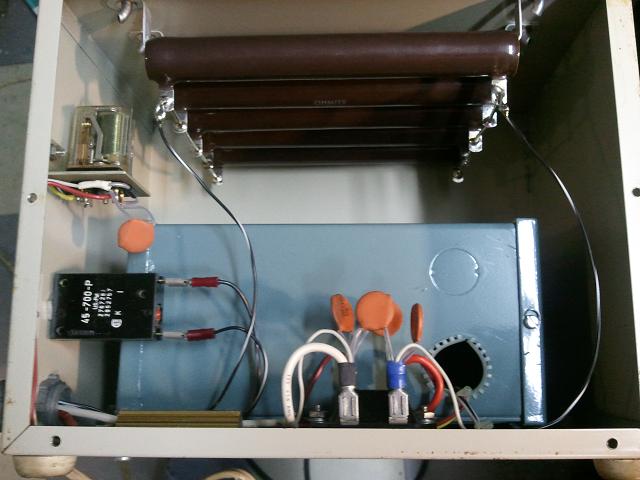
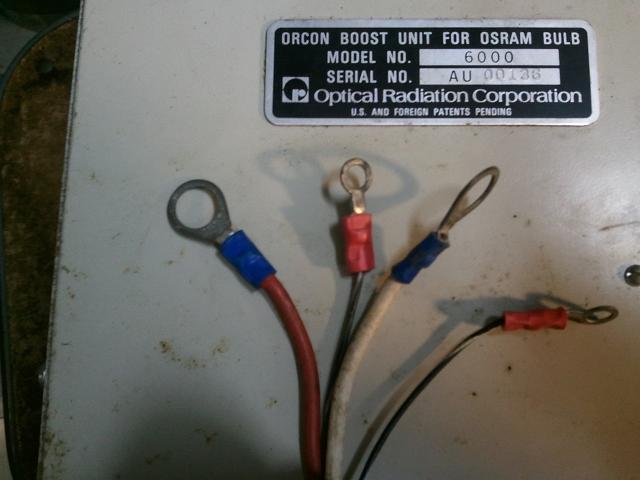
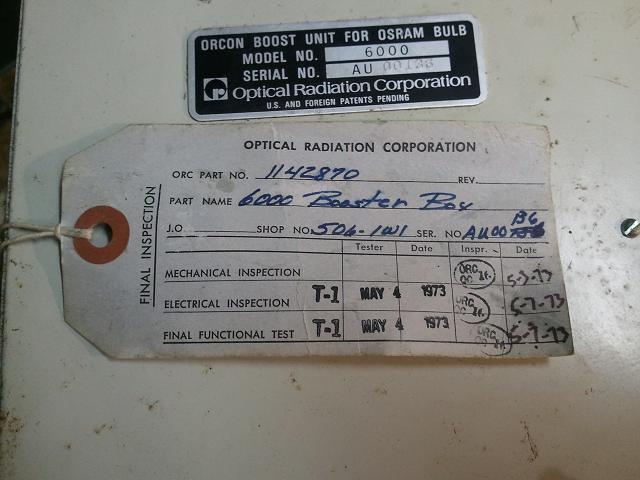
Has anybody ever dealt with one of these units? Friend in Ohio has one of these, and wanted to know what exactly does it do, and how does one go about hooking one of these things up? He posted some photos on the drive-in owners forums, and the thing looks to have been made back in the early 70's.
It has an ORC part number 1142870 if that helps any. He says he's having a difficult time re-igniting a 6000 watt bulb once it gets hot, and was hoping this might be a solution.
Posted by Louis Bornwasser (Member # 3063) on 06-05-2011, 05:32 AM:
First, I am unaware of sny ORC product that is reliable over 4500 watts, especially the orc 6000 (marketing).
That add-on pruduct has 4 wires; two of which are on alligator clips.
Is he using an orc rectifier, if so, which one? Louis
Posted by Tim Sherman (Member # 569) on 06-05-2011, 02:47 PM:
Louis,
I am the one that Barry is refering to. The rectifier is a RPS-X60 The Problem I seem to be having is the lamp will not relight once the bulb is warm unless is cools down completely (10-15 mins) Not enough voltage to reignight the bulb once its hot maybe? and i would assume thats what the boost unit takes care of? The boost unit has 4 wires coming off of it, two heavier awg wires (10awg i think) 1 white and 1 red. the other 2 (about 16awg) are both the same color like a black or brown. All 4 of the wires have ring terminals crimped on them.
Posted by Monte L Fullmer (Member # 2797) on 06-05-2011, 10:50 PM:
..almost sounds like, in automotive terms, a major case of fuel line "vapor lock" - fuel gets hot, expands and refuses to be pulled by the fuel pump until it gets cool and contracts enough to allow flow (why they learned to put pumps in the tank to push the fuel forward and insulate the lines better..)to the carburetor.
Have you done a no-load voltage output reading, per chance right before a "hot start"?
Wonder if there are some tired caps in the igniter if no-load voltage is good...esp if the unit was built in 1973 and never rebuilt.
Good luck - Monte
(p.s.- 6000 posts...getting up there..)
Posted by Sean Weitzel (Member # 244) on 06-05-2011, 11:12 PM:
6000 posts of priceless knowledge. Thanks Monte, and all others on this board. I've never worked in a cinema but feel I could walk in and run the show based on what I have learned here.
Posted by Monte L Fullmer (Member # 2797) on 06-05-2011, 11:59 PM:
N/P (and thx) Sean, and I'm also still learning as I come on here as well - why I have posted quite the bit..
Posted by James Westbrook (Member # 3690) on 06-06-2011, 02:26 AM:
I'm impressed it's lasted this long. May of 1973. Wow.
Posted by Mark Gulbrandsen (Member # 72) on 06-06-2011, 08:05 AM:
quote: Louis Bornwasser
First, I am unaware of sny ORC product that is reliable over 4500 watts, especially the orc 6000
I still have several running. If you repair the burned apart aluminium transformer wiring correctly they last for ever. Donno what the boost box is... Newmaid had a boost box for older Irem rectifiers that you needed because the older Irem rectifiers primary winding was for 240/380 volts(European). Run one on 208 volts and the no load would be so low ~60 to 70 volts dc that you would not be able to light a lamp(especially hot) with several hundred hours on it. The booster worked to increase the no-load dc voltage up to the ~150 volt area so the lamp would ignite. I installed several of them and they worked great.
Mark
Posted by Gordon McLeod (Member # 33) on 06-06-2011, 01:31 PM:
That rectifier was actually a Miller Arc Welder thaat ORC rebranded
The boost box was to raise the no load voltage as osram was one one of the first to change there bulb construction requiring a higher no load voltage (remember when xenon was first intorduced the osram spec was 65v no load)
Two wires connect to the mains 120vac and the two that come from the small rectifier go to the DC output terminals
Posted by Tim Sherman (Member # 569) on 06-06-2011, 02:33 PM:
Gordon,
You are saying the smaller wires connect to a normanl 120vac L1 & neutral I am assuming, or should the 120vac come from the signal wire from the contactor? and the two larger awg wires to the the + and - output of the rectifier? any idea on the poarity of the two? i would guess red + and white -
Posted by Gordon McLeod (Member # 33) on 06-06-2011, 03:47 PM:
They did make a 110 and a 208 version
find the transformer in it and see if there is anything marked on it
Posted by Tim Sherman (Member # 569) on 06-06-2011, 08:49 PM:
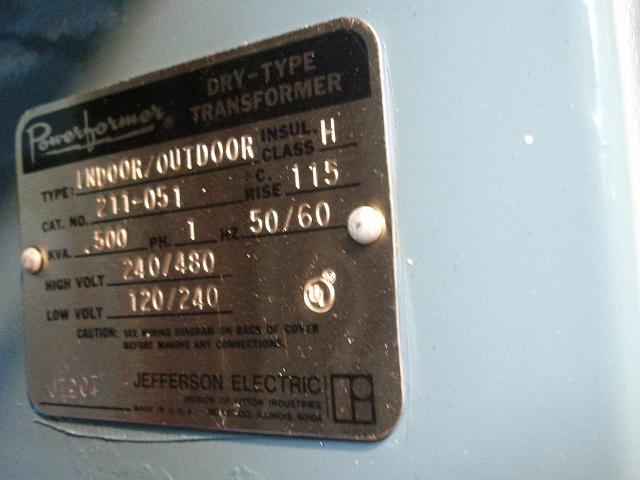
My guess after checking the label would be to hook it up at 120vac. correct me if im wrong
Posted by Tony Bandiera Jr (Member # 2365) on 06-06-2011, 10:41 PM:
The issues in this thread reinforce why I hate ORC's crappy equipment so much. Their designs sucked and they cobbled together things not intended for the use. (Arc welders and their transformers were designed for short duty cycles, like around 20%).
With my griping aside, Tim, to answer your hookup questions, the two small wire should come from the contactor's coil and the large leads hook up as you mentioned, red + white - to the output of the rectifier.
To verify the contactor voltage, connect a voltmeter to the leads on the contactor coil, with the range set to 300v or higher AC and turn the rectifier on. You'll most likely get 120v, but with ORC who knows. They never played by the rules.
Oh yeah, and since this boost box was made in 1973, don't be surprised if it either doesn't work at all or if the caps inside explode. Electrolytic caps that sit around unused dry out and can fail when energized. (I am presuming that there are electrolytic caps in the grey can in the boost box...)
Edited to add:
If the transformer label you posted above mine is in the boost box, then both my hookup suggestion, voltage measurements and comment about e-caps changes to the following:
The small leads should probably connect to any two legs on the LOAD side of the contactor feeding the rectifer.
There appear to be no e-caps if they aren't in the grey box, so the only concern would be misconnection burning something up. You probably don't want to put the "fire" in rectifier, so a good bet on this one would be to get a tech in your area to hook this thing up. It becomes a choice of spending a few hundred for a tech call or a lot more to replace a burned-up rectifier.
Powered by Infopop Corporation
UBB.classicTM
6.3.1.2