This is topic Shadows in the scope format. in forum Film Handlers' Forum at Film-Tech Forum ARCHIVE.
To visit this topic, use this URL:
https://ft-forum.com/ft/cgi-bin/ubb/ultimatebb.cgi?ubb=get_topic;f=1;t=010945
Posted by Leonardo Miceli (Member # 4417) on 06-19-2011, 11:29 AM:
Hi friends. I need some help.
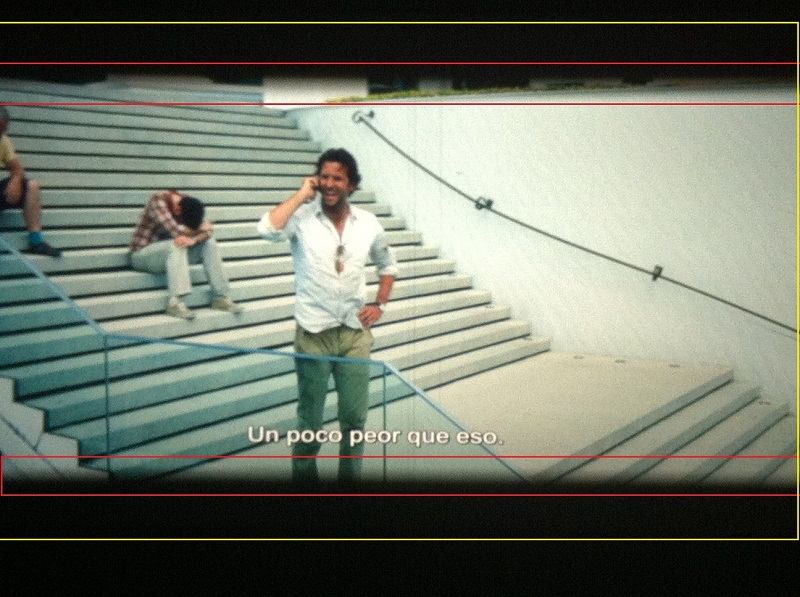
I have 9 cfs2000 consoles with a simplex pr1060. I also have floating screens (flat) in all the auditoriums. The problem is, when the format is in scope, there are shadows in the top and buttom of the image. I need to know if this shadows are normal or what can be causing this problem? the projector angle could be a factor? because all the projectors have more than 10°.
Thanks for your help!
Leonardo
I´m attaching a picture of the problem, the yellow line indicates the screen, and the red box shows the shadows.
Posted by Victor Liorentas (Member # 5272) on 06-19-2011, 12:18 PM:
This looks like the edges of your aperture plate which would normally fall on your masking curtain.
The closer your aperture plate is to the film during projection,the smaller the shadow.
Is your gate close stop set exactly right?
The plates may be filed poorly or are a type with too much space between the film built in.
Posted by Gordon McLeod (Member # 33) on 06-19-2011, 02:27 PM:
Well before you completely blame the apperture plate is the correct lens installed?
I have seen many floating frames where since they are typically a fixed aspect ratio they do not fill them in the scope format
Posted by Monte L Fullmer (Member # 2797) on 06-19-2011, 04:51 PM:
True though, looks like the prime lenses are not the right focal length to fill the screen.
I used to work in a 6plex cinema that had floating screens (and hated them horribly for such since you can't have sharp corners since they were unmasked..) and this is how my scope presentations were also .. blurred edges.
I had PR1050's with curved gates, but with the older single aperture plate setup, and the PR1060's, were close in design outside of that unfortunate swing gate.
I absolutely recognize this problem being that the aperture plate is so far back behind the film plane (about a good quarter inch) in the trap and gate assembly that these shadows are created when the light leaves the aperture plate and enters the film.
If the film was a lot close to the aperture plate, these shadows don't have a chance to be created. Thus, we can more blame the machine setup than the aperture plate if this is so.
Only trick that I did to minimize these shadows was to actually over cut the aperture plate then mask the windows with black tape so the bleedover wasn't too noticable, but gave me more of a better filled screen in scope.
Flat: I bet your image on the screen is terribly surrounded by these shadows.
Posted by Chase Pickett (Member # 5975) on 06-19-2011, 04:59 PM:
I'm guessing your best bet would be to put some tape on the port glass to cut down on the shadows. Just make sure it's tape that won't leave any stickiness behind.
Posted by Joe Redifer (Member # 3) on 06-19-2011, 05:39 PM:
The "tape on the port glass" method doesn't help much if at all. Since the port glass is so far from the focal plane of the lens it will do nothing but create very soft shadows.
Posted by Leonardo Miceli (Member # 4417) on 06-19-2011, 08:09 PM:
the gate closes fine, and the lenses are correctly calculated and installed, and yes, in the flat format is surrounded by these shadows, but in this case over cut the plates leaving these shadows out the screen.
is there any other explanation for this problem or something else I can do to fix it?
Thanks
Posted by Louis Bornwasser (Member # 3063) on 06-19-2011, 08:29 PM:
Remove aperture plates completely to see if there is enough "picture." Shadows should also be gone gone.
Remember on XL, you can only move the gate until the intermittent shoes become tangent to the sprocket.
Sometimes the aperture plate does not seat completely.
Louis
Posted by Monte L Fullmer (Member # 2797) on 06-19-2011, 10:04 PM:
Course, big prob with the PR-1060's was the INT shoe attached to the swing gate, and if that shoe (or sprocket, in that matter) aren't aligned precisely with each other on closure, catastrophic stuff happens.
I do believe that the PR-1060's uses the slider aperture plate that the Mil2K units adopted.
Ya, I was going to mention what Louis said above, but forgot to include that - to take the aperture plate out and see where you're all at with with a no-aperture presentation.
Thus, I bet that your plates were then undercut, which buys you room for trim.
Posted by Michael Brown (Member # 890) on 06-20-2011, 10:43 AM:
Hold on....the yellow line is the edges on the screen?
What ratio is the screen? Is it a flat ratio screen and you are showing the scope image letterboxed across the middle?
Posted by Leonardo Miceli (Member # 4417) on 06-20-2011, 11:00 AM:
That's right, it's a flat screen.
Posted by Robert Minichino (Member # 3495) on 06-20-2011, 11:06 AM:
If you don't have masking, you're going to get soft edges on one of your formats no matter what you do. Projectors differ in their ability to project a sharp frame edge (as others have said, the closer the aperture plate is to the film, the better), and you can file the aperture plate with a bevel to try to sharpen the edge further, but it's still not going to be as sharp as it would be with masking.
Posted by Michael Brown (Member # 890) on 06-20-2011, 11:31 AM:
quote: Monte L Fullmer
Ya, I was going to mention what Louis said above, but forgot to include that - to take the aperture plate out and see where you're all at with with a no-aperture presentation.
It's scope projection on a flat screen, that would leave him with the bottom of the previous frame and top of the next frame visible on screen. ![[Smile]](smile.gif)
The high tech solution to this problem would be to switch out the film projector for a digital - no plate shadow there ![[Wink]](wink.gif)
...could there be a low tech solution like making some black strips of some kind of material to stick on the top and bottom of the screen when projecting scope.
Posted by Monte L Fullmer (Member # 2797) on 06-20-2011, 12:34 PM:
quote: Michael Brown
would be to switch out the film projector for a digital - no plate shadow there
...lol .. got $62K+USD then..?
I've seen, 1x10's painted flat black, or covered with black dubitene fabric for masking strips..
Posted by Frank Angel (Member # 248) on 06-20-2011, 12:35 PM:
The Final Solution would be to have a PROPER screen and masking that match the actual aspect ratio of the picture being projected. As has been already said, if your screen is physically larger than the image and you don't have masking, you will ALWAYS have this kind of blur edge -- it's part of the nature of the film/aperture/optics. The solution is have a correctly designed screen and masking system....you know, like real theatres do. Or invest in digital. And then you might have a better looking image edge, but it STILL wouldn't be properly masked; it just won't be so obvious, but a MISTAKE nontheless.
Posted by Monte L Fullmer (Member # 2797) on 06-20-2011, 12:38 PM:
Sadly, floating screens are tons cheaper to install than framed and masked screens, and I bet his venue was constructed on the economical side .. like some around here and it shows badly.
There is a cheap get-around on this issue and that is to reline the back wall behind the screen with black dubetene fabric then overcut the aperture plates where the image on the screen will look full. The dubetene material should then soak up the stray light that goes beyond the edges of the screen.
-Monte
Posted by Leonardo Miceli (Member # 4417) on 06-20-2011, 02:41 PM:
jaja LOL, I'd like that solution too, but unfortunately it would be $62Kusd x 6, and still I'll have the same problem, because the 35mm projectors will remain installed.
Another question.
why the same kind of shadows produced by a Christie P35GPS projector is sharper or smaller than shadows of the simplex projector?
because I have another complex with the same kind of screens but with christie projectors and in there I don't have the shadows so big.
Posted by Gordon McLeod (Member # 33) on 06-20-2011, 02:57 PM:
The thickness of the aperture plate material and the distance that it is spaced back from the film plane and also the focal length of the projection lens and its depth of focus
Posted by Victor Liorentas (Member # 5272) on 06-20-2011, 02:57 PM:
I am certain it's worse on the Simplex machines because the aperture plates are further away from the film in the gate and perhaps your lamp focus is a bit off.
Posted by Monte L Fullmer (Member # 2797) on 06-20-2011, 03:30 PM:
Ya, those Christie double aperture openings on the P35's are so close to the film plane that very little shadow is created.
Posted by Michael Brown (Member # 890) on 06-20-2011, 03:39 PM:
Interesting photo from flickr of the former elephant and castle Odeon.
"Former Odeon / Coronet Elephant & Castle - the "floating" screen has no masking at the top or bottom but had two black panels which rotated around from the back of the cinemascope screen to mask the sides for standard ratio."
http://www.flickr.com/photos/stagedoor/365965089/
Posted by Monte L Fullmer (Member # 2797) on 06-20-2011, 03:51 PM:
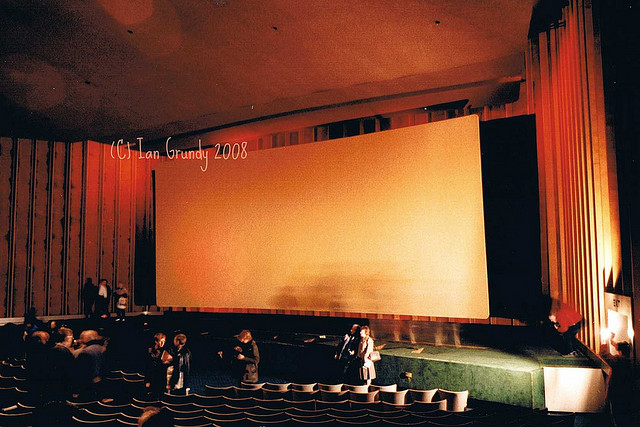
Now, look at this one: maybe this place has some anti-reflective back drapery to hide the shadows if the scope image filled the screen. But, they could have had projectors with excellent usage of apertures where there was slight bleedover on the sides to where it was a good image.
The "floating screen" concept was designed to have small lights surrounding the left/right edges to give it an appearance of a drive-in screen with the sun behind it at dusk.
(Be a good screen for digital though....)
Posted by Michael Brown (Member # 890) on 06-20-2011, 04:44 PM:
Thanks for posting the picture, I just posted the link because I couldn't find the upload button anywhere, am I going mad?
Posted by Monte L Fullmer (Member # 2797) on 06-20-2011, 05:11 PM:
You click the "click here to upload an image" link below the text entry window and follow instruction on how to post pixs here.
I went to that page that you attached the link to and right click and save the pict to the HD and went from there.
Luckilly, it was smaller than the required pixel size, otherwise I'd had to wait until I got to a computer with a pix editor to resize per site requirements.
good luck - Monte
Posted by Louis Bornwasser (Member # 3063) on 06-20-2011, 08:31 PM:
Remember, with masking it is OK to have picture 6 inches into the material; that is why it is black. Louis
Posted by Frank Angel (Member # 248) on 06-20-2011, 09:02 PM:
Well if the floating screen is the same as this picture, then with a correctly sized lens, the scope picture should over-shoot the screen slightly so the shadow projects beyond the frame. With black velour behing the floating screen should aborb the over-shoot. The only image that would be compromised then would be the 1.85 since its left and right edges would fall on the screen.
The one screen I saw like this had a unique solution to the 1.85 image problem. Two slits in the ceiling allowed two ribbons of about 6 - 8 inches each unrolled thru the slits openings in the ceiling. The velour "edges" for the 1.85 would unroll slowly out of the ceiling before the film would start. It looked weird and certainly unusual and a strange "fix' for a problem that initially is created by the silly design itself, but ultimately it did do the job. But that was only needed for 1.85 within scope width; nothing was needed for scope because it was a properly sized scope screen as in the picture above; the scope image overshot on all sides.
IF, on the other hand, the theatre was using a fixed WIDTH screen (adding insult to injury), making it impossible to project scope to fill the screen top to bottom, then the ONLY other solution is to plant plastic explosives around the theatre perimeter and just blow the damn thing up.
Posted by Louis Bornwasser (Member # 3063) on 06-20-2011, 09:47 PM:
You know if you work hard enough, you can forse 35mm to be bad enough that even dvd looks better. You have to work at it, though. Louis
Posted by Monte L Fullmer (Member # 2797) on 06-21-2011, 12:18 AM:
quote: Frank Angel
the theatre was using a fixed WIDTH screen (adding insult to injury), making it impossible to project scope to fill the screen top to bottom, then the ONLY other solution is to plant plastic explosives around the theatre perimeter and just blow the damn thing up.
like this one 6plex I know of that needs this form of distruction: On houses using a 9x18ft screen for both scope and flat - fully filled screen for both images (yes, a 2.00:1 flat aperture plate..) and the flat image looks so crowded being so vertically cropped on both top and bottom .. and framing on this is a trick to make it look decent.
Powered by Infopop Corporation
UBB.classicTM
6.3.1.2