This is topic Port glass window styles and types comparison in forum Film Handlers' Forum at Film-Tech Forum ARCHIVE.
To visit this topic, use this URL:
https://ft-forum.com/ft/cgi-bin/ubb/ultimatebb.cgi?ubb=get_topic;f=1;t=010951
Posted by Alexis Mayer (Member # 3967) on 06-25-2011, 03:42 PM:
I work at a community cinema in Bryn Mawr PA (http://www.brynmawrfilm.org/)that is in the process of planning a major theater upgrade/addition. I have some idea of the various styles and types of port glass windows - individual ones that open and close, long ones that span the length of the booth, angled glass that minimizes the collection of dust - can anyone elaborate on these types of port windows, other types, their pros and cons, and any other elements of consideration when choosing port windows. Thank you for your comments!
~AM
Posted by Brian Guckian (Member # 1678) on 06-25-2011, 04:12 PM:
Here are some pointers:
1) Avoid elongated continuous portholes unless absolutely necessary as they are poor from a sound transmission standpoint and also pass ambient control room / booth lighting into the auditorium
2) Use small, separate projection and viewing portholes, typically 600mm x 600mm / c.2ft square (overall ope, glass size will be smaller to account for frame) for the former and 300mm x 300mm / c. 1ft square (overall ope) for the latter
3) Portholes should preferably be openable for cleaning; the frame surround should be gasketed with a rubber or other type of sound isolating material to prevent noise transmission
4) The glass panes should also be gasketed internally to isolate them from their frames; this a major source of sound transmission that is sometimes overlooked
5) For the projection porthole panes, the glass should be 6-10mm thickness and importantly of the "white" (low iron) float type (e.g. Schott Pyran S) so that there is no colouration of the image. It is also preferable to choose an anti-reflective coated glass, but note that several such products are not fire-rated
6) For greater sound isolation standards (e.g. THX) an angled double porthole needs to be employed for the projection ports (but this is probably not relevant to your situation)
7) Ready-made projection ports, with several different options are made by firms such as Kelmar (Kelmar Projection Ports) and others
Hope this helps - no doubt other contributors here will be able to add to this.
Posted by Scott Norwood (Member # 30) on 06-25-2011, 04:19 PM:
Be aware that there may be fire or public-safety codes relating to this issue. Be sure to look into those before making a decision.
I strongly prefer small portholes (12" square seems to be standard). These keep the amount of light and noise leakage into the auditorium to a minimum. Since projection ports should use proper (and expensive) optical glass, small portholes will keep this cost to a minimum.
My "ideal" booth would have one set of portholes (projection and viewing) per film projector (no viewing port is needed for a video projector), an additional set of portholes with shutters (for a second or third projector, slide projector, 16mm projector, video projector, etc.), and a large (maybe 3' square) port with a shutter. You never know what equipment might be needed in the future (followspot? DLP projector? 16mm projector? something else?), and it is best to prepare for this possibility now. Normally, the shutters on the "extra" ports can remain closed to reduce light leakage.
Also, please make sure that at least one of the viewing ports can be opened from within the booth. This is useful for quick checks of sound volume and also in case cables ever need to be run between the auditorium and the booth.
Unfortunately, the trend (especially in multi-use facilities) seems to be towards either giant portholes that span the length of the booth, or ones that are large enough to allow a single porthole to be used for both projection and viewing. I hate these. ![[Mad]](mad.gif) The only real advantage that I can see is that they give additional flexibility for future equipment additions at the cost of serious noise and light leakage issues.
The only real advantage that I can see is that they give additional flexibility for future equipment additions at the cost of serious noise and light leakage issues.
One more trend that I dislike is for a video projector to be installed between two 35mm projectors. In one such installation, the architect actually included a separate viewing port for the video projector ![[Roll Eyes]](rolleyes.gif) . Coupled with a very short throw, the keystoning in that venue was quite bad. Please do not do this without a really good reason.
. Coupled with a very short throw, the keystoning in that venue was quite bad. Please do not do this without a really good reason.
Posted by Brian Guckian (Member # 1678) on 06-25-2011, 04:39 PM:
Just to clarify also that with a 100mm / 4inch frame all round the size I quoted above for a projection porthole comes to 15 3/4 ins square, which is not dissimilar to Scott's figure of 12 ins.
Another factor in porthole size is the projection throw (short throw will lead to larger image appearing on the glass), distance of the projection lens from the glass, and also thickness of the booth wall.
Measurements should also be referenced to the widest picture format (usually 'Scope) to avoid accidentally clipping the edges of the image, which sometimes happens.
Posted by Monte L Fullmer (Member # 2797) on 06-25-2011, 05:12 PM:
..just make windows large enough, (or use the projectionist side window), so that one can see the screen when targeting bulb installs...and please, make them removable for sound cabling to pass through when doing sound installs and alignments since microphones have to be placed in the auditoriums.
I've seen booths with fully sealed windows - "dang, didn't think on doing sound checks, did yas?"
-Monte
Posted by Brian Guckian (Member # 1678) on 06-25-2011, 06:55 PM:
quote: Scott Norwood
I strongly prefer small portholes (12" square seems to be standard)
Scott is correct; apologies as the larger dimension I gave earlier was based on the use of openable wooden frames, whereas many portholes use smaller, metal frames. So Scott's figure is the right one to start with.
Posted by Scott Norwood (Member # 30) on 06-25-2011, 07:10 PM:
Here's a shot of a "what-were-they-thinking" booth. The video projector has its own viewing port and is between two 16/35 projectors. Also, all of the viewing ports are mounted way too high on the front wall. This is a particularly bad issue because the controls on the Kinoton projectors are mounted on the front of the column, under the lens. This makes it impossible for a normal-height individual with normal-length arms to operate the controls while looking out the viewing port. I suppose that this is one of the few good things about oversized projection ports. The keystoning is pretty bad, which is unfortunate in an otherwise nice installaiton.
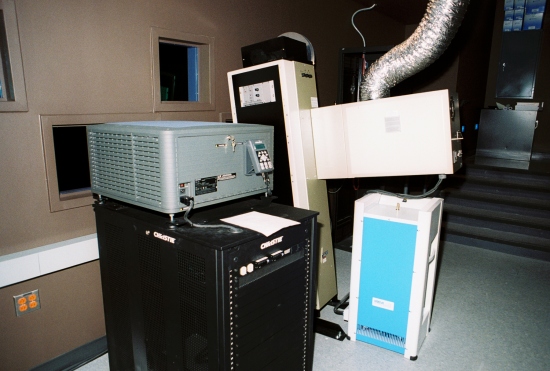
And another shot facing the other direction. Note the position of the projector controls and the excessive height of the viewing port.

Posted by Frank Angel (Member # 248) on 06-29-2011, 03:35 PM:
Large, wall-to-wall openings seem to be the darlings of architects and multi-function facility operators because they allow the audience to see all that high-tech equipment which the operator just paid big bucks for. And I admit, it does have a wow factor, audiences looking up and seeing those big projectors and twinklying indicator lights, but that wow factor lasts about as long as it takes to say "wow." From that moment on, it's just misery for the projectionist.
One of the main things is, that such a construction almost ALWAYS will eschew real optical coated port glass because unless the organization wants to add a huge price tag just for the glass itself, they won't be able to afford the cost of a huge pane of real, optical quality, coated glass for such an install. So right off the bat, whatever else they put it will compromise the image on the screen; how insane to design THAT into a new projection booth?
Next, any operator will find they need to work in near darkness because such a projection "wall" makes controlling booth light spill into the theatre nearly impossible. In the booth in which I work where there is such a window, we can use no general lighting at all and have to run the show using only Little-Lites for illumination, and even those need to be aimed carefully. And you'd better plan to have all the booth walls painted flat black because anything else will reflect light back into the theatre and onto the screen. We had to even take down a small bulletin board on the back wall because, pin a few time schedules to it and the white paper reflected light back onto the screen. And such a large window is very difficult and costly to try to angle it, so be sure they will want to set it like a normal window, i.e., parallel to the walls and that has it's own sets of problems because it reflects that projection beam right back at the projector lens and the metal on the projector body which in turn reflets it back into the theatre and onto the screen.
We found in one instance the window was reflecting a perfect second image from the lens front element back onto the screen causing the image look soft focus. It took us hours to figure out what was wrong with the projector, the lens, the gate and all the other possibilities we considered. Nothing was! It was the damn window.
If you can't easily reach the glass from the theatre side, you'd better make absolutely sure the port glass can be removed for cleaning -- angled or not, it will get dirty (btw, angling the glass is not to keep it clean, it's to reduce reflections both light and sound). You really don't want to have to put scaffolding up every time you need to clean the port glass.
And like everyone says, the sound leakage from booth into the theatre with large windows is a big issue. We couldn't talk in a normal conversational voice without being heard in the balcony.
Posted by Gordon McLeod (Member # 33) on 06-29-2011, 04:23 PM:
I usually spec the projection openings being 30x24 since that allows for other equipment of different optical centres and image sizes to us the same ports
though it has draw backs it does allow flexability
Posted by Alexis Mayer (Member # 3967) on 07-01-2011, 03:29 PM:
Wow, thank you for all for your super informative comments!
Posted by Mark Gulbrandsen (Member # 72) on 07-01-2011, 06:42 PM:
Also, since you are in a large city check your local codes. Some require tempered glass in all window type openings.
Mark
Posted by Gordon McLeod (Member # 33) on 07-04-2011, 08:24 AM:
Most tempered glass has a high Iron content and will depolarize light I use 1/4 Starfire and if one installs a fire damper in the opening that meets all the codes I know of
Posted by Ron Lacheur (Member # 1126) on 07-04-2011, 04:31 PM:
Are fire dampers still required by code? Most of the ones I see are clipped shut and would be difficult to use in a hurry.
Is this leftover from the days of nitrate?
Posted by Robert Minichino (Member # 3495) on 07-04-2011, 06:16 PM:
Fire dampers have thermal links that melt at a certain temperature range and the damper closes via gravity. Their modern purpose is to prevent a fire spreading from one auditorium to another through the booth, although some codes date from the nitrate days and require fire rated separation between the booth and auditorium even for a booth serving a single screen.
Posted by Gordon McLeod (Member # 33) on 07-05-2011, 01:08 PM:
If the booth is not common to multiple theatres then the fire dampers are not required but if it a common to more then one theatre then a damper is required just as it is in any airduct pierceing walls
Posted by Mark Gulbrandsen (Member # 72) on 07-06-2011, 08:21 AM:
Fire shitters are not required in any of the States I do work in. Montana does require shutdown of all air handling equipment including exhaust fans if the building is required to have a fire and smoke detection system. Fire sprinklers however are and are far more important and useful at stopping most fires. It is also possible to temper just about any glass made today.
Powered by Infopop Corporation
UBB.classicTM
6.3.1.2