This is topic Dolby Talks About Dim 3D in forum Film Handlers' Forum at Film-Tech Forum ARCHIVE.
To visit this topic, use this URL:
https://ft-forum.com/ft/cgi-bin/ubb/ultimatebb.cgi?ubb=get_topic;f=1;t=010971
Posted by Frank Angel (Member # 248) on 07-21-2011, 04:19 AM:
Hollywood Reporter
Dolby Sheds Some Light on Exhibition at NATO Event
8:56 PM 7/17/2011
Amid a rising chorus of complaints about 3D projection, the National Association of Theater Owners California/Nevada turned to Dolby Laboratories last week for a special presentation about how best to project 3D movies.
The program came at a time when the media, including critics like Roger Ebert, and even filmmakers such as Michael Bay have been criticizing how 3D movies are projected, charging that they often look too dark.
NATO CA/NV president and CEO Milton Moritz emphasized that last week’s best practices program was in the plans before the media blitz and was not in response to negative press. “I think the industry is taking a beating," he said. "I don’t notice any of our members cutting down on the amount of power and light on the screen."
Among the issues, it has been suggested that due to the cost of light bulbs, they are not replaced as frequently as they should. A 600w Xenon bulb for a digital projector can run $1800, compare with an estimated $1200 for a 600w bulb for a film projector (which can have a longer life), according to Moritz.
"But you don’t want to take the chance of that bulb exploding," he said, noting that there is an incentive for theater personnel to change the bulbs when needed or they could damage the projection system. "(If it explodes) you are taking about a very big expense. You’ve got to shut down the theater; you got to get technical people. It can run into thousands of dollars."
But attendee John Sittig, who handles projection and sound at Arclight Cinemas, suggests that it nevertheless can be an issue. "We (Pacific and Arclight) do change our bulbs when the light starts to deteriorate,” he said. “My personal feeling is that industry wide, that is not necessarily the practice. In some theaters that I have been to, it is very obvious that the picture is much darker that it should be. The bulbs are a big expense, and it is my personal feeling that some exhibitors may try to get every once of light out of them."
Light levels -- which are measured in "foot lamberts" -- were part of the discussion last week at two separate events held in Dolby’s Los Angeles and San Francisco facilities.
The standard for a digital 2D presentation is 14 foot lamberts, while 3D typically ranges between 3.5-5.5 foot lamberts. That would appear to be counterintuitive to 3D's critics, who argue 3D movies need to be projected at brighter levels to compensate for polarized 3D glasses.
“From the public perception, there is a bit of a disparity and it is a little bit alarmist for people who don’t understand the processes,” Stuart Bowling, Dolby’s worldwide technical marketing manager, told NATO members. “It is important to point out to your customers that while 3D is presented at a lower light level, the image they are seeing has been processed and adjusted--re-color timed--to its light levels. They don’t distribute the 2D 14 foot-lambert version for 3D.”
Bowling also suggested best practices for 3D presentation, including that theater personnel check lamps for flicker or dimming, and replace them as necessary.
He also encouraged the use of a framing chart, which was demonstrated to show how it is used it to check a range of presentation elements including white levels.
Among the additional points: Verify that the server is in 3D mode, ensure all optical elements are clean and clear, feed the feature into the digital cinema system with sufficient time to do a test (when possible), make sure the projection and digital cinema system is serviced regularly, and check 3D presentations regularly by walking into the auditorium to look and listen.
Dolby is best known for its sound technologies, but also offers the Dolby 3D theater system, which was recently used for the Transformers: Dark of the Moon premiere in Moscow. A Dolby quick guide to 3D presentations was distributed to workshop attendees during the NATO event.
Posted by Brian Guckian (Member # 1678) on 07-21-2011, 12:35 PM:
Quote from article:
< Bowling also suggested best practices for 3D presentation, including that theater personnel check lamps for flicker or dimming, and replace them as necessary.
He also encouraged the use of a framing chart, which was demonstrated to show how it is used it to check a range of presentation elements including white levels.
Among the additional points: Verify that the server is in 3D mode, ensure all optical elements are clean and clear, feed the feature into the digital cinema system with sufficient time to do a test (when possible), make sure the projection and digital cinema system is serviced regularly, and check 3D presentations regularly by walking into the auditorium to look and listen. >
Sure, but who's going to do all this!
This article takes the usual misguided line that theatres are properly staffed and resourced, and if only the "personnel" just took more care, everything would be fine!
It would be really great if someone just finally put their hands up and admitted that chronic understaffing of cinemas simply doesn't work ![[Frown]](frown.gif)
Posted by Monte L Fullmer (Member # 2797) on 07-21-2011, 12:46 PM:
(the above link )
quote: Frank Angel
A 600w Xenon bulb for a digital projector can run $1800, compare with an estimated $1200 for a 600w bulb for a film projector (which can have a longer life), according to Moritz.
![[Confused]](confused.gif) typo in the wattage here? OR, does someone really know what they're talking about, or just (once again) getting misleadfing information?
typo in the wattage here? OR, does someone really know what they're talking about, or just (once again) getting misleadfing information?
Posted by Mike Blakesley (Member # 26) on 07-21-2011, 02:13 PM:
Is there someplace online where a person can see a very basic explanation about "color timing" and "color space?" Or would one of you color experts here care to expound a bit?
Posted by Monte L Fullmer (Member # 2797) on 07-21-2011, 02:40 PM:
As learning more about digital is that when the projectors are running 3D content, the amperage on the bulb is automatically increased to get more light out and reduced for 2D content (at least with the NEC units and with the BARCO units in CLO mode..).
Course, the big catchword here is: Dolby.
Do they really know about REAL-D processing that the majority of the screens uses since Dolby uses a totally different process and no silver screens?
Thus, with this report, it looks like a very bias article that is tuned towards the Dolby side of the spectrum.
..that Real-D owners can disregard for sure.
-Monte
Posted by Adam Martin (Member # 641) on 07-21-2011, 05:03 PM:
What article did you read? I don't see anything in that article that is Dolby specific.
Don't take the chance of a bulb exploding.
Industry-standard light level goals.
Replace flickering lamps.
Verify white levels.
Clean optical elements.
Regularly service the system.
Do auditorium checks and pay attention to the image and sound.
Sounds like stuff so basic and standard, it should apply to film presentations, too!
Posted by Frank Angel (Member # 248) on 07-21-2011, 06:11 PM:
Let me be Frank here about his article (who else would I be? ![[Big Grin]](biggrin.gif) )....
)....
What a pile-o-shit. What happened with 3D was a blind RUSH TO THE SCREEN; it's as simple as that. 3D installs were ADDED to existing 2D systems rather than evaluating whether any particular 2D system had enough light headroom to be capable of an upgrade that was KNOWN would absorb double the light output by virtue of the polaroid filtering system. It's not like they didn't KNOW the polaroid system would cut light output in half, but they said, Oh, it will be OK...no one will notice it. Instead of anyone saying, hey, most of the 2D projectors out spec-ed to the required 14FtLmbts without headroom to spare. No one was installing systems that could produce MORE than 14FL and then backing off.
Then came the rush to get 3D up and running and 3D was added to systems that could barely reach 14FL for 2D. Now throw up filters on the projector and filters on the viewer and OF COURSE screen brightness is going to look like crap. So what did they do? Did they say we need to upgrade lamphouses so they can reach desired 14FtLmbts for 3D? Nope -- they said, we will just lower the "standard" from to 3.5 to 5.5 foot lamberts! And everyone who looked at the $$$ from AVATAR couldn't give a crap about screen brightness, not the filmmakers, not the studios and not the exhibitor. And now look -- none of them can sit down because they'd got this 3D monster that just bit them in the ass and they don't know what to do about it.
Saying stuff like, "Bowling also suggested best practices for 3D presentation, including that theater personnel check lamps for flicker or dimming, and replace them as necessary.", is ludicrous. Sending some usher in to check for "dimming" isn't going to solve this problem -- it is MUCH bigger than that and they know it.
The first time I heard that the "new" brightness spec for 3D was 3.5 FtLmbs, I recall saying something like -- what a pile-o-shit! Would ANYONE accept 3.5 or even 5.5 for a 2D movie? So if 12-14ftlmb is what is required for a movie to look bright enough, how in the world did they expect to get away with presenting a 5 ftlmb image as acceptable? 3D does not affect the viewer's perception of the image so that it looks BRIGHTER. Foot lamberts is foot lambers; you can't make 3.5 - 5.5 ft lamberts look like 12-14ft lamberts. It's simple MATH, STUPID and any 10 year old can see it.
But the studios had AVATARitis and were wild to get 3D up and running and my contention is that many of the 2D installations simply are not up to the task of getting the additional FtLambert output that is needed to make a 3D presentation look acceptable. Period. Futzing with the bulb, whining about how long you burn lamps or and even supplying specially retimed "premium" dprints won't solve the systemic problem, which is that many of the dprojectors were never installed with the light requirements for 3D in mind and are simply too damn undersized for 3D, which by its very nature requires more light thruput. You can color correct a print so when you project it at a lower light level the COLOR will look correct, but that won't make it BRIGHTER, Einstein. In fact, futzing with the timing to compensate for low light levels is always a compromise, just like it was with the old "DI" prints or the "Radio City Hall" prints, where the picture was developed thinner to let more light thru, but what you got for a bit of extra brightness, you lost in color saturation.
And all that talk at this conference quoted above about not turning down the voltage, NATO is right, no one is going in and purposely turning down the lamp amperage below the rated numbers given my by the manufacturer which would void the warantee. And this statement by the Dolby rep is just stupid: “It is important to point out to your customers that while 3D is presented at a lower light level, the image they are seeing has been processed and adjusted--re-color timed--to its light levels. They don’t distribute the 2D 14 foot-lambert version for 3D.” Like your customers give a rats ass that you are showing a DULL, LIFELESS, DARK picture to them, but hey not to worry, it's been RE-TIMED and ADJUSTED. The fact is that while the color timing is done for 3.5 FtLmb, that doesn't mean that 3.5 FtLmb looks bright enough -- obviously it doesn't to the growing numbers of critics. It isn't because the lamps are burning too long, but because the industry settled on what the could get away with out of existing 2D systems rather than waiting until they could design digital projectors to produce much brighter pictures. Or do what IMAX was smart enough to do -- it's not brain surgery -- you want the picture to look as bright as 2D -- you either need a projector that can compensate for the filtering that everyone knew had to be part and parcel of the polaroid system or you use two projectors. You DO NOT just CHANGE THE SPEC to match whatever the projector can produce. The IMAX 3D looks fine; they did what they needed to do to get the light level up near the 2D spec, they DIDN'T LOWER THE SPEC.
Sorry, if the reporter of the piece is telling the whole story, then this conference didn't address the issue at all, which isn't how long lamps are burned or at what wattage, but in a majority of theatres it seems that the lamps, even at their out-of-the-box brightness level, are not up to the task of giving a bright enough 3D image to match the 2D spec. None of these yahoos is admitting that more than likely many installs are fine for 2D but simply undersized for 3D. Until they admit that 3.5-5.5 is a BAD SPEC from the get go and one that was reached, not by professionals evaluating a picture's brightness and saying, yes, that looks really good, it was reached by people with a vested interest in getting 3D on the screen at any cost saying, "what's the best those installed projectors can do when you stick polaroid filters on them and stick additional polaroid filters on the viewer....3.5, MAYBE 5.5 FtLmbts? OK, then that's the new light level standard for 3D presentation." It's BOGUS and they deserve whatever they get in the way of backlash.
Posted by Drew King (Member # 6349) on 07-21-2011, 06:49 PM:
![[thumbsup]](graemlins/thumbsup.gif) You tell em Frank, I agree.
You tell em Frank, I agree.
thats the nature of this stuff. one hack on top of the next.
Posted by Ken Lackner (Member # 1002) on 07-21-2011, 06:55 PM:
Wow, Frank. The standard light level for 3D has never been what it is for 2D. That is why films are color timed accordingly in post processing. Avatar looked gorgeous in Real D at 5fl. Stunning.
Monte, I'm sure one of the experts will chime in here to explain exactly what color timing is (I'd love a good explanation myself), but it is something that occurs during post processing. Adjusting the lamp for appropriate on-screen brightness is not color timing.
quote: Frank Angel
A 600w Xenon bulb for a digital projector can run $1800, compare with an estimated $1200 for a 600w bulb for a film projector (which can have a longer life), according to Moritz.
I assume they mean 6000w. (As a matter of fact, I didn't even catch the typo until it was pointed out; I read it as 6000!) Why the difference in price? Aside from the different cathode pin, what is the difference between a lamp for film and a lamp for digital?
Posted by John Wilson (Member # 269) on 07-21-2011, 06:56 PM:
quote: Stuart Bowling, Dolby’s worldwide technical marketing manager
feed the feature into the digital cinema system with sufficient time to do a test (when possible)
Well, with Harry it opened 30 minutes before it screened. It was part of a double feature so the first movie was almost finished when it opened up. The auditorium was full of patrons so no chance AT ALL to even attempt to get it on screen, let alone act if there was an issue.
Of course, I had had a 35mm print of it built at that time for 36 hours already so that could be checked no problem.
So why keep the digitals locked? Oh, that's right...because they can. ![[fu]](graemlins/fu.gif)
Posted by Frank Angel (Member # 248) on 07-21-2011, 07:52 PM:
quote: Ken Lackner
Wow, Frank. The standard light level for 3D has never been what it is for 2D. That is why films are color timed accordingly in post processing. Avatar looked gorgeous in Real D at 5fl. Stunning.
That's exactly my point -- foot lamberts is a measurment of light/brightness value reflected off the screen. It is not subjective or arbitarty. The mistake that is biting them in the ass right now is that they set the 3D "standard," not for what a comfortably bright image, but for what they can best expect the systems to produce, regardless of whether or not it meets audience expectations.
A person knows his comfort level when reading a book under a 60w light bulb. Put a 30w light bulb in his reading lamp and you don't think for a moment he isn't going to say IT'S TOO DIM? What makes anyone thing you can drop screen luminance so drastically, more than half...more than the 30w buld represents and think no one is going to complain? It makes no sense. You can't simply say the new standard now for reading is a 30watt bulb, and that you have to make sure you burn it a full 30 watts and only when it's new, and that will fix the elephant in the room which that it's STILL JUST A 30 Watt BULB, not a 60w.
Regardless if a move is in 2D or 3D -- audiences have the same expectation of a "comfortable brightness level." Like it or not, audiences are not getting that expected brightness when they see 3D (and pay extra for it). The so-called standard for 3D was set not to match what an audience expected from their movie screens, but for what is the best they figure 2D projectors with polaroid filters added to them could do. Same way they came up with the Drive-In spec. It was set at 12FtLmbts, not because anyone thought a dimmer 12FL would look better than 14FL, but because realistically on 100 - 140 foot screens, 12FLs was the best they could expect even in the best of scenarios.
Color correction simply keeps the colors correct for a given expected illumination. But getting the colors correct is a completely different issue than getting the image bright enough so that ordinary people don't feel that it "looks too dim" which is what the overall complaint is now about 3D. Seems to me, 3.5 to 5.5FtLmbts is simply too dark an image for most people to set it as the 3D "standard."
I saw AVATAR in IMAX and yes, it was stunningly beautiful and it never felt underlit, even in dark scenes. It looked as bright as any 2D presentation. BUT, that was with dual projectors, so double the light output AND they did not alternate, so both eyes saw their respective images for the full cycle and at the same time together. I am not sure how much extra light that gives each eye, but it certainly adds more than just the double brightness of the two projectors, which in itself is a HUGE difference. Given that, I can guarantee, that the brilliant presentation of AVATAR that I experienced was no anemic 5.5FtLmbts.
Problem is now with non-IMAX single projectors, 3.5 to 5.5, while it's the best lots of those 2D "upgrades" loaded up with light-sucking 3D polaroid filters can do, it simply isn't good enough for what audiences and critics expect. So, like I said, futz all you want with lamp amperage, it's NEVER going to make 3.5-5.5 look like 12 - 14 to an audience.
Posted by Louis Bornwasser (Member # 3063) on 07-21-2011, 08:26 PM:
Again, folks, ft/lamberts has nothing to do with technology. Years ago, we wanted 20 ft/lm for film so that your EYES would f-stop down and you would not get headaches. 16 ft/lm was a compromise because it was thought that most carbon arc systems could not reach 20 withou flickering.
The video people apparently do not understand the need for 16 ft/lm.
I have personally projected Technicolor 3D with 20 ft/lm through the glasses (139 ft/lm on scope). You cannot believe how good that looked! Louis
Posted by Scott Norwood (Member # 30) on 07-21-2011, 09:07 PM:
There is at least one venue in town that gets about 25 fL. This is on a 33' screen, running 35mm (and, soon, 70mm) with 4K xenons. The picture looks great.
Posted by Justin Hamaker (Member # 2165) on 07-21-2011, 10:20 PM:
Another issue is theatre booth personnel are not always being trained properly to check/adjust light output. When our first digital/3D system was installed, I had never even touched a digital projector. The installer spent about 15 minutes "training" me on how to use the system - primarily focusing on ingesting content and building play lists - with almost no mention of maintenance issues.
Fortunately I attended a 3 day training at the Strong facility in Omaha which helped me learn the NEC projectors. Prior to this, I would not have known how to change a bulb, let alone adjust the light level.
I feel NATO or DCI should have a standardized training protocol which covers everything from basic playback, to maintenance, to trouble shooting.
I would even go so far as to say training is a bigger issue than trying to save money on lamps.
Posted by Brad Miller (Member # 2) on 07-22-2011, 12:15 AM:
20fl? Bah!
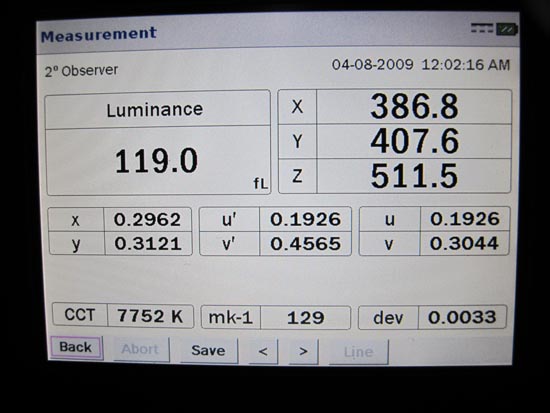
Posted by Jack Ondracek (Member # 1466) on 07-22-2011, 12:36 AM:
Geez, Brad!
Was the screen hot when you turned that thing off?
Posted by Edward Havens (Member # 4715) on 07-22-2011, 01:25 AM:
I was at the presentation in San Francisco last week. Not only was it quite informative and well attended by some of the better projectionists in the Bay Area, it was truly non-brand specific. They knew quite a bit about the RealD, XPand, Technicolor 3D on film and other 3D systems, and about Barcos, Christies, Sonys and other digital projectors, and at no time was there ever a pitch for their specific product. The only people who would poo-poo the seminar are those who were not there.
On a side note, not only did I get to meet a certain someone who spearheaded the introduction of many of Dolby's breakthrough audio formats -- from Dolby Stereo in 1974 to Dolby SR in 1986 and Dolby Digital in 1992 -- but for some reason cannot be mentioned by name in the post without getting an error message (an incredible personal thrill, by the way), I got in to a very good discussion with one of the Dolby techs (I won't say who, but it wasn't the gentleman alluded to before) about the possibility of reintroducing the Left Center and Right Center channels back in to the matrix, and they said they could see it happening in the next few years.
Posted by Monte L Fullmer (Member # 2797) on 07-22-2011, 01:30 AM:
quote: Ken Lackner
Aside from the different cathode pin, what is the difference between a lamp for film and a lamp for digital?
different internal structure for digital requirements, including more xenon pressure, structure in the contact developments for longer luminance output, complient for the glass reflector, et.al. to drive the prices higher for digital usage than for cinema usage.
It can be a bit crazy as such. ... - Monte
Posted by Frank Angel (Member # 248) on 07-22-2011, 02:43 AM:
OK, so if some digital systems can reach 20FtLmbts, then it goes back to my conclusion that given the continuing complaints about poor light performance can ONLY mean that the orginal 2D installs simply aren't designed for the light demands of adding 3D filters and alternating frame rates. Obviously systems that wind up only being able to deliver 3.5 foot lamberts for 3D are wowfully inadaquate for decently bright 3D presentation; these systems will not be delivering presentations that will be pleasing to most audiences.
Problem is, no one seems to be admitting this. The lame attempt to blame exhibitors by diverting attention from the real issue --the BIG mistake olf allowing 3D to be presented on digital systems capable of delivering a sub-SUB par brightness levels that come nowhere near that of good 2D. Until 3D can be presented the way IMAX does or perhaps with the kinds of setups like Brad has demonstrated possible, then 3D will die a slow death as people get fed up with dim, underlit 3D screens and be expected to pay extra for it. And as I said, no amount of futzing around with lamp amperage and lamp longevity and keeping the port glass clean are going to fix how a 5.5 foot lambert (or even less) image is going to be perceived by an audience.
Posted by Edward Havens (Member # 4715) on 07-22-2011, 05:21 AM:
Frank, a question...
Let's say I have a RealD-capable auditorium. Let's call it House 1 for simplicity's sake. And let's say this one week in July, I am playing The Last Airbender in 3D in House 1. It is dark and murky, and one can barely tell it's in 3D. And then let's say the following week, I play Despicable Me in 3D in House 1. But without making a single adjustment, I had a beautiful and bright picture, where the 3D vividly pops off the screen.
Same projector, same xenon lamp, same foot lambert setting. Absolutely zero changes. I haven't even moved the XL unit a single millimeter.
So why is one movie dark and murky and the other beautiful and bright?
I already know the answer, by the way. I was there. I'm curious to hear your response.
Posted by Frank Angel (Member # 248) on 07-22-2011, 05:37 PM:
?? -- A million things can go wrong. If your system is working fine with one digital print but another comes is and it looks like crap, while it could be something gone off in your system, the fastest way to trouble-shoot it would be to play some test material and see if your image is, as you say, beautiful and bright, then it becomes clear the Dprint is suspect. If you are sure you've set everything correctly, then get it replaced just the same way you would get a reel that had unacceptable image problems replaced. But what's the point?
This issue here is that instead of saying 3D presentation in projectors which are not able to hit well-established specs set for acceptable image brightness are unacceptable, they are just saying whatever levels they can reach ARE the specs. That's like going shooting practice and to be sure you hit the target, you shoot first and then call whatever you hit the target. To me, this is bogus practice and is the reason people are getting seriously critical of 3D presentation, execpt for systems that DO reach established, acceptable brightness levels for their 3D, like IMAX, and I take it some some well-designed installs that do reach much higher brightness levels that this idiotic "acceptable" 3.5 FtLamberts.
Posted by Victor Liorentas (Member # 5272) on 07-22-2011, 06:05 PM:
Some films have bright and pretty photography which lends itself to fooling your eyes that the spec is very good but the truth is. It is...
Is not very good.
Posted by Brad Miller (Member # 2) on 07-22-2011, 07:22 PM:
quote: Frank Angel
the fastest way to trouble-shoot it would be to play some test material and see if your image is, as you say, beautiful and bright, then it becomes clear the Dprint is suspect. If you are sure you've set everything correctly, then get it replaced just the same way you would get a reel that had unacceptable image problems replaced. But what's the point?
That is speaking out of ignorance and is nowhere near true. Frank, I know you hate digital cinema, but please don't make stuff up.
Posted by Frank Angel (Member # 248) on 07-22-2011, 07:49 PM:
Brad, please don't keep saying that because it simply is not true. I DON'T hate digital and as my post in just this one thread keeps saying, I think IMAX makes 3D look spectacular, and they are doing that with TWO digital projectors.
As for what you are quoting, I was responding to a question asked about what would be the reason, in a digital system that has been producing bright and beautiful images, that all of a sudden one title would look dull and dark. Read the question. Edward asked what would cause that. He is talking about digital. All I said was, it could simply be a badly authored hard drive and it should be returned for a replacement just like you would return a bad film reel of a feature. This makes me hate digital?
In fact, what I am saying through every post here is that I think 2D digital has as quite acceptable brightness as good as film -- in many systems even better, but 3D often falls short because of the way it has been added to systems that cannot produce the brightness level necessary. How does that make me hate digital?
We just ran WEST SIDE STORY to 4500 people in the park last night. Christie 15KW DIGITAL projector. It was a great success.
Posted by Monte L Fullmer (Member # 2797) on 07-22-2011, 11:16 PM:
Aren't the master or printing negatives just simply scanned to be made for DCI usage?
Posted by Edward Jurich (Member # 1787) on 09-09-2011, 12:31 AM:
Went to see a 3D at the Regal multiplex near Hampden and I25 in Denver. Picture was so dim I actually took the glasses off several times so I could see it better. Sound was crap also, loud enough to hurt my ears but mostly booming bass and midrange, no high end to speak of (could be the kids in the booth blew the horns ).
I am not fond of the digital look so when I can't find a real movie theater I'll invest in a good video projector and watch DVD's at home.
Posted by Jake Spell (Member # 5294) on 09-09-2011, 08:36 PM:
So what was the answer to Edward's question? What made the two movies look so different?
Powered by Infopop Corporation
UBB.classicTM
6.3.1.2