This is topic Philips FP3 or Marin MP30 in forum Film Handlers' Forum at Film-Tech Forum ARCHIVE.
To visit this topic, use this URL:
https://ft-forum.com/ft/cgi-bin/ubb/ultimatebb.cgi?ubb=get_topic;f=1;t=011013
Posted by Julian Baquero (Member # 6489) on 09-01-2011, 01:49 PM:
I have some possibility of buying a pair of Philips FP3 or a Marin MP30. I have very little information about the Philips, can someone tell me how does one compare to the other. What is a reasonable price for any of the two machines in a good working condition.
Can anybody share more information about the Philips. Is it easy to upgrade? Can I use anamorphic lens with it? What type of sound reader comes by default? Reels up to what size can it use?
Posted by Chris Slycord (Member # 4239) on 09-01-2011, 02:31 PM:
While I can't answer to any of these things, I think knowing what sound reader came with them out of the factory is pretty useless, since there's a decent chance the reader you're getting with the machine isn't the same one it originally came with. IMO, you should be asking the seller which reader is on the thing.
Posted by Scott Norwood (Member # 30) on 09-01-2011, 02:56 PM:
I have not dealt with the Philips, but I have worked with the MP30. Here are a few thoughts:
The MP30 comes in several variants--some have xenon lamphouses, dubber attadments, etc. The version that you have will affect the value.
They take standard cinema lenses.
By default, they have white-light mono soundheads. If you are not showing recent (newer than ~2006, at least in the US) color prints, you may not care. It would probably be fairly easy to mount a digital penthouse reader on these if you wanted to go that route. I do not know if there is an LED conversion kit that will work out of the box on these units.
They will hold large reels (I don't know the exact diameter, but it is 24" at least) if that matters to you.
They use weird aperture plates that are unlike anything else that I have seen. The good thing is that they are just flat pieces of metal and would probably be easy to have made if necessary.
The exciter lamp is some weird thing that may or may not be available.
They are reasonably gentle on film, but I have had issues with a couple of excessively splicy test reels that run fine on a Simplex or Century.
Posted by Matthew Taylor (Member # 2310) on 09-01-2011, 05:36 PM:
I used to have an FP3. These are lovely quiet machines but the reader is usually mono solar cell. These are quite difficult to upgrade to stereo, although it can be done. You also need to somehow replace the white exciter lamp with a red reader. My FP3 had a 2000' spool box but you can get spoolboxes to take up to 6000'.
Posted by Mitchell Dvoskin (Member # 751) on 09-01-2011, 07:18 PM:
Like Scott, I have no experience with the FP-3, but I own 2 MP-30's. Like most older equipment, if they were maintained and are in good condition they will give you years of trouble free operation with minimal maintenance. If they were not maintained and are in poor condition, they will be nothing but a headache. Both models are long discontinued, and as such parts are hard to come. For the MP-30, the most common thing to break is the main drive belt, but any industrial belting supplier can have these inexpensively made up for you. Same with the lamp fan belt.
To expand what Scott said about the exciter lamp, they originally came with a lamp that is no longer manufactured. The good news is these lamps tend to last forever. At one time there was a modification kit to change it over to a Cinemacanica exciter lamp, but I have never personally seen one.
I modified one of my MP-30's for analog Dolby Stereo. There is no off the shelf kits, it is a pain in the rear. Of course if you are planning to upgrade either projector to a red reader, it will not matter. However, there is no stock red reader upgrade for either.
Posted by Sam D. Chavez (Member # 1841) on 09-02-2011, 12:35 AM:
BACP make a reader for the FP 5 to FP56. It is likely the soundhead is the same for the FP3.
Best way to find out is to send me a picture of the soundhead.
We replace the solar cell and all the optics as well as provide new electronics.
Posted by Damien Taylor (Member # 4255) on 09-02-2011, 03:55 AM:
Whilst I have been very happy with my FP3, it is not without it's problems.
The soundhead on the Philips is a reverse of the regular Philips soundhead, so nothing made for regular Philips projectors will work. (I would LOVE to be proven wrong here)
When the exciter I am using dies, I'm going to break the glass and solder a star LED where the filament was. Mine has stereo sound added by gluing a stereo cell on the end of the glass light pipe and ditching the photoelectric tube.
You cannot add digital sound to these machines as the spoolbox and projector head form one contiguous unit, and there is no room to mount anything without modifying it to the point where it would be easier to buy something else. Parts are very scarce.
The maximum internal lamp is 1000w incandescent, but the original globes don't exist anymore, so you will need to modify it for something else like a theatrical lamp when they die.
It usually comes with 2000ft spoolbox, but there is a 6000ft one, although it is rarer.
It originally came with an anamorphic lens holder, however mine is missing it. The lens mount is 7cm.
The Philips uses european reel spindles which it's quite hard to find reels for in some parts of the world.
FP3 Soundhead
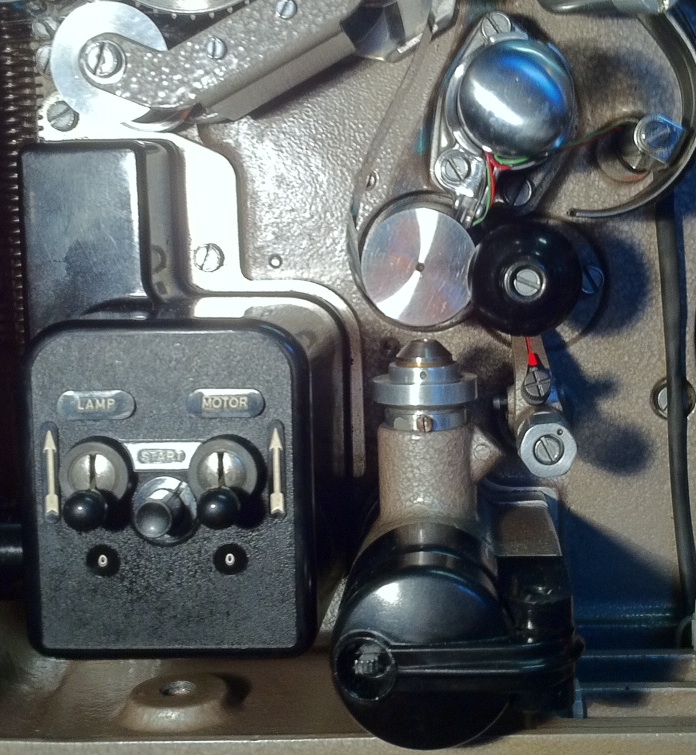
Silver cover used to house PE cell. You can see the wires of the solar cell running up what was the light pipe. The exciter holder has the lamp alignment pin on the bottom making it incompatible even with JAX.
Posted by Simon Wyss (Member # 6218) on 09-02-2011, 10:10 AM:
I have an FP 3, too.
Main difference is about sprocket drums. Philips has one large diameter combined sprocket drum, Marin has two 32-tooth-pair drums. You will find a shrinkage limit with the Marin while the Philips definitely accepts only fresh triacetate or polyester base film.
The Philips which is of Nitzsche ancestry (Saxony) brings light in over a mirror from the left side. The Marin has straight light path.
Posted by Mark Gulbrandsen (Member # 72) on 09-02-2011, 10:38 AM:
My experience on the MP-30(there were a few in Chicago that I serviced) has been that they are much harder on film and the intermittent is vastly inferior to whats in the FP-3. Don't expect to be able to get many spare parts for either...!
Mark
Posted by Damien Taylor (Member # 4255) on 09-02-2011, 10:46 AM:
It's probably not a concern for you, and it would destroy the projector in the event of fire anyway, but the Philips was equipped with nitrate protection. Loops above and below the gate made of string when burnt shut down the lamp, motor and a guillotine cuts the film and blocks the magazine opening.
Posted by Sam D. Chavez (Member # 1841) on 09-02-2011, 11:00 PM:
A BACP RSTR2000 KK reader intended for the FP20 will fit this sound head with a little work.
The LED bracket will fit into the space now occupied by the PEC cell.
The existing lens is replaced with a BACP lens/solar cell.
It is an analog-only reader so whether it is worth the trouble is another issue.
Posted by Rob J. Buskop (Member # 3338) on 09-04-2011, 06:42 AM:
It's always interesting to read comments about something that you're intimately familiar with.
In this case where it's about the FP-3 and the Marin (from Spain)
projector the above applies.
First: As somebody stated earlier, The FP-3 has no Nitsche ancestry at all. This is utter nonsense. The FP-3 was designed
on a Sunday by my old, late, friend Jan Kotte who was the
designing engineer of all Philips projectors. He's the man of the
DP-70 or Norelco AA as it was called in the U.S.
Mr. Kotte was very fond of the FP-3, and rightly so.
It is extremely quiet, has a picture steadiness that's cannot
be improved upon and it is the most "forgiving" projector around.
It is extremely gentle to film and won't derail with a tear or
other mechanical defects the film might have.
Also the design is very elegant.
Conversion to 36V 400 Watt as a light source can be done elegantly. Have done more than six or seven over the years.
Conversion to stereo is also straightforward. Remove the glass
light rod and replace with small hollow tube of same dimensions
and put stereo cell (nicely at proper angle of course) on tip
of tube and go through alignment process.
The soundhead lay out is exactly the same as Mr. Kotte's later
design, the FP-20
So whether you want to keep it simple or go for example with
BACP, it's all possible and do-able.
Comparing this superbly engineered projector with the Marin,
which is just a projector and nothing more, is like comparing
two different world of engineering. The Marin lacks any
sophistication and is a crudely made thing like a lawn mower that indeed does work but falls miles short of the design sophistication and attention to detail in all departments of the Philips. I can tell you a lot about the FP-3, like the story about the Philips sprockets of Kotte design. They take film shrinkage into consideration. A fact that many are not aware of.
So if quality is your thing this is a no brainer! Go with the Philips.
If all of the above does'nt mean anything to you, please get the Marin and leave the FP-3 for someone who knows....
Posted by Simon Wyss (Member # 6218) on 09-04-2011, 08:13 AM:
It’s always annoying to see someone cite a name incorrectly.
I’d like to apologize for my false information and any wrong I did to Jan Kotte by it.
Still, some resemblance between the Philips design EL 8710 and the Nitzsche Kinino and Castor cannot be denied. Mr. Kotte may well have known those makes from the 1920ies.
Posted by Julian Baquero (Member # 6489) on 09-04-2011, 09:45 AM:
Thanks to everyone who has reply to my post. I have learned a ton form the post and I can make a better picture of both machines. I was offered a Marin, but I think the owner was asking far to much for it. I knew nothing about the history of the FP3, no that I've been enlighten, I will certainly concentrate in getting one.
One final question, how much is a fair price? There are 5 available in Venezuela, but the owner is asking for the equivalent of $10.000 USD for each one! which I think is crazy. That is about twice or triple what a Microcine Mignon or a Cinemeccanica Portacine would cost.
Posted by Rob J. Buskop (Member # 3338) on 09-04-2011, 11:43 AM:
Yes, Julian, Ten thousand dollars is too much indeed.
I've acquired one for a friend some time ago via German Ebay for
around $800.00 which was extremely cheap. An average price would
be somewhere around the two- to three K in Dollars. Allow
yourself some time to find a nice one.
What is nice, is to go to youtube and see the video called:
The Philips FP3 35mm Projector.
Nicely made and it gives you at least some idea of what you're
gonna get.... If you're lucky, that is!
Posted by Simon Wyss (Member # 6218) on 09-04-2011, 01:34 PM:
Totally agree.
Philips is a nice apparel. Bought mine for 500 Swiss Francs, cast column, tripod, magazine, transformer, fresh wiring, and couple spare lamps.
Posted by Cameron Glendinning (Member # 3516) on 09-04-2011, 05:38 PM:
I have a mp 30, which has a cinemacanica 1.6 k lamphouse added, stereo cell and now a red led star light. Its reliable and does a great job but is no kinoton/ philips level of engineering. As far as I'm concerned it will be of no value within 12 months! One non modified mp 30 went for US$1700 on ebay reciently (within the year).
Posted by Damien Taylor (Member # 4255) on 09-05-2011, 01:09 AM:
quote: Rob J. Buskop
What is nice, is to go to youtube and see the video called:
The Philips FP3 35mm Projector.
Rob, this is my machine and I am very happy with it. I paid about $2000 but it is in amazing condition, came with both the cast base and the tripod, and a 6000ft and 2000ft magazine.
My machine came from Norway. It has a metal tag on the front which I think means it was used in the Norwegian defence force, which might explain the good condition.
If you can give me any more information about these machines I would appreciate it.
Posted by Damien Taylor (Member # 4255) on 09-05-2011, 05:23 AM:
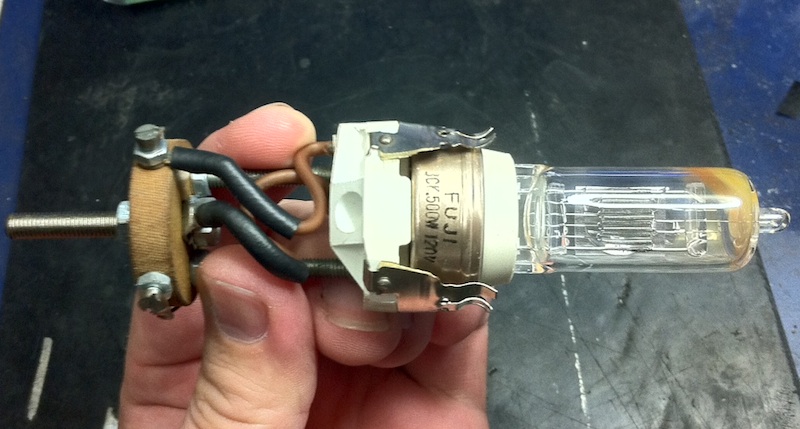
Also this is the way someone has modified my machine to use 120V 500W BCK bulbs, by making a holder that mimics the old base so it can fit in the original lamphouse. Is this similar to your conversions?
Posted by Rob J. Buskop (Member # 3338) on 09-05-2011, 10:21 AM:
Yes, that's rather similar to my light conversion for the FP-3.
The difference is in the choice of lamp where I used the well known 36V 400Watt halogen bulb.
I use exactly the same "base construction" to maintain the originality and practicality of being able to very simply take the lamp unit out.
With the lamp I use, I make two rod extensions from the upper fitting, going down to hold a round platform low into the lamp housing, on which I used to install a quality socket for the small halogen lamp.
Of course the power supply and it's connections had to be modified to accomodate 36V at 11+ Amps.light unit.
Anyway, you got yourself a beautiful piece of machinery there, my friend! Hats off to you!!
Posted by Gordon McLeod (Member # 33) on 09-05-2011, 02:25 PM:
Compared to many other machines the MP30 has rettained a high value I always want to get a pair of them for rentals but the price is a bit steep for the limited demand
Posted by Simon Wyss (Member # 6218) on 09-10-2011, 04:07 AM:
Rob, it might be valuable to compare informations. Michael Rogge has this list where he writes: Around 1932 Philips obtained the rights to J.Nitzsche projectors.
I have a book , Kniha o filmu by Emil Holan, Praha 1938. There are a number of illustrations in it of Philips projectors, namely model IX with front motor and lamp house from America, among other products. What I mean to say is that we don’t know history exactly. Jan Kotte was not even 21 when he joined Philips. He’d have been Superman in developing cine machinery within a few years without any experience.
It’s that I don’t believe the stories from the 1930s. Arri say it was Erich Kästner who developed the Arriflex before 1937. Kästner was also around 21 when hired by Arnold & Richter. The famous camera, in my eyes, is not of German origin but rather a licence product from Bell & Howell’s Rockwell Engineering Laboratory of Chicago. There is a patent on a claw film movement issued for Albert Howell from 1931. The drawing shows a mechanism very similar to what was employed with the Arriflex.
Nothing against Mr. Kotte. It’s just a bit too perfect of a story how it’s told. Mr. Kästner wouldn’t have admitted either that he only took part in an industrial project. He gave his name for the events. Yet, the machines don’t swindle.
Posted by Julian Baquero (Member # 6489) on 09-23-2011, 10:24 AM:
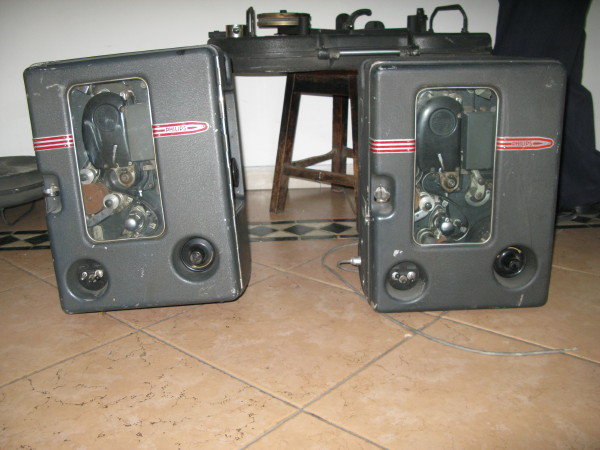
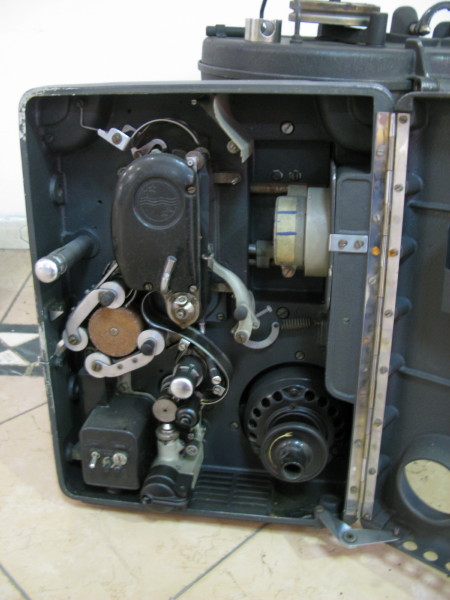
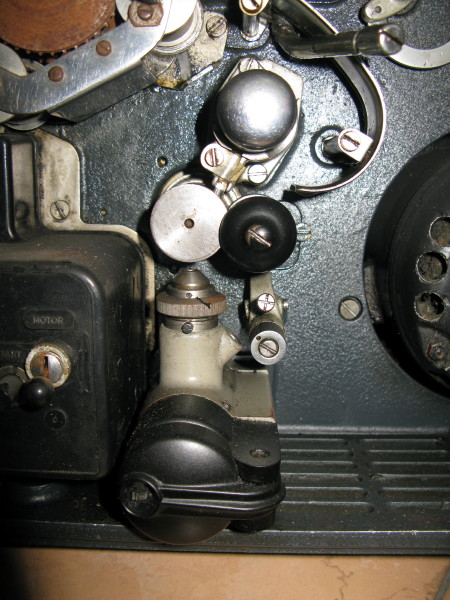
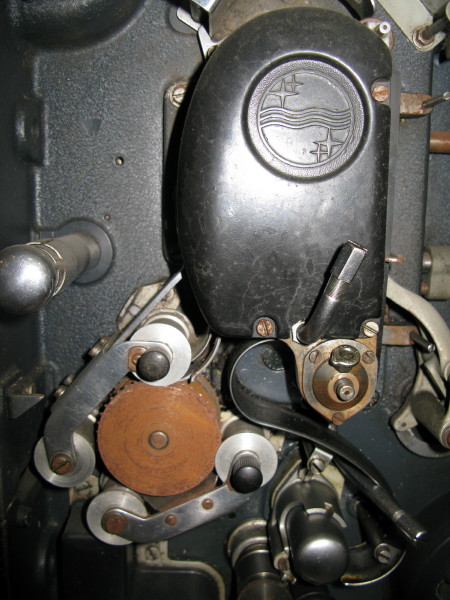
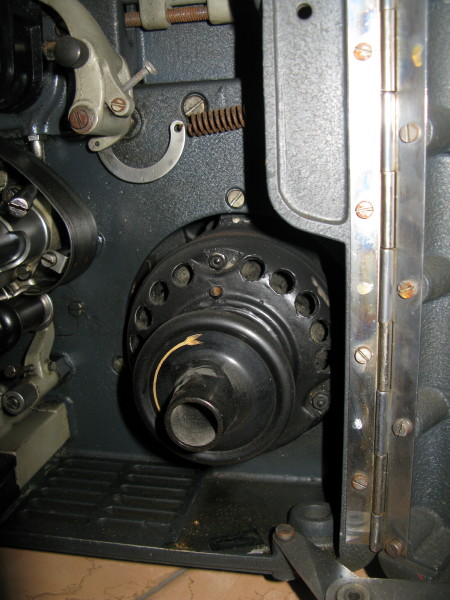
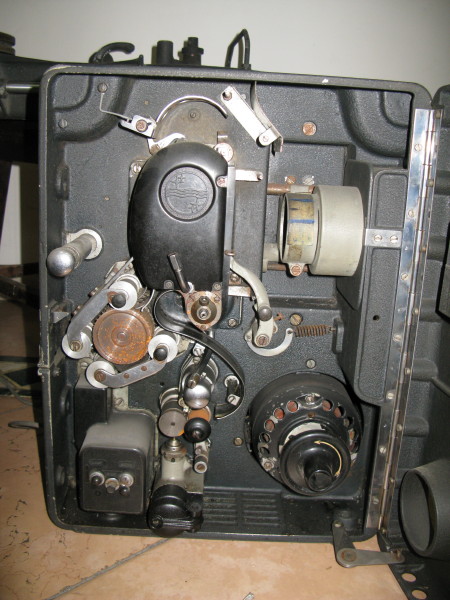
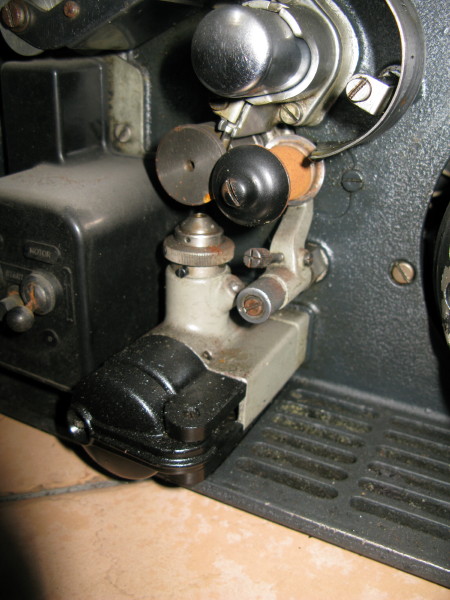
Hi to everybody. I finally had the opportunity of taking a look at this two Philips FP3. Now I have to make an offer for them. They are not in the best condition, but I think they can be put to work, at least one and use the other for spares. They have been stored at least 5 years and some parts already have some rust. One of them has no power cable, the other has cable but no plug. There are 2 x 2000 ft magazines. They don't have any lens. I was told the lamp is Halogen 1000 Watts but I couldn't take out the socket, I think they still have the original incandescent bulb (can someone comment on this) I am posting pictures. Please any advice on condition and price is welcome.
more pictures here: Flickr
Posted by Emiel De Jong (Member # 4225) on 09-25-2011, 03:48 AM:
Julian, for me it looks like all the important parts are there.
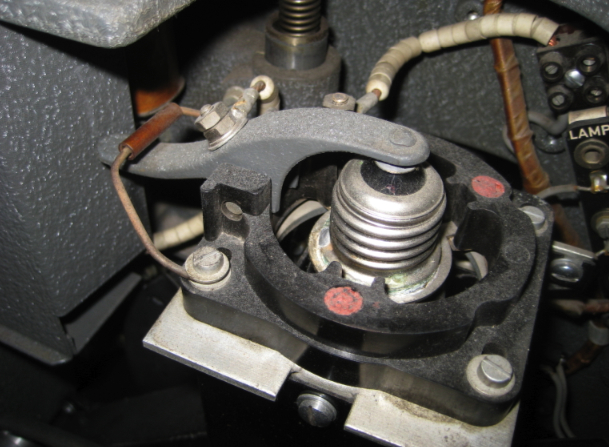
However the lampholder has been modified, this is a picture of an original one. Also the backing mirror for the lamp has been removed, this is not so much of a problem as the later models didn't have one anyway. These machines definitely need some work...
Posted by Mark Gulbrandsen (Member # 72) on 09-25-2011, 09:19 PM:
The main thing is they are all there. No missing parts that I can see. Are the colums included as I don't see those? If not yopu can probably rig something in theor place but these will not sit on a table as the magazine hangs down below the bottom of the projector housing. I would definately go with those over the MP-30. Phillips will have a far superior intermittent than the doggy MP-30 has. The MP-30's I serviced were extremely unimpressive from a machanical quality standpoint.
Mark
Posted by Damien Taylor (Member # 4255) on 09-26-2011, 03:11 AM:
As others have said, these machines are in rough shape, but they are complete. This is the best way, as the machines subpar condition should give you some leverage on the price. These would be a good project to restore if you were so inclined. Now I wish I had another one!
Also, these have big HEAVY suitcase like power supply/rectifiers, do they come with these, as the projector requires about 3 different voltages 120 for the motor/lamp, 12 for the framing and pilot lamps and 5DC for the exciter. approx.
The wire you see coming out of that socket on the right is the photocell output. The bigger Jones type connection on the left is the power umbilical.
Posted by Julian Baquero (Member # 6489) on 09-26-2011, 11:23 AM:
Thanks guys for the feedback. The machines need serious work. Emiel I suppose the lack of mirror lowers light transmision, I was told the bulbs are halogen 1000 watts, that should me more than OK for home use.
Marc the stands/columns are there, I didn't take pictures from them, they were badly stored and the are in bad shape rust and pigeon carp all over. I really don't like them much, because the are to big and heavy, they also limit the portability, they could be replaced with large wood tripods.
Damien they don't have any suitcase or rectifier, I thought this work straight out of the wall. Should I have to worry about this?
This week I will make my offer which will be rather on the low side, I hope I can get a good deal and buy both of them.
Posted by Mark Gulbrandsen (Member # 72) on 09-26-2011, 04:25 PM:
They did make a wooden tripod for these but I've never seen one in person. Considering their weight you should grab the metal columns!! Having them also keeps these machines all original. Just get the colums sandblasted and then re-paint them. Making a regulated DC supply is very easy using voltage regulator integrated circuits. If you have a friend that is savvy with electronics that shold be easy. The pilot lamps do not need to be regulated... they may last longer though. I to would bid low considering the corrosion... but they look to be all there and that is most important. Did you turn them over by hand to see that it all turns smoothly?
Mark
Posted by Julian Baquero (Member # 6489) on 09-26-2011, 08:23 PM:
Hi Mark, if I make a deal I will take the columns at least to have all the original parts as possible. I did turn the parts and they rotate easily. I think I can handle making the rectifiers if I have the right specs at this time I know nothing about them.
Posted by Damien Taylor (Member # 4255) on 09-27-2011, 05:58 AM:
The Framing lamps are 6V/0.5A AC and the exciter is 6.5V/4.8A DC I used to have the motor voltage and lamp, I ***think*** they are both 120AC but i'll have to check. I have a manual for these but it's very long. I could scan some important bits like schematics etc if you like. There should be a metal plate schematic inside the back door!
They made a stock metal tripod for these too. It's not as good as the pedestal, and I only use mine occasionally. The pedestal has the bonus of the fact it originally came with the power cable that goes into the back of the projector and leads to a terminal block inside a hatch in the base where you can wire in all your own power supplies.
Also my backing mirror is cracked, but many of the globes you will probably use already have reflectors inside them.
Maybe the FP3 Pro Rob can help me here, when did they switch from the matt grey paint seen here to the glossy gold/sandstone my one has?
Posted by Julian Baquero (Member # 6489) on 09-27-2011, 06:30 PM:
Hi Damien thanks for the information and offering the schematics, I still don't have the projector, but if it becomes a reality I will let you know and I will accept the scans of the drawings. Correct me if I am wrong, regulators are only needed for DC, halogen lamps are AC so they would only need an AC transformer if they are something different from 120V. What is the use of the framing lamp? super 8 and 16mm projectors don't use them. I saw the bulbs that this projectors have and they don't have any mirror inside, what is the effect of this if the original mirror was removed as Emiel noted.
Posted by Damien Taylor (Member # 4255) on 09-28-2011, 03:24 AM:
Yeah the only DC thing is the exciter and you can get a power supply for those pretty cheap. The one in the original power supplies used a rectifier valve which would probably be dead by now anyway.
The framing lamp and pilot lamp have a pretty simple purpose. The Pilot lamp, which is contained in that housing above the large sprocket that comes all the way out. It simply lets you know that the power supply is connected and working, and gives a little bit of light to work by. The framing lamp is right inside the gate and it's purpose is so you can thread the film with a dull light as the main lamp will not turn on without the motor running.
Posted by Emiel De Jong (Member # 4225) on 09-28-2011, 06:42 AM:
As I understand, they deleted the hollow mirror already in 1955, because it was possible to shorten the lamp's life dramatically with a badly adjusted mirror. I guess that the extra light output such a mirror gave was just not worth the trouble. What the effect is with other lamps than the intended original I don't know but I think as long as the condensor lenses (between lamp and film) are there you're fine.
Posted by Damien Taylor (Member # 4255) on 09-28-2011, 08:28 AM:
As far as I can tell there were many revisions of this machine, this is what my data plate says;
Type No. 8710 - 05
Serial No. 8.2336
I guess that means that mine is a Mk V or something. I couldn't tell you what the differences were. I know that early machines had a fixed aperture and a wooden gate. I really wish there was more info out there on the internet about these machines.
Posted by Ian Parfrey (Member # 5122) on 09-28-2011, 02:30 PM:
I have a design question about these machines and I'd like to get any opinions I can on this.
From a purely 'film-friendly' perspective, these projectors appear to be rather poorly designed. By this I am referring to the use of the two film-guiding rails seen above the gate and just post the intermittent. I can understand that the use of the single sprocket would greatly simplify the gearing/belting required to make the machine work, but to my eyes this basic design would place the film at greater risk of damage due to rail wear than would multi-sprocket designs that do not feature these rails.
I can see many similarities to the 16mm BTH 450 in regards to the use of these rails and wonder if I am being overly critical of this design.
I will admit that I have neither seen or used either of these projectors, but from my admittedly limited point of view, they appear to be rather unkind to film.
Is this a fair critique of these machines?
Posted by Damien Taylor (Member # 4255) on 09-28-2011, 05:40 PM:
The rail thing directly above the gate is a pileup shutdown switch, the film never runs on it. There is a rail directly behind the Philips logo, but I've never seen them worn, much less harming prints.
Powered by Infopop Corporation
UBB.classicTM
6.3.1.2