![[beer]](graemlins/beer.gif)
quote: Randy StankeyTo answer your questions:
Does the problem sound the same when changing from projector #1 to projector #2 as it sounds when changing from #2 to #1?
What if one projector is running at a constant speed but slightly slower or faster than the other? Would the digital processor ramp the sound up or ramp it down in order to blend the incoming and outgoing tracks together? If so, would you hear an increasing pitch when changing over in one direction and a decreasing pitch when changing over in the other direction?
![[Eek!]](eek.gif)
![[Smile]](smile.gif)
quote:Do I understand correctly that you have tried starting with BOTH reels at a midway point (that is not "wow-ing") and executing a changeover from there? In other words, what happens when you perform a changeover with "known-working" data blocks incoming/outgoing?
"Hell! I'd piss on a sparkplug if I thought it'd do any good."
![[evil]](graemlins/evil.gif)
![[Mad]](mad.gif)
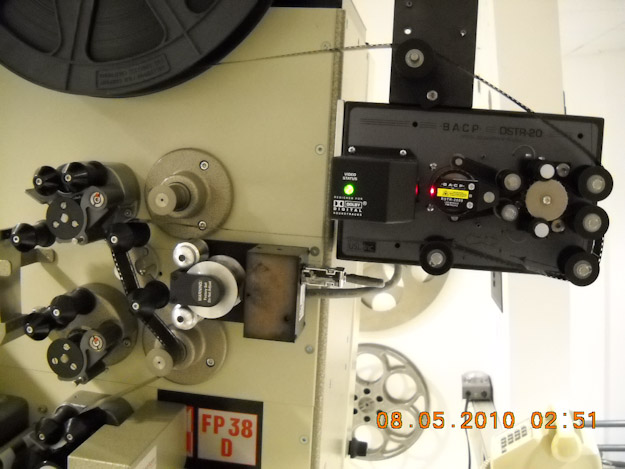 (I will pay for shipping.)
![[Roll Eyes]](rolleyes.gif)
quote: Tony Bandiera JrYou are correct, sir.
Now, as for the mid-reel start and stops you suggested they seem to have no effect at all. But remember that the way Dolby Digital data is read and "cached" at reel transitions (To cover the effects of splices in platter ops and the duplicate data read on incoming reels heads in a changeover op) is part of the reason I am convinced that software is the problem.
quote: Tony Bandiera JrYou are correct again.
Mark, the odds favor #1 at this point
quote:Okay. Just checking -- when things aren't working the way they're "supposed" to work, I do like to experiment to rule things out.
Now, as for the mid-reel start and stops you suggested they seem to have no effect at all. But remember that the way Dolby Digital data is read and "cached" at reel transitions (To cover the effects of splices in platter ops and the duplicate data read on incoming reels heads in a changeover op) is part of the reason I am convinced that software is the problem.
It has been 430 days since the last post.