This is topic setting levels in forum Film Handlers' Forum at Film-Tech Forum ARCHIVE.
To visit this topic, use this URL:
https://ft-forum.com/ft/cgi-bin/ubb/ultimatebb.cgi?ubb=get_topic;f=1;t=011120
Posted by Jim Henk (Member # 3628) on 12-30-2011, 01:47 AM:
I'd like to continue a topic that unfortunately had to be deleted. Rightfully so, of course, as the topic heading violated forum rules, and was given plenty of notice to correct it before deletion. Good job, no doubt.
But as for the conversation itself: the submitter asked for guidance in sound alignment. He didn't use these words, but he meant both A-Chain, and B-Chain.
What caught my attention were the responses. They largely consisted of urgings to let the professionals handle it.
I couldn't agree less.
Cost of equipment was cited. First, a quick search for an RTA and oscilloscope told me that it would cost about the same as a good head and soundhead if somebody's really all that interested. There is also oscilloscope and RTA software and USB hardware available for a lot less, and for both Mac and Windows machines. Buzz tracks and the like turn up from time to time. There are a few currently eBaying right now for about $20 bucks each.
What really got me were responses that kinda hinted at job security stuff. I'm a hobbyist now. But I was "on the board" (everybody's last moment relief) in union booths in both the Los Angeles and Orange County locals until I left the field many years ago. And I ran into a *lot* of this. Folks wouldn't teach, because why would they be needed, after all if the newest guy could do what they knew. Can we not do that?
Typical example of enforced ignorance: right now, I've got a CP200 with a signal that isn't making it all the way through. The details of that aren't important. What *is* important is that it's inexcusable (on me, that is...) that I didn't have a holistic enough idea of what to look for because it was all kept a deep dark secret.
Another example: there was a class in 504 that all new guys were supposed to take essentially learning how to field strip an E-7 and put it back together again properly. Just an example machine, of course, but it would give good springboard material for the future. Trouble was, nobody was willing to take the time to teach the class. Ever.
The guy who wanted to learn how to align a sound system was hungry to learn. He who puts out the energy to learn should be taught.
That's just how I feel, anyway.
Posted by Monte L Fullmer (Member # 2797) on 12-30-2011, 02:18 AM:
I left a comment in that deleted post (which was removed as I was sending it, thus it never made it to be seen or read..) about my experiences in learning tech stuff:
No, these guys will never teach, but as for me as a simple projectionist, I started to ask questions left and right from the get-go where I started at a 'mom and pop' drive-in and the owner would have a tech come from out of state to service his drive-in prior to the beginning of the season. This is where I took the "plunge" in wanting to learn-and to do so is by asking questions.
Then, when I moved to indoor houses is when the techs came around for their contracted service visits to the theatre that I was working at. I then, was doing the same-asking questions left and right, to where they would show me how to do things and where I picked up the knowledge real quick. Towards the end of the usage of these technicians, I was like an assistant to them from the knowledge that I was shown by asking and showing interest. Doing so, it got them out quicker and the task was still completed and accurate.
Plus, being mechanically minded as I am, I also began to study the parts manuals to understand how the machine ran in proper order with the correct parts in their respective places.
Thus, I just "took the plunge" head first and not worrying on the consequences afterwards. Yet, made the mistakes as I was going along where I definitely learned from them.
It's kind of a 'brotherhood' sort of thing - it's "their" trade and only to be shared amongst the other technicians. Outsiders, in their experiences, really don't show that much interest, nor care how it's done - they just want it to run correctly and properly.
Posted by Jim Henk (Member # 3628) on 12-30-2011, 03:13 AM:
My point exactly! Thank you, Monte.
The guy was asking questions. A great answer for somebody still working in the booth. Hope he's still reading. Of course somebody *not* working there, the research gets a little more difficult, because as well as something may be written, you would very often need somebody to check with, who can show you: "No, that actually needs a lot more accurate clearance than just adjusting by eye...", etc.
Not an easy answer.
BTW, never have actually seen a good discussion of the actual steps of an A-chain... Be fun to stick a loop on a soundhead with a variety of pickup styles on a bench, hooking up a scope, and know what the heck you're doing. Weird, yes, but stamp collecting has never done it for me.
I put a new head to soundhead interface gear on a head I have, and pounded it onto the shaft. Mentioned it to someone, and was properly berated for pounding anything onto anything. May have done damage. We'll see. At least I did it to my own machine. Get the idea?
Not an easy answer, at all.
Posted by Monte L Fullmer (Member # 2797) on 12-30-2011, 04:03 AM:
..just hope you had a block of wood inbetween the gear and the hammer...or used a brass, or plastic head hammer...
Sometime, that is what happens ... rules have to get bent to fit and fix the situation at times.
quote: Jim Henk
BTW, never have actually seen a good discussion of the actual steps of an A-chain
A good guess why there will never be one is that, 1)-each tech might have his own slight unique way in doing the service, and 2)-that tech doesn't want to be held liable for what he is saying/teaching to his 'student' in case that 'student' fubars something up when that student attempts the same task, that 'student' then has a reason to come back at who taught him..and possibly that tech might be associated/employed with a service/supply company, and they don't need any liability issues either.
Also, to add in defense to the techs, is that showing and talking slows them down and they are on a time clock of sorts in as well as trying to be done in a reasonable time to save their customer a bit on the charge on the service bill.
Posted by Jim Henk (Member # 3628) on 12-30-2011, 04:54 AM:
Yes I did, thankfully, and too true.
I wonder how long this is still going to be an issue. Not a lot of knowledge being held back on stagecoach making anymore... And not a lot of 35mm's being installed any longer. A few special purpose situations, but not many. Anybody here a former tech, and feels like doing an article with a lot of disclaimers? The manuals in the Warehouse all start out with a coversheet warning the user that they are on their own as far as risk is concerned. Sounds very reasonable to me.
Posted by Louis Bornwasser (Member # 3063) on 12-30-2011, 08:02 AM:
When I serviced 35mm, I thought of myself as primarily a teacher, less so a maintenance guy. There is always enought "trouble" to keep you in business; it is not necessary to keep people ignorant.
Besides, the ones you teach either succeed (Yay!) or fail (more work for you.)
My biggest problem was after the owners refused to let their operators learn. They were specifically kept out of the booth while I was there. Louis
Posted by Gordon McLeod (Member # 33) on 12-30-2011, 09:30 AM:
Well just my 2 cents worth
no problem wanting to learn then do so
all the people who work sucessfully in this industry have invested a lot of money and time buying test gear, and paying for courses to do what we do and then adapting that to practical field experience.
The other point is I have had all too often had to loose a lot of time making repairs to systems that well intentioned people played with
A little knowledge is a very dangerous thing
Posted by Richard Hamilton (Member # 321) on 12-30-2011, 10:39 AM:
I have no problem teaching or giving advice. When I worked here locally, the projectionists were always scared to call me (I don't know why). But I would talk them through any problems that I could over the phone. When I asked the person I trained before I left the company he just said "you're Rick"!
At Kerasotes I taught a training class, but it was for regional managers.
At Megasystems we would bring in techs from the venues we were installing and they would spend a week at our shop tearing down and rebuilding a projector.
At Strong I was supposed to hold training classes, but I left.
Makes it easier when you are on call 24/7 and have to drive across town in the middle of dinner or book a flight overseas. Talking someone through a problem over the phone is alot easier.
As far as the sound, I didn't want anyone touching the settings once I was done. All password protected.
I was doing work at the IMAX theater at the Museum of Natural History in N.Y. and the guys in the booth wanted me to change some stuff on the Media Matrix (sound system)they had seen the password. I refused and told them to call their local techs from the company that installed it. They just wanted to "adjust" some settings. It was installed by a professional audio company from N.Y.
Rick
Posted by Jim Henk (Member # 3628) on 12-30-2011, 12:30 PM:
quote: Gordon McLeod
A little knowledge is a very dangerous thing
It certainly is.
Of course, didn't everyone here go through a point of having "a little knowledge"? Sure glad they didn't stop just because of that.
Posted by Sean Weitzel (Member # 244) on 12-30-2011, 12:58 PM:
Also being like Jim and just a hobbiest I realized early on that the information isn't readily available outside of equipment manuals but reading this board for 10 years really helped me gain a lot of knowledge about the field.
Having said that, one thing I have never seen anyone comment on or describe is how to make and thread test loops. I can never figure out the best way to safely get a loop running without it shredding or getting in the way of the lens.. Also having trouble figuring out how to properly make a 70mm tone loop and where to thread it in the penthouse. Anyone have any tips?
Posted by Sam D. Chavez (Member # 1841) on 12-30-2011, 01:21 PM:
I assume Sean has Century JJ's?
35mm loops need to be run through the entire projector and work best if you have a weighted roller on the bottom of the loop to keep it from backing up into the projector. Keeping the loop from getting in front of the lens is always a problem.
A well placed paper clip or other widget at the top of the projector will keep it out of the way.
As to 70mm;
I always ran loops only through the penthouse and the top sprocket. It is impractical to run through the entire projector as back in the acetate day you would ruin 12 feet of film all at once if anything went wrong. If you work at it you can come up with an exact size loop that will not require removal of the top sprocket stripper.
I did this hundreds of times on TAP and studio calls as the less you disturbed the projectors, the less trouble you got into.
(I learned this the hard way in Vancouver, BC on a preview of "Altered States". I removed the chrome loop size detector from a AA11 to run loops. One end ties to a microswitch in the back of the AA and it was just itching to break after 20 years and did so.
This resulted in having to remove the lamphouse (carbon arc) to get to the back of the projector. That's 90 minutes of stress I would rather avoid.)
Now, if the loop is polyestar, the loop must be the exact size so as not to create standing waves of film or all hell can break loose in the JJ and result in bent rollers and even a stripped gear.
Posted by Sean Weitzel (Member # 244) on 12-30-2011, 01:49 PM:
Yes Sam.. JJ's with a turret. Thanks for that advice very helpful!
Posted by Monte L Fullmer (Member # 2797) on 12-30-2011, 01:56 PM:
quote: Sam D. Chavez
create standing waves of film or all hell can break loose in the JJ and result in bent rollers and even a stripped gear.
Ya, tell me on that one...was doing dolby alignment on a CAT701 mounted on an PR-1050 after replacing the LED.
Had a loop of new trailer to check dolby track and just using the upper sprocket to do the pulldown.
Loop got away and wrapped itself around the upper sprocket, seized up the sprocket super tight and shredded the fibre gear attached to the shaft.
Luckily, we had a spare gear, but had to clean out the back side of shredded fibre and clean out the oil sump. Then, had to realign the vertical shaft assembly so both end gears were aligned since that sudden stop also jarred that assembly out of alignment.
Life's little lessons to learn from.
Posted by Steve Guttag (Member # 268) on 12-30-2011, 02:31 PM:
Okay...I'm in the chat room right now...all questions answered...you've got 5-minutes...
...I was in the chat room for 15-minutes and there were no questions...see...no interest.
Posted by Jim Henk (Member # 3628) on 12-30-2011, 04:44 PM:
quote: Steve Guttag
...I was in the chat room for 15-minutes and there were no questions...see...no interest.
Well, ya got us all there. Good job. ![[Roll Eyes]](rolleyes.gif)
Posted by Brad Miller (Member # 2) on 12-30-2011, 07:45 PM:
quote: Sean Weitzel
I can never figure out the best way to safely get a loop running without it shredding or getting in the way of the lens.
I set this up for Telluride, although only the projectionists used it. The rollers are not in the way of normal projection. (The lower roller exists to pull the film out of the way of the lens.)
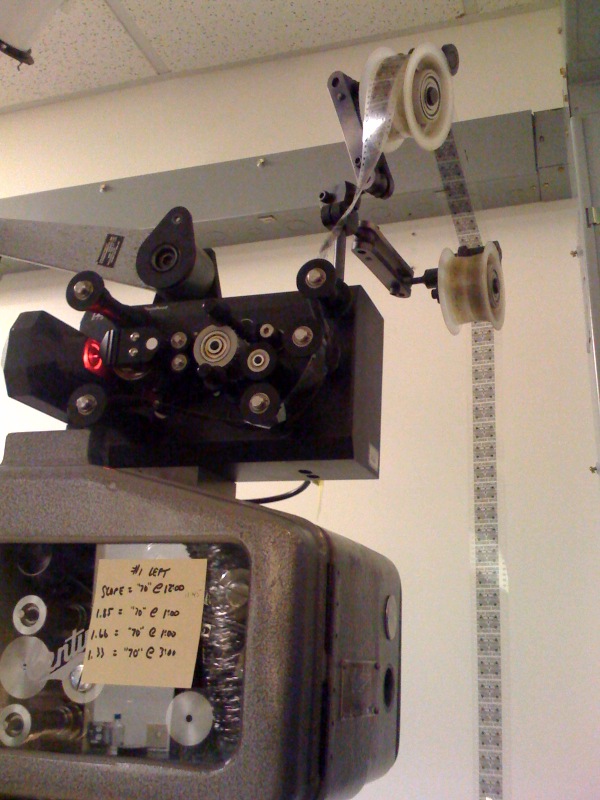
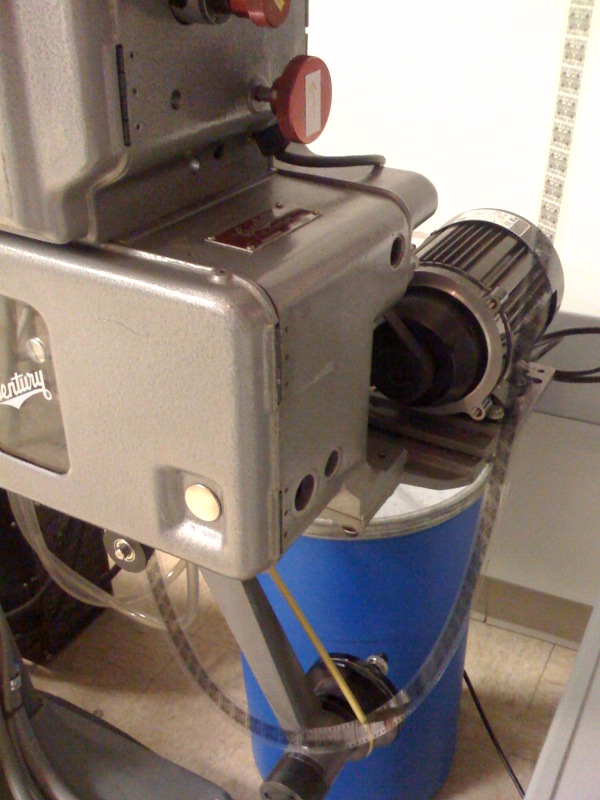
You must have enough length at the bottom to almost touch the lower takeup shaft so that weight will pull the film out of the soundhead. Don't make the loop tight!
This is also the ONLY way to run a "scratch test". Without guidance rollers, trying to run a scratch test with a loop is a complete waste of time.
Posted by Tony Bandiera Jr (Member # 2365) on 12-30-2011, 09:34 PM:
quote: Jim Henk
....I put a new head to soundhead interface gear on a head I have, and pounded it onto the shaft. Mentioned it to someone, and was properly berated for pounding anything onto anything. May have done damage.....
Wonder who berated you for that one? ![[Big Grin]](biggrin.gif)
On topic, Jim, I disagree with your position for one main reason:
So far, the vast majority of "wannabe techs" of the current generation I have encountered have the attention span of a gnat. They are unwilling to TAKE THE TIME to learn how to do ANYTHING properly. They are too quick to dive in and start fucking with settings without a clue as to the effects and how they affect other things (like possibly blowing out speakers, etc.)
Without actually meeting someone face-to-face and assessing their background and capabilities it is very dangerous to give advice over the internet. Would you trust a doctor who is getting instructions on your gallbladder operation via a computer?
Also, a lot of the unwillingness of technicians to share their knowledge is from the simple fact that the knowledge was gained by a lot of time, hard work and financial outlay. The current attitude of entitlement rampant with the current generation is another factor in this.
The services of a good technician are like any other commodity, it has an actual cash value and should not be arbitrarily given away for free..(unless said tech is independently wealthy and retired or has too much work to handle.)
Finally, would you be willing to tell me how to do your job?
Posted by Jim Henk (Member # 3628) on 12-31-2011, 03:07 AM:
quote: Tony Bandiera Jr
Finally, would you be willing to tell me how to do your job?
Actually, gladly. Of course, in my engineering support field, we work with transparency as a goal. That way, the developers and management who work our tools and services understand how each of our work compliments each other. We work hand and glove, each understanding the big picture, and everybody's productivity rises. Of course the company is tanking because they make phones that *aren't* iPhones, but that's another story. Look, I'm working a side business very hard right now so that I can even say goodbye to Engineering (and having to answer to *any* boss) once and for all. Personally, I'd never be so callous as to experiment on somebody else's stuff. But I'd *love* to experiment on *my* stuff. Knowledge is terrific.
But I digress.
Yes. The techs, on the whole, have worked extremely hard, and put out a lot more personal energy and resources than just mere money. And they deserve tremendous respect for that. And yes, eager-beavers screw things up. In other fields, (engineering included) grabby hands are terminated. (Did you *never* screw something up on something that you shouldn't have been? C'mon... never??? Okay, you can stop with the private guilty grin now)
Of the flip side, when things go south, the operator on duty (assuming that there is one) is expected to *fix it*. Now. Otherwise, why are we paying the operator instead of some minimum wage kid to babysit the machines once in a while when he's not inventorying cups? (Don't say it... that's exactly what happens... I know. Gee, maybe lack of perceived value was at least one of many factors - possibility?)
Management wants them out of the booth while the tech is there? Then no complaints are warranted when the show has a bad hair-day. But anyone who blocks their own people from gaining knowledge that will assist them in their job, in any field, needs therapy and our pity.
Do we, or the techs really need to add to all that?
Again, somebody wants to learn. People don't work out no matter what you're doing. Is it wise to tell them no, because others didn't do so good? Or do you point them in good directions, or maybe even interview them, check references, etc. if you're in a potential teaching position yourself. (And if they don't work out, you move on to someone else who will, if you want to.)
How would you feel if you asked a question here, and someone said for you to go away, little boy - call a professional. Hell would have no such fury...
Posted by Tony Bandiera Jr (Member # 2365) on 12-31-2011, 12:55 PM:
Ok Jim, I'm gonna go for the jugular on this statement:
quote:
Actually, gladly. Of course, in my engineering support field, we work with transparency as a goal. That way, the developers and management who work our tools and services understand how each of our work compliments each other. We work hand and glove, each understanding the big picture, and everybody's productivity rises. Of course the company is tanking because they make phones that *aren't* iPhones, but that's another story.
No, your company's tanking BECAUSE of the transparency. Why do you think Apple has become so dominant? Because they closely guard their proprietary software and apps. It took a long time for them to allow other developers into the fold, and they are closely monitored. Love or hate them, Apple's got a pretty sound business model in regards to financial stability.
quote: Jim Henk
... And yes, eager-beavers screw things up. In other fields, (engineering included) grabby hands are terminated...
So why should the cinema tech field be any different?
quote: Jim Henk
...(Did you *never* screw something up on something that you shouldn't have been? C'mon... never??? Okay, you can stop with the private guilty grin now)
More times than I care to count..and guess who had to fix it? Yep, I did, and often on my own nickel. Now if you were running a theatre and one of your wannabe techs fucked something up and lost you shows or damaged equipment would you be smiling about it?
quote:
Of the flip side, when things go south, the operator on duty (assuming that there is one) is expected to *fix it*. Now. Otherwise, why are we paying the operator instead of some minimum wage kid to babysit the machines once in a while when he's not inventorying cups? (Don't say it... that's exactly what happens... I know. Gee, maybe lack of perceived value was at least one of many factors - possibility?)
Not possibility..certainty.
quote: Jim Henk
Management wants them out of the booth while the tech is there? Then no complaints are warranted when the show has a bad hair-day. But anyone who blocks their own people from gaining knowledge that will assist them in their job, in any field, needs therapy and our pity.
Management is management for a reason, and they are well within their rights to set whatever policy they want. I can tell you after working for RCA Service for many years the main reason management doesn't allow operators in the booth during tech calls is because they KNOW for a fact that some (most) of them will suddenly become "hands on" in the worst possible way.
As a projectionist, my job was to present the show as management orders. If they want me to start early, start late, run the reels out of sequence, run the film backwards, then I am expected to follow the order whether I like it or not. It was not my position to question it. As a tech, my job was/is to make the repairs or adjustments as needed, to point out any potential problems and let management decide if they wanted those issues fixed. If not, I note it on the service report and they sign it. If it goes tits up later despite my advance notice, then they are on the hook for any costs/liability involved.
I agree that no complaints would be warranted, but again, that is management's call, not yours or mine as the technician.
They need our pity and therapy? Don't be a drama queen.
quote:
Again, somebody wants to learn. People don't work out no matter what you're doing. Is it wise to tell them no, because others didn't do so good? Or do you point them in good directions, or maybe even interview them, check references, etc. if you're in a potential teaching position yourself. (And if they don't work out, you move on to someone else who will, if you want to.)
Nothing wrong with wanting to learn at all..and you seem to have lost sight of the fact that I have offered to teach you on dealing with your own equipment when you're ready. And in your case I have the benefit of some knowledge as to your technical skills and willingness to learn, so I have no qualms with teaching you pretty much anything.
Now as for someone on this forum who I never met, how would I, or anyone else for that matter, "interview" them or check their references?
Any individuals I have taught in the past were screened and tested before I invested the time and energy in teaching them, and they have all worked out quite well.
And in your case, as you pointed out, we're talking about your personal screening room, not a place of business. HUGE difference. Why do you think I have invested so much money into my personal screening room equipment? I did it so that I am free to experiment and develop AMX code and new configurations for my clients without messing up their stuff.
quote: Jim Henk
How would you feel if you asked a question here, and someone said for you to go away, little boy - call a professional. Hell would have no such fury...
An ill-thought out comment Jim...mainly because I have enough contacts in the industry, many of whom are here on this forum, who know (or know of) me and my experience and qualifications.
And I haven't been a little boy for over 40 years.
I am glad you brought up this discussion though..
Posted by Richard Hamilton (Member # 321) on 12-31-2011, 01:30 PM:
Tony,
Well said...and you saved me a bunch of typing.
Rick
Posted by Jim Henk (Member # 3628) on 12-31-2011, 01:44 PM:
I think that all sides have been fleshed out really well. So no response there.
But naw, the iPhone is just so much cooler, so that's what has grabbed the public's imagination, leaving my company with few options. That's a marketing and an original idea thing.
No, proprietary intellectual property isn't shared with other companies. That'd be silly. But that's because of copyright infringement stuff, not job security. But inner processes? All common knowledge. And the tools used? I can give you URLs to tutorials all over the place. Nothing secret there. Utilization of those tools inside the company? Documented, published, and taught to all new engineering staff. And one company's usage is fundamentally the same as another's, with some customization as appropriate. It's why I've worked basically the same job tools in banking, manufacturing, travel industry, and lots more. Just wish they'd stay in business long enough for me to put pencils in my desk.
Jugular? I'm going off in a corner and sob now. Waaaaaaaahhhhhhhh!!!! I have no self-image.
BTW: Almost have enough of a system to get taught on now. Good timing, huh?
Powered by Infopop Corporation
UBB.classicTM
6.3.1.2