Fluorescent lights tend to start flashing when they fail so I would be wary of using them in auditoria even if they work when new.
The dimmable lamps designed for retrofitting into existing fittings have the disadvantage that they are controlled by the power supply, rather than a control system designed for them.
Posted by Oscar Neundorfer (Member # 458) on 01-18-2012, 04:58 AM:
The dimming ability of LED lamps is for the most part pretty good, much better than the 50% Jim mentioned. And they are constantly improving. Most work well with Triac based dimmers, although some work better with FET (reverse phase or trailing edge) dimmers.
The big problem with LED dimming ability is a perception issue. Since incandescent lamps have a major color shift to the orange-yellow color temperature when dimmed, it appears they dim much lower. However in tests done with many different LED lamps and a light meter, I have seen many go down to 5% to 10% of maximum light output. But without the color shift, it still looks brighter to the eye.
As far as lifetime is concerned,we will just have to wait and see how they do over time.
Posted by Larry Zuverink (Member # 1483) on 01-18-2012, 10:24 AM:
The problem with the LEDS is that they are "dimmable" but not theatrical dimmable. We have some installed and they "Pop on" and also are very finicky with flicker at certain levels. What they need to have is some thing like the
http://www.national.com/pf/LM/LM3445.html#Overview
But I havn't found any lamps with this incorperated yet.
To answer your original question we replaced 100watts with 12.5 watts and they are slightly brighter.
Posted by Scott Norwood (Member # 30) on 01-18-2012, 11:33 AM:
Regarding color shifts when dimming: wouldn't it be possible to design LED lamps and/or fixtures to provide that effect? There are some neat LED assemblies designed for planetarium cove lighting that can turn the dome any color that one desires. Same for the lighting for the interior of the Boeing 787. It seems that this should be easy enough to apply to theatrical applications (although, admittedly, it would probably require entirely new fixtures and/or electronics and would be scarily expensive, at least for now).
Posted by Steve Guttag (Member # 268) on 01-18-2012, 04:55 PM:
Middle Atlantic Products (racks) have a nifty rack light that we have used (combo with a power strip) and what it does is has a mix of orange and white LEDs in it. What really dims is the white LEDs so as the user dims the light, the color progressively shifts orange. That sort of scheme could be used.
-Steve
Posted by Gordon McLeod (Member # 33) on 01-18-2012, 05:05 PM:
A few years ago i designed and had built some art deco wall fixtures (metal work was by the original company who built them in the 30's) and i used LED modules from tempo industries and they just required 9v AC and they dimmed almost to black with out any issues
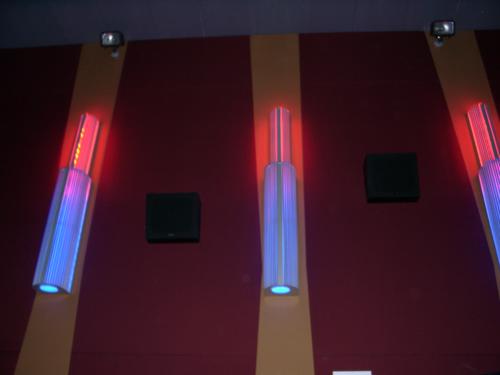
Posted by David Buckley (Member # 2600) on 01-18-2012, 08:37 PM:
The lack of ability of CFLs to dim well was noted above.
I've not played with dimmable CFLs, but do dim fluorescent lights regularly; a new fluoro tube needs "running in" for at least a hundred hours (and preferable a few times that) before it'll dim reliably. I wonder if CFLs have the same feature...?
Posted by Frank Angel (Member # 248) on 01-20-2012, 09:40 PM:
Gordy - MOST EXCELLENT lights!! You amaze, my friend.
Posted by Brad Miller (Member # 2) on 01-20-2012, 10:01 PM:
Gordon, you seriously need to manufacture and sell those!
Posted by Jim Henk (Member # 3628) on 01-20-2012, 11:18 PM:
Yes! Wow, those are beautiful!
Posted by System Notices (Member # 2357) on 04-17-2014, 07:57 PM:
It has been 817 days since the last post.
Posted by Frank Angel (Member # 248) on 04-17-2014, 07:57 PM:
Anyone know if there has been any practical developments in this area now that a few years has passed since the last post here? We are now in the quandry that our house lighting consists of a few hundred 34w (actually 40w long life) incandescents in the soffet bands across our ceiling; we need to plan on what to do when they become totally phased out in the next wave of energy-saving legislation. We want to go to LEDs, but no one is willing to live with a solution that will not mimic incandescents' smooth full-to-zero / zero-to-full dimming capability.
If anyone has any hardcore info on the lastest dimable LED technology that's out there, our Lighting Director would love to hear it.
Surely the LED manufactures who are now heavily into LED migration into stage lighting must have solutions for this problem.
Aside: In Radio City Music Hall, even incandescents had their dimming problems -- there were so many of them to light the stage that to get a quick blackout was impossible; even if you killed the power to every one of those hundreds of high wattage instruments with 500w and 1000w were bulbs, the time it would take for all of them to go from full on to full off was too long given the time it takes for the lamp glow to go out, then multiply that time factor by hundreds. They solved it using a motorized shutters to close off the lamp opening to kill the after burn glow. Never saw this myself, only heard of it from stagehands who claimed they knew. Sounds plausable, thought they would have to employ some be pretty fast (and quiet) shutters.
Posted by Dave Macaulay (Member # 813) on 04-18-2014, 09:45 AM:
If you want a real fade to black then you pretty much have to use LED stage lighting fixtures and DMX control. You can also control the color with most of these.
Dimmable LEDs are much better now but there's still a dead band between "off" and maybe 5-10%. I've found that setting the "off" level of the dimmer at where the LEDs just come on is best: the lamps are essentially off and you don't get the noticeable flashing on when dimming up.
There are a few types of dimmable LEDs with different characteristics. One brand may work OK with your existing dimmer but another not so well. Kelmar dimmers seem pretty good with most LEDs, current production dimmers are very good. Kelmar sells a LED output module to add on to their dimmers that works quite sell if you have problems. Leaving one tungsten lamp on the dimmer circuit solves a lot of LED dimming problems but that tungsten lamp may have a reduced life: I don't know why.
I have used "Pulsar" dimmers from NCD http://www.controlanything.com/ but they are a bit of a pain to set up and only have network or USB control - no physical control buttons and no real way to add them. They have comprehensive configuration options and work very well with LED lamps (once you figure out the setup). There are many models available with up to 8 output channels and up to 1500W output.
The basic problem is that at very low voltage a dimmable LED lamp's "ballast" can't work.
DMX lighting separates control and power, the dimmer circuit in the lamp controls LED current directly and they dim linearly to full off. Tungsten lamps are essentially just resistors, so they're naturally dimmable by varying the voltage. LEDs are current driven: the lamp's internal circuitry has to mimic dimming by reducing the current as voltage drops: non-dimmable models try to maintain LED current (and brightness) as voltage drops... that's why they dim poorly and then go off from fairly bright as you drop the voltage.
Non-compatible dimmers send out voltage spikes that are enough to power the LED electronics. Adding a tungsten lamp provides enough resistive load to soak up those spikes so the LEDs dim better without flashing or pulsing. The Cine-Q dimmers used in most Cineplex houses are hopeless (the auditorium seems like an 80s disco with strobe lights) with pure LED lighting but (just) acceptable if a tungsten lamp is left on each load circuit.
Posted by Frank Angel (Member # 248) on 04-20-2014, 11:43 AM:
Couldn't you just put a load resistor across each circuit? This would removed the issue of the bulbs short life (burning out in the middle of a show) while still loading the circuit for the LEDs.
Posted by Mark Gulbrandsen (Member # 72) on 04-20-2014, 12:26 PM:
For those of you that have or use Kelmar dimmers, the Cree lamps work really well in them. The advantage of LED is that you can use lamps with more lumens in them than an equivalent incandescent lamp. Most of the 60 watt equivalent LED laps draw only 8 to 10 watts! Most of my customers are using the 60 watt Cree's and some have eliminated the clean up lights because they draw less and are almost as bright when full up.
Note that Kelmar also sells an LED lamp ballast thingy that allows other LED lamps to also work with their dimmers.
Mark
Posted by Randy Stankey (Member # 64) on 04-20-2014, 02:08 PM:
I second that Cree product.
I replaced all the lights in my apartment with Cree LED.
You can get "warm" or "daylight" color, now.
I live in a 2-BR townhouse and last month's electric bill was 240KW/h. I'd say that more than half of that was taken up by the furnace and the refrigerator. I bet, if I turned the temperature down and was super conscious about turning lights off when I don't need them, I could easily get that down to less than 200KW/h.
BTW: Don't bother with the UtiliTech (Lowe's brand) or the Sylvania. They both suck. Go straight for the Cree brand. They are the most reliable, by far.
Posted by Mark Gulbrandsen (Member # 72) on 04-20-2014, 02:33 PM:
I'm completely converted except my garage floods which I will when they burn out. I bought about half at Loew's (Can't remember the brand but not the one you mentioned) and half at Home Depot (Crees). No problems with any of them in about a 6 month period now. I prefer the daylight color balance as it seems more natural.
Mark
Posted by Jeffry L. Johnson (Member # 453) on 04-28-2014, 04:34 PM:
Cincinnati Museum Center OMNIMAX uses Sky-Skan LED system for theater lighting.
Looks great. Plenty bright and dimmable.
I'm still using incandescent lamps. I've started using cold cathode lamps to replace the incandescent. Cold cathode don't dim as nicely as incandescent. Haven't found dimmable LED lamps that are screw-in replacements for my selection of incandescent lamps.