This is topic An open letter to Tyler Perry in forum Film Handlers' Forum at Film-Tech Forum ARCHIVE.
To visit this topic, use this URL:
https://ft-forum.com/ft/cgi-bin/ubb/ultimatebb.cgi?ubb=get_topic;f=1;t=011170
Posted by Brad Miller (Member # 2) on 02-25-2012, 05:09 PM:
Mr. Perry,
If you are going to continue to make boring movies that attract a ridiculous amount of customers, could you please at least conform to the audio standards set by the industry? Every-single-movie you make we have to run the volume at 8.5 to 9.
Thank you.
Posted by Robert E. Allen (Member # 1351) on 02-27-2012, 04:00 PM:
Hey Brad: I've seen most everything Perry has made and found them both entertaining and inspirational. I was wondering why you called them "boring". As for the sound you still had a couple of notches to go on your fader. Is it that you don't want the operator at the projector (where he/she should be anyway until the feature hits the screen or at least return to it to check focus and sound)?
Posted by Tony Bandiera Jr (Member # 2365) on 02-27-2012, 04:40 PM:
Robert:
While I can agree that the operator should be present at the start of the feature to check sound, focus, etc, it should NOT be the operator's responsibility to make up for the incompetence of the filmmaker/labs/editors.
Many years ago when I had to run Academy Qualifiers, a filmmaker came in with his 16mm print and a seven page (!) cue sheet telling the projectionist when to raise and lower the volume, adjust the tone and try to compensate for scenes that were printed too dark. I told the filmmaker that I had many other screens to attend to, and that I would start his film, check volume and focus and that was it, it would run the rest of the way with no more than random spot checks.
After his third entry into the booth without permission to whine about his film, I told him in no uncertain terms that his "baby" was just another piece of plastic running through a machine and I didn't give a rat's ass about his inability to have a properly recorded print made. Further, the next time he came into my booth without permission I would have him removed from the property and if necessary, arrested for trespassing.
Later that evening I apologized for being so harsh but also explained to him the reality of exhibition in today's (back then) environment. I also gave him tips on what to do when he had a new print struck to avoid the issues he had.
The point is, right or not, the reality is and has been for a long time that exhibition has been performed with little or no direct supervision by someone who may or may not be technically competent to provide a "flawless" presentation, with rare exception.
I can't believe I'm saying this, but at present, the closest we will ever get is a properly set up, spec'd and maintained digital system....or a film system where each competent operator has no more than two or three screens max to attend to so he/she can be diligent enough to catch any issues rapidly.
Yes, a good projectionist CAN handle a multiplex of say 10 screens with success, but my point is that it is physically impossible to closely monitor that many screens at all times.
I miss the days of single screen changeover operations where you HAD to stay alert..or totally fuck up the show.
Posted by Mike Blakesley (Member # 26) on 02-27-2012, 06:51 PM:
quote: Tony Bandiera Jr
I miss the days of single screen changeover operations where you HAD to stay alert..or totally fuck up the show.
Yup, I remember those days and my boss busting through the booth door when I would "accidentally" let the arc drift too much! ![[Big Grin]](biggrin.gif)
Posted by Robert E. Allen (Member # 1351) on 02-27-2012, 07:28 PM:
I too remember those days fondly Tony and Mike, While I have run multiplexes most of my experiences has been with carbon arc changeovers. I found that far less complicated than xenon automated systems. Digital would probably blow my mind.
Posted by Brad Miller (Member # 2) on 02-27-2012, 08:18 PM:
Robert, there are 3 kinds of movies being made today in regards to sound.
#1 Tyler Perry movies. We always have to play them about 9 on the fader.
#2 Michael Bay movies. These typically play about 4 on the fader.
#3 Every other movie. These all play quite perfectly at 7 on the fader.
Tyler and Michael need to get their act together, plain and simple.
And yes, Tyler Perry movies are quite boring to me with their awful scripts, acting and crank-them-out-like-a-daily-soap-opera production value. In fairness Mr. Bay's crapfests don't do anything for me either. Still, the entertainment value of the movies are only my opinion. The fader issue is fact.
Posted by Joe Redifer (Member # 3) on 02-27-2012, 09:31 PM:
quote: Robert E. Allen
you still had a couple of notches to go on your fader.
So it's fine if the sound plays at an acceptable level just as long as it is within the range of "notches"? How much is a notch anyway? I was always annoyed when I was asked to turn the sound up or down a notch.
quote: Robert E. Allen
Is it that you don't want the operator at the projector
Irrelevant with today's automation. The automation is perfectly capable of adjusting the volume to 8.5 or 9. It's just that isn't the standard. This affects both dynamic range and noise floor.
Posted by Bobby Henderson (Member # 840) on 02-27-2012, 09:31 PM:
"Filmmakers" (videographers really) need to get their movies mixed at the right audio level and just stop being assholes.
I've never watched a Tyler Perry movie in a commercial theater setting so I never knew about him mixing the movie audio low. Maybe he is doing that so all the people in the movie theater yakking away at each other, on their phones or talking at the screen can hear what they are saying.
My biggest gripe with audio still persists with the jerks who create movie trailers and commercials. Those damned things are always more hot than the feature. And it doesn't even make any difference if you're watching something in the movie theater or seeing something at home. The commercial audio is always quite a bit louder. I really would like to be there when the suit wearing executive tells the audio guy to ride that mixing fader hotter and hotter. I'd blind-side the suit with an elbow into his cheek bone. Those guys need an ass-beating lesson like that obviously. They have never taken any of the previous hints in more reasonable tones.
Posted by Jock Blakley (Member # 6552) on 02-27-2012, 09:42 PM:
Our trailer packs are a good bit of fun that way - start in SR-D at 3.5 for the ads, then over to A-type at 5, then back to SR-D but this time at 4, then mono at 9, and so on.
Another year or two of the loudness wars and the ads will hit that magic ~2.5 mark on the CP-500... where 0.1 each way renders them inaudible or deafening.
Posted by Manny Knowles (Member # 1171) on 02-27-2012, 09:47 PM:
quote: Joe Redifer
How much is a notch anyway?
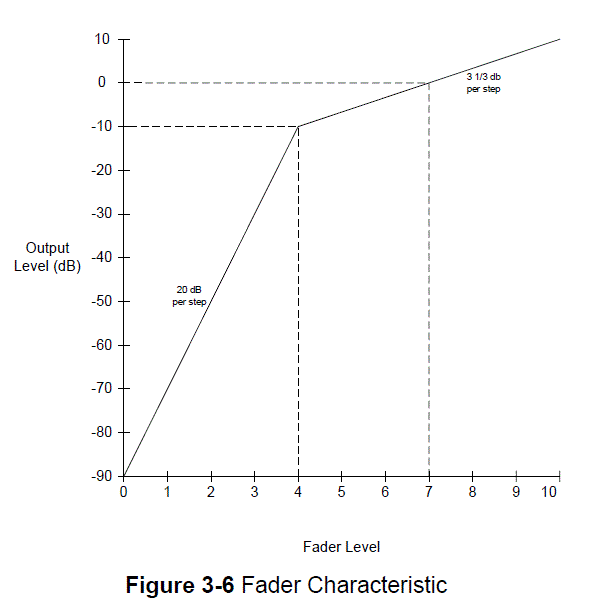
Someone from Dolby once told me that each point on the fader translated to a difference of about 3dB SPL. Almost anyone can discern a difference of about 2dB. Audio professionals can often detect a difference of about 1dB. So it depends on who's asking? A pro might only want a difference of 0.3-0.5 but an "average Joe" might need a full "notch" to sense a change.
However, I have found that this idea starts to fall apart when you are operating in the lower range -- roughly 4.0 and under -- where a difference of 0.1 can make a big difference between something being too loud or just right.
So, if the Tyler Perry movies are working those low numbers, then it takes more effort to find the fader setting that is "just right" -- whereas, if a movie is playing near 7.0, there's more wiggle-room because you'd need a difference of 0.3 to 0.5 to make the same kind of dent. If 7.0 is too loud, I usually try 6.5 first. And if you're really super-picky then you have a few decimal "notches" to fine-tune the level. (But that's not usually necessary.)
Not so with the lower numbers -- There's nothing between 4.0 and 3.9 (on a CP650) and, believe me, there can be a huge difference between those two fader settings.
So there are, in my opinion, very practical concerns if a film is recorded too loud.
And, if we're talking about an optical track, there's a good bet they've got optical clash if it's recorded so hot that we're working the 4's on the fader. Optical clash = distortion.
Posted by Robert E. Allen (Member # 1351) on 02-27-2012, 09:59 PM:
Joe - The last house I worked with automation was a CineMark Tinseltown with Christie projectors and consoles. It did not control either sound level or focus.
Posted by Joe Redifer (Member # 3) on 02-27-2012, 10:04 PM:
Cinemark is not really known for installing impressive booth equipment. But the projector and consoles are irrelevant. It's the automation that matters.
Posted by Bobby Henderson (Member # 840) on 02-27-2012, 10:07 PM:
quote: Manny Knowles
And, if we're talking about an optical track, there's a good bet they've got optical clash if it's recorded so hot that we're working the 4's on the fader. Optical clash = distortion.
Does Tyler Perry put a lot of thumping audio into the music mix of his movies? Could he perhaps be mixing everything else really low to provide more room for some booming music at a certain point of the show? Modern movie mixes are made first and foremost for 5.1 digital audio and then compressed downward for the analog optical track, but if someone wanted to save money and try to use the same mix for both digital and analog he would really have to bring down the levels to avoid crashing the matrix.
Posted by Manny Knowles (Member # 1171) on 02-27-2012, 10:14 PM:
One easy way to tell -- we'll do an A/B comparison of Brad's favorite Tyler Perry movie!
Road Trip!!! We're goin' to Texas!!!
![[beer]](graemlins/beer.gif)
Posted by Brad Miller (Member # 2) on 02-27-2012, 10:24 PM:
Tyler Perry did not make Road Trip, although that is a much better movie than anything he has made. ![[Razz]](tongue.gif)
Posted by Manny Knowles (Member # 1171) on 02-27-2012, 10:40 PM:
Is that the movie where the dude gets the prostate massage...and likes it? ![[thumbsup]](graemlins/thumbsup.gif)
Posted by Sam D. Chavez (Member # 1841) on 02-27-2012, 11:05 PM:
FWIW, on Dolby processors, there is 10dB increase from 7 to 10 on the fader.
The AES and SR.D soundtracks can go as loud as + 18dB per channel from reference level, regardless of the fader setting until you run out of power amp or speaker components, whichever goes first.
The optical analog level can only go up 6 to 8dB from reference level or you literally run out of room on the optical soundtrack.
Posted by Robert E. Allen (Member # 1351) on 02-28-2012, 12:32 AM:
Whatever automation they stuck in their consoles Joe didn't do it.
Posted by Martin McCaffery (Member # 37) on 02-28-2012, 09:47 AM:
Just curious, are the Perry movies low all the way through, or just in the beginning?
I ask because Roger Corman used to have the first 10mins of his movies mixed low so the theatre would crank it up so the rest of the film would be as loud as he wanted.
Posted by Tony Bandiera Jr (Member # 2365) on 02-28-2012, 12:50 PM:
The only problem with using Corman's method today is that so many theatres have crappy sound systems (or incompetent techs who don't know how to do a proper B chain) that if you tried to play a movie at the reference level the sound would be excruciatingly shrill or unbalanced.
A properly set up system should be able to play louder than "7" without killing your eardrums.
Posted by Mike Blakesley (Member # 26) on 02-28-2012, 01:46 PM:
We play most of our movies at 6.0. I myself am just fine with listening to a movie at 7, but noisy scenes do get really loud. Some people just don't like sound to be that loud, even though the sound is good. So, for us at least, 6.0 is a good compromise -- the loud stuff still has a good amount of oomph, but it's not making people upset.
The Star Wars re-issue is kinda soft...we're playing that at 7.1.
Posted by F. Hudson Miller (Member # 5318) on 06-09-2012, 11:36 AM:
Okay guys this is touchy one but . . .
I am a sound editor. When we mix a film it is done so in the super controlled environment of the re-recording stage. Every morning (and often at lunch) the engineers come in and pink the room and set it for 85 SPL. That is correct reference level required to playback the film as the director expects.
Unfortunately I believe most of the playback problems can be attributed to poor theater (and complex) design and failure to maintain the B chain. You can believe we never do a critical playback (in a studio or a civilian theater) with out a complete tweak of the theater (snd & pix). You would not believe how far out some of these theaters are! Film offers a sonic experience that most people will never experience at home. Hell, we even advertise the sound system on marquee! So please harass your management to take some of that popcorn cash and put it into regular sound alignments.
In a perfect world every theater would be pinked every morning and its SPL set to 85. If this were the case, the master fader would develop cobwebs between adjustments. But we know that its not a perfect world and that sound has, since about 1932, been the red-headed bastard step child of the film biz.
Enough soap box.
The loving care that a real projectionist gives our work is greatly appreciated by all those who work hard to bring big screen entertainment to audiences around the world. There is nothing more fulfilling for a film-maker than to sit in a screening and experience a film the way it was intended. Keep up the fine work, the audience only gets a great show when we are working together!
F. Hudson Miller
Sound Editor & Film Lover
(Hope you didn't loose to many drivers on Armageddon)
Posted by Steve Guttag (Member # 268) on 06-09-2012, 12:40 PM:
Mr. Miller,
First off...THANK YOU for participating here. It is great when someone from production gets into the mix (no pun). It offers a different perspective.
While I agree with you that much of the problem with how movies sound in the typical multiplex can be attributed to the poor set up of the theatre (not just the tuning but the equipment choice and acoustics of the room) but some blame HAS to be pointed at you guys who mix movies just too damn loud. Furthermore, you are not helped by your "friends" in the promotional departments that start every movie with trailers (or ads) that are mixed even LOUDER for the sole purpose of advertising...to satisfy the customer, the volumes get lowered and then the feature...that which you put your heart and soul into, gets to suffer as a result.
I have MANY (and I mean VERY MANY) studio screenings in my time...from World Premier on down and I have to say, regardless of the room I'm in, most of the time the mix was way too hot. And it really varies based on who mixed the movie too. I almost never get into a problem when I screen a movie mixed by say Larry Blake. It has a lot of dynamics, can be played at reference and very few complain about the level. Again, the room and the equipment play a very large part in this.
This past week, I did a screening of Prometheus in a THX certified screening room. All I can say is "wow!" Those guys/gals who mixed this movie had a lot of fun on that one. The film had a lot of dynamic range, and great balance. The mix was most excellent and did not fatigue ones ears despite having some VERY loud scenes. Now this room has very good acoustics and very good equipment too...key factors in making the sound mix translate into the theatre environment successfully.
One big complaint I have with most of the mixes I hear coming out of Hollywood is that the dialog seems to get buried behind the effects and music. It is as if you all don't get that the music and effects only augment the performance. The dialog is the most important sound coming from the speakers (at least 99% of the time). When you all over do with with the explosions and the music, if causes the typical movie goer to complain about the volume...which brings the whole mix down, including the dialog...which ruins the movie (for me, at least).
And on a personal note...please try to pan the dialog...my brain knows that when someone is standing on the left part of the screen that their voice is 20-40 feet away from their mouth...it is most distracting.
Posted by F. Hudson Miller (Member # 5318) on 06-09-2012, 01:52 PM:
Very cool to be allowed to play in this pool!
I agree, we can go overboard at times. I think that this happens for a number of reasons. Among them is the fact we are often covering up for the lack of story - you can't blame that one on us! Additionally it is usually the director who makes the final calls on track level, he is trying to get in his last licks with the mix and the overzealousness can sometimes show.
I have worked on a great many Jerry Bruckheimer films. If you notice the dial tends to be a little hot and can jump off the screen a bit. As a result, we sometimes are accused of an "ADR'd" sound by critics. That is part of the choice made to insure you aren't afflicted with "what did he say" syndrome.
It is this dialogue intelligibility that also makes us timid with panning the dial very much. The L & R channels are often running fx and, sadly, almost always running music. We try to keep the center as clear for Dial as possible. There is a theory that 5 across the front would make everything cleaner - since I haven't worked on many films that originated in that format I can't tell you if that is true or not. Another reason dial is not panned is because theaters are notorious for having screwed up L&R channels. If the dial moves right and there is a mis-matched, damaged, or worse no speaker at all, the dial just goes away. Management is much more likely to replace the broken center channel if there is no dia.
As for over all volume levels, a couple of notes. Theater trailers and ads are too hot. In the TV world they have set up standards that are messing with the dynamic range of theatrical films when they are broadcast. Too bad, because it is the ads and not the programs that were the main offenders.
Also, many theaters are under-equipped to play big sound films. When a cheap sound system is driven by huge track everybody suffers, but mostly the audience. When the playback system is smokin most films sound pretty good. Don't underestimate the effect of over modulation (distortion) to turn loud into horrific!
This all said, people ask "why not make the films to match the average theater?" But would you really want us to? An Indy 500 car is kind of a joke on a city street, but it would be a shame not "go for it" in its designed venue. We often take films and play them back in good theaters to see how they "translate." We obviously choose the best theaters to do this in. If it plays well in the AMPAS Samuel Goldwyn Theater, we know we have done our part of the job!
Also, don't under-estimate the influence of out target audience (12-24, everything else is gravy). What may be over the top for the "sophisticated" ear is just right for the "less seasoned" ear. In the end $$$ do have a huge impact.
This all said we, are also continuing to learn how to use and not abuse all the digital formats. The goal is to get the max bang without the max pain!
Enjoying the colloque!
Posted by Joe Redifer (Member # 3) on 06-10-2012, 03:14 AM:
Hello F. How are you? While I certainly agree with the level setting, I imagine you'll also agree that's only a small part of the B chain that can affect such things. Even if everything is at 85db etc, if the room is poorly EQ'd as they often are, it's still going to sound much too harsh and often way too loud. You should start with setting the levels, then EQ, then check the levels again and then do a listening test. Like Brad says, you should never rely on the testing equipment 100%. I have also found this to be very, very true. Most theater techs tune a room to the number and call it a day. So when mixing, calm down around the 4K and make sure never to put Aerosmith in the mix again! ![[Smile]](smile.gif)
Interesting story (I hope): We did a test screening of the movie Hope Floats. Sandra Bullock was here and all that. The sound was run from a dubber for this cinematic masterpiece. The auditorium they ran it in normally had fairly decent sound. I don't purport that it was anywhere near perfect, but it did pass THX certification at a time when THX still almost meant something. Of course they came in and re-EQed and adjusted everything for Hope Floats. Afterwards the auditorium just sounded awful. Very harsh and we had to lower the volume. I couldn't fix it with any great effect because I was just learning about that stuff at the time. By the time Star Wars Ep 1 came out I did fix it and it sounded pretty damned awesome. Anyway I really wish they would have attempted to put it back the way they found it. I don't know if they cranked the high frequencies to compensate for the magnetic track but man it sounded harsh. They should have brought their own Cat 64's but they did not.
Oh, and I'm betting trailers are "loud" because there's usually lots of explosions going off in quick successions and I wouldn't be surprised if some were compressed to the point of a 50db dynamic range (at most). It seems that way with TV ads.
Well, nice talking with you, F! Tell your brother, Murray Abraham, that I said "Hi!"
Posted by Marco Giustini (Member # 4544) on 06-10-2012, 05:34 AM:
Welcome and thanks for your contribution.
Everything that has been said is very interesting and educational.
I used to work in post production and it's really amazing how much difference there is between it and the exibition world. In Post production a "click" in sound is totally unacceptable. In a commercial cinema we can live with HF units that have fallen on the floor.
It's so true when it's said that a good sound system will sound terrific and won't require many adjustments/repairs. But most of the theatres wouldn't understand, they prefer to install cheap stuff, which then needs to be repaired every now and then - and they sound horrible.
Also the average "sound check" is easily summarized into a few points:
- Place a non calibrated microphone on the Dolby Spot
- Dial the EQ to the line at all costs
- Level the channels
- Walk away
Next time the engineer comes, they choose a slightly different position for the mike and "wow, you need a new EQ".
This is often requested by the theaters themselves. If you spend 2 hours doing your EQ, listening to some material, and checking that the speakers are still aimed correctly, you're an incompetent, since "the other guy" did everything in 15 minutes.
Pink auditoria? I've met so many people using different test equipment. There is no consistency between calibrations, so the level read usually varies 2-3dB depending on the equipment used. So what's the point in having the sound system checked regularly?
It's so annoying that sound is so underestimate in cinemas. But you keep doing the right job, don't adapt your sound for crappy theatres. And please do pan the dialogues, that would force many installers to make sure L and R are consistent with the Centre channel, something that is very hard to do following the aforementioned task list
Looking forward to reading your posts again,
Thanks
PS: attached CP650 fader graph
Posted by Brian D. Whitish (Member # 825) on 06-11-2012, 12:13 AM:
Hi Mr. Miller. I have a friend that works as a rerecordist at Warners. Ron Bartlett. Did the rerecording on Prometheus. Do you know him by chance?
Posted by Chuck McGregor (Member # 6826) on 06-11-2012, 03:30 AM:
For what it's worth here is another graph of fader levels. The specific non-USL processors models are unfortunately not identified, although the Dolby curve is consistent with the CP650 graph already posted. Each dot is a 0.1 "notch."
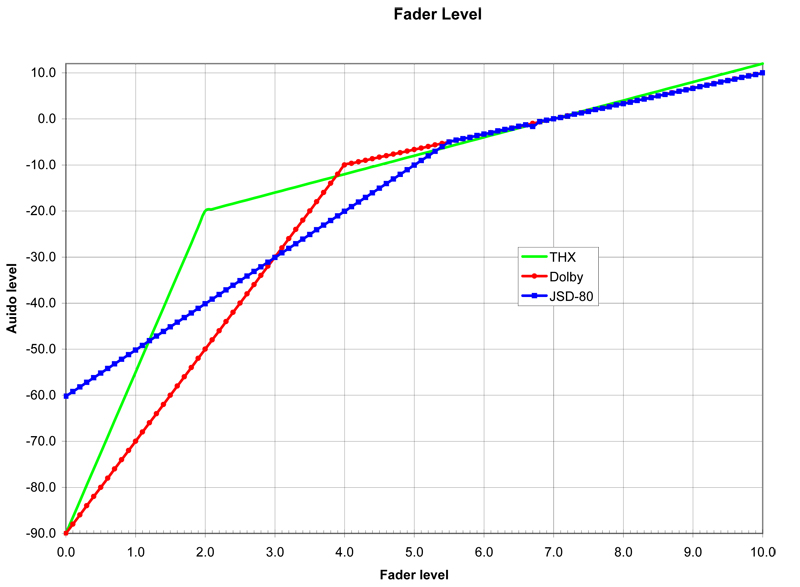
It should be obvious that below 7.0 a "notch" can vary considerably depending on the processor and/or manufacturer.
As to audio levels, the theater I work with does a lot of alternative content (Emerging Pictures, Met Live, Nat'l Theater, et al) in addition to 35 mm (optical).
Since the system was completely "renovated" last fall, to keep consistent dialog levels for the various presentations, the fader levels have covered a 27 dB range or a fader range on the JSD-80 from 4.6 to 10.0. Just to be clear, we preview everything to determine the fader level for that content, often 2 settings are needed if there are trailers or video previews. Films are more consistent than the video content, but including trailers have covered a 15 dB range.
I posted an Excel chart next to the processor of the fader settings listing the +/- dB from 7.0 for every 0.1 fader step.
In case there is any question, the theater's equipment is high quality that has been properly gain structured, calibrated, and tuned with hard copies of all the performance measurements. (Curious if other cinemas have or are provided with the measured performance data.)
Posted by Louis Bornwasser (Member # 3063) on 06-11-2012, 12:15 PM:
The graps above only prove that the only reference we have is "7".
It also proves that we are damn straight NOT using it. Louis
Posted by Tony Bandiera Jr (Member # 2365) on 06-12-2012, 10:58 PM:
RE Manny's Optical Clash...anyone remember the "Addams Family Rap" trailer? I have a copy and the optical clash on that track is horrendous and very visible, both on the bench and when running without the aperture plate.
Stallone's "Cobra" also had a lot of issues with the bass, never got a chance to see if it was too hot in post or if the optical track was clashing...
Posted by Marc D Fishman (Member # 6992) on 06-17-2012, 07:07 PM:
I can't find the quote button yet, and this is my first post on this site.
I have been in the audio post production business for 22 years (spending the last 16 as a re-recording mixer.)
As a side note, I worked at the Continental Theater in Denver when it used to be a single screen.. it was during the time of 1/2 shifts being filled by union projectionists, and since I was an assistant manager at the time, I had to learn my way around the booth..
I would really like to open a dialog with the projectionist community about the state of audio playback in our cinemas today.
I am lucky to live near one of AMC's premiere theaters (Burbank 16) and have had 4 really diverse, and all fairly terrible, experiences in there over the past month.. in one of their smaller rooms, one medium, and the IMAX and ETX auditoriums (#1 and #14.)
The company I work for has been mixing Tyler Perry's films for the past 5 years, so I might have some insight.. however, I didn't mix any of them, but know the mixer(s) who did.
We obviously spend our lives slaving over the audio tracks for films... and without fail, any film with a Dolby license (>99.9% in the last 15 years) have been mixed at a reference level that coincides with the CP value at 7.. 85db SPL for the LCR, 83 each surround, and 89-90 for the sub.)
While I understand the fact that not all theaters have the best equipment, and I can sympathize theater to theater leakage, loud trailers, etc... I just don't understand the rationale that projectionist use in arbitrarily choosing playback levels..
If a film was shot to be projected at a certain luminance, it was mixed to be played back at industry standard... it's not arbitrary, and while I've mixed a number of films that would be on the lower side of the spectrum, there was always a reason to do so, and we (i.e. the director, editor, myself and the sound supervisor) were all aware of how it would be played back in a theater properly setup to have 7 = reference...
I would really like to have an open, civilized discussion on these boards about audio playback in theaters...
Posted by Mike Blakesley (Member # 26) on 06-17-2012, 08:16 PM:
quote: Marc D Fishman
I would really like to have an open, civilized discussion on these boards about audio playback in theaters...
Marc - welcome to the forums!
The Quote button is underneath the message-entry area, to the right of the "instant graemlins."
Or an easier way to quote is type [qu ote] (without the space in the middle) in front of the text you want to quote, and put [/qu ote] at the end of the quoted text.
I'm sure many of us would love to participate in the topic you describe. I'll leave it to you to start a new topic on it...just click the "New Topic" button.
Posted by Joe Redifer (Member # 3) on 06-17-2012, 10:06 PM:
This forum software is about 10 years old so it doesn't have modern features like a quote button or box near each post. Gotta manually enter it all in.
Posted by David Zylstra (Member # 4230) on 06-18-2012, 03:27 PM:
quote: Marc D Fishman
I would really like to have an open, civilized discussion on these boards about audio playback in theaters...
I echo Mike's comments about starting a new topic - it would definitely be productive as many on this board have experiences with the resulting "real world" guest experience.
Posted by Michael Uebler (Member # 6876) on 06-21-2012, 12:21 PM:
I can't speak for the Madea movies, but i ran good deed not too long ago, and the audio was right on but i did have to tell an audience full of angry customers that they couldn't continue the movie the first time i showed it. after my change over to the second reel the foot of my sweet srait simplex film gate fell off. Low and behold the guy that worked there befor me only left me a metric set of allen wrenches when the screw is in standard, so we were forced to shut down and i had to take it home and fix it.
Posted by Chris Slycord (Member # 4239) on 06-21-2012, 04:49 PM:
Since you're running changeovers wouldn't it make more sense to put that second reel onto the first projector and send someone to get you a set of wrenches? I know I'm being a "Monday morning quarterback" and all but just a thought...
Posted by Robert E. Allen (Member # 1351) on 06-21-2012, 06:12 PM:
You're right Chris. And that could be done in less time than a commercial break on a TV station running a movie.
Posted by Tony Bandiera Jr (Member # 2365) on 06-21-2012, 07:02 PM:
Not to mention you CAN run the entire show on one machine if you have to, you'll just have a short break at the end of each reel.
Unless the booth catches fire or you have a complete power outage, there is NO excuse for not finishing a show in a changeover house.
Posted by Jock Blakley (Member # 6552) on 06-21-2012, 11:09 PM:
And it's even easier if you're running 6000' changeover.
Posted by Mike Frese (Member # 4361) on 06-22-2012, 01:13 AM:
quote: Marc D Fishman
I just don't understand the rationale that projectionist use in arbitrarily choosing playback levels..
Simple answer: customer complains that it is too loud or they can't hear it well, it gets changed.
Posted by Chris Slycord (Member # 4239) on 06-22-2012, 01:44 PM:
And it's a bit odd to call doing that "arbitrary." Arbitrary makes it seem like it's some whimsical decision by the projectionist to mess with things.
Posted by Manny Knowles (Member # 1171) on 06-22-2012, 01:57 PM:
Yeah, that bugged me too.
I've got a lot of training and experience in mixing for film and I certainly do not set levels "arbitrarily."
My current cinema is THX certified, as was the last one (which was regularly tuned by Tom Holman himself) -- so that removes the systems from the equation.
If the dialogue "tickles" my ear, then it's too loud -- Holman did extensive experimentation with professional and student mixers and they generally "agree" to within 1-2dB C SPL as to what is the "correct" level for dialogue -- so I'd say that validates my ability to determine an appropriate playback level.
One could be a stickler and play everything at the magic "7" on the fader; but what good is it to satisfy (only) the film-maker -- who probably isn't in attendance -- at the expense of alienating the audience?
Posted by Marc D Fishman (Member # 6992) on 06-25-2012, 12:45 PM:
To say you can use your ears (and obviously everyone is different due to age, hearing damage, gender, etc.. too many factors to list) to determine playback level based on how loud you think the dialog should be completely negates the fact that the average dialog level can vary almost 10db over the course of a film... it might tickle your ear in one scene but be too low in another...
That was my point.. we have a reference.. arbitrary might not have been the proper word to use.
Posted by Manny Knowles (Member # 1171) on 06-25-2012, 03:42 PM:
Obviously some common sense is at work here too -- I'm not setting levels based on one scene -- and I think I can tell when a scene is supposed to be loud, or quiet, or normal.
If we want to be really picky about it -- the mixers are setting levels arbitrarily too -- and naively if they think they have the final word on reproduction level.
(And how good is THEIR hearing? Depends on how many Bruckheimer films.)
Who gets final cut? The projectionist. That's who.
Posted by Scott Norwood (Member # 30) on 06-25-2012, 03:49 PM:
Out of curiousity, how often to sound mixers get to hear their work in "normal" commercial theatres?
Unlike a mixing stage, theatres can be empty or full, depending on showtimes and the popularity of the film being shown. A theatre with two people in it sounds dramatically different than the same theatre with a thousand people in it. In most cases, the fader would need to go down slightly for the empty house and up slightly for the full one. As long as the channels are balanced with respect to each other and the system is otherwise well designed and in good order, I see no problem with this. The fader knob is there for a reason (and not just to turn down trailers).
Also, in the real world, not every film exhibition venue has perfect acoustics and a proper sound system. We have "live" houses, "dead" houses, mono houses, Dolby houses, mono/surround houses, drive-ins, multi-use venues, etc. Standards are great, but the theatre is ultimately responsible for putting on a show that people will enjoy enough that they will come back to the same theatre to see another film.
In any case, I think that it is great that we have some people from the production community who are participating here. We all (I hope!) want to improve the quality of what movie audiences see and hear, and it would be great to be able to work together to do that.
Posted by Manny Knowles (Member # 1171) on 06-25-2012, 03:58 PM:
I wouldn't propose dumbing-down the mix to accommodate imperfect houses, if that's what you're going after.
The THX dub stages at Lucasfilm used to have noise generators to simulate typical AHU noise. They found that their rooms were "too quiet" and some of the subtleties fell below the noise floor of the typical cinema. So they could turn these noise generators on/off as a means of testing something out if they weren't sure it would be heard.
Posted by Scott Norwood (Member # 30) on 06-25-2012, 05:15 PM:
Agreed completely. The film should be mixed to sound great in an "ideal" house. But some mixes sound bad in bad rooms and that can require fader adjustment. I don't see why there should be anything wrong with this if it improves the experience for the audience (and, no, the projectionist does not usually design the space...he just has to make the best with what he has).
Posted by Marc D Fishman (Member # 6992) on 06-26-2012, 11:38 AM:
Scott... Can't speak for every one, but I go to the cinema quite often.
Regarding packed vs. empty.... it is a misconception that people absorb sound to a degree that effects SPL (not saying that is what you are stating, but just pointing out that this common myth is false...)
I work on a lot of comedies... and they preview a lot... so I'm ultra familiar with going to a run through in the morning, being there for the calibration done in an empty auditorium, and then hearing it with a capacity room..
Obviously the noise of the audience, along with their concessions, popcorn bags, etc, can raise the noise floor of the room.. and on a comedy laughter can swallow up dialog on the edge of being too low...
It's always a balance during the final mix of knowing where those points are and not over compensating so the dialog comes screaming out at you...
After that long winded comment, I think it's important to remember that most of us (i.e. sound post production people) are more concerned with the turning down of our mixes... we know what the reference is, so I'm just trying to have a discussion about why it's getting turned down.
Manny.... the HVAC noise generator at Skywalker was a useful tool back in the day.. last time I mixed up there was 18 years ago, and I don't think they still have it on their stages (I'll find out) and we do need to be vigilant about mixing things in that are so subtle that they will be lost in the noise floor of a large room or with a vocal audience.
Obviously we have a standard, and the only way to achieve what the director intended is to properly calibrate the theater using standard industry practices and leaving the calibrated CP at 7...
While you may have had some experience and training, I don't think our ears are the proper way to decide what level the films should play at... we know the reference, and how to achieve it, and I think that even when we don't "like" it when films are too loud, we have to respect the vision of the film makers...
Just my .02... and again, just trying to have an open progressive discussion.
Posted by Manny Knowles (Member # 1171) on 06-26-2012, 12:26 PM:
We have faders for a reason -- some movies are just mixed too damn loud -- (and a few are too quiet) -- that may be what the director intended but I question how much directors and producers really know about sound -- don't forget that our audiences are actually your customers -- if we played every movie at 7 -- even in the calibrated rooms -- it would be bad for business.
Trust me -- a lot of us here are VERY WELL familiar with the standards. We're not idiots.
Some movies are poorly mixed. It happens. Admit it and move on. Otherwise, this isn't really an "open" discussion.
Posted by Scott Norwood (Member # 30) on 06-26-2012, 01:00 PM:
quote: Marc D Fishman
Regarding packed vs. empty.... it is a misconception that people absorb sound to a degree that effects SPL (not saying that is what you are stating, but just pointing out that this common myth is false...)
Hmm...interesting. I always assumed that clothing (especially in the winter, when people wear thick coats) made a huge difference, but maybe it's more the increase in the noise floor. Either way, I do feel that films need to be played louder in full houses.
Marc -- I am interested to learn what it is like to go from hearing your own sound work on a mixing stage to hearing it in a theatre. Is it hugely disappointing? Or do you feel that a typical theatre that is well maintained is capable of reproducing the track accurately?
Posted by Marc D Fishman (Member # 6992) on 06-26-2012, 01:51 PM:
quote: Manny Knowles
We have faders for a reason -- some movies are just mixed too damn loud -- (and a few are too quiet) -- that may be what the director intended but I question how much directors and producers really know about sound -- don't forget that our audiences are actually your customers -- if we played every movie at 7 -- even in the calibrated rooms -- it would be bad for business.
Trust me -- a lot of us here are VERY WELL familiar with the standards. We're not idiots.
Some movies are poorly mixed. It happens. Admit it and move on. Otherwise, this isn't really an "open" discussion.
Manny..... I never said you were idiots..
However, you are making assumptions about what directors and producers know, and are becoming judge and jury on what mixes suit your tastes....
You say you've been on a dub stage before for a mix ( you said you had "mixing experience") so I would think you would understand not only the process but the involvement of the directors and producers in it.
Are you trying to "protect" the directors from themselves?
Define "poorly" mixed.
Is it too loud? Too quiet... what make you the arbiter of taste in regards to the quality of the mix.
Sometimes I mix the dialog so it does "tickle the ear" for a reason...
We don't spend months of time, and hundred of thousands, or in some cases over a million +, on sound track creation not knowing that the film might be loud or too quiet.
Michael Bay makes movies for 13 year olds (for the most part..) Are you and I to judge what is good for them?
I can only admit that there are films that I don't subjectively agree with on how they sound...
I think some are way too loud... I think that some are not at all what I would subjectively agree with.. and I think some are too quiet.
So if you want to have me agree on that point I most certainly do.
But your putting a general label on a mix as being "bad" leaves too much room for subjective interpretation leading you to turn it down.
I've mixed close to 150 films, and on each one the director is intimately involved in the creation of the sound track, and has signed off on the final product on not only our dubbing stage, but at print checks and often screenings.
This doesn't happen in a vacuum.. even on the "bad" mixes.
The audience, our customers... they are paying good money to experience a story the way the director intended..
IMO.. it's not your place, or mine, to subjectively determine what that intention is and then try to enhance/correct/fix it.
I'm 43, and understand that a majority of the film going public (or at least the ones the studios think are spending the money at the theaters) isn't in my demographic... I would assume most of us who have been doing this for a while would agree.
Stepping outside this debate, however, is more pertinent to what I think is the real issue...
I commend you for taking the time and effort to at least verify what each film sounds like in a given room (even if I fundamentally disagree with changing it based on your tastes...)
However, my bigger issue is that there aren't more people like you who are working in the theaters who even understand what we are talking about here..
I know I have an unrealistic expectation for every film to play at reference..
But that's not my real concern (or goal)...
I went to six films over the span of the last month at a rather good theater (the AMC Burbank 16.)
Here were my experiences.
1. Avengers - DCP, 7.1. The subs were off (I spend two months mixing next door to that film... my room was shaking non stop so I knew how much content there was in the track, and what to expect.) Level of CP i would guess to be around 4.5 - 5 (it was easily 6-8 db low...)
2. Snow White - DCP, ETX 11.1 Passive Up Mix. AMC thinks they need to play above reference in their ETX room (after I spoke to the manager, she confirmed as much.) However, that wasn't my complaint... the subs were easily 10-15db too loud.. it was painful, and the "test" Dolby Atmos systems ceiling speakers were literally moving...
3. Prometheus - Digital IMAX 5.0 - Center speaker was 2-3 db too low. Dialog on both trailers and feature were fairly low, and I had a member of the sound team who was on the mix stage the entire time confirm it for me. Right surround was distorting.
4. Safety Not Guaranteed - DCP 5.1. Playing 6-8db too low, and it's a quiet film.
I contacted AMC corporate through their web site and received a follow up from the manager... she had the cine tech crew out as well as IMAX techs (she said they felt the room was in spec.) And now I have a contact for any other issues..
Since the follow up, I've been there twice.
Saw a film there two weeks ago, That's My Boy, in the same auditorium I say Avengers in.. it was perfect.
And yesterday I saw Brave in Dolby Atmos... obviously, it was also exemplary.
Obviously it's just a matter of making an effort, and holding exhibitors accountable to maintaining consistent standards of presentation...
That's my real concern.... if you, or any others on this forum who actually care, had been there, I suspect these issues wouldn't occur...
This shouldn't be a debate about playing loud films at a more reasonable level, or turning up films that can't be heard....
My whole point in starting this discussion is about getting the experience to be consistent....
That's all...
Posted by Frank Angel (Member # 248) on 06-26-2012, 02:41 PM:
quote: Marc D Fishman
Regarding packed vs. empty.... it is a misconception that people absorb sound to a degree that effects SPL (not saying that is what you are stating, but just pointing out that this common myth is false...)
Yah, well, then it's a myth that the myth is false, especially in a large house, of which I am well versed because I have worked as a house sound mixer in our 2400 seat theatre for decades and a recording engineer for just as long, I can tell you that even a layman can hear the difference in the sound of a packed house compared to an empty one. Even feedback thresholds change between empty and full.
Reverberation is certainly affected by clothing and the 2400 human body mass that's dumped into the space between the time we do a lengthy sound check and the time of the actual show. Even body heat and moisture will impact sound.
There's a famous story (not myth) about a recording session when Lenny Berstein and his NY Philharmonic were recording for Nonesuch; they had recorded for two days and then need to do match segments to cover a few things he was not happy with. On the third day the orchestra was back in the studio and the session began, but neither Bernstein nor the recording engineers could get the sound to match what they had recorded the previous two days, even though everything in the studio was exactly the same as the first recording sessions. Finally one of the engineers noticed that a lot of the musicians had hung up wet overcoats on racks at one end of the studio. The temperature had dropped the night before and it had also rained. The first two days were sunny and warm -- no wet coats. They removed the coat rack and outerware and voilá, problem solved.
So I have to disagree; sound levels in a theatre, at least in a large one like ours, most certainly does get affected by dumping a couple of thousand humans with clothing into the space.
My experience in our smaller space is certainly similar -- we have a 200 seater that is used for film and live recitals. Musicians were not happy with the treatment the acousticians gave the walls when they designed the space. Musicians complained (which is all they do when not actually playing) the space was to "dead" and they couldn't hear each other. The original design required both side walls to be covered with 24lb velour that was chosen specifically for its sound absorbing characteristics -- again by a reputable acoustic design firm -- not just by happenstance. The solution was to put that velour on tracks so that it could be pulled back to expose wood for the music recitals but then pulled to over the walls for film or other playback. 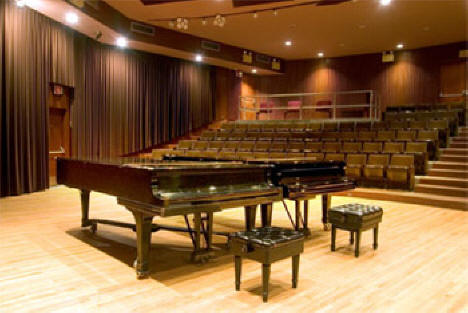
The Sam Levenson Recital Hall -- those curtains on the side wall had to be on travers tracks so they could be pulled all the way back to the rear of the room.
So if curtain material can significantly change sound characteristics, surely clothing and substantial mass does will.
As for the "director's intent" -- is the director's intent ever to make people leave the theatre in disgust because the sound is to loud or too low (especially to loud)? IMHO, there is no guarantee that everyone in the chain from the dubbing stages & mixing desk to the labs striking prints or authoring DCPs have all done everthing EXACTLY to spec or even if that director had ear wax buildup when he was screaming that the wanted the explosion louder. The last and final word in the chain is the audience that paid $15 to see his "work;" if they are all complaining that it's too loud, then damn it, it's too loud.
Let me ask you --is a theatre operator supposed to trust hunks of dumb hardware and an LED readout when his patrons are walking out in droves? I have seen THAT happen and sorry, I don't care how much money and time and effort goes into the process on the dubbing stage, surely neither you nor any sane director wants to loose his audience at the exhibition stage. What may "tickle your ears" may, if any single parameter in the long chain of processes that go from your hands on the fader to that fader in the booth is out of wack, than that sound level may no longer be a tickle but a full fledge audio assault.
And THAT, boys and girls, is why there has been a fader on every audio playback system since the invention of the electron tube.
Posted by Martin McCaffery (Member # 37) on 06-26-2012, 02:47 PM:
Just to add, there is also no such thing as a quiet audience. Even if they don't speak, the combined low level sound of 2400 people breathing adds to the ambient sound.
Posted by Louis Bornwasser (Member # 3063) on 06-26-2012, 03:31 PM:
What we are seeing here is the classic: "Every playback should be identical so that we can control the input to suit" versus the "I have to accommodate my clients" arguement.
Unfortunately rooms, systems, and people are not going to agree. (and I'm not even getting into the I'd-mix-it-my-way people.)
This IS a big problem; home systems can allow an infinite range of wierdness, while professional (public) system must be somewhat middle-of-the-road to keep complaints down.
SMPTE and, later, Dolby, attempted to "herd the cats" on this. I would be interested to hear Ioan Allen's take on this. Louis
Posted by Joe Redifer (Member # 3) on 06-26-2012, 03:52 PM:
quote: Marc D Fishman
on a comedy laughter can swallow up dialog on the edge of being too low...
How about people yelling at the screen? This happens in Tyler Perry movies.
Also, people actually laugh at the comedies released to theaters?
Posted by Bobby Henderson (Member # 840) on 06-26-2012, 04:03 PM:
From my own personal experiences of watching movies in different theaters and watching a lot of movies in the same auditorium within a certain multiplex I can clearly tell volume levels are varying both from venue to venue and sometimes feature to feature as well.
For example, I can remember DTS tracks of certain MGM/UA releases being especially hot in comparison to other features in DTS. I watched a test run of Goldeneye in DTS, played in a THX-certified house. At the time this particular theater had been open for only a year. I had seen several movies in DTS in that auditorium. Goldeneye was unquestionably louder. The opening action sequence was painfully loud with the Dolby CP-65 fader at 6.5, nevermind trying it at 7! The track was more tolerable with the fader at 5.5.
The technicians on the mixing stage might indeed be running pink noise and setting the reference at 85db on every Hollywood movie release, but something would have to explain the track volume differences I have heard from one feature to the next in the same auditorium on the same equipment at the same settings.
Volume differences from one feature to the next are pretty minor in comparison to the anger inspiring situation with movie trailer volume.
If movie directors and sound designers really want the theater's booth personnel to keep that fader set at 7 all the time they really need to stroll down to the studio's marketing department and deliver a brutal ass-chewing. Overly loud movie trailers and commercials generate more complaints about loudness than anything in the actual feature. Likewise, those overly loud trailers and commercials are the main thing that will cause a manager to visit the booth, turn down the master fader and leave it there.
The marketing people crank up the volume on TV commercials too. But I have remedies for that: the mute button, the DVR's fast forward button (on recorded events) and changing the damned channel. The marketing people need to wake the hell up and master ALL of their stuff at the appropriate level rather than 3db-10db above the main program.
Posted by Manny Knowles (Member # 1171) on 06-26-2012, 04:23 PM:
This is not an "open and progressive" conversation.
It's a very complex problem that is not going to be resolved by trying to defend reasonable action to one mixer.
Waste of time.
Case closed.
Posted by Chris Slycord (Member # 4239) on 06-26-2012, 05:15 PM:
If directors all know about sound, why did I have a guy rage at me that he couldn't get his DD-only print to play in 5.1 in an SDDS house? And why when I explained we could only hook it up to work with SDDS or DTS did he say "I've never heard of those"? Clearly, because he was intimately involved in the sound and also educated on the subject...
Oh and this guy knew so much about cinema sound, that he thought we could redirect the LCR mix to also play in the rear and that when we weren't going to be able to do that on nearly no-notice, that the solution was to tell us to progressively turn up the fader to near 10.
No surprise, when the show was run for actual guests, they all complained when the volume was turned to his requested level...
Posted by Marc D Fishman (Member # 6992) on 06-26-2012, 07:03 PM:
quote:
From my own personal experiences of watching movies in different theaters and watching a lot of movies in the same auditorium within a certain multiplex I can clearly tell volume levels are varying both from venue to venue and sometimes feature to feature as well.
The technicians on the mixing stage might indeed be running pink noise and setting the reference at 85db on every Hollywood movie release, but something would have to explain the track volume differences I have heard from one feature to the next in the same auditorium on the same equipment at the same settings.
Volume differences from one feature to the next are pretty minor in comparison to the anger inspiring situation with movie trailer volume.
If movie directors and sound designers really want the theater's booth personnel to keep that fader set at 7 all the time they really need to stroll down to the studio's marketing department and deliver a brutal ass-chewing. Overly loud movie trailers and commercials generate more complaints about loudness than anything in the actual feature. Likewise, those overly loud trailers and commercials are the main thing that will cause a manager to visit the booth, turn down the master fader and leave it there.
The marketing people crank up the volume on TV commercials too. But I have remedies for that: the mute button, the DVR's fast forward button (on recorded events) and changing the damned channel. The marketing people need to wake the hell up and master ALL of their stuff at the appropriate level rather than 3db-10db above the main program.
Bobby...
Every film is going to have an average level that is going to of course vary... we don't stare at a meter and try and make it be one certain level.. the reasons are varied as to how loud or soft I mix a film, but they mostly have to start, in my case, with the overall subjective quality of the sound from the production recordings..
I completely agree about trailers.. I think the TASA standard is way too loud, and should be reexamined... Congress took it into their own hands in regards to TV, and now we are "saddled" with the CALM act...
And your suggestion is being heeded and hopefully we as a group can get something done about it.
Understanding that fact (that most trailers are way louder on an average level than a feature) I would think the solution in some cases would be to automate a level change from the pre show to the feature.
Frank... I've not seen one study that suggests that bodes absorb sound to any great degree...
While I wouldn't argue your experience in live venues, and large ones at that, I don't think the effect that I've experienced, even with changes in the reverberant field, are as great in most film theaters, which were mostly built much more "dead" than most live music venues...
And I've never said that there are times when the films don't need to be turned up or down..
What I've said is that I want theaters to take more care in making sure the experience is consistent so the issues I recently experienced will be minimized...
quote: Chris Slycord
If directors all know about sound, why did I have a guy rage at me that he couldn't get his DD-only print to play in 5.1 in an SDDS house? And why when I explained we could only hook it up to work with SDDS or DTS did he say "I've never heard of those"? Clearly, because he was intimately involved in the sound and also educated on the subject...
Oh and this guy knew so much about cinema sound, that he thought we could redirect the LCR mix to also play in the rear and that when we weren't going to be able to do that on nearly no-notice, that the solution was to tell us to progressively turn up the fader to near 10.
No surprise, when the show was run for actual guests, they all complained when the volume was turned to his requested level...
Clyde... you and I both know there is a big difference between a director understanding the exhibition nuts and bolts, and most directors knowing how to craft a sound track..
One bad apple...
quote: Manny Knowles
This is not an "open and progressive" conversation.
It's a very complex problem that is not going to be resolved by trying to defend reasonable action to one mixer.
Waste of time.
Case closed.
I understand the complexity of the problem.
Theater to theater transfer, leakage, sub leakage, loud trailers, theater policies, poor and broken equipment, poor construction, customer complaints, etc..
And as I said, while I don't agree with the idea of turning down tracks that your think are too loud, it's always going to be an issue when the audience complains, or you're blowing subs, or etc...
Posted by Tony Bandiera Jr (Member # 2365) on 06-26-2012, 07:28 PM:
Marc, open your mind and don't get sensitive, no one is or has been attacking you personally...but you are wrong about bodies affecting sound, I have done both listening tests and measurements with pink noise and RTA on my room at UC Irvine (See the pics warehouse on here), a prime example of a room with film sound being given short shrift. With a population in the room of 150 or more, there are measurable AND audible artifacts...loss of HF, odd dips in the midrange, and a marked reduction in reverberation.
Manny is quite knowledgeable in both live and film sound and I have generally found his observations to be spot-on.
I have also spent a few years mixing live sound (house mix and stage monitors) for a variety of bands in a good range of venues, and yes the presence/lack of people in the venue makes a HUGE difference in the overall sound. In many venues (outdoors specifically) EQ and levels that work during the morning sound check get radically changed during the evening performance when the air is denser and cooler....simple physics PROVE that sound waves WILL change characteristics when the transmission medium (AIR) changes in temperature, density or humidity.
If you choose to bow out of this discussion with the attitude in your last post, then that is a shame and candidly, childish.
Posted by Marc D Fishman (Member # 6992) on 06-26-2012, 07:44 PM:
Tony.. not taking it personally..
I never said that people don't create noise in a room... I said they don't absorb sound to a meaningful degree... if you can point me to reattach which suggests otherwise I'm all ears.
And again, I understand why things get turned down... I'm not here to argue that point..
I want a consistent experience for film goers... If it gets turned down for a loud film, it needs to be returned to 7 to at least evaluate the next film that is playing.
My concerns are more about education the exhibitors (not the booth operators..)
While we initially go sidelined on the reasons why levels are attenuated, I've already stated that's not what I think this discussion should be about (which I understand that this thread started about initially.)
I think most of us do this solely out of our love for films... we can debate what is too loud, whats too quiet etc... I thought I had made that clear earlier.
I was in the middle of editing my response as you posted yours to me.
I am sure Manny has a lot to offer.. he seems to feel that I am not willing to learn from those here who have vastly different experience than I do (which is also what I would hope to add to any discussions here...)
Which is why I signed up for this site in the first place.
Posted by Bobby Henderson (Member # 840) on 06-26-2012, 10:16 PM:
I, for one, am just frustrated in general with the average level of sound quality in movie theaters. It isn't very good, but it could be so much better. I've heard great sound mixes in some truly great movie theaters. Many others in this forum have witnessed "film done right" as well. It's fantastic. IMHO, a lot more commercial movie theaters should be hitting that mark but they're not doing so for a wide variety of reasons. Like Manny said, this problem is indeed very complex.
Most of the problems we have been discussing, such as creating movie trailers and commercials with acceptable volume levels that are more consistent with the main feature, could be solved with some phone calls, meetings, etc. IMHO, movie studios and commercial theaters should be doing more in the way of working together to improve the quality of movie sound in commercial theaters.
The toughest problem rests with the audiences.
I think audience apathy allows bad movie theaters to continue being bad. I've complained quite a bit here about theaters not really doing much to maintain their sound systems. A driver gets blown here and there and may remain broken for years on end -maybe even deliberately so in order for the theater chain to save money on maintenance costs. A lot of audience members don't seem to care. As long as they can hear the dialog coming out of the center channel they're willing to overlook the shortcomings elsewhere in the sound system.
Most audience members have never heard a great sound mix in a great movie theater. So they don't know what they're missing. And even if they witnessed a movie with stellar presentation quality most can't put their finger on the technical reasons that made it great. Movie studios and theater chains could be doing more to educate audiences about the differences, but that would risk making audiences aware that there are not so many good theaters and a lot of bad theaters. It's safer for the bottom line to keep audiences in the dark and keep on saving dollars by putting off sound system repairs.
And then there's the deplorable level of inconsiderate audience behavior ranging from compulsive mobile phone use to spilling soda and popcorn all over the floor. The piggish behavior gives some executives all the justification they need in cutting corners on theater design. Why install nice carpet all over the complex if the pigs are going to immediately ruin it? Some of these problems could be solved if theater chains would adopt a tougher, more courageous attitude in dealing with disruptive and destructive audience behavior. Sometimes that customer is not only flat out wrong, he needs to be bounced out of the theater and land on his ass in the parking lot.
quote: Marc D Fishman
Every film is going to have an average level that is going to of course vary... we don't stare at a meter and try and make it be one certain level.. the reasons are varied as to how loud or soft I mix a film, but they mostly have to start, in my case, with the overall subjective quality of the sound from the production recordings.
I understand this. What I'm talking about is pretty clear differences from one movie to the next overall from the dialog level and the most dynamic peak levels. One movie's loudest explosions and gunfire won't be nearly as loud as similar effects in another movie.
I like highly dynamic movie sound. It's fun to have a soundtrack startle the hell out of an audience. It's really funny to look through the port glass and see a few hundred people jump in unison. But the dynamics shouldn't be violating the pain threshold. With the example of Goldeneye I mentioned, that movie passed that threshold. We couldn't get through the first action sequence. The machine gun fire was painfully loud. Lots of high frequencies at high db levels. Shrill. And when the baddies blew that steel door off the hinges we were jumping out of the seats heading upstairs to the booth.
Posted by Manny Knowles (Member # 1171) on 06-26-2012, 10:33 PM:
Dear Brad,
The people responsible for mixing the Tyler Perry comedies appear to have decided that you and your cinemas must take 100% of the blame for the Perry films being too loud in your theaters.
No, it doesn't matter that movies from other filmmakers seem to play just fine. Those filmmakers are also 100% wrong.
And, no -- it doesn't matter that 4.0 has been pointed out to be a full 10dB down from 7.0 -- which is arguably such a large difference as to strongly suggest an issue upstream.
Your ability to play all those other movies at or near 7.0 simply means that THOSE films were mixed 10dB too low. (Why doesn't anybody get this?)
To reiterate, the Tyler Perry films are fine the way they are. It's all on you, baby.
Furthermore, please return your fader(s) to the 7 position so that you don't deprive your audience of experiencing these fine films as the director intended -- Never mind that Mr. Perry's people think something is wrong with your setup -- and don't worry about upsetting your customers -- play it at 7 anyway.
You wouldn't play the film at a different brightness, would you?
Don't answer that -- it was purely rhetorical. I wouldn't want to give you the opportunity to point out that NOBODY has EVER complained that a movie was projected too bright.
Remember -- Seven.
Always at 7.
Repeat after me:
SEVEN.
There's a good boy.
Wanna cookie?
Posted by Joe Redifer (Member # 3) on 06-26-2012, 10:44 PM:
Well like you said Manny, the projectionist has the final cut. And there isn't anything that anyone else in the world can do about that. You make your movies loud or quiet, we'll turn them down or up. End of story.
I like this one, too:
quote: Manny Knowles
We have faders for a reason
If the studios had their way, would sound processors not have faders at all?
Posted by Aaron Garman (Member # 1653) on 06-26-2012, 11:23 PM:
What's the point of a standard if no one follows it?
It's too bad THX had to start certifying VHS tapes, blenders, condoms, and anything to make a buck: the original intent was to make all this crap a moot point.
And Bobby's right: once you've heard good film sound, you know what bad sound is.
AJG
Posted by Manny Knowles (Member # 1171) on 06-26-2012, 11:27 PM:
THX certified condoms:
"The Science of Sensation"
![[Eek!]](eek.gif)
![[sex]](graemlins/sex.gif)
![[evil]](graemlins/evil.gif)
...and now I understand why you bought the THX "Wow!" laserdisc! ![[Wink]](wink.gif)
Posted by Aaron Garman (Member # 1653) on 06-26-2012, 11:36 PM:
Gives a whole new meaning to "Deep Note"
AJG
Posted by Manny Knowles (Member # 1171) on 06-26-2012, 11:40 PM:
Oh my!
How'd I miss that one!?
LOL
Posted by Brad Miller (Member # 2) on 06-27-2012, 12:03 AM:
Dear Manny,
Please re-read my initial post on this thread.
quote: Brad Miller
Mr. Perry,
If you are going to continue to make boring movies that attract a ridiculous amount of customers, could you please at least conform to the audio standards set by the industry? Every-single-movie you make we have to run the volume at 8.5 to 9.
Thank you.
Posted by Marc D Fishman (Member # 6992) on 06-27-2012, 12:29 AM:
Manny et al...
My concern is about maintaining a consistent level of presentation.
As I said, I think some films are too loud, and some too quiet.. that's not my point (although I did myself no favors in pushing forward on the reasons why that may or may not be the case..)
If you read about my experiences at the AMC, it had nothing to do with the level of the films in question and everything to do with an exhibitor committing the time and / or resources to care about the quality of presentation.
I would think that someone who makes their living in the world of academia would be more encouraged to engage others without belittling snide posts, or actually have a healthy discussion without resorting to drawing a hard line in the sand and telling the other party to accept it or get lost...
quote: Bobby Henderson
Most audience members have never heard a great sound mix in a great movie theater. So they don't know what they're missing. And even if they witnessed a movie with stellar presentation quality most can't put their finger on the technical reasons that made it great. Movie studios and theater chains could be doing more to educate audiences about the differences, but that would risk making audiences aware that there are not so many good theaters and a lot of bad theaters. It's safer for the bottom line to keep audiences in the dark and keep on saving dollars by putting off sound system repairs.
You summed up a great deal of my concerns...
Over the last month I have reached out to many of my peers about this issue..
All of the points talked about here come up.. trailers are too loud, the systems aren't up to snuff, some films are too loud (yes, even some of us think so) etc..
In addition to educating the public, who I think are fairly savvy due to the proliferation of home theaters and the ever shrinking ability to have a good system at home for not a lot of money, the real education, IMO, needs to start with the chains and their management.
If a given projectionist feels a film is too loud, they will turn it down.. but when it doesn't get turned back up for the next feature, or can't even identify that the subs are off, or etc... those are inexcusable in my eyes.
Most members here are obviously passionate about films... if there were more people like this in a majority of theaters, things would be overall much more coherent and predictable.
Posted by Chris Slycord (Member # 4239) on 06-27-2012, 01:01 AM:
quote: Marc D Fishman
Clyde... you and I both know there is a big difference between a director understanding the exhibition nuts and bolts, and most directors knowing how to craft a sound track..
One bad apple...
I find it completely bizarre to say that not knowing about the existence DTS and SDDS as being part of "exhibition nuts and bolts."
And sure, that was only one guy, but if you are so naive to believe that he's the only one I've got a bridge to sell you.
PS: I'm not named Clyde. It's like you combined my first initial with random parts of my last name
Posted by Manny Knowles (Member # 1171) on 06-27-2012, 01:14 AM:
Brad -- I confused MIchael Bay and Tyler Perry -- I'm sure that happens a lot -- LOL -- the point being that those movies (both directors) are just fine -- it's not them; it's you.
SEVEN
quote: Marc D Fishman
I would think that someone who makes their living in the world of academia would be more encouraged to engage others without belittling snide posts, or actually have a healthy discussion without resorting to drawing a hard line in the sand and telling the other party to accept it or get lost...
The people in the world of academia seem to think I know what I'm doing.
So if you were me and the people are screaming bloody murder because a movie is too loud -- or begging me to turn it up louder -- what would you do? Tell them to accept it or get lost?
Posted by Scott Jentsch (Member # 1681) on 06-27-2012, 11:27 AM:
There must be a formula that represents the average number of posts in any thread here before THX gets dragged through the mud...
Aside from the reach for humor, my understanding that THX's involvement in the home theater side of things was to bring standards to the processes. Whether it was a DVD or a videotape, the idea that maintaining a consistent, testable condition is a good one, no?
Especially now that everything is moving toward Digital Cinema, I would think that getting back to that simple idea would be easier than ever. In fact, I would be shocked if this wasn't part of the production process.
Can you shed some light on that, Marc?
If varying sound levels of movies is such a concern, how about we shed some light on it? Perhaps a thread for each release so that people can comment on what they are experiencing in their theaters?
If someone is experiencing an issue, but no one else is, that could be an indicator to that first party that they have a problem that is unique to their situation, and further investigation is warranted. If there are widespread reports of "Witness Protection" (for example) being too soft, then it becomes common knowledge that this is perhaps an issue with the source material and not isolated to one theater.
It might be too much to hope that those in the production side and those in the exhibition side could collaborate and share information freely, but without even that much information, there is no data, just anecdotal evidence that doesn't do any substantial good.
May I humbly suggest the following sample thread?
quote:
Sound Check - Goldeneye
"Played Goldeneye (DCP) on Screen 3 at AMC Burbank, and found the intro scene so loud, we had to turn the fader down to 5 to reach listenable levels.
Theater last calibrated two months ago, spot checked levels, everything looks good at first glance."
Posted by Manny Knowles (Member # 1171) on 06-27-2012, 11:47 AM:
Say -- that's not a bad idea, Scott!
Would this be a welcome addition to the "Feature Info" threads?
Or is there any concern about "cluttering" those with lots of posts pertaining to fader levels?
As for THX, it seems only natural when issues of sound standardization issues crop up. This problem was supposed to be solved already -- almost 30 years ago, dammit!
So, for the record...
Lucasfilm/THX probably should have come up with a different name for certifying consumer stuff, to reserve "THX" as a designator that a venue has been professionally verified to meet the standard -- not just the products/media used therein.
THX gear in a house or car (or even a cinema) doesn't guarantee that it has been (or even could be) properly implemented to meet the same standard that was once reserved for true THX cinema certification.
In the case of home theatre and car stereos, I suspect there isn't a whole lot of THX measurement or calibration carried out on the installation. Certainly the standards would need to be relaxed in order to "pass" most consumer installations.
When it became possible for people to say "I have that in my home" it devalued what THX once stood for. It's no longer special -- no longer a symbol of excellence -- if anyone or everyone can claim they have it. How many "bests" can there be?
And, of course, the very suggestion that a VHS recording meets "the" THX standard...well...that just strains credibility.
See also: Is THX Still Relevant
Posted by Marc D Fishman (Member # 6992) on 06-27-2012, 12:39 PM:
quote: Manny Knowles
The people in the world of academia seem to think I know what I'm doing.
So if you were me and the people are screaming bloody murder because a movie is too loud -- or begging me to turn it up louder -- what would you do? Tell them to accept it or get lost?
Manny... I never implied you didn't know what you're doing... I simple stated that based on the tone of your comments back to me you don't seem to be interested in trying to engage me in a helpful manner..
Please don't put words into my mouth.
A question for those following my concerns..
How many times do you find your self playing the films at a level other than 7, and of that percentage, how many times do you feel it's too loud, and how many times do you feel it's too quiet.
quote: Scott Jentsch
Aside from the reach for humor, my understanding that THX's involvement in the home theater side of things was to bring standards to the processes. Whether it was a DVD or a videotape, the idea that maintaining a consistent, testable condition is a good one, no?
Especially now that everything is moving toward Digital Cinema, I would think that getting back to that simple idea would be easier than ever. In fact, I would be shocked if this wasn't part of the production process.
Can you shed some light on that, Marc?
If varying sound levels of movies is such a concern, how about we shed some light on it? Perhaps a thread for each release so that people can comment on what they are experiencing in their theaters?
If someone is experiencing an issue, but no one else is, that could be an indicator to that first party that they have a problem that is unique to their situation, and further investigation is warranted. If there are widespread reports of "Witness Protection" (for example) being too soft, then it becomes common knowledge that this is perhaps an issue with the source material and not isolated to one theater.
It might be too much to hope that those in the production side and those in the exhibition side could collaborate and share information freely, but without even that much information, there is no data, just anecdotal evidence that doesn't do any substantial good.
As Manny alluded to, THX media certification wasn't intended to be an arbiter of subjective content.
They were concerned with objective QC... in terms of audio, clipped levels, drop outs, distortion, etc..
I am lucky to attend a lot of screenings outside of public venues, and I can be fairly certain that what I'm hearing at many of those are as intended...
I don't think there is an overall concern from most of my peers that there is a huge issue with varying levels... an awareness, but not so much a concern.
All of the stages in town where films are mixed, and certified by Dolby to print master in, are close enough so that when a film like "Witness Protection" (and for full disclosure it was mixed at the company I work for on a stage I'm fairly familiar with) comes out at whatever overall level it does, it's gone though so many QC stages (from mix to print master to print and DCP check, etc.) it couldn't be a surprise to anyone how loud (or in this case low) it was....
And as the OP said, it's been an issue in many houses, requiring a substantial amount of gain.
Your post got me thinking about the possibility of having the information of the overall loudness content of a film... much like Dialog Normalization values for broadcast and media Dolby Digital..
Since we have a dubbing and exhibition standard, I think most film makers would find that kind of information not needed... we aren't going to get Michael Bay, Chris Nolan or other directors who like there films loud, to change their ways... and as I've made clear, while it's not always my cup of tea (loud films) I have to respect their tastes and desires...
IMO, I would love for audiences to experience it as intended... and I fully understand that's not always going to happen in all instances.
And again, for clarity (and I myself most certainly clouded up my initial point) I'm concerned with the fact that most theaters don't have employees that know what to check for, change it for one film but don't bother changing it back for another, have speakers off or broken, have a policy like Landmark for all films to play at 5, etc....
As much as Manny and I hit it off on the wrong foot, I am wholly apprciative of his efforts to present to his audience a good experience.
Not every film I've mixed has ended up as loud as I've wanted them (and I've only mixed a couple of really loud films...) but its always been a conversation with the directors, film editors and producers.
Many things to think about..
Posted by Aaron Garman (Member # 1653) on 06-27-2012, 01:04 PM:
When folks come into our theatre and think THX is a sound format comparable to Dolby, you know you have a branding problem.
I'm all for getting back to a simple idea of "THX means perfect picture and sound in this cinema" thing. The problems started when they started certifying...well...everything else. While their intent was to show that a certain product had gone under an excellent QC standard, slapping the label everywhere with no differentiation took away a lot of credibility. They kind of shot themselves in the foot. Some may say it's comparable to what IMAX has done...but that's a whole other topic.
In other words...what Manny said.
Now, if someone else were to step in and do what THX originally was trying to do, then I'm all for it. I don't see THX exclusively doing it for professional, commercial cinemas any longer. Add to that, the brand is already hurt by years of improper use.
I too like Scott's idea.
AJG
Posted by Marc D Fishman (Member # 6992) on 06-27-2012, 01:53 PM:
quote: Aaron Garman
Now, if someone else were to step in and do what THX originally was trying to do, then I'm all for it. I don't see THX exclusively doing it for professional, commercial cinemas any longer. Add to that, the brand is already hurt by years of improper use.
I too like Scott's idea.
AJG
Aaron.. what was more important than the initial certification, IMO, was the program that THX maintained for year, the TAP...
Posted by Manny Knowles (Member # 1171) on 06-27-2012, 02:06 PM:
The only potential criticism of TAP (and Dolby's version) was that the studios had to "opt in" and pay for the service. So only some movies got checked -- maybe only certain markets too.
Another potential issue with TAP was that consumers were invited to "Phone THX" -- and it's hard to believe this didn't cause a few false alarms. Although, I know of one case where TAP was called in to investigate what turned out to be a real problem.
Ideally, there would be a pool of skilled professionals serving a kind-of "jury duty" so that all films, in all places, across a variety of play dates, could be subject to inspection.
(It's tempting to believe that we could do it right here on Film-Tech -- but that's arguably the fox guarding the hen house.
Carrot = I'll "pass" you if you "pass" me.
Stick = I'll "fail" you if you "fail" me.)
I imagine we would need a large, national, volunteer corps of "disinterested" (yet interested/knowledgeable) and anonymous checkers.
Not impossible; but perhaps improbable.
Lastly, I should point out the dilemma of the checker -- there's no risk in finding flaws -- aka "having an eye for detail" -- but declare something "perfect" and that now opens YOU to criticism that your standards are not high enough -- so I would expect scores to be skewed down a bit.
This is a very complex problem. If it weren't for that, it'd be solved by now.
Another option -- a microphone permanently mounted in the auditorium performing a sort-of "transfer function" on the movie -- the processor can "know" what it's sending out and what it ought to get back -- the volume LED turns green when you're playing content at the dub-stage level -- perhaps within a tolerance range of +/- 1.5dB.
If it's too loud (for you) and you want to turn it down, then at least you know with some degree of certainty that you're imposing your taste onto the mix -- it wouldn't stop people from using the volume control, but it would let you know that you're "disagreeing" with the intent.
VPF peeps -- be forewarned -- there will be hell to pay for disagreeing! ![[eyes]](graemlins/eyes.gif)
Posted by Joe Redifer (Member # 3) on 06-27-2012, 02:31 PM:
Another problem with TAP is that you had to stay until the end of the credits to know if the movie was part of the TAP program or not. Who's gonna be sticking around if there are issues? Most people don't stick around as it is.
Dolby's version was ridiculous. They cared more about what trailers played than anything else.
Posted by Marc D Fishman (Member # 6992) on 06-27-2012, 02:33 PM:
One of the ideas that I've thrown out to my colleagues is exactly as you mention, i.e. having the studios and exhibitors pool resources to create a group of trained "checkers.."
I did think that the roll out of D-Cinema would've included at least booth condition feedback so that at the least studios could know where things are... while a mic in the auditorium isn't a bad idea, I don't think there is a consistent way to know where things should be as opposed to the setting on the fader.
I think that taste has less to do with consistency.. if theaters would invest the resources (mainly money) to hire educated projection staff of course this wouldn't be happening..
While I haven't agreed with some things said over the past couple of days, I would be besides myself to have more people like those that bother to show up here and participate running things day to day, and not settling for the best they can make it...
Posted by Manny Knowles (Member # 1171) on 06-27-2012, 02:43 PM:
quote: Marc D Fishman
while a mic in the auditorium isn't a bad idea, I don't think there is a consistent way to know where things should be as opposed to the setting on the fader.
The processor would have the ability to meter the outgoing sound (digital cinema) or incoming sound (film) and, from there, it would be a simple matter to correlate those readings to an "expected" SPL measurement -- it could work based on peaks, or something like the Leq(m) method used by TASA -- but that's the gist of the idea.
(Edit: The trouble with the Leq(m) approach is that it would require some metadata -- the Leq(m) score from the dub stage -- as well as a full run of the entire movie in the theatre, and the system would need to somehow "know" when the feature starts/ends -- otherwise trailers would be included. The "peak method" would provide instant, ongoing feedback for any moment in the show, including the individual trailers.)
The mic would need to be calibrated as part of the initial install, in much the same way as a Dolby Auditorium Assist mic.
Posted by Sam D. Chavez (Member # 1841) on 06-27-2012, 03:04 PM:
USL has a new widget that has both mic and camera meant to be permanently mounted in the back of the cinema. It has Ethernet so the data can be seen from a remote location. For instance, it can looks at the color balance to see if anything has changed since last time. Same for volume levels.
It's meant to alert to a problem and maybe save the tech a trip to the site. New features are emerging as we speak.
On another side note, I worked with Tom Holman on his original TAP and THX ideas. He actually envisioned taking the fader off the wall and forcing cinemas to play at reference level.
An idealist for sure.
Posted by Manny Knowles (Member # 1171) on 06-27-2012, 03:07 PM:
That's Tom!
Sam -- can you make that product I described?
I want serial number 1 please!
It's all well and good to know if anything's changed "since last time" but what if "last time" was wrong?
Shouldn't 0dBFS have an absolute SPL corollary? etc?
Posted by Aaron Garman (Member # 1653) on 06-27-2012, 04:11 PM:
I'll volunteer to be a legitimate, knowledgeable checker. I'd honestly do it if I got to see the movie for free too. Make the program open to people, but have them past a pretty tough test to see if they are actually knowledgeable.
AJG
Posted by Joe Redifer (Member # 3) on 06-27-2012, 04:36 PM:
I'd do it as well but I want to be paid because I am an evil capitalist.
Posted by Aaron Garman (Member # 1653) on 06-27-2012, 04:49 PM:
I mean I wouldn't turn down the money...but I'd do it just to get free movies again!
Throw in a free popcorn and water, and call it a nice little hobby.
AJG
Posted by Brad Miller (Member # 2) on 06-27-2012, 07:11 PM:
quote:
quote: Manny Knowles The people in the world of academia seem to think I know what I'm doing.
So if you were me and the people are screaming bloody murder because a movie is too loud -- or begging me to turn it up louder -- what would you do? Tell them to accept it or get lost?
Manny... I never implied you didn't know what you're doing... I simple stated that based on the tone of your comments back to me you don't seem to be interested in trying to engage me in a helpful manner..
Please don't put words into my mouth.
A question for those following my concerns..
How many times do you find your self playing the films at a level other than 7, and of that percentage, how many times do you feel it's too loud, and how many times do you feel it's too quiet.
quote: Scott Jentsch Aside from the reach for humor, my understanding that THX's involvement in the home theater side of things was to bring standards to the processes. Whether it was a DVD or a videotape, the idea that maintaining a consistent, testable condition is a good one, no?
Especially now that everything is moving toward Digital Cinema, I would think that getting back to that simple idea would be easier than ever. In fact, I would be shocked if this wasn't part of the production process.
Can you shed some light on that, Marc?
If varying sound levels of movies is such a concern, how about we shed some light on it? Perhaps a thread for each release so that people can comment on what they are experiencing in their theaters?
If someone is experiencing an issue, but no one else is, that could be an indicator to that first party that they have a problem that is unique to their situation, and further investigation is warranted. If there are widespread reports of "Witness Protection" (for example) being too soft, then it becomes common knowledge that this is perhaps an issue with the source material and not isolated to one theater.
It might be too much to hope that those in the production side and those in the exhibition side could collaborate and share information freely, but without even that much information, there is no data, just anecdotal evidence that doesn't do any substantial good.
As Manny alluded to, THX media certification wasn't intended to be an arbiter of subjective content.
They were concerned with objective QC... in terms of audio, clipped levels, drop outs, distortion, etc..
I am lucky to attend a lot of screenings outside of public venues, and I can be fairly certain that what I'm hearing at many of those are as intended...
I don't think there is an overall concern from most of my peers that there is a huge issue with varying levels... an awareness, but not so much a concern.
All of the stages in town where films are mixed, and certified by Dolby to print master in, are close enough so that when a film like "Witness Protection" (and for full disclosure it was mixed at the company I work for on a stage I'm fairly familiar with) comes out at whatever overall level it does, it's gone though so many QC stages (from mix to print master to print and DCP check, etc.) it couldn't be a surprise to anyone how loud (or in this case low) it was....
And as the OP said, it's been an issue in many houses, requiring a substantial amount of gain.
Your post got me thinking about the possibility of having the information of the overall loudness content of a film... much like Dialog Normalization values for broadcast and media Dolby Digital..
Since we have a dubbing and exhibition standard, I think most film makers would find that kind of information not needed... we aren't going to get Michael Bay, Chris Nolan or other directors who like there films loud, to change their ways... and as I've made clear, while it's not always my cup of tea (loud films) I have to respect their tastes and desires...
IMO, I would love for audiences to experience it as intended... and I fully understand that's not always going to happen in all instances.
And again, for clarity (and I myself most certainly clouded up my initial point) I'm concerned with the fact that most theaters don't have employees that know what to check for, change it for one film but don't bother changing it back for another, have speakers off or broken, have a policy like Landmark for all films to play at 5, etc....
As much as Manny and I hit it off on the wrong foot, I am wholly apprciative of his efforts to present to his audience a good experience.
Not every film I've mixed has ended up as loud as I've wanted them (and I've only mixed a couple of really loud films...) but its always been a conversation with the directors, film editors and producers.
Many things to think about..
I'm thinking how many people noticed there was not a single paragraph in the above post with 2 or more sentences in it.
Sorry, couldn't resist.
Posted by Manny Knowles (Member # 1171) on 06-28-2012, 11:35 AM:
Gave the idea some more thought and the trouble is it will keep pointing the user back to reference level. We already have a way of getting to reference level. That's not the problem, so we don't need another solution for that.
The problem is that some movies -- when played at reference level -- come across as too loud/quiet -- which brings me back to the reason for having the volume adjustment on the processor.
Fortunately, with digital cinema, it is quite easy to place a volume adjustment cue at the start of the feature. That way if the trailers cause the operator to lower the volume, the cue at the start of the feature can restore to the "chosen" level for the main attraction.
For Brad -- Oops! I did it again.
Posted by Scott Norwood (Member # 30) on 06-28-2012, 11:59 AM:
quote: Manny Knowles
Fortunately, with digital cinema, it is quite easy to place a volume adjustment cue at the start of the feature. That way if the trailers cause the operator to lower the volume, the cue at the start of the feature can restore to the "chosen" level for the main attraction.
This works fine with most film automation systems, too. See here. The problem is that many theatres do not bother and end up just turning down the fader for everything in order to make the complaints stop. For some reason, audiences (especially people over a certain age) tend to complain when a film is being played too loud, but almost never complain when the sound is too quiet.
Question: at what point did playback levels become standardized? Lots of older films have leaders that say things like "play at standard Columbia Pictures fader setting for this theatre." Soundtracks from the 1930s and 1940s seem to be all over the map in terms of playback levels (a problem which tends to be made worse by the fact that we are showing reprints of these now, many of which have re-recorded tracks). Older installations often have a provision for adjusting the fader setting at every reel change, due to slight differences in the recording level of each reel. And, even today, Dolby processors have a "mono trim" adjustment, which leaves some room for a judgment call when playing back a format 01 track.
Posted by Manny Knowles (Member # 1171) on 06-28-2012, 12:21 PM:
Back in my multiplex days, I used to have the Christie/Pennywise CA-21 automation installed -- that made it super-easy to specify separate trailer/feature fader settings.
For the past (almost) decade, working single-screen setups, it's a simple manual adjustment for the film shows.
I've seen those older film leaders, but I've also seen the ones that say "PROJECTIONIST: PLEASE FOCUS." I just tune that sort of stuff out -- of course we're going to focus the movie. The projectionist who isn't going to focus the movie is also not going to be on the lookout for silly little love notes from the distributor.
But it never occurred to me that there may have been a time when each studio had their own reference level. That's certainly a possibility, I suppose.
Posted by Sam D. Chavez (Member # 1841) on 06-28-2012, 02:00 PM:
I've never understood the idea of old people wanting the sound turned down even now as I am becoming one.
There used to be a sign at the steam calliope in Central Park Merry go Round boxoffice, "If the Calliope is too loud, you're too old".
Also, the idea of saving the sound by turning it down for empty houses vs. full ones is just wrong. I used to do it myself until it was pointed out to me.
Posted by Manny Knowles (Member # 1171) on 06-28-2012, 02:05 PM:
...after all, movies are mixed in big empty theatres. (Universal's Hitchcock dub stage is pretty freakin' big, for example.)
The whole notion of reference level presumes an empty room -- that's the state of the room during both calibration and mixing -- so "norm" is an empty room.
If anything, for a full house, you'd make it louder.
Posted by Chris Slycord (Member # 4239) on 06-28-2012, 02:41 PM:
Yes, but I think that is what happens. People turn the sound up for the bigger crowds then it gets left alone at the same level. So while it might not be a default action of "turn it down for the small crowd" but it happens that way anyway (in many theaters anyway).
Posted by Aaron Garman (Member # 1653) on 06-28-2012, 02:45 PM:
They bought their tickets, they knew what they were getting into...
I say, let their ears bleed.
AJG
Posted by Manny Knowles (Member # 1171) on 06-28-2012, 02:58 PM:
Let 'em crash! LOL
Posted by Joe Redifer (Member # 3) on 06-28-2012, 04:18 PM:
Somehow I missed this comment the first time around:
quote: Scott Jentsch
If varying sound levels of movies is such a concern, how about we shed some light on it? Perhaps a thread for each release so that people can comment on what they are experiencing in their theaters?
Nice in theory. Not too sure how much response it would get. I raised quite the issue with the horrible sound in the Digital IMAX version of Mission Impossible 4 I saw at the Regal Colorado Mills. Very loud, extremely harsh and painful to the ears. Manager claimed the IMAX version had a hot mix and it's not the fault of the IMAX auditorium filled with shitty Klipsch speakers and an equally inept EQ. I couldn't get any other responses from people who had seen that in digital IMAX to confirm or deny the manager's report.
Posted by Robert Harrison (Member # 3202) on 06-28-2012, 05:33 PM:
If reference level is so holy and sacred, why then have I received no less than 3 notes from distributors recently to go past it? Both "Snow White and the Huntsman" and "Ted" were to be run at 7.3 (in the latter case, only for 35mm, not for DCP) and on "Rock of Ages," a vague note about playing it as loud as we could. Well, I ran it at 10 and the friggin roof caved in.
Who's gonna pay for that? Hmmm! WHO'S GONNA PAY FOR THAT!
Posted by Brad Miller (Member # 2) on 06-28-2012, 07:07 PM:
Seriously, the biggest problems that cause "the turning down of the fader" are:
*EQ
*Room acoustics
*Speaker choice
*Speaker layout and physical alignment
Typically the biggest offender of the above is the actual EQ settings. Most techs tune "to the line" and they end up over-EQing which sounds awful. Few techs actually keep a reel with them of familiar content that checks the system in various ways. Fewer seem to understand the X curve does need to be tweeked slightly depending on the room. Some techs don't even understand how the X curve works and go for a horizontal line all the way up to 20KHz on their RTA.
The worse the EQ, the lower the volume MUST be played to prevent ear fatigue (or just flat out offensive sound). Once the EQ is fixed, the overall level in the room will go higher. The problem the sound mixers don't take into account is that their mixing rooms are carefully calibrated, but few movie theaters in the overall scheme of things actually are. The result is "turn it down".
Here are some basic rules to follow. Kick your sound tech out of the building if he:
*Doesn't listen to his work after he is done.
*Doesn't bring in his own reel to listen to and instead uses whatever is laying around (often trailers).
*Has a beautifully straight line on his RTA when he is done.
*Has wildly varying EQ settings from band to band (assuming a graphic eq).
*Doesn't start by checking the crossovers before he attacks the EQ.
Also when he is done if you find each auditorium has to play at a different volume for the same movie, you need to find a new sound tech. For example, a movie that plays comfortably at 6.5 in one auditorium should play comfortably at 6.5 in ALL auditoriums.
Also note the less of a difference the fader needs to be set at between trailers vs. feature, the worse the EQ is.
Posted by Jonathan Goeldner (Member # 4854) on 06-28-2012, 08:47 PM:
I thought the letter was going to be about 'stop making stupid movies' ...
quote: Joe Redifer
Nice in theory. Not too sure how much response it would get. I raised quite the issue with the horrible sound in the Digital IMAX version of Mission Impossible 4 I saw at the Regal Colorado Mills. Very loud, extremely harsh and painful to the ears. Manager claimed the IMAX version had a hot mix and it's not the fault of the IMAX auditorium filled with shitty Klipsch speakers and an equally inept EQ. I couldn't get any other responses from people who had seen that in digital IMAX to confirm or deny the manager's report.
I thought the IMAX-Digital presentation I saw of 'Titanic' (3D) at AMC Rio Gaithersburg Maryland - was the loudest most abrasive listening experience ever - the sound was simply too loud for the size of the auditorium - in my mind it was beyond acceptable.
Posted by Aaron Garman (Member # 1653) on 06-28-2012, 10:04 PM:
I saw Titanic in digital IMAX 3D at the Portage IMAX in Portage, IN: too harsh, poor EQ. I very vividly remember the 4 times I saw it at our old General Cinema, specifically the SDDS showing. That is my reference standard and nothing yet has touched it.
I'd pay extra to see a movie in a house I knew had a proper EQ. Does anyone even know how to do one anymore? I wish I did, because at least I give a ![[bs]](graemlins/bs.gif) compared to some of the techs I met in my service in the booth.
compared to some of the techs I met in my service in the booth.
AJG
Posted by Victor Liorentas (Member # 5272) on 06-28-2012, 10:31 PM:
My liemax experience of Titanic was also harsh mainly when anyone shouted but my IMAX Experience at the Henry Ford Museum was just as loud but sounded smooth and perfect.
What in the eq is wrong here??
Posted by Joe Redifer (Member # 3) on 06-29-2012, 12:23 AM:
Sounds like digital IMAX is just a raw deal. Raw on your ears, anyway. I think IMAX purposely wants to damage people's hearing. Someone should file a lawsuit against them as it can permanently damage people's hearing. I honestly don't think they know what good sound is.
quote: Brad Miller
Here are some basic rules to follow. Kick your sound tech out of the building if he:
*Doesn't listen to his work after he is done.
*Doesn't bring in his own reel to listen to and instead uses whatever is laying around (often trailers).
*Has a beautifully straight line on his RTA when he is done.
*Has wildly varying EQ settings from band to band (assuming a graphic eq).
*Doesn't start by checking the crossovers before he attacks the EQ.
Seriously. Everyone should abide by this. The part I bolded is also something that many overlook. For example, on Cat 64 cards I'll often see one frequency dialed in at 8 or 9 o'clock. The one next to it at 5 o'clock and then the next one at 8 or 9 o'clock again. For a graphical EQ you'd have a giant spike next to a large dip or whatnot (on the settings, not the reading). Basically you want it smooth as you can get it. Having each band all over the place like that creates a very harsh sound, even if it's only a few bands on any given channel. Hopefully Dolby Atmos takes the EQing out of the equation (and does a good job with it).
Posted by Tony Bandiera Jr (Member # 2365) on 06-29-2012, 12:35 AM:
Victor, most of the issues with IMAX and LIEMAX sound seem to stem from both their use of "cinema wannabe" speakers and the lack of proper EQ, in the first case you mentioned I'm betting too much high end and midrange.
To back up several posts and respond to Marc's statement:
quote: Marc D Fishman
I never said that people don't create noise in a room... I said they don't absorb sound to a meaningful degree... if you can point me to reattach which suggests otherwise I'm all ears.
Marc, NO ONE here has said that the issue is people "create noise in a room", but you sir are dead wrong in your opinion that people don't absorb sound to a meaningful degree.
I assume by "reattach" in your post you meant research well I can tell you from my OWN measurements (and my 30+ years in this industry as a service tech) I have PROOF that they make a measurable difference. I am sure that with some effort (which I don't have time to spend on right now) online there will be plenty of studies that prove my (our) positions right and yours wrong.
I am surprised and dismayed that someone in your profession does not know or acknowledge the simple FACT (of the physics of sound waves,) i.e. ANY materials in a given space WILL have (often profound) effects on the acoustic properties of said space.
Human bodies provide a multitude of surfaces and sizable surface area which will affect sound wave propagation and reflection..and of course clothing also has many properties which affect acoustics, mainly by absorption.
When you are mixing a film on the dubbing stage, is the room full of people or empty? What acoustic treatments are in place? Are those treatments "adjustable" i.e. can they be removed/relocated to make the space more (or less) reverberant? If you change ANY of those variables when you are working on a mix you WILL hear audible differences which you will need to re-mix to correct. (And if you can't hear those differences then perhaps it's time for an ear exam or to hang up your hat and go fishing. )
Sound and acoustics are a very complex discipline and there is one sure thing in the discipline: NO TWO SPACES WILL EVER HAVE THE EXACT SAME ACOUSTIC PROPERTIES OR "SIGNATURE". If there ever was a way to perfectly recreate the same acoustic signature in the construction of spaces of all the infinite possible sizes/shapes/configurations/seating capacity/properties of the people in the space/number of people in the space etc. then there would be no need for any type of on-site EQ or delay processing now would there?
Off to bed, got to work early tomorrow and I have spent more time on this that I should have.
Posted by Brad Miller (Member # 2) on 06-29-2012, 01:46 AM:
This thread has gone on long enough without a clear understanding of the problem.
Pop quiz time...what is wrong with this picture?

It is obvious the guy tuning this room TRIED to keep things somewhat smooth in his calibrating, but where he screwed up was trying to correct a problem with EQ rather than investigating WHY he needs to crank the shit out of the 1.25 and 1.6k frequencies.
-
-
-
-
-
-
-
-
-
-
-
-
-
-
-
-
-
-
-
-
-
-
-
-
-
-
-
-
-
-
-
-
-
-
-
-
-
-
-
-
-
-
-
-
-
-
-
-
-
-
What is wrong with this one?

Here we have a pretty good example of OVER-EQ'ing. I see this sort of stuff all the time in the field, and it is flat out wrong. For example, what's going on there at 100hz where he feels the need to single out this one frequency band and crank it about 8-10db over the adjacent frequencies? Same thing at 250hz and 500hz (which is particularly bad since that is at a typical speaker's crossover frequency). Overall though, this EQ is pretty bad end to end.
-
-
-
-
-
-
-
-
-
-
-
-
-
-
-
-
-
-
-
-
-
-
-
-
-
-
-
-
-
-
-
-
-
-
-
-
-
-
-
-
-
-
-
-
-
-
-
-
-
-
How about this one? Can ANYONE tell me what is wrong with this picture?

Seriously??? Whoever tuned this room should be the poster child for "how to completely fuck up the sound in an auditorium".
Get used to it Marc. There are idiots out there in charge of tuning MOST sound systems and there isn't much of anything that can be done. The days of "sound techs" are gone. The big companies are hiring anyone off the street or the Best Buy "Geek Squad" to install the digital systems...and then these same guys are destroying the sound presentation you guys labor over so hard to create.
Posted by Frank Angel (Member # 248) on 06-29-2012, 02:52 AM:
DAMN, Brad....honestly, I would venture a guess that you would be better off switching those EQs out of the chain altogether and you'd probably get better sound. Do you actually see end results like that in the field? Wouldn't even a mildly competent sound tech take one look at those final settings and realize right away he's mucked up big-time or at least something is seriously wrong with the room, the equipment or his procedure? First thing I would say is, "When's the last time you checked the accuracy of your RTA," or "Hey, dude, did you drop your calibration mic from the balcony?"
Scott asked about standards on older titles. When I first started, I worked in the State Theatre in Austin. No matter what the audio level "standard" might have been, if any -- and yes, you saw "Play this film 3 points lower than average for sound level for this theatre" or some such printed right in the leader itself, the antithesis to the concept of a standard, even negating whatever the projectionist set on his fader, was the House Sound Master.
This contraption was nothing but a wall box in the house with a control knob ganged to a small sylsen; that motor was wired to a sylsen motor mechanically ganged to the Simplex Sound Fader in the booth. No matter what the "level instructions" might have been on the leader or stuffed in the film can or even what the projectionist had set his fader at, the last and final word was the Manger's ears since he was the one who had a key to that box in the back of the orchestra. Everything else was at the mercy of what he felt was a comfortable level for this room.
The fear that we voice today that perhaps turning it down for this or that reason might mean it would never get turned back up I think was probably much less a concern back then when you had pretty attentive and conscientious people in those positions; they actually took pride in what they did. First time I saw that piece of equipment in action was when I turn up the fader for the opening of a TCFox CinemaScope film. Imagine my amazement when I watched the fader turn itself back down against my wishes. The director wouldn't have a chance against that final arbitrator of sound level!
Posted by Bobby Henderson (Member # 840) on 06-29-2012, 12:41 PM:
quote: Frank Angel
The fear that we voice today that perhaps turning it down for this or that reason might mean it would never get turned back up I think was probably much less a concern back then when you had pretty attentive and conscientious people in those positions; they actually took pride in what they did.
Another tremendous difference: 20 years ago and earlier the vast majority of theaters were playing an optical based mono or stereo soundtrack with limited dynamic range. Only so many theaters could play 70mm prints with magnetic audio tracks and many of the soundtracks on 70mm were designed within the limits of what optical could handle. Digital sound changed all of that. I don't think bad EQ was quite so noticeable in an analog-only house versus one equipped to play digital.
Digital sound is fantastic in a properly designed, equipped & maintained movie theater. It sounds great, has startling dynamics yet isn't painful or fatiguing to the listener. Digital sound isn't so good when the presentation is flawed for various reasons, including improper EQ.
Not only would my ears be hurting if the sound was played loud under that setting. Dogs in the next county might be howling in pain. The 3 highest frequency bands are cranked.
I have a hunch a lot of theaters are "tuned" by someone working on auto-pilot just wanting to get in and out of there as fast as possible in order to be at the hotel bar in time for happy hour. It's either that or the person has 358 theater locations he has to visit that week so the corporate office can save money on labor costs. I wouldn't be surprised if both guesses were true.
The bean counter executives in the home offices need to realize a lot of people, right or wrong, think their own home theater sound systems sound a lot better than what they hear in the theater. Sadly, I think a lot of customers are correct in that thinking in a lot of cases. Shitty theater sound is still shitty even if it is shitty on a large scale. My home system, while not all that super impressive, still sounds pretty damned good even though it is small and "near field."
IMHO, any commercial movie theater should have a sound system that just blows away what all but the richest person could do with a home theater system. That isn't happening right now and it's a marketing liability for commercial theaters and it is getting worse as ticket/concessions prices keep creeping higher and higher. I feel if I'm going to pay something like $20 to watch a movie just once in a commercial theater the sound quality (and everything else) had better be nothing less than outstanding.
It might take a combination of what Dolby Atmos does with auto-EQ and a system that can tell when a speaker is blown or has a faulty connection to get movie theater sound back on a positive track. The current system, largely based on corporate dictated deferred maintenance and maintenance done on the cheap, is NOT working.
Posted by Manny Knowles (Member # 1171) on 06-29-2012, 12:50 PM:
Unfortunately, as far as the "bean counters" are concerned, here is the logic behind putting designations like "THX," "Dolby" and "Digital" on the marquee:
People will believe it sounds good if you brand it, and simply tell them that it sounds good. Nobody ever really knew what these things were, but they bought into it anyway.
Overwhelm and dominate them with how loud and powerful the system is. Beat them into submission. (aka "Shock & Awe")
Theatres have taken this notion and are running with it. For example, "ETX" and even "IMAX."
Self-branding means that you have exclusive use of the name of your system, and (perhaps most important) you don't have to pay a license fee (or answer to anybody) in order to use/abuse it. It's yours and yours alone, to keep and to do with it whatever your little heart desires.
Trust me -- there WILL be bad Atmos implementations. The first ones will sound great because Dolby will be fawning over it like a newborn first-born but eventually it'll get away from them and rage out of control. It won't be Dolby's fault, but I predict it will happen. [Edit: it could possibly be their fault. See below.]
Remember how awesomely mind-blowing the CGI was in Terminator 2 and Jurassic Park when the technology was new and the stakeholders wanted to ensure it would "go over" well? And now look at CGI: Looking as tacky, cheap and obvious as a $20 crack-whore "doing the ho-stroll."
"Bitch better have my money!"
(There are never enough opportunities to quote Pimp of the Year from "I'm Gonna Get You Sucka.")
Speaking of...
Dolby Atmos in the home. << That's where the waters will become murky all over again. People in the home are bound to implement it incorrectly -- Dolby's own research on 5.1 home theatre supports this. What this leads to is a miscalibration of the audience and a lowering of expectations to the point where even a mediocre theatrical application seems "better" by comparison to the widespread bastardization of the technology. In that case, it would be Dolby's fault.
quote:
Turning and turning in the widening gyre
The falcon cannot hear the falconer;
Things fall apart; the centre cannot hold;
Mere anarchy is loosed upon the world,
The blood-dimmed tide is loosed, and everywhere
The ceremony of innocence is drowned;
The best lack all conviction, while the worst
Are full of passionate intensity.
from "The Second Coming" by William Butler Yeats.
Posted by Bobby Henderson (Member # 840) on 06-29-2012, 03:08 PM:
I have always thought theater chain efforts of self-branding to copy THX, IMAX, etc. came off as very pretentious to anyone with a clue to movie theater tech stuff and confusing to anyone who didn't know the tech stuff. I think the only reason why average customers are willing at all to pay for it is the very simple thought: "our show is in the big auditorium." Whoopie freaking doo!
Sometimes the self-branding attempts are unintentionally funny. I mean, who didn't make jokes about AMC's "HITS" screens? The very first time I saw a blurb about HITS it was a knee-jerk reaction to re-think it as "SHITS."
I also see these counterfeit efforts as failures on the part of THX and IMAX to properly educate the public about their product when their products still meant something.
Too often THX was wrongly thought of as a sound format rather than a rigid certification standard saying a theater auditorium had been designed to certain specifications, boasted certain pieces of approved equipment and in operation met sound performance standards set by THX. I guess that was too complicated for the average member of the general public to understand. The "see it in THX" marketing stuff, IMHO, confused things further. Obviously when THX got into certifying VHS tapes and computer speakers the brand suffered. What else were they going to certify? How about THX certified tampons to improve the sound of queefs?
IMAX' own problems were self-created. They're killing off the 15-perf 70mm film format and replacing it with a far lower resolution "digital" alternative. Dual HDTV resolution projectors? Whoopie.
Movie theater chains don't need IMAX in order to build a big auditorium featuring a large wall to wall screen, big sound system and digital projection. There's hardly anything special about that (especially when it's not even done right). I think IMAX is lucky theater chains are going along with it right now. But just like what happened with THX in the late 1990s, I can see a lot of exhibitors jumping the Digital IMAX ship.
Posted by Manny Knowles (Member # 1171) on 06-29-2012, 04:23 PM:
quote: Bobby Henderson
counterfeit efforts
That's what has become of American mainstream cinema these days. I was interviewed a couple of months ago and talked about "counterfeit experiences" -- today's audiences aren't getting anything fresh and new -- they're getting a lot of remakes, reboots and sequels -- movies are quoting or referencing other movies -- copies of copies of copies -- consume, regurgitate, consume again -- essentially "the same" but still different and definitely not as good -- definitely not fresh.
Posted by Marco Giustini (Member # 4544) on 06-30-2012, 03:57 AM:
quote: Brad Miller
Here are some basic rules to follow. Kick your sound tech out of the building if he:
*Doesn't listen to his work after he is done.
*Doesn't bring in his own reel to listen to and instead uses whatever is laying around (often trailers).
*Has a beautifully straight line on his RTA when he is done.
*Has wildly varying EQ settings from band to band (assuming a graphic eq).
*Doesn't start by checking the crossovers before he attacks the EQ.
So true.
I add the following:
* Doesn't go behind the screen and check what the speakers are, their conditions and their aiming.
* Doesn't run some test signals walking into the auditorium before beginning the EQ to make sure the speakers are all fine
Those EQ Brad posted are the norm unfortunately.
Not only are they caused by incompentecency and people rushing to leave, but also for using a single mike stuck in the magical "Dolby" position.
That's why a multiplexer is not only recommended, but definitely required in my humble opinion. If you stick a single mike in the room, you HAVE TO check other positions as well and it would be wise to focus on biggest anomalies only, unless you start doing averages.
Posted by Marc D Fishman (Member # 6992) on 06-30-2012, 11:14 AM:
quote: Tony Bandiera Jr
Marc, NO ONE here has said that the issue is people "create noise in a room", but you sir are dead wrong in your opinion that people don't absorb sound to a meaningful degree.
Tony.. I stand by my statement..
Bodies in a room will not absorb direct sound to a meaningful degree... the only measurement I've ever seen was around 5% from 2kHz up..
I never said, or implied, that bodies don't have an impact on the sound of a room..
Of course they change the reverberant characteristics of a room... and of course all the degree of the change from empty to full is varied based on so many factors (seat construction, rake of the room, etc...)
My experience has been that the raised noise floor of a full auditorium has a much more detrimental effect on the perceived SPL level than the other changes we are talking about.. and it's also, in my experience, is promotional to the overall loudness of a given track.
I've had the experience of mixing a film in an "empty" room and then hearing it in a variety of venues and hearing it both during the run through and then with a packed house..
I'm very aware of how rooms change from empty to full..
quote: Tony Bandiera Jr
And if you can't hear those differences then perhaps it's time for an ear exam or to hang up your hat and go fishing.
I have my hearing checked regularly, thank you very much...
quote: Brad Miller
Get used to it Marc. There are idiots out there in charge of tuning MOST sound systems and there isn't much of anything that can be done. The days of "sound techs" are gone. The big companies are hiring anyone off the street or the Best Buy "Geek Squad" to install the digital systems...and then these same guys are destroying the sound presentation you guys labor over so hard to create.
I might indeed have to "get used to it.."
Doesn't mean I have to lay down and continue to watch it happen.
I had a great meeting at Dolby this week to discuss the Atmos system, work flow, etc..
As has been pointed out by Manny, it's not going to fix all of our problems, and there will inevitably be some less than ideal installs...
However, Dolby is committed to being rigorously involved in the next 18 months of installations, and really maintaining a standard.. this isn't going to simply be an off the shelf install..
In addition, with the new Lake based processors and EQ, it's not going to be a easy as someone coming in messing with the parametric like it exists today..
quote: Bobby Henderson
I have a hunch a lot of theaters are "tuned" by someone working on auto-pilot just wanting to get in and out of there as fast as possible in order to be at the hotel bar in time for happy hour. It's either that or the person has 358 theater locations he has to visit that week so the corporate office can save money on labor costs. I wouldn't be surprised if both guesses were true.
The bean counter executives in the home offices need to realize a lot of people, right or wrong, think their own home theater sound systems sound a lot better than what they hear in the theater. Sadly, I think a lot of customers are correct in that thinking in a lot of cases. Shitty theater sound is still shitty even if it is shitty on a large scale. My home system, while not all that super impressive, still sounds pretty damned good even though it is small and "near field."
IMHO, any commercial movie theater should have a sound system that just blows away what all but the richest person could do with a home theater system. That isn't happening right now and it's a marketing liability for commercial theaters and it is getting worse as ticket/concessions prices keep creeping higher and higher. I feel if I'm going to pay something like $20 to watch a movie just once in a commercial theater the sound quality (and everything else) had better be nothing less than outstanding.
It might take a combination of what Dolby Atmos does with auto-EQ and a system that can tell when a speaker is blown or has a faulty connection to get movie theater sound back on a positive track. The current system, largely based on corporate dictated deferred maintenance and maintenance done on the cheap, is NOT working.
Bobby... you've summed up my feelings exactly.
Right after I made my first post here, I also fired off an email to some of my colleagues (some Academy members, other mixers, engineers, etc...)
I've gotten a great deal of response and some great ideas..
As a group, I think we've been a little hand in the sand for ignoring the issue and just accepting it... we're a little spoiled because not only do we get to listen to the tracks on our stages all day, but it's rare we go to a screening that isn't private, or invitation only, at a premiere venue, or at least one tuned the day of the event...
Hopefully over the next year we will able to do something a little more pro active about it...
I, for one, am completely committed to it.
I'd appreciate any and all feedback.
Posted by Marco Giustini (Member # 4544) on 06-30-2012, 12:08 PM:
I also believe that the production should have a little more involvement in the exhibition world. After all they invest so much money in the product, why should you not pretend to have it shown in a decent way?
If you hire a Coca Cola fridge, you HAVE TO display Coca Cola for a certain percentage of space. You cannot display Pepsi, or Coca Cola will take the fridge away.
Maybe it would be the right time for production to pretend something. But seriously, not asking to run their movies with the processor set to "7dB"...
Posted by Manny Knowles (Member # 1171) on 06-30-2012, 12:15 PM:
I haven't seen or carried out any formal testing, but suffice it to say that "something changes" when the audience shows up.
Even if a "full house" is only absorbing (or perhaps masking) from 2kHz on up, that's still going to have an effect on speech intelligibility (consonants) and also the music may sound a little dull.
Of course the phenomenon may reside in the realm of psychoacoustics. For example, things seem louder in a darkened room, versus with the lights on. And I've personally faked a doppler shift by suddenly changing the volume of an effect. Maybe, in a full room, things sound a little subdued.
I may not know the cause, but I know what my ears are telling me. Something happens.
Remember -- instruments alone can't be trusted -- it's totally possible to tune a busted speaker to the X-Curve -- I know, because I've done it -- and just look at Brad's EQ examples (on the previous page). Those folks probably just tuned to the curve and left. At some point you have to give yourself some credit and go take a listen.
Posted by Joe Redifer (Member # 3) on 06-30-2012, 12:26 PM:
Marc, it's absolutely true. Just because you've seen certain measurements doesn't mean that there isn't a noticeable difference between in perceived volume between an empty house and a full house. A movie with a full house must be turned up to be played back as comfortably from what it would be with a small audience in the same auditorium. Remember, we actually work in theaters and have seen this stuff happen. We're not just making this up. Stand by your statement all you want but honestly you're just not qualified to make this call. We do have the credentials and experience to make this ascertainment, however. Try mixing parts of a movie with a 500 people in your room and other parts of the movie in an empty room. I think as you watched the movie back in one sitting, you'd notice the difference.
Posted by Michael Brown (Member # 890) on 06-30-2012, 04:18 PM:
The problem is who is turning the fader up for a full screen?
Look at many digital multiplexes who don't have projectionists and just have managers who run the shows - if an auditorium is full the manager is probably working on the floor looking after customers, nobody up in the booth to babysit the fader setting!
----------------
My site runs at about 5.5 for features- but that is an fairly broad average. Got some screes running at 4.4 and others up to 5.8 to give the same volume in the auditorium! - expect that is because we had 3 different engineers do all our digital installs.
Posted by Marc D Fishman (Member # 6992) on 06-30-2012, 04:31 PM:
quote: Joe Redifer
Marc, it's absolutely true. Just because you've seen certain measurements doesn't mean that there isn't a noticeable difference between in perceived volume between an empty house and a full house. A movie with a full house must be turned up to be played back as comfortably from what it would be with a small audience in the same auditorium. Remember, we actually work in theaters and have seen this stuff happen. We're not just making this up. Stand by your statement all you want but honestly you're just not qualified to make this call. We do have the credentials and experience to make this ascertainment, however. Try mixing parts of a movie with a 500 people in your room and other parts of the movie in an empty room. I think as you watched the movie back in one sitting, you'd notice the difference.
Joe..
I never said bodies in an auditorium don't have an impact, great or small, on the sound of the room.
What I said is that human bodies do not absorb sound to a great degree.
In other words, the differences in sound between and empty room and a full house aren't due to the loss of direct sound coming out of the speakers being absorbed by a human bodies mass.
I've never been any find any research that suggests otherwise.
That in no way negates all of the other things those bodies do to the room (i.e. changes to the reverberant field, high end roll off, etc....)
Since the sound of any given room is determined by both the direct sound and reverberation of the room, of course the effects of having all of those people will vary wildly from venue to venue.
I'm not sure how I can make this comment any clearer...
As I related in my experience, I've found the raised noise floor a a large crowd to have a much greater impact on the sound than the other differences I've encountered... purely a subjective commentary on my part, but I based it on knowing exactly how the track was supposed to sound vs. how it sounded in an empty room vs. how it sounded in a full room.
In mixing films, we have to be keenly aware, and able to adapt, to differences in how rooms sound..
Our two premier west side mixing rooms are identical in construction, furnishings and equipment... they only vary as being reverse mirror images of each other.
And they sound different. So we have to adjust, or know not to adjust, for some of those differences...
I'm not sure much clearer I can state my point, which is contrary to none of the various posts that have responded to it.
BTW... as a side note, my only experience in running a booth came from two summers working at the Continental back when it was a single screen.. at the time I was extremely lucky to get some training from Richard Bateman.
Posted by Louis Bornwasser (Member # 3063) on 06-30-2012, 04:33 PM:
I personally know of one (otherwise good) tech from out-of-town who installed 40 CP-750 in three days.
Working from 10 pm until noon, he gets in 14 hours per day times 3. 42 hours.
Assuming the crossovers, amps and speakers are perfect, that means he has to average 1.2 hours per install. That includes unpacking the 750 and removing the cp-500/650 before racking the 750s. With only one mike cord, he will have 80 trips to/from the booth, 2 per hour.
How much "individual attention" can happen?? Louis
Posted by Manny Knowles (Member # 1171) on 06-30-2012, 04:40 PM:
quote: Marc D Fishman
I never said bodies in an auditorium don't have an impact, great or small, on the sound of the room.
What I said is that human bodies do not absorb sound to a great degree.
In other words, the differences in sound between and empty room and a full house aren't due to the loss of direct sound coming out of the speakers being absorbed by a human bodies mass.
I've never been any find any research that suggests otherwise.
And what I said was (paraphrasing)...
The fact is that something happens when the audience shows up and the movie sounds different -- appreciably different -- to the point where adjusting the master fader is a good call.
In short, bodies do seem to affect sound to a great degree -- to a great enough degree that it matters to those of us "in the field" and we are compelled to do something about it.
Note that we aren't raising the volume arbitrarily, either -- we've heard the movie in an empty room, same as you -- and we get to hear it with a crowd, too -- we are doing our best to offset and restore the experience (SPL-wise).
Most important, we get to hear it "in the field" in our own theatres -- and you really don't.
Don't pretend to know everything.
Posted by Brad Miller (Member # 2) on 06-30-2012, 04:48 PM:
quote: Louis Bornwasser
I personally know of one (otherwise good) tech from out-of-town who installed 40 CP-750 in three days.
I am not shocked by this, but this is an excellent example of the half-assed job MOST installers are performing these days. Sure there are exceptions, but it is not the norm.
Posted by Scott Norwood (Member # 30) on 06-30-2012, 04:50 PM:
Regarding the "why movies are played below reference level," here is one of my examples. This was about a year ago for a preview screening of the Disney film "African Cats" (a documentary about lions). The screening was at an art museum which occasionally hosts "playdate" events for kids. Some of these (including this one) include movie screenings. The audience was primarily made up of kids (under age ten or so, I would guess).
This venue was recently built, and has top-quality equipment that was installed by the best-qualified technician I have met. The print was brand-new and the SRD track read perfectly with an error count of 0s and 1s. The print arrived in locked cans, and we were not given the lock combination until the morning of the screening, which made it impossible to watch a reel or two ahead of time.
Throughout the screening, the house manager kept telling me to turn down the sound because she was getting complaints. Apparently, the roar of the lions in the film was sufficiently loud to scare the kids in the audience. By the end, I think that I ended up with the fader at or slightly below 5.0.
Would it have been better to play the film at 7.0 and scare away the entire audience? Honestly, I didn't think that the mix was too loud, but how could I argue with screaming, crying kids?
Was it dumb on the part of the venue to invite young children to a movie that would scare them? Yes. But, given the situation, did I really have any choice but to play the film below reference level?
Posted by Joe Redifer (Member # 3) on 06-30-2012, 06:32 PM:
quote: Michael Brown
The problem is who is turning the fader up for a full screen?
The Film-Tech DCS does. It adjusts the volume based on the number of tickets sold. Though I imagine an owner can choose not to use this function, but at least it is available.
Posted by Mike Blakesley (Member # 26) on 06-30-2012, 09:44 PM:
I wonder if Marc Fishman was at the CinemaCon presentations, which were (as documented in a thread in Yak) overly loud. I'm sure those trailers were played at "7" on that system, but as a professional moviegoer it was far too loud. And I'm a guy who likes "loud."
When we got home from there I ran some trailers at "7" on our system. The sound characteristics were similar as the CinemaCon presentations -- I thought it sounded too loud. We normally play trailers at 4.0.
I listen to every movie's dialogue and adjust for that, and I let the rest take care of itself. I don't really care what the "recommendation" is. I don't think this makes me a bad showman -- I know what my crowd likes, because we get constant compliments on our sound. (And nobody has EVER said they wished it was louder.)
Right now we're playing "Brave" at 6.3 and it sounds just fine. Several kids scared out of their wits have left already tonight. But no volume complaints.
Two weeks ago we played Madagascar 3....that movie had a decidedly softer mix and we played it at 7.0, and it could have gone a point or two louder without bugging anyone.
Posted by Manny Knowles (Member # 1171) on 07-01-2012, 12:46 AM:
quote: Mike Blakesley
I listen to every movie's dialogue and adjust for that, and I let the rest take care of itself.
That's what I do. And I listen to a good number of scenes. I always start at 7 and go from there. On a DCP, I'll skip through and sample a number of scenes. On a print, I'll sample from the first and the final reel, toggling between them.
As those reels are rewinding, I can thread Reel-2, since I don't test with it.
(If the final reel is short and looks like it'll be mostly credits, then I test with the next-to-last reel.)
For me, most trailers fall somewhere in the 4.5 to 5.5 range.
An inspection report/cue sheet is prepared for every movie -- there's a space for the playback fader level.
If the movie has trailers, there's a space to list them and a fader position is noted for each trailer.
Of course, when it's a DCP, the volume adjustments are handled via automation.
Posted by Marco Giustini (Member # 4544) on 07-01-2012, 05:24 AM:
I would like to add something here.
How many people around are capable of seriously judging how loud a film is?
I had to take my staff through extensive training to have them understanding the difference between 6 and 7, and what was loud and what not. We were watching the entire feature before showing it to the customers. Our starting setting was 6.5, we usually ended up between 6 and 7. But, particularly before some training, if I had chosen to start at 5.5, I am sure they would have ended up between 5 and 6.
Sound level is subjective. I like it loud, I've seen films being mixed and the reference level there was "my" reference level, and consistent with the one I was showing films at my theatre.
But that is not obvious for everybody else.
Also, our ears are not microphones. The perceived loudness depends on your physical state. I clearly remember chosing a fader setting for a movie at 3am, which sounded too loud the following morning, after a sleep. Which sounded fine later on in the afternoon!
On top of that, we can discuss of sound system, EQ etc. etc.
And BTW, I've also never found a huge difference between an empty and a full house. I was usually turning the volume up 0.5.
I think it depends on the acoustic of the room. On a "lively" room, 400 people can make the difference, and as a consequence the level would need a major amendement.
On a properly controlled room with good chairs, I don't think so, at least this is my experience.
Posted by Manny Knowles (Member # 1171) on 07-01-2012, 01:01 PM:
Microphones are great, but they're no substitute for ears.
Take a busted speaker.
Set up your mic and RTA.
Tune that sucker to the X-Curve.
It can be done.
Then use your ears -- play your favorite music through that thing -- it's gonna sound so great, man!
Or, take a perfect speaker and intentionally mis-tune it, like the examples posted by Joe and Brad.
My point -- to reiterate -- is that we can only rely on our tools -- including "reference level" -- up to a point. The job isn't done until you give yourself some credit -- and go listen to it. This is why Dolby, DTS and THX all provided test reels. Dolby even named one of its test reels "Listen."
Now, if you don't trust your ears, that's a different story. Find someone who has good training, good skills, all of the tools, and good judgment -- and then pay them to make you sound good.
As for judging loudness -- it is subjective. I'm sure there are demographics that drive some theaters to "play it loud" and others that need it turned down. In the end, we have a responsibility to keep the customers happy. It's good for them, good for us and good for the distributor. Maybe the director or sound person will be offended, but what good will it do to play every movie at reference level (satisfying 2 people who aren't even in your audience) if that's driving your audience away?
Reference level is just that -- it's for reference -- it's "home" -- start there and make a judgement call.
This is actually a limitation to the notion that we could all post our fader levels in a forum here -- some markets will NEED to have a lower playback level and some will need a louder one. And then the flame wars will begin.
I once worked in a market where the fader levels were particularly low -- so gradually, over a period of maybe a year -- I snuck the fader level up. There were issues with the room acoustics, so we couldn't go past 6 there.
If you're dealing with a mis-calibrated audience, you can't suddenly bring them into alignment. You have to gradually acclimate them -- like bringing a print out of cold storage and getting it ready for projection -- can't do that in a hurry.
Posted by Frank Angel (Member # 248) on 07-01-2012, 01:54 PM:
quote: Marco Giustini
Sound level is subjective
There it is in a nutshell. And if it is subjective, then it's the people who have to listen to the playback will determine if it's too loud or too soft. Why would you expect them to conform to a reference level when they are 1) saying it is not comfortable and 2) paying for the ticket? What is the goal of the whole process -- to make the audience conform to the reference or to give the audience a presentation that keeps them in their seats rather that getting up to complain?
And everything Manny said.
Posted by Brad Miller (Member # 2) on 07-01-2012, 04:12 PM:
quote: Manny Knowles
Or, take a perfect speaker and intentionally mis-tune it, like the examples posted by Joe and Brad.
Manny, Joe may have faked his EQ photo to help demonstrate the point, but the ones I posted are ACTUAL EQs from theaters.
Posted by Marco Giustini (Member # 4544) on 07-01-2012, 04:51 PM:
Frank,
Don't get me wrong, I don't mean to say that. As mentioned, I used to run my film at 7-ish and when I was at some studios I was listening to the same levels I was used to listen at my cinema.
What I wanted to say is that loudness tends to be subjective. What is ok for me could be darn too loud for someone else. Obviously, there is a reference level that has to be maintained.
But 90% of times people show their features between 4.5 and 5.5. I can't recall a cinema processor set to a number greater than 6.0 during the last few years (this also caused by wrong reference levels found of course).
This is one of the reasons why, unfortunately, I stopped going to the cinema. I don't want to pay for watching a big TV.
Posted by Manny Knowles (Member # 1171) on 07-01-2012, 04:56 PM:
Yes, Brad -- I'm pretty sure Joe's isn't from a real cinema processor -- actually, it looks like a screen shot from Final Cut Pro.
My point being that -- fake or not -- the mistakes that are illustrated there are typical ones.
Yours being real validates his point further.
Posted by Louis Bornwasser (Member # 3063) on 07-02-2012, 04:12 AM:
I once had a (nameless) world premiere that was set up to standards in a 2000 seat theatre.
The sound mixer himself rode gain on the entire picture. 2000 "guests" complained about the level which was run a 10 on a CP-65.
That is when we found out that cocaine reduces your hearing about 20-25 db. Louis
Posted by Sam D. Chavez (Member # 1841) on 07-02-2012, 10:08 AM:
I don't think it's the white powder.
I had the late Buzz Knudsen himself flooring the remote fader on "Witness" to the point the HF drivers were bottoming out during the last 20 minutes during the scenes in the silos. I looked over to the Post Production guy sitting next to Buzz and he just shrugged.
I believe Buzz Knudsen was too old for cocaine by then.
It's boredom and hearing the same thing over and over for a month, particularly with the director.
Posted by Mark Lensenmayer (Member # 134) on 07-02-2012, 01:11 PM:
A few weeks ago, I went to see AVENGERS in a remodeled large-screen room...digIMAX-like, but not with that name.
The sound was absolutely AWFUL...some of the worst I've ever heard. It was impossible to understand the dialogue, the left surrounds were distorted...not just bad sound, TERRIBLE sound. I usually don't say much about things like that...I just don't go back to that location, but I had to say something to the management about this...this installation was only a few days old. I had been to another location of this chain with a similar installation, and the sound there was outstanding.
Talked to the management, who apologized. They told me that they felt that the installer had done a very poor job of setting up the room, and they had been adjusting the center channel level so it wasn't too loud. Then, they said there had been a power outage and all of the eq settings in that room had been erased. They then called down the "projectionist" who told me that they had reached the limit of adjustment and that he was going to bring in his laptop that night and fix things. It looked to me like they were just guessing.
I don't think I'll be going back there. But this is a good example of how the best intentions of the mixing team can be ruined by operators who make things worse.
Posted by Kenneth Wuepper (Member # 1174) on 07-02-2012, 01:23 PM:
Sam,
You hit it with your last observation. I have witnessed many live performances in our theatre where the sound mixers had traveled with the shows and done dozens of performances. They usually liked to play with the way music and effects sound in the house mix but, since they know the dialog by heart, they drown it out with the rest of their mix.
The audience is new to the story and the dialog so they are getting this one chance to "take it all in". What is most important to the story? Perhaps the audience will not leave the theatre mimicking the last explosion, but hopefully, the last song or spoken words. (Upon which the sequel will be based)
Posted by Chris Slycord (Member # 4239) on 07-02-2012, 02:00 PM:
quote: Mark Lensenmayer
I don't think I'll be going back there. But this is a good example of how the best intentions of the mixing team can be ruined by operators who make things worse.
I see it as a mixture of them plus the tech. I mean, whoever it was apparently didn't save the eq settings somewhere for safe keeping.
Posted by Bobby Henderson (Member # 840) on 07-02-2012, 02:31 PM:
quote: Brad Miller
I am not shocked by this, but this is an excellent example of the half-assed job MOST installers are performing these days. Sure there are exceptions, but it is not the norm.
When our local Carmike 8 first opened at the end of 1994 whoever did the original install and setup of the sound systems in the two THX houses really screwed the pooch. The DTS machines and/or THX crossovers were not set up correctly. But no one knew this until the summer of 1995 when the theater finally started getting movies with DTS CD-ROM discs. Basically a lot of the sub-bass audio was ending up in the surround speakers, particularly the left surround channel. The drivers in the surround speaker cabinets were rattling against the speaker covers. I was worried all those speakers were going to get fried. I not only told the manager and district manager about it, I also contacted DTS. They got a tech in there to fix the sound systems. After that those houses sounded excellent.
Posted by Scott Jentsch (Member # 1681) on 07-06-2012, 12:02 PM:
quote: Manny Knowles
Reference level is just that -- it's for reference -- it's "home" -- start there and make a judgement call.
This is actually a limitation to the notion that we could all post our fader levels in a forum here -- some markets will NEED to have a lower playback level and some will need a louder one. And then the flame wars will begin.
That makes sense, but the poster could take that into account. If they normally play movies at 5, but such-and-such movie required a change from the norm, that would be a variance worth reporting.
In that case, my previous example could be:
quote:
Sound Check - Goldeneye
"Played Goldeneye (DCP) on Screen 3 at AMC Burbank, and found the intro scene so quiet, we had to turn the fader up to 7 to reach listenable levels.
Most movies play at 5 comfortably, so this movie was exceptionally quiet in this room."
I'm curious about the comments about not being able to trust the RTA to get a good result. If a flat response doesn't actually result in a good-sounding theater, how the heck can there be any way to standardize when the measurable results won't get you where you need to go? It would seem that relying on such subjectivity would be a big part of the reason why sound can be such a mess.
Am I naive in thinking that a properly treated room with a flat frequency response should not be able to replicate the soundtrack properly? Is it not just about frequency response, but reflections or other characteristics that create havoc in an auditorium? I can imagine that a room that reverberates too much would create all kinds of problems, but I would also think that there are ways to measure for and eliminate such issues.
While I don't think that sound mixers should change what they do because the real world can't figure out how to present their work, I do think that people in the industry need to be aware that such challenges exist and that awareness should create pressure to fix the problems that exist.
Posted by Louis Bornwasser (Member # 3063) on 07-07-2012, 10:27 PM:
Bobby: dts never had a sub channel. It was cobbed onto left surround originally. (now both surrounds). Yes, dts is a 5.0 box. Louis
Posted by Marco Giustini (Member # 4544) on 07-08-2012, 05:08 AM:
Yes, but eventually the bass content was filtered to the subwoofer channel. If memory serves, 6D was better at filtering, leaving less LF content in the surrounds.
Scott,
The reason why the RTA is not 100% accurate is that the shape and slope of the curve you see is affected by acoustic. The 2KHz slope is caused by reflections, the microphone pick them up as in phase/out of phase signals and shows the results accordingly. Our ears (brain) can do a better job and distinguish between direct and reflected sound. For example if you have a nasty reflection in your room, it could heavily affect what the RTA is showing and the subjective listening could end up being awful.
If you read the ISO2969 literature, it says that the point where the RTA graph should start to drop and the slope of the graph depends on the acoustic (size of the room in general). Hence what is called X-500, X-250... On the D2 RTA you can display those curves, there also is a different approach called "sliding knee" which moves the hinge point from 2K to a different level, usually 3Khz-ish.
What is right and what is wrong has to be assessed by the engineer, by careful listening of some well known content.
That said, the standard X-Curve in an average auditorium usually leads to a good result, usually not too far away from the proper one. But it cannot be predicted 100% in advance.
Posted by Steve Guttag (Member # 268) on 07-08-2012, 08:19 AM:
Louis, I believe you are mistaken on this. That is, DTS always put the subs on both surround channels...this is going all of the way back to the original DTS-6. Since they were just LPF the surround channels for the sub...you would always want it to be symmetrical so any crosstalk would not be as apparent. Where you really picked off what they were doing was on the tone-sweeps of the test discs. When the sub would sweep its tone...one could often hear the surround woofers pumping but sense the frequency was way below a typical surround's ability...all one heard was the woofers mechanical noise and some air through the ports.
I always liked the build quality of the original DTS-6 and was quite impressed by the use of Jensen transformers.
Posted by Scott Jentsch (Member # 1681) on 07-11-2012, 10:54 AM:
Marco, thanks for the explanation. It does seem as though the issue is one of room acoustics affecting the measurements, which aren't necessarily detected by the RTA.
In home theater, many receivers have the Audyssey (Denon and others) or YPAO (Yamaha) measurement technologies. I seem to remember that Audyssey was implemented for commercial installations as well...
I would think that in this day and age, equipment would exist that would be able to detect and measure more than just sound levels, but also reverberation and other characteristics. I fully believe that a very experienced technician could do the same, but that's subject to his/her physical/emotional condition. If their hearing is going, or if they just have a headache that day, I can imagine that the results could be very different from the week before.
As a trained engineer, I like scientific measurements. As long as the equipment is calibrated, the results should always be repeatable, trackable, and able to be duplicated if equipment is replaced/repaired. The trick is to have the equipment to measure the right things, so nothing is missed...
Posted by Bobby Henderson (Member # 840) on 07-11-2012, 01:53 PM:
In the case of what happened here with the DTS setup, I think something in the DTS players and/or THX crossover wasn't set up correctly. At a certain frequency setting any audio below that level is supposed to be filtered out of the surround channels and redirected to the subwoofer channel.
quote: Steve Guttag
I always liked the build quality of the original DTS-6 and was quite impressed by the use of Jensen transformers.
The Carmike location here still has the same, original DTS-6 units on screens #4 and #5 as it did when it opened at the end of 1994. The machines still work. Can't say the same for some of the DTS-6D units that were installed on the other 6 screens in later years. Of course it's now a moot point since the theater hasn't received a 35mm film print to play in a couple years.
Posted by Ron Funderburg (Member # 4561) on 07-11-2012, 03:39 PM:
We bout all the DTS 6 units 6 years ago when we bought the theater. I mean when the owners bought the theater. They were great until a short time before we started to convert and 3 went down the last two weeks of operation. FRUSTRATING!
Posted by Marco Giustini (Member # 4544) on 07-11-2012, 04:42 PM:
quote: Scott Jentsch
As a trained engineer, I like scientific measurements. As long as the equipment is calibrated, the results should always be repeatable, trackable, and able to be duplicated if equipment is replaced/repaired. The trick is to have the equipment to measure the right things, so nothing is missed...
That's correct. Unfortunately the standard sound kit does not take into consideration something very important: time. That's why the result is depending on acoustic and you have to final judge the result.
Posted by Manny Knowles (Member # 1171) on 07-12-2012, 09:29 PM:
Sound is also a lot more slippery than people like to admit.
For example, move that microphone over by just one seat, and you've got a different result.
Posted by Steve Guttag (Member # 268) on 07-12-2012, 10:11 PM:
In a crappy theatre...in a theatre with good acoustics and things properly set up...moving a mic over one seat should not have a dramatically different result. One of the nice things about working with proper THX rooms is that, generally, they have the room part correct.
Posted by Manny Knowles (Member # 1171) on 07-12-2012, 10:50 PM:
alas, unfortunately... life is a little more "interesting" than that
Posted by Steve Guttag (Member # 268) on 07-13-2012, 06:15 AM:
Do you really want to compare your experiences to mine? I'll wager I've set up many times more rooms than you.
Posted by Manny Knowles (Member # 1171) on 07-13-2012, 12:15 PM:
Simmer down now -- there's no need to be offended -- i think you misunderstood me -- i'm talking about ALL theaters, in general -- they're not all THX, and most could could probably never be -- the WORLD is more interesting when you take this into account. So, I stand by my comment that moving the mic one seat over will yield a significantly different result. That's gonna be true for most people.
You are blessed and fortunate to have your name attached to some prestige projects. This isn't about challenging credentials or anything like that. I'm much more interested in shining a light on the truth of the overall situation as I happen to see it.
If the cap don't fit, don't wear it.
Now...If we DID compare experiences, mine would still prove my point -- which is that many of the theaters I have set up -- and the rooms I have watched movies in -- have all been compromised by the realities of the existing space, budget restrictions, limited skill, etc
(and that includes some THX sites)
...and you know that this is a reality of the business.
Posted by Tony Bandiera Jr (Member # 2365) on 07-13-2012, 01:49 PM:
quote:
We bout all the DTS 6 units 6 years ago when we bought the theater. I mean when the owners bought the theater. They were great until a short time before we started to convert and 3 went down the last two weeks of operation. FRUSTRATING!
Ron, that's what I call the "Screw you" syndrome. Those DTS units KNEW you were planning on pulling them out of service so they decided to say "Screw you, I'm breaking down NOW" instead.
My 1991 YZ250 dirtbike did the same thing to me the day before I sold it, I was out riding at a practice track and the bike decided to nose over in midair on a 50' double jump. I let go from 25' up in the air, hit the ground hard and dislocated my shoulder. The bike? It did a mid-air flip, landed on its wheels and rolled down the track before flopping over on its side. Not a scratch on it. Rat bastard.
Why did it do it? Because one of my loud-mouthed racer buddies decided to ask why I was riding it that day when it was being sold the next morning, right in front of the bike. Up 'till then the bike had no idea it was being sold.
Posted by Louis Bornwasser (Member # 3063) on 07-14-2012, 06:00 AM:
I just always assumed it was "the inate perversity of inanimate objects." Louis
Posted by Steve Guttag (Member # 268) on 07-14-2012, 09:00 PM:
No...I understood you and in general, if you move your mic just one seat...in the VAST majority of cinemas, the change in response is not significant (not that there won't be any change). I still contend that your statement is false for the overwhelming majority of theatres...again pitting your experience to mine...I'll win on this one.
Posted by Manny Knowles (Member # 1171) on 07-16-2012, 10:03 AM:
We're just going to have to disagree. I know what I've seen and you know what you've seen. And it isn't that I don't believe you. I just know what I've experienced, and I trust my experiences more than you trust them. That's okay.
I've personally sat in theaters where moving over as little as one seat makes a difference that can be heard with the ears and certainly measured on an RTA. A recent example -- a difference of one seat between myself and my friend -- he said there was too much bass. I, on the other hand, had "none." We switched seats during the (end) credits and it was a very dramatic difference.
As for HF, it's easy to hear changes just by moving your head around, without even getting out of your chair.
If THX theaters were so perfect, they wouldn't have to insist on the use of microphone multiplexers, and placement of those mics would not be critical. According to Tom Holman, dub stages are frequently calibrated with 3 of the 4 mics at the main mixer's chair -- 3 mics in 1 chair -- with the fourth one a row or two back, where the director or producer typically sits. And this includes the original THX dub stages he designed at Lucasfilm.
I don't want to get too hung up on taking "one seat" too literally -- although as I have pointed out, i've heard a difference with my own two ears often enough -- and I also don't want to limit this to THX theaters because they are uncommon. I suspect that the majority of cinemas are not designed (architecturally) with good acoustics in mind. Instead they are designed, first and foremost, to accommodate a certain quantity of seats. I'm not saying that there is no attempt to improve acoustics, but I am saying that at some point it's "good enough" for what they're trying to do, and this opens the door for greater seat-to-seat variances.
If your experiences are different, that's fine. But they are not the "be all, end all" of this. I won't accept that, if it means throwing away everything that I know is true. It's easy for you to discount my experiences, since you know very little about them.
I'd sooner accept that our mileage varies because, as I originally stated, "sound is more slippery than most people would care to admit." Apparently, that includes you.
Posted by Mike Blakesley (Member # 26) on 07-16-2012, 01:46 PM:
quote: Manny Knowles
he said there was too much bass. I, on the other hand, had "none."
This little quote proves how subjective sound is.
Posted by Marc D Fishman (Member # 6992) on 07-16-2012, 03:54 PM:
quote: Manny Knowles
If THX theaters were so perfect, they wouldn't have to insist on the use of microphone multiplexers, and placement of those mics would not be critical. According to Tom Holman, dub stages are frequently calibrated with 3 of the 4 mics at the main mixer's chair -- 3 mics in 1 chair -- with the fourth one a row or two back, where the director or producer typically sits. And this includes the original THX dub stages he designed at Lucasfilm.
I've never seen a room tuned with 3 mics in one cluster position... on our stages, in a 4 mic setup, there are 3 mics across a parallel of the mixing positions(one center of the console, the other two on the flanks...) and typically one at the credenza center seat..
Very similar to how I've seen large venues tuned..
I think maybe there was a misunderstanding of what Tomlinson was describing...
The methods for tuning rooms (and the need for x-curve eq, etc.) is being re-evaluated by several groups, including a working SMPTE one.
Low end measurements can vary so much just in feet of variance to the measuring devices (and one of the reasons that averaging is so important) that we've started experimenting with using band based noise in order to better match variances between speaker setups (i.e. mains vs. near fields...)
Interesting times, and our conventional wisdom is definitely being "re-examined.."
Add to this the new way in which ATMOS rooms will be measured and corrected, and I expect we will gain some new ideas and tools to better translate across venues.
Posted by Chris Slycord (Member # 4239) on 07-16-2012, 05:19 PM:
quote: Mike Blakesley
This little quote proves how subjective sound is.
On the other hand, Manny implied that when he switched seats his assessment mirrored that of his friend, so his experience indicates much more than just that everything was subjective at least from how I read it.
Posted by Aaron Garman (Member # 1653) on 07-16-2012, 11:35 PM:

Posted by John Wilson (Member # 269) on 07-17-2012, 06:15 AM:
^ 
Posted by David Buckley (Member # 2600) on 07-17-2012, 09:44 PM:
The last word: YouTube, one minute in
Posted by Aaron Garman (Member # 1653) on 07-17-2012, 09:55 PM:
Posted by Cameron Glendinning (Member # 3516) on 07-17-2012, 10:59 PM:
Thank you David
Posted by Bobby Henderson (Member # 840) on 07-18-2012, 10:06 AM:
Awesome.
Posted by Marco Giustini (Member # 4544) on 07-18-2012, 04:55 PM:
ahah LOL!
Posted by Joe Redifer (Member # 3) on 07-18-2012, 08:35 PM:
I've never watched that show because that Sheldon guy looks very bizarre, like an even more distorted Jimmy Fallon. But it turns out the character is pretty funny. I was pleasantly surprised by that!
Posted by James Westbrook (Member # 3690) on 07-19-2012, 01:37 AM:
That's the only sitcom I bother watching.
Posted by Ken Lackner (Member # 1002) on 07-19-2012, 01:59 PM:
Wow. I always thought he looked familiar, and I never realized the similarity to Jimmy Fallon until now.
Posted by Joe Redifer (Member # 3) on 07-19-2012, 04:58 PM:
But look at the other guy's face as he talks/listens to his lady friend. What's HIS deal? JUST LOOK AT HIS FACE! What a creeper.
Posted by Manny Knowles (Member # 1171) on 07-20-2012, 12:02 PM:
quote: Marc D Fishman
I think maybe there was a misunderstanding of what Tomlinson was describing...
No -- I was there in the room a few times when he did this, so I don't understand how there could've been a misunderstanding -- his words were "that's how important that seat is."
quote: Chris Slycord
On the other hand, Manny implied that when he switched seats his assessment mirrored that of his friend, so his experience indicates much more than just that everything was subjective at least from how I read it.
Yes, we both actually switched seats and heard this for ourselves. He's a cinematographer, so sound isn't really his area. He still talks about this experience -- and here I am still talking about it -- It was that big of a difference.
What *was* subjective was the nagging feeling that it "just didn't sound right" to me -- whereas *he* felt I was just being picky. It was subjective UNTIL WE MOVED -- and each confirmed that the other was in fact hearing something different.
Posted by Louis Bornwasser (Member # 3063) on 07-20-2012, 12:09 PM:
I use ONE microphone just off center, 2/3 back. I do use pink noise to listen for odd sounds. After tuning andlevel setting, I move the mike at least 5 ft and recheck.
btw: it is an unwritten rule in live sound that if you bump 6 eq faders, you are done. More than that YOU are the problem or the room cannot be tuned. If you see anything full up or full down, that is wrong. If you see adjacent eq "one up; one down" that is wrong also.
The longer live, the LESS eq I use. (I can hear the phase distortion even the best equalizers have.) Louis
Posted by Manny Knowles (Member # 1171) on 07-20-2012, 12:17 PM:
Louis, are you saying that if you live long enough, you'll leave 'em all flat?
Posted by Louis Bornwasser (Member # 3063) on 07-20-2012, 12:21 PM:
I already leave some flat in rooms where hf and lf do the job. Louis
Posted by Marc D Fishman (Member # 6992) on 07-20-2012, 12:25 PM:
quote: Manny Knowles
No -- I was there in the room a few times when he did this, so I don't understand how there could've been a misunderstanding -- his words were "that's how important that seat is."
That's simply not how it's done today on dub stages, nor in any theater I've been in while Dolby was tuning it, TH's demonstration notwithstanding...
Posted by Manny Knowles (Member # 1171) on 07-20-2012, 01:13 PM:
I just had a thought -- our consoles at USC were considerably smaller than commercial facilities -- 32 faders and a center section on a Euphonix for example -- I think you're probably right in that the mic's were spread across the console -- which was often manned by a single mixer -- 3 mics for one person but not literally all in one chair.
I hate being wrong...
Powered by Infopop Corporation
UBB.classicTM
6.3.1.2